# Manufacturing Mag - Full Content Index
> Manufacturing today and where it's going. News, analysis, technology reviews, and market data for manufacturing professionals.
Generated: 2026-10-25T01:20:10.922Z
Total articles: 155
Total news items: 50
---
# Articles
## Your Plant Has Until November 20 to Finish HazCom 2024
- URL: https://www.manufacturingmag.com/article/your-plant-has-until-november-20-to-finish-hazcom-2024
- Category: Quality & Compliance
- Published: 2026-10-21
- Summary: Suppliers had to ship HCS 2024 safety data sheets for substances by May 19. Employers now have until November 20, 2026 to reconcile them, fix in-house labels, rewrite the written program and retrain. Mixtures come later: suppliers in November 2027, plants in May 2028.
The HazCom 2024 compliance deadline for employers is November 20, 2026 for substances. By that date, plants must, as necessary, update alternative workplace labels, revise the written hazard communication program, and train workers on newly identified hazards. Mixtures follow later: suppliers by November 19, 2027, employers by May 19, 2028.
That November date was originally July 20. On January 15, 2026, OSHA announced that it was pushing back every compliance date under the revised Hazard Communication Standard (HCS 2024) by four months. The agency's extension notice said the delay was meant "to give the agency time to publish the necessary guidance materials for the regulated community to review before the revised HCS provisions take effect."
The supplier deadline for substances has already passed. Manufacturers, importers and distributors had to comply by May 19, 2026, so revised safety data sheets (SDSs) and labels should already be reaching your receiving dock. For a plant, then, the remaining work is mostly reconciliation. Your suppliers do the classification. You have to make what they sent match your labels, your written program and your training before November 20, which leaves about a month.
## The dates that matter
OSHA published the final rule on May 20, 2024, and it took effect July 19, 2024, according to the agency's rulemaking page. The rule aligns the standard "primarily with the seventh revision" of the UN Globally Harmonized System (GHS). The extended compliance dates are written into 29 CFR 1910.1200(j), and the law-firm summary from Morgan Lewis and the table from VelocityEHS list the same dates.
WhoCoversOriginal dateExtended date
Manufacturers, importers, distributorsSubstancesJanuary 19, 2026May 19, 2026
EmployersSubstancesJuly 20, 2026November 20, 2026
Manufacturers, importers, distributorsMixturesJuly 19, 2027November 19, 2027
EmployersMixturesJanuary 19, 2028May 19, 2028
Until the applicable date arrives, paragraph (j)(4) lets manufacturers, importers, distributors and employers "comply with either this section or § 1910.1200 revised as of July 1, 2023, or both during the transition period." For substances at your plant, that transition period ends November 20.
## What the rule requires of a plant
Here is the employer obligation in 1910.1200(j)(2)(ii):
"For substances, all employers shall, as necessary, update any alternative workplace labeling used under paragraph (f)(6) of this section... and provide any additional employee training ... for newly identified physical hazard, or health hazards or other hazards covered under this section no later than November 20, 2026."
The same clause also requires employers to update the hazard communication program. That gives a plant three tasks: relabel in-house containers where needed, update the written program, and train people on hazards that are new to them. The words "as necessary" carry a lot of weight here. If a supplier's revised SDS doesn't change a product's hazards, the label and training for that product may not need to change.
The heavier analytical work belongs to suppliers. They classify the chemical, write the SDS and print the shipped-container label. J.J. Keller reported in November 2025 that OSHA expects most employers to need only minimal updates because the revisions are limited. That article came out before the extension, so the dates in it are the original ones.
Morgan Lewis's employer action list follows the same order this article does: "inventory hazardous chemicals and confirm applicability of new hazard classes; coordinate with suppliers on updated SDS and labels; review and revise written hazard communication programs; assess training gaps related to newly identified hazards; and monitor OSHA guidance materials."
## Step 1: Reconcile the SDSs you have received since May 19
Start with the chemical inventory. Go through every product on the list and mark which ones now have an SDS revised under HCS 2024. For each of those, compare the new version with the one it replaces, section by section. According to IHMM's July 2026 summary, Sections 2, 3, 9, 10 and 11 change to reflect revised classifications and new terminology for physical and chemical properties. A change in Section 2 (hazard identification) is usually what drives a label or training update.
The new or changed hazard classes to look for, per VelocityEHS and IHMM:
- **Flammable gases** are now split into Categories 1A and 1B. Pyrophoric and chemically unstable gases fall under 1A.
- **Desensitized explosives** are a new hazard class with four categories.
- **Non-flammable aerosols** are now covered as Aerosols Category 3. Check maintenance cribs, where aerosol lubricants, cleaners and coatings tend to collect.
- **Chemicals under pressure** are a new category taken from GHS Revision 8.
- **Hazards from changes in physical form or from reaction products.** IHMM notes that HCS 2024 requires manufacturers to evaluate hazards arising from "a change in the chemical's physical form" and from "chemical reaction products associated with known or reasonably anticipated uses." Combustible dust from grinding a solid is one example. For any plant that machines, sands or grinds, this item is likely to matter most.
You may also see trade-secret claims written as "prescribed concentration ranges" rather than open-ended ranges. That changes what Section 3 looks like but does not create any work for you.
Make sure the current SDS is the one workers can get to. Paragraph (g)(8) requires employers to keep SDS copies for each hazardous chemical and to ensure they "are readily accessible during each work shift to employees when they are in their work area(s)." If you use binders on the floor, swap the pages on every shift and at every station, not only in the electronic system.
You don't necessarily have to keep the superseded SDS. Under 29 CFR 1910.1020, SDSs "need not be retained for any specified period as long as some record of the identity (chemical name if known) of the substance or agent, where it was used, and when it was used is retained for at least thirty (30) years." Archive the old version in a way that keeps that identity, location and date record.
## Step 1a: Chase the SDSs that haven't arrived
Some products will still be on 2012-format SDSs. Paragraph (g)(6) requires manufacturers and importers to provide an appropriate SDS with the initial shipment, either with the containers or sent before or at the time of shipment. Keep a simple request log with the product, supplier, date requested, follow-up date and date received. Send it to purchasing, since they hold the supplier relationships. The transition clause allowed suppliers to use either version only until their own applicable date. For substances, that date was May 19, so a substance SDS still in 2012 format is worth questioning.
## Step 2: Relabel secondary containers, if your system calls for it
This step mainly affects plants that use the alternative workplace labeling permitted by (f)(6)(ii): a "Product identifier and words, pictures, symbols, or combination thereof, which provide at least general information regarding the hazards of the chemicals." The November 20 relabeling duty is aimed at these in-house systems.
Walk the floor with the list of SDS changes from Step 1. Look at day tanks, spray bottles, transfer drums, parts-washer reservoirs and any other container filled from a bulk source. Wherever the hazard information changed on the new SDS, update the in-house label to match. When you handle incoming containers, remember that employers may not remove or deface existing labels unless the container is immediately marked with the required information.
Two changes will show up on incoming stock, and receiving should be told about them so they aren't flagged as nonconforming:
- **Small containers.** Under (f)(12), containers of 100 mL or less may carry a reduced label: product identifier, pictogram, signal word, manufacturer contact, and a statement that the full label information is on the immediate outer package. Containers of 3 mL or less may carry only the product identifier if a full label would interfere with normal use. Keep the outer packaging, or move its information to your system, before you throw it away.
- **Released for shipment.** When suppliers learn of significant new hazard information, they have six months to revise labels. Under the 2024 changes to (f)(11), they don't have to relabel containers already "released for shipment" as long as they send the updated label with each shipment. As a result, a drum may arrive with an older label on the container and a newer one in the paperwork. Receiving needs a procedure for applying the updated label or routing it to the right person.
## Step 3: Rewrite the written program
Paragraph (e)(1) requires a written program that "at least describes how the criteria specified in paragraphs (f), (g), and (h) of this section for labels and other forms of warning, safety data sheets, and employee information and training will be met." It also has to include the list of hazardous chemicals and explain how employees are told about the hazards of non-routine tasks.
In practice, revise four sections:
- **Chemical list.** Reconcile it against the Step 1 inventory and note which entries have HCS 2024 SDSs.
- **Labeling system.** Describe the in-house labels as they will exist after Step 2, and add how receiving handles small-container labels and labels shipped separately from the container.
- **SDS management.** Write down the request-and-follow-up procedure from Step 1a, how SDSs are made accessible on every shift, and how superseded versions are archived under the 1910.1020 record rule.
- **Training.** Update the content to cover the HCS 2024 hazard classes and say what triggers retraining.
Also review the non-routine task section. Grinding, cutting or cleaning out a vessel are the kinds of jobs where hazards from physical-form changes are most likely to appear.
## Step 4: Retrain the people who need it, and document it
Paragraph (h)(1) requires training "at the time of their initial assignment, and whenever a new chemical hazard the employees have not previously been trained about is introduced into their work area." Under (h)(3), training must cover:
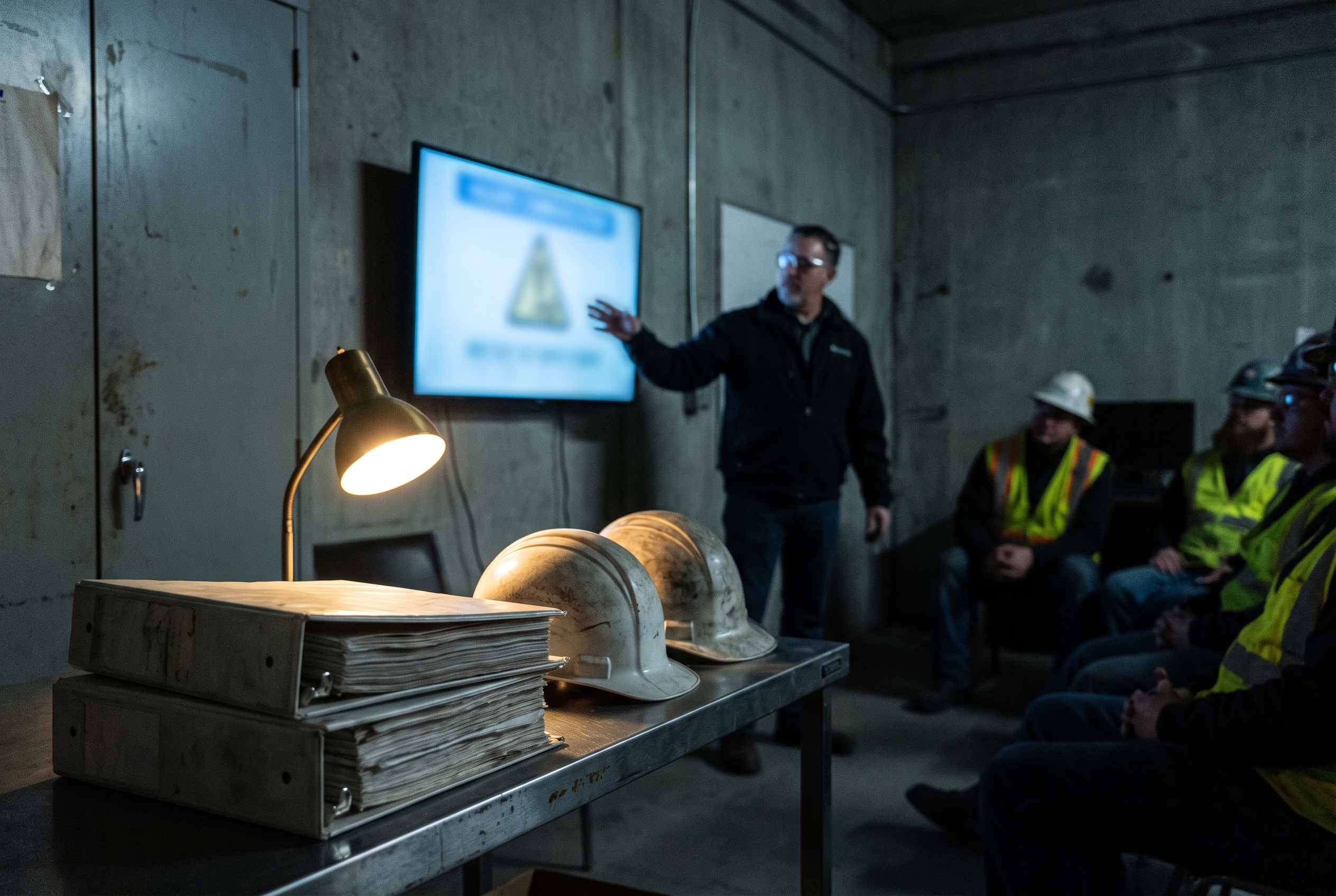
- methods for detecting a release
- physical and health hazards, including simple asphyxiation, combustible dust and pyrophoric gas hazards
- protective measures such as work practices, emergency procedures and PPE
- the details of the site's program, its labeling system and how to use SDSs
The trigger in the text is a new hazard in a work area. Use the Step 1 results to map each newly identified hazard to the areas and jobs where the product is used, then build the session around that map. Retraining every employee is usually unnecessary. Anyone whose in-house labels changed in Step 2 should at least be shown the new label.
Keep a record of who was trained, on which products and hazards, when, and by whom. The standard text reviewed for this article does not include a dated-records requirement for HazCom training. Still, customer and registrar auditors will ask for records, and a sign-in sheet tied to a product list is the simplest way to show the work was done.
## What can wait: mixtures
Most of what a plant buys (coolants, cleaners, coatings, adhesives) is a mixture, and mixtures are on a later schedule. Suppliers have until November 19, 2027. Employers have until May 19, 2028. You may see November 2027 described as "the mixtures deadline," but that is the supplier date. Your plant's mixture deadline is six months after it.
Mixture SDSs will arrive in larger numbers than the substance SDSs did, so set up the process now. If the inventory comparison, supplier request log, label walk and targeted training work for substances this fall, you can reuse them for mixtures in 2027 and 2028.
## Checklist: from now to November 20
These target dates are suggestions that work back from the deadline. Adjust them to your site.
TaskSuggested ownerTarget date
Confirm chemical inventory; flag substances with HCS 2024 SDSsEHS leadOctober 28
Compare SDS Sections 2, 3, 9, 10, 11; list changed hazards by product and areaEHS leadNovember 2
Send supplier requests for missing or 2012-format substance SDSs; start the logPurchasingNovember 2
Floor walk; update alternative secondary labels; brief receiving on small-container and shipped-label rulesArea supervisors with EHSNovember 9
Revise written program: chemical list, labeling, SDS management, training, non-routine tasksEHS leadNovember 12
Deliver targeted training; file attendance and content recordsSupervisors and trainerNovember 19
Replace floor SDS copies; archive superseded versions with identity, location and date recordEHS leadNovember 20
## Related reading
- How the New AI Agents for Manufacturing From Tulip, Siemens and Honeywell Compare
- When Should a Mid-Size Plant Register Its Own Apprenticeship Program?
- Is Your Motor Supplier Ready for the January DFARS Magnet Rule?
- Who Owns Lockout/Tagout When a Contractor Services Your Equipment?
- A Supplier Audit Checklist That Starts With Corrective Action
- Does a Job Shop Entering Aerospace Need AS9100 or ISO 9001?
- More Quality & Compliance coverage
## Sources
- 29 CFR 1910.1200, Hazard Communication (OSHA)
- HCS 2024 compliance date extension (OSHA)
- OSHA QuickTakes, January 15, 2026
- OSHA's Final Rule to Amend the Hazard Communication Standard
- More Time to Comply: OSHA Pushes Back Hazard Communication Deadlines by Four Months (Morgan Lewis)
- OSHA Extends Deadlines for HazCom 2024 Compliance (VelocityEHS)
- Changes Under OSHA's GHS Revision 7 Alignment: November 2026 Next Deadline (IHMM)
- First HazCom compliance date just around the corner (J.J. Keller)
- A Refresher on the 2024 HazCom Final Rule (VelocityEHS)
- 29 CFR 1910.1020, Access to employee exposure and medical records (OSHA)
---
## How the New AI Agents for Manufacturing From Tulip, Siemens and Honeywell Compare
- URL: https://www.manufacturingmag.com/article/comparing-the-new-factory-ai-agent-platforms-from-tulip-siemens-and-honeywell
- Category: Industrial IoT
- Published: 2026-10-20
- Summary: Tulip, Honeywell and Siemens with NVIDIA announced factory AI agent platforms within two weeks. They target different problems, sit at different stages of release, and none of them has published pricing. Here is how they compare on deployment, integration, human control and the numbers behind the claims.
Three vendors announced AI agents for manufacturing within two weeks this October, and none of them published a price. Tulip expanded its Composable AI Agents on October 6. Honeywell Technologies introduced Forge Cognition on October 14. Siemens and NVIDIA showed agent-based production planning at Siemens' Erlangen electronics plant on October 19. The three platforms go after different problems. Tulip is aimed at frontline apps and the workflows around them, Honeywell at facility and building operations, and Siemens at production planning and ramp-up.
**How we built this comparison:** it draws on the vendors' primary releases and a small number of press reports, all linked below. We did not test any of the products. Every performance figure in this article is the vendor's own. The comparison is independent of sponsorship.
## What are the new AI agent platforms for manufacturing?
In brief, Tulip offers composable agents inside its frontline operations platform, Honeywell offers a self-contained agentic AI and simulation platform for facilities, and Siemens offers planning agents that are checked against a digital twin of the whole plant. All three tie AI agents to operational data and keep a human in the approval loop, but the jobs they do differ.
## Tulip: Composable AI Agents and MCP connectors
Tulip made its announcements at Operations Calling 2026 in Boston and framed them as capabilities "that put AI to work for the people who run the factory floor," according to the company's press release. The release says Composable AI Agents were "Introduced at Operations Calling 2025" and "can be used in even more floor operations, always with a preserved operational record for human-in-the-loop quality assurance." The October release gives the agents no explicit availability label. They did, however, appear in Tulip's LTS16 release on July 1, 2026 marked as Beta, described as agents "trained on your own SOPs, validation frameworks, and data models to accelerate every step from solution design to production."
Tulip announced several pieces around the agents:
- **MCP Connectors (in preview mode):** native Model Context Protocol connectors that work in both directions. According to the release, "external AI tools and coding agents can read from and act on Tulip apps, tables, and workflows, and Tulip agents can call external systems the same way."
- **Industrial Connectivity (preview):** an operational data layer that brings machine data from existing drivers, historians and a unified namespace (UNS) into Tulip and joins it with human context.
- **Factory Playback:** first introduced with NVIDIA last year, it "turns local edge server camera streams and advanced vision-language models into a complete, replayable history of the floor." Tulip says new human activity detection shows where time goes, whether a procedure was followed and whether a part was assembled to spec.
- **Enterprise Library:** a single library of apps and assets on a customer's Center of Excellence instance, due to ship later this year.
CEO Natan Linder set out the company's position in the release: "AI has one job, to unlock human potential. Humans are not going away; they will keep working differently and better."
## Honeywell Technologies: Forge Cognition
Honeywell's October 14 release describes Forge Cognition as "a self-contained agentic AI and simulation platform for facility operations." It combines real-time digital twins with AI agents across buildings, campuses and industrial operations. Most of the software stack comes from NVIDIA: Nemotron open models, Omniverse libraries for simulation, Cosmos open models with the Metropolis VSS Blueprint for vision AI, and RTX PRO GPUs. Dell supplies the infrastructure.
Suresh Venkatarayalu, Honeywell Technologies' chief technology officer, said in the release that the platform "combines AI with operational context and engineering expertise, opening a new era of intelligent operations where AI can analyze, recommend and act alongside people."
## Siemens and NVIDIA: Intelligence Center X agents at Erlangen
The Siemens release, "Siemens partners with NVIDIA to advance AI-driven, autonomous factories," follows the companies' January 2026 CES announcement that they would build "the world's first fully AI-powered manufacturing sites." At Erlangen they demonstrated two things: virtual production ramp-up and agent-based production planning.
The NVIDIA blog post on the event says "Siemens Intelligence Center X agents, built with the NVIDIA Factory Operations Blueprint, use factory data and planning tools to recommend options." The agents compare materials, line capacity, delivery commitments, and changeover time and cost. Siemens' release says that when new orders arrive, the system "automatically generates various production scenarios and shows planners the impact of each option based on defined KPIs," and that "Before implementation, these proposals are validated using a Digital Twin of the entire production facility."
On inspection, NVIDIA Cosmos world models produce the training data. Per Siemens: "AI now generates photorealistic representations of PCB assemblies from their digital twins to train the vision systems, enabling engineers to prepare inspection before physical prototypes are available."
Intelligence Center X itself is not new this month. Digital Engineering 24/7 reported that Siemens announced it at Realize LIVE Americas 2026 in Detroit. It combines Mendix low-code, Graph Studio and AI Studio, which comes from the Rapidminer portfolio. That report gave no general availability date and no pricing.
The plant matters for context. Siemens says the Erlangen site was established in 1971 and employs approximately 1,000 people, and that "more than 100 AI algorithms are already in active use across production, logistics, quality inspection and maintenance." Cedrik Neike, who heads Siemens Digital Industries, cites "an annual productivity increase of seven percent." The site is set for further expansion through 2030, with Siemens investing €500 million in the transformation. NVIDIA's blog describes that same €500 million as investment in the Erlangen Technology Campus. This is a mature, heavily instrumented showcase plant, not a typical mid-market shop.
## Where do factory AI agents run: cloud, on-prem or edge?
Honeywell gives the clearest answer. Forge Cognition runs on-premises, and the release states: "Dell Technologies provides the AI infrastructure underpinning Forge Cognition through the Dell AI Factory with NVIDIA, including Dell PowerEdge XE servers, Dell AI Data Platform data and storage engines, Dell cyber resiliency solutions and support from Dell Services." It adds that "The platform uses NVIDIA RTX PRO GPUs and is expanding to accommodate far-edge deployments with NVIDIA DGX Spark."

Tulip's most explicit on-site element is Factory Playback, which works from "local edge server camera streams." The October release does not give a deployment model for the agents or the MCP connectors.
Siemens' release does not say whether the Erlangen agents run in the cloud, at the edge or on-premises.
For a plant with data residency requirements or an air-gapped network, this is the first thing to settle. If a vendor runs inference on dedicated GPU servers in your building, you will need rack space, power, cooling and IT support budgeted alongside the license. If inference runs off-site, you will need a clear statement of which production data leaves the plant.
## What systems do the agents connect to?
Tulip has the most detailed integration story. Its MCP connectors run both ways, so outside AI tools can act on Tulip apps and Tulip agents can call outside systems. Industrial Connectivity pulls machine data from existing drivers, historians and a UNS. For plants already running Tulip apps on the line, this is the most direct route. Bidirectional "act on" access also means permissions and audit scope need to be designed before any connection goes live.
Honeywell says Forge Cognition coordinates actions "across supported existing systems." The release does not list which systems are supported, so buyers should ask for that list.
Siemens' agents apply approved changes "through the connected planning system," according to NVIDIA. The demonstration took place in a Siemens plant on Siemens tooling. How well the approach carries over to a plant running a different ERP, MES or scheduling stack is not addressed.
## Which factory AI agent platforms are available now?
None of the three is described as generally available across the board. Each one is at a different stage.
- **Tulip:** Composable AI Agents shipped as Beta in LTS16 in July. MCP Connectors and Industrial Connectivity are in preview. Enterprise Library ships later this year.
- **Honeywell:** Forge Cognition is in pilot at six named sites: NVIDIA's Voyager campus, the Fairmont Hotel in Dubai, NEX Mall in Singapore, Vanderbilt University, and Honeywell's own campuses in Bangalore and Richardson, Texas. Per the release, "Customers can engage Honeywell Technologies today to identify and scope Forge Cognition deployments, with capabilities expanding over time." Scoping is not the same as a shipping SKU.
- **Siemens:** the agents are running in production testing at Erlangen. The release says nothing about commercial availability for customers.
Five of the six Honeywell pilot sites are hotels, malls, universities and corporate campuses. The release positions the platform for industrial operations too, but none of the named pilots is a production line.
## Can AI agents in a factory act without human approval?
All three vendors keep a person in the loop for now, and they do it in different ways.

- **Honeywell:** "Customers can operate Forge Cognition in manual, semi-autonomous or autonomous modes. Operators set the level of oversight and control and can override it at any time." The autonomous mode is listed, but Venkatarayalu told Fortune that "We have not opened up an autonomy right now" and that "For me, I wouldn't deploy these agents without my control system in place."
- **Siemens:** per NVIDIA, "The production controller reviews the trade-offs and approves the plan before the agent applies permitted changes through the connected planning system." The agent recommends options, a person approves, and the agent then makes only changes it is permitted to make.
- **Tulip:** agents run "always with a preserved operational record for human-in-the-loop quality assurance."
On regulated lines (FDA, AS9100, customer-audited automotive), the preserved record matters as much as the approval step. Ask each vendor for a sample audit trail: what the agent saw, what it recommended, who approved it, and what changed in which system.
## How should operators read the vendor numbers?
Every figure below comes from the vendor and is a projection or a pilot result. None comes from independent measurement.
**Siemens** says that for new printed circuit board assemblies, which are the core of the drives and frequency converters made at Erlangen, "virtual production preparation can reduce engineering effort by up to 85 percent and cut time-to-market by up to 40 percent." It also says "end-to-end agent-based production planning can enable cost savings of up to 20 percent." All three figures are "up to" values for one product family at one plant that already runs more than 100 AI algorithms. Treat them as an upper bound from a best case, not a planning assumption.
**Honeywell's** pilot figures come from NVIDIA's Voyager campus: "Up to 90% reduction, on average, in unnecessary alerts," an identified "up to 10% potential reduction in energy and utility consumption," and a comfort score held above 95% (a weighted average of temperature, humidity and CO2). These are building metrics. The alert-fatigue result may carry over to plant utilities and maintenance alarming, but it is not evidence of production-line throughput or quality gains. The energy figure is a potential reduction that was identified, not one that was realized.
**Tulip** published no performance figures.
If you are building a business case on alert reduction or uptime, model the value from your own numbers. Our downtime cost calculator separates [lost contribution margin](/article/what-does-an-hour-of-unplanned-downtime-cost-your-plant) from incremental recovery costs, which keeps an agent's projected benefit from being double-counted.
## What have the vendors not disclosed?
DisclosureTulipHoneywell Forge CognitionSiemens / NVIDIA
PricingNot disclosedNot disclosedNot disclosed
Deployment modelFactory Playback uses local edge servers; not stated for agents or MCPOn-prem on Dell PowerEdge XE with RTX PRO GPUs; far edge on DGX Spark expandingNot stated
Release statusAgents Beta in LTS16; MCP and Industrial Connectivity in preview; Enterprise Library later this yearPilot at six sites; scoping available nowProduction testing at Erlangen; no customer availability stated
General availability dateNone given for MCP or Industrial ConnectivityNone givenNone given
Hardware sizingNot statedServer family named, sizing not statedNot stated
Performance figuresNone publishedBuilding and campus pilot metrics"Up to" projections for PCB assemblies at one plant
Human controlPreserved operational record for human-in-the-loop QAManual, semi-autonomous, autonomous modes; operator overrideProduction controller approves plans
## What should a plant manager ask each vendor?
- **Where does inference run, and where does our data go?** Get it in writing for each component, not just the platform as a whole.
- **What hardware do we need?** For on-prem options, ask for server count, GPU class, power and cooling for a plant of your size, and who supports it.
- **What does it integrate with today?** Ask for the supported list for your MES, historian, ERP and scheduling system, and whether each integration is shipping, in preview or on a roadmap.
- **What can the agent do without a person?** Find out which actions need approval, who approves them, and whether the permission model can be set per line or per system.
- **What does the audit trail look like?** Ask for a sample record you could hand to an FDA, AS9100 or customer auditor.
- **What is the commercial model?** Licensing basis, hardware ownership, services, and what a pilot costs compared with a production rollout.
- **What has been measured on a production line like ours?** Separate vendor projections and building pilots from results measured on comparable lines.
## Bottom line for the capex budget
These are three different bets, not three versions of one product. Tulip fits plants already building frontline apps that want agents and MCP access on top of them. Honeywell fits facility-wide operations, meaning utilities, energy and alarm load, with a defined on-prem hardware stack. Siemens is showing what planning agents can do in a highly digitized plant on its own tooling, with no stated path to buy it yet. Until pricing and general availability dates are published, the sensible step for most mid-market plants is a scoped pilot with clear exit criteria, not a platform commitment. If you are weighing agents against a core MES decision, start with our MES buying guides and make the agent layer prove its value on top.
## Related reading
- When Should a Mid-Size Plant Register Its Own Apprenticeship Program?
- Is Your Motor Supplier Ready for the January DFARS Magnet Rule?
- Can 3D Printed Solid Rocket Motors Reach Full Rate in 2027?
- How to Choose Predictive vs Preventive Maintenance for Each Asset
- Why Your OEE Number Hides Most of Your Lost Capacity
- More Industrial IoT coverage
## Sources
- Tulip Brings AI to the Factory Floor at Operations Calling 2026 (Tulip press release, Oct 6, 2026)
- LTS16 Is Here! AI Agents, Connector Versioning, more (Tulip Community, July 1, 2026)
- Honeywell Technologies Launches Forge Cognition with NVIDIA and Dell Technologies (Honeywell press release, Oct 14, 2026)
- Exclusive: Honeywell Technologies launches a 'brain behind the building' with Nvidia and Dell (Fortune, Oct 14, 2026)
- Siemens partners with NVIDIA to advance AI-driven, autonomous factories (Siemens press release, Oct 19, 2026)
- Siemens Factory Erlangen: Where Industrial AI Becomes Reality (Siemens press feature)
- NVIDIA Lands in Europe for GTC Berlin (NVIDIA blog, Oct 19, 2026)
- Siemens Launches Industrial-Scale, Agentic AI Orchestration Platform (Digital Engineering 24/7, June 2, 2026)
---
## When Should a Mid-Size Plant Register Its Own Apprenticeship Program?
- URL: https://www.manufacturingmag.com/article/when-should-a-mid-size-plant-register-its-own-apprenticeship-program
- Category: Workforce Development
- Published: 2026-10-19
- Summary: Federal rules set no minimum headcount for sponsoring a registered apprenticeship. What decides it is how many good mentors a plant has. Here is how a 100 to 1,000 person plant should choose between sponsoring its own program, joining a group sponsor or waiting.
Few mid-size plants have to decide whether they want apprentices. Most want them. The real choice is who holds the paperwork. Before a plant puts a registered apprenticeship program manufacturing leaders can run in-house into the 2027 budget, it should answer three questions. Does it have enough qualified mentors? Does it need standards written for its own occupations? Can it carry the compliance load without help from an intermediary?
The policy timing favors acting soon. An April 23, 2025 executive order told the Labor, Commerce and Education secretaries to plan "to achieve and exceed the goal of one million new active apprentices." In March 2026, the Department of Labor committed to deciding on registrations within 30 days. A $35.8 million federal incentive fund now pays sponsors $3,500 for each new advanced manufacturing apprentice who gets through 90 days. Manufacturing is still a small slice of the system, though. HR Dive reports 678,014 apprentices nationwide in FY2025, and only 30,479 of them in manufacturing.
This guide covers what registration commits a plant to, where the real capacity limit sits, how sponsoring compares with joining a group sponsor, what the return evidence says, and when waiting is the right call.
## What does a registered apprenticeship program require?
A registered program has to meet the federal standards in 29 CFR 29.5: a defined training term, related instruction, a rising wage schedule, a supervision ratio and a capped probationary period. These are the items that hit the budget:
- **Term.** The term can be time-based, meaning "the completion of the industry standard for on-the-job learning (at least 2,000 hours)." It can also be competency-based, or a hybrid of the two.
- **Related instruction.** "A minimum of 144 hours for each year of apprenticeship is recommended." That is classroom or technical instruction on top of floor time. The plant has to decide whether to pay for those hours.
- **Wages.** Standards must include "a progressively increasing schedule of wages to be paid to the apprentice consistent with the skill acquired."
- **Ratio.** Standards must set "a numeric ratio of apprentices to journeyworkers consistent with proper supervision, training, safety, and continuity of employment."
- **Probation.** "The probationary period cannot exceed 25 percent of the length of the program, or 1 year, whichever is shorter."
Who registers the program depends on the state. Under 29 CFR 29.2, the registration agency is either the DOL Office of Apprenticeship or a recognized State Apprenticeship Agency. The first practical step is to find out which one covers your plant's state, because that tells you whose forms, review queue and staff you will deal with.
## Is there a minimum company size to sponsor an apprenticeship?
No. None of the 29.5 standards reviewed for this article sets a minimum headcount for employers. The limit in practice is the ratio and supervision requirement, which comes down to how many qualified journeyworkers a plant has who can actually mentor.
Walt Pozgay, manufacturing training manager at GE Appliances, put it plainly to HR Dive: "It's not that we don't want to take more. It's that I can only take as many apprentices as I can get good mentors." If a company the size of GE Appliances hits that limit, a 300-person plant will hit it sooner.
## A mentor count test for mid-size plants
Before you look at incentive money, do this exercise for each occupation you are considering, such as maintenance technician, CNC machinist or tool and die maker:
- List the journeyworkers in that occupation who are good at the work and also willing and able to teach it.
- Take out anyone who is retiring within the program term, working mandatory overtime most weeks, or the only cover for a critical asset.
- Apply the ratio you plan to write into your standards. What is left is your real cohort size.
- Check that cohort size against the hiring need. If you can only support one or two apprentices a year in each occupation, the admin work of standalone sponsorship is spread over very few people.
If the count reaches zero in an occupation, you have learned that a program there will not run well yet, whoever sponsors it.
## Should you sponsor your own program or join a group sponsor?
Sponsor yourself if you have mentor depth across several cohorts and need standards built around your own occupations. Join a group sponsor if you have few mentors, are starting your first cohort, or would rather someone else handle registration and compliance.
## The legal basis for the split
29 CFR 29.2 separates two roles. A *sponsor* is "any person, association, committee, or organization operating an apprenticeship program and in whose name the program is (or is to be) registered or approved." An *employer* is any organization employing an apprentice "whether or not such person or organization is a party to an Apprenticeship Agreement with the apprentice." That separation is what makes the group-sponsor model work. An association can hold the registered standards while your plant hires, pays and trains on the floor.
## What group sponsors look like in manufacturing
- **Manufacturing Skills Institute (Virginia).** A federally funded industry intermediary. It offers group-sponsored programs for CNC Machinist, Electrical Technician, Maintenance Technician, Mechatronics/Automation Technician, Quality Inspector, Robotics Technician, Tool and Die Maker, and Welder. Pricing is listed as "Contact for Pricing."
- **Idaho Manufacturing Alliance.** Acts as group sponsor so member employers do not have to manage federal registration and compliance alone.
- **MACNY (New York).** Acts as group sponsor and intermediary for New York State registered [apprenticeships](/article/which-factory-roles-are-hardest-to-fill-this-fall).
- **FAME.** Managed by the Manufacturing Institute. A multi-employer chapter model in which students attend community college two days a week and work at least 24 hours a week, over three days, for a sponsoring employer while they earn an associate degree.
## The trade-off
FactorSponsor your ownGroup sponsor / intermediary
Who holds the registered standardsYour plantThe association or intermediary
Control over occupations and competenciesFullYou work within the occupations the sponsor already offers
Registration and compliance workYours (Standards Builder submission, records, reporting)Largely handled by the sponsor
Hiring, wages, on-the-job learningYoursStill yours
Speed to first cohortDepends on drafting standards and the registration queueUsually faster when the occupation is already registered
Cost visibilityInternal staff timeFees are often unpublished; ask for a quote
Some things stay with the plant whichever path it takes: hiring, the wage bill and floor mentoring. Those are most of the real cost. A group sponsor reduces the administrative overhead, but it does not reduce the mentor requirement.
## Do registered apprenticeships pay back for employers?
The best evidence says they usually do. The returns typically arrive over several years, not within the apprenticeship itself. Three studies are worth knowing:
- **DOL synthesis.** Kevin Hollenbeck's 2024 review for DOL's Chief Evaluation Office finds that the most rigorous estimates put employer ROI at 40 to 90 percent: "for each $1.00 invested, employers can expect to reap a benefit of $1.40 to $1.90." He concludes that employers underinvest in apprenticeship.
- **American Apprenticeship Initiative employers.** An October 2022 Urban Institute study surveyed 68 employers. "Of the 68 employers surveyed, 46 (68 percent) achieved a positive net return over the 5 years," and "the median return on investment is $144 for every $100 invested." Even during the apprenticeship, 60 percent recouped at least 80 percent of their costs and almost 40 percent recouped their full costs.
- **Manufacturing specifically.** A 2020 Jobs for the Future study of the Industrial Manufacturing Technician apprenticeship across six sponsors found that "on average, every $1.00 invested in apprenticeship returned $1.48."
Read these numbers carefully. In the Urban sample, about a third of employers did not reach a positive return within five years. For a CFO, the useful way to frame it is a race between two curves: how quickly apprentice output rises, and how quickly the wage schedule rises. Wages are the largest cost line. A plant with strong mentors and well-defined competencies gets apprentices to productive work sooner. A plant that puts apprentices on a short-staffed shift with no one to teach them usually does not.
## What incentives offset apprenticeship costs?
There are two layers: a federal per-apprentice payment for advanced manufacturing, and state tax credits that differ a lot from state to state.
## Federal manufacturing incentive
According to HR Dive, a $35.8 million federal incentive fund run by the Arkansas Department of Commerce pays sponsors $3,500 for every new advanced manufacturing apprentice who completes a 90-day probationary period. It recognizes programs run by groups of employers, trade associations and intermediaries such as FAME, so plants in group-sponsor arrangements are not shut out. Demand is high. Cody Waits, executive director of Arkansas' Division of Workforce Connections, told HR Dive: "We've received over 115 applications from over 33 states for 2,500 apprentices." Assume the money is limited and could be used up.
The 90-day condition matters for how you run the first few months. You only get the payment for apprentices who get through probation, and early drop-out is the most common way programs lose people (see below).
## State tax credits
Apprenticeship.gov's state tax credit page lists per-apprentice credits from $750 in Montana ($1,500 for veterans) up to $7,500 or 50 percent of wages in Connecticut. Here is a selection of states with large manufacturing bases:
StateCredit per apprentice (as listed)
Ohio$5,000 or 15% of wages
New Jersey$5,000, plus $5,000 for key industries
Massachusetts$4,800 or 50% of wages
Illinois$3,500
Kansas$2,500 (up to 20 apprentices)
Texas$2,500
Tennessee$2,000 or 10% of wages
Alabama$1,250 (up to 10 apprentices)
South Carolina$1,000 per apprentice employed at least seven months
The page does not show when it was last updated. Before you build a credit into a payback model, have your tax adviser confirm the current terms and eligibility with the state agency.
## How should the apprentice wage schedule be designed?
The rule requires wages that rise "consistent with the skill acquired." The simplest way to defend the schedule, and to keep it affordable, is to tie each wage step to a documented skill milestone instead of to time served alone.
- **Time-based steps** are simple to run. They raise pay on the calendar whether or not output has improved.
- **Competency-based or hybrid steps** tie each raise to skills that have been demonstrated and signed off, for example qualifying on a machine family, completing PM routes on its own, or running first-article inspection. Faster learners move up sooner, and the plant pays for skill it can actually use.
DOL's March 2026 guidance, reported by CMM, includes Circular 2026-01 on program design under all three completion approaches. Read it before you draft. If you join a group sponsor, ask whether its standards allow competency-based progression in the occupations you need.
Look at the start of the schedule as well. NPR's profile of Virco Manufacturing notes that its apprentice is paid for class days at Pulaski Technical College as well as for plant hours. Whether you pay for related instruction affects both the cost model and who will apply.
## How do you keep apprentices through completion?
Retention is the weakest point in the national system. Social Finance's analysis of DOL RAPIDS data found that "of the ~167,000 apprentices who started a registered apprenticeship program in 2017, just ~78,000, or 46.8%, completed the program within 6 years." Cancellations "tend to spike in the early months of apprenticeship and decline sharply thereafter." The supports it recommends include pre-apprenticeship, mentorship and living stipends.

For a plant, this means the first months need the most attention. That is when the assigned mentor, the shift schedule and the first wage step need to be working as planned, and it overlaps with the 90-day window for the federal incentive.
## Stay-or-pay agreements
Some employers try to protect their investment with repayment agreements. California's AB 692 took effect January 1, 2026 and applies to new contracts only. It bans most employment-contract terms that require repayment when a worker leaves. Mayer Brown notes that it "does not apply to contracts for repayment of enrollment costs associated with enrollment in apprenticeship programs approved by the California Division of Apprenticeship Standards." Rules in other states were outside the scope of this article. Have employment counsel review any repayment clause before you use it, and treat it as a backstop. Mentoring and a credible wage path are what keep people.
## Is it better to wait or move now?
The argument for moving now is mostly about process and money. Under Bulletin 2026-35, the Office of Apprenticeship committed to registration decisions within 30 days of a sponsor's final submission of signed local standards in Standards Builder. A public "shot clock" page tracks monthly registrations and average time to register in OA-administered states. Labor Secretary Lori Chavez-DeRemer said when the guidance came out: "We're removing the administrative roadblocks that have prevented Registered Apprenticeship from scaling to meet demand," as reported by CMM. Add the per-apprentice federal incentive and state credits, and the offsets are larger now than they have been.
The argument for caution is about capacity at DOL. Washington Monthly reported in December 2025 that Office of Apprenticeship staffing was "down by as much as 30 percent," that at least $30 million appropriated the year before went unspent, and that new-apprentice growth in 2025 was "only about 3 percent so far," compared with double-digit annual gains from 2016 to 2020. By that outlet's count, active apprentices grew from roughly 359,000 in FY2015 to more than 670,000 at the end of FY2024. The 30-day commitment covers OA's own determinations. If your state runs a State Apprenticeship Agency, ask that agency what timeline it expects.
Neither argument settles the question for a given plant. Mentor capacity and demand stability do.
## A decision framework for mid-size plants
## Sponsor your own program when:
- You have enough qualified mentors to run more than one cohort in an occupation, or several occupations at once.
- You need standards built around your own equipment, processes or occupations that existing group sponsors do not cover.
- You have, or will assign, someone to own registration, records and reporting.
- You expect hiring demand to hold steady for longer than the program term.
## Join a group sponsor or intermediary when:
- This is your first cohort and you only have a few mentors.
- The occupation you need, such as maintenance technician, CNC machinist or welder, is already offered by a regional sponsor like MSI, the Idaho Manufacturing Alliance or MACNY, or by a FAME chapter.
- Speed matters more to you than control over the standards.
- Nobody on staff can take on compliance. Get a written fee quote, since intermediaries often do not publish pricing.
## Wait when:
- The mentor count test comes out at zero or one for the occupation you need.
- Demand in that occupation is uncertain enough that you might lay off the people you would be training.
- You cannot fund the wage schedule through the full term without depending on incentives that may run out.
Virco shows the incremental route. NPR reports that the school-furniture maker in Conway, Arkansas started with a single three-year registered tool and die apprenticeship and now plans to add 20 more apprentices in other departments. For most mid-size plants, starting with one occupation where mentors and demand are both strong, then expanding once the first cohort reaches its wage steps on schedule, is lower risk than designing a program for the whole plant up front.
## Related reading
- Is Your Motor Supplier Ready for the January DFARS Magnet Rule?
- Can 3D Printed Solid Rocket Motors Reach Full Rate in 2027?
- How to Hedge Factory Power Costs Inside PJM
- Amazon Plans to Hire Welders for Its Greenwood, Indiana Plant
- Machinery and Fabricated Metal Carried August's Factory Hiring
- More Workforce Development coverage
## Sources
- 29 CFR § 29.5, Standards of apprenticeship (Cornell LII)
- 29 CFR § 29.2, Definitions (Cornell LII)
- Hollenbeck, The Return on Investment to Employers from Registered Apprenticeships, DOL (2024)
- Urban Institute, Do Employers Earn Positive Returns to Investments in Apprenticeship? (Oct 2022)
- JFF, The Next-Gen IMT Apprenticeship: A Return on Investment Study (July 2020)
- HR Dive, Updated federal guidance and funds may boost manufacturing apprenticeships (May 4, 2026)
- Apprenticeship.gov, Program Registration Monthly Shot Clock
- CMM, Labor Department Offers New Apprenticeship Guidance (March 12, 2026)
- Holland & Knight, Executive Order: Preparing Americans for High-Paying Skilled Trade Jobs of the Future
- Washington Monthly, Trump's Broken Promise of "One Million Apprentices" (Dec 4, 2025)
- NPR via VPM, Desperate for skilled workers, a furniture maker looks to apprenticeships for relief (March 13, 2026)
- Social Finance, Reaching One Million Active Apprentices Starts with Retention (Nov 7, 2025)
- Apprenticeship.gov, State Tax Credits and Tuition Support
- Mayer Brown, A Deeper Dive Into California's New Limitations on "Stay or Pay" Clauses (March 9, 2026)
- Manufacturing Skills Institute, Registered Apprenticeship Program
- Idaho Manufacturing Alliance, Build your workforce with an apprenticeship program
- FAME USA, Students
---
## Is Your Motor Supplier Ready for the January DFARS Magnet Rule?
- URL: https://www.manufacturingmag.com/article/is-your-motor-supplier-ready-for-the-january-dfars-magnet-rule
- Category: Aerospace & Defense
- Published: 2026-10-18
- Summary: On January 1, 2027, the DFARS restriction on samarium-cobalt and NdFeB magnets reaches back to the mine. Here is how a tier-2 motor or actuator maker can map its BOM, get usable origin declarations from suppliers, and prepare a nonavailability file if no compliant capacity exists.
The DFARS rare earth magnet rule, DFARS 252.225-7052, restricts defense acquisition of samarium-cobalt (SmCo) and neodymium-iron-boron (NdFeB) magnets tied to China, Russia, Iran or North Korea. On January 1, 2027, the restriction widens. Today it covers magnets "melted or produced" in those countries. From that date it also covers material "mined, refined, separated, melted, or produced" there, so it reaches every step from the mine to the finished magnet.
For a tier-2 motor or actuator maker, that turns a familiar audit question into a much harder one. Through December 31, 2026, the customer needs to know where the magnet alloy was melted and the magnet made. From January 1 the customer also needs to know where the rare earth was mined, separated and refined. If your rotors, actuators or sensors use magnets you buy from a magnet house or a distributor, those answers sit two to four tiers above you, and your prime will expect you to have them.
This guide covers what changes, what 2026 added, and a four-step plan for getting a supplier base ready. That includes what to do when the compliant source you qualified has no capacity to sell you.
## What changes on January 1, 2027
The clause text on acquisition.gov (clause date MAY 2024) covers five materials: samarium-cobalt magnets, neodymium-iron-boron magnets, tantalum metals and alloys, tungsten metal powder, and tungsten heavy alloy, along with any finished or semi-finished component that contains it. The covered countries are North Korea, China, Russia and Iran.
The 2027 dates are not new. They were set by the final rule in DFARS Case 2021-D015, published in the Federal Register and effective on May 30, 2024. Many suppliers have been treating it as a distant deadline, and it now arrives in about ten weeks.
ProvisionThrough Dec. 31, 2026From Jan. 1, 2027
Prohibited activity in a covered country"Melted or produced""Mined, refined, separated, melted, or produced"
Scope for SmCo and NdFeB magnetsMelting of the alloy and all later production stepsThe entire supply chain, from mining through production of finished magnets
COTS exceptionExempt unless the item is 50% or more tungsten by weightExempt unless the item is 50% or more covered material by weight
The COTS change is easy to overlook. Under the current rule, the COTS exception only falls away for heavy tungsten content. From January the test is 50% or more covered material by weight, according to Crowell & Moring's analysis of the rule. Most motors will stay under that threshold, but a magnet sold as a COTS item, or a magnet-dense subassembly, may not.
## Watch the clause number
Under the Revolutionary FAR Overhaul class deviations, the clause may appear in your contracts as DFARS 252.225-7961, "Restriction on the Acquisition of Certain Magnets, Tantalum, and Tungsten," rather than 252.225-7052. Wiley reports that the deviation also streamlined DFARS 225.7018-2 to make clear the mined, refined and separated prohibition starts on or after January 1, 2027, not December 31, 2026. A contract review that searches only for "7052" will miss deviation-clause contracts.
## Exceptions that remain
- **Electronic devices.** The exception reads: "An electronic device, unless otherwise specified in the contract." That last phrase means the exception depends on each contract. A program can switch it off.
- **Recycled NdFeB.** The only recycled-material exception in the 2024 rule comes from the statute, 10 U.S.C. 4872(c)(3)(C). It covers NdFeB magnets made from recycled material, provided the recycled material is milled and the final magnet sintered in the United States.
- **Flowdown.** Under paragraph (d), contractors must include the clause in subcontracts and other contractual instruments for items that contain covered materials, commercial products included, unless an exception applies.
## What 2026 added
Two federal actions this year raised the stakes on the existing clause.
## The FY2026 NDAA
According to Pillsbury, the FY2026 NDAA added molybdenum, gallium and germanium to the materials covered under 10 U.S.C. 4872. The gallium and germanium restrictions take effect December 18, 2027. Molybdenum follows the existing timelines. The law also created a recycled-material exception for SmCo magnets when milling and sintering happen in the United States, and made national security waivers under section 4863 apply to section 4872 restrictions.
Keep the statute and the clause apart. The clause text cited in this article, dated MAY 2024, lists the original five materials and only the NdFeB recycled exception. Read the clause version that each contract actually incorporates, and ask your contracting officer how the statutory additions will be handled on your programs.
## Executive Order 14415
Executive Order 14415, "Securing America's Defense Supply Chains and Ensuring Domestic Acquisition of Critical Materials," was signed July 20, 2026. Orrick reports that after January 1, 2027, waivers under 10 U.S.C. 4872 will only be issued if the contractor submits a formal mitigation plan that the Secretary or a designee accepts. The plan must:
- Identify the specific source of the noncompliant material.
- Document exhaustive efforts to obtain compliant material, or show that none was available.
- Describe the steps to remove the noncompliant material from the supply chain.
- Set a strict projected timeline.
Orrick says the requirement applies to subcontractors at every tier. Wiley and Holland & Knight both read the order to say that failing to qualify a domestic source does not, on its own, establish nonavailability.
The order also sets a longer timeline. Holland & Knight reports that supply-chain mapping policy is due January 16, 2027 and implementing regulations by April 16, 2027. Both firms describe a requirement for contractors to submit an indentured bill of materials that traces all components, parts, equipment, software and materials back to the origin of the raw materials, and to vet suppliers for risks such as foreign ownership, control or influence. Holland & Knight reports that the policy includes notification of significant supply-chain risks within 15 days and corrective action plans within 45 days.
## Step 1: Map the BOM
Start with part numbers, not suppliers. Flag every item that contains SmCo or NdFeB: motor rotors, actuators, sensors, magnetic couplings, speakers and similar parts. Do the same for tungsten and tantalum content. Z2Data, a supply-chain data vendor, describes finding covered materials through full material declarations (FMDs) and then tracing those products up the supply chain.

For each flagged part, record:
- **Which contracts carry the clause**, under either 252.225-7052 or 252.225-7961.
- **Whether the item might qualify for the COTS exception** under the new 50% covered-material weight test, with the weight calculation on file.
- **Whether you are relying on the electronic-device exception.** If you are, check each contract for language that overrides it, and get the contracting officer's position in writing. Do not assume that because one program accepted it, the next one will.
- **Whether the magnet is claimed as recycled**, and if so, where the milling and sintering took place.
## Step 2: Decide how far upstream to go
For magnets, the answer is all the way to the mine. A usable chain of custody looks like this:
- Mine (rare earth ore)
- Separation into individual rare earth oxides
- Refining into metal and alloy
- Magnet production: melting or strip casting, milling, sintering
- Magnet supplier or distributor
- Your rotor, actuator or subassembly
Today's rule asks about steps 4 through 6. The 2027 rule asks about all six. The middle of the chain is where Chinese content is hardest to rule out. CSIS estimated in October 2025 that China accounts for roughly 70% of rare earth mining, 90% of separation and processing, and 93% of magnet manufacturing. A magnet sintered outside China can still be made from oxide separated inside it.
Heavy rare earth additions need their own line in the trace. On April 4, 2025, China imposed export licensing on seven rare earths (samarium, gadolinium, terbium, dysprosium, lutetium, scandium and yttrium) and on magnets. Samarium is the "Sm" in SmCo, and dysprosium and terbium are common NdFeB additives. CSIS and Tech Times describe those April 2025 controls as still in effect. A supplier that traces its neodymium and praseodymium but not its dysprosium or terbium has not finished the job.
The CSIS analysis lists F-35, Virginia- and [Columbia-class](/article/what-navy-submarine-work-demands-from-a-machine-shop) submarines, Tomahawk, radar, Predator UAVs and JDAM among the defense uses of rare earths. If your parts end up on any of these programs, expect your prime to ask early and in detail.
## Step 3: Get origin declarations you can audit, and flow the clause down
Put the clause in your subcontracts and purchase orders for items that contain covered materials, including commercial-item buys, as paragraph (d) requires. Then replace the one-line "DFARS compliant" checkbox with a stage-by-stage declaration from each magnet supplier:
StageWhat to request
MiningCountry and mine or operator
SeparationCountry and facility producing the separated oxides, including heavy rare earth additions
Refining (metal/alloy)Country and facility
Melting and magnet productionCountry and facility for melting or strip casting, milling and sintering
Supporting recordsPurchase records, certificates or lot traceability you can audit
Z2Data describes the work as needing visibility into the second, third and fourth tiers, plus supplier engagement campaigns that check the answers rather than simply collecting them. Expect a first round of incomplete declarations, and budget the follow-up time.
If you run an AS9100 quality system, fold this into the supplier controls you already have instead of building a parallel process. Make stage-by-stage origin a condition of approved-supplier status for magnet sources. Require contractual notice before a supplier changes its source at any stage, including the oxide or alloy. Review the declarations at each periodic supplier re-evaluation. The indentured BOM that EO 14415 anticipates will need the same data, so collecting it once and in a consistent format saves rework in 2027.
## Step 4: Build the nonavailability file before you need it
The hard case is common. You have qualified a non-China magnet source, but it cannot ship the quantity, grade or delivery schedule your program needs. The existing route for that situation is a nonavailability determination under DFARS 225.7018-4.
- **Individual determination.** The head of the contracting activity can make one for a single contract. It must be supported by an analysis and a written certification from the requiring activity explaining why the alternatives are unacceptable.
- **Class determination.** This requires approval from USD(A&S). A notice asking interested parties for information must be published in the GPE at least 30 days in advance, and the determination and its rationale are made public to the extent national security and confidential business information allow.
DFARS PGI 225.7018-4 lists the data required. Part A, which the contractor supplies, covers:
- The current noncompliant source: manufacturer, country of origin, specifications, delivery dates, quantities and pricing.
- Market research on compliant alternatives: manufacturers, specifications, delivery, quantities, unit pricing, and the cost and schedule of any redesign or requalification.
In Part B, the government analysis weighs quality, quantity, required form, timeliness, unit price, and the cost of redesign or requalification. Crowell & Moring advised in 2024 that contractors without compliant sources before January 1, 2027 should start "aggregating data to pursue and support a nonavailability determination." The firm gave that advice more than two years ago.
Build the same file so it also covers the four elements of an EO 14415 mitigation plan: the named noncompliant source, a record of exhaustive sourcing efforts, removal steps and a timeline. The market research, quotes and requalification estimates support both. Given how Wiley and Holland & Knight read the order, a file that amounts to "we tried to qualify a domestic source and could not" is unlikely to be enough. Document who you contacted, what they quoted, what they could deliver and when, and what it would cost to redesign around the gap.
## Capacity reality check
The compliance plan only works if compliant magnets exist to buy. In April 2026, CSIS analysts Gracelin Baskaran and Meredith Schwartz warned that "unless significantly more capacity comes online in the next eight months, adhering to this requirement may not be feasible."

Here is the documented state of domestic supply:
- **MP Materials, Independence (Fort Worth).** MP began making NdFeB magnets there in December 2025, according to its Q2 2026 Form 10-Q. Its August 6, 2026 results release said magnet qualification "advanced through additional deliveries for customer qualification and regulatory testing." Put plainly, the plant was still in qualification. Tech Times reports that Independence targets commercial magnet sales in the second half of 2026, with capacity ramping toward 3,000 metric tons per year.
- **MP Materials, 10X (Northlake, Texas).** Under the July 10, 2025 MP and DoD partnership, the 10X magnet plant is expected to begin commissioning in 2028, bringing total US magnet capacity to an estimated 10,000 metric tons or so. The deal includes a 10-year NdPr price floor of $110/kg, and 100% of 10X output is to be bought by defense and commercial customers. The 10-Q says construction has started and that the Department of War must buy all 10X magnets or approve commercial syndication. A mid-market buyer should not plan on 10X volume before 2028, and should expect access to run through that offtake structure.
- **USA Rare Earth, Stillwater, Oklahoma.** Tech Times reports the company commissioned Phase 1a in March 2026, targeting 600 metric tons per year.
The calendar adds pressure. According to CSIS, China's October 2025 expanded controls, which included a foreign-direct-product-style rule on trace Chinese rare earth content, were suspended for one year after the Trump-Xi meeting. Tech Times reports that the suspension expires November 10, 2026, about seven weeks before the DFARS expansion takes effect.
For operators, that leads to three decisions:
- **Dual-qualify now.** A single compliant magnet source still in ramp-up is a schedule risk, not a solution. Qualify a second source in parallel, even if it costs more per unit.
- **Push for longer-term supply agreements.** With new domestic capacity committed through offtake arrangements, spot buying is the weakest position. Lock in allocation where you can, and tie it to the origin-declaration terms from Step 3.
- **Budget for redesign and requalification.** If a compliant grade differs from what your motor was designed around, the engineering and test cost belongs in this year's capex and program budgets. Those same figures go into the PGI Part A market research.
## Checklist: from now to 2028
WhenActionOwner
NowMap supply chains for covered materials and identify affected contracts, including 252.225-7961 deviation clauses (Orrick's "immediate" phase)Contracts, engineering
NowPull FMDs, flag SmCo, NdFeB, tungsten and tantalum part numbers, and document COTS weight calculationsEngineering, quality
October through December 2026Send stage-by-stage origin declaration requests and validate responses through tiers 2 to 4Purchasing, quality
October through December 2026Develop mitigation plans, document alternative sourcing, and submit waiver requests (Orrick)Contracts, purchasing
Before Jan. 1, 2027Update subcontract and PO terms to flow down the clause, including commercial-item buysContracts
Before Jan. 1, 2027Assemble PGI 225.7018-4 Part A data for any part without a compliant sourcePurchasing, contracts
Jan. 1, 2027Expanded "mined, refined, separated" scope takes effect; routine 4872 waivers end under EO 14415All
Jan. 16, 2027EO 14415 supply-chain mapping policy dueContracts, quality
Apr. 16, 2027EO 14415 implementing regulations due; check indentured BOM and 15/45-day reporting requirements against your processQuality, contracts
Dec. 18, 2027Gallium and germanium restrictions take effect under the FY2026 NDAAEngineering, purchasing
2027 onwardMonitor, track funding and keep documentation (Orrick); re-verify origin at supplier re-evaluationsQuality
2028MP 10X commissioning expected to begin; reassess source strategyPurchasing
## Related reading
- Can 3D Printed Solid Rocket Motors Reach Full Rate in 2027?
- How to Hedge Factory Power Costs Inside PJM
- Who Owns Lockout/Tagout When a Contractor Services Your Equipment?
- More Aerospace & Defense coverage
## Sources
- DFARS 252.225-7052, Restriction on the Acquisition of Certain Magnets, Tantalum, and Tungsten (acquisition.gov)
- Federal Register: DFARS Restriction on Certain Metal Products (DFARS Case 2021-D015), May 30, 2024
- DFARS 225.7018-4, Nonavailability determination
- DFARS PGI 225.7018-4, Nonavailability determination
- Crowell & Moring: DoD Expands Restrictions on Supply Chain for Certain Magnets, Tantalum, and Tungsten
- Orrick: Defense Supply Chain Compliance, Critical Minerals Waiver Cessation Takes Effect January 1, 2027
- Holland & Knight: President Trump Signs Executive Order on Defense Supply Chains, Critical Materials
- Wiley: New Executive Order Expands Supply Chain Due Diligence for Defense Contractors
- Wiley: DFARS Overhaul Class Deviations
- Pillsbury: NDAA Expands Sourcing Restrictions for Critical Minerals and Batteries
- Z2Data: How the Top U.S. Manufacturers Are Preparing for DFARS 252.225-7052
- CSIS: Rare Earth Export Restrictions One Year Later
- CSIS: China's New Rare Earth and Magnet Restrictions Threaten U.S. Defense Supply Chains
- Tech Times: Rare Earth Magnets, China's November 10 Deadline and US Gap Money Can't Close
- MP Materials Q2 2026 Form 10-Q
- MP Materials Reports Second Quarter 2026 Results
- MP Materials and DoD partnership press release, July 10, 2025
---
## Can 3D Printed Solid Rocket Motors Reach Full Rate in 2027?
- URL: https://www.manufacturingmag.com/article/printed-solid-rocket-motors-face-a-2027-full-rate-test
- Category: Aerospace & Defense
- Published: 2026-10-17
- Summary: Leidos picked X-Bow Systems to build booster motors for the Army's Low-Cost Containerized Munition. Additive propellant production can compress mix, cast and cure, but qualification, static fires and a thin sub-tier still set the 2027 clock.
On Oct. 12, 2026, at the AUSA Annual Meeting and Exposition in Washington, Leidos selected X-Bow Systems to develop and produce booster motors for the US Army's Low-Cost Containerized Munition (LCCM), according to X-Bow. The award puts 3D printed solid rocket motors on a fixed production clock. More precisely, it puts X-Bow's additive process for making solid propellant on that clock. X-Bow says that "under the agreement, X-Bow will move through design, qualification testing, and static fires ahead of full-rate production of booster motors at scale in 2027."
That gives the company about a year to go from selection to full rate. Printing propellant can shorten part of the factory process. It can't shorten qualification, and it does nothing about a sub-tier that depends on a single domestic oxidizer source. Operators and investors should watch the period between the first static fire and acceptance of the first production lot.
## What is the Low-Cost Containerized Munition, and why the rush?
LCCM is Leidos' entry in a Pentagon effort to buy cruise missiles in volume at fixed prices. On May 13, 2026, the Defense Department signed framework agreements with Anduril, CoAspire, Leidos and Zone 5 to "procure over 10,000 low-cost cruise missiles over three years beginning in 2027," Breaking Defense reported. The agreements "include firm-fixed material unit costs for production lots in 2027 through 2029."
Firm-fixed material unit costs change who carries the risk. When a booster runs late, needs rework or fails a static fire, the prime and its suppliers absorb the cost; it doesn't flow back to the government as a cost-plus adjustment. Military Times reported that the department planned to start buying test missiles from all four companies in June 2026 for an assessment phase.
The Leidos release says the company's initial order is 3,000 LCCMs and that "Leidos started LCCM work in December, reaching a conceptual design with the Pentagon." It adds that "full system design, development and test will result in production beginning in 2027." LCCM is "approximately twice the size of the AGM-190A," and Leidos is expanding production in Huntsville, Alabama and McEwen, Tennessee. "We're answering the Department of War's call to revolutionize procurement of critical capabilities at scale, with a focus on speed to operational capability," Leidos CEO Tom Bell said.
## What does a booster motor do on a cruise missile?
The booster is the solid rocket motor that pushes the missile out of its launch container and up to flying speed, Defense Daily reported. It burns briefly at launch and is not the engine that carries the missile in cruise.
For the supply chain, that makes the booster a one-shot energetic component that must work every time in every containerized round. Defense Daily also reported that the Army's initial order to Leidos is expected to be 3,000 units, so X-Bow's first production commitment is measured in thousands of boosters.
## How are solid rocket motors made conventionally, and what does 3D printing replace?
Conventional solid propellant is made in batches: it is mixed, cast into shape and cured, often in different buildings, and curing can take days or weeks. Additive approaches try to replace that sequence with one continuous, digitally controlled deposition process.
A Raytheon patent on propellant additive manufacturing (US10287218B2, filed in 2016) describes the conventional route. Mixing "may occur at a first location, the casting or other depositing of it to build up a propellant piece may occur at a second location, and the curing of the propellant piece may occur at a third location." The patent says the process "may involve considerable delays for the transportation between steps... with the curing process taking days or weeks." The patent belongs to Raytheon, not X-Bow, and is cited here only to describe the baseline that printing aims to replace.
X-Bow's process is its patented Additive Manufacturing of Solid Propellant (AMSP). The company calls it "patented, digital-first, and flight-validated" and presents it as an alternative to "decades-old batch-based" motor production, according to its November 2025 facility announcement. The LCCM announcement says X-Bow will apply its additive process to the booster. It does not describe the booster's design, so the precise answer is that AMSP is being applied to this booster program.
The business case for printed propellant is mostly about cycle time and work in process. If mixing, deposition and curing take place in one controlled cell instead of moving between buildings, a plant can hold fewer partially finished motors and react faster when demand jumps. That case only pays off after the process is qualified for a particular motor.
## What capacity is behind X-Bow's 2027 promise?
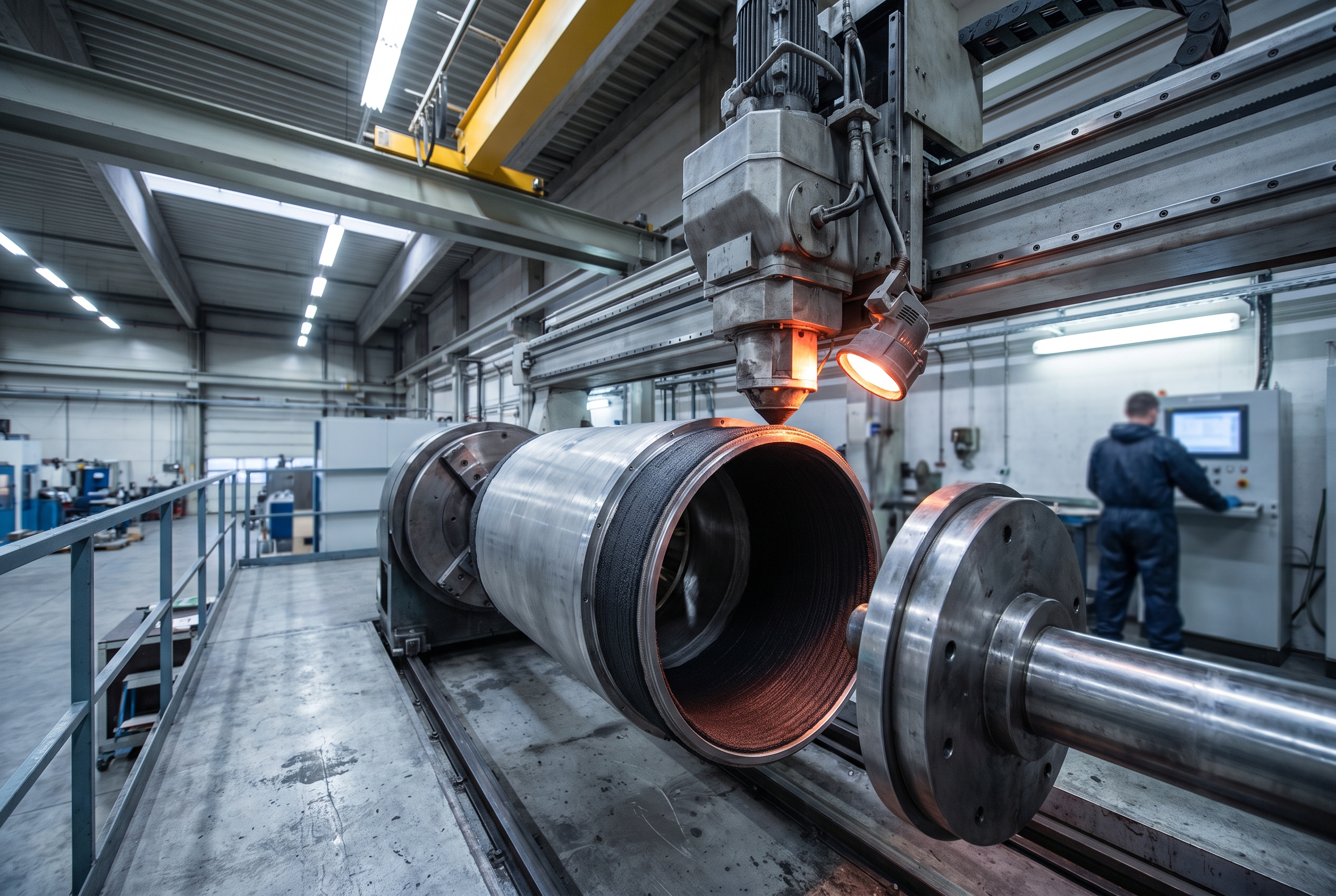
X-Bow finished installing its AMSP production line in Luling, Texas on Nov. 19, 2025. The company says the line will start at 1 million lb of energetics a year and grow to 3 million lb within 12 to 24 months. Those are company figures. X-Bow says that output equals roughly 3,000 to 3,800 Standard Missile motors or 30,000 to 50,000 tactical solid rocket motors a year. It funded the facility with about $40 million of its own private capital, plus co-investment from the US Air Force and DARPA. "Our Texas campus provides production and surge capacity for tactical, strategic, and hypersonic solid rocket motors," founder and CEO Jason Hundley said at the time.
X-Bow has some delivery history to point to. Defense Daily reported that the company recently delivered 2,100 rocket-assisted takeoff motors to AEVEX Corp. for its Disruptor drone and holds an active Navy contract for solid rocket motor boosters for the future Navy Modular Missile. In August 2025, X-Bow and the Army announced a $13.9 million cost-matched joint investment to design, prototype and static-fire an AMSP motor for the standard-range GMLRS. The DoD Office of Strategic Capital and Army PEO Missiles and Space were among the coordinators, and Kord Technologies, a KBR subsidiary, provides engineering support.
The company also says LCCM is one of six new propulsion programs it won in 2026 across the Navy, Army and Missile Defense Agency, and that "the company's revenue and backlog have more than doubled since 2023." On LCCM, Hundley said: "Modern conflict is decided by how many rounds you can put downrange, not how exquisite each one is." He added that the partnership lets X-Bow "turn out combat-ready rocket motors at production scale, fast."
Our analysis: an initial LCCM order in the low thousands is small next to X-Bow's stated nameplate capacity. Raw pounds of energetics are unlikely to be the binding constraint in 2027. Qualifying a new motor and getting its hardware and ingredients delivered on time are more likely to be.
## Where do qualification and static fires usually slip?
Schedules usually slip at the hardware around the propellant (nozzles, insulation, cases and igniters) and whenever an ingredient changes, because one change can force requalification of the propellant, the motor and the missile. A printed propellant grain doesn't remove either risk.
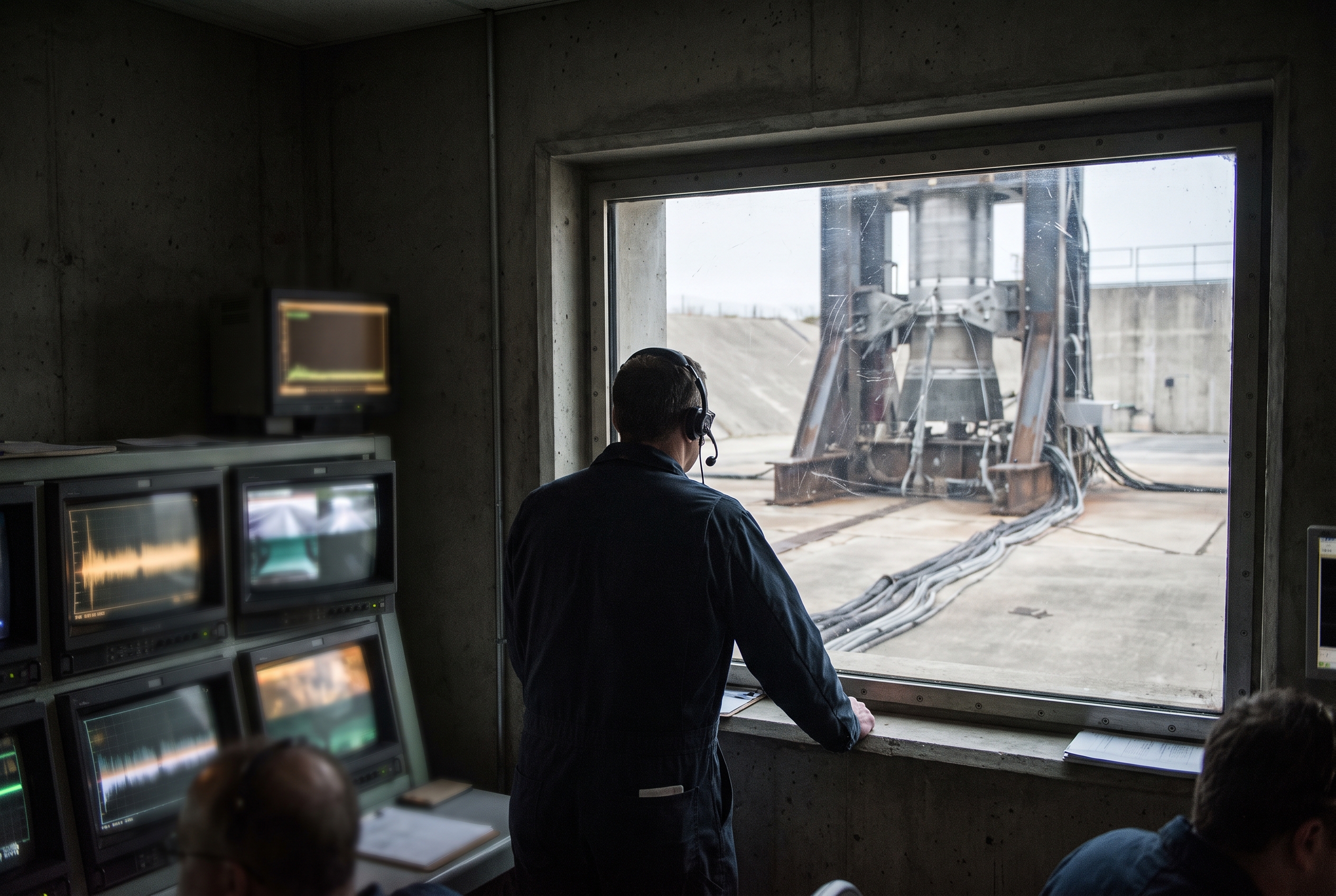
Breaking Defense's January 2026 report on the motor supply chain identified motor cases, igniters and insulation as chokepoints and said certain nozzles take 7 to 10 months to source. Andy Davis, Nammo's vice president of engineering and strategy, described what happens when an ingredient supplier disappears: "I then have to requalify the propellant. I then have to requalify, potentially, the rocket motor, and I have to potentially requalify the missile."
Mature motors still fail in exactly these areas. CBS News reported that about 20 seconds after a Vulcan liftoff in February 2026, one Northrop Grumman GEM 63XL booster had an apparent nozzle burn-through. It was Vulcan's second booster nozzle failure. The first, on the October 2024 second certification flight, "triggered a lengthy investigation and corrective action." The GEM 63XL is a large space-launch booster made conventionally, not a tactical motor. The relevant point is that nozzle and insulation problems can surface late and take months to resolve, whatever process produced the propellant.
Conventional new entrants are also working on long timelines. Breaking Defense reported on Oct. 13, 2026 that Avio USA will build motors for Lockheed Martin's Extended Range GMLRS and PrSM after qualification, at a "900,000-square-foot plant in Hurt, Va., [is] scheduled to start building motors in 2029." Incumbents are expanding too. The Defense Post reported that L3Harris won a $250 million standard-range GMLRS motor contract and that its Camden, Arkansas facility is due to open later in 2026, while Lockheed targets 14,000 GMLRS rockets a year across all sources.
The operator takeaway is to read X-Bow's 2027 date as a qualification schedule, not as a statement about factory capacity.
## Which sub-tier materials limit solid rocket motor production?
The tightest inputs are ammonium perchlorate oxidizer, HTPB binder and long-lead hardware such as nozzles, cases, igniters and insulation. Each has few qualified suppliers, and switching suppliers sets off requalification.
- **Ammonium perchlorate:** AMPAC is the only US-based source, a "single point of failure," according to Govini analysis cited by Breaking Defense.
- **HTPB-45M binder:** Helicon Chemical is trying to become a second source, but a promised $15 million Pentagon contract stalled. Breaking Defense, citing CEO Jack Sarnicki, put qualification of Helicon's production at 18 months to two years.
- **Nozzles:** some take 7 to 10 months to source.
- **Cases, igniters and insulation:** also flagged as chokepoints.
The base has been shrinking for decades. GAO found in 2017 that "since 1995, the industry has consolidated from six U.S. manufacturers to two U.S. manufacturers," and that "one SRM manufacturer estimated a decrease in suppliers, from approximately 5,000 to 1,000, over the last 20 years."
For a purchasing manager, the key point is that an additive line still consumes the same kinds of oxidizer and binder as a batch line. It also needs nozzles, cases and igniters from the same thin supplier base. Printing changes how propellant is formed. It doesn't change where the ingredients come from.
## What should suppliers and investors watch?
Watch static-fire results, qualification sign-off, delivery of the first production lots against firm-fixed unit costs, and whether X-Bow's other programs compete for the same capacity and inputs.
- **Static fires and qualification sign-off.** These are the first public evidence that the booster design and AMSP process meet requirements. A nozzle or insulation problem found here could delay the schedule by months.
- **First production lots against fixed prices.** The framework agreements fix material unit costs for 2027-2029 lots. Scrap, rework and yield on early lots will show up directly in supplier margins.
- **Competing demand on Luling and the sub-tier.** X-Bow reports six new propulsion programs in 2026. In our analysis, if several move into production at the same time, they will draw on the same AMSP line, the same oxidizer and binder supply, and the same nozzle and case vendors. Investors should ask how capacity is allocated among programs.
- **Sub-tier qualification news.** Any progress on a second domestic binder source, or any disruption at the sole ammonium perchlorate source, affects every motor maker, conventional or additive.
## The bottom line
Printing can shorten the mix, cast and cure portion of motor production and reduce the work in process tied up in batch curing. It does not speed up qualification, and it does not add suppliers of oxidizer, binder or nozzles. X-Bow's full-rate date in 2027 depends on the static fires passing and on the sub-tier delivering on time. The Luling line's capacity matters less to that date than either of those.
## Related reading
- How to Hedge Factory Power Costs Inside PJM
- Who Owns Lockout/Tagout When a Contractor Services Your Equipment?
- How ASML's scanner shortage sets US fab timelines
- What Navy Submarine Work Demands From a Machine Shop
- Will Boeing's Engineer Offer Reset Pay at Aerospace Suppliers?
- If Boeing Engineers Strike, Who Signs Off on Supplier Deviations?
- More Aerospace & Defense coverage
- Is Your Motor Supplier Ready for the January DFARS Magnet Rule?
## Sources
- Leidos Selects X-Bow to Provide Rocket Motors for U.S. Army's Low-Cost Cruise Missile (PR Newswire, Oct. 12, 2026)
- X-Bow To Supply Rocket Booster For Leidos Low-Cost Cruise Missile (Defense Daily)
- Leidos to build initial 3,000 low-cost containerized munitions through Department of War framework agreement (PR Newswire, May 13, 2026)
- Pentagon launches new framework agreements to acquire 10,000 low-cost cruise missiles (Breaking Defense, May 13, 2026)
- Pentagon reaches agreements with defense firms on containerized missiles (Military Times, May 13, 2026)
- X-Bow Readies Nation's Newest Solid Rocket Motor Facility for Production (PR Newswire, Nov. 19, 2025)
- X-Bow Systems and U.S. Army Announce $13.9 Million Joint Investment for Next-Generation GMLRS Rocket Motor (PR Newswire, Aug. 18, 2025)
- US10287218B2: Solid propellant additive manufacturing method and system (Raytheon, Google Patents)
- With the boom for solid rocket motors for missiles, a perilous crunch in the supply chain (Breaking Defense, Jan. 12, 2026)
- GAO-18-45 Solid Rocket Motors: DOD and Industry Are Addressing Challenges to Minimize Supply Concerns
- ULA Vulcan rocket suffers booster problem while launching classified Space Force payloads (CBS News, Feb. 12, 2026)
- Avio, Lockheed sign agreement for solid rocket motor production (Breaking Defense, Oct. 13, 2026)
- L3Harris Wins $250M Deal for Record GMLRS Rocket Motor Output (The Defense Post, Oct. 14, 2026)
---
## How to Hedge Factory Power Costs Inside PJM
- URL: https://www.manufacturingmag.com/article/how-to-hedge-factory-power-costs-inside-pjm
- Category: Sustainability
- Published: 2026-10-16
- Summary: PJM capacity prices went from $28.92 to $329.17/MW-day, and the market monitor says total wholesale power costs were up 50% in the first half of 2026. With capacity prices now set through May 2029, a plant's capacity tag, its contract structure and its curtailment plan are what it can still control.
Industrial electricity rates PJM manufacturers pay rose sharply in 2026. EIA puts the July average industrial price at 10.95¢/kWh in Ohio and 11.04¢ in Pennsylvania. Capacity is the fastest-growing piece of the bill. PJM capacity prices are now set through May 2029, so the hedges that work are a lower capacity tag, a better-structured energy contract and curtailment sold as demand response.
## What plants in Ohio and Pennsylvania pay now
According to EIA's Electric Power Monthly (Table 5.6.A), Ohio's average industrial price was 10.95¢/kWh in July 2026, up from 9.05¢ a year earlier. Pennsylvania's rose from 9.87¢ to 11.04¢. Increases elsewhere in the PJM footprint were smaller in some states and larger in others:
StateJuly 2025 (¢/kWh)July 2026 (¢/kWh)
Ohio9.0510.95
Pennsylvania9.8711.04
New Jersey14.9215.63
Maryland13.6616.21
Virginia9.7010.07
Illinois10.6411.87
US average9.339.77
Source: EIA Electric Power Monthly, Table 5.6.A, average industrial price.
The wholesale components explain where the increase came from. PJM's Independent Market Monitor, Monitoring Analytics, reported on August 13, 2026 that total wholesale cost rose from $76.16/MWh in the first half of 2025 to $114.50/MWh in the first half of 2026, an increase of 50.3%. The parts moved at very different rates:
- **Energy:** $49.21 to $72.68/MWh (+47.7%)
- **Capacity:** $6.39 to $19.61/MWh (+207.1%)
- **Transmission:** $18.82 to $19.88/MWh (+5.6%)
Energy is still the biggest line item. Capacity has roughly tripled per MWh, and it is the line a plant manager has the most direct control over.
## Why it happened
PJM buys capacity three years ahead in its Base Residual Auction (BRA). In the auction for the 2024/25 delivery year, the RTO-wide price was $28.92/MW-day. For 2025/26 it was $269.92, and Utility Dive reported that consumers were expected to pay $14.7 billion for capacity that year, up from $2.2 billion. Some zones paid well above the RTO price: $466.35/MW-day in BGE (Maryland) and $444.26 in Dominion.
Every auction since has cleared at the FERC-approved cap:
- **2026/27:** $329.17/MW-day, results released July 22, 2025 (PJM)
- **2027/28:** $333.44/MW-day, auction held December 2025
- **2028/29:** $325.00/MW-day, results released July 14, 2026 (PJM)
Data centers are a real factor, mostly through the capacity market. The IMM estimates that counting data center load in the capacity market raised first-half 2026 total wholesale cost by $11.11/MWh, or 9.7%, from $103.40 to $114.50. Through July, Utility Dive reported from the monitor's figures that data center load made up 9% ($10.48/MWh) of wholesale costs, and that data center load growth added $29.4 billion to capacity market revenues over the last four auctions. The monitor's office has recommended keeping forecast data center demand out of the capacity market and requiring data centers to bring their own new generation.
The energy price rose for other reasons. The real-time load-weighted average LMP went from $51.75 to $72.54/MWh, up 40.2%. The IMM attributes 45.3% of that increase to the transmission constraint penalty factor component and 34.9% to fuel and consumables. Market power accounted for 8.8% and emissions for 5.1%. Calling the whole increase a data center story gets the cause wrong, and it leads to the wrong hedge.
## The capacity price is known. Your exposure to it is not.
All three capacity prices that run through May 2029 are now set: $329.17, $333.44 and $325.00 per MW-day. PJM said the 2028/29 cap was 2.5% below the year before. A plant can't hedge a price that is already fixed. What it can still change is the number of megawatts that price is multiplied by, and how its energy purchases are structured.
Supply is still tight. The 2028/29 auction procured 138,318 MW UCAP, plus 10,864 MW from FRR regions. It came in 6,831 MW short of the reliability requirement, the first time the whole RTO has missed the requirement in consecutive auctions. Total auction value was $16.4 billion. "These auction results show that demand for electricity continues to grow faster than electricity supply," PJM CEO David Mills said. PJM said it would ask FERC for approval to hold a special Reliability Backstop procurement in September 2026 to cover the shortfall. Prices after 2028/29 have not been set, and this article doesn't forecast them.
Enel North America has translated the 2028/29 cap into commercial and industrial terms. By Enel's figures, it equals $118,625/MW-year. Enel expects retail capacity charges to average about $110,000/MW-year, which it says comes to about 2.5¢/kWh at a typical 50% load factor and is "more than five times higher" than 2024/25, about 0.5¢/kWh.
## Lever 1: Contract term and structure
*This section is editorial analysis, not sourced fact.*
Start by splitting the invoice into three parts: energy, capacity and transmission. Many retail contracts pass capacity and transmission through at cost. Others fold them into a fixed all-in price. With capacity prices set through May 2029, a fixed all-in price no longer protects the buyer from capacity-price risk, because that risk is gone. What it mostly locks in is the energy price, plus whatever premium the supplier charges for carrying uncertainty about your tag.
That has practical consequences:
- **If you plan to cut your tag,** a capacity pass-through lets you keep the savings. A fixed price built on last year's tag gives some of that value to the supplier.
- **Energy is where term and structure matter.** Energy was the largest wholesale component in H1 2026 at $72.68/MWh, and its drivers (congestion and fuel) are still moving. Fixed blocks, index pricing or a mix should be decided on energy exposure alone.
- **Compare offers line by line.** Ask each supplier to quote energy separately from capacity and transmission, so you can see where each one's premium is.
Expect fewer offers that beat the default rate. In its May 20, 2026 notice, the Pennsylvania PUC said "current wholesale market trends have resulted in fewer supplier offers below the utility rate than in prior years." The residential Price to Compare changes on June 1 ranged from +1.5% at PPL to +11.88% at Penelec, with West Penn at +10.3%. Those are residential default rates, not industrial prices. They are useful as a sign of the market's direction.
## Lever 2: Peak-load management (your capacity tag)
Your capacity charge is your [peak load contribution](/article/pjm-capacity-prices-data-center-tax-rust-belt-manufacturers) (PLC) multiplied by the capacity price. As quoted on BGE's supplier page from PJM rules: "PJM will identify the five highest weather normalized PJM system coincident load hours that occurred on different days over the period from June 1 through September 30." The PLC is based on the customer's load in those five hours (5CP), scaled to zonal load. The method above is BGE's. Ask your own utility how it calculates the tag.

Timing matters. AEP Ohio sends new PLC (capacity) and NSPL (transmission) tags to retail suppliers each December. PLC values run June 1 through May 31. NSPL values run on a calendar year. So summer 2026 load set the tag billed from June 2027 through May 2028, the year priced at $333.44. Summer 2027 will set the tag for 2028/29 at $325.00. The NSPL transmission tag is separate and on a different calendar, so check how it is set before assuming one curtailment plan covers both.
**The value of cutting the tag.** Take a hypothetical plant with a 5 MW PLC. Cutting 1.5 MW during the 5CP hours saves about 1.5 × $333.44 × 365 ≈ $182,600 in 2027/28. Spread over the plant's annual consumption at a 60% load factor, that is about 0.69¢/kWh.
Load-shedding steps on the floor are familiar ones. Run batch processes, ovens and heat-treat cycles in the morning or overnight on likely peak afternoons. Stage compressed-air and chiller loads so they don't peak together. Pre-cool, and build work-in-process ahead. PJM's 5CP hours fall on hot summer afternoons, but the plant won't know which five hours counted until afterward. Most plants act on peak alerts and accept some false alarms. Price those false alarms honestly: lost output on a missed shipment can outweigh a share of the capacity savings. ManufacturingMag's downtime cost calculator separates lost contribution from recovery costs, which is the comparison to make before committing a line to curtailment.
## Lever 3: Demand response
Lowering your tag cuts your own bill. Demand response sells your flexibility to the grid. There are two broad types:
- **Load management (capacity DR):** you commit curtailable MW as a capacity resource and are paid for it. If PJM calls and you don't deliver, you pay penalties.
- **Economic DR:** you choose to reduce load when energy prices are high, and you are paid for the reduction, with no standing capacity obligation.
The program is large and is being used. PJM's Summer 2026 outlook projected an expected peak of about 156,400 MW, against about 180,200 MW of generation and about 7,800 MW of contracted demand response. PJM called on non-emergency DR six times in summer 2025. Michael Bryson, PJM's SVP of Operations, cited "continued load growth driven by data centers outpacing new generation." Demand response made up about 5% of the 2028/29 cleared capacity mix.
The main risk is committing more curtailment than you can deliver. A plant that enrolls 2 MW but can only shed 1.2 MW on a high-production day pays penalties that can wipe out the payment. Enel says new DR penalty structures and audit rules take effect in 2028/29. Any curtailment provider's terms should be read with that in mind. Base your commitment on the load you can reliably shed during peak season, not on nameplate capacity.
## Lever 4: On-site generation and storage
Running behind-the-meter generation or discharging a battery during likely 5CP hours lowers the load the utility measures, and so lowers the tag. A battery sized to cover the peak-alert afternoons is the cleanest way to get the 1.5 MW reduction in the example above without cutting output. Get site-specific quotes; this article doesn't assume equipment costs.

Backup diesel is a separate question. Emergency-certified engines can't simply be enrolled as demand response. EPA's RICE NESHAP technical documents page lists guidance dated April 15, 2016 on the vacatur of RICE NESHAP and NSPS provisions for emergency engines, along with the D.C. Circuit mandate for the vacatur dated May 4, 2016. Bring in your air-permit team before any generator is included in a peak-shaving or DR plan.
## Worked example: one 5 MW tag across four auctions
*Illustrative only. This is ManufacturingMag's arithmetic on verified RTO clearing prices for a hypothetical plant with a 5 MW PLC at a 60% load factor (26,280 MWh/yr). It leaves out utility scaling and capacity-loss factors, zonal price differences and retail margins, so actual bills will differ.*
Delivery yearRTO price ($/MW-day)Tag set by5 MW tag: $/yr (¢/kWh)3.5 MW tag: $/yr (¢/kWh)
2024/25$28.92Summer 2023~$52,800 (0.20¢)n/a
2026/27$329.17Summer 2025 (already set)~$600,700 (2.29¢)n/a
2027/28$333.44Summer 2026~$608,500 (2.32¢)~$426,000 (1.62¢)
2028/29$325.00Summer 2027~$593,100 (2.26¢)~$415,200 (1.58¢)
For context, the IMM's H1 2026 wholesale energy component was $72.68/MWh (about 7.27¢/kWh) and transmission was $19.88/MWh (about 1.99¢/kWh). Both are wholesale averages, not retail rates. At the 2024/25 price, capacity cost was a rounding error next to energy. Now it is roughly a third the size of energy, and tag management alone can move it by about 0.7¢/kWh.
## Plant manager checklist
- **Find your tags.** Pull your current PLC and NSPL from your supplier invoice or utility data, and note which summer set each one.
- **Map peak-hour load by line.** Use interval data from last summer's likely 5CP afternoons to see which lines, compressors and HVAC loads were running.
- **Price a curtailment plan.** For each load you could shed, weigh lost contribution and recovery cost (use the downtime cost calculator) against about $121,700 per MW-year of capacity value at the 2027/28 price.
- **Decide on DR enrollment.** Commit only the MW you can deliver on your busiest peak day.
- **Then set the contract.** Choose energy term and structure on energy risk, and make sure the capacity line passes through so your tag savings show up on the bill.
## Related reading
- Who Owns Lockout/Tagout When a Contractor Services Your Equipment?
- How ASML's scanner shortage sets US fab timelines
- What Navy Submarine Work Demands From a Machine Shop
- More Sustainability coverage
## Sources
- PJM Inside Lines: 2028/29 Base Residual Auction results
- PJM Inside Lines: 2026/27 Base Residual Auction results
- Utility Dive: PJM capacity prices hit record highs (July 31, 2024)
- Monitoring Analytics: Market Monitor H1 2026 release (Aug 13, 2026)
- Utility Dive: Data center load made up 9% of PJM wholesale costs (Aug 27, 2026)
- EIA Electric Power Monthly, Table 5.6.A
- Pennsylvania PUC: June 1, 2026 price changes
- Enel North America: PJM 2028/2029 capacity auction results
- BGE Supplier: Peak Load Contribution overview
- AEP Ohio: CRES calculation processes
- PJM Inside Lines: Summer Outlook 2026
- EPA: Technical documents, RICE NESHAP
---
## Who Owns Lockout/Tagout When a Contractor Services Your Equipment?
- URL: https://www.manufacturingmag.com/article/who-owns-lockouttagout-when-a-contractor-services-your-equipment
- Category: Quality & Compliance
- Published: 2026-10-15
- Summary: OSHA's lockout/tagout standard doesn't pick a winner when an outside technician services your equipment. It makes the host and the contractor tell each other their procedures, and each employer remains responsible for protecting its own people. This guide covers what the rule requires, how group lockout works with mixed crews, and where host plants get cited.
A contractor arrives to rebuild a press or service a compressor, and someone on the floor asks the obvious question: whose locks, and whose procedure? Contractor lockout tagout responsibilities fall under 29 CFR 1910.147(f)(2), and the short answer is "both of you, coordinated." The standard requires the host and the outside employer to share their procedures with each other. It does not say which procedure wins. That decision belongs to the two employers, and they need to make it and write it down before anyone touches an isolation point.
This explainer covers what the regulation says, how OSHA has interpreted it, how group lockout works when crews from more than one company share a job, and where host plants actually get cited.
## What does OSHA require when outside contractors do lockout/tagout?
The standard sets two duties. Both employers must exchange procedures, and the host must make sure its own employees respect the contractor's program. The official text of 1910.147 reads:
(f)(2)(i): "Whenever outside servicing personnel are to be engaged in activities covered by the scope and application of this standard, the on-site employer and the outside employer shall inform each other of their respective lockout or tagout procedures."
(f)(2)(ii): "The on-site employer shall ensure that his/her employees understand and comply with the restrictions and prohibitions of the outside employer's energy control program."
The second paragraph is the one hosts tend to overlook. While the contractor is working, your operators and anyone else in the area are typically *affected employees* under the definitions in 1910.147(b): people who operate or use the machine being serviced, or who work where the servicing happens. You have to make sure they understand the contractor's lockout rules and follow them. Telling them to stay away from the press for the day doesn't cover it.
Contractors don't get a lighter version of the rule either. OSHA's lockout/tagout eTool page on outside personnel says contractors and other outside servicing personnel doing covered work "must adhere to all the standard's requirements."
## Whose lockout procedure applies, the host's or the contractor's?
The regulation sets no default. It requires the two employers to disclose their procedures to each other and leaves the choice to them. In practice that makes it a coordination decision both companies should document, not a rule you can look up.
OSHA's Nov. 16, 2000 interpretation letter (Richard E. Fairfax, then Director of the Directorate of Compliance Programs) sets the frame. Three points from it matter on the floor:
- The host knows the site best. "The host employer often will have greater familiarity with the energy control procedures used at the host facility." Your stored-energy sources, valve lineups and odd isolation points are things a visiting technician may not know.
- Each employer is responsible for its own people. "Both the host employer and the contractor employer have independent obligations to provide the protection under the standard for their respective employees." Neither company can hand that duty to the other.
- The contractor can't simply defer to the host. "The contractor employer must take reasonable steps consistent with its authority to protect its employees if the contractor knows, or has reason to know, that the host employer's energy control procedures are deficient or otherwise insufficient."
The practical approach: before the job, agree in writing which procedure governs which isolation points. Often the host's machine-specific procedure handles isolation and the contractor's program handles its own crew's locks. Then confirm the combined arrangement still gives every worker the protection of a personal lock. If the contractor reviews your procedure and finds a gap, expect them to raise it. Under the 2000 letter, they have to.
## What must the host and contractor tell each other?
The (f)(2)(i) exchange is the minimum. Several other parts of the standard decide what that conversation needs to cover. The full text is available from the Legal Information Institute:
- **Notifying affected employees.** Under 1910.147(c)(9), affected employees "shall be notified by the employer or authorized employee of the application and removal of lockout devices or tagout devices," before controls go on and after they come off. Decide who makes those notifications, your supervisor or the contractor's lead, and how operators will hear them.
- **Device identification.** Under (c)(5)(ii)(C), devices "shall indicate the identity of the employee applying the device(s)." Under (c)(5)(ii)(B), devices must be standardized within the facility by color, shape or size. If the contractor's locks look different from yours, agree how your operators will recognize them and know not to touch them.
- **Who removes locks.** Under (e)(3), each device "shall be removed from each energy isolating device by the employee who applied the device." The only exception covers an employee who is unavailable, and it requires documented procedures. Agree in advance what happens if a contractor technician leaves the site with a lock still on.
## Training stays with each employer
A common shortcut is to brief the contractor on arrival and assign a host employee to escort them. OSHA addressed that directly in an April 23, 2007 interpretation letter. A company asked whether a pre-job briefing plus an "authorized employee" escort was enough for a vendor doing a single job. OSHA's answer: "No, your suggested approach does not fulfill all the requirements for training employees in LOTO procedures as specified in §1910.147(c)(7)."
Contractor technicians are authorized employees, and their own employer must make sure they get (c)(7) training. According to the letter, a briefing and an escort "may partially satisfy the communication requirements" but don't relieve the contract employer of its training duty. For the host, the takeaway is to ask for evidence of that training before the job, not after an incident.
## How does group lockout work with mixed crews?
When more than one person or crew services the same equipment, 1910.147(f)(3)(i) requires a procedure that gives employees "a level of protection equivalent to that provided by the implementation of a personal lockout or tagout device." Paragraphs (f)(3)(ii)(A) through (D) set out the elements:
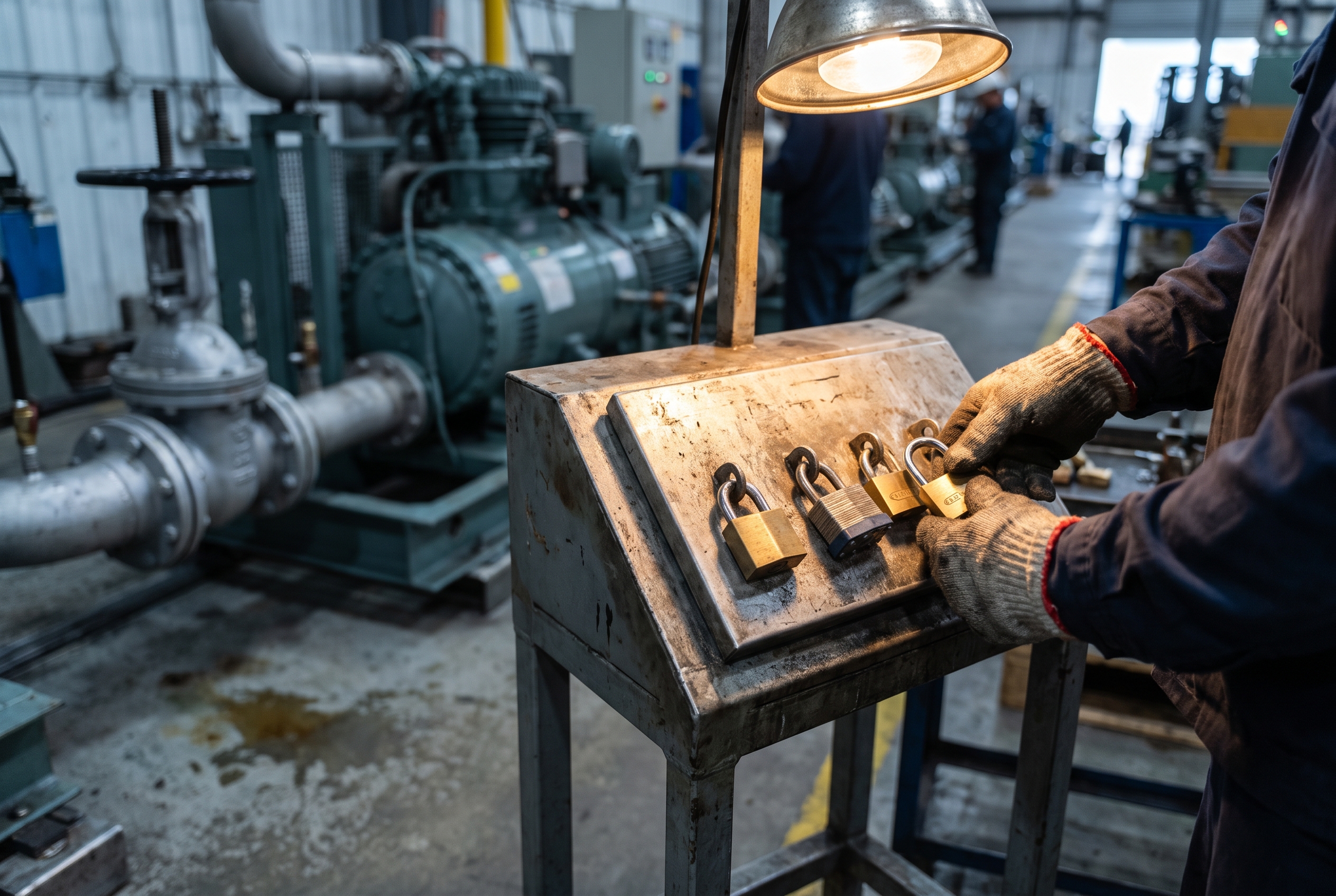
- **One primary authorized employee.** Primary responsibility sits with one authorized employee for a set number of workers under a group device, such as an operations lock.
- **A way to track exposure.** That person must have a way to ascertain the exposure status of each group member.
- **One overall coordinator for multi-crew jobs.** When more than one crew, craft or department is involved, overall job-associated lockout or tagout control goes to an authorized employee designated "to coordinate affected work forces and ensure continuity of protection." On a contractor job, that could be someone from the host or from the contractor. What matters is that it is one named person.
- **Every worker hangs a personal lock.** "Each authorized employee shall affix a personal lockout or tagout device to the group lockout device, group lockbox, or comparable mechanism when he or she begins work, and shall remove those devices when he or she stops working."
## A supervisor's lock plus a log is not enough
OSHA's May 21, 2021 interpretation (Patrick J. Kapust, Acting Director, Directorate of Enforcement Programs) rejected an arrangement in which a supervisor put a single lock on the group lockbox and kept a written log of the authorized employees. Each authorized employee has to apply a personal lock. The same letter accepted a satellite-lockbox setup, in which each authorized employee locks a satellite box so the supervisor can't retrieve the key to the operations lockbox. That design is useful when contractor and host crews come and go at different times.
## Verification: a right, not a requirement
Under OSHA's July 27, 2023 interpretation (Kimberly A. Stille, Director, Directorate of Enforcement Programs), when the primary authorized employee verifies isolation, other group members don't each have to verify. However, every authorized employee in the group "must be informed of their right also to verify" and "must be allowed to personally verify that hazardous energy sources have been effectively isolated, if they so choose." For a contractor technician who doesn't know your equipment, that right matters. Build time for it into the pre-job plan. The same letter says the group lockbox doesn't have to be at the isolation point and has no specific mounting requirement.
## What happens at shift change on a multi-day contractor job?
Section 1910.147(f)(4) requires specific procedures during shift or personnel changes to ensure continuity of protection, "including provision for the orderly transfer of lockout or tagout device protection between off-going and oncoming employees." Contractor jobs that run past the planned window are a common place for this to break down. The contractor's crew rotates, the host's coordinator goes home, and nobody owns the handoff.

Plan the transfer before the job starts: who the oncoming coordinator is, how new locks go on before old ones come off, and how affected operators on the next shift get notified. If schedule pressure is what tempts people to skip steps on a long outage, put a realistic number on that pressure first. ManufacturingMag's downtime cost calculator separates lost contribution from incremental recovery costs, which helps when deciding whether a longer, properly staffed outage is worth it.
## Where do lockout/tagout citations actually come from?
Control of Hazardous Energy (1910.147) ranks No. 3 on OSHA's preliminary FY2026 Top 10, which covers Oct. 1, 2025, through Aug. 31, 2026. Safety+Health magazine reported 1,863 lockout/tagout violations, up from No. 4 the year before. The data was presented by Prent Cline, Acting Deputy Director of OSHA's Directorate of Enforcement Programs. Only fall protection (4,041) and hazard communication (1,961) were cited more often.
The most recent subsection breakdown is for FY2025. That year, per Safety+Health, lockout/tagout drew 2,177 violations. The most-cited subsections were:
SubsectionRequirementFY2025 violations
(c)(4)Energy control procedure675
(c)(7)Training and communication422
(c)(6)Periodic inspection345
(c)(1)Energy control program208
(d)Application of control152
The contractor clause, (f)(2), isn't in the top five. Most citations are for program basics: written procedures, training and periodic inspections. That's the real exposure for a host. If you bring in an outside technician to service equipment that has no documented procedure, the citation risk is mostly about your own program, whatever the contractor does. The same Safety+Health report ranked lockout/tagout second in FY2025 for cumulative proposed penalties ($13,134,743.26), second among serious violations (1,688) and second among willful violations (15).
One detail matters for contractor work. Under (c)(6)(i)(A), the at-least-annual periodic inspection "shall be perfomed by an authorized employee other than the ones(s) utilizing the energy control procedure being inspected" (the misspelling is in the official text). If contractors regularly use a procedure on your equipment, include that work in the inspection.
## Can the host employer be cited for a contractor's lockout violation?
Yes. OSHA's Multi-Employer Citation Policy, CPL 2-0.124, effective Dec. 10, 1999, says that "on multi-employer worksites (in all industry sectors), more than one employer may be citable for a hazardous condition." It isn't limited to construction. The policy defines four roles:
- **Creating:** the employer that caused the hazardous condition.
- **Exposing:** an employer whose own employees are exposed to the hazard.
- **Correcting:** an employer responsible for correcting the hazard.
- **Controlling:** an employer with "general supervisory authority over the worksite, including the power to correct safety and health violations itself or require others to correct them."
A host plant can fit several of these at once. It controls the site, its operators may be exposed, and its own procedure may be what created the gap. Hiring a contractor doesn't move liability off the host. OSHA's current lockout/tagout enforcement directive is CPL 02-00-147, The Control of Hazardous Energy: Enforcement Policy and Inspection Procedures, effective Feb. 11, 2008.
## What does a lockout/tagout violation cost in 2026?
According to an OSHA memo dated May 21, 2026 (Erin Gilmore, Acting Director, Directorate of Enforcement Programs), "There are no inflation-based increases to OSHA civil penalties for 2026." The 2025 amounts carry over because the government shutdown kept BLS from producing October 2025 CPI-U data.
Violation typeMinimumMaximum
Serious$1,085$16,550 per violation
Other-than-serious$0$16,550 per violation
Willful$11,823$165,514 per violation
Repeat$4,256$165,514 per violation
Failure to abate$16,550 per day
Because multiple employers can be cited for the same hazard, one bad contractor job can produce citations for both companies.
## Floor checklist before the contractor arrives
- **Put the procedure exchange in writing up front.** Make the (f)(2)(i) disclosure part of the purchase order or contractor prequalification, not a conversation at the gate.
- **Decide whose procedure covers which isolation points.** Document it, and confirm every worker still has personal-lock protection.
- **Ask for evidence of (c)(7) training.** The contractor's employer owes its technicians full authorized-employee training. Your briefing and escort don't replace it.
- **Choose the group lockout method and the coordinator.** Name the primary authorized employee and, for multi-crew jobs, the overall coordinator. No supervisor-lock-plus-log setups.
- **Tell workers about their right to verify.** Make sure contractor and host authorized employees know they can verify isolation themselves.
- **Brief and notify affected operators.** Cover the contractor's restrictions under (f)(2)(ii), what their devices look like, and who gives the (c)(9) notices when locks go on and come off.
- **Plan the shift-change transfer.** Write down the (f)(4) handoff before the job, especially if it might run long.
- **Close the loop.** Include the contractor job in the next annual periodic inspection of that procedure.
## Related reading
- How ASML's scanner shortage sets US fab timelines
- What Navy Submarine Work Demands From a Machine Shop
- A Supplier Audit Checklist That Starts With Corrective Action
- Does a Job Shop Entering Aerospace Need AS9100 or ISO 9001?
- The 45X Credit, Explained for Plant Finance Teams
- More Quality & Compliance coverage
- Your Plant Has Until November 20 to Finish HazCom 2024
## Sources
- 29 CFR 1910.147, The control of hazardous energy (lockout/tagout), OSHA
- 29 CFR § 1910.147, Legal Information Institute, Cornell Law School
- OSHA Interpretation, Nov. 16, 2000: Applicability of OSHA's LOTO standards; isolation and verification procedures
- OSHA Interpretation, April 23, 2007: Application of LOTO requirements to compressed gas cylinders
- OSHA Interpretation, May 21, 2021: Group Lockout or Tagout
- OSHA Interpretation, July 27, 2023: Group Lockout/Tagout
- OSHA Lockout/Tagout eTool: Outside Personnel (Contractors)
- OSHA Directive CPL 2-0.124: Multi-Employer Citation Policy
- OSHA Directive CPL 02-00-147: The Control of Hazardous Energy: Enforcement Policy and Inspection Procedures
- OSHA: Top 10 Most Frequently Cited Standards (FY2026, preliminary)
- Safety+Health: Fall Protection remains atop OSHA's annual "Top 10" list (Sept. 15, 2026)
- Safety+Health: The most frequently cited standards in FY 2025 (Nov. 24, 2025)
- OSHA Memo: 2026 Annual Adjustments to OSHA Civil Penalties (May 21, 2026)
---
## How ASML's scanner shortage sets US fab timelines
- URL: https://www.manufacturingmag.com/article/what-asmls-capacity-warning-means-for-us-fab-timelines
- Category: Semiconductors
- Published: 2026-10-14
- Summary: ASML says its planned supply for 2027 and 2028 will not fully meet customer demand, and some customers want to order for 2029 and 2030. For US fabs and their suppliers, lithography slots now matter more than groundbreakings.
On October 14, 2026, ASML used its third-quarter results to issue a supply warning. With that, the ASML capacity shortage in 2027 stopped being analyst speculation and became company guidance. "We now expect that our supply as currently planned for both 2027 and 2028 will not fully meet the demand of our customers," CEO Christophe Fouquet said in the Q3 2026 release. He added that "some customers are expressing an interest in placing orders with us for 2029 and even 2030."
Every advanced US fab project depends on these machines. Fab owners, construction contractors and the suppliers around them should read the warning this way: a fab's first-wafer date now depends on when its lithography tools arrive, more than on how fast the building goes up.
## What ASML reported and what it said about supply
ASML reported Q3 2026 net sales of €11.7 billion, a gross margin of 57.5% and net income of €5.0 billion. For Q4 it guided to net sales of €14.2 billion to €15.2 billion at a gross margin of about 57%. Full-year 2026 guidance is now €44 billion to €45 billion, a narrower range than July's €43 billion to €45 billion, with a gross margin of about 56%, according to the company's release.
The financial results were not the main news. Fouquet attributed the demand to AI spending: "Our customers continue to increase their short- and medium-term equipment demand forecasts with us, driven primarily by their views on the size and duration of AI-related investments." He also said ASML is "investigating ways to increase capacity for 2028 beyond the 30% increase we previously communicated."
He was more direct on the earnings call. "30% in 2027, 30% in 2028 will not allow us to meet our customer demand. We have to do more," Fouquet said, according to Investing.com's transcript. He said customers "expect that their supply will not meet the demand at least until 2028."
## How many scanners ASML can build
ASML set out its capacity plan in July. The Q2 2026 release said ASML planned "to add 30% to our 2026 low NA EUV capacity of around 65 for 2027" and was investigating "another 30% for 2028." It planned a similar 30% increase for 2027 on its 2026 DUV immersion capacity of about 130 systems.
Our own arithmetic, not an ASML figure: 30% on about 65 low-NA EUV systems comes to about 85 systems for 2027. Another 30% would bring 2028 to about 110. ASML is now saying that even those numbers fall short.
Most of 2027 was already spoken for in July. On the Q2 call, management said 2027 EUV capacity was "close to being fully covered with orders," according to The Motley Fool's transcript.
Outsiders now get less information on the order book. Starting in Q1 2026, ASML stopped publishing quarterly net bookings and moved to an annual backlog disclosure. It first announced the change at its November 2024 Investor Day (Yahoo Finance). Suppliers and investors can no longer track the queue quarter by quarter. Fouquet's qualitative statements are the best signal available between annual updates.
## How scanner allocation reaches a US fab ramp
The following is our analysis. ASML has not disclosed how it allocates tools among customers.
EUV and DUV immersion scanners sit on the critical path of a leading-edge fab. A building can be topped out, the cleanroom certified and the utilities commissioned, and the fab still cannot run production wafers on its most advanced layers until its lithography tools are installed and qualified. With 2027 EUV output close to fully ordered and ASML saying 2027 and 2028 supply falls short, a fab that has not secured slots cannot move its first-wafer date earlier, however quickly construction moves.
That changes how to read a project schedule. A groundbreaking says a site is being prepared. A confirmed tool move-in date says the owner has secured a place in a queue that ASML says will stay oversubscribed through at least 2028.
The exposure is not limited to logic. Micron's FY2026 10-K says: "We plan to increase EUV adoption at the 1δ (1-delta) DRAM node utilizing the latest-generation EUV tools." Memory ramps also depend on EUV supply.
## US projects by readiness
The major US projects are at very different stages:

- **TSMC Arizona.** TrendForce reported in December 2025, citing Nikkei Asia and Commercial Times, that TSMC expected to install equipment at Fab 2 in the July to September quarter of 2026, setting up 3nm production in 2027. TSMC's $165 billion Arizona plan covers five chip plants, two [advanced packaging](/article/silicon-interposers-and-the-gap-in-us-advanced-packaging) facilities and an R&D center. TSMC expects about 30% of its most advanced chips to be made in the US.
- **Micron Boise.** Micron expects first wafer output from its first new Boise fab in mid-2027 and from the second in late 2028, Idaho News reported. Fiscal 2026 capex was $27.37 billion.
- **Samsung Taylor.** TrendForce, citing Hankyung, reported in January 2026 that EUV trial operations at Taylor Fab 1 would start in March, against a 50,000-wafer 2nm target. In March, TrendForce, citing Korea JoongAng Daily, reported that full-scale production would slip to early 2027. Samsung said its "production start" milestone means completing mass-production preparations by the end of 2026.
- **Intel Ohio.** Intel moved Mod 1 and Mod 2 operations to 2030 and 2031 from an original target of the end of 2026, Manufacturing Dive reported. Naga Chandrasekaran, EVP and chief global operations officer, cited "a prudent approach to ensure we complete the project in a financially responsible manner."
Our reading: the projects with the clearest near-term dates (TSMC Arizona and Micron Boise) are the ones tied to specific tool-install and first-wafer milestones. The Taylor and Ohio dates have each moved. In a market where ASML says 2027 and 2028 are oversubscribed, a project that slips may not get back to its original date quickly, because the scanner capacity it would need is already committed to other customers.
## What SEMI's numbers say
SEMI's latest 300mm Fab Outlook, released October 13, 2026, projects global 300mm front-end equipment spending of $149 billion in 2026, up 31% from 2025, growing at double-digit rates to $227 billion in 2029. "Semiconductor demand is increasingly translating into physical manufacturing expansion across the global industry," said SEMI President and CEO Ajit Manocha.
SEMI expects Americas equipment spending to "more than double," from $18.1 billion in 2026 to $40.6 billion in 2029, about 2.2 times the 2026 level. EE Times Asia reported the same figures. Worldwide, SEMI counts 20 new 300mm fabs or lines starting construction in 2026, 3 of them in the US, and 18 in 2027, 4 of them in the US. It expects 13 new fabs or lines to begin operations or first silicon in 2026 and 23 in 2027.
The forecasts have kept rising. In October 2025, SEMI forecast global 300mm spending of $116 billion for 2026 and $374 billion for 2026 to 2028, with the Americas investing $60 billion over that period (eeNews Europe). In April 2026 it raised the 2026 figure to $133 billion and projected $151 billion for 2027, $155 billion for 2028 and $172 billion for 2029 (SEMI). The October release raised 2026 again, to $149 billion, and 2029 to $227 billion.
Our analysis: higher spending forecasts do not mean faster ramps when the scarcest tool is supply-constrained. If ASML's output is fixed for a given year, more customers wanting more tools in that year mostly makes the queue longer. Spending may also land later than planners expect, because a large share of equipment value arrives with the scanners and the tools that run alongside them.
## Construction comes before tools
SEMI also forecasts global fab construction spending rising 23% to $47.5 billion in 2026, then 33% to $63.3 billion in 2027, before reaching $68.4 billion in 2028. Shell construction drives this demand first: general contractors, mechanical, electrical and plumbing trades, cleanroom builders, and process gas and chemical suppliers. Tool hookup, install and qualification work comes later, timed to scanner and tool delivery.
The gap between those two phases is where suppliers get caught. A cleanroom contractor can be fully booked on a site while the hookup subcontractor waiting on the same site sees nothing for months because the tools have not shipped.
## What fab-adjacent suppliers should do
This is our guidance, based on the figures above, not advice from ASML or SEMI:
- **Key capacity plans to tool move-in and first-wafer dates.** Groundbreakings and announced investment totals are weak scheduling signals. A customer's confirmed equipment install window is a strong one.
- **Ask about lithography slots.** When you bid on fab-adjacent work, ask the owner or general contractor whether EUV and immersion tools are booked and for which quarter. A vague answer is useful information.
- **Build schedule buffers where volume or capital is not committed.** Samsung Taylor and Intel Ohio show how far dates can move. Price and staff those jobs on the assumption that the schedule will change.
- **Plan for demand lasting through 2028 and beyond.** Customers want to order for 2029 and 2030, ASML is studying capacity beyond its stated 2028 plan, and The Next Web reports that ASML's second Dutch campus is due in 2029. Multi-year commitments to labor, facilities and inventory carry less demand risk than usual, provided they are tied to projects with confirmed tool dates.
## Risks and caveats
- **Forecasts keep moving.** SEMI has raised its outlook in each of its last three releases. Forecasts that rise this quickly can also be cut.
- **China exposure.** China was about 20% of ASML's 2026 revenue, according to the Q3 call. TNW reports it as "about a fifth." A change in that demand would change how much capacity is available to everyone else.
- **High NA timing differs by customer.** On the Q3 call, Fouquet said Samsung will use High NA EUV in high-volume manufacturing starting in 2028, and that TSMC confirmed High NA introduction around 2030. ASML's Q3 materials also cite Samsung's plan to adopt High NA for DRAM manufacturing by 2028.
- **2028 capacity is still under study.** ASML has said 30% more is not enough but has not announced a larger figure. Until it does, any 2028 tool schedule should be treated as provisional.
- **Less visibility.** With quarterly bookings no longer published, the next firm read on the backlog comes with ASML's annual disclosure.
## Related reading
- What Navy Submarine Work Demands From a Machine Shop
- A Supplier Audit Checklist That Starts With Corrective Action
- How the Wolfspeed Pentagon loan could reshape a SiC supplier fresh out of Chapter 11
- More Semiconductors coverage
## Sources
- ASML Q3 2026 results release (Yahoo Finance syndication)
- ASML Q3 2026 earnings call transcript (Investing.com)
- ASML says it cannot meet chip tool demand in 2027 or 2028 (The Next Web)
- ASML Q2 2026 press release, Form 6-K (SEC EDGAR)
- ASML Q2 2026 earnings call transcript (The Motley Fool)
- ASML drops key orders metric (Yahoo Finance)
- SEMI 300mm Fab Outlook, October 2026 (PR Newswire)
- SEMI forecasts $227B by 2029 (EE Times Asia)
- SEMI 300mm forecast, April 2026 (PR Newswire)
- SEMI 300mm forecast, October 2025 (eeNews Europe)
- TSMC Arizona Fab 2 timing (TrendForce)
- Micron Boise fab timing (Idaho News)
- Micron FY2026 Form 10-K (SEC EDGAR)
- Samsung Taylor EUV trials (TrendForce)
- Samsung Taylor production timing (TrendForce)
- Intel delays Ohio chip project to 2031 (Manufacturing Dive)
---
## What Navy Submarine Work Demands From a Machine Shop
- URL: https://www.manufacturingmag.com/article/what-navy-submarine-work-demands-from-a-machine-shop
- Category: Aerospace & Defense
- Published: 2026-10-13
- Summary: Anduril's Baltimore County yard won't open until 2030, and July's Navy submarine awards are the stronger demand signal today. This checklist is for shops weighing submarine work: traceability, weld and NDT qualifications, CUI controls, sponsorship and capacity.
Submarine industrial base suppliers need four things before a prime will put their parts on a boat program. The first is material traceability built on objective quality evidence. The second is welders and procedures qualified to NAVSEA S9074-AQ-GIB-010/248. The third is NDT performed under T9074-AS-GIB-010/271. The fourth is NIST SP 800-171 controls for controlled unclassified information. Some work also requires a sponsored facility clearance.
The latest reason machine shops are asking about this is Arsenal-2. [Anduril](/article/pentagon-printing-propellant-x-bow-1100-motors-191m-solid-rocket-motor-base) announced the shipyard on Oct. 6, 2026, for the Tradepoint Atlantic site at Sparrows Point in Baltimore County, Md. The headline figure of $6.6 billion combines two different kinds of money. According to DefenseScoop, Anduril is investing $3.7 billion of its own to build and staff the yard. The other $2.9 billion is a Navy contract ceiling. Naval News, carrying the announcement text, describes that contract as "up to $2.9 billion, with payments tied directly to demonstrated production outcomes."
The schedule matters as much as the money. The announcement says "initial operations are expected to come online in 2030, with production scaling progressively thereafter as Anduril builds the workforce, supplier base, infrastructure, and manufacturing throughput required for submarine production." A shop has several years to qualify. It does not have a near-term RFQ. Shops should spend that time closing gaps in their quality system, welding, NDT, cyber and security, because none of these can be fixed quickly once a quote request arrives.
## Where the demand is today
Arsenal-2 is large. DefenseScoop reports 187 acres and more than 2 million square feet, and WMAR-2 News adds a 1,200-foot graving dock. The War Zone, citing the announcement, reports 3,100 direct jobs, more than 11,000 indirect jobs, $2 billion a year in economic output and an estimated $312 million a year in wages. Officials told The War Zone the yard "would add about 9 million hours of labor a year," which they described as roughly a 15% increase in production capacity.
The first products are modest. Breaking Defense reports the yard will "initially produce basic modules, such as torpedo tubes." The War Zone also lists spherical air flasks. Anduril aims to build full sections over time, eventually including bows and sterns. Those sections go to General Dynamics Electric Boat and HII Newport News Shipbuilding for final assembly. Before Arsenal-2 opens, an Anduril facility in Orange County will support "production of Virginia-class test assets and critical maritime components, including torpedo tubes," which Breaking Defense says gives the company "a two-year operational head start."
Anduril president and chief strategy officer Chris Brose presented the yard as added capacity, not a competitor to the existing builders: "This is not about taking food off the plate of anybody. This is about putting more food on the table." The announcement also says Anduril will build a supplier base. No source says what Arsenal-2 will buy from outside shops or whether it will subcontract machining. A tier-2 opportunity at the new yard is a reasonable inference, but it has not been confirmed.
The firmer demand signal arrived earlier. On July 29, 2026, the Navy awarded $76.6 billion in submarine contracts, according to Breaking Defense:
- $42.1 billion for nine Block VI Virginia-class boats
- $29.5 billion for five Build II Columbia-class boats
- $5 billion for shipyard enhancements
The same report, citing GAO, says shipbuilders were delivering Virginia-class boats at a rate of one per year as of June 2025, half the Navy's target of two. That shortfall explains the funding. Rep. Joe Courtney said "thousands of small business manufacturers who are essential to the industrial base now have the certainty they have been asking for to make needed investments in hiring, facilities, and equipment." Electric Boat president Mark Rayha said the awards give "Electric Boat and our suppliers" the "demand certainty we need to continue investing in capacity and hiring."
For a plant manager, the multi-boat awards are the order book available now, and Arsenal-2 is a possible later customer. The qualification work below applies to both.
## Checklist 1: Material traceability and objective quality evidence
Submarine quality rests on SUBSAFE. The Navy started the program in 1963 after losing USS Thresher. According to the Thresher Base summary, SUBSAFE certification "covers design, installed material, fabrication processes and as well as comprehensive testing." Records "back to original material composition as well as detailed testing results must be reviewed and retained throughout the life of a submarine."

The program's safety record explains why the Navy will not relax these rules. In a 2003 statement to the House Science Committee quoted by Thresher Base, RADM Paul Sullivan said, "In the 50 years since the inception of the SUBSAFE program, there has not been a loss of a SUBSAFE certified submarine." The Johns Hopkins LENS casebook counts 16 submarine losses in the 48 years before SUBSAFE and one in the 63 years since. That loss was USS Scorpion in 1968, which was not SUBSAFE-certified.
The principle that matters on the shop floor is objective quality evidence (OQE). SUBSAFE and Navy Level I material control both depend on it. If the evidence is missing, the part cannot be certified, even when it is good. A plant manager should ask these questions:
- **Receiving:** Can you tie every piece of incoming stock to its mill certification and original material composition, and can you reject material when the paperwork does not match?
- **Storage and segregation:** Can controlled material be kept physically and administratively separate from commercial stock, so it cannot be substituted on a busy second shift?
- **Marking and transfer:** When a bar is cut into blanks, does the identification follow every piece?
- **Record retention:** Can your systems keep records for the service life of a submarine, not just the length of a customer warranty?
The exact marking, segregation and documentation clauses come from the prime's purchase order and supplier quality requirements. Read those documents for the specific rules. Do not rely on secondhand summaries. If your traceability depends on a spreadsheet and one person's memory, that is the first gap to close.
## Checklist 2: Welding qualification
If the work includes welding or brazing, NAVSEA S9074-AQ-GIB-010/248 sets the requirements. It covers "the qualification of welding and brazing procedures, welders, welding operators, brazers and brazing operators that must be met prior to any production fabrication." A shop's commercial or structural weld qualifications do not carry over automatically.

The words "prior to any production fabrication" decide the budget question. Qualification has to come before revenue. To qualify a cell, a shop takes it off paying work, runs test coupons, sends them for testing and pays for the welders' time while they qualify. The cost depends on how many processes, materials and positions the customer needs. It is best to scope this against a specific part family from a specific customer instead of trying to qualify for everything in advance. If qualification takes a working cell out of production, the downtime cost calculator separates lost contribution margin from incremental recovery costs. That makes it easier to compare the cost against the expected order value.
## Checklist 3: Nondestructive testing
NAVSEA T9074-AS-GIB-010/271, "Requirements for Nondestructive Testing Methods," covers NDT for "internal and surface discontinuities in metals," according to the Intertek Inform abstract. Intertek lists Revision 0, issued in 1997, as withdrawn on April 29, 2024. Ask your customer which revision its purchase order invokes before you write procedures or train inspectors.
Personnel certification is the harder problem. ASNT's Naval Shipbuilders NDT Level III exam "aligns with the Navsea Technical Publication T9074-AS-GIB-010/271 requirements and is part of an employer-based certification system." A naval shipyard administrator must sponsor the candidate. The exam is open-book, with 50 questions in 2.5 hours, and has no fee. It is not open to the public. It is intended for Level III examiners at primes or sub-tier contractors serving Newport News or Electric Boat.
This leads to a make-or-buy decision. Building in-house NDT means a Level III who can only certify through a shipyard sponsor, so you need a customer relationship first. Buying NDT from a lab that already holds naval qualifications costs more per part but lets you start without that relationship. Most shops new to the work will buy NDT first and bring it in-house once the volume justifies it.
## Checklist 4: Cyber and controlled unclassified information
Many shops are waiting on CMMC. That is a mistake. The Department of War suspended CMMC Phase 2 on July 13, 2026. Phase 2 was scheduled for Nov. 10, 2026, and would have required third-party (C3PAO) Level 2 certification. According to Morgan Lewis, the following obligations still apply: self-assessments, DFARS 252.204-7012, the 110 security controls in NIST SP 800-171 and score submissions to SPRS.
The schedule for CMMC is still unclear. Covington reported that the CMMC Reform Task Force sent its report to the DoW CIO on Sept. 11, 2026. The report had not been made public, and no new implementation dates had been set as of Sept. 21. Whatever the final rule says, a shop that receives controlled drawings needs a documented CUI enclave, a current self-assessment and an honest SPRS score now. Primes can see your score, and a weak one can lose a quote before anyone reviews your price.
## Checklist 5: Facility clearance and sponsorship
Some submarine work requires a facility clearance (FCL). The most important rule is that you cannot request one on your own. "A company cannot self-nominate for an FCL," according to Bradley Arant Boult Cummings in the National Law Review. A government contracting activity or an already-cleared prime has to sponsor you. The rules are in the NISPOM, 32 CFR Part 117, and DCSA administers them.
What this means for a shop:
- Key management personnel, meaning the senior management official, the facility security officer and the insider threat senior official, must hold personal clearances at or above the facility level. Make sure the people who would fill those roles are eligible.
- DCSA reviews foreign ownership, control or influence. If you have overseas investors or a foreign parent company, sort that out before you look for a sponsor.
- After a sponsorship is accepted, the company has 20 days to submit its package. Prepare corporate documents, ownership records and organization charts in advance.
Not every machined part requires a cleared facility. The contract's security requirements decide, so ask the prime early. Do not assume you need an FCL, and do not assume you don't.
## Checklist 6: Capacity, capex and who pays for it
The Navy has spent money on suppliers for years. GAO-24-107732 found that "since 2018, the Navy reported receiving more than $2.6 billion to invest in the submarine supplier base." GAO-25-106286 reported that Congress provided $2.456 billion in FY2024 supplemental funding for the private submarine industrial base. BlueForge Alliance, the Navy's nonprofit integrator for the submarine industrial base, received a $950 million contract on Sept. 11, 2024, bringing its total to $1.3 billion, according to Breaking Defense.
GAO's caution matters as much as the dollar figures. In the 2024 report, GAO said the Navy lacked the metrics to show that its supplier investments were working. In 2025, it recommended investment metrics and a ship industrial base strategy. For a shop, this means program priorities and reporting requirements can change. If a machine, building expansion or training program is partly funded through a supplier development program, get the terms in writing before you sign: what you must deliver, what you must report, who owns the equipment and what happens if volumes fall short.
On the floor, consider these capacity questions:
- **Size:** Torpedo tubes, air flasks and hull sections are large. Check that your machine envelopes, crane capacity, floor loading and shipping access can handle the parts you plan to quote.
- **Reserved capacity:** First articles and qualification runs take spindle hours from paying work. Decide which machines you will dedicate and price the lost commercial throughput.
- **Demand duration:** Multi-boat awards support a multi-year depreciation schedule better than a single job does. Base capex on demand from named customers, not announced totals.
## How to get seen by the primes
The New England Submarine Shipbuilding Partnership maintains a searchable supply-chain database through SENEDIA. Companies can list their capabilities and certifications there, including AS9100, ISO and NADCAP. Listing is low-cost, and it keeps your shop visible to buyers. Use it together with direct contact through the prime supplier portals at Electric Boat and Newport News Shipbuilding.
For Arsenal-2, Anduril's Orange County operation is the earliest likely point of entry, since it will produce Virginia-class test assets and torpedo tubes before the Baltimore yard opens in 2030. Anduril has not said how it will source parts, so watch for supplier outreach rather than expecting it.
## Bid/no-bid: a plant manager's list
- **Quality system gap:** Can your receiving, segregation, marking and record retention produce objective quality evidence that lasts for the life of a boat? If not, budget the fix before you quote.
- **Weld qualifications:** Which processes and materials does the target part family need under S9074-AQ-GIB-010/248, and which cell will you take offline to qualify them?
- **NDT path:** Will you buy NDT from a qualified lab or build in-house capability that requires shipyard sponsorship? Confirm which 271 revision applies.
- **CUI enclave:** Do you have a current NIST SP 800-171 self-assessment and SPRS score? The CMMC suspension does not change this.
- **Sponsor path:** Does the work require an FCL? If it does, who will sponsor you, and are your key managers eligible for clearance?
- **Capacity reserved:** Which machines, people and floor space are committed, and what commercial work will you give up to free them?
A shop that can answer all six is ready to quote. A shop that cannot has several years before 2030 to fill the gaps, and the existing primes are buying now.
## Related reading
- A Supplier Audit Checklist That Starts With Corrective Action
- How the Wolfspeed Pentagon loan could reshape a SiC supplier fresh out of Chapter 11
- The Hardest Manufacturing Jobs to Fill This Fall Are Hybrid Roles
- Will Boeing's Engineer Offer Reset Pay at Aerospace Suppliers?
- If Boeing Engineers Strike, Who Signs Off on Supplier Deviations?
- The Strongest Machine-Tool Half in 28 Years — and Aerospace, Not Detroit, Is Signing the POs
- More Aerospace & Defense coverage
- Can 3D Printed Solid Rocket Motors Reach Full Rate in 2027?
- Is Your Motor Supplier Ready for the January DFARS Magnet Rule?
## Sources
- DefenseScoop: White House, Anduril announce plans for new 'software-defined' shipyard (Oct. 6, 2026)
- The War Zone: Anduril Dives Into Submarine Construction With New Baltimore Plant (Oct. 6, 2026)
- Breaking Defense: Anduril launches new shipyard to manufacture components for Virginia-class subs (Oct. 6, 2026)
- Naval News: Anduril, U.S. Navy Invest $6.6 Billion to Expand America's Submarine Industrial Base (Oct. 6, 2026)
- WMAR-2 News: Trump visits Baltimore County to announce new $3.7B shipyard plans
- Breaking Defense: Navy awards $76.6B in contracts for new Virginia, Columbia-class subs (July 29, 2026)
- GAO-24-107732, Columbia Class Submarine (Sept. 30, 2024)
- GAO-25-106286, Shipbuilding and Repair: Navy Needs a Strategic Approach for Private Sector Industrial Base Investments (Feb. 27, 2025)
- Breaking Defense: Navy awards BlueForge Alliance new $950M contract (Sept. 11, 2024)
- Thresher Base: SUBSAFE Program, The Legacy of USS Thresher
- Johns Hopkins LENS: Navy SUBSAFE case study
- EverySpec: NAVSEA S9074-AQ-GIB-010/248
- Intertek Inform: NAVSEA T9074-AS-GIB-010/271
- ASNT: Naval Shipbuilders NDT Level III
- Morgan Lewis: Department of War Suspends CMMC Phase II Requirements (July 2026)
- Covington, Inside Government Contracts: CMMC Reform Task Force Updates (Sept. 2026)
- National Law Review / Bradley Arant Boult Cummings: Facility Clearances 101 (Oct. 2, 2026)
- SENEDIA / New England Submarine Shipbuilding Partnership: Supply Chain Database
---
## A Supplier Audit Checklist That Starts With Corrective Action
- URL: https://www.manufacturingmag.com/article/a-supplier-audit-prep-checklist-for-tier-2-plants
- Category: Quality & Compliance
- Published: 2026-10-12
- Summary: Customer auditors write up the same clauses year after year. This week-by-week supplier audit checklist for tier-2 plants puts corrective action, control plans, calibration and traceability ahead of cleaning up binders.
A useful supplier audit checklist puts the effort where customer auditors actually write findings. For automotive work that means corrective action and problem solving first. Both clauses lead the IATF 16949 major nonconformance rankings in the IATF's 2024 data and in the IAOB analysis presented at the 2025 AIAG Quality Summit. Tidying binders comes later.
## Supplier audit checklist: the short version
Start about eight weeks before an OEM or tier-1 audit and work through the clauses in the order auditors most often cite them:
- Close corrective actions, with data from effectiveness checks and updated documents (8 to 6 weeks out).
- Line up PFMEA, control plan, work instruction and gauge for every part number (6 to 5 weeks).
- Check calibration and MSA records, including how out-of-tolerance gauges were handled (5 to 4 weeks).
- Confirm document control and customer-specific requirements (4 to 3 weeks).
- Run a timed traceability drill both forward and backward (3 to 2 weeks).
- Do layered floor walk-throughs while the process is running (2 to 1 weeks).
## What auditors write up most often
The data is consistent. In the IATF global data summarized by simpleQuE (shares of total volume as of November 25, 2024), these clauses produced the most findings:
RankMajor nonconformances (IATF 2024)ShareMinor nonconformances (IATF 2024)Share
110.2.3 Problem solving10.06%8.5.1.5 Total productive maintenance4.30%
210.2.1 Nonconformity and corrective action5.65%8.3.5.2 Manufacturing process design output4.06%
38.3.5.2 Manufacturing process design output4.32%8.5.1.1 Control plan3.91%
48.5.1.1 Control plan3.11%6.1.2.3 Contingency plans3.88%
57.1.5.1.1 Measurement systems analysis3.10%8.5.1.3 Verification of job set-ups3.23%
In that dataset, total productive maintenance moved to the top of the minor findings, replacing contingency plans.
A second dataset agrees. An IAOB analysis presented at the 2025 AIAG Quality Summit used the NC-CARA database from 19 IAOB certification bodies. As simpleQuE reported, its top five clauses were problem solving (10.2.3), nonconformity and corrective action (10.2.1), manufacturing process design output (8.3.5.2), measurement systems analysis (7.1.5.1.1) and control plan (8.5.1.1). The only change from the IATF 2024 list is that MSA and control plan swap fourth and fifth place. The same five clauses lead both lists.
**For aerospace suppliers:** the most recent AS9100-family data available here is older. In the IAQG-OASIS Americas data for 2019 (the Americas sector holds about half of global AS91XX certifications), auditors wrote 17,184 nonconformances: 15,298 minor and 1,886 major. The top combined findings were control of production (8.5.1), nonconformity and corrective action (10.2.1, which drew the most majors), measurement traceability (7.5.3.2 document control also ranked, along with 7.1.5.2 traceability), information for external providers (8.4.3), control of externally provided processes (8.4.1.1), type and extent of supplier control (8.4.2), internal audit (9.2.2) and competence (7.2), according to simpleQuE. Treat those figures as 2019 context. The overlap with the IATF data still holds: corrective action, measurement and supplier control.
## 8 to 6 weeks out: close corrective actions properly
Most of the effort belongs here. The IAOB data shows where corrective-action findings come from. Sub-clause 10.2.1 d) accounted for 60.45% of clause 10.2.1 nonconformances. simpleQuE summarizes that sub-clause as weak monitoring and follow-up on whether corrective actions were effective. Sub-clause 10.2.3 f), reviewing and updating documented information, accounted for 40.83% of problem-solving nonconformances. Put simply, plants are getting written up for corrective actions that were never checked to see if they worked, and for fixes that never made it into the documents.
Pull every open corrective action report (CAR) and every one closed in the past audit cycle. For each one, check:
- **Root-cause evidence.** Look for the analysis itself, not only a box with a conclusion in it.
- **Effectiveness check with data.** The record should show what was measured after the fix, over what period, and the result. "Closed, no recurrence" without numbers will not hold up.
- **Document updates.** Was the PFMEA revised? Was the control plan? The work instruction? Lessons learned? Check that the revision dates come after the CAR.
- **Honest status.** If an action really is still open, document where it stands, the containment in place, and the planned verification date. Do not backdate a closure.
The IAOB presentation also named the root causes behind these findings: inadequate training, gaps in procedures and insufficient management oversight. If the same weakness shows up across several CARs, fix the procedure and the review cadence as well as the individual records.
## 6 to 5 weeks out: align control plans and PFMEAs
Process design output (8.3.5.2) and control plan (8.5.1.1) appear in the top five for both majors and minors in the 2024 IATF data. These findings usually come from a mismatch between documents and the floor. For each active part number, trace one chain: PFMEA failure mode, then the control-plan characteristic, then the work instruction, then the gauge actually in use at the station. Log every gap, such as a characteristic in the control plan with no instruction, a gauge on the floor that differs from the one specified, or a reaction plan the operator cannot find.
Include two more items from the minor-finding list in the same pass:
- **Job set-up verification (8.5.1.3).** Pull set-up records for a sample of recent changeovers and confirm they are complete and signed off.
- **Contingency plans (6.1.2.3).** The UT Center for Industrial Services advises testing contingency plans and reviewing them at least once a year. A plan that has never been exercised is a likely finding. UT CIS also recommends treating control plans as living documents and not something written once at launch.
## 5 to 4 weeks out: calibration and MSA
MSA (7.1.5.1.1) is a top-five major finding in both datasets, and IATF 16949 asks for more on calibration records than ISO 9001 does. According to a clause explainer by Pretesh Biswas (a paraphrase, not the standard's text), records under 7.1.5.2.1 cover:

- out-of-calibration readings and the risk assessment that follows
- an evaluation of whether earlier measurement results are still valid
- notifying the customer when suspect product has already shipped
- statements of conformity after calibration
- verification of software used for product and process control
- records for all gauging
"All gauging" covers more than most plants' calibration lists. A CalibrationOS explainer notes that employee-owned, customer-owned and supplier-owned gauges are included. Walk the floor and toolboxes and compare what you find against the master list. Then pick every out-of-tolerance event since the last audit and confirm the full reaction is on file. Finally, check that each gauge named in a control plan has a current MSA study.
## 4 to 3 weeks out: document control and customer-specific requirements
At the point of use, confirm the revision on the floor matches the controlled master. Remove obsolete copies, including laminated ones taped to machines. Check that approval trails are complete. Then turn to customer-specific requirements (4.3.2), which led UT CIS's list of top findings from IATF 16949 transition audits. Confirm that each customer's current requirements document is in the system, that someone owns it, and that its requirements show up in the affected procedures.
## 3 to 2 weeks out: run a traceability drill
Clause 8.5.2.1 requires documented traceability plans based on risk and failure severity. According to the Biswas explainer on that clause, the plans must let you identify and segregate nonconforming or suspect product, meet customer and regulatory response-time requirements, and keep records in a format (electronic, hardcopy or archive) that makes that response time achievable. They must also serialize where the customer or a regulation requires it and extend to externally provided products with safety or regulatory characteristics.
Test this with a timed drill:
- **Forward:** pick a supplier lot, ideally a part with safety or regulatory characteristics, and find every finished lot it went into and where each one shipped.
- **Backward:** pick a shipped finished lot and recover its input lots, process records, set-up verification, inspection results and the gauges used.
- **Time it** against the customer's required response time. If records sit in a format that slows retrieval, that is the finding to fix.
Also check how product status is shown on the floor. The explainer notes that inspection and test status should not be shown only by where product sits in the flow, unless that is inherently obvious.
## 2 to 1 weeks out: layered floor walk-throughs
Use the final two weeks for short, repeated audits on the floor, modeled on layered process audits. AIAG publishes the CQI-8 Layered Process Audits Guideline, now in its second edition. AIAG says LPAs run while the process is running, so they can catch nonconformances before the job is finished, which reduces rework, scrap and the need for inspection. In practice, supervisors, managers and plant leadership each check the same small set of controls on different shifts:

- **TPM records.** Total productive maintenance is now the top minor finding. Confirm that planned maintenance happened when scheduled and that the records show it.
- **Part status marking** at each station and in holding areas.
- **Set-up verification** done and recorded at the most recent changeover.
- **Reaction plans.** Ask operators what they do when a characteristic is out of spec, and check that the answer matches the control plan.
TPM gaps cost money on the line as well as in the audit. To size what weak maintenance discipline costs in unplanned downtime, use the free downtime cost calculator. It separates lost contribution from incremental recovery costs.
## Audit week: show the record
Choose one escort for the auditor who knows the floor, plus a runner who can pull records quickly. Set up an evidence room with the CAR log, control plans, calibration master list and traceability drill results indexed so they can be found fast. When the auditor asks a question, answer with the record: hand over the effectiveness data and the revised PFMEA instead of explaining that the fix worked. Answer only what is asked. If something is missing, say so and write it down. A known gap with a dated plan holds up better than an improvised explanation.
## What is changing
- **IATF 16949:** the IATF issued Sanctioned Interpretations #27 to 30 in November 2025, effective that month (IATF Global Oversight). Read them against your procedures before the next surveillance audit.
- **ISO 9001:2026:** published 16 September 2026, according to DNV and LRQA. DNV says ISO 9001:2015 certificates stop being valid after 30 September 2029. LRQA lists the main changes as requirements on quality culture and ethical behavior, risks separated from opportunities, stronger change management, core QMS terms added to the standard, and expanded guidance in Annex A.
- **Medical devices:** FDA's [Quality Management System](/article/machine-shop-iso-9001-2026-transition-checklist) Regulation took effect February 2, 2026, and incorporates ISO 13485:2016 by reference (FDA). Tier-2 plants that supply device makers should expect customer audits to reflect it.
## Related reading
- Does a Job Shop Entering Aerospace Need AS9100 or ISO 9001?
- How the Wolfspeed Pentagon loan could reshape a SiC supplier fresh out of Chapter 11
- The Hardest Manufacturing Jobs to Fill This Fall Are Hybrid Roles
- More Quality & Compliance coverage
- Who Owns Lockout/Tagout When a Contractor Services Your Equipment?
- Your Plant Has Until November 20 to Finish HazCom 2024
## Sources
- simpleQuE: IATF 16949 Top Nonconformances, Highlights from the 2025 AIAG Quality Summit
- simpleQuE: The Top 10 IATF 16949 Major and Minor Audit Nonconformances of 2024
- simpleQuE: AS9100 Standards Major and Minor Nonconformances for 2019
- UT Center for Industrial Services: Top Findings During IATF 16949:2016 Transition Audits
- Pretesh Biswas: IATF 16949:2016 Clause 7.1.5.2.1 Calibration/verification records
- CalibrationOS: IATF 16949 Calibration and MSA Requirements
- Pretesh Biswas: IATF 16949:2016 Clause 8.5.2.1 Identification and traceability
- AIAG: AIAG Simplifies Layered Process Audits
- IATF Global Oversight: IATF 16949:2016 Sanctioned Interpretations
- DNV: ISO 9001:2026 Standard Revision
- LRQA: ISO 9001:2026 is live, the transition period has begun
- FDA: Quality Management System Regulation (QMSR)
---
## How the Wolfspeed Pentagon loan could reshape a SiC supplier fresh out of Chapter 11
- URL: https://www.manufacturingmag.com/article/wolfspeeds-road-from-chapter-11-to-a-pentagon-loan
- Category: Semiconductors
- Published: 2026-10-11
- Summary: Barely a year after leaving Chapter 11, Wolfspeed has a conditional, non-binding commitment from the Department of War's Office of Strategic Capital for up to $1.5 billion over 30 years. The loan would fund silicon carbide wafers and power devices, GaN production and radiation hardening. The conditions on capital, offtake and governance matter more to buyers than the headline number.
On Oct. 7, 2026, Wolfspeed, the Durham, N.C. silicon carbide (SiC) maker, said it had signed a conditional commitment letter with the Department of War's Office of Strategic Capital (OSC). The letter covers a senior secured delayed-draw term loan of up to $1.5 billion with an expected 30-year maturity. The Wolfspeed Pentagon loan is not done. It is non-binding until the parties sign definitive agreements, and the company's own Form 8-K says "no assurances can be made" that it will reach those agreements or get funded, or that the deal will close on the contemplated terms "or at all."
Still, the commitment comes from a supplier that left Chapter 11 only in September 2025. If it closes, it would refinance Wolfspeed's senior debt and tie the company more closely to the defense establishment. For plant managers and purchasing teams buying SiC substrates or power devices, the conditions attached to the money matter more than the $1.5 billion figure.
## 2023 to 2024: becoming a pure-play SiC company
Wolfspeed narrowed its business before it ran into financial trouble. Effective Dec. 2, 2023, it completed the sale of its RF business to MACOM for about $75 million in cash plus 711,528 MACOM shares, valued at about $60.8 million. Then-CEO Gregg Lowe said the sale made Wolfspeed a pure-play silicon carbide manufacturer.
In October 2024, Wolfspeed was offered $750 million in [CHIPS Act](/article/sk-hynix-indiana-hbm-packaging-plant-2029-analysis) funding for the John Palmour Manufacturing Center in Siler City, N.C., and its expansion in Marcy, N.Y. (Mohawk Valley). Lowe called it "proposed funding," according to Electronics Weekly.
## 2025: a prepackaged restructuring
The balance sheet broke first. Here is the sequence:
- **June 22, 2025:** Wolfspeed signed a Restructuring Support Agreement with its senior secured noteholders, convertible noteholders and Renesas.
- **June 30, 2025:** It filed a prepackaged Chapter 11 case in the U.S. Bankruptcy Court for the Southern District of Texas (Manufacturing Dive).
- **Sept. 8, 2025:** The court confirmed the plan of reorganization.
- **Sept. 29, 2025:** Wolfspeed emerged from Chapter 11.
The company said the restructuring cut total debt by about 70%, pushed maturities out to 2030 and lowered annual cash interest by about 60%. Manufacturing Dive put the reduction in funded debt at $4.6 billion. Renesas, which had placed a $2.06 billion supply deposit with Wolfspeed, converted it into convertible notes, common stock and warrants. Manufacturing Dive reported that Renesas expected a loss of about ¥250 billion (about $1.7 billion).
For buyers, the operational record of the case matters most. In its first post-emergence quarterly release, Wolfspeed said it paid vendors and served customers throughout the process. It ended that quarter with $926 million in cash. At emergence, CEO Robert Feurle said: "Wolfspeed has emerged from its expedited restructuring process, marking the beginning of a new era, which we are entering with new energy and a renewed commitment to the growth mindset and entrepreneurial spirit that have powered Wolfspeed since its inception."
## 2026: a smaller business with cash on hand
The fiscal fourth-quarter 2026 results, released Aug. 19, 2026, show a company that has stabilized but not grown:

- Revenue was $149.6 million, down from $197.0 million a year earlier. Power products contributed $106.3 million and materials $43.3 million.
- Cash, cash equivalents and short-term investments were about $1.1 billion as of June 28, 2026.
- Long-term debt was $931.0 million, and convertible notes, net, were $756.5 million. Holders converted $46 million of convertibles to equity during the quarter.
- Revenue from AI data centers more than doubled year over year in fiscal 2026.
- Guidance for fiscal first-quarter 2027 revenue is $140 million to $160 million.
So Wolfspeed has liquidity, a debt stack due in 2030 and a revenue run rate well below where it was a year earlier. The OSC commitment is aimed at that debt and the convertibles.
## Oct. 7, 2026: how the OSC facility is built
According to the 8-K, the facility would fund in up to four tranches:
- **Tranche one, $600 million:** refinances in full the outstanding first-lien senior secured notes due 2030 and pays transaction fees.
- **Remaining $900 million:** up to three more tranches of $200 million to $400 million each.
- **Term:** an expected 30-year maturity, with a 36-month commitment period during which Wolfspeed can draw the tranches.
- **Pricing:** interest "expected to be comparable to the U.S. Treasury rate of a similar maturity plus a risk premium that will be determined on a final basis in the Definitive Agreements." The spread has not been disclosed.
- **Repayment:** if there is no default, interest may be capitalized for the first five years. After that, Wolfspeed would pay interest and principal quarterly in cash, and the loan "will amortize on a 25-year straight-line basis."
- **Warrants:** issued pro rata as each tranche funds, in two pieces of 5% and 2.5% of outstanding equity. Each has an exercise price based on volume-weighted average price (VWAP) and can be exercised for ten years. The press release puts the total at up to 7.5% of fully diluted equity.
CFO Gregor van Issum called it "another significant milestone in our ongoing efforts to optimize Wolfspeed's capital structure and improve our financial foundation."
## What the money would fund
The 8-K defines the "Project" that the loan supports in four parts:
- Building out domestic SiC wafer and power-device production.
- Establishing or onshoring domestic low- and/or high-voltage GaN production.
- Investing in GaN-on-SiC RF epitaxial wafer technology.
- Developing a domestic radiation-hardening capability.
The press release ties the GaN epitaxy upgrades to "next generation communications infrastructure and electronic warfare systems." It lists Wolfspeed's manufacturing footprint as North Carolina, New York and Arkansas. Feurle said: "SiC and GaN have critical national security applications. With this financing, the company would be well positioned to not only continue to serve the DoW but also expand its capabilities for the benefit of U.S. national security as a whole."
The GaN items reverse part of the 2023 strategy. Wolfspeed sold its RF business to become a pure-play SiC company. The OSC Project now brings GaN power and GaN-on-SiC RF epiwafers back into scope, this time with defense applications attached.
## The conditions are the real story
The 8-K sets out terms that would change Wolfspeed's capital structure and governance well before most of the money arrives.
**New outside capital.** Wolfspeed must contribute "Qualifying Sources" received after June 28, 2026 "in an aggregate amount of at least $750 million." These are third-party equity or equity-linked proceeds from parties not affiliated with the U.S. government. For the first tranche, the requirement includes $50 million of qualifying equity raised before the facility's effective date, plus a further $100 million.
**Convertible equitization.** Wolfspeed must use "commercially reasonable efforts to equitize a substantial majority of the aggregate principal amount of the Company's outstanding convertible notes." With $756.5 million of convertibles on the books at fiscal year-end, existing shareholders face dilution from the conversions, the required equity raises and the government warrants.
**Offtake before later tranches.** To draw beyond the first tranche, Wolfspeed must enter "certain commercial arrangements, including offtake agreements, on terms acceptable to the OSC." No counterparties have been named.
**Governance and control.** The covenants limit changes of control and require a board with a majority of U.S. citizens, a CEO who is a national of a permitted jurisdiction and a U.S. headquarters. OSC gets the right to name a non-voting board observer. The covenants also include "the grant to the DoW of certain rights on products or services related to the Project." The filing does not describe what those rights are.
## OSC has not made a commitment this size before
OSC was established on Dec. 1, 2022. According to the Congressional Research Service, the program's FY2026 appropriation of $97.8 million for the DOD Credit Program account can subsidize up to $4.4 billion in loans. Its recent conditional commitments were smaller: $820 million to Performance Drone Works (July 31, 2026) and $400 million to Sunrise Energy Metals (Aug. 7, 2026). OSC's 2025 loan to MP Materials was $150 million, DefenseScoop reported. DefenseScoop also reported that the Pentagon asked for about $20.2 billion for the Defense Strategic Capital Credit Program in FY2027, up from less than $1.5 billion in FY2026. At up to $1.5 billion, the Wolfspeed commitment is OSC's largest so far, in a program that is asking Congress for much more money.
## What SiC buyers should do now
If the facility closes, the first tranche pays off the first-lien notes due 2030. That removes the main near-term refinancing risk for a supplier that has already been through bankruptcy. Two other features cut the other way. The offtake condition means some future capacity would be committed under arrangements OSC must approve. The DoW product rights are undefined, so buyers cannot yet tell how they might affect allocation or priority in a tight market.
- **Keep second-source qualification going.** Until definitive agreements are signed, this is a letter, not a loan. Even after closing, the allocation effects of the offtake and product-rights terms are unknown.
- **Put financial health in supplier reviews.** Track Wolfspeed's progress toward the $750 million in qualifying capital, the $50 million pre-closing equity raise and the convertible equitization. Each one is a public signal of whether the deal is moving.
- **Ask about allocation directly.** At the next business review, ask the supplier how offtake commitments and any DoW rights would interact with your existing supply agreements. Get the answer in writing if you can.
- **Price the exposure.** If a SiC part feeds a constrained line, estimate what a supply interruption would cost. The free downtime cost calculator separates lost contribution margin from incremental recovery costs. That gives you a figure to set against the cost of qualifying a second source.
## How the market reacted
Wolfspeed shares rose 14% in morning trading on Oct. 8, 2026, to $35.89, and were up 108% year to date, 24/7 Wall St. reported. ON Semiconductor fell 2% and Texas Instruments 1%. The move shows how investors priced lower refinancing risk. It does not show that the deal will close.
## Who Wolfspeed would answer to
In about 15 months Wolfspeed has gone from Chapter 11 to a possible 30-year lender relationship with the Department of War. If the deal closes, the change goes beyond the balance sheet. A U.S.-citizen board majority, a government observer in the boardroom, warrants for up to 7.5% of the equity and unspecified rights over Project products would give the government real influence over a key SiC supplier. Buyers should plan for that relationship, not just the loan amount, and treat the signing of definitive agreements as the milestone to watch.

## Related reading
- The Hardest Manufacturing Jobs to Fill This Fall Are Hybrid Roles
- Why TSMC is buying silicon interposers from New York
- How to Run a SMED Changeover Study on a Stamping Press
- More Semiconductors coverage
## Sources
- Wolfspeed Form 8-K, Oct. 7, 2026 (SEC EDGAR)
- Wolfspeed press release, Exhibit 99.1, Oct. 7, 2026 (SEC EDGAR)
- Wolfspeed announces conditional 30-year, $1.5 billion loan commitment (wolfspeed.com)
- Wolfspeed emergence press release, Sept. 29, 2025 (SEC EDGAR)
- Wolfspeed's Plan of Reorganization Confirmed, Sept. 8, 2025
- Manufacturing Dive: Wolfspeed files for Chapter 11 bankruptcy
- Wolfspeed Q1 FY2026 results, Oct. 29, 2025 (SEC EDGAR)
- Wolfspeed Q4 FY2026 results, Aug. 19, 2026 (SEC EDGAR)
- Wolfspeed completes sale of RF business to MACOM, Dec. 4, 2023 (SEC EDGAR)
- Electronics Weekly: Wolfspeed wins $750m Chips Act award, Oct. 16, 2024
- CRS IF13215: Office of Strategic Capital, Overview and Considerations
- DefenseScoop: Pentagon requests more than $20B for strategic capital loan program in 2027
- 24/7 Wall St.: Wolfspeed soars 14% on conditional Department of War loan commitment
---
## The Hardest Manufacturing Jobs to Fill This Fall Are Hybrid Roles
- URL: https://www.manufacturingmag.com/article/which-factory-roles-are-hardest-to-fill-this-fall
- Category: Workforce Development
- Published: 2026-10-10
- Summary: Factories added only 9,000 jobs in September, yet August openings ran nearly 26% above a year earlier and quits rose to 197,000. A new Xometry survey ranks automation operators, quality engineers and maintenance technicians as the hardest roles to fill, and finds that pay raises work far better for large plants than for small shops.
The hardest manufacturing jobs to fill this fall are not the ones most plant managers would have named five years ago. In Xometry's 2027 U.S. Manufacturing Outlook, released Oct. 1, 2026, executives put AI and automation operators at the top of the list, followed by quality engineers and maintenance technicians. Machinists and CNC programmers came after them. The federal labor data released over the past two weeks is consistent with that picture. Plants are adding very few workers, openings are still well above last year's level, and more of the people already on the floor are quitting.
Two notes on timing, since the releases overlap. The payroll and wage figures below come from the September Employment Situation report, released Friday, Oct. 2. The openings, hires and quits figures come from the August Job Openings and Labor Turnover Survey (JOLTS), released Sept. 29. All of them are preliminary.
## Turn a hard-to-fill role into a hiring brief
For readers comparing the hardest manufacturing roles to fill in 2026, Xometry’s October 1 release identifies AI and automation operators as the hardest role in its executive research, ahead of quality engineers, maintenance technicians and CNC programmers. This is a vendor survey finding, not a BLS ranking of every occupation or a prediction for your local labor market.
Before reposting a vacancy, use these editorial planning questions to separate an immediate hiring requirement from a skill your plant can teach:
- **Define the work:** name the equipment, shift and three tasks the person must perform safely. Separate operating a cell from programming it or maintaining it.- **Separate entry skills from training:** list what must be demonstrated on arrival, what will be taught, who will mentor the worker and what sign-off establishes readiness.- **Check an existing training route:** compare your task list with the Department of Labor’s advanced manufacturing occupations and competency frameworks, including mechatronics, robotics and industrial maintenance. A listed occupation does not establish a nearby opening or a suitable provider.- **Choose the next conversation:** take that brief to a local training partner before committing to a new program. Use our plant apprenticeship decision guide to compare sponsoring a program with joining an existing one.
## How many manufacturing jobs were added in September 2026?
Very few. According to the BLS Employment Situation summary, manufacturing employment "was little changed in September (+9,000)" but "is up by 72,000 since a recent low in December 2025." Plastics and rubber products added 5,000 jobs and machinery added 5,000.
The broader economy was not much stronger. Nonfarm payrolls rose 29,000 and unemployment was 4.2%, both of which BLS described as little changed. Revisions to earlier months went down: July went from +21,000 to -10,000 and August from +162,000 to +133,000. Anyone planning headcount on the latest monthly print should keep in mind that the print can move substantially.
Factory employment is drifting up from its December low. That is a slow recovery, not a hiring boom, and the turnover data shows why it feels harder on the floor than the payroll line suggests.
## Are manufacturing job openings rising or falling?
Both, depending on which comparison you use. BLS JOLTS Table 1 puts manufacturing job openings at 522,000 in August 2026. That is down 54,000 from 576,000 in July but up from 416,000 in August 2025, an increase that Manufacturing Dive reports as nearly 26%. The openings rate was 4.0%, compared with 4.4% in July and 3.2% a year earlier.
Durable goods account for almost all of the year-over-year increase:
- **Durable goods:** 380,000 openings (4.6% rate), down from 423,000 in July but up from 252,000 in August 2025.
- **Nondurable goods:** 142,000 openings (2.9% rate), below the 165,000 posted a year earlier.
The durable side covers machinery, transportation equipment, fabricated metals and electronics, which are the plants most likely to be running automated cells, CNC equipment and audited quality systems. That is the same group of jobs the Xometry respondents flagged.
## Are factory workers quitting more?
Yes. BLS JOLTS Table 4 shows 197,000 manufacturing quits in August, up from 174,000 in July and 159,000 in August 2025. The quits rate rose to 1.6%, from 1.4% in July and 1.3% a year earlier. Nondurable goods accounted for 97,000 quits (a 2.0% rate) and durable goods for 100,000 (1.3%).
Hiring also picked up. BLS JOLTS Table 2 shows 332,000 manufacturing hires in August (2.6% rate), compared with 293,000 in July and 299,000 a year earlier. Manufacturing Dive, citing BLS, reported 95,000 layoffs and discharges in August and total manufacturing separations of 311,000, up nearly 3% year over year.
Put together, plants are hiring more people in order to stand still. Hires of 332,000 against separations of 311,000 leave a small net gain, which matches the weak payroll number. For a plant manager, more of the recruiting budget is going to replace people rather than add capacity.
The slack in the labor pool has also shrunk. Manufacturing Dive reported 423,000 unemployed manufacturing workers in September, compared with 571,000 a year earlier, a drop of nearly 26%. Fewer experienced factory workers are available to hire.
## How fast are manufacturing wages rising?
Faster than wages across the private sector. BLS Table B-3 puts average hourly earnings in manufacturing at $36.92 in September 2026, compared with $35.70 a year earlier. That is a gain of $1.22, or about 3.4%. Average hourly earnings for all private nonfarm employees rose 3.0% over the same 12 months, to $37.81.
GroupSept. 2025Sept. 2026
Manufacturing, avg. hourly earnings$35.70$36.92
Durable goods$37.94$39.08
Nondurable goods$31.93$33.23
Manufacturing, avg. weekly earnings$1,428.00$1,498.95
Two details matter for wage planning. First, the average manufacturing hourly wage is still below the all-private average even though it is growing faster, so factories are catching up rather than leading. Second, nondurable goods pay about $5.85 an hour less than durable goods, and nondurable goods also had the higher quits rate in August. Food, plastics, paper and chemical plants are competing for hourly workers with both durable goods manufacturers and employers outside manufacturing.
## What are the hardest manufacturing jobs to fill?
According to Manufacturing Dive's reporting on Xometry's survey of 150 manufacturing executives, these are the shares of respondents naming each role as hardest to fill:
- **AI and automation operators:** 34%
- **Quality engineers:** 31%
- **Maintenance technicians:** 29%
- **Machinists:** 23%
- **CNC programmers:** 20%
The Xometry release states it directly: "AI and automation operators have become manufacturing's hardest role to fill, ahead of quality engineers, maintenance technicians, and CNC programmers." Manufacturing Dive quotes Xometry CEO Sanjeev Singh Sahni: "AI is moving earlier into the manufacturing process, and the skills our industry needs are moving with it."
## 1. AI and automation operators (34%)
This is a job that plants have created themselves. Every cobot cell, vision inspection station or AI scheduling tool needs someone on the floor who can run it, recover it after a fault and tell when its output looks wrong. According to the Xometry release, 57% of manufacturers now report significant returns on AI investment, up from 44% a year earlier. As more of those projects pay off, more plants are deploying them, and the demand for people who can run them grows faster than any ready-made labor pool.
An automation-operator title may combine several skills, but it is too broad to say there is no established training pipeline. The Department of Labor lists mechatronics and robotics technician apprenticeships, and provides industrial maintenance and mechatronics competency frameworks on its advanced manufacturing resource page. Those routes are starting points, not proof that a local program covers your equipment or has available places. Map the actual tasks to a provider’s curriculum and budget for plant-specific training and supervision.
## 2. Quality engineers (31%)
Respondents expect AI to have a large effect on quality control: 47% named it as an area of AI's biggest impact, behind manufacturability and costing (51%) and ahead of production execution (32%), per the Xometry release. Our editorial read, which goes beyond the survey data: AI inspection and analytics tools produce more data, but someone still has to own the control plan, decide what counts as a nonconformance, and stand in front of a customer or registrar during an ISO 9001, AS9100 or FDA audit. That accountability does not move to software. Plants adding AI to quality are likely to need more quality engineering judgment, not less.
## 3. Maintenance technicians (29%)
An open maintenance position costs a plant money in a way most others do not, because its cost shows up as unplanned downtime. When a line goes down and the qualified tech is on another shift, or the position has been empty for months, the plant loses output it cannot recover and often pays for overtime, expedited parts or outside service as well.
To put a figure on that seat, use our downtime cost calculator. It separates the contribution margin lost on output you did not ship from the incremental costs of recovery, such as overtime, expediting and scrap. Run it on a realistic estimate of the extra downtime hours you are absorbing because a position is open, and compare the result with the fully loaded cost of a technician plus a signing or retention premium. At many plants the open position costs more than the wage increase it would take to fill it.
More automation also raises the skill level required. A technician who was strong on hydraulics and mechanical drives now also needs to read ladder logic, troubleshoot servo faults and work with the vision systems feeding the AI tools above. That overlap is one reason the top three roles cluster together.
## 4 and 5. Machinists (23%) and CNC programmers (20%)
The established trades still rank on the list, but behind the newer hybrid roles. That does not mean machinists are easy to hire. It suggests the trades pipeline (community college programs, apprenticeships, union and employer training) is producing at least some supply, while the automation, quality and maintenance roles have no comparable pipeline yet. For a job shop whose output depends on spindle hours, a missing machinist still idles a machine. The ranking shows where the market is short of people, not which roles matter to a given plant.
## Why doesn't raising pay solve the manufacturing labor shortage?
For many plants, especially smaller ones, it has not. According to the Xometry release, "A quarter of manufacturers say raising pay produced no meaningful improvement in hiring or retention, and larger companies are having far more success with it than smaller ones." Manufacturing Dive reports that 81% of firms with more than 500 employees saw results from raising pay, compared with 46% of firms with fewer than 200.

The likely reasons are structural, and they are our analysis rather than survey findings. A large plant raising pay can usually offer a full benefits package, shift choice, internal promotion paths and a training department along with the higher wage. A 120-person shop that matches the hourly rate is still offering a narrower job, and the larger competitor can raise again. With manufacturing wages already rising faster than the private-sector average, a wage-only strategy for a small shop means competing in a bidding war against companies with more money.
Pricing makes this harder. The Xometry release says 94% of manufacturers plan to raise prices in 2027. Some of that will cover labor costs, but a tier-2 supplier with a fixed-price contract and an OEM customer pushing for cost-downs cannot always pass wage increases through. That leaves less room for repeated raises.
## What should mid-market manufacturers do instead?
Wages still need to be competitive. Beyond that, the shops doing better are investing in their own pipelines, keeping the people they have, and choosing automation with its staffing needs in mind.
## Turn school partnerships into a real pipeline
According to Manufacturing Dive's reporting of the Xometry survey, 91% of respondents partner with schools, technical colleges or training programs, but only 59% describe those relationships as "active and formal rather than occasional." That gap is where a mid-market plant can gain an edge. A formal partnership has a named owner at the plant, a curriculum the plant helped shape, paid work-based learning or a registered apprenticeship, and a defined hiring path at the end. An occasional plant tour does not produce hires.
Start with the role you most need. If maintenance is your bottleneck, build the program around mechatronics and controls, not general manufacturing awareness. Treat it as [capex](/article/reshoring-boom-labor-not-capital-binding-constraint) for the workforce: set a multi-year budget, measure cost per completed hire, and track how long graduates stay.
## Price retention against replacement
With quits rising, every departure starts a replacement cycle: recruiting, onboarding, a ramp-up period with lower output and higher scrap, and often overtime for the people covering the gap. Build a simple model of that cost for each critical role, using your own data. For maintenance and quality roles, add the downtime and escape risk while the position is open. Once that number is on paper, spending on retention (shift differentials, skill-based pay steps, a paid certification path, predictable schedules) becomes a capex comparison rather than an HR request.
## Choose automation knowing what it does to headcount
Automation does two things to staffing at the same time. It can reduce the number of operators a cell needs, and it creates demand for the hard-to-find automation operator, maintenance and quality roles described above. Before approving a cell, write down who will run it, who will maintain it and who will own its quality data, and whether those people already work for you. If the honest answer is "we will hire them," include that hiring difficulty and its timeline in the payback calculation. A cell that removes three general operator positions but needs one automation tech you cannot find will not deliver on schedule.
The best candidates for these new roles are usually already on the payroll. Production workers who know the process, the parts and the failure modes are a better starting point for an automation operator than an outside hire who knows the robot but not the product.
## Caveats on the data
- **Vendor survey, small sample.** Xometry is a manufacturing marketplace, and per Manufacturing Dive the outlook surveyed 150 manufacturing executives. The role percentages come from Manufacturing Dive's reporting of the survey. Read the ranking as directional, not as a census of the labor market.
- **Preliminary federal data.** The September payroll and wage figures and the August JOLTS figures are preliminary and will be revised. July and August payrolls were already revised down in the latest release.
- **Different reference months.** Openings, hires and quits are August data. Payrolls and wages are September data.
## Related reading
- Why TSMC is buying silicon interposers from New York
- How to Run a SMED Changeover Study on a Stamping Press
- What Adding a Third Shift Costs a Nissan Supplier
- Amazon Plans to Hire Welders for Its Greenwood, Indiana Plant
- Machinery and Fabricated Metal Carried August's Factory Hiring
- 25,000 Steelworkers Are on a 30-Day Clock. Boeing's 17,000 Engineers Come Back to the Table Sept. 8.
- More Workforce Development coverage
- When Should a Mid-Size Plant Register Its Own Apprenticeship Program?
## Sources
- BLS, Employment Situation Summary, September 2026 (released Oct. 2, 2026)
- BLS, Employment Situation Table B-3: Average hourly and weekly earnings by industry
- BLS, JOLTS Table 1: Job openings by industry
- BLS, JOLTS Table 2: Hires by industry
- BLS, JOLTS Table 4: Quits by industry
- Manufacturing Dive, "Manufacturing industry adds 9K jobs in September" (Sara Samora, Oct. 2, 2026)
- Manufacturing Dive, "Manufacturability, costing cited as key areas of AI impact: Xometry survey" (Jeff Kinney, Oct. 7, 2026)
- Xometry 2027 U.S. Manufacturing Outlook press release, via Stock Titan (Oct. 1, 2026)
---
## What Is a Silicon Interposer? CoWoS and the US Supply Chain
- URL: https://www.manufacturingmag.com/article/silicon-interposers-and-the-gap-in-us-advanced-packaging
- Category: Semiconductors
- Published: 2026-10-09
- Summary: GlobalFoundries signed a multi-year, $2 billion deal to make CoWoS silicon interposers for TSMC in Malta, New York, with volume production ramping in the first half of 2028. Here's what the part does, what is new about the deal, and what GF has not disclosed.
In the passive packaging discussed here, a silicon interposer is a slab of silicon that a processor or AI accelerator and its high-bandwidth memory (HBM) stacks sit on side by side. It carries wiring far denser than an organic substrate can support, and through-silicon vias pass signals and power down to the package substrate below. Think of it as a wiring backplane made of silicon.
On Oct. 8, 2026, GlobalFoundries (GF) announced a multi-year, $2 billion agreement to make silicon interposers for TSMC's CoWoS [advanced packaging](/article/sk-hynix-indiana-hbm-packaging-plant-2029-analysis) ecosystem at its fab in Malta, New York. Volume production is expected to start ramping in the first half of 2028. Most buyers haven't dealt with this part before, so we start with what it is.
## Silicon interposer explained
This passive interposer has no transistors doing compute. Its job is to connect things. Converge Digest puts it this way: "Silicon interposers provide high-density electrical connections between processors, accelerator chiplets, and high-bandwidth memory (HBM) stacks within advanced semiconductor packages."
Silicon is used instead of a conventional package laminate because of density. SemiWiki's Daniel Nenni writes that "the silicon interposer enables wiring densities far beyond what organic substrates can support, with metal line pitches in the low single-digit microns," and that "through-silicon vias pass signals and power vertically through the interposer, connecting it to the package substrate below." An AI accelerator has to move huge amounts of data to and from its memory stacks, and it needs that many short, fine wires to do it.
These parts can be large. On TSMC's CoWoS technology page, the company has described an interposer "larger than 2X-reticle size (or ~1,700mm2)" that integrates SoCs with more than four HBM2/HBM2E cubes. That figure comes from an earlier generation of the technology. It shows the scale involved and should not be read as today's ceiling.
## CoWoS-S, CoWoS-R and CoWoS-L: which interposer is used?
Not every CoWoS package uses a full silicon interposer. TSMC distinguishes three approaches:
- **CoWoS-S:** a silicon interposer connects logic dies and HBM stacks, with embedded deep-trench capacitors.
- **CoWoS-R:** a redistribution-layer interposer made of polymer and copper traces provides the connections.
- **CoWoS-L:** an RDL-based interposer incorporates local silicon interconnect chips for dense connections between dies.
For a purchasing or capacity discussion, identify the package variant first. Ask which interposer process is qualified, who supplies it, and whether quoted capacity covers interposer fabrication, package assembly or final test. A capacity announcement for one step does not establish availability for the completed package.
Packaging comparison checked against TSMC's documentation on October 19, 2026.
## Why deep-trench capacitors are the new piece
GF's announcement highlights one feature in particular. The company says it expects to "expand capacity at its Malta facility and establish the first U.S.-based source of silicon interposers supporting [advanced packaging](/article/intel-23b-stock-offering-14a-capex-before-contract) technologies, including embedded deep trench capacitor components."

Deep-trench capacitors are built into the interposer itself. They store charge right next to the processor. Converge Digest explains: "Deep trench capacitors provide high-density capacitance within silicon structures. Integrating these components into interposers can help improve local power delivery and reduce voltage fluctuations associated with rapidly changing processor workloads." AI workloads can swing from idle to full load very quickly. Having charge stored a few microns from the die is part of what keeps the supply voltage stable through those swings.
## The US did make interposers before this deal
The "first U.S.-based source" wording is easy to misread as "the US made no interposers before." That is wrong. In October 2024, Greg Kleese, GF's Aerospace and Defense Business Line Director, told 3D InCites that GF manufactures its 65PKG interposers in Malta and that the process is "production qualified, which is TRL9."
3D InCites reported the 65PKG specs at the time:
- Three or four layers of 1.2 µm-thick copper
- 0.8 µm minimum critical dimension
- 1.6 µm vias between layers
- 10 µm x 100 µm through-silicon vias for signal, power and ground
In that 2024 article, deep-trench and MIM capacitors were listed only as future possibilities. The same piece pointed out that the US had historically had no production-volume sources of silicon interposers beyond prototypes: "in the U.S there just aren't any such sources." GF's 65PKG work had already begun to change that.
So the gap this deal fills is narrower and more precise: there was no US source of interposers compatible with TSMC's CoWoS ecosystem that also carry embedded deep-trench capacitors. The Deep Dive makes the same point in its headline: the deal builds on existing US interposer production.
## Deal terms, and what was not disclosed
According to the GF press release:
- **Value:** $2 billion, multi-year manufacturing agreement
- **Term:** an initial five years, with a framework for future capacity expansion
- **Site:** GF's fab in Malta, New York
- **Timing:** volume production expected to begin ramping in the first half of 2028
The release quotes one person, Ed Kaste, senior vice president of CMOS Business at GF: "Advanced packaging is becoming increasingly critical to delivering the performance, power efficiency and scale required for next-generation AI systems. By providing manufacturing service using GF's trusted U.S. manufacturing footprint, we are creating a secure, scalable source of essential advanced-packaging elements that will help customers accelerate innovation and strengthen the semiconductor supply chain."
The release gives no job count and no capex figure. The Deep Dive reports that GF has not provided specifics on guaranteed purchase commitments, annual revenue, production volumes or capital expenditures. The forward-looking statements in the release mention funding GF has received, including awards under the US CHIPS and Science Act and New York State's Green CHIPS program, but they do not tie any specific award to this project. Read the $2 billion as a contract value. It does not tell you how much will be spent on tools or buildings in Malta.
The two companies already had ties. In November 2025, GF licensed TSMC's gallium nitride (GaN) technology.
## Where Malta fits in the US packaging buildout
The interposer deal is one part of a larger domestic CoWoS supply chain that is coming together. In June 2026, TrendForce reported that TSMC and Amkor signed a 10-year agreement under which TSMC buys advanced packaging and test services from Amkor in Arizona. Amkor added 67 acres next to a 104-acre site in Peoria, with production slated to begin in 2028. The companies will jointly define technologies including InFO and CoWoS. TrendForce also reported that TSMC plans its first Arizona advanced-packaging facility, with CoWoS and 3D-IC capacity, by 2029.

Taken together, the onshore CoWoS footprint for 2028 to 2029 looks like this: interposer manufacturing in New York, plus packaging, assembly and test in Arizona. Converge Digest notes that an advanced AI package needs much more than logic transistors: "high-quality interposers, fine-pitch interconnects, power delivery components, substrates, assembly, and testing." Until now the US had been missing several of those pieces at production scale.
## What operators and suppliers should do with this
*The points below are our analysis, not reported fact.*
- **Plan around a 2028 window.** The Malta ramp (first half of 2028) and Amkor Peoria's production start (2028) fall close together. Toolmakers, materials suppliers and service providers to wafer fabs and back-end packaging should look at sales capacity, field service staffing and qualification resources for that period, not for next year.
- **Put demand in the right state.** Interposer manufacturing is a wafer-fab process, and it lands in New York. Substrate, assembly and test demand tied to this buildout sits mainly in Arizona. Suppliers that serve both front-end and back-end steps may need separate coverage plans for the two regions.
- **Do not budget off the headline.** No capex, volume or purchase-commitment figures have been disclosed. Anyone building a forecast on Malta equipment demand is guessing until GF says more.
- **Track the right milestones.** Converge Digest names the indicators that will show whether this program is real: qualification, early yields, interposer dimensions, supported packaging generations, and any expansion beyond the initial term. These are better progress signals than any follow-on announcement.
## The bottleneck is moving to the package
For years the US chip debate centered on transistors and leading-edge fabs. AI accelerators have changed what is scarce. A top-end GPU is of no use without an interposer that can connect it to HBM, deliver clean power, and survive assembly. GF already makes production-qualified interposers in Malta. What the TSMC agreement adds is CoWoS compatibility and embedded deep-trench capacitors, in a fab within driving distance of a growing New York semiconductor corridor. The milestone to watch is GF's volume ramp in the first half of 2028. Until that happens, the US packaging gap is closing on paper, not yet on the line.
## Related reading
- How to Run a SMED Changeover Study on a Stamping Press
- What Adding a Third Shift Costs a Nissan Supplier
- How Suppliers Should Plan Around the Stellantis Windsor Plant Shutdown
- More Semiconductors coverage
- How the Wolfspeed Pentagon loan could reshape a SiC supplier fresh out of Chapter 11
## Sources
- GlobalFoundries: GF reaches agreement to establish U.S.-based supply of silicon interposers for advanced AI packaging (Oct. 8, 2026)
- 3D InCites, Phil Garrou: IFTLE 610: Looking for Silicon Interposers? Try GlobalFoundries! (Oct. 28, 2024)
- The Deep Dive: TSMC's $2 Billion Deal With Rival GlobalFoundries Builds on Existing US Interposer Production (Oct. 8, 2026)
- Converge Digest: GlobalFoundries Signs $2B TSMC Deal for CoWoS Interposer Manufacturing
- SemiWiki, Daniel Nenni: The Chronicle of TSMC CoWoS (Jan. 28, 2026)
- TrendForce: TSMC, Amkor Sign 10-Year Arizona Advanced Packaging Pact (June 17, 2026)
- TSMC: CoWoS technology page
- GlobalFoundries investor release: GlobalFoundries Licenses GaN Technology from TSMC
---
## How to Run a SMED Changeover Study on a Stamping Press
- URL: https://www.manufacturingmag.com/article/running-a-smed-changeover-study-on-a-stamping-press
- Category: Automotive
- Published: 2026-10-08
- Summary: A practical guide to running a SMED changeover study on a stamping press. Film and time the die change, separate internal from external work, streamline what is left without skipping the safety rules, and use a worksheet to decide whether the freed minutes go to capacity or to smaller batches.
A SMED changeover study on a stamping press follows six steps:
- Charter the study and write the safety rules.
- Film and time the change from last part to first good part.
- Break the video into elements.
- Sort each element as internal or external.
- Move work to external, then streamline what is left.
- Standardize, train and re-time.
On a press line, the minutes between the last part of one run and the first good part of the next are capacity you have already paid for. The press, the floor space and the crew are all on the books, and while the die change runs, none of them produce anything. A SMED study is how you get those minutes back on purpose. When it is done well, it gives you three things: a timed baseline, a list of setup elements split into internal and external work, and a worksheet that tells you whether to spend the recovered time on more output or on smaller batches.
This guide covers the method, the history behind it, the safety rules that apply to die setting, and the arithmetic you need before you take hardware requests to the capex committee.
## The terms, in plain language
The Lean Enterprise Institute (LEI) Lexicon defines SMED, single-minute exchange of die, as "a process for changing over production equipment from one part number to another in as little time as possible." "Single minute" means a single-digit number of minutes, so the target is a changeover under 10 minutes.
LEI splits setup work into two kinds:
- **Internal setup** is work that can only be done with the machine stopped. LEI's example is inserting a new die.
- **External setup** is work that can be done while the machine is still running the previous job. LEI's example is moving the new die to the press.
The core strategy is to turn as much internal work as possible into external work, then shorten whatever internal work is left.
The stopwatch rule matters more than most teams expect. In LEI's changeover entry, which uses a stamping press as its example: "Changeover time is measured as the time elapsed between the last piece in the run just completed and the first good piece from the process after the changeover." The clock stops at the first *good* piece, not when the die is clamped and not when the press first cycles. Tryout, adjustment and first-piece approval are part of the changeover. Write the start and stop points into the study charter before anyone starts filming. If you don't, the baseline and the re-time will not measure the same thing.
## A short, honest history
SMED is usually credited to Shigeo Shingo. The record is more complicated than that, and the details are useful to a stamping plant, because the method grew up on presses.
LEI's Lexicon credits Shingo's setup-reduction insights, "developed in the 1950s and 1960s," with two ideas: separating internal from external setup, and then converting internal work to external. Shingo set out the system in his 1985 book, *A Revolution in Manufacturing: The SMED System*. It was first published by Productivity Press and is now published by Routledge, which lists Andrew P. Dillon with Shingo. The publisher's page says the book contains twelve case studies, including Toyota, Matsushita and Bridgestone. The page also quotes a Ford Cleveland Engine Plants testimonial that changeover was cut "from 4 to 5 hours to an average of 2.5 to 4 minutes."
A former Toyota trainer tells it differently. In a 2006 interview with Art Smalley published by LEI, Isao Kato says that from the late 1940s, long changeovers at Toyota fell "from four hours to one hour and 40 minutes." He adds: "By 1962 average changeover time was 15 minutes and by 1971 it was down to 3 minutes company wide in the stamping department." Kato says Shingo "really only participated in one workshop in 1969 long after the single minute mark was actually broken internally by others." On the machine in that workshop, Kato says, the combined ideas cut setup "from one hour and forty minutes initially down to just about forty minutes." In Kato's view, Shingo's "main successes with set up reduction came in companies outside of Toyota on much smaller machines." This is one insider's account, and it should be read that way.
Christoph Roser's history of quick changeover on AllAboutLean traces the method back further. According to Roser, Taiichi Ohno saw Danly stamping presses on a US trip that could change dies quickly, and Toyota then bought several Danly presses for its Motomachi plant. Roser also says Toyota built its approach on the US World War II Training Within Industry framework known as ECRS: Eliminate, Combine, Rearrange, Simplify. Roser's article does not cite academic sources, so these points are his.
The practical lesson is that quick die change on stamping presses came from steady, plant-level work over many years. No single workshop produced it. Expect your own results to come the same way.
## Step 1: Set up the study
**Pick one press and one frequent die pair.** Choose a changeover that happens often enough that savings add up and that you can film several times within a few weeks. A die pair that changes over weekly or more often is a good starting point.
**Build a cross-functional team.** Include die setters, press operators, toolroom, quality (they own first-piece approval) and maintenance. The setters know where the time goes. Quality decides when a part counts as "good," and that is when the clock stops.
**Write the safety rules down first.** A die change on a mechanical power press is regulated work. Speed is never a reason to take shortcuts on it.
- Under OSHA 29 CFR 1910.217(d)(9)(i), "the employer shall establish a diesetting procedure that will insure compliance with paragraph (c) of this section." Under (d)(9)(iv), "the employer shall provide and enforce the use of safety blocks for use whenever dies are being adjusted or repaired in the press."
- Section 1910.217(d)(8) requires that "handling equipment attach points shall be provided on all dies requiring mechanical handling." Under (d)(7), both the upper and lower shoes must have provision for secure mounting to the bolster and slide.
- The lockout/tagout standard, 1910.147, defines servicing and maintenance to include setting up and adjusting equipment. Its exception for minor tool changes during normal production is narrow. It covers only routine, repetitive work that is integral to production and is done with alternative effective protection. Plan a full die change under the plant's lockout procedures.
Any streamlined sequence the team designs must still include lockout, safety blocks and the diesetting procedure. Treat these as fixed elements in the study, not as candidates for cutting. Whoever is filming stays out of the die area and must not slow the crew down or get in its way.
## Step 2: Film and time the changeover
Record the whole changeover, from the last good part of the outgoing job to the first approved part of the incoming one. Video is the standard way to start. Tennessee MEP, part of the University of Tennessee, describes a typical 3-5 day SMED event in which day 1 is video recording and analysis of the current changeover.
Some method advice:
- **Film more than one changeover, and more than one crew.** A single recording can catch an unusually good or bad day. A baseline built from several changeovers and different setters shows what typically happens and how much it varies between crews. The variation between crews is often where the first easy gains are.
- **Use two cameras.** One wide shot shows walking, waiting and crane or forklift movements. A second camera follows the lead setter. Make sure both have timestamps, or sync them to a clock that is visible in the frame.
- **Do not coach during the baseline.** Film the changeover as it is normally done. Improvements come later.
- **Tell the crew why you are filming.** The study is about the method, not about individual setters. If people feel watched, they work differently, and the baseline is no longer accurate.
## Step 3: Break the video into elements
Go through the footage with the setters and list every element with its start time, end time, who did it, and whether the press was stopped. A spreadsheet is enough. Then group the elements into categories that make sense on a press:
GroupTypical elements
Prep and fetchFinding the next die, tools, bolts, shims, paperwork, first-piece gauges
Die outUnclamping, lifting or rolling the old die off the bolster, moving it away
Die inBringing the new die to the press, locating it on the bolster
Clamp and shut heightClamping upper and lower shoes, setting shut height
Feed and coil setupCoil change, feed length, straightener and pilot settings
Tryout and first-piece approvalInching, first hits, measurement, quality sign-off
AdjustmentsShimming, re-setting shut height, re-hitting until the part is good
As you go, flag four kinds of waste: walking, searching, waiting (for the crane, forklift, toolroom or quality) and repeated adjustments. Repeated adjustment is the one to watch most closely on presses. A die that needs three hits and two shim changes to make a good part is a sign that shut height, locating or die maintenance is not under control.
## Step 4: Sort internal from external
For every element, ask one question: *does this really need the press stopped?* Many elements are done with the press down only out of habit. On a stamping press, common candidates to move to external work include:

- Moving the next die to the press and staging it before the last part of the current run. This is LEI's own example of external setup.
- Checking the incoming die beforehand: confirming it was repaired after its last run, and checking shims and parts.
- Preparing the next coil and presetting feed parameters where the equipment allows it.
- Putting the right tools, fasteners and first-piece gauges at the press before shutdown.
- Calling quality before the last part, so the inspector is waiting at the press instead of the press waiting for the inspector.
Write the result as two lists. The internal list is the target for Step 5. The external list becomes a pre-changeover checklist, with an owner and a trigger, such as "complete before last 200 parts."
## Step 5: Convert and streamline
Once the external work is out of the downtime window, work on what remains. Use ECRS as the checklist: for each internal element, can it be eliminated, combined with another, rearranged, or simplified?
**Standardize clamping.** PFA Inc., a maker of quick die change equipment, advises plants to "standardize the clamping method and clamping height for a particular press or group of presses" in its quick die change guidance. If every die clamps at the same height with the same method, setters stop looking for the right bolt, block and wrench.
**Size clamps properly if you buy them.** PFA's vendor rule of thumb for hydraulic or quick clamps is: required force per clamp = (maximum die weight × 4) ÷ number of clamps. Round the clamp count up to the nearest even number. This is a supplier's sizing guide. Have your own engineering review confirm it for your presses and dies.
**Fix die handling.** PFA lists three ways to remove dies: a mobile platform such as a forklift, a permanently mounted die table, or a bolster extension with integrated rollers. The right choice depends on die weight, floor layout and how many presses share the equipment. If dies need mechanical handling, they must have handling attach points under OSHA 1910.217(d)(8).
**Work in parallel.** Two people working on opposite sides of the press, each following a written sequence, can cut elapsed internal time without cutting any steps, as long as the lockout procedure covers both of them.
**Get rid of adjustments.** Standard shut height across a die family, fixed locators on the bolster and good die maintenance between runs all reduce the number of hits before a good part. Adjustment is often the largest element that teams underestimate.
**Separate no-cost fixes from capex.** Put every idea in one of two columns. Staging, checklists, tool carts, a quality call-ahead and a fixed sequence cost little or nothing. Hydraulic clamps, die carts, bolster extensions and subplates are capital spending. Do the no-cost column first and re-time. Then justify hardware against the changeover that is left, not against the original baseline.
## Step 6: Standardize, train and re-time
Write the new sequence as standard work: the external checklist, the internal steps in order with who does each, the safety steps included, and the target time. Train every crew on it, then film again using the same start and stop points as the baseline.
Tennessee MEP schedules this as part of the event itself. Days 2-3 redesign and test the sequence on-site, and days 4-5 standardize and train. The provider says a single event achieves "30-70%" changeover reduction and lists smaller batch sizes among the outcomes. Treat that as the provider's claim about its own events, not as a benchmark your press should reach. Your re-timed result is the only number that counts.
## The worksheet: what are the recovered minutes worth?
A shorter changeover gives you minutes. You can spend them in one of two ways: more output, or more changeovers with smaller batches. The worksheet below covers both. **All numbers are illustrative.** The arithmetic is ours, not sourced data. Replace the figures with your own.
## Part A: capacity
LineInputIllustration
A1Baseline changeover (min)45
A2New changeover (min)20
A3Minutes recovered per change (A1 minus A2)25
A4Changeovers per week10
A5Press minutes freed per week (A3 × A4)250
A6Good parts per running minute20
A7Extra parts per week (A5 × A6)5,000
A8Contribution margin per part$0.40
A9Weekly value (A7 × A8)$2,000
A9 only counts if the extra parts can be sold. Freed minutes on a press that is not a constraint are worth little in contribution. Price the minutes at contribution margin, not at revenue. Keep incremental costs separate (coil, overtime you avoid or add, expedited freight you no longer pay). ManufacturingMag's free downtime cost calculator keeps lost contribution and incremental recovery costs in separate lines, which helps when you compare the value of the freed time against a quote for clamps or a die cart.
## Part B: smaller batches
The second way to use the gain is to keep total weekly changeover time the same and change over more often. LEI's EPEI entry (every product every interval) defines EPEI as "the frequency with which different part numbers are produced in a production process or system." If every part number is made every three days, EPEI is three days. LEI notes that "a machine with long changeovers (and large minimum batch sizes) running many part numbers will inevitably have a large EPEx unless changeover times or the number of part numbers can be reduced."
LineInputBeforeAfter
B1Weekly changeover budget (min)600600
B2Minutes per changeover6020
B3Changeovers per week (B1 ÷ B2)1030
B4Part numbers on the press1010
B5Times each part runs per 5-day week (B3 ÷ B4)13
B6Illustrative EPEI (5 days ÷ B5)5 daysAbout 1.7 days
B7Run length per part, relative to before1About one-third
Going from 60 to 20 minutes per change allows three times as many changeovers in the same downtime budget. If demand stays the same, each run is about one-third as long. Cycle stock, the inventory you build in one run and draw down until the next, shrinks roughly in proportion. The press runs the same number of hours. What you gain is less finished-goods and WIP inventory, less floor space for racks, and a faster response when a customer changes the schedule.
## Decision guide: capacity or batch size?
- **Choose capacity (Part A)** when the press is a bottleneck with a backlog, you are paying overtime or outsourcing work to meet demand, or a second press is in next year's capex plan. Recovered minutes can delay or eliminate that purchase.
- **Choose smaller batches (Part B)** when the problem is inventory: high finished-goods or WIP days, racks taking up floor space, die-changed parts sitting for weeks, or customers whose releases change faster than your run cycle.
- **Split the gain** when both apply. Many plants put part of the recovered minutes into output and part into an extra changeover cycle each week.
Whatever you choose, track three numbers over time: changeover minutes (measured last piece to first good piece), EPEI for the press, and inventory days for the parts it makes. If changeover minutes fall but neither output nor inventory moves, the gain is being lost somewhere, usually in waiting or in a schedule that was never changed.
## Common pitfalls
- **Filming only once.** One changeover is an anecdote. Film several, with different crews.
- **Not defining start and stop.** If the baseline stops the clock at "die clamped" and the re-time stops at "first good part," the comparison is meaningless.
- **Treating tryout as outside the changeover.** Adjustment and first-piece approval are inside the window by LEI's definition, and they are often where the most time goes.
- **Buying QDC hardware before fixing the external work.** Hydraulic clamps will not help if the press sits idle waiting for the die to arrive. Do the staging, checklists and no-cost fixes first, then justify capex against what is left.
- **Skipping the safety procedure.** The diesetting procedure and safety blocks under 1910.217 and lockout under 1910.147 are part of standard work. A changeover that is faster because a step was skipped is a violation, not an improvement.
- **Not re-timing.** Without a second video under the same rules, you have a plan and no result.
## Related reading
- What Adding a Third Shift Costs a Nissan Supplier
- How Suppliers Should Plan Around the Stellantis Windsor Plant Shutdown
- How to Find the Cost Crossover Between Binder Jetting and Metal Injection Molding
- How to Answer a 30% Price-Down Letter Without Losing the Program
- Ford Just Retired the Moving Assembly Line at Louisville — and Turned 146 Parts Into 2
- More Automotive coverage
## Sources
- Single Minute Exchange of Die, Lean Enterprise Institute Lexicon
- Changeover, Lean Enterprise Institute Lexicon
- Every Product Every Interval, Lean Enterprise Institute Lexicon
- Isao Kato Interview on Shigeo Shingo's Influence on TPS (Art Smalley, LEI, 2006)
- The History of Quick Changeover (SMED), AllAboutLean (Christoph Roser)
- A Revolution in Manufacturing: The SMED System, Routledge
- SMED, Quick Changeover for Tennessee Manufacturers (Tennessee MEP)
- How to Implement Quick Die Change: 8 Steps (PFA Inc.)
- OSHA 29 CFR 1910.217, Mechanical power presses
- OSHA 29 CFR 1910.147, The control of hazardous energy (lockout/tagout)
---
## What Adding a Third Shift Costs a Nissan Supplier
- URL: https://www.manufacturingmag.com/article/third-shift-math-for-suppliers-behind-nissans-us-localization
- Category: Automotive
- Published: 2026-10-07
- Summary: Nissan says its next step in the US is three shifts and no new factory. Suppliers asked to keep pace need a cost model that covers the shift differential, per-head benefits, support staff, fatigue risk and lost maintenance time, and that accounts for a customer that has changed direction twice in 18 months.
**Adding a third shift costs more than the base wage times the hours.** A supplier pays the shift differential, which under federal rules also raises the overtime rate, plus per-head benefits, recruiting and training, extra supervision and support staff, higher fatigue-related error risk, and lost preventive maintenance time once the plant runs around the clock.
That question is now in front of every supplier feeding Nissan's US plants. At a September 28, 2026 media roundtable in Yokohama, Christian Meunier, chairperson of the Management Committee for Nissan Americas, said Nissan is targeting 80% localization of its US sales by the end of 2030. That is up from about 65% today and about 40% before the US tariffs of early 2025, according to Reuters, Automotive World and Just Auto, which cited Nikkei Asia.
"In April of last year, we had significant headwinds from the tariffs [...] we pivoted toward building more US cars and localising all the cars and the parts," Meunier said, as quoted by Automotive World.
A week earlier, Quartz quoted him on how Nissan intends to get there: "We're now maxing out the production capacity in the U.S. The next step is going to be three shifts." On a new plant: "I think we're very well equipped to succeed without major investment and a new factory and everything else. Maybe after 2030."
No new factory means the added volume has to come out of existing assets, at Nissan and at its supply base. For a tier-1 or tier-2 shop running two shifts, the request will arrive as a volume number. The decision behind it is whether to cover that number with overtime, a third crew or new equipment. This article lays out the math, with every assumption labeled so you can replace it with your own.
## First, discount the volume signal
Quartz reports that adding a third shift at both Smyrna, Tennessee and Canton, Mississippi could lift Nissan's US output to roughly 1 million vehicles a year, up from nearly 487,000 in 2025. Treat that as a capacity ceiling, not a production schedule. It is roughly double last year's output, and nothing in the reporting puts a date on it.
Suppliers also have reason to be wary of direction changes. Consider the past 18 months:
- **Early 2025: shifts cut.** Manufacturing Dive reported that Nissan planned to cut one shift at each site by mid-April 2025. At Smyrna, the Rogue line went from two shifts to one while the Murano, Pathfinder and QX60 line stayed on two. At Canton, the Altima lines went from two shifts to one while the Frontier line stayed on two. Nissan said there would be no job cuts and offered voluntary buyouts.
- **Spring 2026: EVs cancelled.** WLBT reported on May 1, 2026 that Nissan told suppliers it "will not move forward with previously announced EV programs at its Canton, Mississippi, facility." Nissan had announced $500 million for Canton EVs in 2022.
- **2026: PHEV dropped.** Automotive World reports that Nissan has stopped North American production of the Rogue plug-in hybrid. "Plug-in hybrid in the US has almost disappeared because the incentives are gone from the government," Meunier said.
- **Now: three shifts.** The same lines that lost a shift in 2025 are the ones Meunier now says will run three.
Headcount moved too. Manufacturing Dive reported 5,700 employees at Smyrna and 4,300 at Canton in early 2025. WLBT reported Canton at 3,200 in May 2026. A supplier that sized its own crew to those cuts has to rebuild it before it can add to it.
Timing matters for hybrid content as well. The Rogue e-Power hybrid goes on sale in the US in November 2026, imported from Japan at first. Reuters reports that US production "could begin as early as 2028." Meunier wants hybrids to reach 30-40% of US C-segment sales "very quickly," per Reuters. Suppliers of hybrid-specific parts should not staff for US volume ahead of that.
## Where the volume lands
Nissan is concentrating on three US-built models, the Rogue, Pathfinder and Frontier, which make up 55% of its US sales, according to Just Auto citing Nikkei Asia. That tells suppliers which commodities get stressed first.
- **Smyrna.** Quartz describes it as a 6 million-square-foot plant running two shifts, building the Rogue alongside other Nissan and Infiniti crossovers. Meunier tied the third shift to the new Rogue launch "in the next couple months."
- **Canton.** It builds the Altima and Frontier. A Nissan spokesperson told WLBT that Canton is "the leading candidate to produce body-on-frame vehicles." Frame, chassis and truck-specific suppliers should watch that line closely, but a "leading candidate" is not an awarded program.
## Labor math, step 1: separate per-head costs from per-hour costs
Start with the Bureau of Labor Statistics Employer Costs for Employee Compensation for private-industry manufacturing, June 2026, measured per hour worked:
ComponentCost per hour workedShare
Total compensation$48.62100%
Wages and salaries$32.5066.9%
Total benefits$16.1233.1%
Insurance$4.729.7%
Paid leave$3.64
Legally required benefits$3.537.3%
Supplemental pay$2.625.4%
Retirement$1.60
These are industry averages, not your plant's numbers. Their value is in the structure. Some lines are mostly **per-head**: insurance and much of paid leave are incurred for each person on the payroll, regardless of how many hours they work. Others are mostly **per-hour**: wages, and benefits calculated as a share of pay.
That split drives the overtime-versus-new-crew decision:
- **Overtime** adds no new per-head costs, but under the Fair Labor Standards Act covered employees must be paid "at a rate not less than time and one-half their regular rates of pay" for hours over 40 in a workweek. You pay a 50% wage premium on every added hour.
- **A new crew** works at straight time but brings a full set of per-head costs, plus one-time recruiting and training.
One detail matters for the model. Supplemental pay ($2.62) already includes premium pay such as overtime and shift differentials in the average. If you build a loaded rate for new hires and then add a differential separately, take supplemental pay out of the benefits figure first, or you will count premium pay twice. Benefits excluding supplemental pay come to $13.50 per hour worked.
## Labor math, step 2: the differential raises your overtime rate
Third-shift work usually carries a differential, and federal rules treat it as part of pay for overtime purposes. Under 29 CFR 778.207(b), "the Act requires the inclusion in the regular rate of such extra premiums as nightshift differentials (whether they take the form of a percent of the base rate or an addition of so many cents per hour)." The DOL fact sheet adds that the regular rate "includes all remuneration for employment except certain payments excluded by the Act itself."
In practice, a third-shift worker who also works overtime gets time-and-a-half on the base rate *plus* the differential. Third-shift overtime costs more per hour than day-shift overtime, by 1.5 times the differential.
No verified source gives a standard third-shift differential for manufacturing, so the example below uses a **$3.00 per hour differential as an illustrative input**. It is not a market figure. Replace it with your own.
Illustrative rate (assumed $32.50 base, $3.00 differential)Day shiftThird shift
Straight-time regular rate$32.50$35.50
Overtime rate (1.5 x regular rate)$48.75$53.25
Overtime premium over day-shift overtimen/a$4.50
Staffing a third shift partly with overtime from the day crew, which is a common bridge while hiring catches up, costs the most per hour of any option in this model.
## A worked example, with every number labeled
Assume a supplier needs **2,000 additional direct labor hours a week** to keep pace with a customer's higher rate. All inputs below are illustrative: BLS averages for wages and benefits, the assumed $3.00 differential, and an assumed support crew.
**Option A: overtime on existing crews (day-shift rate)**
- 2,000 hours x $48.75 = **$97,500 a week** in wages
- Plus payroll taxes and wage-linked benefits on those wages (per your plan)
- No new per-head costs, no hiring or training
**Option B: a new third-shift crew (50 operators x 40 hours)**
- 2,000 hours x ($35.50 wage including differential + $13.50 benefits excluding supplemental pay) = **$98,000 a week**
- Support staff, assumed one lead, one quality tech, one maintenance tech and one material handler, at the same loaded rate: 4 x 40 x $49.00 = **$7,840 a week**
- Running total: **about $105,840 a week**, before one-time recruiting and training
On paper, overtime looks slightly cheaper. That is why many suppliers default to it, and why the comparison is misleading if it stops there. Two things break it.
**Overtime runs out of people.** Spread 2,000 hours across a 100-person crew and each person works 60-hour weeks indefinitely. NIOSH training material says that, compared with 8-hour shifts, the risk of accidents and errors rises 13% on 10-hour shifts and 28% on 12-hour shifts. Compared with day shifts starting after 7 a.m., it rises 15% on evening shifts and 28% on night shifts. Covering sustained volume with 12-hour overtime days stacks fatigue risk on top of the cost, and in automotive that risk shows up as quality escapes, containment and chargebacks.
**The support crew is the honest cost of a third shift.** A third shift without its own lead, quality coverage, maintenance tech and material handling is a shift that calls days in when something goes wrong. Build those roles into the model as inputs for your plant. Don't leave them out to make the third shift look cheaper.
## The maintenance window disappears
A two-shift plant gets its preventive maintenance window at no cost: the idle third shift and weekends. A three-shift plant loses most of that time, and PM has to come out of production hours or be scheduled more tightly.

The best documented case in our research is old and comes from a single plant, so treat it as an illustration rather than a benchmark. In 2001, Material Handling & Logistics reported that after Cooper Tire's Texarkana plant went to 24/7 operation, preventive maintenance moved from every 30 days to every 24 because equipment was running an extra 36 hours a week. Core maintenance staff stayed on days, a skeleton crew covered the rest of the week, and the plant stocked pre-assembled replacement components so a failed unit could be swapped quickly instead of repaired in place. The plant's maintenance manager said continuous operation could raise production capability and profit margin by 40%, provided in-process inventory stayed low and processes were synchronized. That was one manager's claim for one plant.
The practical lessons still apply:
- Recalculate PM intervals on runtime hours, not calendar days.
- Pre-stage swap components for constraint assets so repairs happen off the line.
- Decide explicitly who covers breakdowns on nights and weekends, and at what rate.
When PM must come out of production time, price it properly. Our free downtime cost calculator separates lost contribution margin from incremental recovery costs such as overtime, expediting and scrap. On a constrained asset running three shifts, lost contribution is usually the larger number, because there is no idle shift left to make up the volume.
## Decision framework: overtime, third shift or capex
**Use overtime when demand is short or uncertain.** Given Nissan's record of cutting shifts, cancelling programs and dropping a powertrain within 18 months, overtime is the right first response until volume is committed in writing. It avoids per-head costs you cannot easily unwind. Cap it in hours per person per week so fatigue risk does not build up.
**Add a third shift when the volume commitment outlasts the payback on hiring and training.** The test:
Months to recover = (recruiting + training + ramp-up scrap and inefficiency) / (monthly overtime cost avoided - monthly third-shift cost)
If the result is longer than the volume commitment you can get in writing, stay on overtime. In the illustrative example above, the third shift costs more per week than overtime, so it never pays back on labor cost alone. It only makes sense once you put a price on fatigue, quality risk and the hard limit on overtime hours. That is a judgment, so make it explicitly.
**Choose capex when one constrained asset is the risk.** A second press, cell or tool set makes sense when a single asset running three shifts has no PM window left, or when the third-shift premium over the program life exceeds the equipment cost. The new asset still needs operators, so the savings are the premiums, not the full wage:
Payback months = (equipment + installation + PPAP and qualification) / (monthly third-shift or overtime premium avoided + monthly downtime risk avoided - monthly operating cost of added asset)
Count the qualification time. A second asset that takes most of a year to approve will not help with a launch that is a couple of months away.
## What to ask Nissan purchasing before you commit
- **Volume and duration in writing.** A capacity planning volume is not a release. Ask for the program volume and how long it runs, and what happens if it changes.
- **Hybrid timing.** Is your part tied to US Rogue e-Power production, which Reuters says could begin as early as 2028, or to the imported launch? Hybrid-specific content should be staffed to the later date.
- **Capacity cost recovery.** If you add a shift or equipment at Nissan's request, ask whether the piece price, a capacity payment or a volume guarantee covers it.
- **Tooling ownership.** If a second tool set solves the constraint, find out who owns and pays for it, and what happens to it if the program is cut.
- **Program changes.** Ask what Nissan will cover if the program changes again, as the Canton EV programs did.
Nissan's plan is sensible for Nissan: Meunier's no-new-factory approach gets more output from paid-for buildings. The risk is that the capital avoided at the OEM shows up at the supplier as differential-loaded overtime, a third crew hired for an unconfirmed volume, and equipment run without a maintenance window. Run the numbers with your own inputs and get the volume commitment in writing before you hire.
## Related reading
- How to Choose Predictive vs Preventive Maintenance for Each Asset
- How Suppliers Should Plan Around the Stellantis Windsor Plant Shutdown
- How to Find the Cost Crossover Between Binder Jetting and Metal Injection Molding
- How to Answer a 30% Price-Down Letter Without Losing the Program
- Ford Just Retired the Moving Assembly Line at Louisville — and Turned 146 Parts Into 2
- The Reshoring Boom's Mirror Image: Honda Torches $15.7B in EV Plans as GM, Ford and Samsung Idle Battery Lines
- More Automotive coverage
- How to Run a SMED Changeover Study on a Stamping Press
## Sources
- Quartz via Yahoo Finance, Sept 21, 2026: Meunier's three-shift and no-new-factory quotes; roughly 1 million units vs. nearly 487,000 in 2025; Smyrna on two shifts
- Automotive World: 80% localization target; Sept 28, 2026 Yokohama roundtable; Rogue PHEV production stopped
- Just Auto, citing Nikkei Asia: 65% now, 40% before tariffs; Rogue, Pathfinder and Frontier at 55% of US sales
- Reuters via Investing.com: Rogue e-Power launch timing; US production as early as 2028; hybrid share goal
- Manufacturing Dive: 2025 shift cuts by line; 2025 headcounts
- WLBT, May 1, 2026: Canton EV cancellation; body-on-frame candidate; 3,200 employees
- BLS Employer Costs for Employee Compensation, Table 4, June 2026
- US DOL Fact Sheet #23: Overtime Pay Requirements of the FLSA
- 29 CFR 778.207, Cornell LII
- NIOSH Work-Hour Training, Module 3 (CDC)
- Material Handling & Logistics, 2001: Install Maintenance Into Your 24/7 Schedule
---
## How Suppliers Should Plan Around the Stellantis Windsor Plant Shutdown
- URL: https://www.manufacturingmag.com/article/planning-supplier-capacity-around-windsor-assemblys-three-idle-weeks
- Category: Supply Chain
- Published: 2026-10-06
- Summary: Windsor Assembly will not build Pacificas or Chargers the weeks of Oct. 19, Oct. 26 and Nov. 2. Feeder suppliers now face five idle weeks out of about seven. This guide covers releases, inventory, Ontario layoff rules, EI paperwork and cash.
Stellantis has cancelled production at Windsor Assembly for the weeks of Oct. 19, Oct. 26 and Nov. 2, 2026. That extends a Stellantis Windsor plant shutdown that started with two idle weeks in September. Unifor announced the cancellation first. AM800 reported on Oct. 2: "Unifor says production has been cancelled for the weeks of Oct. 19, 26, and Nov. 2." CTV News Windsor also reported the multi-week fall layoff. The plant builds the Chrysler Pacifica minivan and the Dodge Charger. For a supplier feeding either vehicle, the calendar from Sept. 21 to the expected restart contains five idle weeks out of about seven. CarBuzz expects production to resume "in and around November 9." Nobody has confirmed a product plan for Windsor beyond that date.
This article is for the plant manager, controller or operations VP at a feeder plant or tier-2 supplier. It covers what to do with releases, inventory, people and cash between now and the restart, and how to set triggers in case the restart slips.
## The timeline so far
- **Sept. 20, 11:59 p.m.:** The Unifor-Stellantis collective agreement expired, according to Unifor.
- **Weeks of Sept. 21 and 28:** Production was cancelled (CarBuzz). AM800 reported that "the facility in Windsor has been down the past two-weeks along with feeder plants."
- **Oct. 2:** Unifor announced the next three cancelled weeks. AM800 quoted the notice: "Employees must not report to work unless told otherwise, and the schedule for skilled trades will be determined at a later date."
- **Oct. 5:** Stellantis confirmed that the plant "will be down the weeks of Oct. 19 and 26 as well as Nov. 2" (AM800).
- **Around Nov. 9:** Expected return to production, per CarBuzz.
- **Jan. 1, 2027:** Date of the threatened U.S. tariff increase on Canadian vehicles, parts and steel.
## What is known, and what is not
Stellantis gave its reason in a statement quoted by AM800: "Stellantis continues to evaluate and adjust its manufacturing operations in response to evolving market conditions, including consumer demand and the impact of tariffs." The same report says Unifor Local 444 "represents over 6,400 workers at the minivan plant." Outlets have given different headcounts, so treat that figure as AM800's.
Three things make the outlook hard to plan around.
**The contract.** On Sept. 11, Unifor said the parties "have reached an impasse in collective bargaining negotiations, following 10 days of intensive talks," and that "there will be no tentative settlement without a suitable resolution for Local 1285 members at Brampton." The union says Stellantis "signed a Memorandum of Understanding with defense industry supplier Roshel, who has expressed interest in purchasing the plant." On Sept. 25, CK News Today reported that "Unifor has not scheduled any strike votes to date," that the parties "remain in conciliation, a process mandated under the Ontario Labour Relations Act," and that "all terms and conditions of the current contract remain in place."
**Windsor's product plan.** Unifor's statement says "the company has yet to confirm forecasted plans for the Windsor Assembly Plant and Etobicoke Casting Plant." Suppliers have no confirmed signal past the restart.
**Tariffs.** CBS News reported on Aug. 24 that President Trump said tariffs on Canadian cars, trucks, automotive parts and steel would rise to 50% on Jan. 1, 2027. Non-U.S. vehicles and parts currently carry a 25% tariff. For planning purposes, treat it as a scenario with a date attached.
Dealer stock suggests Stellantis can afford to wait. CarBuzz counts about 10,000 Pacificas at U.S. dealers, which it calls roughly a three-month supply, against Pacifica sales "topping 101,000 units in the first nine months of the year." The Charger looks weaker. CarBuzz reports "8,800 gas-powered Chargers at dealers, nearly as many as it's sold this year, plus 96 Charger EVs," and says Dodge "sold fewer than 9,000 Chargers in the first nine months of the year." Windsor Mayor Drew Dilkens told AM800 that "the feeder plants that supply the parts that go into the vehicles are all in jeopardy."
The 2025 shutdown gives a sense of scale. MoparInsiders reported that the April 2025 tariff shutdown "affected nearly 4,500 workers at the main plant, plus another 2,000 across local parts suppliers and feeder plants," and that five feeder facilities "which supply everything from interiors to drivetrain components, also had to shut down, impacting over 1,250 employees." Those are 2025 figures. No 2026 source we reviewed names the feeder plants laying off staff for the October and November weeks.
## Releases and schedules: reconcile the shutdown with each part release
**Correction, October 12, 2026:** An earlier version advised loading the announced idle weeks as firm zero demand. A plant-wide announcement does not establish which supplier releases or service shipments have changed. Model the reported gap as a planning scenario, then reconcile each affected part and destination with the latest customer release and written buyer or scheduling instructions before changing the executable plan.
FCA US's 2015 TradeWeb guidelines (pages 3–4) distinguish material releases, which authorize resource commitments, from shipping schedules, which supplement release information. They also distinguish changes to selected parts from data that must be retained for other parts. This is historical system guidance, not verification of Windsor's current EDI process or any supplier's 2026 contract. Confirm the applicable message rules and authorization with your own customer contact.
**Release-reconciliation checklist:** Keep one row per part number and ship-to location:
- **Current instruction:** Record the latest release or schedule identifier, revision time, quantity and ship date; retain the previous version for comparison.
- **Scope of the change:** Ask which production quantities stop and whether service, export, other-plant or restart requirements remain. Do not zero unrelated demand.
- **Open commitments:** List material, outside processing and parts already in transit. Request written direction on changes before cancelling or rescheduling supplier orders.
- **Owner and next check:** Assign a buyer or planner to resolve conflicting messages and record when the customer will issue its next update. Keep unresolved quantities flagged as assumptions.
- **Reconcile your own releases now.** Once the affected quantities and dates are confirmed, agree any changes to tier-2 purchase orders, raw-material calls and outside processing with the relevant suppliers under your current arrangements. Track unconfirmed changes separately; a plant news report is not a cancellation instruction.
- **Get the part list in writing.** Ask your Stellantis buyer which part numbers are affected, whether service or export volumes on the same numbers continue, and when releases for the period after Nov. 9 will be issued. A written answer matters later if you seek cost recovery.
- **Plan the restart as a ramp.** Assume the first week back runs below the old rate while the OEM refills its line-side stock and works through quality holds. Build the schedule so that short first-week releases do not cause overtime.
- **Run Pacifica and Charger as separate scenarios.** Their demand signals differ. Pacifica dealer stock is about three months of supply. Charger dealer stock is close to everything Dodge sold in nine months. Charger-only part numbers carry more risk of reduced rates after the restart, so give them a more conservative build plan.
## Build ahead or burn down
Some suppliers will be tempted to keep lines running and bank parts for the restart. That only makes sense under narrow conditions:
- The part carries no pending engineering change and little obsolescence risk. This is a harder test for Charger content.
- You can finance the working capital without straining your credit line.
- You have the floor space, and the cost of handling the parts twice (pack, store, retrieve, re-inspect) is lower than the cost of an idle line.
If those conditions do not hold, burn finished goods and WIP down to safety stock and stop. Set a specific rule for shelf-life items such as sealants, adhesives, primers and coated parts: either consume them before expiry or stop receiving them. Do not let a three-week gap turn into scrap.
To compare the options, separate what you lose from what you spend. Lost contribution margin on cancelled volume is gone whatever you do. Incremental costs, such as storage, double handling, restart scrap, expedited freight and overtime during the ramp, are the ones you can still control. Our downtime cost calculator splits those two lines so the build-ahead decision rests on the right number.
## Using the idle weeks
Three weeks of known downtime is rare. Use it for work that normally competes with production:

- Planned maintenance shutdowns, overdue PMs and work you have been deferring on presses, welders and paint systems.
- Die and tool refurbishment, especially on high-hit tooling for Pacifica content.
- Changeover studies, filmed and timed while the line is not under pressure.
- Cross-training and certification for operators and maintenance staff you keep on.
Decide early whether your skilled trades stay on through the gap. At the OEM, the trades schedule "will be determined at a later date," per Unifor's notice. Feeder plants should not wait for that answer to plan their own maintenance work.
Write the restart checklist now: first-article inspection on tooling that has been in storage, gauge calibration checks, and PPAP notification or quality containment for any process, tool or material that changes during the shutdown. Customer quality teams will be watching the first shipments after a long idle.
## Temporary layoffs in Ontario: the ESA math
The Ontario Employment Standards Act guide sets the limits on temporary layoffs:
- A temporary layoff is "not more than 13 weeks of lay-off in any period of 20 consecutive weeks."
- A layoff can run longer, but must stay under 35 weeks in any 52, if the employer meets a condition. The conditions include continuing substantial payments, continuing benefit or pension contributions, or the employee receiving supplementary unemployment benefits.
- Since Nov. 27, 2025, layoffs of 52 or more weeks in any 78 are possible by written agreement, with Director approval.
- "A 'week of lay-off' is a week in which the employee earned less than half of what they would ordinarily earn."
If your plant idled in step with the OEM in September and again for the three fall weeks, that is five weeks of layoff, well within 13 in 20. Track each employee's rolling 20-week count anyway. If more weeks are cancelled, the count is what tells you when you need a qualifying condition or a written agreement. The week-of-layoff definition also matters if you run partial weeks: a short week in which someone earns half or more of normal pay does not count toward the limit, and one in which they earn less than half does. Check your collective agreement as well, since it may set notice, recall or benefit terms on top of the ESA minimums.
## Paperwork and income support
**Records of Employment.** According to the ESDC ROE guide, "when an employee has had or is anticipated to have 7 consecutive calendar days with no work and no insurable earnings from the employer, an interruption of earnings occurs." The CRA says electronic ROEs are generally due "within five calendar days after the end of the pay period in which an employee experiences an interruption of earnings." Paper ROEs are due within five calendar days of the interruption or of the employer becoming aware of it. Make sure payroll knows the dates now.
**SUB top-ups.** A supplemental unemployment benefit plan lets an employer raise employees' weekly income during a temporary stoppage of work. The plan payment plus EI may not exceed 95% of normal weekly earnings. Registered plan payments "are not considered as earnings and are not deducted from Employment Insurance (EI) benefits." The timing rule is strict: "SUB plans must be registered before their effective date." If you want a top-up for the fall weeks and do not already have a registered plan, start that work immediately. A SUB plan also helps satisfy one of the ESA conditions for a longer temporary layoff.
**EI tariff measures.** ESDC's March 20 release had extended the waiting-period waiver and the suspension of separation-payment rules to claims established up to Oct. 10, 2026. On Aug. 25, Finance Canada announced it was "extending by one year the temporary Employment Insurance (EI) measure to waive the 1-week waiting period." It also extended the separation-payment measure by one year and the extra 20 weeks for long-tenured workers by eight months (Finance Canada). Tell laid-off employees to apply promptly.
**Work-Sharing.** ESDC says "Work-Sharing agreements must have a minimum duration of 6 weeks and can last up to 26 weeks." That makes the program a poor fit for a three-week full idle and a better fit for a longer stretch of reduced hours, such as a slower Charger rate after the restart. Tariff special measures "will now remain in effect to March 31, 2028." They allow a "maximum total of 152 weeks," waive the cooling-off period between agreements, and allow utilization "to exceed 60%." Extension requests are due "a minimum of 4 weeks prior to the end date." Finance Canada has also said a new Workforce Retention and Retraining Program "will be established, combining the existing EI Work-Sharing program and Worker Retention Grant," with up to $1,000 per participant for training and administrative costs.
## US-side feeders and WARN
Suppliers shipping to Windsor from U.S. plants have a simpler notice question. Under 29 U.S.C. 2101, an "employment loss" includes "a layoff exceeding 6 months, or a reduction in hours of work of more than 50 percent during each month of any 6-month period." WARN applies to an employer that "employs 100 or more employees, excluding part-time employees." A three-week layoff with a defined recall date is not an employment loss under the federal definition. If the gap becomes an extended or indefinite reduction, the 6-month tests become relevant. Several states have their own notice laws with different thresholds, so check with counsel in each state where you operate.
## Protecting cash
Five idle weeks out of about seven will hit receivables a few weeks after the volume stops, which is when payroll for the restart is due. Rebuild your 13-week cash forecast now:
- Tie weekly receipts to confirmed part-level shipment plans and invoice terms. Model an idle-week downside separately; do not assume every service, export or other-destination shipment stops.
- Confirm payment dates on parts already shipped and invoiced, and chase anything overdue before the gap.
- Talk to your own suppliers about terms before you need to, not after.
- Defer discretionary capex. Keep spending on items that protect the restart, such as tooling and critical spares.
- Check credit-line covenants against a quarter with lower revenue, and speak to your lender early if a covenant is at risk.
- Review your purchase-order terms for recovery of costs tied to cancelled firm releases, and raise it with the buyer while the facts are fresh.
Federal liquidity programs are available. Finance Canada describes a "$500 million liquidity stream through BDC's Pivot to Grow program, to provide working capital to businesses facing cash-flow shortfalls," with "loans ranging from $250,000 to $5 million." For larger firms, the "$10 billion Large Enterprise Tariff Loan facility" now extends liquidity supports "from 24 to 36 months" and the maximum loan term "from 10 to 15 years." The August package also includes a $1.5 billion Regional Tariff Response Initiative for small and medium-sized businesses.
## Three scenarios, each with a trigger
Agree on these with your leadership team now, so the response is already decided when the news arrives.
**A. Restart around Nov. 9 as expected.** Trigger: firm releases for the week of Nov. 9 arrive. Action: recall staff on the ramp schedule, run the restart quality checklist, and resume tier-2 releases at reduced first-week quantities.
**B. More weeks cancelled while the Brampton impasse continues.** Trigger: another cancellation notice, or no firm releases for the period after Nov. 9 by a date you set in advance. Action: update each employee's 13-in-20 count; decide whether to meet an ESA condition (continued benefits or a registered SUB plan) for layoffs beyond 13 weeks; burn inventory to safety stock; draw on committed liquidity.
**C. A 50% tariff from Jan. 1, 2027.** Trigger: the increase takes effect or the OEM cuts rates in anticipation. Action: prepare a Work-Sharing application for reduced hours, keeping the 6-week minimum and 4-week extension lead time in mind; reprice or rework the cost of any U.S.-bound content; resize the cash forecast for a lower run rate.
## Decisions to make this week
- Reconcile the reported Oct. 19, Oct. 26 and Nov. 2 idle weeks against each current part release before changing MRP or downstream orders.
- Get the affected part numbers and the release timing for the period after Nov. 9 in writing from your buyer.
- Decide build-ahead or burn-down for each part family, with Charger content treated conservatively.
- Schedule maintenance, tooling and changeover work for the gap and decide who in the trades stays on.
- Brief payroll on ROE dates; start SUB registration if you want a top-up.
- Rebuild the 13-week cash forecast and open conversations with your lender and BDC if needed.
- Write down the triggers for scenarios B and C.
## Related reading
- How to Find the Cost Crossover Between Binder Jetting and Metal Injection Molding
- How to Cut Single Source Supplier Risk After the F-150 Stoppage
- Why MasterBrand Is Turning Kinston Into a Frameless-Only Plant
- More Supply Chain coverage
## Sources
- AM800 CKLW: Windsor Assembly Plant to idle again (Oct. 2, 2026)
- AM800 CKLW: Dilkens concerned as Windsor Assembly Plant faces more downtime (Oct. 5, 2026)
- CTV News Windsor: Windsor Assembly Plant to idle again
- CarBuzz: Chrysler's Last Car Standing Faces Major Production Headaches After Union Deadlock (Oct. 5, 2026)
- Unifor: Statement on contract negotiations with Stellantis (Sept. 11, 2026)
- CK News Today: Unifor, Stellantis contract negotiations still stalled (Sept. 25, 2026)
- CBS News: Trump announces 50% tariffs on Canadian auto and steel imports starting in 2027 (Aug. 24, 2026)
- MoparInsiders: Windsor Assembly Returning To Work, But For How Long?
- Ontario: Your guide to the Employment Standards Act, Termination of employment
- ESDC: How to complete the record of employment (ROE) form
- CRA: What should you do if an employee has an interruption of earnings?
- ESDC: Supplemental Unemployment Benefit Program
- ESDC: Work-Sharing Program
- ESDC: Government of Canada extending Employment Insurance temporary measures (Mar. 20, 2026)
- Finance Canada: Support for Canadian workers and businesses affected by U.S. tariffs (Aug. 2026)
- Finance Canada: Canada announces targeted countermeasures and substantive support (Aug. 25, 2026)
- Cornell LII: 29 U.S. Code § 2101, Definitions
---
## How to Find the Cost Crossover Between Binder Jetting and Metal Injection Molding
- URL: https://www.manufacturingmag.com/article/binder-jetting-vs-metal-injection-molding-where-costs-cross-over
- Category: Additive Manufacturing
- Published: 2026-10-05
- Summary: No independent study gives one break-even volume for binder jetting and MIM. The crossover is a calculation a sourcing engineer runs for each part. It depends on tooling amortization, how often the design changes, part size, sinter yield and whether the supplier's printer platform will still be supported.
In binder jetting vs MIM, there is no single crossover volume. MIM carries a part-specific mold and a lower piece price. Binder jetting skips the mold but costs more per part and holds looser sintered tolerances. The crossover is the lifetime volume at which amortized tooling plus the MIM piece price drops below binder jetting's cost per good part.
A sourcing engineer comparing the two processes usually has two quotes in front of them. One has a mold charge and a low piece price. The other has no mold charge and a higher piece price. The tempting shortcut is to ask a supplier for "the" break-even quantity. We found no verified independent study that gives one. What exists are vendor rules of thumb, which come from companies with a stake in the answer, plus process data that tells you which inputs move the number. This guide treats the crossover as a calculation you run on each part.
Todd Jensen, general manager of US MIM producer Smith Metal Products, gave [Additive Manufacturing](/article/rimpac-2026-uss-essex-distributed-manufacturing-3d-printing) a useful frame: "MIM, which requires a mold, is inherently a high-volume process. AM, which thrives at the smaller 'bridge' quantities prior to full production, is a natural complement" (Additive Manufacturing). The rest of this guide is about deciding where your part sits on that spectrum.
## How each process makes a part
**Metal injection molding** blends fine metal powder with a binder to make feedstock. The feedstock is injected into a part-specific mold, the binder is removed (debinding), and the part is sintered. According to Wikipedia's MIM reference, sintering typically shrinks the part by about 15% in each dimension, and vacuum sintering commonly reaches 96-99% density.
**Binder jetting** spreads a thin layer of powder, jets a liquid binder onto the cross-section, and repeats. The build is then cured and depowdered, and the parts are sintered. Parts sit in loose powder during the build, so no support structures are needed (AMFG). AMFG reports that HP says its Metal Jet uses under 1% binder, which HP calls "an order of magnitude" less than the 10%+ binder content of MIM feedstock.
Both routes end in a sintering furnace, and that matters for who can offer both. [Additive Manufacturing](/article/pentagon-additive-budget-83-percent-velo3d-dla-contract) reports that Smith Metal Products did not have to add sintering capacity to adopt binder jetting, because sintering was already a core step in its MIM operation. For a buyer, this means some MIM shops can quote both processes on the same part, which makes a side-by-side comparison easier.
## Driver 1: Annual and lifetime volume
The core arithmetic is tooling amortization. Mold cost divided by the parts the mold will make over its life gives you a per-part tooling charge. Add that to the MIM piece price and compare the total with the binder jetting piece price. The volume at which the two lines meet is your crossover:
**Crossover volume = MIM tooling cost ÷ (binder jetting cost per good part minus MIM cost per good part)**
Here is a worked example. *All figures below are hypothetical and chosen only to show how the math behaves. They are not market prices.* For scale, Chinese MIM vendor ZCMIM quotes its own molds at "$5,000 to more than $10,000" (ZCMIM). Your mold quote depends on the part.
- **Base case:** $10,000 mold, $2.00 MIM piece price, $3.50 binder jetting piece price. Crossover = 10,000 ÷ 1.50 = about 6,670 parts.
- **Add yield:** assume 90% first-pass sinter yield on binder jetting and 98% on MIM. Cost per good part becomes about $3.89 (BJ) and $2.04 (MIM). Crossover = 10,000 ÷ 1.85 = about 5,400 parts.
- **Add secondary machining** of $0.75 per binder-jetted part to hold a tight feature. BJ rises to about $4.64 per good part. Crossover = 10,000 ÷ 2.60 = about 3,850 parts.
- **Add one design change** that forces a second mold, taking tooling to $20,000. Crossover = 20,000 ÷ 2.60 = about 7,690 parts.
The point is not the numbers. It is that reasonable changes to yield, finishing and engineering-change assumptions move the crossover by thousands of parts. ZCMIM says MIM is "cost-advantageous once production volume is above 20,000." Treat that as a vendor's rule of thumb, not a planning figure. A MIM supplier has an interest in that threshold, and it will not fit every geometry, alloy or tolerance stack. Use lifetime volume, not annual volume, in the denominator, and use a realistic forecast rather than the program's best case.
## Driver 2: Tooling cost and how often the design changes
The mold is the step change in MIM economics, and it is tied to one revision of the part. US MIM producer Nichols Portland puts it plainly: "If a design change is required, a new mold must be designed and manufactured, which increases lead times and costs" (Nichols Portland).

Binder jetting prints from a CAD file, so a revision costs no tooling. Programs that are still taking engineering change orders, or that need many low-volume variants of a part family, lean toward binder jetting because each variant would otherwise need its own mold. Because the build is driven by files, different variants can also share a build.
Smith Metal Products sells binder jetting on this basis. It positions printing as a way to make prototypes and adjust designs "before the final MIM mold is established," instead of building "expensive test molds" (Smith Metal Products). If your change history suggests more than one revision before launch, put the probable second mold into your crossover math, as in the last bullet above.
## Driver 3: Part size and mass
MIM favors small parts. Nichols Portland recommends it "for metal pieces and parts under 100 grams" and calls it "an extremely effective method for pieces and parts under 40 grams." Wikipedia describes the sweet spot as parts of roughly 25 mm and 10 g, and says MIM is "not suitable for the manufacture of parts of more than 20 cm."
Binder jetting build boxes are measured in hundreds of millimetres. Hubs lists typical build size as 400 x 250 x 250 mm, with machines up to 800 x 500 x 400 mm. HP's product page gives the Metal Jet S100 an effective build volume of 430 x 309 x 140 mm. Bigger is not automatically easier, though. Large, thin or unsupported features can slump or distort in the furnace. A part outside MIM's mass sweet spot is a reason to quote binder jetting, not proof that it will sinter cleanly.
## Driver 4: Sinter yield and tolerance
This is where quotes most often mislead, because a printed part is not a good part. Binder-jetted parts start out much less dense than they finish. In a peer-reviewed 2024 study of binder-jetted 316L stainless (Kráľ, Dzuro and Debski, Materials), relative density rose from about 61.21% in the green state to 98.7% after sintering. Shrinkage was uneven. The first series shrank about 12.1% in X and 12.02% in Y but 15.83% in Z. A second series came in slightly above 13% in X and Y and 18.90% in Z. [Additive Manufacturing](/article/newport-news-shipbuilding-aml3d-arcemy-wire-arc-additive-manufacturing-fleet)'s reporting on Smith Metal Products makes the same practical point: shrink in AM can differ between XY and Z in a way MIM shops are not used to.
Prediction is improving but is not solved. Oak Ridge National Laboratory researchers (Lee, Nandwana and Simunovic, ORNL) report that binder-jetted parts deform significantly in sintering because of volume shrinkage. Their models predicted shrinkage to about 3% accuracy, but they write that deformation "is difficult to predict, which prevents the widespread application of this technology." ZCMIM likewise describes binder-jet shrinkage as "non-homogenous" and "difficult to predict with high precision." Before sintering, Hubs notes, binder-jetted parts are "very brittle in their green state and may fracture during post processing," so some parts are lost at depowdering before they ever reach the furnace.
Published tolerances reflect that difference:
- **Binder jetting:** ±2% or 0.2 mm, down to ±0.5% (Hubs). ZCMIM cites about ±0.2 mm.
- **MIM:** ±0.3% is common (Wikipedia). Nichols Portland quotes ±0.5%.
Yield losses and any machining needed to bring binder-jetted features into tolerance belong in cost per good part. If a supplier quotes binder jetting per printed part with no stated first-pass yield, the quote is incomplete.
## Driver 5: Material and machine cost
On powder, the processes are closer than they once were. Desktop Metal's marketing, published before its bankruptcy, says its Production System can run low-cost MIM powders and recycle up to 99% of unused powder (Desktop Metal). The same page claims up to 1,200 watch bezels in one build at $1.06 each. Read that as a vendor's best case for a small part nested densely in a full build, not as a benchmark for your part.
Capital is the other side. Consultancy AMPOWER says sinter-based AM, which includes binder jetting, can cut costs by more than 40% compared with laser powder bed fusion, a gap it expects to grow to as much as 60%. The prerequisite is "a high packing density and large volume production" (AMPOWER). Note that the comparison is with laser powder bed fusion, not MIM. AMPOWER also notes that binder jetting needs a special sintering furnace, so the initial investment is relatively high (AMPOWER). For a buyer, that capex shows up in the piece price. A service bureau that can pack your part densely alongside other work will quote better than one running half-empty builds.
## Sidebar: Supplier risk is now a line item
The binder jetting equipment base has changed hands in the past 15 months, and that belongs in any multi-year sourcing decision.
- Desktop Metal, which had absorbed ExOne's binder-jet technology, filed for Chapter 11 in late July 2025. Nano Dimension, which had completed its acquisition of Desktop Metal in April 2025, said it would not acquire the assets (Plastics Machinery & Manufacturing).
- Arc Impact bought Desktop Metal's key assets out of bankruptcy for $7 million, including the binder-jet Production System and X-Series platforms (3DPrint.com). TCT reports that a "dedicated team has been appointed to support existing Desktop Metal customers" (TCT Magazine).
- On 27 May 2026, Nano Dimension agreed to sell Markforged to Stratasys for $42.5 million in cash, with closing expected in the second half of 2026. Per TCT, the deal "does not include Markforged's Metal Binder Jetting product line, which Nano Dimension will retain" (TCT Magazine).
None of this means a binder-jet part is a bad bet. It means the RFQ should ask which printer platform the bureau runs, who supports it today, and what happens to spare parts and process parameters if that support changes. A MIM mold has its own ownership questions, but it does not depend on a printer OEM's balance sheet.
## The hybrid path: print first, mold later
For many programs the answer is both processes, in sequence. Print binder-jetted parts through design validation and launch, while volume is uncertain and changes are cheap. Once the design freezes and demand is proven, cut the MIM mold. This is the practice Smith Metal Products describes, and it fits Jensen's "bridge" framing. The handoff is not free: binder-jetted and molded parts shrink differently, so qualify the MIM parts on their own rather than assuming the printed parts validated them. The benefit is that you buy the mold once, for a design that has stopped moving.
## Decision table
FactorLeans binder jettingLeans MIMWhat to ask on the RFQ
Lifetime volumeLow or uncertainHigh and stablePrice at two or more volume breaks from each supplier
Design maturityStill changingFrozenCost and lead time of a mold revision
Part mass and sizeLarger parts, beyond MIM's sweet spotSmall parts, under about 40-100 gLargest dimension the supplier will commit to
Tolerance±0.5-2% acceptable, or machining planned±0.3-0.5% needed as-sinteredIs secondary machining included in the piece price?
GeometryNo supports needed; internal passages are hard to depowderMust be moldableThin walls and long spans: what distortion does the supplier expect?
VariantsMany variants, low volume eachOne design, high volumeCan variants share a build, and at what price?
Supplier continuityPlatform supported and parameters owned by the bureauMold owned by the buyerPrinter platform, OEM support status, mold ownership and expected mold life
YieldQuoted first-pass sinter yield is credibleMature, stable processQuoted first-pass yield, and who pays for scrap
## What to do with your next RFQ
Send the same drawing, revision and volume breaks to both a binder jetting supplier and a MIM supplier, ideally including a shop that runs both. Ask each for quoted first-pass sinter yield, whether secondary machining is in the price, mold ownership and life, and pricing at at least two volumes. Then compare cost per good part, including amortized tooling and a realistic allowance for design changes. Run the crossover formula with your numbers, not a vendor's. And revisit it when the design changes or the volume forecast moves, because that is when the answer changes.
## Related reading
- How to Cut Single Source Supplier Risk After the F-150 Stoppage
- Why MasterBrand Is Turning Kinston Into a Frameless-Only Plant
- Where September's Input Price Surge Hits Factory Margins
- More Additive Manufacturing coverage
## Sources
- Binder Jetting Follows in Footsteps of Metal Injection Molding, Additive Manufacturing (Peter Zelinski)
- 3D Binder-Jet Printing, Smith Metal Products
- Metal Injection Molding: A Beginner's Guide for Engineers, Nichols Portland
- MIM vs MBJ, ZCMIM (vendor)
- What is Binder Jetting 3D printing?, Hubs
- Metal injection molding, Wikipedia
- Applying Binder Jetting Technology to 316L Stainless Steel Materials, Materials (2024)
- Powder spreading, densification, and part deformation in binder jetting additive manufacturing, ORNL
- Why Binder Jetting?, Desktop Metal (vendor)
- Metal Binder Jetting: All You Need to Know, AMFG
- Additive Manufacturing with sinter-based technologies, AMPOWER
- Metal binder jetting implementation strategy, AMPOWER
- Desktop Metal files for Chapter 11 bankruptcy, Plastics Machinery & Manufacturing
- Arc Takes Over Desktop Metal, 3DPrint.com
- Desktop Metal relaunches under new ownership, TCT Magazine
- Stratasys to acquire MarkForged from Nano Dimension in $42.5m all-cash deal, TCT Magazine
---
## How to Cut Single Source Supplier Risk After the F-150 Stoppage
- URL: https://www.manufacturingmag.com/article/a-single-source-parts-checklist-after-fords-f-150-stoppage
- Category: Supply Chain
- Published: 2026-10-04
- Summary: An unnamed supplier issue idled F-150 output at Dearborn Truck and cost shifts at Kansas City Assembly. This five-step checklist helps buyers find their own exposed parts, rank them by time-to-survive against time-to-recover, put a price on a stop, and choose between buffer stock and a second source.
**Single source supplier risk** is what a plant is exposed to when a part comes from only one approved supplier or site. If that source goes down, so does the line. Managing it takes five steps: flag single-source parts on the bill of materials, compare time-to-survive with time-to-recover, cost a stop in contribution margin, choose a mitigation, and plan how to qualify a second source.
- Flag every BOM line, sub-tier inputs included, that has one approved manufacturing site.
- Rank those parts by comparing time-to-survive (TTS) with time-to-recover (TTR).
- Cost a stop in lost contribution plus incremental recovery spend.
- For each part, pick buffer stock, a second source, a second site, or accepted risk.
- Plan PPAP qualification for any new source.
## What happened at Dearborn and Kansas City
Ford stopped F-150 production at Dearborn Truck Plant in Michigan starting Thursday, Sept. 24, 2026, because of a supplier problem. Production was set to restart on Tuesday, Sept. 29, according to CBT News and The Deep Dive. Mark DePaoli, director of UAW Region 1A, said Ford told 3,500 to 4,000 Dearborn workers to stay home, with downtime scheduled through Sept. 30.
Dearborn was not the only plant affected. Kansas City Assembly in Missouri lost F-150 shifts to the same supplier issue. "We've barely worked the last two weeks," said Jim Fisher, bargaining chair of UAW Local 249. The Deep Dive reports Ford has cancelled 15 F-150 shifts there since Sept. 1. Transit van production at the plant kept running.
CEO Jim Farley spoke to reporters on Sept. 30. "We are back up and running," he said, according to Reuters. "The supplier issue, you know, we have ways to address it. It is impacting our third-quarter wholesale. But I'm very optimistic." Ford has not said how large the wholesale impact is.
Ford has also not identified the supplier or the part. Spokesman Dave Tovar said the company does not comment on supplier disruptions, and Reuters reported that Farley did not name the supplier either. According to Reuters, the disruption has nothing to do with the Novelis aluminum problem, and Farley said Ford is "fully recovered" from the two fires at Novelis late last year.
## Why buyers outside Detroit should care
F-Series trucks produce the bulk of Ford's profits, and Reuters reports F-Series sales were down 11% year over year through August 2026. CBT News puts dealer pickup supply at about 40 days, short of Ford's 50- to 60-day target. A supplier problem that Ford has never publicly described still managed to idle the company's most important product at two plants while inventory was already thin.
Yahoo Finance argued that because two plants were hit, the cause is probably one component deep in the supply chain. That is the outlet's own reading, not something Ford has said. It still describes a pattern any multi-plant manufacturer should check for: one input feeding several lines.
Ford has seen this before with a concentrated supplier. After the Novelis fires (the second one struck Novelis' Oswego, N.Y., plant on Nov. 20, 2025), Ford estimated the disruption could cost it $1.5 billion to $2 billion and 90,000 to 100,000 F-Series units in the fourth quarter of 2025, WardsAuto reported. Ford planned to recover about 50,000 of those units in 2026. Even with a recovery plan, roughly half the lost volume was never coming back.
## Step 1: Find your single-source exposure
Go through the bill of materials one line at a time. Don't stop at the tier-1 part number. Ask each supplier where the critical sub-tier inputs come from: castings, resins, chips, coatings, fasteners, and heat treat or plating done by sub-contractors. Flag every item with only one approved manufacturing site.

Then split the flagged list in two:
- **Single-source:** other capable suppliers exist, but you chose one, usually for price, volume leverage or a past qualification. These are the cheaper ones to fix.
- **Sole-source:** only one supplier can make the part, often because of proprietary tooling, a patent or a specialized process. Here the realistic options are buffer stock, a second site at the same supplier, or a redesign.
Last, link each flagged part to every plant and product that uses it. A part feeding two final assembly lines carries twice the exposure of one feeding a single line, and its spend can look the same on paper.
## Step 2: Rank parts by time-to-survive against time-to-recover
MIT's David Simchi-Levi built a risk method around two figures. Supply Chain Digest summarizes them this way:
- **Time-to-recover (TTR):** "the time it would take for a particular node, a supplier facility, a distribution center, or a transportation hub, to be restored to full functionality after a disruption."
- **Time-to-survive (TTS):** "the maximum duration that the supply chain can match supply with demand after a node disruption."
The method "was implemented successfully at Ford Motor Company," Simchi-Levi wrote in Harvard Business Review in 2015, and MIT News also reported its use at Ford. Supply Chain Digest reported that Ford "had hundreds of suppliers for which TTS was less than one week, meaning a supplier disruption would cause an almost immediate disruption to Ford's product supply capability." At the other end, some Ford suppliers had a TTS of about 50 weeks.
To use the method for each flagged part:
- Estimate TTS yourself from on-hand inventory, in-transit stock, supplier finished goods you can actually claim, and any alternate part you could substitute without new approvals.
- Ask the supplier for TTR covering a realistic bad case such as a fire, a press failure or a sub-tier outage. Discount the answer. Simchi-Levi warns that "Suppliers tend to be optimistic about the information that they provide."
- Rank by the gap. When TTS is shorter than TTR, a disruption will stop your line. Those parts go to the top, regardless of how small the purchase order is.
## Step 3: Put a dollar figure on the stop
You need a cost before you can justify a fix. ManufacturingMag's downtime cost calculator asks for six inputs: stopped hours per incident, saleable units per hour, contribution per unit, output not recovered (%), incremental recovery cost per incident, and incidents per month. The formula is lost contribution (stopped hours × saleable units per hour × contribution per unit × unrecovered output share) plus incremental recovery costs, multiplied by monthly incident frequency.
Use the inputs carefully:
- **Contribution, not revenue.** The calculator defines contribution as selling price minus variable costs. Plugging in revenue overstates the loss.
- **A realistic unrecovered share.** Overtime and Saturday shifts can win back some output, but not when demand is lost, capacity is already full, or the customer has resourced the work.
- **Incremental recovery costs.** Count expedites, premium freight, overtime premiums and sorting or rework.
**Worked example (hypothetical numbers):** a mid-market assembler loses 16 hours on a line that ships 30 saleable units an hour at $400 contribution each, and expects to recover 60% of the lost output on overtime. Lost contribution is 16 × 30 × $400 × 40% = $76,800. Add $25,000 for premium freight and overtime premiums and one incident costs $101,800. Enter one incident per month in the calculator to get that per-incident figure, then multiply by your own estimate of how often such an event happens each year. At an assumed one event every two years, expected annual cost is about $50,900.
The calculator leaves out safety impacts, penalties, customer loss and cascading effects unless you enter them. For a part that feeds several lines, those cascading effects may be most of the bill. It runs locally in your browser.
## Step 4: Choose a fix for each part
There are four options. Compare each one's annual cost against the expected stop cost from Step 3.
- **Buffer stock sized so TTS is longer than TTR.** This follows directly from the Simchi-Levi method. Carrying cost is the price. In the hypothetical above, three extra weeks of a part with $600,000 in annual spend ties up about $34,600, and at an assumed 20% carrying rate that costs roughly $6,900 a year, well under the $50,900 expected loss. Buffers fail when TTR is long, as with a fire, or when the part has a shelf life.
- **A dual-qualified second source.** This costs the most up front and usually means splitting volume, which can cost you price leverage. It is the only fix that holds when TTR runs to months.
- **A second site at the same supplier.** Qualification is faster, but you stay exposed to anything that hits the whole company, such as financial distress, a labor dispute or a shared sub-tier input.
- **Accept the risk.** This is a reasonable choice when TTS already exceeds TTR or the expected stop cost is small. Write down the decision and its owner.
## Step 5: What qualifying a second source involves
In automotive and many other supply chains, the gate is the Production Part Approval Process. PPAP was developed by the Automotive Industry Action Group (AIAG) as part of APQP. According to the Wikipedia summary, approval is required "whenever a new or modified component is introduced to production, or the manufacturing process is changed," and "may also be required if components are processed by external sub-contractors." Quality-One says it more simply: "A PPAP is required for any new part submission as well as for approval of any change to an existing part or process."
There are five submission levels. Level 1 is a Part Submission Warrant (PSW) alone. Level 5 is a PSW with complete data available for review at the supplier's site. Your customer's requirements set the level, and with it how much documentation and time you need.
Budget for these items before you start:
- Tooling and fixtures at the new source
- Sample runs and dimensional layouts
- Measurement system analysis (MSA)
- Process capability studies
- Your customer's review and approval time, which you don't control
Start qualification while nothing is wrong. Qualifying a source in the middle of a stoppage means the PPAP timeline gets added to your recovery time.
## Single-source parts checklist
- Flag every BOM line, sub-tier inputs and outside processing included, that has one approved manufacturing site.
- Classify each as single-source (a choice) or sole-source (one capable supplier).
- Map each flagged part to every plant and product it feeds.
- Estimate TTS from your own inventory and pipeline data.
- Get supplier TTR for a realistic bad case and discount it.
- Rank parts by the TTR-minus-TTS gap.
- Cost a stop with the downtime cost calculator using contribution margin, a realistic unrecovered share and recovery costs.
- Choose buffer, second source, second site or accepted risk, and record the owner.
- For any new source, set the PPAP level, budget and timeline with your customer.
- Review the list quarterly and whenever a supplier changes sites, sub-tiers or ownership.
## The open question for your own plant
Ford says the supplier issue has been dealt with and that Farley is "very optimistic." It has still not said what failed or where. For everyone else, what matters is which parts on your own BOM have a time-to-survive under a week, and whether anyone has checked the supplier's recovery estimate against reality. That list can be built this quarter, before a stoppage forces it.
## Related reading
- Why Your OEE Number Hides Most of Your Lost Capacity
- Why MasterBrand Is Turning Kinston Into a Frameless-Only Plant
- Where September's Input Price Surge Hits Factory Margins
- More Supply Chain coverage
- How Suppliers Should Plan Around the Stellantis Windsor Plant Shutdown
## Sources
- Reuters (Mike Colias, via 93.3 The Drive): Ford F-150 supplier disruption to impact 3Q sales, CEO says
- The Deep Dive: Ford's F-150 Line Sits Idle In Michigan As Its Canadian Super Duty Plant Nears Launch
- CBT News: Ford's Farley says F-150 supplier issues are fixed
- Yahoo Finance: Ford (F) Halts F-150 Production at Dearborn Over a Supplier Problem
- WardsAuto: Ford faces up to $2B quarterly hit from Novelis plant fire
- Supply Chain Digest: Time-to-Survive and Supply Chain Risk
- Harvard Business Review (David Simchi-Levi): Find the Weak Link in Your Supply Chain
- MIT News: Risk Exposure Index used by UN Office for Disaster Risk Reduction
- Wikipedia: Production part approval process
- Quality-One: PPAP
- ManufacturingMag: Manufacturing Downtime Cost Calculator
---
## Why MasterBrand Is Turning Kinston Into a Frameless-Only Plant
- URL: https://www.manufacturingmag.com/article/why-masterbrand-is-turning-kinston-into-a-frameless-only-plant
- Category: Supply Chain
- Published: 2026-10-03
- Summary: MasterBrand is ending Value Semi-Custom work at its Kinston, N.C. cabinet plant. Up to 391 jobs will go, and the site will build only frameless cabinetry and components. Here is the merger logic behind the move, how the plant got here, and what operators should take from it.
MasterBrand Cabinets will end all Value Semi-Custom operations at its plant at 651 Collier-Loftin Road in Kinston, N.C. From then on the plant will make only frameless cabinetry and components. The MasterBrand Kinston layoffs affect up to 391 workers. A state WARN notice dated Sept. 28, 2026 says those employees "will permanently lose their current positions," according to WCTI News 12. The notice says the first separations will begin Nov. 27, 2026, or within 14 days after that date.
A company spokesperson told Neuse News that about 390 employees are affected and about 180 will stay at Kinston. Non-frameless production is moving to MasterBrand plants in Indiana, Illinois and Oregon by late November 2026.
This article draws on the WARN notice as reported, company statements, public filings and state records. ManufacturingMag did not visit the plant or interview anyone at MasterBrand. Where we discuss changeovers, freight and labor, that is our analysis built on those facts. It is not reported data.
## What changes at Kinston
The Kinston site is moving from a mixed plant to a single-construction plant. According to the company spokesperson, it will focus only on frameless cabinetry and components. That includes Ultracraft frameless production, which recently moved to the site. Value Semi-Custom work is leaving.

For readers outside the cabinet trade: a frameless (European-style) cabinet is a box with no face frame on the front, and the doors usually cover the whole box edge. A framed cabinet has a hardwood face frame attached to the front of the box. The two are built differently and use different parts and assembly steps. A plant set up for one is not automatically efficient at the other.
On the people side, the spokesperson said affected workers will get "enhanced severance packages with pay and benefits continuation, outplacement support and connections to workforce resources." They can also apply for other MasterBrand jobs, and some of those jobs come with relocation help. The company did not say how many of the affected workers it expects to transfer and how many will leave. Neuse News also reported that when it published, the notice was not yet on North Carolina's public WARN listings. The company said it had notified the relevant agencies.
## Official resources for affected Kinston workers
North Carolina Commerce's Rapid Response program supports workers and employers facing layoffs. Its official page directs readers to NCWorks for local career-center contacts and to the Division of Employment Security for unemployment-insurance information. It lists the Division of Workforce Solutions at 800-562-6333 for program information.
Use the state's WARN reports page to check published notice summaries. These resources do not confirm an individual worker's separation date, severance terms or benefit eligibility. Ask the employer for written details specific to your position and the state agency about its services. We have not verified that a particular on-site session has been scheduled for Kinston.
## Why now: the American Woodmark merger math
MasterBrand says the Kinston decision came out of an ongoing review of its manufacturing network following its merger with American Woodmark. That all-stock deal closed May 28, 2026, according to the company's second-quarter 2026 earnings release.
The same release sets the financial goal behind the review:
- MasterBrand raised its long-term target to **more than $100 million in annual run-rate cost synergies** by the end of year three after close.
- About **$30 million** in annualized synergy actions were already done by late July.
- Net sales for the quarter ended June 28, 2026 were **$815.2 million**, including $125.5 million from American Woodmark.
- Legacy MasterBrand sales fell **5.6%** year over year.
- Restructuring charges were **$9.2 million**, mainly for corporate workforce cuts. The release also lists American Woodmark's closure of its Monterrey, Mexico facility as a cost action.
"With integration ahead of schedule, we remain confident that this combination positions MasterBrand to streamline our cost structure," CEO Dave Banyard said in the release.
Put plainly, the first visible cost actions after the merger were corporate headcount and one Mexican plant. Kinston is the first big production move announced since the release. When legacy sales are falling and the company has publicly committed to more than $100 million in savings, plant-level consolidation is the obvious next step. Merging two cabinet networks leaves overlapping capacity, and specialization is one way to remove it without closing a building.
## How Kinston got here
Kinston has taken on and lost product lines several times over the past 15 years:
- **April 2010:** MasterBrand announced 334 Kinston jobs and a $3.75 million investment in a new cabinetry line. The project was backed by a $200,000 One North Carolina Fund grant (NC Department of Commerce).
- **2011:** MasterBrand said it would lay off more than 150 Kinston workers as it moved Aristokraft production to Indiana. Headcount was expected to drop to about 370, compared with about 900 at the peak of the housing boom (WCTI).
- **Nov. 23, 2021:** The state announced that MasterBrand would add more than 450 jobs (464 tied to the incentive) over five years and invest more than $13.5 million to expand capacity. Average wages for the new jobs were to exceed the Lenoir County average of $39,839. A Job Development Investment Grant (JDIG) authorized reimbursements of up to $3,878,000 over 12 years, paid only if job targets were met (NC Department of Commerce). At the time, MasterBrand already employed about 800 people in Kinston and planned to reach the new total by adding a shift (Neuse News). "We are proud to expand our operations in Kinston, which allows us to better meet the demand of our customers while providing new jobs," Banyard, then MasterBrand president, said in the 2021 release.
- **December 2024:** MasterBrand said it would close the Ultracraft Cabinetry plant in Liberty, N.C., in 2025. That plant had 200 employees and had built cabinets since 1986. The Statesville plant would close too. "The production in North Carolina will funnel to the Kinston site, where the plant has enough room to accommodate an increase in operations," the Randolph Record reported.
- **September 2026:** The WARN notice ends Value Semi-Custom work. Kinston becomes the frameless site.
The pattern matters for anyone running a multi-plant network. Kinston was first the collection point for North Carolina production. Once the network roughly doubled through the merger, the plant was narrowed to a single construction method. The decision that made it the collection point (floor space and an existing workforce) is the same one that made it the natural home for one product family.
## The operator's case for a single-construction plant
MasterBrand has not released changeover, throughput or cost figures for Kinston, so what follows is reasoning, not reported results.

**Fewer product-family switches.** A mixed plant changes over more than equipment. Material flow, parts kitting, assembly sequencing, quality checkpoints and operator skills all shift between framed and frameless work. If a plant builds only frameless boxes and components, the hardest of those changes disappear. Remaining changeovers are within one family (sizes, finishes, door styles), and those are usually shorter and easier to standardize.
**Concentrated volume.** Ultracraft frameless work is already at Kinston. Putting the rest of the frameless volume on the same lines spreads fixed costs (equipment, engineering support, supervision) over more units of a similar product. It also lets the plant set capex, maintenance schedules and preventive-maintenance intervals around one process instead of two.
**Simpler staffing and training.** One construction method means a narrower set of skills to train and certify. That may be part of why the retained workforce is about 180. In general, a plant can run with fewer indirect roles once the product mix gets simpler. MasterBrand has not explained how it arrived at the retained headcount.
**The cost: less flexibility.** A specialized plant is efficient only while its product sells. If demand for the frameless work assigned to Kinston softens, the site may have less product-family flexibility. The announcement does not establish that Kinston is MasterBrand's only frameless plant or identify backup capacity for each product line. Ask which sites are qualified to make the specific products and how much transfer capacity is available. The 2011 Aristokraft move shows this plant has gone through demand-driven cuts before.
If you are modeling a similar line transfer, count the ramp-up losses at the receiving plant and the wind-down at the sending plant separately from the steady-state savings. Our downtime cost calculator separates lost contribution from incremental recovery costs. That is the split you need to see whether a transfer pays back within the synergy window.
## Correction: Kinston is not a company-wide shipping map
*October 8, 2026:* An earlier version inferred that MasterBrand had no second frameless site and that every frameless order shipped from Kinston. The cited Kinston announcement does not establish either claim. MasterBrand's May 2024 Supreme acquisition announcement describes a broader framed and frameless portfolio and facilities in several states; it does not establish current product-by-plant assignments. We have removed the unsupported network-wide conclusions.
## Freight, lead times and the network tradeoff
The reported transfer concerns Kinston's Value Semi-Custom work, which is moving to facilities in Indiana, Illinois and Oregon, while Kinston focuses on frameless cabinetry and components. It is not a complete map of MasterBrand's manufacturing network. No shipment-level freight or lead-time figures are provided in the cited Kinston reporting, so the following are questions to test for the affected product lines, not company-wide routing conclusions.
- **Check the origin of each frameless product line.** Do not assume every MasterBrand frameless order ships from Kinston. Ask the supplier for the shipping origin, freight terms and quoted lead time for the actual brand and product on the order; then compare the old and new lanes.
- **Framed lanes may get shorter for some customers.** Moving framed work to three plants in the Midwest and West could bring it closer to customers in those regions and farther from Southeast customers who used to be served from Kinston.
- **Mixed orders get harder.** A dealer or builder ordering both framed and frameless products may now get them from different plants on different schedules. That can complicate consolidation and jobsite timing.
Whether the manufacturing savings outweigh the freight and service costs depends on order mix and customer locations, and MasterBrand has not disclosed those.
## The labor pool question
About 390 affected workers in Lenoir County is a large number for one employer's single announcement. The company's package (severance, continued pay and benefits, outplacement, internal job postings, some relocation help) is standard for a large reduction. The open question is how many workers take a transfer. The receiving plants are in Indiana, Illinois and Oregon, and many hourly workers will not move across the country for their current wage. Neuse News's note that the notice was not on the state's public WARN list at first publication matters mainly to local workforce agencies planning rapid-response services.
For MasterBrand's own operations, there is a less visible risk. The workers who stay at Kinston have just watched most of their colleagues leave, and some of them may leave too. A specialized plant depends on experienced operators on fewer lines, so retaining the 180 is part of making the plan work.
## The incentive question
The 2021 JDIG was performance-based: the state reimburses only when the company meets its job targets. That structure exists for situations like this one, where a company's plans change before the incentive period ends.
Critics of state incentives see a different lesson. "This is yet another reminder that announced jobs are not actual jobs," Brian Balfour, senior vice president of research at the John Locke Foundation, told Carolina Journal. Balfour also said a Locke analysis found more than 80% of completed JDIG projects failed to create the promised number of jobs.
Both points can be true. Performance-based grants limit taxpayer losses when jobs don't appear. But the headline job number in an announcement, whether in 2010 or 2021, shows what a company plans, not what it is committed to. Coverage of the 2021 investment varies: WITN reported $13.7 million, while the state's release says more than $13.5 million. We use the state's figure.
## What plant managers and ops VPs should take from Kinston
If your company has just closed a merger and announced a synergy target, expect a network review to reach the plant floor. Kinston suggests what to watch for and what to ask.
- **Which product families stay, and why?** Specialization usually follows whatever the site already does at the most volume or does better than other plants. Kinston kept the family it had just taken in from Liberty. Know which of your product families is your plant's strongest claim.
- **How much real spare capacity do the receiving plants have?** A move that looks good on paper can fail if receiving plants run short on labor, tooling or floor space during ramp-up. Ask for the receiving plants' staffing plans, not only their square footage.
- **How was retained headcount set?** Ask whether the number comes from a line-by-line staffing model for the new mix or from a top-down cost target. The answer shows how much margin the plant has when demand shifts.
- **What is the freight and service cost?** Make sure the network model includes outbound lanes, mixed-order consolidation and lead times, not just conversion cost per unit.
- **What incentive obligations come with the site?** If the plant has a performance-based state grant, operations and finance should know the job targets and how a reduction affects them before the WARN notice goes out.
Kinston has taken in production and lost it before. This time the plant will make only frameless cabinetry and components, which ties its future to one product family and one integration plan.
## Related reading
- Where September's Input Price Surge Hits Factory Margins
- Does a Job Shop Entering Aerospace Need AS9100 or ISO 9001?
- Can Multi-Laser Metal Printing Undercut Investment Casting?
- How to Price Heat Risk Into Next Year's Supplier Terms
- Why Did Factory Output Slip in August After Seven Straight Gains?
- More Supply Chain coverage
- How to Cut Single Source Supplier Risk After the F-150 Stoppage
- How Suppliers Should Plan Around the Stellantis Windsor Plant Shutdown
## Sources
- WCTI News 12: MasterBrand to cut up to 391 jobs at Kinston facility (Sept. 30, 2026)
- Neuse News: MasterBrand changes to affect 390 workers at Kinston facility (Sept. 30, 2026)
- WITN: MasterBrand Cabinets slashes nearly 400 jobs at Kinston manufacturing facility (Sept. 30, 2026)
- Carolina Journal: Cabinet manufacturer slashes jobs at Kinston location (Oct. 2, 2026)
- MasterBrand: Second Quarter 2026 Financial Results, SEC 8-K exhibit (Aug. 4, 2026)
- NC Department of Commerce: MasterBrand Cabinets will expand in Lenoir County (Nov. 23, 2021)
- Neuse News: MasterBrand Cabinets to expand and add 464 new jobs (Nov. 23, 2021)
- NC Department of Commerce: Cabinet manufacturer to bring 334 jobs to Lenoir County (April 22, 2010)
- Randolph Record: Liberty cabinet plant to close in 2025, with 200 jobs lost (Dec. 9, 2024)
---
## Where September's Input Price Surge Hits Factory Margins
- URL: https://www.manufacturingmag.com/article/where-septembers-input-price-surge-hits-factory-margins
- Category: Supply Chain
- Published: 2026-10-02
- Summary: ISM's Prices Index rose 6.8 points to 77.9 in September while the PMI was nearly unchanged at 54.5. All 16 reporting industries paid more, and no commodity fell in price. Several inputs are both getting more expensive and getting harder to source, which puts Q4 quotes at risk.
The ISM prices paid September 2026 reading came out on October 1, and it moved much more than the headline did. The Institute for Supply Management's Prices Index rose 6.8 points to 77.9, up from 71.1 in August. The Manufacturing PMI was nearly unchanged at 54.5, down 0.1 point from 54.6. Demand is holding up, and costs are rising in nearly every category. All 16 industries that reported on prices said they paid more. None said they paid less, and ISM listed no commodity as down in price. ISM says raw-material prices have now risen for 24 consecutive months.
For a plant manager or operations VP, the question is less about the macro picture and more about which lines on the bill of materials are moving and whether those costs are already locked into orders that ship months from now.
## What 77.9 tells you, and what it does not
Do not read the Prices Index as a percentage price increase. It shows how widely purchasing managers are reporting higher prices. In September, 58.6% of respondents reported paying more, up 12.4 points from 46.2% in August, according to ISM. The share of buyers facing increases rose sharply in one month.
The index does not show how large any single increase is. A plant with mostly steel in its BOM and a plant with mostly corrugated and diesel in its costs can both count toward the same 77.9 and see very different hits to margin. The survey tells you to check your own costs. Your own BOM tells you how big the problem is.
## Three drivers, and some long streaks
ISM's Susan Spence explained the cause directly: "The Prices Index reading is still being driven by (1) increases in steel and aluminum prices that impact the entire value chain, (2) tariffs applied to many imported goods and (3) increases in petroleum-based products as a result of the Middle East conflict."
The commodity list shows how long some of these increases have run. In ISM's count of consecutive months of reported increases, aluminum is at 34, copper at 15, steel at 11, steel products at 10, hot-rolled steel at 9, stainless steel at 8 and resins at 8. Oil-based and plastic-based products are both at 6, and freight and fuel are both at 7. Diesel fuel (2 months) is a newer addition. Reuters, reporting on the release, said diesel prices were at record highs.
The full up-in-price list also includes brass products, copper products, corrugated products, electrical components, electronic components, memory components, nickel, packaging materials, printed circuit boards, semiconductors, soybean meal and zinc. With increases this long and this broad, a single annual price review is unlikely to keep pace.
## Exposure map: which growing industries carry which costs
Twelve industries reported growth in September: Electrical Equipment/Appliances; Nonmetallic Mineral Products; Primary Metals; Plastics & Rubber; Computer & Electronic Products; Fabricated Metal Products; Furniture & Related Products; Food/Beverage/Tobacco; Transportation Equipment; Machinery; Miscellaneous Manufacturing; and Chemical Products. Two contracted: Printing & Related Support Activities and Textile Mills. ISM said only 2% of manufacturing GDP was contracting in September, compared with 22% in August.
The grouping below is ManufacturingMag's analysis. It matches ISM's commodity lists to the industries that are growing. ISM does not publish this mapping. The respondent comments are quoted from the ISM release.
## Metals-heavy: Primary Metals, Fabricated Metal, Machinery, Transportation Equipment, Electrical Equipment
Inputs affected: steel in several forms, aluminum, copper, nickel, zinc and brass. An Electrical Equipment, Appliances & Components respondent said: "Raw metals continue to be challenging, especially with the uncertain nature of tariffs being on and off again." A Machinery respondent pointed to "the higher cost of components from overseas due to tariffs and freight rates," and said higher interest rates are slowing new construction projects. A Transportation Equipment respondent cited "the trade war with Canada, which every day is getting worse."
## Electronics-heavy: Computer & Electronic Products, Electrical Equipment, Machinery
Inputs affected: semiconductors, memory components, printed circuit boards, and electrical and electronic components. A Computer & Electronic Products respondent listed tariff challenges, "finding alternate sources of supply outside of China, local pushback on data centers in the U.S. and continuing material/component shortages."
## Resin and oil-heavy: Plastics & Rubber, Chemical Products
Inputs affected: resins, oil-based products and plastic-based products. These are the costs most directly tied to the petroleum driver Spence named.
## Freight and packaging: Food/Beverage/Tobacco, Furniture, Miscellaneous Manufacturing
Inputs affected: fuel, diesel, freight, corrugated products and packaging materials. A Food, Beverage & Tobacco respondent said: "Fuel costs are still affecting transportation costs and the overall cost of goods. Beef costs remain high, with no relief in sight."
Most plants fall into more than one group. A machinery builder buys steel, PCBs and freight. The map is a starting point for deciding which supplier contracts to review first.
## Double exposure: rising prices and short supply on the same items
The most serious risk is in items that appear on both ISM lists. Copper, steel, aluminum (products), electrical components, electronic components, memory and printed circuit boards are all rising in price and also listed as in short supply. The short-supply list also includes DRAM and tungsten products. Electronic components have been in short supply for 19 consecutive months, and electrical components for 15.

For these items, the risk is to both margin and delivery. ISM's Supplier Deliveries Index was 59.0, which means deliveries slowed for the 10th month in a row. One Machinery respondent said: "Orders have doubled yet again, and delivery times have also doubled, in the semiconductor, electronics and government sectors, with remaining sectors flat to down." When an input is both expensive and hard to get, switching suppliers to save money may not be possible, and paying a premium for supply you can count on can be the better choice.
## Why Q4 quotes matter
The backlog figures make the timing worse. Backlog of Orders rose 4.6 points to 56.4. New Orders rose 1.6 points to 55.3. Production fell 1.6 points to 56.7, and Inventories fell 2.0 points to 48.6. Customers' Inventories were at 41.6. A Fabricated Metal Products respondent said: "Order levels remain strong and elevated; we have orders through year-end at above forecast levels. Our biggest challenge continues to be a severe shortage of workers."
When order books run to year-end and inventories are shrinking, a fixed-price quote issued in October sets the selling price now. The material bought to fill that order may be priced weeks or months later, after more of the increases already underway. A plant that quotes from last quarter's standard costs is giving away margin on every order in that backlog.
## What purchasing and sales teams can reprice or protect
These are practical options for operators to consider. They are not ISM findings.
- **Index-linked or surcharge clauses.** Tie metals and resin content to a published index, or add a surcharge that adjusts at set intervals. This shifts part of the input risk to the customer on long-lead orders.
- **Shorter quote validity.** Cut validity windows on quotes with large shares of steel, aluminum, copper, electronics or resin. A 90-day quote in a market where buyers report paying more every month carries real risk.
- **Separate freight and fuel lines.** With freight and fuel rising for seven straight months and diesel newly on the list, quoting delivered pricing with logistics bundled in hides a cost that is moving on its own.
- **Qualify second sources for short-supply items.** Start with the double-exposure parts: PCBs, memory, electronic and electrical components, and the metals. Qualification takes time, so begin before a shortage stops a line.
- **Decide deliberately between inventory and cash.** Buying ahead on items that are rising in price and in short supply can protect both margin and delivery dates, but it uses working capital and adds the risk of carrying stock. Make the decision part by part, based on lead time and exposure, rather than as a blanket policy.
## The counterpoint: do not price as if demand is guaranteed
Some of the strength may not last. A Chemical Products respondent said: "Better performance was driven primarily by temporary market effects, including (1) geopolitical uncertainties, (2) customers bringing forward purchases, (3) delayed raw material price increases and (4) reduced competitor capacity." Customers who bought early to get ahead of price increases will not repeat those orders, and delayed raw-material increases still have to come through.
The headline also came in below expectations. Reuters reported that economists had expected the PMI to rise to 55.0. Reuters added that the price increase fit economists' expectation that inflation could stay above the Fed's 2% target for some time. New Export Orders fell 2.3 points to 50.9, and Imports fell 1.5 points to 51.0. Employment rose 1.5 points to 52.7. Repricing to protect margin makes sense. Repricing on the assumption that customers have no other choice can lose orders if demand softens.
## What to watch, and the decision to make now
In the October ISM report, three indexes matter most for this decision: the Prices Index (does breadth keep rising from 77.9 or level off?), Supplier Deliveries (does the slowdown continue past 10 months?) and Backlog of Orders (does 56.4 hold?). If prices and deliveries both stay high while backlogs grow, cost protection in contracts becomes more urgent.
The decision to make now is simpler. Pull the BOMs for orders shipping in Q4 and Q1. Flag every line that appears on ISM's up-in-price list, and give priority to the ones that also appear on the short-supply list. Then check whether the quotes behind those orders protect you. If they do not, change the terms on the next quote.
## Related reading
- Does a Job Shop Entering Aerospace Need AS9100 or ISO 9001?
- Can Multi-Laser Metal Printing Undercut Investment Casting?
- Product Carbon Footprint Explained for Component Suppliers
- How to Price Heat Risk Into Next Year's Supplier Terms
- Why Did Factory Output Slip in August After Seven Straight Gains?
- How to Audit a Battery Line for Chinese Licensed Technology
- More Supply Chain coverage
- Why MasterBrand Is Turning Kinston Into a Frameless-Only Plant
- How to Cut Single Source Supplier Risk After the F-150 Stoppage
## Sources
- Manufacturing PMI at 54.5%; September 2026 ISM Manufacturing PMI Report (PR Newswire)
- US manufacturing steady in September, input prices increase (Reuters via Investing.com)
---
## Does a Job Shop Entering Aerospace Need AS9100 or ISO 9001?
- URL: https://www.manufacturingmag.com/article/as9100-or-iso-9001-which-does-a-job-shop-entering-aerospace-need
- Category: Quality & Compliance
- Published: 2026-10-01
- Summary: The purchase order decides, not the standard. What AS9100 Rev D adds to ISO 9001 on the shop floor, why OASIS listing matters, when ISO 9001 still wins work, and what certification costs in time and auditor days.
A machine shop with an ISO 9001 certificate gets its first aerospace RFQ, and the owner asks the obvious question: AS9100 vs ISO 9001, which one do we need? Start with the purchase order, not the standard. For most production work with aircraft OEMs and tier-1 suppliers, the buyer will expect an accredited AS9100 certificate listed in the IAQG's OASIS database. Some aerospace purchase orders and some federal contracts can still be met with ISO 9001. Which one applies to you is written into the quality clauses your customer flows down.
This guide covers what AS9100 Rev D adds to ISO 9001 in plant-floor terms, who requires what, when ISO 9001 is enough, what certification costs in time and auditor days, and how to time the project now that [ISO 9001:2026](/article/a-supplier-audit-prep-checklist-for-tier-2-plants) is out and the aerospace successor standard is still pending.
## What is the difference between AS9100 and ISO 9001?
**AS9100 Rev D is ISO 9001:2015 with aerospace requirements added on top.** Registrar Amtivo puts it plainly: "AS9100 contains all of the compliance requirements within ISO 9001 and additional ones that address issues specific to the aerospace industry." As of late September 2026, consultancy JBird QMS notes that "AS9100D is still the current revision, and it is still built on ISO 9001:2015."

For an ISO 9001 shop, that is the most useful fact in the whole decision. You are not replacing your quality system. You are adding clauses to it. The work is in finding which of those clauses your shop already handles informally and which ones need new discipline on the floor.
## What AS9100D adds, clause by clause
The clause numbers below follow the breakdown published by ISO 9001 Expert. The "typical gap" column is our reading of where a disciplined ISO 9001 job shop usually stands. It is not a requirement list. Your gap analysis will differ.
AS9100D clauseWhat it coversTypical gap in an ISO 9001 job shop
8.1.1 Operational risk managementIdentifying and controlling risks to delivering the product, at the operational levelRisk is often handled at the management-review level, not job by job. Expect a documented process and records.
8.1.2 Configuration managementControlling the configuration of the product, drawings and specifications through its lifeRevision control exists, but tying every traveler, program and inspection plan to the correct customer revision may be informal.
8.1.3 Product safetyPlanning and controlling processes that affect product safetyUsually new. Requires defined responsibility and awareness, not only inspection.
8.1.4 Prevention of counterfeit partsKeeping counterfeit or suspect parts out of the productPurchasing and receiving procedures typically need new controls and training.
8.4 Purchasing, sub-tier flow-downFlowing customer requirements down to your suppliersOutside processors (plating, heat treat, NDT) must receive the same requirements you received. Often the biggest paperwork lift.
8.5.1.1 Production equipment, tools and NC programsControl of production process equipment, tooling and numerical control machine programsShops often lack formal NC program revision control, approval and storage rules.
8.5.1.2 Special processesValidation and control of special processes such as welding and heat treatingNew if you run these in-house. If outsourced, it becomes a supplier-control issue.
8.5.1.3 Production process verificationVerifying the production process, with first article inspection per AS9102Many shops do first-piece checks. AS9102 FAI is a defined, documented format and takes inspection capacity.
8.5.2 Identification and traceabilityTraceability, including key characteristicsLot and material traceability through every operation, plus extra control of characteristics the customer flags as key.
Quality-One also lists human factors, ethics training and monitoring of supplier delivery performance as AS9100D emphases beyond ISO 9001:2015.
How large that gap turns out to be depends on how the shop already runs. When Coastal Machine & Supply of Carencro, Louisiana moved from oil and gas into aerospace after the 2020 downturn, quality manager Karl Crow told Modern Machine Shop that a gap analysis showed the company already met 95% of the requirements. "We needed more checklists and documentation, and some of our forms required more specific wording," he said.
## Is AS9100 required for aerospace suppliers?
**Not by law, but by almost every customer.** Amtivo: "Although you're not legally required to implement AS9100 if you operate in the AS&D sector, almost every client will demand certification." The requirement reaches you through the contract.
## Boeing
Boeing's supplier quality requirements are in document D6-82479. Its QMS approvals page describes appendices for 9100 (manufacturers), 9110 (maintenance organizations) and 9120 (distributors). Initial approval is "by Industry Controlled Other Party certification recognition, Boeing 2nd Party assessment or a combination of these two processes."
Boeing's supplier FAQ says certified quality systems to AS9100, AS9110 and AS9120 may be used for approval if the certification body is accredited by ANAB (or an international equivalent) and the supplier is listed in OASIS. The same FAQ also says: "Boeing contractually flows QMS standards (ISO 9001, AS9100, AS9110, AS9120) and expects suppliers to obtain accredited QMS certification." Boeing decides which quality appendix applies and imposes it in the purchase contract or order. So at Boeing, ISO 9001 is a contractual option for some supplier types. Your PO tells you which one you are.
The FAQ adds that first-tier suppliers under D6-82479 must evaluate and select distributors based on their ability to conform to AS/EN/SJAC 9120. If you buy material through distribution, that requirement affects how you choose suppliers.
## Federal contracts
FAR 46.202-4 lists example "higher-level" quality standards a contracting officer can impose: ISO 9001, ASQ/ANSI E4, ASME NQA-1, SAE AS9100, SAE AS9003 and ISO/TS 16949. It also lists SAE AS5553 for counterfeit electronic parts as a product- or process-specific standard. The contract clause, FAR 52.246-11 (Dec 2014), has the contracting officer insert the specific standard. The prime must flow it down to lower-tier subcontracts for critical and complex items, or where the subcontract requires control of design, work operations, in-process control, testing and inspection.
In practice, a federal prime's PO to you may name ISO 9001, may name AS9100, or may not apply a higher-level standard at all, depending on what you make.
## Why does OASIS listing matter?
**OASIS is where aerospace buyers look you up, and listing is mandatory for an accredited AS9100 certificate.** The Online Aerospace Supplier Information System is an IAQG database holding supplier and audit data for every company with an accredited AS9100, AS9110 or AS9120 certificate. According to PRI, entry into OASIS is not optional for those certificate holders. The IAQG also requires certification bodies to revoke the certificate of any supplier that refuses to take part.
Two practical consequences follow. First, an AS9100 certificate from a registrar outside the accredited scheme will not show up where Boeing and other buyers check, so confirm accreditation before you sign with a registrar. Second, your audit history follows you. A messy surveillance audit is visible to customers who have access to your OASIS record.
## Can a job shop supply aerospace with only ISO 9001?
**Sometimes, when the PO names ISO 9001 or the prime's flow-down allows it.** The openings are real but narrower than the AS9100 market:
- **POs that name ISO 9001.** Boeing says it contractually flows ISO 9001 for some suppliers. Federal contracting officers can name ISO 9001 under FAR 46.202-4.
- **Subcontract work where the prime's flow-down permits it.** Read the quality clauses, not the prime's marketing material.
- **Non-critical, non-complex items.** FAR 52.246-11 forces flow-down of the higher-level standard for critical and complex items. Simpler parts may carry lighter requirements.
There is also AS9003, SAE's Inspection and Test Quality System. Its scope line reads: "This document contains the minimum requirements for supplier Inspection and Test Quality System." It was first issued in October 2001 and revised in July 2012 (AS9003A). According to SAE, AS9003B has been stabilized since December 2021. It still appears in the FAR's list of examples, but a shop planning to grow in aerospace should not treat it as the main path.
The usual path looks like Jeco Plastic Products in Indiana. CEO Craig Carson told NIST MEP: "We started with ISO 9001 compliance which allowed us to go after more customers and that led to our newest and largest customer then requiring us to become AS 9100 certified." ISO 9001 got Jeco in the door until one large customer asked for more. Most job shops should expect the same.
## Where does Nadcap fit?
**Nadcap is a separate accreditation for special processes, on top of AS9100.** Administered by the Performance Review Institute, Nadcap is an industry-managed program with 24 accreditations, including heat treating, nondestructive testing, welding, chemical processing, additive manufacturing and composites. AS9100 certification does not give you Nadcap accreditation. If your parts need any of those processes, whether in-house or through an outside processor, ask the customer early whether its flow-down calls for Nadcap.
## How long does AS9100 certification take?
**About 6 months to upgrade an ISO 9001 system plus 2-4 months for audits, according to consultancy American Quality Management (AQM).** In a July 2024 post, AQM estimates a "9-12 month process to implement and integrate an AS9100 system prior to certification" for organizations new to formal quality systems. For ISO 9001-certified companies, "typically 6 months is sufficient to upgrade the system." Either way, add "2-4 months for scheduling/undergoing the stage 1 and stage 2 audits."

*Photo: nist.gov*
Shops with good systems can go faster. Coastal Machine & Supply had audits in November and January and was certified in February, under four months from audit to certificate, per Modern Machine Shop. The shop credited its ProShop ERP, adopted in 2019, which already held much of the documentation and traceability an auditor wants to see.
Small shops do not need to do it alone. R&M Machine Shop in Fyffe, Alabama, with 12 employees, earned AS9100 in 2021 with help from the Alabama Training Network, part of the MEP system. According to NIST MEP, the help covered the quality manual, procedures, forms, internal auditor training and Stage I/Stage II readiness. The shop reported $600,000 in new or retained sales and 12 jobs created or retained. "ATN was instrumental in getting certified to the AS9100 standard," said VP Jonathon Andrews. Jeco got AS9100D in August 2023, meeting a customer deadline, with grant-funded internal auditor training from Purdue MEP, and reported $2,000,000 in immediate new sales.
## How much does AS9100 certification cost?
**Registrar fees are the visible cost. Internal time is usually the bigger one.** AQM says initial certification audits "generally take 2-5 days," surveillance audits "1-3 days," and "daily auditor fees range $1500-$3000 plus travel costs." On those figures, an initial audit of 2 to 5 days works out to roughly $3,000 to $15,000 in auditor fees before travel. The certificate is valid for three years, with annual surveillance audits and a full recertification audit at the end of each cycle, according to AQM. Budget for it as a recurring cost, not a one-time project.
The costs that do not show up on the registrar's invoice are where budgets go wrong. Quality manager and engineering hours to write and run new procedures. Inspection capacity for AS9102 first articles, which ties up a CMM and an inspector on every new part number or revision. Software or ERP work to carry traceability and NC program control. Training hours for internal auditors and the floor. For most job shops these internal costs will outweigh the audit fees. Estimate them in hours before you commit to a customer deadline.
## Should you wait for ISO 9001:2026 or IA9100?
**No. If a customer needs AS9100 now, certify to AS9100D and plan for a transition audit later.**
ISO 9001:2026 was published on 16 September 2026, according to ISO/TC 176. The transition dates: accreditation bodies should be ready to assess by 31 March 2027. From 31 March 2028, new and initial accredited certifications may only be issued to ISO 9001:2026. Organizations certified to ISO 9001:2015 have until 30 September 2029 to transition. BSI summarizes the changes: ethical behaviour and [quality culture](/article/machine-shop-iso-9001-2026-transition-checklist) become part of leadership responsibility, climate change and sustainability are explicitly part of organizational context, risk and opportunity are separated, a new Annex A of guidance is added, and awareness must cover quality culture and ethical behaviour.
On the aerospace side, AS9100D remains the current revision. Several consultancies, including Apex Quality Assurance, JBird QMS and CVG Strategy, report that the IAQG is renaming AS9100, AS9110 and AS9120 to IA9100, IA9110 and IA9120. They expect changes in quality culture, human factors, cybersecurity and information security, supplier and sub-tier controls, counterfeit parts and product safety. In its 24 September 2026 update, JBird QMS said it had found no announcement that IA9100 had been released and that "the transition window has not been announced."
Two planning points follow. First, waiting for IA9100 means turning away aerospace work for an unknown period, while an AS9100D certificate wins work today and will move through a transition audit like everyone else's. Second, the direction is consistent. Quality culture and ethics show up in ISO 9001:2026 and in consultancies' expectations for IA9100, and AS9100D already emphasizes ethics training and human factors. A shop that builds those into its system now will have less to redo later. If you stay on ISO 9001 only, note the dates: your 2015 certificate is good until 30 September 2029, but plan the transition into your surveillance cycle rather than leaving it for the last year.
## Decision checklist for the operations VP
- **Read the PO and the quality clauses.** For Boeing work, find which D6-82479 appendix is imposed. For federal work, look for FAR 52.246-11 and the standard the contracting officer inserted.
- **Classify the parts.** Critical or complex items, key characteristics and special processes all raise the bar. Ask whether Nadcap applies to any process in the routing.
- **Check OASIS.** Confirm what your target customers' existing suppliers hold, and make sure any registrar you hire issues accredited certificates that will be listed.
- **Run a gap analysis against the clauses above.** Pay particular attention to configuration management, NC program control, AS9102 first articles, traceability and sub-tier flow-down.
- **Estimate internal hours and auditor days.** Use AQM's 2-5 initial audit days and $1,500-$3,000 day rates for the registrar side. Then estimate quality, inspection and software hours separately.
- **Call your state MEP center.** R&M Machine Shop and Jeco both used MEP help for manuals, procedures and internal auditor training.
- **Don't wait for IA9100.** Certify to AS9100D if a customer requires it, and budget a later transition audit.
## Related reading
- Can Multi-Laser Metal Printing Undercut Investment Casting?
- Product Carbon Footprint Explained for Component Suppliers
- Will Boeing's Engineer Offer Reset Pay at Aerospace Suppliers?
- More Quality & Compliance coverage
- Who Owns Lockout/Tagout When a Contractor Services Your Equipment?
## Sources
- ISO/TC 176 News: ISO 9001:2026 has been released
- BSI: ISO 9001:2026 key changes and guidance
- JBird QMS: Aerospace quality standards are changing in 2026
- Apex Quality Assurance: IA9100 in June 2026
- CVG Strategy: IA9100 Series Standards Due for Release in 2026
- Amtivo: AS9100 vs ISO 9001: What's the Difference?
- ISO 9001 Expert: ISO 9001 and AS9100 Rev D: What Aerospace Adds to QMS
- Quality-One: AS9100D
- PRI: Online Aerospace Supplier Information System (OASIS)
- PRI: Nadcap
- Boeing Suppliers: Quality Requirements & Information (FAQ)
- Boeing Suppliers: Quality Management Systems (QMS) Approvals
- FAR 46.202-4 Higher-level contract quality requirements
- FAR 52.246-11 Higher-Level Contract Quality Requirement
- SAE Mobilus: AS9003 Inspection and Test Quality System
- American Quality Management: AS9100 Certification: Answering Your Top Questions
- Modern Machine Shop: Shop Moves to Aerospace Machining With Help From ERP
- NIST MEP: R&M Machine Shop Soars to New Heights with AS9100 Certification
- NIST MEP: AS9100 Certification Assistance by Purdue MEP Leads to Acquisition of New Client
---
## Can Multi-Laser Metal Printing Undercut Investment Casting?
- URL: https://www.manufacturingmag.com/article/can-multi-laser-metal-printing-undercut-investment-casting
- Category: Additive Manufacturing
- Published: 2026-09-29
- Summary: EOS brought its six-laser M4 Onyx to IMTS 2026 claiming 30% lower part cost. The independent evidence supports a narrower case: printing wins on lead time and hard-to-source parts, while tooled, high-volume castings still hold on unit cost.
**In metal 3D printing vs investment casting, multi-laser powder bed fusion wins on time to first part and on low-volume, complex or supply-constrained parts. It rarely beats mature, tooled, high-volume castings on unit cost. For flight-critical parts, the cost of qualification usually decides the case more than machine speed does.**
That is the short answer. This article explains how we got there, starting with the machine that put the question back on the table this month.
## What EOS brought to Chicago
EOS showed its M4 Onyx laser powder bed fusion (LPBF) system in North America for the first time at [IMTS 2026](/article/when-does-a-printed-assembly-fixture-beat-a-machined-one), held September 14-19 at McCormick Place in Chicago, VoxelMatters reported. EOS launched the machine at Formnext in November 2025, and its launch release put commercial availability in Q1 2026. The system uses six 400 W lasers. EOS aims it at serial production in aerospace, defense, energy and semiconductor.
Modern Machine Shop's IMTS coverage names the EOS M 400-4 as its predecessor and says the new build volume is 25% larger. EOS's spec page gives the build volume as 450 x 450 x 400 mm and notes that the figure includes the build platform. Materials listed in the release are titanium, nickel and stainless steel, with other options on request. Validated processes on the spec page include Ti64 at 60 µm and IN718 at 40 and 80 µm layers.
EOS makes three headline claims. The six lasers "provide 50% higher throughput and reduce part costs by 30%," and the system offers "up to 97% system availability (OEE) with full-service contracts." Patrick Boyd, EOS marketing director, told VoxelMatters the company is "working closely with customers and partners across the defense and aerospace supply chain to help address the growing need for faster, more resilient production." Sebastian Becker, EOS head of product management for metal, called it "our most productive metal AM system to date."
Missing from all of this: a baseline, a price and a customer. The release does not say what system the 50% and 30% figures are measured against. TCT Magazine's launch coverage, VoxelMatters and MMS do not disclose a price or name a buyer either.
## How an operator should read the claims
**The 30% part-cost figure.** A cost reduction with no stated baseline and no published cost model can't go into a business case. It could be measured against an older EOS machine, a different part or a different utilization rate. Treat it as a question for the sales engineer, not an input. Ask which machine it is compared against, which part and material, what layer thickness, what utilization, and whether powder, gas, labor and post-processing are included.
**The 97% figure.** Three qualifiers matter. It is "up to." It depends on a full-service contract, which is its own line item. And it is labeled OEE when it describes availability. OEE multiplies availability by performance (speed against the ideal rate) and by quality (good parts as a share of total). A machine that is up 97% of the time but runs slow jobs or scraps builds will post an OEE well below 97%. Plant managers should model availability at a realistic level for their shop and then apply their own performance and quality rates.
The gap between a vendor ceiling and your actual uptime has a price. If you're sizing one printer against casting capacity, run the difference through our downtime cost calculator. It separates lost contribution margin from incremental recovery costs such as expediting and overtime. On a single machine with no backup, that difference can be the whole business case.
**Other vendor figures.** EOS also claims job changeovers "in less than 30 minutes," "more than 90% powder material recovery," and integrated error detection that "reduces quality assurance expenses by up to 50%." All three come from the vendor. The QA claim matters most for the comparison with casting, because inspection and qualification are where AM costs tend to pile up. Ask for the data behind it before counting on it.
## Why laser count drives cost per part
The logic behind multi-laser machines is sound even if EOS's specific numbers can't be checked. On industrial metal printers, machine time is the largest cost line. John Borrego, writing in War on the Rocks, puts it at over half of per-piece cost. More lasers spread the hourly cost of the machine over more parts.
The best independent model of that effect comes from John E. Barnes of The Barnes Global Advisors, published in Additive Manufacturing Media in 2021. In a modeled control-arm case, a 12-laser system produced 36 times the annual parts of a single-laser machine, and "we see the cost of producing our TBGA control arm fall by 87%." Barnes wrote that this "now puts it in the competitive space of casting and machining solutions in terms of $/kg."
Two caveats. First, this is a model of a 12-laser machine, not a production result and not a study of the M4 Onyx. Second, Barnes attached a condition: "Having the operational tempo to bring on a multi-laser machine is necessary, otherwise your productivity will suffer." A six-laser machine that sits idle half the week carries its full depreciation on half the parts.
The starting point matters too. NIST's 2014 cost study (SP 1176, by Douglas Thomas and Stanley Gilbert) found that "in many instances, the cost of producing a product using [additive manufacturing](/article/rimpac-2026-uss-essex-distributed-manufacturing-3d-printing) processes exceeds that of traditional methods." Multi-laser systems narrow that gap. They don't erase it for every part.
## Where casting is weakest: lead time and capacity
In aerospace, the case for printing rests less on unit cost than on the calendar. BCG's July 2024 report, Fixing Aerospace's Supply Chain: Casting and Forging, found that "the manufacturing process can take 6 to 18-plus months, depending on the part, size, metal, process, and level of vertical integration." BCG also reported:

- Titanium lead times of about nine months.
- One high-demand steel alloy from a single supplier with "a lead time of 70 to 80 weeks."
- "Many US foundries and forges had to lay off half or more of their workforce during COVID."
- "Most contracts are for five to seven years," which locks in capacity and makes it hard to switch sources.
Two years later the constraint is still there. Deloitte's midyear 2026 A&D outlook lists "engines, electronics, castings, forgings, titanium, high-temperature alloy, and energetics" as factors limiting the ramp in aircraft, missiles, munitions, drones, satellites and naval platforms. It adds that contractors "are increasingly exploring [additive manufacturing](/article/pentagon-additive-budget-83-percent-velo3d-dla-contract) and digital production tools to augment constrained casting and forging supply chains, accelerate qualification of replacement parts."
Note the word "augment." Deloitte doesn't describe AM replacing casting.
Commercial casting is a different market. Niagara Investment Castings, a commercial foundry rather than an aerospace superalloy house, says most of its investment casting tooling falls between $1,000 and $10,000, with a typical tool life of 50,000 pieces. It quotes samples 3-5 weeks after tooling, an 8-week production lead time once a part is approved, and rapid-prototype castings in under three weeks. Those figures belong to one foundry and are a lower bound, not an aerospace benchmark. They still make the point: for commodity castings in common alloys, a printer has little lead-time advantage to sell. The lead-time case is strongest for aerospace and superalloy parts stuck in long queues.
## Qualification often decides the cost
For regulated parts, qualification can cost more than every other difference between the two processes. NIST's AM Part Qualification program states that "extensive empirical testing consisting of thousands of individual tests, costing millions of dollars and necessitating several years to complete, is required to qualify parts." It also says minor process changes require complete re-qualification.
That has a direct consequence for anyone looking at the M4 Onyx or any new platform. A different laser count, build volume and gas flow is a process change. Parts qualified on an older machine, even one from the same vendor, don't carry over automatically. The speed gain has to cover a new qualification campaign before it starts saving money.
BCG limits AM substitution to a narrow set: "advanced machining and [additive manufacturing](/article/newport-news-shipbuilding-aml3d-arcemy-wire-arc-additive-manufacturing-fleet) is a viable alternative for some select parts that may have lower strength or less difficult shape requirements." On material properties, War on the Rocks quotes a naval materials expert who says printed parts can "meet or exceed the properties of a cast product," while matching wrought properties is impractical for now. Borrego also notes that "quality assurance is still a significant challenge in larger adoption." For a part that is cast today, the property bar is reachable. For a forged part, AM is generally not the answer.
## A break-even worksheet, not a crossover number
Any single "print below X units, cast above X" figure hides the inputs that matter. The better approach is to build the comparison per part number. The table below lists the cost lines to fill in with your own quotes and plant data.
Cost lineInvestment castingMulti-laser LPBF
Up-front toolingWax-die tooling cost divided by tool life or program volume, whichever is lowerNone, but build plates and fixtures still apply
Lead-time penaltySafety stock, expediting, line-down risk while waiting for a casting slotMachine lead time, install and ramp; lower once running
Unit processingFoundry piece price plus finish machiningMachine-hour cost divided by parts per build, adjusted for real utilization
MaterialAlloy price and yieldPowder price, recovery rate and inert gas
Post-processingGating removal, machining, inspectionSupport removal, heat treatment, HIP if required, machining, inspection
QualificationOften already done on legacy partsFull campaign, amortized over program volume and repeated after process changes
Two effects work against each other. Casting tooling is a fixed cost, so it favors printing at low volumes. AM qualification is also a fixed cost, and a large one for regulated parts, so it pushes the break-even volume the other way. A part with long program life and stable demand can absorb qualification. A part needed in small quantities for a short program often can't, unless the casting alternative means a year-long wait.
Utilization runs through every line. Barnes' warning applies here: the machine-hour cost in this table only holds if the plant has enough qualified part numbers to keep the machine busy.
## For investors: incumbents are growing, not shrinking
If multi-laser printing were displacing castings at scale, it would show up in incumbent results. It doesn't. Howmet Aerospace reported Q2 2026 Engine Products revenue of $1.37 billion, up 32% year over year, and said the segment "absorbed approximately 485 net headcount in the quarter in support of expected revenue increases." Total revenue was $2.55 billion, up 24%. CEO John Plant said "demand in the gas turbines market is extraordinary with customers already revisiting and adding to their demand outlooks."
Casting capacity is being added. The realistic role for AM in the near term is to relieve pressure on specific parts, not to take share from casting across the board.
## Facility check before the capex request
A six-laser production machine is a facilities project as much as an equipment purchase. From EOS's spec page:

- Weight: approximately 5,700 kg. Check floor loading.
- Machine footprint: 5500 x 2370 x 2730 mm. Minimum installation space: 7100 x 6000 x 3300 mm.
- Power: 45.0 kW maximum, 29.0 kW typical, on a 3 x 54 A supply.
- Compressed air: 7 bar, 20 m³/h.
Budget for powder handling and storage, inert gas supply and whatever post-processing capacity you don't already have, such as heat treatment and support removal. The machine price, which EOS hasn't published, is only one part of the total cost.
## Verdict: when to print and when to keep casting
We did not visit an M4 Onyx installation or test the machine. This assessment is based on published vendor specifications and independent research cited below.
**Print when:**
- Volumes are low and the tooling cost can't be spread across enough parts.
- The part has complex internal features that are hard or impossible to cast.
- The casting slot is more than 12 months out and a line-down or delivery penalty is costly.
- You need spare parts for legacy platforms whose tooling is gone or worn out.
- You can qualify the part once and run it for years on a stable process.
- You have enough qualified work to keep a multi-laser machine busy.
**Keep casting when:**
- The part belongs to a mature, tooled family with qualification already done.
- Volumes are high and steady, and tooling life is far from used up.
- A commercial foundry can deliver on a normal schedule.
- Your qualification path would restart with each machine or process change.
Parts that need wrought properties fall outside both options, since neither casting nor printing is the usual answer there.
Multi-laser printing has moved the cost line. For the right parts, especially in supply-constrained aerospace and defense programs, it can undercut a casting that won't arrive for a year. For mature, high-volume cast part families, it doesn't beat casting on cost, and vendor throughput claims without a baseline don't change that.
## Related reading
- What Tier-3 Foundries Should Expect From the GE Castings Deal
- Product Carbon Footprint Explained for Component Suppliers
- Will Boeing's Engineer Offer Reset Pay at Aerospace Suppliers?
- More Additive Manufacturing coverage
- How to Find the Cost Crossover Between Binder Jetting and Metal Injection Molding
## Sources
- EOS: Industrial Scale: Introducing the EOS M4 ONYX (press release, Nov 18, 2025)
- EOS: EOS M4 ONYX product page and specifications
- VoxelMatters: IMTS 2026 brings the North American debut of EOS's six-laser M4 Onyx
- Modern Machine Shop: EOS Showcases AM's Shift From Prototyping to Production
- TCT Magazine: EOS introduces M4 ONYX line at Formnext
- Additive Manufacturing Media: Making a Slow Decision on a Fast Technology (John E. Barnes)
- NIST SP 1176: Costs and Cost Effectiveness of Additive Manufacturing
- NIST: Additive Manufacturing Part Qualification
- BCG: Fixing Aerospace's Supply Chain: Casting and Forging (July 17, 2024)
- Deloitte Insights: Midyear update, 2026 Aerospace and Defense Industry Outlook
- Howmet Aerospace: Second Quarter 2026 Results
- Niagara Investment Castings: Frequently Asked Questions
- War on the Rocks: The Additive Manufacturing Mirage in Defense (John Borrego)
---
## Product Carbon Footprint Explained for Component Suppliers
- URL: https://www.manufacturingmag.com/article/inside-a-product-carbon-footprint-boundaries-data-and-allocation
- Category: Sustainability
- Published: 2026-09-28
- Summary: When a customer asks for a PCF, they almost always mean cradle-to-gate. This guide covers which rulebook applies, where the boundary sits, how primary data share and data quality ratings work, and how to allocate plant energy and scrap across part numbers before the 2027 requirements take effect.
A product carbon footprint (PCF) is the greenhouse gas emissions of one unit of a product, reported in kgCO2e. When a customer asks a component supplier for one, it almost always means cradle-to-gate: emissions from raw material extraction to the supplier's factory gate, excluding customer use and end-of-life, because the supplier cannot know how the part will be used.
The request usually shows up as a line in a supplier questionnaire or a new field in a customer portal. How good your answer is depends on the plant floor: how your electricity is metered, how your bill of materials is sourced, and how you split shared energy across hundreds of part numbers. This guide covers the rulebooks behind the request, the boundary you are expected to draw, the data fields a customer's system will read, and the allocation choices an auditor will ask you to explain.
## Why a supplier's answer is cradle-to-gate
The GHG Protocol Product Standard allows a cradle-to-gate inventory for intermediate products whose final use is unknown. Its standard example is an aluminum ingot, which can become a beverage can, a window frame or an engine block. A bracket, a casting or a molded housing is in the same position. Any life-cycle stage you leave out has to be disclosed and justified. A comparison of the major protocols by Wang, Wang and Yang (2018) found that ISO 14067, the GHG Protocol and PAS 2050 all permit cradle-to-gate assessment.
## The rulebook stack: ask which one applies before you calculate
PCF rules come in layers, and each layer narrows the one above it.
- **General standards.** ISO 14067:2018 sets principles, requirements and guidelines for quantifying and reporting a product's carbon footprint, consistent with the ISO 14040/14044 life cycle assessment standards. It explicitly covers partial footprints such as cradle-to-gate. It addresses climate change only and leaves offsetting and communication out of scope. The GHG Protocol Product Standard sits next to it.
- **Cross-sector exchange method.** WBCSD's Partnership for Carbon Transparency (PACT) released PACT Methodology Version 3 on 30 April 2025 and withdrew V2. PCFs already calculated under V2 stay valid for three years. Recalculation is triggered earlier by a major process change exceeding 10% or by a product containing more than 5% biogenic carbon.
- **Sector rulebooks.** In automotive, the Catena-X standard CX-0136 Use Case PCF states that "the methodology used for calculating a PCF MUST be conformant with Product Carbon Footprint Rulebook V4," and excludes use-phase and end-of-life emissions. In chemicals, the Together for Sustainability (TfS) PCF Guideline fills the same role.
- **Data format.** The PACT Technical Specifications for PCF Data Exchange (v3.0.3, 18 November 2025) define the fields your PCF must contain when it passes from your system to your customer's.
Carbon-accounting software company Tanso reports that Catena-X PCF Rulebook v4 was published in September 2025. Tanso describes it as prescribing a uniform cradle-to-gate boundary and setting binding specifications "where ISO deliberately leaves room for interpretation." That is the practical reason to ask your customer which rulebook they require before you start. A footprint that conforms to ISO 14067 in general can still be rejected if it does not follow the specific choices of the customer's sector rulebook.
The sector bodies say they are converging. TfS said in a January 2025 news post that its guideline update improved "definitions for waste and decisions in multi-output processes," aligned data quality ratings across frameworks, and synchronized with WBCSD PACT, Catena-X and the Global Battery Alliance. CO2 AI, a carbon-accounting vendor, reports that the TfS v3.0 allocation hierarchy is "in complete alignment with Catena-X and WBCSD PACT."
## Drawing the boundary
For a typical component supplier, a cradle-to-gate boundary includes:
- Extraction and processing of raw materials, plus the upstream footprint of purchased parts.
- Inbound transport of those materials and parts.
- Your own gate-to-gate processes: machining, forming, heat treatment, coating, assembly, and the utilities and buildings that support them.
- Storage and movement between stages. PACT's methodology page says its cradle-to-gate boundary "contains product storage and shipping processes, including transportation within and between the life cycle stages."
Outbound logistics to the customer is calculated separately under PACT and is not part of the cradle-to-gate figure. Use and end-of-life are out. The PACT tech spec also asks for a description of the processes included in each life-cycle stage. Write down what is in and what is out, and for each exclusion give a reason an auditor would accept.
## Declared unit and reference period
Every PCF is stated per declared unit. For discrete parts that is usually one piece. For bulk or semi-finished material it is usually one kilogram. The PACT tech spec requires the figure excluding biogenic CO2 uptake (pcfExcludingBiogenicUptake, in kgCO2e per declared unit). It also requires a reference period: the start and end dates of the activity data behind the number. If your figure uses a calendar year of utility bills and production counts, those are the dates you report. If a process changes significantly partway through, the reference period determines what the footprint actually represents.
## Primary data, data quality and the 2027 deadline
Wang, Wang and Yang define primary data as direct measurements and secondary data as what you use when primary data is not available. On the floor, primary data is your metered kWh and therm readings, your actual material consumption and your supplier-specific footprints. Secondary data is database or industry-average emission factors.
Two fields in the PACT tech spec turn this distinction into numbers a customer can compare across suppliers:
- **Primary data share** (primaryDataShare, SHALL be reported): the "share of primary data in the final absolute PCF value excluding biogenic CO2 uptake," as a percentage. CO2 AI gives the TfS formula as *PDS = (Sum of |Impact Contribution| × PDS of each input) / Total PCF*. Each input is therefore weighted by its contribution to the footprint and by its own primary data share. A supplier-specific PCF with high primary content raises your score. An industry-average factor for the same material does not.
- **Data quality ratings** (SHALL): technologicalDQR, geographicalDQR and temporalDQR, each scored from 1 to 5 as a weighted average across all inputs. PACT's own breakdown of the V3 updates notes that this five-level scale replaced the previous three-level system.
These fields are not optional for much longer. Tanso reports that under Catena-X, primary data share and DQR become mandatory after a transition phase ending in 2027. CO2 AI reports the same 2027 timing for TfS, with voluntary reporting until then. Tanso also reports that Catena-X registration became "an official part of BMW's procurement process" in April 2025, and that Volkswagen, Mercedes-Benz and Ford followed. For automotive suppliers, the quality of this data is already part of sourcing decisions.
## Where the numbers come from in a real plant
A defensible PCF draws on four data streams:

- **Bill of materials with sourced weights.** For many components, purchased material is typically a large share of the total. Use gross input weights, not finished part weights (see the section on scrap below).
- **Supplier-specific PCFs.** Request them from your mill, resin supplier, forge or casting house, preferably in the PACT format so the primary data share and DQR carry through. Each supplier PCF you get in place of an average factor improves both your number and its credibility.
- **Metered energy.** Electricity, natural gas and any other fuels, ideally metered below the utility meter.
- **Production data.** Good-part counts, run times and downtime by machine and part number, usually from MES or the ERP routing.
The fourth stream is the one most plants underuse. A Factory-X "PCF Guidance" document, announced by Fraunhofer IWU on August 6, 2026 with contributors including ESTAINIUM and Siemens, recommends "spatial and temporal process separation through submetering, combined with production data, thereby reducing reliance on estimates." In practice, that means a machine-level or line-level meter timestamped against the same clock as your production records. You can then tell which part number was running when the energy was drawn.
## Allocating plant energy across part numbers
Most plants run many products through shared equipment and shared buildings, so some emissions have to be divided. The GHG Protocol Product Standard's order of preference, as tabulated by Wang, Wang and Yang, is:
- Avoid allocation by subdividing processes, redefining the functional unit, or expanding the system.
- Use physical relationships.
- Use economic or other allocation methods.
PACT V3, according to PACT's own summary, "includes a new decision tree to guide the allocation process." The Factory-X guidance covers how emissions "can be distributed within multi-product manufacturing environments using process subdivision, system expansion, or allocation methods." It gives "practical examples of allocating building-related emissions, downtime-related emissions, and machine energy consumption."
Applied to a job shop or a tier-2 line, that hierarchy usually looks like this:
- **Subdivide first.** Submetering is how you subdivide. If a machining cell has its own meter and you know which jobs ran on it and when, most of that cell's energy is attributed directly and never has to be allocated.
- **Then use a physical basis.** Where energy is still shared, divide it on a physical relationship you can measure and defend, such as output mass or recorded machine time. Choose the basis that tracks what drives the energy use on that asset.
- **Handle idle time and overhead separately.** Energy drawn during downtime and warm-up, and building loads like HVAC, lighting and compressed air, do not behave like cutting energy. The Factory-X examples treat them as separate categories. Your method should do the same, not fold them silently into per-part machine energy.
- **Use economic allocation last.** Splitting by revenue is easy to calculate, but it sits at the bottom of the hierarchy. Expect to explain why a physical basis was not workable.
Whatever method you use, write it down. The PACT tech spec field allocationRulesDescription (SHOULD) asks for a "description of the allocation rules applied to the PCFs foreground data including an explanation of the underlying reasons." Customers will ask about this, and auditors will compare it with what your spreadsheet actually does.
## Scrap: gross input, and the co-product question
The most common error on the floor is building the footprint from finished part weight. A machined part that begins as a heavier bar or billet carries the footprint of the whole bar, because you bought and processed the whole bar. Start from gross material input, including chips, trim, runners and rejects.
Next, decide how the scrap leaving your dock is treated. PACT V3 "clarifies how to distinguish co-products from waste" as part of its allocation decision tree, and TfS says its update improved definitions for waste and multi-output decisions. The Factory-X guidance also addresses scrap, packaging and transportation, with worked examples for a milled component, a forged component and an additively manufactured suspension fork.
Recycled material is where rulebooks differ most. Under a cut-off approach, in general terms, the product that generates the scrap does not take credit for its later recycling, and the product that uses recycled content carries the burden of the recycling process but not the original production. Other approaches share burdens and credits differently. Your customer's rulebook decides which approach applies, so confirm it before you set up a scrap-credit line in your model.
## Electricity: grid average or contract
For many metal-cutting and forming plants, electricity is the largest emission source inside the gate. You can apply either a grid-average emission factor for your region or a contract-based factor that reflects renewable energy purchases, energy attribute certificates or supply contracts. The two can produce very different footprints for the same physical kWh. That is why customers ask which one you used.
PACT V3 provides what PACT's own article calls "high-level guidance" on electricity and contractual instruments such as RECs and Guarantees of Origin. Before a certificate purchase counts toward a customer-facing PCF, check the conditions in the specific rulebook your customer requires. Either way, disclose the basis so the number can be compared with other suppliers'.
## Verification
Third-party verification information is optional (MAY) in the PACT data-exchange spec, but that is changing. According to PACT, companies may pursue verification of their PCF calculation model until 2030. After that, the requirement shifts toward verification of the PCF program. The Catena-X rulebook library lists a PCF Verification and Certification Framework v2.0 alongside PCF Rulebook v4.0. A calculation model that is built once, documented and verified scales across part numbers far better than a series of one-off spreadsheets.
## The operator's takeaway: this is a metering and data project
A credible PCF depends less on carbon accounting skill than on plant data infrastructure. The spending usually goes to three places: machine- or line-level submetering, linking those meters to MES or production counts, and a structured supplier request program for material PCFs. Compare those costs with the risk of being scored below a competitor on primary data share and DQR once those fields are mandatory in 2027. For suppliers selling into OEMs that have made Catena-X registration part of procurement, that comparison drives the budget case.
**Pre-2027 checklist**
- **Rulebook:** Confirm with each major customer whether they require PACT V3, Catena-X Rulebook V4 or TfS.
- **Declared unit:** One piece or one kilogram, applied consistently across the product family.
- **Boundary:** Cradle-to-gate with inbound and internal transport and storage. Outbound delivery reported separately. Exclusions documented and justified.
- **Reference period:** Start and end dates for all activity data.
- **Metering:** Submeters on the highest-load assets, time-aligned with production data.
- **Allocation rule:** Subdivide, then physical, then economic. Idle and building loads handled separately. Reasoning recorded for allocationRulesDescription.
- **Scrap:** Gross material input. Co-product versus waste decision recorded. Recycling approach matched to the rulebook.
- **Electricity factor:** Grid-average or contract-based, disclosed.
- **Primary data share and DQR:** Calculated now, even while voluntary, so you know where you stand.
- **Verification:** Plan for calculation-model verification and track the Catena-X framework if you sell into automotive.
## Related reading
- How to Cut a Plant Power Bill Before You Sign a PPA
- Will Boeing's Engineer Offer Reset Pay at Aerospace Suppliers?
- Amazon Plans to Hire Welders for Its Greenwood, Indiana Plant
- More Sustainability coverage
## Sources
- PACT Methodology Version 3, WBCSD
- PACT Methodology, carbon-transparency.org
- PACT Standard V3 is Here: A Breakdown of the Major Updates, PACT Insights
- Technical Specifications for PCF Data Exchange (Version 3.0.3)
- CX-0136 Use Case PCF 2.2.2, Catena-X Library
- Rulebooks, Catena-X Library
- Wang, Wang & Yang (2018), Comparison of Product Carbon Footprint Protocols, Int. J. Environ. Res. Public Health
- ISO 14067:2018, Carbon Footprint of Products Standard Revised, ANSI Blog
- Calculating the Carbon Footprint of an Industrial Product, Fraunhofer IWU
- Catena-X for automotive suppliers: PCF requirements and Rulebook v4, Tanso
- What you need to know about TfS PCF Guidelines Version 3.0, CO2 AI
- TfS announces new updates to the PCF Guideline, TfS Initiative
---
## Will Boeing's Engineer Offer Reset Pay at Aerospace Suppliers?
- URL: https://www.manufacturingmag.com/article/will-boeings-engineer-offer-reset-pay-at-aerospace-suppliers
- Category: Aerospace & Defense
- Published: 2026-09-27
- Summary: Boeing's revised SPEEA offer guarantees a 10% raise on Oct. 2 if ratified, and 26% guaranteed over four years. Suppliers competing for the same engineers should plan around that guaranteed floor, not the 34% headline.
The Boeing engineer contract offer now in front of SPEEA's Puget Sound Professional and Technical units would raise pay by a guaranteed 10% on Oct. 2, as long as members ratify it by Oct. 1. Electronic voting runs from Sept. 24 through Oct. 1, 2026. The current contracts expire Oct. 6, and a strike could begin as early as Oct. 7, according to KIRO 7 and the Lynnwood Times. The result was not known when this article went to press.
The vote covers more than 16,000 engineers, scientists and technical workers. The Lynnwood Times reports 12,696 people in the Professional unit and 3,959 in the Technical unit. Most work in Puget Sound, with smaller groups in Oregon, California and Utah. Aerospace suppliers are not at the table, but they hire from the same pool of stress, design, manufacturing and certification engineers. Whether or not the offer passes, it tells tier-1 and tier-2 shops where the largest airframer in the country thinks engineering pay has to go.
## What the offer guarantees
Boeing made the revised offer on Sept. 11 and updated it on Sept. 17. Here is what its SPEEA negotiations page and updates archive describe:
- **10% guaranteed increase at ratification.** "If this contract offer is ratified by Oct. 1, the 10% guaranteed wage increase would be effective Oct. 2 and would be reflected in your Oct. 22 paycheck."
- **Another 4% guaranteed increase in March 2027.**
- **A 6% annual wage pool in each of 2028, 2029 and 2030.** According to Boeing, the "6% annual wage pools include a 4% minimum guarantee." Managers allocate the remaining 2% based on performance and where each employee sits in the salary range.
- **A higher incentive target.** The employee incentive plan target goes to 7% from 5%, starting in 2027, with the first payout in 2028.
Boeing sums it up as "34% in total wage funds over four years, with 26% of that fully guaranteed for everyone." Those two numbers answer different questions. The 34% is the total money going into wage pools. It is not a raise every engineer receives. The 26% is the part every covered employee gets no matter how the pools are divided.
Boeing's 26% is a simple sum: 10 + 4 + 4 + 4 + 4. When the increases compound, the guaranteed floor comes to about 28.7% (1.10 × 1.044). That is our arithmetic, not a Boeing figure. A supplier modeling its competitive position should use this compounded floor as the baseline. It is the minimum movement a Boeing Puget Sound engineer can expect if the deal is ratified. The 34% figure is the upper reference point, and it is spread unevenly across the workforce.
## Why Boeing improved the offer
Members rejected the first offer in August by wide margins. The Professional Unit voted 64.25% against (7,238 no, 4,027 yes), and the Technical Unit voted 71.87% against (2,795 no, 1,094 yes). Strike authorization passed with 87.82% of professionals and 89.71% of technical workers, the Lynnwood Times reported.
That first offer included a 3% increase retroactive to Feb. 20. Boeing described its total wage funds as 28.5%, according to its Aug. 5 update. SPEEA described 29.4% in compounded wage pools over four years, or 31.9% once promotions and out-of-sequence increases are included. The revised offer changes the structure more than the total. Most of the money is now guaranteed, and the largest guaranteed step lands right away.
"We took the feedback we heard from our employees and SPEEA's bargaining teams to deliver an offer with more value that includes guaranteed pay increases and a larger wage pool," Boeing's Ben Nimmergut told the Lynnwood Times.
Both SPEEA Bargaining Unit Councils recommended acceptance by the required 60% supermajorities, KIRO 7 reported. The Professional Unit council said the offer meets "most of the needs of the members." The Technical Unit council was more cautious and told members to "examine both the advantages and limitations of the proposed agreement."
## Where the pay bar sits
Boeing projects that the average professional-unit salary will rise from $152,000 to $208,000 over the life of the contract, and the average technical-unit salary from $119,000 to $163,000, according to the Lynnwood Times. Here is how those figures compare with federal benchmarks:
BenchmarkFigureSource
Boeing Professional unit average, today (Boeing projection)$152,000Lynnwood Times
Boeing Professional unit average, end of contract (Boeing projection)$208,000Lynnwood Times
Aerospace engineers, U.S. mean, May 2025$142,060BLS OEWS
Aerospace engineers, U.S. median, May 2025$134,960BLS OOH
Aerospace engineers, median in aerospace product and parts manufacturing$137,030BLS OOH
Aerospace engineers, top 10%over $205,890BLS OOH
Mechanical engineers, U.S. mean, May 2025$113,610BLS OEWS
Mechanical engineers, U.S. median, May 2025$104,110BLS OOH
Aerospace product and parts manufacturing employs 38% of the country's 67,710 aerospace engineers, so the $137,030 industry median is the most direct federal benchmark for supplier engineering pay. It sits about $15,000 below Boeing's current Puget Sound professional average. These are different populations. SPEEA's professional unit includes many disciplines and experience levels, and the BLS data is from May 2025. The direction of the gap is clear, though. Boeing's projected end-of-contract average of $208,000 is above the threshold for today's national top 10% of aerospace engineers.
## Puget Sound: the gap grows on day one
The Seattle-Tacoma-Bellevue market already pays well above the national average. In May 2025, architecture and engineering occupations there averaged $60.55 an hour, compared with $51.36 nationally, and made up 2.4% of local employment, compared with 1.7% nationally, according to BLS. The all-occupations mean was $44.13, compared with $33.54 nationally.

The most recent occupation-level Seattle data we could verify is from May 2023. At that time the metro had 5,090 aerospace engineers with a $151,700 mean and 3,770 mechanical engineers with a $119,180 mean (BLS May 2023 metro estimates). Those figures are three years old and should be treated as a floor.
The immediate math: a 10% step on Boeing's $152,000 professional average is about $15,200. On the $119,000 technical average it is about $11,900. If the deal passes, a Puget Sound supplier's pay gap to Boeing grows by that much in one paycheck cycle, before any supplier merit cycle comes around. On the guaranteed steps alone, the $152,000 average would compound to about $195,600 by 2030 (our arithmetic). Boeing's own projection is $208,000, which also reflects the discretionary pool money, promotions and workforce mix.
## Wichita: a Boeing town again
Wichita is a different labor market. Boeing closed its acquisition of Spirit AeroSystems on Dec. 8, 2025, bringing about 15,000 employees at five sites into the company: Wichita, Dallas, Tulsa, Prestwick and Belfast, according to Boeing. Wichita suppliers that used to compete with a tier-1 for engineering talent now compete with the OEM directly.
Wages there are lower. In May 2025, Wichita architecture and engineering occupations averaged $46.44 an hour, below the $51.36 national figure, while making up 2.6% of local employment, compared with 1.7% nationally (BLS). That concentration is higher than Seattle's. The May 2025 release does not break out individual engineering occupations. The May 2023 table lists 670 mechanical engineers with a $90,850 mean and no aerospace engineer row (BLS).
Boeing's most recent Wichita settlement is not an engineering contract. On Jan. 30, 2026, SPEEA's Wichita Technical & Professional Unit, about 1,600 people that the union describes as "nonexempt employees and exempt salaried non-professional employees," ratified a 4.8-year agreement by a 671 to 111 vote (SPEEA; Leeham News). The deal provides 20% in wage pools over 58 months (5% in July 2026, 3.5% in March 2027, 4% in March 2028, 3.5% in March 2029 and 4% in March 2030), a 2% annual guaranteed minimum and a $6,000 ratification bonus. "The average WTPU-represented worker will be making more than $117,000 a year when this contract is done in 2030," negotiation chair James Hatfield said.
Wichita's engineers and scientists belong to a separate unit, the Wichita Engineering Unit, whose contract expires Dec. 1, 2028. That negotiation will take place with the Puget Sound terms in plain view. Wichita employers are already under pressure: a Wichita worker quoted by Leeham News pointed to competition from Textron Aviation as a reason wages need to rise to "attract and retain high-skilled laborers."
## The Southeast: indirect pressure
The SPEEA Puget Sound contract does not set pay in the Southeast aerospace clusters, but it does shape what a move to Boeing looks like for an engineer willing to relocate. In May 2025, Charleston-North Charleston had 340 aerospace engineers with a $145,750 mean (location quotient 2.00) and 940 mechanical engineers with a $113,940 mean (BLS). Huntsville had 4,880 aerospace engineers with a $135,660 mean and a location quotient of 42.03, meaning the occupation is about 42 times as concentrated there as in the U.S. overall. It also had 2,150 mechanical engineers with a $115,110 mean (BLS).
Huntsville aerospace pay is below the national aerospace mean, and the market is highly concentrated. Employers there compete mostly with one another. The Puget Sound offer matters most for the mobile end of that workforce: experienced stress, loads and certification engineers whose skills carry across programs.
## What suppliers should budget: a framework
We have no supplier pay survey or turnover data behind this section. It is a way to test engineering compensation budgets against the verified numbers above.

- **Model the floor, not the headline.** Run a guaranteed-floor scenario (26% simple, about 28.7% compounded, over four years) and a full-pool scenario at Boeing's 34%. If your planned engineering increases fall well short of the floor scenario, your gap to Boeing's Puget Sound pay will widen every year of the contract, including for your strongest people.
- **Look at timing as well as size.** The largest guaranteed step lands Oct. 2 if the deal is ratified. A supplier on a spring merit cycle will be behind by a full 10% for several months. An off-cycle market adjustment for exposed roles costs less than replacing a senior engineer mid-program.
- **Target retention money.** Across-the-board raises at Boeing's pace will not fit most mid-market margins. Identify the roles whose loss would stall a first-article inspection, a certification package or a customer audit. For most shops that means stress, certification and senior manufacturing engineers. Price retention adjustments for those roles first.
- **Count total cash, not only base pay.** Boeing's incentive target rises to 7% from 5% starting in 2027. If your bonus plan pays less or pays out less reliably, the difference in total cash is larger than the base-pay comparison shows.
- **Build labor escalation into long-term agreements.** Engineering labor is part of the cost of sustaining work and design changes. Escalation clauses tied to 2% or 3% annual labor assumptions will not match a customer whose own engineering floor is 4% a year after the first-year jump.
- **Segment by market.** A Puget Sound shop faces the direct gap. A Wichita shop faces Boeing, Textron Aviation and a 2028 engineering negotiation. A Huntsville or Charleston shop mostly faces local rivals, plus the occasional relocation offer.
## What to watch
- **The Oct. 1 ratification result.** If it passes, the 10% shows up in Oct. 22 paychecks, and supplier retention conversations will begin soon after.
- **Oct. 7.** If the offer fails, that is the earliest date a strike could begin. For suppliers, the near-term question would then be delivery schedules and engineering dispositions, not pay.
- **The next BLS OEWS release.** Occupation-level May 2025 data for Seattle and Wichita engineers would replace the 2023 figures and show how much of the Boeing effect is already in the local market.
- **The Wichita Engineering Unit contract,** which expires Dec. 1, 2028.
## Related reading
- Amazon Plans to Hire Welders for Its Greenwood, Indiana Plant
- Food Plants, Not Car Plants, Drove US Robot Installations in 2025
- How to Choose Predictive vs Preventive Maintenance for Each Asset
- If Boeing Engineers Strike, Who Signs Off on Supplier Deviations?
- The Strongest Machine-Tool Half in 28 Years — and Aerospace, Not Detroit, Is Signing the POs
- Boeing Is Studying 70 Jets a Month. Its New Line Builds One.
- More Aerospace & Defense coverage
- What Navy Submarine Work Demands From a Machine Shop
- Can 3D Printed Solid Rocket Motors Reach Full Rate in 2027?
## Sources
- Boeing: SPEEA 2026 negotiations page
- Boeing: 2026 SPEEA negotiations updates archive
- Lynnwood Times, Sept. 12, 2026
- Lynnwood Times, Sept. 18, 2026
- KIRO 7: Engineers, technical workers ready to vote
- SPEEA: August offer endorsement
- Leeham News, Sept. 14, 2026
- BLS OEWS Table 1, May 2025
- BLS OOH: Aerospace Engineers
- BLS OOH: Mechanical Engineers
- BLS: Seattle-Tacoma-Bellevue, May 2025
- BLS: Wichita, May 2025
- BLS: Charleston-North Charleston, May 2025
- BLS: Huntsville, May 2025
- BLS: Seattle-Tacoma-Bellevue, May 2023 OEWS
- BLS: Wichita, May 2023 OEWS
- BLS: Aerospace Engineers, May 2023 OEWS
- Boeing: Completes Acquisition of Spirit AeroSystems
- SPEEA: Wichita Technical & Professional members approve contract
- Leeham News: Boeing Wichita WTPU vote
- SPEEA: Wichita Technical & Professional Unit
- SPEEA: Wichita Engineering Unit
---
## Amazon Plans to Hire Welders for Its Greenwood, Indiana Plant
- URL: https://www.manufacturingmag.com/article/amazon-is-hiring-welders-to-build-its-own-warehouse-robots-in-indiana
- Category: Workforce Development
- Published: 2026-09-26
- Summary: Amazon will spend more than $100 million on a 585,000 sq ft fabrication, robotic welding and powder coating plant in Greenwood, Indiana, with 300 jobs expected by 2028. Here is what the headline pay figure means and how local shops can get ready before it opens.
On Sept. 24, 2026, Amazon and Indiana Gov. Mike Braun announced that Amazon will invest more than $100 million in a 585,000-square-foot advanced manufacturing plant at 1175 Collins Road in Greenwood, Johnson County, south of Indianapolis. The site will put advanced fabrication, robotic welding, automated powder coating and assembly under one roof. It is expected to launch by 2028, and welders, CNC operators and powder coating technicians are among its 300 planned jobs.
## Amazon robotics manufacturing Indiana plant: the basics
- **Announced:** Sept. 24, 2026, jointly by Amazon and Gov. Braun (Amazon press release; WBIW).
- **Investment:** more than $100 million.
- **Site:** 1175 Collins Road, Greenwood, Indiana; 585,000 square feet (WISH-TV).
- **Processes:** advanced fabrication, robotic welding, automated powder coating and assembly, supported by AWS and AI-powered smart manufacturing systems.
- **Jobs:** 300 manufacturing and engineering positions. Amazon says the roles "earn an average of nearly $100,000 per year."
- **Timeline:** "expected to launch by 2028," per Amazon. Area Development reports production is scheduled to begin in 2028, with 300 jobs by the end of that year.
A note on timing: the headline framing that Amazon "is hiring" gets ahead of the facts. None of the announcement materials include job postings or a hiring start date. The accurate reading is that Amazon plans to hire for a plant that opens in 2028.
## What the plant will make
Amazon's release is worded carefully: "The facility will produce products used in Amazon fulfillment centers across North America." The release does not use the word robots to describe Greenwood's output, and it names no specific products.
Other outlets frame the plant more broadly. Quartz describes Greenwood as a robot-making plant, the fourth such plant for Amazon, and says it will supply "parts for Amazon's North American fulfillment and robotics operations." Quartz also reports that Greenwood, together with the Austin, Texas robotics plant Amazon announced on Aug. 19, 2026, will double Amazon's robot-making capacity. Those two claims come from Quartz. Amazon's release does not make them.
Amazon does say it "has built one of the largest industrial robotics manufacturing operations in the world at its facilities in Massachusetts and manufactured more than one million robots in the U.S. to date." Based on the process list, Greenwood looks like the metal side of that effort: fabricated, welded, coated and assembled hardware, rather than electronics or software.
## Why operators should read this as vertical integration
*This section is analysis, not reported fact.* Fabrication, welding, powder coating and assembly are the core services of a contract fab-and-finish shop. When a company with Amazon's volume brings those steps in-house for its own fulfillment equipment, regional suppliers should not treat Greenwood as a new customer. It is a large captive shop entering the same labor market they hire from.
That distinction matters for sales planning. The announcement contains nothing that points to outsourced work for Indiana job shops. The plant is built to do the work itself, with robotic welding cells and automated coating lines. The pressure on local shops will come from competition for the people who program, run, inspect and maintain that equipment.
## The trades list overlaps with every job shop in the metro
Amazon lists these roles for Greenwood:
- CNC operators
- Welders
- Powder coating technicians
- Assemblers
- Manufacturing engineers
- Quality assurance specialists
- Controls engineers
- Program managers
Almost all of these match the org chart of a typical Indianapolis-area contract fabricator or tier-2 supplier, which is why we see the overlap as direct (again, our analysis). Controls engineers and QA specialists who can run a robotic weld cell or document a coating process are hard to find in any market, and a new employer with Amazon's name recognition will draw applications from them.
## Reading the pay number carefully
The number most coverage has repeated is "an average of nearly $100,000 per year." Operators planning 2027 and 2028 labor budgets should read it with three caveats.
**1. It is a blended average.** The 300 roles include manufacturing engineers, controls engineers and program managers as well as assemblers and welders. An average across that mix tells you nothing on its own about the welder or coating technician rate. Amazon did not disclose pay by trade.
**2. Average and median are both in circulation.** Holly Sullivan, Amazon's VP of Economic Development, said in the release that the facility "will create jobs with a median salary well above the regional average." Amazon did not publish a median figure. The only number given is the average.
**3. The local benchmarks are well below it.** The Bureau of Labor Statistics' May 2025 wage release for Indianapolis-Carmel-Greenwood, published July 9, 2026, gives these means:
Occupation groupIndianapolis metro meanU.S. meanShare of metro employment
All occupations$31.34/hr$33.54/hr100%
Production$24.48/hr$24.81/hr6.0% (5.5% nationally)
Architecture and engineering$46.08/hr$51.36/hr1.5% (1.7% nationally)
ManufacturingMag's calculation, assuming 2,080 full-time hours a year: the local production mean works out to about $50,900 a year, and the all-occupation mean to about $65,200. "Nearly $100,000" comes to roughly $48 an hour, about double the local production mean. It is also slightly above the local architecture and engineering mean of about $95,800 a year.
These comparisons show the size of the gap, not what Amazon will pay a welder. Because the $100,000 figure includes engineering and management salaries, it cannot be read as a trade rate. We could not verify metro-level wage data for individual trades, so we do not publish local welder or coater benchmarks here.
## Scale in context
Three hundred jobs is a modest number for a metro where production occupations make up 6.0% of employment, above the national share of 5.5%. We do not expect Greenwood to move metro-wide wages. The effect will be concentrated in a few trades: robotic welding, powder coating, CNC operation, controls and quality. For a mid-market shop that depends on a few certified welders or one experienced coating lead, losing even two people to a new employer can hurt throughput.
If you want to put a number on that risk, our downtime cost calculator separates lost contribution from incremental recovery costs such as overtime and expediting. That makes it useful for estimating what an unstaffed weld cell or coating line costs per shift.
## What local manufacturers can do before 2028
*Analysis and recommendations.* A 2028 launch gives shops in the area roughly two budget cycles to prepare. Useful steps:

- **Run a retention review now.** Identify the certified welders, powder coating technicians, CNC operators and controls people whose departure would stop a line. Check their pay against current market data, not last year's structure.
- **Build or expand an apprenticeship pipeline.** A skilled-trades pipeline takes years to fill, and a plant opening in 2028 will be hiring from whatever pool exists then. Shops that start apprentices in 2026 and 2027 will have people who are qualified, and loyal, when recruiting ramps up.
- **Cross-train on critical processes.** If only one person can dial in your coating line or program your weld robot, you have a single point of failure. Cross-training lowers the cost of any one departure.
- **Budget for a wage adjustment in 2027 and 2028.** Even without trade-level figures from Amazon, a large employer advertising a near-$100,000 average will shape what candidates expect.
## Incentives and the site
Quartz reports that "Amazon stood to gain from a tax abatement that had been obtained by the site's previous developer." The announcement materials we reviewed (Amazon's release, WBIW, WISH-TV and Area Development) did not give the abatement's amount, term or holder, and did not describe any state incentive package.
Local officials were enthusiastic. Greenwood Mayor Mark W. Myers told WISH-TV: "We want projects that bring real, long-term value to our community, and 300 skilled jobs with average salaries of nearly $100,000 a year is exactly the kind of opportunity we want to see." Amanda Rubadue of Aspire Johnson County told the station the project "checks so many of the boxes we identified when developing Johnson County's new economic development strategy."
Gov. Braun said in Amazon's release: "This $100 million investment will bring 300 high-paying, skilled jobs to the community that offer Hoosier families real careers in advanced manufacturing. Indiana has always been a state that builds things, and Amazon's investment reinforces our position as the nation's leader in manufacturing."
According to Amazon and WISH-TV, Amazon has invested more than $40 billion in Indiana since 2008 and employs more than 27,000 people directly in the state.
## Comparison: Greenwood vs. Austin
Greenwood, IndianaAustin, Texas
AnnouncedSept. 24, 2026Aug. 19, 2026
InvestmentMore than $100 million"Multi-billion-dollar"
Jobs300 manufacturing and engineering300 to 500 manufacturing and engineering
Output (per Amazon)Products used in Amazon fulfillment centers across North AmericaRobotics systems that work alongside Amazon employees to handle repetitive tasks and heavy lifting
TimingExpected to launch by 2028See Amazon's Austin release
The difference in investment suggests the two plants have different jobs to do. Amazon describes Austin as building robotics systems. Greenwood's process list (fabrication, welding, coating, assembly) points to heavier metal hardware. Quartz treats the two as a pair that together doubles Amazon's robot-making capacity.
## What is still undisclosed
Four gaps matter to a plant manager setting a 2027 to 2028 labor budget:
- **Pay by trade.** No welder, coater, CNC or assembler rates have been published.
- **Median pay.** Sullivan referred to a median, but no figure was released.
- **Incentive terms.** Neither the abatement Quartz mentions nor any state package has been detailed publicly.
- **Hiring start date.** Only the 2028 launch and the end-of-2028 jobs target are public.
When Amazon posts its first Greenwood job listings, the trade-level pay ranges will be the number to watch. Until then, local shops should plan for a well-funded competitor for skilled labor rather than wait for a precise figure.
*This article is based on public announcements, news coverage and Bureau of Labor Statistics data. ManufacturingMag did not visit the site or interview Amazon or local officials. Quotes are taken from the sources cited.*
## Related reading
- Food Plants, Not Car Plants, Drove US Robot Installations in 2025
- How to Choose Predictive vs Preventive Maintenance for Each Asset
- How to Price Heat Risk Into Next Year's Supplier Terms
- Machinery and Fabricated Metal Carried August's Factory Hiring
- 25,000 Steelworkers Are on a 30-Day Clock. Boeing's 17,000 Engineers Come Back to the Table Sept. 8.
- The Factory Boom That Isn't Hiring: ISM Hits 55.6 — a Four-Year High — and Payrolls Added Just 5,000 Manufacturing Jobs
- More Workforce Development coverage
- When Should a Mid-Size Plant Register Its Own Apprenticeship Program?
## Sources
- Amazon to Create 300 High-Paying Jobs at New Advanced Manufacturing Facility in Greenwood, Indiana, Amazon US Press Center
- Governor Braun announces 300 high-wage jobs at new Amazon manufacturing facility, WBIW
- Amazon to invest $100M in new Greenwood manufacturing facility, WISH-TV
- Amazon building $100 million robotics plant in Indiana, Quartz via Yahoo Finance
- Amazon Plans Greenwood, Indiana, Manufacturing Operations, Area Development
- Amazon Announces New Manufacturing Facility in Austin, Texas, Amazon US Press Center
- Occupational Employment and Wages in Indianapolis-Carmel-Greenwood, May 2025, U.S. Bureau of Labor Statistics
---
## Food Plants, Not Car Plants, Drove US Robot Installations in 2025
- URL: https://www.manufacturingmag.com/article/where-38500-new-robots-landed-in-us-factories-last-year
- Category: Automation & Robotics
- Published: 2026-09-25
- Summary: The US installed almost 38,500 industrial robots in 2025, up 12%, and passed Japan as the world's second-largest market, according to IFR. Automotive stayed flat. Food, warehousing, logistics and medical buyers supplied the growth.
US industrial robot installations rose 12% in 2025 to about 38,400 units, according to the International Federation of Robotics' World Robotics 2026 report, released September 24, 2026. That moved the United States past Japan into second place worldwide, behind China. The growth did not come from the auto industry. Automotive, still the largest buyer, was flat. The additional robots went to food plants, warehouses, logistics operations and medical manufacturers.
For operators and investors, the mix matters more than the total. It shows which applications US buyers now think will pay back, and it suggests where the next round of [automation capex](/article/bill-gates-robot-tax-ai-token-tax-south-korea-precedent) is headed.
## The numbers in context
IFR reports the US figure two ways. Its US-specific release gives 38,400 units. Its global release rounds that to "almost 38,500 units." It is the same data rounded differently. The September numbers replace IFR's preliminary June 18 estimate of 38,000 units and 11% growth.
IFR President Jane Heffner called 2025 "the third strongest year on record behind 2018 and 2022" for the US. The broader picture:
- **World:** 603,000 installations, up 11%. The operating stock rose 9% to a record 5 million units. "The new mark of five million robots operational in factories worldwide is more than double the number seven years ago," Heffner said.
- **China:** 354,000 units, up 20%. That is 59% of global installations and almost 60,000 units above China's previous record.
- **Japan:** 36,219 units, down 19%, which dropped it to third behind the US.
- **Republic of Korea:** 30,000 units, down 1%.
- **Germany:** 24,842 units, down 8%, which is 41% of EU installations.
- **European Union:** 60,500 units, down 11%, according to IFR data reported by The Next Web.
Among the large markets outside China, the US grew while Japan and Europe shrank.
## Who bought the robots
IFR's September release gives three US industry figures for 2025:
- **Automotive:** 13,500 installs in 2025; -1% change; approximately 35% of US installs.
- **Metal and machinery:** 3,000 installs in 2025; -15% change; approximately 8% of US installs.
- **Food and beverage:** 2,900 installs in 2025; +30% change; approximately 8% of US installs.
**Our calculation from IFR figures, based on about 38,400 total US installs.*
"Growth came from the food industry and sectors like warehousing, logistics or medical. At the same time automotive has stayed stable as the largest customer," Heffner said in the US release.
Together the three named industries account for about 19,400 units, roughly half the US total. The September release does not break down the other half. IFR's June preliminary data offers some detail: it put electrical and electronics at about 3,000 units, and Manufacturing Dive's report on that data said installations in non-manufacturing areas grew 41%. Much of the growth therefore sits in categories that most plant-floor benchmarking ignores.
## Why food and logistics
This section is our analysis, not IFR data. Food, warehousing and logistics have a lot of repetitive end-of-line work: palletizing, case packing, case handling and tray loading. Labor turnover in these jobs is high. Modern grippers and vision systems can handle a wide product mix in these tasks, so the business case no longer requires the long, stable runs that justified the classic automotive body-shop cell. When a plant keeps rehiring for the same palletizing job, the robot's payback depends on turnover and training costs as well as wages.
Order data from the Association for Advancing Automation (A3) points the same way. A3 counted 36,766 robots ordered in North America in 2025, worth $2.25 billion. Units rose 6.6% and revenue 10.1%. A3 says non-automotive demand outpaced automotive, and orders for automotive components stayed below 2024 levels. These are orders rather than installations, and they cover North America rather than the US alone, so they do not reconcile directly with IFR. The direction matches, though.
Collaborative robots are part of this shift. A3 counted 7,212 cobots ordered in 2025, worth $241 million. That is 19.6% of units but only 10.7% of revenue. Q4 2025 brought 2,953 cobot orders, the highest quarterly volume since A3 began tracking cobots separately. Alex Shikany, A3's executive vice president, said "the rebound in robot orders over the course of 2025 reflects renewed confidence," meaning confidence that automation can address workforce shortages and raise productivity.
## What the flat auto number tells you
US automotive installs fell 1% to 13,500. Elsewhere the auto picture moved sharply. According to IFR data reported by The Next Web, China's automotive installs rose 38% to a record 78,900 and EU automotive installs fell 25% to 14,900. Brazil's automotive installs rose 212% to almost 2,100, which IFR attributes to investment by Chinese carmakers.
Against those swings, the US auto sector held steady rather than expanding. The data does not show where recent US EV and battery investment went in robot terms, and we will not guess. For suppliers to auto OEMs, the practical point is that auto-driven robot demand did not grow in 2025. Integrators and robot vendors are pursuing work in food, logistics and medical, which affects their pricing and how much capacity they have for your project.
## Capex under a labor constraint
IFR's US outlook links the investment case to labor: "Uncertainty and trade tensions will be a burden in the short term, but reshoring policy and labor scarcity will provide excellent opportunities for robotics in the long run."
The labor constraint is visible in federal data. US manufacturing job openings stood at 608,000 in July 2026 (BLS JOLTS via FRED, not seasonally adjusted). Robot density shows how much room is left. IFR's April 2026 density report, based on 2024 data, puts the US at 307 robots per 10,000 manufacturing employees, eighth in the world. Germany has 449, Japan 446 and Korea 1,220. A record installation year does not close a gap that large quickly.
## What a robot costs a mid-market buyer
A3's figures give a rough price benchmark. By our calculation, the average order value in 2025 was about $61,000 per robot overall and about $33,000 per cobot. Excluding cobots, the average for the remaining robots works out to about $68,000.
These figures cover the robot only. A working cell also needs:
- Integration and programming, usually through a system integrator
- End-of-arm tooling, fixtures and vision
- Guarding, safety scanners and risk assessment, including for many cobot applications once the payload or task requires it
- Lost output during installation, commissioning and ramp-up
- Training for maintenance and operators
Commissioning downtime is the cost buyers most often leave out of the justification. If the cell replaces manual work on an existing line, the line may run slowly or stop while the robot is installed and debugged. Our free downtime cost calculator separates lost contribution margin from incremental recovery costs such as overtime and expediting. Use it to put a number on commissioning and changeover time before you sign.
## Robot-cell quote worksheet: price the commissioning window
*Buyer worksheet added October 7, 2026. This is an editorial comparison method, not a vendor quote or a forecast of savings.*
Copy the five items below into spreadsheet rows with one column per integrator. Give each bidder the same part mix, shifts and acceptance test. Mark every item as included, excluded or still unpriced; a lower headline price is not comparable if another bidder includes the work needed to reach production.
- **Installed cell.** Request: Itemized robot, tooling, fixtures, guarding, utilities, integration and programming scope. Enter: Quoted amount plus priced exclusions; avoid counting bundled items twice.
- **Production interruption.** Request: Installation schedule identifying when the existing line must stop and who owns each dependency. Enter: Stopped production hours, not total project calendar hours.
- **Output recovery.** Request: Production planner's catch-up capacity and customer delivery requirements. Enter: Share of output that cannot be recovered; extra overtime, expediting and other recovery costs separately.
- **Ramp-up and acceptance.** Request: Written throughput, quality and product-mix test, operator training scope and responsibility for retesting. Enter: Expected shortfall after restart and incremental trial/scrap costs outside the quoted scope.
- **Recurring support.** Request: Service response, spare-parts terms, software charges and maintenance responsibilities. Enter: Annual costs and exclusions, separated from the one-time installation budget.
For the interruption row, open the downtime cost calculator. Enter stopped hours, normal saleable output per hour, contribution per unit, the percentage of output not recovered, and incremental recovery costs. For a single commissioning event, set incidents per month to 1 and use the per-incident result once in the project budget. Do not annualize that one-time disruption. The calculator does not estimate cell purchase cost, ramp-up scrap, financing or the robot's full return on investment.
Run a second case with the longer stoppage and lower recovery your production planner considers plausible. Ask the integrator what changes the installation window and which acceptance obligations are in its quote. If a line can keep shipping from inventory and recover all output later, unrecovered contribution may be zero; additional recovery costs can still remain. Do not count the same missed units again as lost revenue or ramp-up loss.
Keep recurring net benefits separate: redeployed labor is not automatically a payroll saving, and added capacity needs saleable demand. For a full investment comparison, NIST's manufacturing investment-analysis guidance provides methods including net present value, payback and sensitivity analysis. Use those methods with the full project cash flows after comparing the bids on the same scope.
## Supply side: imports, integrators and service
IFR says most robots installed in the US are still imported from Japan and Europe. Several American robot makers have emerged, and there are many domestic system integrators. In China, domestic suppliers held 55% of their home market in 2025 (195,000 units), down from 57% in 2024.
For a buyer, import reliance matters less for tariff speculation than for day-to-day operations: spare-parts lead times, where service technicians are based, and whether the integrator has trained staff for the specific brand. Put spare-parts availability and response times into the service contract, not just the quote.
## Elsewhere in the Americas
IFR's regional figures matter for nearshoring decisions:
- **Mexico:** fewer than 5,200 installs, down 7%, the third straight annual decline.
- **Canada:** almost 4,000, up 5%.
- **Brazil:** almost 4,300, up 38%, driven by Chinese carmakers' automotive investment.
If a sourcing plan assumes Mexican suppliers are automating quickly to offset labor costs, the installation data for 2025 does not support that assumption. Ask suppliers about their automation directly during qualification.
## Outlook and what to do
IFR forecasts global installations will rise 9% to 655,000 in 2026 and reach 806,000 by 2029. According to The Next Web, IFR expects 2026 growth of 11% in Asia, 2% in the Americas and 0% in Europe. After the 2025 jump, US volume is expected to grow slowly.
For a plant considering its first or next cell, the 2025 data points to a clear starting place: repetitive end-of-line work where turnover is high and the task is easy to define, such as palletizing, case packing and machine tending. Before signing, benchmark three things: the fully loaded cost of the cell compared with the robot price, commissioning downtime at your contribution margin, and the vacancy and retraining cost of the job the cell will cover. If the business case works only on wage savings, it probably depends too heavily on staying fully staffed.
## Related reading
- How to Choose Predictive vs Preventive Maintenance for Each Asset
- How to Price Heat Risk Into Next Year's Supplier Terms
- Is Robot-as-a-Service Cheaper Than Owning a Tending Cell?
- More Automation & Robotics coverage
## Sources
- IFR: Five Million Robots now Operate in Factories Globally (Sept 24, 2026)
- IFR via Business Wire: U.S. Now Second-Largest Robotics Market, Following China (Sept 24, 2026)
- IFR: US Robot Industry Returns to Double Digit Growth (June 18, 2026)
- The Next Web: China installs 59% of new factory robots as EU installations fall 11% (Sept 24, 2026)
- Manufacturing Dive: US robotics installations rebounded in 2025, on track for more growth (June 26, 2026)
- IFR: Robot Density Surges in Europe, Asia, and Americas (April 8, 2026)
- The Robot Report: North American robot orders rise by 6.6% in 2025, reports A3 (Feb 7, 2026)
- FRED / BLS JOLTS: Job Openings, Manufacturing (JTU3000JOL)
---
## How to Choose Predictive vs Preventive Maintenance for Each Asset
- URL: https://www.manufacturingmag.com/article/predictive-or-preventive-maintenance-matching-the-strategy-to-each-asset
- Category: Industrial IoT
- Published: 2026-09-24
- Summary: Predictive maintenance is not a plant-wide upgrade over preventive. It is a choice you make one asset at a time, based on how the asset fails, how critical it is and how long spare parts take to arrive. This guide uses DOE, NIST and RCM research to show where calendar PMs work, where condition monitoring pays and where running to failure is the sensible choice.
Predictive vs preventive maintenance is an asset-level choice. Preventive work runs on a fixed schedule; predictive work is triggered when condition monitoring shows a failure developing. DOE guidance puts preventive savings at 12% to 18% over reactive and predictive at a further 8% to 12%, but predictive pays only where an asset gives measurable warning before failing.
The evidence points one way. Buying sensors for the whole plant is the wrong question. The useful question is which maintenance strategy each asset has earned, and that depends on how the asset fails, what happens to the plant when it does, and how long a replacement part takes to arrive. This guide sets out the benchmarks, the reliability research behind them, and a ranking method a plant manager can apply to an asset list before the next capex cycle.
## The benchmarks, and what they do not promise
The most widely cited public benchmark is the operations and maintenance best-practices guide that Pacific Northwest National Laboratory maintains for the Department of Energy's Federal Energy Management Program. It says preventive maintenance savings "can amount to as much as 12% to 18% on average" compared with reactive maintenance. It also says that "a properly functioning predictive maintenance program can provide a savings of 8% to 12% over a program that utilizes preventive maintenance alone." A facility that relies heavily on reactive maintenance, the guide adds, "could easily recognize savings opportunities exceeding 30% to 40%."
Read those numbers carefully. They are averages from past studies, not a guarantee for any given line. The predictive figure also carries a condition: the program has to be "properly functioning." A vibration sensor on a non-critical fan does not earn 8% to 12% of anything. The same PNNL page lists the risks for both approaches. For preventive maintenance these are catastrophic failures that are still likely, heavy labor, unneeded maintenance, and incidental damage caused during that unneeded work. For predictive maintenance they are higher investment in diagnostic equipment, higher investment in staff training, and "savings potential not readily visible to management."
## Why calendar PMs often miss
Calendar-based preventive maintenance assumes that equipment wears out on a predictable schedule, so replacing or overhauling it at a fixed interval heads off failure. Reliability-centered maintenance (RCM) research tested that assumption directly.
The foundational study is the 1978 *Reliability-Centered Maintenance* report by F. Stanley Nowlan and Howard Heap. It was written at United Airlines under U.S. Department of Defense sponsorship (report AD-A066579), and RCM is now defined by SAE JA1011 (1998), with guidance in SAE JA1012 (2002). Nowlan and Heap sorted component failures into six conditional-probability patterns. Accendo Reliability's summary gives the shares as follows:
- **Pattern A, bathtub:** about 4%
- **Pattern B, wear-out:** about 2%
- **Pattern C, fatigue:** about 5%
- **Pattern D, initial break-in:** about 7%
- **Pattern E, random:** about 14%
- **Pattern F, infant mortality:** about 68%
Only patterns A, B and C show age-related behavior, and together they account for about 11% of failures. For everything else, a fixed-interval overhaul does little to stop the failure. Where infant mortality dominates, an overhaul can make things worse, because it resets the component to its riskiest period. That matches PNNL's warning about incidental damage during unneeded maintenance.
One caveat matters for an industrial audience. The Nowlan and Heap data came from airline components. A plant's mix of pumps, gearboxes, conveyors, presses and hydraulics will not match those percentages exactly. Treat them as a signal of direction: age-based replacement is the right tool for a minority of failure modes, not the default for every asset on the PM schedule.
## The P-F interval test
If most failures are not age-related, the next question is whether they give a warning. Predictive maintenance depends on the P-F interval. ISA's InTech magazine (Kevin Clark, CMRP, 2019) defines it as "the time between when potential failure is detected in an asset and when it reaches the failed state."
The length of that interval depends on the detection technology. According to InTech, "With vibration, we can see indications of faults 12 to 18 months in advance." The article ranks oil analysis and ultrasound among the earliest indicators and thermography as a late one. It also makes a point that bears directly on budgets: "The more often assets are inspected and the more sensitive the method of inspection, the more time there will be between detection of potential failure and when failure actually takes place."
Condition monitoring earns its cost only when three things are true:
- The failure mode produces a measurable precursor, such as vibration, wear debris in oil, ultrasonic emission or heat.
- The warning arrives early enough to schedule labor and a production window.
- The warning arrives early enough to get the replacement part. If a gearbox has a 20-week lead time and your monitoring method only flags trouble a few weeks ahead, the sensor tells you about a failure you still cannot prevent.
The third condition is the one most often left out of the business case, and it is where spare-parts strategy and maintenance strategy meet.
## A three-question ranking for every asset
The framework below is ManufacturingMag's editorial synthesis of the RCM and P-F research above. It is not a published standard. Score each asset on the asset register on three questions.
**1. How does it fail?** Sort the dominant failure modes into three groups:
- Age-related, meaning wear-out with a reasonably predictable life
- Random, but with a detectable warning
- Random, with no practical warning
**2. What happens when it fails?** Check whether it stops the constraint or bottleneck operation, whether there is redundancy, and whether the failure creates a safety hazard or a quality escape.
**3. How long do parts take compared with the warning?** Compare the lead time for critical spares, including repair or rebuild time, with the P-F interval your detection method can realistically deliver.
The answers point to one of four strategies: run-to-failure, calendar preventive maintenance, route-based manual condition monitoring, or continuous online monitoring. The table below shows how they map.
Asset profile
Dominant failure behavior
Criticality and spares
Suggested strategy
Consumable and wear items with predictable life (belts, filters, wear liners)
Age-related wear-out
Varies; parts usually stocked
Calendar or usage-based preventive maintenance
Critical rotating equipment on the constraint (main drives, large gearboxes, process pumps)
Random, with detectable precursors
High; long-lead or custom spares
Continuous online vibration and/or oil monitoring
Moderately critical equipment with some redundancy or stocked spares
Random, with detectable precursors
Medium; spares available in reasonable time
Route-based handheld condition monitoring and inspection
Cheap, non-critical, quickly replaced items (small motors, lighting, off-line auxiliaries)
Random, little or no warning
Low; off the shelf
Run-to-failure, with spares on hand
Critical equipment that fails randomly with no practical warning
Random, no detectable precursor
High
Engineering fix: redundancy, redesign or strategic spares; neither PM nor PdM will prevent it
The middle row is where plants tend to overspend. A Plant Engineering article by Bryan Christiansen, founder and CEO of the CMMS vendor Limble, argues that "no technique works for each asset class." Some equipment justifies IoT sensors, while for other equipment manual inspections plus basic sensors are enough. The author has a commercial interest in maintenance software, but the point is consistent with the P-F logic above: route-based checks with a handheld instrument can give adequate warning on an asset whose failure is survivable and whose parts are close at hand.
The last row is the uncomfortable one. Some critical failures give no usable warning. The answer there is an engineering or inventory decision, not a maintenance schedule.
## What the survey data says about outcomes
The largest U.S. dataset on maintenance outcomes comes from NIST. In a 2021 paper in the International Journal of Prognostics and Health Management, Douglas Thomas and Brian Weiss estimated U.S. manufacturers' total annual maintenance costs and losses at an average of $222.0 billion. The paper builds on their earlier survey report, NIST AMS 100-34, *Economics of manufacturing machinery maintenance* (June 2020).
The comparisons are striking:
- Respondents relying more on predictive and preventive maintenance than on reactive maintenance reported **52.7% less unplanned downtime** and **78.5% fewer defects**.
- Respondents relying more on predictive than on preventive maintenance reported **18.5% less unplanned downtime** and **87.3% fewer defects**.
These are survey correlations, not results from a controlled trial. Plants that invest in predictive programs may also differ in management discipline, capital intensity or product mix. NIST is candid about the limits. Its June 2021 news release says maintenance "is estimated to be between 15% and 70% of the cost of goods sold." Manufacturers have reported "35% to 45% reductions in downtime and 65% to 95% reductions in defects" from advanced maintenance, and cited reductions in maintenance cost from predictive maintenance range from 15% to 98%. The release also says the effect at the national level "is not well documented." A range of 15% to 98% is not a forecast. It tells you results depend heavily on the asset and the execution.
The defect figures deserve attention from quality managers. Maintenance strategy affects scrap and escapes as well as uptime, so the business case for monitoring a spindle or a press may rest as much on quality as on availability.
## Size the payback before buying sensors
Headline downtime figures are easy to find and hard to apply. AEMT's reporting of Siemens' *True Cost of Downtime 2024* puts the loss from unplanned downtime at about $1.4 trillion a year across the world's 500 largest companies, equal to 11% of their revenues. It also says an idle line at a major automotive plant can cost up to $2.3 million per hour. The same report shows improvement: monthly downtime incidents fell from 42 in 2019 to 25, and average monthly unplanned downtime fell from 39 hours to 27.
Those numbers describe the Global 500. A mid-market machine shop or tier-2 supplier should not build a sensor business case on an automaker's hourly figure. The relevant number is your own, and it has two parts that are often lumped together:
- **Lost contribution:** the margin on output you could not make and cannot recover. This applies mainly when the failed asset is the constraint and demand exceeds capacity.
- **Incremental recovery costs:** overtime, expedited freight on parts, outside repair, scrap from restart, and premium freight to the customer.
If a non-constraint asset fails and the lost output can be made up on the next shift, lost contribution may be close to zero and only the recovery costs count. ManufacturingMag's free downtime cost calculator separates the two. Run it for each candidate asset before you get a monitoring quote. An asset whose realistic failure cost is small will not pay back continuous monitoring, however good the sensor is.
## Work one asset through the calculator
**Illustrative example, not a plant benchmark:** suppose one asset stops for two hours, normally produces 50 saleable units an hour, and earns $20 contribution per unit. Half the missed output can be recovered later. Recovery adds $300 per incident, and the same type of stop occurs twice a month. Enter these assumptions in the downtime cost calculator:
Calculator fieldExample inputEvidence to collect
Stopped hours per incident2Stop and restart timestamps from the work order
Saleable units per hour50Normal good-output rate for the affected product
Contribution per unit ($)20Finance-approved contribution, not the selling price
Output not recovered (%)50Orders actually lost after available catch-up production
Incremental recovery cost per incident ($)300Extra costs attributable to the stop, without double-counting margin inputs
Incidents per month2A representative history for this failure mode
The result is $1,000 lost contribution (2 × 50 × $20 × 50%), $1,300 total cost per incident and $2,600 per month. If all output can be recovered, change unrecovered output to 0%: the example falls to $300 per incident and $600 per month. Re-estimate recovery costs too if catch-up production changes them.
**Cost exposure is not promised savings.** If a monitoring proposal could prevent only one of those two incidents each month, the modeled avoided cost would be $1,300, before monitoring subscriptions, analyst time and planned intervention costs. Record the evidence behind that prevention assumption; do not automatically apply a published industry savings percentage. PNNL identifies diagnostic equipment and staff training among predictive maintenance costs. Compare the full incremental program cost with the portion of loss it can plausibly avoid, and test a lower-benefit case. Safety, quality and required maintenance decisions need their own assessment; a low dollar estimate does not justify dropping them.
## The costs that do not show up on the sensor quote
PNNL's risk list for predictive maintenance is short and accurate: diagnostic equipment, training, and savings "not readily visible to management." The first item is the hardware quote. The second and third are where programs stall.
- **Analyst time.** Vibration spectra, oil reports and ultrasound readings need someone qualified to interpret them. Whether that is an internal analyst or a contracted service, it is a recurring cost.
- **Response workflow.** An alert that does not become a planned work order, a parts requisition and a scheduled production window has no value. The CMMS and the planning process have to be ready before the alerts start.
- **Proving the savings.** Avoided failures leave no trace in the P&L. Record each confirmed catch, the failure mode, the estimated avoided cost (using the same contribution and recovery split as above) and the part lead time. Without that record, the program is the first line cut in a downturn.
The same discipline applies to preventive maintenance, where the hidden costs run the other way: labor spent on tasks that prevent nothing, and the risk of damaging equipment while doing them.
## A checklist for the next capex cycle
- **Start where three conditions overlap.** Pick the few assets that are critical to the constraint or to safety and quality, have long spare-parts lead times, and fail in ways that give detectable warning. These are your candidates for online monitoring.
- **Keep calendar PMs where wear-out dominates.** Belts, filters, lubrication and wear parts with predictable life still belong on a schedule.
- **Use route-based condition monitoring for the middle tier.** Handheld instruments and trained inspectors cover moderately critical assets without continuous sensors.
- **Run cheap, non-critical items to failure on purpose.** Stock the spares and document the decision so it is a strategy, not neglect.
- **Audit the PM list.** For each task, name the failure mode it prevents. Drop or change tasks that have none, especially intrusive overhauls on components whose failures are not age-related.
- **Price each candidate asset first.** Use the downtime cost calculator to separate lost contribution from recovery costs, then compare the result with the full program cost: hardware, analysis, training and planning time.
- **Match the detection method to the lead time.** If the parts take longer than your monitoring method's warning, either choose an earlier-warning technology or stock the spare.
Assign each asset the strategy it earns, and the choice between predictive and preventive maintenance mostly takes care of itself.
## Related reading
- What Does an Hour of Unplanned Downtime Cost Your Plant?
- How to Price Heat Risk Into Next Year's Supplier Terms
- Is Robot-as-a-Service Cheaper Than Owning a Tending Cell?
- Why Your OEE Number Hides Most of Your Lost Capacity
- Which Industrial AI Demos at IMTS Are Ready for a Plant Floor?
- More Industrial IoT coverage
- How the New AI Agents for Manufacturing From Tulip, Siemens and Honeywell Compare
## Sources
- O&M Best Practice Issue Discussion: Maintenance Approaches, PNNL for DOE FEMP
- Maintenance Costs and Advanced Maintenance Techniques in Manufacturing Machinery: Survey and Analysis, NIST
- Economics of manufacturing machinery maintenance (NIST AMS 100-34), NIST
- Potential Cost Savings as US Manufacturers Spend Billions on Machinery Maintenance, NIST
- Reliability-centered maintenance, Wikipedia
- Living With The 6 Failure Patterns, Accendo Reliability
- Adopting a P-F curve methodology, ISA InTech
- How to extend the P-F interval for critical assets, Plant Engineering
- The True Cost of Downtime 2024: A Comprehensive Analysis, AEMT
---
## How to Price Heat Risk Into Next Year's Supplier Terms
- URL: https://www.manufacturingmag.com/article/how-to-price-heat-risk-into-next-years-supplier-terms
- Category: Supply Chain
- Published: 2026-09-23
- Summary: Forty percent of manufacturers reported heat-related disruption this year, and supplier fulfillment took the worst of it. Here is the contract language, the dual-site math, the supplier diligence questions and the OSHA heat triggers to build into agreements you sign before December.
Extreme heat supply chain disruption hit 40% of manufacturers globally in 2026, according to a Global Electronics Association survey reported by Supply Chain Dive. Supplier fulfillment was the most affected area, cited by 50% of respondents. The practical response is not weather forecasting. It is heat-specific contract language in your next sourcing cycle.
Read the survey as a purchasing signal rather than a weather story. The most affected area was not the respondent's own equipment or its own workforce. It was supplier fulfillment, which is the exposure a plant manager has the least direct control over and the most contractual leverage against. Heat now carries a probability you can attach to a supplier term you are about to sign.
## Right-size the number before you act on it
The 40% headline should not be read as 40% of plants going dark. In the same survey's North America breakout, 57% of respondents reported no disruption at all, 20% reported minor disruption, 6% moderate and 6% major. Most North American respondents had an uneventful summer. A meaningful minority did not.
The association's chief economist, Shawn DuBravac, is blunt that supplier delays come from a mix of causes: labor, supplier factory constraints, freight and warehouse bottlenecks. Heat is one input among several. Any sourcing analysis that attributes every late shipment to weather will overspend on the wrong mitigation.
Two sourcing caveats worth carrying into any internal memo. First, the underlying association report was not publicly posted on electronics.org's news or blog index as of September 23, 2026, and no sample size has been published, so Supply Chain Dive is the citable source of record and the percentages are directional. Second, the frequently quoted 29% figures for operating constraints from cooling limits and 29% for power reliability appear in the publication's North America section. Attribute them to North American respondents unless you have the underlying report in hand.
The forward-looking numbers are the ones that belong in a contract discussion. More than two-thirds of manufacturers worldwide expect heat-driven interruptions to productivity or throughput in coming years. In North America, 14% expect major or moderate future impacts and 32% expect minor ones. That is roughly half the respondent base pricing in some degree of future heat exposure.
## Why this sourcing cycle is the one that matters
Two calendars are converging. NOAA's National Centers for Environmental Information recorded August 2026 as the warmest August in the 1850 to 2026 record, at 2.38 degrees F (1.32 C) above the twentieth century average, beating the previous 2023 and 2024 tie by 0.14 degrees F. June through August 2026 was the warmest such period in NOAA's 177 year record, at 2.18 degrees F (1.21 C) above average. That is the physical baseline your suppliers operated against this year.
The regulatory calendar runs behind it. OSHA's heat rule (RIN 1218-AD39) published as a proposed rule on August 30, 2024, the post-hearing comment period closed October 30, 2025, and the Unified Agenda now lists a Supplemental Notice of Proposed Rulemaking for December 2026 with final action scheduled for October 2027. Most annual supply agreements get signed before that supplemental proposal lands. You are pricing a known regulatory change into a contract that will outlive the uncertainty.
## 1. Write heat contingency language, not force majeure hope
Do not assume boilerplate covers this. Analysis of English law by Ward Hadaway (June 29, 2026) sets out three constraints that apply to most common-law drafting. A heatwave falls inside a force majeure clause only if the clause expressly names extreme weather or acts of God. The event must actually prevent performance, not merely make it more expensive or more difficult. And rising foreseeability cuts against the claiming party over time: the more routine severe heat becomes, the harder it is to argue it was beyond contemplation. A supplier that misses a delivery because its chillers could not keep a curing oven room in spec is describing hardship, not prevention.
The answer is express terms. Specify each of the following rather than leaving them to a general clause:
- **An objective heat-event definition.** Tie it to something measurable at the supplier's site: a National Weather Service heat advisory for the supplier's county, or a stated heat index threshold sustained for a stated duration. Avoid "unusually hot weather."
- **A notice obligation with a fixed window.** Notice within a set number of hours of the triggering condition, not within a set number of days of the missed ship date. Late notice should cost the supplier its relief.
- **An affirmative mitigation duty.** Require the supplier to run its own heat plan, shift production windows, and use qualified alternate capacity before claiming relief.
- **Allocation rules for partial capacity.** If the supplier can run at 60%, state how the 60% is divided among customers. Pro rata by trailing twelve month volume is a common and defensible default. Silence here means you find out after the fact.
- **Whether relief is excuse or price adjustment.** These are different commercial outcomes. Decide in advance whether a qualifying heat event excuses the delivery, extends it, or triggers a negotiated surcharge with a cap.
- **A duration limit and an exit.** Relief that runs indefinitely is a standing option written in your favor's opposite. Cap it, and give yourself a termination or resourcing right past the cap.
## 2. Dual-site qualification, with the cost stated
Second sourcing is the obvious mitigation and the expensive one. Qualification is not a purchase order. It is engineering time, first article inspection or full PPAP submission depending on the customer standard, tooling duplication or transfer, and in regulated work a customer or notified-body review. Budget it as a project with a schedule, because the calendar cost (weeks to months of qualification lead time) is usually the binding constraint, not the invoice.
That cost means you qualify selectively. The part numbers that justify it share a profile: single site of manufacture, long lead time, no economically sensible safe stock, and a supplier footprint in a hot-climate geography. The International Labour Organization's July 2024 analysis found 71% of the global workforce was exposed to excessive heat as of 2020, rising to 74.7% in Asia and the Pacific, and associated heat with 22.85 million occupational injuries and 18,970 deaths a year. If your tier two sits in that exposure band, the labor side of heat risk is already priced into your BOM whether you have measured it or not.
There is a cheaper middle option that most buyers underuse: a qualified but dormant second site, held current with a small periodic proving order. You carry the qualification cost once and a modest annual cost to keep the approval, the tooling and the operator familiarity alive. What you avoid is discovering during an actual outage that your "approved alternate" has not run the part in three years.
## 3. The diligence questions to put in the supplier packet
Ask these the way you ask for a quality manual. They are answerable in writing, and a supplier that cannot answer them has told you something.

## Cooling load
- Installed cooling tonnage versus peak process heat load, and the ambient design temperature that sizing assumed.
- Redundancy on chillers, cooling towers and compressed air dryers. A dryer that stops keeping dew point in spec on a 100 degree day takes pneumatics and coatings with it.
- Which processes degrade first as ambient rises, with the temperature named: curing and adhesive cure windows, SMT reflow profiles, metrology labs that hold a stated temperature and humidity band, environmental test chambers competing with the building for the same cooling capacity.
- Whether any of that equipment sits under an uninsulated roof or in a mezzanine area that runs hotter than the floor.
## Power firmness
- Firm or interruptible tariff. Interruptible rates look good on the utility line item and are a supply risk on yours.
- Enrollment in curtailment or demand response programs, how many hours per season the utility can call them, how much notice they get, and whether they have ever been called.
- Backup generation: covered loads (production, or just life safety and IT), fuel on site, run duration, and last load-bank test date.
- Whether the supplier's balancing authority sits in a region flagged for elevated summer risk. NERC's 2026 Summer Reliability Assessment found just over 58 GW of new capacity added since summer 2025 against roughly 11 GW of aggregate peak demand growth, and still flagged three areas at elevated risk under above-normal conditions, with extreme heat the primary reliability threat. Read the assessment PDF directly for the named regions; secondary summaries do not agree on the third.
## 4. Turn the answers into terms
Diligence that does not change a clause is a filing exercise. Tie the answers back to the agreement:
- Where cooling redundancy is thin or the tariff is interruptible, require a safety stock obligation held at the supplier's cost, or at a third-party warehouse outside the affected grid.
- Require written notice of any change in tariff class or curtailment program enrollment. This is a one-sentence clause and it closes a real gap: suppliers switch to interruptible rates for the savings and nobody tells purchasing.
- Where the exposure is material, set service-level credits against the specific failure mode you identified rather than a generic OTIF penalty.
- Request the supplier's heat plan as a standard qualification document. If they operate in California, they already have one.
To size any of this you need a number for an hour of lost output. Separate lost contribution margin from incremental recovery cost (overtime, expedited freight, scrap at restart) rather than multiplying revenue by hours. Our free downtime cost calculator splits those two lines, and the same figure works for both a supplier stoppage and an internal curtailment hour.
## 5. Your own floor: where 80 and 90 degrees would land
The proposed federal standard covers indoor and outdoor work across general industry, construction, maritime and agriculture. It would require employers to identify indoor work areas where the heat index could reach 80 degrees F or more, which is a mapping exercise you can run now with a handheld meter and a shift schedule.
Map by area and by shift, not by building average. The places that will surprise you: near furnaces, presses, ovens and dryers; mezzanines and anything above conveyor level; the unconditioned warehouse; the dock during summer afternoons with the doors open; and enclosed rooms that pick up heat from adjacent process equipment.
The proposed initial heat trigger is a heat index at or above 80 degrees F for more than 15 minutes in any 60 minute period. As proposed it would require a written Heat Injury and Illness Prevention Plan for employers with more than 10 employees, temperature monitoring, drinking water exceeding one quart per hour per employee, shaded or air-conditioned break areas, two-way communication, acclimatization procedures for new and returning workers, and training.
The proposed high heat trigger is a heat index at or above 90 degrees F. It would add paid 15 minute rest breaks every two hours, hazard alerts, and either a buddy system or supervisor observation. The paid break requirement is the one with a direct labor line consequence, and it is the one to model against your actual mapped hours before assuming it is immaterial.
Treat 80 and 90 as planning numbers rather than compliance deadlines. A supplemental proposal is a signal that the final rule may differ materially from what was proposed, and final action is not scheduled until October 2027.
## 6. What is enforceable today, so you do not budget for the wrong thing
Two things are live now. OSHA's revised Heat National Emphasis Program took effect April 10, 2026 and runs through April 2031. It cut the targeted industry list by roughly 30% to about 55 industries, adding plastics product manufacturing and dropping basic chemical manufacturing, removed numeric inspection quotas, and uses an expected heat index of 80 degrees F to define heat priority days. Enforcement under the NEP proceeds through the General Duty Clause, so the absence of a final standard is not the absence of exposure.
California's indoor heat standard is the more instructive model. Title 8 section 3396 took effect July 23, 2024, applies when indoor temperature exceeds 82 degrees F, requires cool-down areas maintained below 82 degrees F, and requires measuring and recording the greater of temperature or heat index once conditions reach 87 degrees F. Seven states had their own heat protections at the time of the federal proposal. If you want a template for what a workable indoor program looks like on a real plant floor, the California standard is the one with operating history behind it, and its 82 and 87 degree thresholds are a more conservative planning basis than the federal 80 and 90 for indoor work.
## 7. The capex read
Split the mitigation list into spend that pays back on the operating line regardless of what the rule says, and spend that is pure compliance.
Pays back on its own: spot cooling at specific workstations rather than conditioning the whole envelope; roof and envelope work, where reflective roofing and insulation cut both cooling load and winter heating; heat recovery off compressors, ovens and process water; and rescheduling heat-intensive runs to off-peak windows, which reduces coincident demand and can move a demand charge line that recurs every month whether or not it is hot. These also reduce the number of hours your floor sits above the proposed triggers, which shrinks the compliance obligation as a side effect.
Closer to pure compliance: written plan development, training time, monitoring instrumentation and recordkeeping, and the labor cost of paid rest breaks if the high heat trigger survives in something like its proposed form. Budget these as a program cost, not a project, because they recur.
The sequencing argument is simple. The operating-line items are worth doing on their own merits at current energy prices, and doing them first lowers the size of the compliance bill you eventually write.
## The one page checklist
**For purchasing, before the next agreement is signed:**
- Identify single-site, long-lead part numbers with suppliers in hot-climate geographies and no safe stock cover.
- Add an express heat-event clause with an objective index trigger, a notice window, a mitigation duty, allocation rules for partial capacity, and a stated remedy type.
- Cap the duration of relief and attach a resourcing right past the cap.
- Send the cooling-load and power-firmness questions with the RFQ, not after an incident.
- Require notice of any change in tariff class or curtailment enrollment.
- Decide which parts get a dormant qualified second site with a periodic proving order, and fund the qualification calendar.
**For the EHS lead, before next summer:**
- Map heat index by area and shift, including mezzanines, dock and unconditioned warehouse.
- Count the hours above 80 and above 90 degrees heat index by area, and price the paid-break scenario.
- Check whether any of your NAICS codes sit on the revised Heat NEP target list.
- Draft the written plan against the California 82 and 87 degree structure, which is live and defensible today.
- Put acclimatization procedures in place for new hires and returning workers, which is the lowest-cost item on the proposed list and the one tied to the most incidents.
None of this requires a view on climate policy. It requires a view on whether a supplier term signed this quarter will still be the right term in August.
## Related reading
- Is Robot-as-a-Service Cheaper Than Owning a Tending Cell?
- What Does an Hour of Unplanned Downtime Cost Your Plant?
- Price Your Next Robot Cell Against Toyota's Automation Math
- Why Did Factory Output Slip in August After Seven Straight Gains?
- How to Audit a Battery Line for Chinese Licensed Technology
- What Tier-3 Foundries Should Expect From the GE Castings Deal
- More Supply Chain coverage
- Why MasterBrand Is Turning Kinston Into a Frameless-Only Plant
## Sources
- Electronics manufacturers fret over extreme heat disruptions, Supply Chain Dive, September 22, 2026
- Unified Agenda entry, RIN 1218-AD39, Heat Injury and Illness Prevention in Outdoor and Indoor Work Settings, reginfo.gov
- Heat Injury and Illness Prevention in Outdoor and Indoor Work Settings, NPRM, 89 FR 70698, govinfo
- OSHA's Proposed Heat Injury and Illness Prevention Standard in Focus, Ogletree Deakins
- OSHA Refines Heat Enforcement Strategy While Federal Heat Rule Remains Pending, Beveridge & Diamond, April 23, 2026
- Cal/OSHA Heat Illness Prevention Guidance and Resources, California Department of Industrial Relations
- Monitoring Global Temperature and Precipitation in August 2026, NOAA NCEI
- 2026 Summer Reliability Assessment, NERC
- NERC: Generation Growth to Ease Summer Strain but Risks Remain, America's Electric Cooperatives, May 19, 2026
- More workers than ever are losing the fight against heat stress, International Labour Organization, July 25, 2024
- When temperatures rise: can heatwaves constitute force majeure under English law?, Ward Hadaway, June 29, 2026
---
## Is Robot-as-a-Service Cheaper Than Owning a Tending Cell?
- URL: https://www.manufacturingmag.com/article/is-robot-as-a-service-cheaper-than-owning-a-tending-cell
- Category: Automation & Robotics
- Published: 2026-09-22
- Summary: IMTS put preengineered tending cells and subscription robots side by side the same week the Fed raised rates. On a $120k cell, the hike adds about $15 a month. Shift count moves the buy-or-subscribe answer far more.
**Robot as a service cost** usually runs about $8-15 per robot-hour in indicative third-party figures. Owning a $120k CNC tending cell costs roughly $3.0k-$3.5k a month over five years, counting financing and maintenance. That puts the break-even near $8.50-$10 an hour on two shifts and $17-$20 on one. Single-shift or uncertain work favors RaaS. Steady two-shift work favors owning.
Plant managers got two signals in the same week. At IMTS 2026, which ran Sept. 14-19 at McCormick Place in Chicago, exhibitors pitched preengineered machine-tending cells next to a robots-as-a-service (RaaS) demonstration. On Sept. 16 the Federal Open Market Committee voted 12-0 to raise the federal funds target range by a quarter point to 3.75-4.00%, and major banks lifted prime from 6.75% to 7.00% the next day. The question for anyone with a tending cell in next year's capex plan: does the rate hike tip the decision from buy to subscribe?
Our math says it barely matters. What decides it is how many hours the cell runs.
## What exhibitors put on the floor at IMTS
The automation story at this year's show was about deployment, not robot specs. Modern Machine Shop's IMTS automation guide listed several preengineered tending systems:
- **Mitsubishi Electric Automation** showed LoadMate Plus, a single-machine cell aimed at long-term deployment, and ARIA, a compact, configurable system for mill and lathe tending.
- **KUKA** showed tending cells paired with EMAG, Matsuura and Syil machines.
- **Fastems** showed its modular FPS-S pallet system, which starts at one or two machines and expands into a linear flexible manufacturing system.
The financing angle came from KUKA and integrator Formic Automation. According to KUKA's show announcement, the two companies demonstrated a KR CYBERTECH robot tending an EMAG WPG 7 cylindrical grinder under Formic's RaaS model. KUKA pitched it as automation "without significant capital expenditure." These are exhibitor descriptions. ManufacturingMag did not test the systems.
## What you pay for in each model
## Owning the cell
AMD Machines, an integrator, puts an installed cobot tending cell at $90k-$150k, with typical payback of 14-22 months. Its figures assume 0.75-1.5 FTE displaced across shifts at a fully burdened $55k-$65k per operator per year, and put the robot arm at about 25-40% of total cell cost. AMD sells cells, so treat those payback figures as a vendor's best case.

The purchase price is only the first cost. Formic, which sells the subscription alternative, lists the cost lines owners take on:
- Safety analysis: up to $10k
- Installation: $5k-$25k
- Project management: $7.5k-$30k
- Maintenance: 5-10% of project cost per year
- Replacement parts: $2k-$20k per occurrence
- Reprogramming: $5k-$25k per change
Formic's example workcell costs $150k. The company also says buying makes sense for highly customized systems that will be used 10 years or more, or where the manufacturer has in-house engineering. That is a fair concession from a company that makes money when customers do not buy.
## Subscribing
Under RaaS, the provider owns the equipment and charges a recurring fee. Formic says its model bundles equipment, engineering, maintenance and 24/7 monitoring. When Formic launched in 2021, Robotics 24/7 reported that it charged an hourly rate with performance SLAs, backed by a $100M debt facility, with Formic carrying the financing risk.
That financing risk is the key point. Under RaaS the rate hike lands on the provider's balance sheet first. Whether it reaches your hourly rate depends on your contract's escalation terms.
**A pricing caveat.** Formic's own pages publish no rates. The figures that circulate, $8-15 or $8-24 per robot-hour, come from third-party aggregators that cite no source. The only other published tending price point we found is old: in 2021 Rapid Robotics priced its machine-tending subscription at "less than $2,100 per month." Treat every subscription figure in this article as an indicative range and get quotes before you model your own cell.
## The five-year model
We built a simple comparison on the numbers above. These are our calculations, not vendor quotes.
AssumptionValue
Installed cell cost$120k (mid-range of AMD's $90k-$150k)
Financing60-month equipment loan at prime + 2 points
Rate before Sept. 178.75% (6.75% prime + 2)
Rate after Sept. 179.00% (7.00% prime + 2)
Maintenance5-10% of project cost per year (Formic's range)
Two shifts16 hours x 22 days = 352 robot-hours per month
One shift8 hours x 22 days = 176 robot-hours per month
RaaS rate$8-15 per robot-hour (indicative, unverified)
The owned case leaves out residual value, tax effects and reprogramming. Labor savings are the same in both cases because the robot does the same work either way, so they drop out of a buy-versus-subscribe comparison. They still matter for whether to automate at all.
## Result 1: the rate hike is a rounding error
Loan rateMonthly paymentFive-year totalChange vs. 8.75%
8.75% (old prime + 2)about $2,477about $148.6kn/a
9.00% (new prime + 2)about $2,491about $149.5kabout +$860
9.75% (a further 75 bp)about $2,535about $152.1kabout +$3.5k
The Sept. 16 hike adds about $15 a month to a $120k tending cell loan, or about $860 over five years. Even a full percentage point adds only about $3.5k over the term. One unplanned spindle crash can cost more.
The Fed's forecast matters more than the hike itself, because it tells you not to count on a cheap refinancing. The September Summary of Economic Projections puts the median fed funds rate at 4.1% at the end of 2026 and 2027 and 3.9% in 2028, with a longer-run median of 3.2%. It projects PCE inflation at 3.7% in 2026, falling to 2.3% in 2027. Secondary coverage calls this the first hike since 2023. For a five-year equipment loan, assume roughly today's rate for most of the term.
## Result 2: utilization decides it
Add $30k-$60k of maintenance over five years to about $149.5k of financed payments and the owned cell costs about $180k-$210k, or $3.0k-$3.5k a month. That cost is fixed whether the cell runs one shift or three.

The RaaS bill scales with hours:
ScenarioOwned cell per monthRaaS at $8/hrRaaS at $15/hrBreak-even RaaS rate
One shift (176 hrs)$3.0k-$3.5kabout $1.4kabout $2.6kabout $17-$20/hr
Two shifts (352 hrs)$3.0k-$3.5kabout $2.8kabout $5.3kabout $8.50-$10/hr
At one shift, the whole indicative RaaS range comes in under the cost of ownership. At two shifts, the answer depends on the quote: a rate near $8 still beats owning, while a rate near $15 costs about $1.8k-$2.3k a month more. Going from one shift to two swings the subscription bill by thousands of dollars a month. The rate hike moved the owned cell by $15.
That also assumes the cell actually runs two full shifts, 22 days a month, for five years. If your volume forecast is shaky, the owned cell's fixed cost is what exposes you.
## What else moves the break-even
- **Residual and redeploy value.** An owned robot can be moved to another machine or sold after five years. The model gives it zero value, which understates the owner's case. Under RaaS, nothing comes back to you when the contract ends.
- **Tax timing.** The One Big Beautiful Bill Act made 100% bonus depreciation permanent for qualified property acquired after Jan. 19, 2025. A CPA firm reports the 2026 Section 179 limit at $2.56M, with phaseout starting at $4.09M; confirm that with the IRS or your tax adviser. Either way, this is mostly a timing benefit. Subscription fees are deductible operating expenses too, so the owner gets the deduction sooner, not a larger one.
- **Changeover frequency.** At $5k-$25k per reprogramming change, a high-mix shop that retools a cell several times a year can wipe out the owner's advantage. Find out whether your RaaS contract covers redeployment or bills it separately.
- **Downtime exposure.** An owner carries the full cost of a failed cell. A RaaS contract with a real uptime SLA moves some of that risk to the provider. To put a number on the risk, use our downtime cost calculator, which separates lost contribution from recovery costs.
- **Contract minimums and exit terms.** An hourly rate with a monthly minimum at two-shift volume is effectively a fixed cost, which erases RaaS's main advantage on uncertain work.
## Decision rules
**Subscribe when:**
- The cell will run one shift, or volume is uncertain.
- You have no in-house robot programming or maintenance skills.
- You want to prove out a part family before committing capex.
- The job mix changes often enough that reprogramming costs add up.
**Buy when:**
- The work is stable and runs two or more shifts, or lights-out.
- You have internal engineering to program and maintain the cell.
- Your planning horizon is five years or longer (Formic itself points to 10 or more years for customized systems).
- You can capture residual or redeploy value at the end.
**Consider a hybrid:** run a pilot on RaaS, and buy once hours and cycle times are proven, provided the contract includes a buyout option that credits some of the fees you have already paid.
## Questions to ask a RaaS vendor
- **What does "uptime guarantee" mean in the contract?** Measured how, over what period, and with what credit if they miss it?
- **Who pays for reprogramming** when a part or machine changes?
- **Is there an escalation clause** tied to interest rates, inflation or labor costs?
- **Is there a buyout option,** and how is the price calculated?
- **What is the minimum term,** and what does early exit cost?
- **How are hours metered?** Spindle time, robot power-on time or scheduled shift time? Is there a monthly minimum?
Get quotes from at least two providers and plug them into the model above against your real shift pattern. The hourly rate matters, but the minimum and metering terms often decide which option costs less.
## Related reading
- What Does an Hour of Unplanned Downtime Cost Your Plant?
- Price Your Next Robot Cell Against Toyota's Automation Math
- Why Did Factory Output Slip in August After Seven Straight Gains?
- Lease or Buy the Next CNC Machine After the Fed's Rate Hike?
- Bill Gates Wants to Tax Every Token and Every Robot Arm. One Country Tried It — and Quietly Called It Something Else.
- More Automation & Robotics coverage
- Food Plants, Not Car Plants, Drove US Robot Installations in 2025
## Sources
- Federal Reserve: FOMC statement, Sept. 16, 2026
- Federal Reserve: Summary of Economic Projections, Sept. 16, 2026
- Raisin: Fed rate decision, September 2026
- BNY increases prime lending rate to 7.00%
- M&T Bank increases prime rate
- RoboticsTomorrow: KUKA showcases scalable machine tending robotics at IMTS 2026
- Modern Machine Shop: IMTS 2026 automation and robotics guide
- Formic: Buying or renting robots by the hour
- Formic: Robots-as-a-Service
- AMD Machines: Cobot payback period benchmarks
- CobotFinder: Robotics as a Service companies (2026)
- The Robot Report: Rapid Robotics Series B (Aug. 2021)
- Robotics 24/7: Formic offers RaaS and financing (2021)
- IRS: Guidance on additional first-year depreciation under OBBB
- Reed Corporation CPA: 2026 Section 179 and bonus depreciation
---
## What Does an Hour of Unplanned Downtime Cost Your Plant?
- URL: https://www.manufacturingmag.com/article/what-does-an-hour-of-unplanned-downtime-cost-your-plant
- Category: Industrial IoT
- Published: 2026-09-21
- Summary: Vendor surveys put an hour of downtime at $125,000 or even $2.3 million. Your line has its own number. Here is how to build it from lost contribution margin and incremental recovery costs, without double counting.
The cost of unplanned downtime for one hour on your line is two numbers added together: lost contribution margin (good units per hour at the bottleneck times price minus variable cost, counted only if that output cannot be made up later) plus incremental recovery costs such as overtime, expediting, restart scrap, contractors and customer penalties.
That is the number worth putting in a capex request. The numbers that usually end up there instead come from vendor surveys. Siemens' True Cost of Downtime 2024 report puts an hour of automotive downtime at up to $2.3 million. ABB's 2023 survey puts a typical industrial outage at close to $125,000 an hour. Both are real survey results. Neither describes a mid-market plant running one constrained line and two with slack. This explainer walks through how to calculate your own figure, what to leave out, and where the published benchmarks fit.
## The two parts of a downtime hour
Every hour of unplanned downtime splits into two cost buckets, and most bad estimates come from mixing them up.
- **Lost contribution margin.** The profit you would have earned on output that is now gone for good. It applies only when the lost units cannot be produced later.
- **Incremental recovery costs.** Cash you spend because of the stop: overtime to make up volume, expedited parts and freight, scrap and rework from the stop and restart, outside service calls, and customer penalties or chargebacks.
Fixed costs, such as salaried staff, depreciation, rent and hourly wages you would have paid during the shift anyway, belong in neither bucket. They were going to be spent whether the line ran or not. Adding them turns a downtime estimate into an overhead allocation, and it inflates the number in a way finance will catch.
## Step 1: Find the constrained line rate
Start with good units per hour at the bottleneck, not nameplate speed. If a filler is rated at 600 units per hour but the line averages 400 good units after minor stops, rate losses and rejects, then 400 is the output you lose when it goes down. Nameplate speed overstates the loss by the full gap between rated and demonstrated performance.

If the machine that stopped is not the constraint, the answer changes. A stop on a non-bottleneck machine with buffer ahead of the constraint may cost little or nothing in lost output until the buffer runs dry. Measure the stop by its effect on the constraint.
## Step 2: Calculate per-unit contribution margin
Contribution margin is revenue minus variable costs, meaning costs that rise and fall with each unit made, such as materials and variable delivery costs. Fixed costs are excluded by definition (Corporate Finance Institute). Per unit:
**Per-unit contribution margin = selling price minus variable cost per unit**
**Lost contribution per hour = good units per hour at the constraint × per-unit contribution margin**
Decide up front how you treat hourly direct labor. Most plants pay the crew for the full shift whether the line runs or stops, so within a shift that labor behaves like a fixed cost. If you leave it out of variable cost here, leave it out of the [downtime cost](/article/why-your-oee-number-hides-most-of-your-lost-capacity) as well. Write the convention down so the next person who updates the model uses the same one.
## Step 3: Apply the recoverability test
This is the question that decides whether your number is large or modest: **can the lost volume be made up later?**
- **Constrained or sold-out line.** The line already runs every available hour and customers take everything it makes. An hour lost is an hour of sales gone. Count the full lost contribution.
- **Line with slack.** There is an open shift, a weekend, or a second line that can absorb the volume. The sale is not lost, it is delayed. Lost contribution goes to roughly zero, and the cost moves into recovery: overtime, expediting and the risk of a late delivery.
Many lines sit in between. A line may be able to recover a stop in a slow month but not in peak season. If so, calculate both cases and use the one that matches the period you are budgeting for.
## Step 4: Add incremental recovery costs, one line at a time
List each cost the stop actually causes. A reasonable set of line items:
Recovery costHow to price it
Overtime to make up volumeHours needed × crew size × overtime rate. Under the Fair Labor Standards Act, non-exempt employees must get at least 1.5 times their regular rate for hours over 40 in a workweek (US Department of Labor). Treat 1.5x as the floor; union contracts and weekend premiums may be higher.
Expedited inbound parts and rush sparesThe premium over normal freight and pricing, not the full part cost if you would have bought it anyway.
Expedited outbound freightPremium freight to hit a ship date the stop put at risk.
Scrap and rework from stop and restartUnits scrapped or reworked during the stop and warm-up, priced at variable cost plus rework labor.
Outside contractors or OEM service callsInvoice cost, including call-out and travel charges.
Customer penalties and chargebacksContractual late-delivery penalties, or the expected value if a penalty is only likely.
Note the overtime logic under the labor convention from Step 2. The straight-time wages paid while the line was stopped were a sunk shift cost. The overtime hours worked to recover the volume would not have been worked at all without the stop, so the full overtime pay for those hours is incremental, not only the half-time premium.
## Worked example: the same stop on two lines
*All figures below are hypothetical round numbers for illustration. They do not describe any real plant.*
A bearing failure stops a line for one hour. Demonstrated rate at the constraint is 400 good units per hour. The product sells for $50 and carries $30 of variable cost, so per-unit contribution margin is $20. The restart scraps 60 units. The crew is 12 hourly operators at $28 an hour.
Cost lineLine A: sold outLine B: has slack
Lost contribution (400 × $20)$8,000$0 (volume recovered)
Recovery overtime (12 × $28 × 1.5 × 1 hour)$0 (no hours to recover into)$504
Restart scrap (60 × $30 variable cost)$1,800$1,800
OEM service call$2,500$2,500
Expedited bearing$1,200$1,200
Expedited outbound freight$0$900
**Cost of the hour****$13,500****$6,904**
Same failure, same repair, and the cost on the sold-out line is roughly double. On Line A, the lost margin is the largest item. On Line B, the repair bill and the restart scrap outweigh everything else. The same logic tells you which line should get the vibration sensor first.
Neither figure comes close to $125,000. That is not because the survey is wrong. The survey is measuring something else.
## Common mistakes that inflate or hide the number
- **Counting fixed overhead.** Dividing annual plant overhead by operating hours and calling it a downtime cost adds money that is spent whether the line runs or not.
- **Counting idle wages twice.** If hourly labor is treated as fixed within the shift, do not add idle straight-time wages on top of lost contribution.
- **Using nameplate speed.** Use demonstrated good output at the constraint.
- **Counting lost sales on a line with slack.** If the volume comes back on Saturday, the cost is Saturday's overtime, not the margin.
- **Forgetting restart scrap.** Warm-up, purge and first-article rejects after a stop are real and repeat on every event.
- **Ignoring frequency.** One hour is the unit. The annual exposure is cost per hour times hours lost per year, and that is the figure that ranks projects.
## How the published benchmarks compare
The survey figures are useful context about direction and scale. They should not stand in for your own figure.
- **ABB, Value of Reliability (2023).** A Sapio Research survey of 3,215 plant maintenance decision-makers in July 2023, across sectors including energy, chemicals, food and beverage, metals, and oil and gas, found a typical business loses close to $125,000 per hour of unplanned downtime (Reliabilityweb). The US-specific figure from the same survey was about $103,000 per hour (RoboticsTomorrow). The survey also found that more than two-thirds of industrial businesses have an unplanned outage at least once a month, 21% still run to failure, and 60% plan to increase reliability investment over the next three years.
- **Siemens, The True Cost of Downtime 2024.** Unplanned downtime costs the world's 500 largest companies about $1.4 trillion a year, or 11% of revenue. An hour of automotive downtime costs up to $2.3 million, up 113% since 2019, against roughly 19% US price inflation over the same period (AEMT summary).
- **Fewer stops, higher cost per stop.** Siemens found large manufacturers averaged 25 downtime incidents per facility per month, down from 42, and lost 27 hours per plant per month, down from 39 (Plant Services). Plant Services also reports that heavy-industry downtime costs rose 319% from 2019.
Two caveats apply to all of these. They are self-reported, and they skew toward large companies with high-value, tightly scheduled lines, where lost output is rarely recoverable. A 150-person contract manufacturer with an open third shift has a very different recoverability profile. The trend is the transferable finding: stops are getting less frequent and more expensive each, so the cost per event is the number to watch.
## Using the number
Once you have a defensible cost per hour for each line, it does three jobs:
- **Ranking maintenance capex.** Multiply cost per hour by expected hours avoided for each project. A rebuild on the constrained line often beats a larger project on a line with slack.
- **Sizing spare-parts inventory.** Compare the carrying cost of a critical spare with the expected downtime hours saved by having it on the shelf instead of on an expedited truck.
- **Justifying [condition monitoring](/article/predictive-or-preventive-maintenance-matching-the-strategy-to-each-asset) or IIoT sensors.** Put sensors where an hour costs the most, which is usually the bottleneck on a sold-out line. The recoverability test tells you where that is.
## Calculate your own number
ManufacturingMag's free downtime cost calculator keeps the two buckets separate. Enter your demonstrated line rate, per-unit contribution margin, whether the volume can be recovered, and your recovery costs line by line. You get a per-hour figure for your plant rather than one borrowed from a survey.
## Related reading
- Price Your Next Robot Cell Against Toyota's Automation Math
- Why Did Factory Output Slip in August After Seven Straight Gains?
- Lease or Buy the Next CNC Machine After the Fed's Rate Hike?
- Which Industrial AI Demos at IMTS Are Ready for a Plant Floor?
- How to Keep Shipping When Your Plant Systems Go Dark
- More Industrial IoT coverage
- How the New AI Agents for Manufacturing From Tulip, Siemens and Honeywell Compare
## Sources
- Reliabilityweb: ABB survey reveals unplanned downtime costs $125,000 per hour
- RoboticsTomorrow: ABB survey reveals unplanned downtime costs $103,000 per hour
- Siemens: The True Cost of Downtime 2024 (PDF)
- AEMT: The True Cost of Downtime 2024, A Comprehensive Analysis
- Plant Services: Inflation-driven trends are causing unplanned downtime costs to surge 300% in heavy industry
- US Department of Labor: Overtime Pay
- Corporate Finance Institute: Contribution Margin Ratio
---
## What Toyota’s Automation Estimate Can Tell a Robot-Cell Buyer
- URL: https://www.manufacturingmag.com/article/toyota-puts-a-64-billion-price-tag-on-factory-automation
- Category: Automation & Robotics
- Published: 2026-09-20
- Summary: Toyota’s reported modernization figures do not establish a robot price. Build a cell investment case from a scoped quote, recurring costs and cash savings.
**Correction, October 17, 2026:** An earlier version treated Toyota's reported annual modernization estimate divided by a program-wide robot count as a usable robot-cost benchmark. That division does not establish a purchase price, installed cost or annual operating cost. We have removed the derived installed-cost range and comparisons. The payback example below uses hypothetical inputs, not Toyota's economics.
Toyota's reported factory automation estimate is a signal of potential modernization activity, not a price list for a supplier's next cell. The reported annual spending and robot count do not establish how many units would be installed each year, how spending would be allocated, or the program's duration. A buyer needs a scoped quote and site-specific cash flows to evaluate an investment.
## What Toyota said, and what it did not say
Reuters reported the estimate on September 18, 2026 from Tokyo (Daniel Leussink). The discussion itself happened earlier in the month, at a Toyota Motor Europe technology briefing where the company demonstrated its in-house robot. Three caveats need to survive any retelling.
First, Toyota has not committed to the money. Reuters is explicit that the company described the estimate *without specifying whether it would definitely take place or for how many years*. Treat it as a planning estimate, not a budget line.
Second, the scope is wider than Toyota's own plants. The figure covers Toyota, its group companies, and major suppliers. Of the 400,000 units, roughly 150,000 land at Toyota's own facilities and roughly 250,000 at group companies and supplier or partner sites, according to trade coverage from Automotive World.
Third, and this is where a lot of coverage went wrong: the 400,000 figure is not 400,000 humanoids. Reuters describes a mix of humanoid and non-humanoid machines, including replacements for equipment Toyota already runs and new installations. ASSEMBLY Magazine reads the same facts as spanning industrial robots, automated material handling, and future human-robot collaboration. Several outlets framed it as a humanoid fleet. It is a refresh of an entire industrial base with some humanoid content in it, which is a very different capital story.
## Why the headline figures do not price a robot
Dividing 1 trillion yen by 400,000 gives 2.5 million yen. The arithmetic is correct; the interpretation is not established. An annual spending flow divided by an unspecified program-wide quantity cannot tell a buyer the cost of the units installed in a particular year. The scope also includes modernization beyond the robot itself.
Multiplying that ratio by an assumed seven-to-ten-year life does not recover an installed price. That would require evidence about the installation schedule, asset mix, replacement cycle and allocation of spending that the reported headline figures do not supply. There is no supported $111,000–$159,000 Toyota installed-cost range to use in a quote comparison.
## The market benchmark it is measured against
North American firms ordered 8,940 robots worth $622 million in Q2 2026, per data from the Association for Advancing Automation (A3) as reported by The Robot Report. That is an average of $69,575 per robot. First-half 2026 came in at 17,995 units and $1.166 billion, or $64,796 average. Those are robot-only figures. No tooling, no end effector, no guarding, no safety validation, no integration labor.

An industry order-value average is also not a quote for your application. Ask the integrator to itemize hardware, end effectors, fixtures, controls, installation, commissioning, training and ongoing support. Compare the deliverables and exclusions directly; a price ratio alone cannot prove that scope is missing.
## A worked payback for a tier-2, with the assumptions on the table
This is a hypothetical, simplified pre-tax example with steady annual savings. The installed cost, labor capture and running costs are assumptions, not a supplier quote or a Toyota-derived estimate. Replace them with your own evidence; redeployed time is not automatically a cash saving.

- **Installed cell:** $130,000, an illustrative input independent of Toyota’s reported figures.
- **Labor rate:** $48.62 per hour worked, total compensation for manufacturing, June 2026 reference period, from the BLS Employer Costs for Employee Compensation release of September 9, 2026 ($32.50 wages plus $16.12 benefits). One single-shift position at 2,080 hours costs about $101,100 fully burdened.
- **Annual run cost:** Assume $16,300 a year for this example. Obtain actual support, maintenance, energy and consumables estimates for a real proposal; this is not an industry percentage benchmark.
**The gross number:** $130,000 divided by $101,100 is 1.29 years, about 15 months. This gross calculation omits running costs and is not the net-payback result.
**The illustrative single-shift number:** net annual saving of $101,100 less $16,300 is $84,800. Payback is 1.53 years, about 18 months.
**If only part of the labor cost is actually avoided:** Assume 80 percent of the modeled labor cost is avoided after allowing for loading, fault recovery and inspection. In that scenario, saving drops to about $80,900 gross and $64,600 net. Payback moves to 2.0 years.
**What two shifts do:** assume the same capital, a second fully utilized shift and a higher annual run cost of $19,500. Two positions at $48.62 across 4,160 hours is about $202,300 a year. At 80 percent capture and $19,500 in run cost, net saving is about $142,300 and payback falls to roughly 11 months. That result depends on demand, utilization and actually avoiding the assumed labor costs; it is not a forecast for a second shift.
If your justification rests on uptime rather than headcount, run the avoided downtime through our free downtime cost calculator first and separate [lost contribution margin](/article/what-does-an-hour-of-unplanned-downtime-cost-your-plant) from incremental recovery cost before you put a number in the capital request. Those two get conflated constantly, and it inflates the case in a way a CFO will find.
## Build the investment case from cash flows
List the initial installed cost, the timing of later expenditure, annual cash savings, recurring costs and expected residual value. Keep released labor capacity separate from costs the business will actually avoid, and do not count the same throughput benefit as both labor savings and added sales.
NIST's Guide to the Smart Investment Tools describes manufacturing investment tools using cash flows to estimate net present value, internal rate of return and payback. Its detailed tool also supports sensitivity analysis. Use an investment model for changing annual cash flows; the simple division above assumes steady savings and omits financing, taxes and the time value of money.
Tax deductions are not supplier discounts. Have your finance or tax adviser model applicable treatment and timing consistently across both costs and savings before comparing after-tax alternatives.
## What actually lands on suppliers, and when
The supplier split is the real news in this story. 250,000 of the 400,000 units sit outside Toyota's own walls, at group companies and partners. Whether a customer asks you to fund that directly or expects it absorbed through piece price, it belongs in the capex plan you write in 2027 for a 2028 start.
The order data suggests the tier is already moving ahead of the assemblers. In the first half of 2026, North American automotive OEM robot orders fell 25 percent while automotive component orders rose 24 percent in units. Component suppliers are automating faster than the people they ship to.
The US exposure is concrete rather than abstract. Toyota's official North American facilities list, updated May 8, 2026, shows 14 manufacturing entities in the region: 11 in the United States across Kentucky, Indiana, Texas, Mississippi, Alabama, West Virginia, Missouri, Tennessee, TABC in California, Mazda Toyota in Alabama and Toyota Battery Manufacturing in North Carolina, plus one in Canada and two in Mexico. The supply bases feeding those plants are where a 2028 modernization expectation would show up first.
The workforce pressure that makes this live is not theoretical either. In NAM's Q3 2026 Manufacturers' Outlook Survey, more than 54.9 percent of respondents named attracting and retaining talent as their primary business challenge.
## Lead time and price risk
Look again at the A3 numbers. Q2 2026 units rose 4.3 percent year over year while order value rose 21.3 percent. Price and mix are moving against small buyers. The cheap end is growing in count but not in dollars: [collaborative robots](/article/detroit-stopped-buying-robots-auto-oem-orders-fell-25-percent) were 2,774 units in the first half, 15.4 percent of units, but only $114 million, 9.8 percent of value.
Now add a potential 400,000-unit program with a 2028 start date. Even if Toyota executes a fraction of it, that is a queue, and a tier-2 ordering two cells in 2028 may be standing behind it for integrator capacity, not just for hardware. Two practical moves: lock integrator engineering capacity with a dated purchase order rather than a verbal slot, and negotiate spares and service pricing at the time of the cell order, when you still have leverage, instead of at the first breakdown.
## What would have to be true for the number to hold
Toyota has not committed to this spend, and its own robotics work is early. The company's robot is ELEY, for Embodied Learning robot for Enhanced Yield: roughly 50 kg, a wheeled base, a two-fingered gripper, and quasi-direct-drive [actuators](/article/schaeffler-humanoid-gym-aeon-1000-unit-rollout) chosen for backdrivability. Workers wear finger-shaped jigs modeled on the robot's hands and repeat a task so the machine learns by demonstration. It folded T-shirts with near-perfect accuracy after about 1,500 practice sessions over two weeks, drawing on a skill base Toyota puts at roughly 18,000 veteran takumi workers.
Toyota's own Frontier Research page, dated March 31, 2026, names the open problems without spin: reliability over long production runs, positional repeatability, and the data infrastructure required for robot learning. Those three are the difference between a demonstration and a production asset. Folding a T-shirt is compliant, forgiving, and tolerant of a few millimeters of error. A torque-controlled fastening operation with a documented quality record is none of those things.
Hiroki Nakajima, Toyota's executive vice president and CTO, framed the program this way: "We aim for a world where robots coexist with humans, rather than replacing them." For the estimate to hold, learned-behavior robots would have to clear repeatability and uptime thresholds they have not yet cleared publicly, and the supply base would have to absorb 250,000 units on a timeline it has not agreed to.
## The three questions for your next quote
- **What is included and excluded?** Get an itemized installed scope, acceptance criteria and a list of customer-supplied work. Compare like-for-like deliverables instead of an assumed arm-to-cell price ratio.
- **What costs recur, and when?** Request support, spares, maintenance, energy and software costs with their timing. Identify planned replacements and the basis for any service-life assumption.
- **Which savings become cash?** Document the work displaced, staffing or overtime changes actually achievable, expected utilization and ramp-up. Test the proposal with lower savings and higher costs before approving it.
Toyota's reported estimate provides context for automation demand. Your investment decision needs your own scoped quote, operating evidence and cash-flow model.
## Related reading
- Why Did Factory Output Slip in August After Seven Straight Gains?
- Lease or Buy the Next CNC Machine After the Fed's Rate Hike?
- The 45X Credit, Explained for Plant Finance Teams
- More Automation & Robotics coverage
- Is Robot-as-a-Service Cheaper Than Owning a Tending Cell?
- Food Plants, Not Car Plants, Drove US Robot Installations in 2025
## Sources
- Toyota estimates factory automation could cost $6.4 billion per year from 2028, Reuters wire text, Daniel Leussink, Tokyo, September 18, 2026
- Toyota plans to deploy 400,000 factory robots from 2028, Automotive World
- Toyota estimates factory automation could require 400,000 robots, ASSEMBLY Magazine
- Changing the future through gentle touch, Toyota Frontier Research, March 31, 2026
- Q2 2026 robotics demand increased across industries, reports A3, The Robot Report, reporting data originated by the Association for Advancing Automation
- Employer Costs for Employee Compensation, June 2026, US Bureau of Labor Statistics, released September 9, 2026
- Facts About Manufacturing, National Association of Manufacturers, Q3 2026 Manufacturers' Outlook Survey
- Manufacturing worldwide: North America, Toyota Motor Corporation, updated May 8, 2026
*Payback and tax figures in this article are illustrations built from the stated public data, not advice on a specific purchase. Confirm depreciation treatment with your tax advisor.*
---
## Why Did Factory Output Slip in August After Seven Straight Gains?
- URL: https://www.manufacturingmag.com/article/why-did-factory-output-slip-in-august-after-seven-straight-gains
- Category: Supply Chain
- Published: 2026-09-19
- Summary: The Fed's industrial production August 2026 report shows manufacturing output fell 0.3%, ending a seven-month run of gains. Autos and aerospace fell hardest, machinery bucked the trend, and ISM orders and backlogs are thinning. Here is how tier suppliers should respond.
The Federal Reserve's industrial production August 2026 report, released September 18, ended a streak that operators had started to take for granted. According to the Fed's G.17 release, "Manufacturing output decreased 0.3 percent in August after increasing for seven consecutive months." Total industrial production was unchanged (0.0%) after a 0.2% gain in July, and it held flat only because utilities rose 1.8% and mining edged up 0.1% while factories pulled back.
The miss was meaningful. Consensus expectations compiled by investingLive called for manufacturing to rise 0.3% and total industrial production to rise 0.3%. Reported coverage described August as the first manufacturing decline of 2026. Even so, total industrial production stood at 103.1% of its 2017 average, 1.4% above a year earlier, per the ABA Banking Journal. This is a soft month, not a collapse, and the figures are preliminary: the Fed routinely revises prior months.
## Where the drop came from
Durable goods did the damage. Durable manufacturing fell 0.5%, with what the Fed called "broad-based declines across categories." Nondurable manufacturing was flat.
Fed Table 1 shows the biggest movers:
- **Motor vehicles and parts:** down 1.2% in August, after 0.0% in July.
- **Aerospace and miscellaneous transportation equipment:** down 1.2%, reversing a 0.7% gain in July.
- **Computer and electronic products:** down 0.5%.
- **Primary metals:** down 0.3%, after a 1.9% drop in July.
- **Fabricated metals:** down 0.1%.
- **Electrical equipment and chemicals:** both flat.
- **Machinery:** up 0.5%.
By market group, the automotive products group fell 1.0% (after a 1.3% drop in July), business equipment fell 0.5%, defense and space equipment fell 1.2%, and construction supplies fell 0.7%. Consumer goods rose 0.1% and materials rose 0.2%. One note on sourcing: the ABA Banking Journal reported defense and space equipment at minus 1.8%, but the Fed release shows minus 1.2%, and we use the Fed figure.
It is tempting to read this as a model-changeover blip in autos. The data does not support that reading on its own. The ABA Banking Journal reports that manufacturing excluding motor vehicles and parts still edged down 0.2%. Autos were the largest single drag, but the softness reached beyond the vehicle supply chain.
## The exception: machinery
Machinery rose 0.5% in August and ran at 83.4% utilization, up from 83.0% in July and well above its 1972-2025 average of 78.2%, according to Fed Table 7. Capital-equipment makers are in a very different position from vehicle suppliers. A machinery shop running five points above its long-run utilization rate is dealing with lead times and scheduling pressure, while an auto parts plant is dealing with idle hours. Operators who serve both markets should not average the two signals into one plan.
## What 75.7% utilization means on the floor
Capacity utilization measures output as a share of sustainable capacity: roughly, how much of the plant a manufacturer can run on a realistic, repeatable schedule is actually in use. It is a better gauge of margin pressure than output alone, because fixed costs (depreciation, salaried staff, facility overhead) do not shrink when volume does.
The August readings from Fed Table 7, with 1972-2025 averages in parentheses:
IndustryAugustJulyLong-run average
Total industry76.3%79.4%
Manufacturing75.7%76.0%78.2%
Durable manufacturing75.8%76.7%
Motor vehicles and parts69.0%69.9%74.4%
Aerospace and misc. transportation73.4%74.4%73.4%
Machinery83.4%83.0%78.2%
Primary metals67.3%77.1%
Fabricated metals78.3%78.5%
Nondurables75.6%79.9%
Manufacturing as a whole sits 2.5 points below its long-run average. Motor vehicles and parts, at 69.0%, are 5.4 points below theirs. When auto utilization runs below 70%, OEMs and their suppliers are spreading fixed costs over too few units, which is exactly when purchasing departments push harder on piece prices and payment terms. Tier suppliers should expect that pressure to flow downstream.
Aerospace slipped back to exactly its long-run average of 73.4%, from 74.4% in July. Primary metals, at 67.3% against a 77.1% average, remain the most underused of the major durable industries in the table. Fabricated metals, at 78.3%, are running essentially at their norm.
Total industry utilization of 76.3% was close to the 76.4% consensus, so the surprise was concentrated in factory output rather than in the overall capacity picture.
## Hard data versus the survey
The ISM August 2026 Manufacturing PMI report tells a softer but still positive story. The PMI came in at 54.6, down from 55.6 in July, marking an eighth straight month of expansion. The production index held at 58.3, down just 0.2 points.
So survey respondents said production was still growing while the Fed's hard data showed factory output falling. That gap matters less than the leading indicators inside the ISM report:
- **New orders:** 53.7, down 3.0 points.
- **Backlog of orders:** 51.8, down 3.2 points.
- **Employment:** 51.2, down 1.6 points.
- **Inventories:** 50.6, down 0.6 points.
- **[Supplier deliveries](/article/where-septembers-input-price-surge-hits-factory-margins):** 59.3 (a reading above 50 indicates slower deliveries).
- **Prices:** 71.1, unchanged.
Put together, this is a margin squeeze setup for tier suppliers. Order books and backlogs are thinning, which reduces the volume that absorbs fixed costs. At the same time, input prices are still rising at a rapid pace and suppliers are still delivering slowly, which pushes buyers to carry safety stock. ISM transportation equipment respondents named the problem directly: "High steel and aluminum prices (due to Section 232 tariffs) continue to make profitability a challenge." Another said their main customer is "shifting production from U.S. plants to Mexico plants."
## Supplier decision framework: hold inventory or cut shifts?
For auto and aerospace tier suppliers, one weak month does not justify a structural response, but falling orders and backlogs do justify tightening the plan. A practical sequence:
- **Reconcile OEM releases against firm orders.** Forecast releases can run ahead of what the customer actually commits to. Build to the firm portion and treat the rest as a planning range, not a production target. If your customer is moving volume to other plants, as one ISM respondent reported, the releases are where you will see it first.
- **Weigh carrying cost against metal price exposure.** With the ISM prices index at 71.1 and respondents citing Section 232 steel and aluminum costs, buying ahead can look like a hedge. It only works if the finished goods ship. Compare the carrying cost of raw material and finished inventory against the expected price move, and against the risk that a thinner order book leaves parts on the shelf.
- **Use flexible labor levers before permanent ones.** ISM still shows expansion, employment is above 50, and August data is preliminary. Cutting overtime, dropping a weekend shift or reducing temporary headcount preserves the ability to ramp back up. Permanent layoffs of skilled operators are expensive to reverse in a tight trades labor market.
- **Put the slack to work.** Idle hours are the cheapest time to schedule planned maintenance, changeover studies and line rebalancing. Before you pull a line down, use our downtime cost calculator to separate [lost contribution margin](/article/what-does-an-hour-of-unplanned-downtime-cost-your-plant) from incremental recovery costs. When the line was not going to be fully loaded anyway, planned downtime costs far less than the same outage in a busy month.
Machinery builders face the opposite question. At 83.4% utilization, the risk is quoting lead times you cannot hold. The softer business equipment market group (down 0.5%) is worth watching as a signal of whether that tightness lasts, but the August data shows machinery output still rising.
## A note on aerospace
Aerospace and miscellaneous transportation equipment fell 1.2% in August after a 0.7% gain in July, and defense and space equipment fell 1.2%. Utilization fell back to the industry's long-run average. The Fed release does not attribute the decline to any specific program, company or event, and one month of data is not a trend. Aerospace suppliers should treat it as a single-month move and check it against their own customer schedules rather than reading a cycle into it.
## What to watch next
- **The October G.17 release**, covering September output, along with any revisions to August. A revision could change the size of the decline or the streak itself.
- **ISM September new orders and backlog readings.** Another drop in both would confirm that the August softness is feeding through to order books.
- **OEM production schedules**, especially in autos, where utilization is already more than five points below its long-run average.
**The takeaway for plant managers:** August was the first factory output decline after seven monthly gains, and it hit autos and aerospace hardest, but the broader survey data still shows expansion. Trim with flexible levers, build to firm orders, use the slack for maintenance, and wait for the September data before making permanent cuts.
## Related reading
- 25,000 Steelworkers Are on a 30-Day Clock. Boeing's 17,000 Engineers Come Back to the Table Sept. 8.
- Lease or Buy the Next CNC Machine After the Fed's Rate Hike?
- The 45X Credit, Explained for Plant Finance Teams
- How to Audit a Battery Line for Chinese Licensed Technology
- What Tier-3 Foundries Should Expect From the GE Castings Deal
- GM Walked Away From a 680-Acre Battery Plant. Samsung SDI Is Finishing It for the Grid.
- More Supply Chain coverage
- How to Price Heat Risk Into Next Year's Supplier Terms
## Sources
- Federal Reserve G.17 Industrial Production and Capacity Utilization (September 18, 2026)
- Federal Reserve G.17 Table 1: Industrial production percent changes
- Federal Reserve G.17 Table 7: Capacity utilization
- ABA Banking Journal: Industrial production was unchanged in August
- investingLive: US industrial production 0.0% versus 0.3% expected
- ISM August 2026 Manufacturing PMI Report (PR Newswire)
---
## Lease or Buy the Next CNC Machine After the Fed's Rate Hike?
- URL: https://www.manufacturingmag.com/article/lease-or-buy-the-next-cnc-machine-after-the-feds-rate-hike
- Category: Automation & Robotics
- Published: 2026-09-18
- Summary: The Fed raised rates Sept. 16, effective Sept. 17. On a CNC purchase, tax capacity and residual value matter more than the quarter point. A worked $750,000 model shows where leasing wins.
## Lease vs buy CNC machine: the short answer
Buy the CNC machine if your shop pays federal income tax, will run the machine past five years and can borrow below the lease's implicit rate: 100% [bonus depreciation](/article/bill-gates-robot-tax-ai-token-tax-south-korea-precedent) cuts the after-tax cost sharply in year one. Lease if you cannot use the deduction, expect fast obsolescence, or the lessor passes its tax benefit through as a low rate.
Take a plant finance team holding a purchase order for a $500,000 to $900,000 five-axis or horizontal machining center, with a signature due before the fourth quarter. On Sept. 16 the Federal Open Market Committee voted 12-0 to raise its target range by a quarter point to 3.75% to 4.00%. The new range took effect Sept. 17, according to the Fed's implementation note. The September dot plot points to one more hike before year-end. That makes the decision feel like a timing call. For most profitable shops, the numbers below show it is really a tax decision and a bet on resale value.
## What moved, and what did not
The FOMC statement said "inflation remains elevated" and that the increase "will support a timelier return to the Committee's 2 percent goal." It gave no explicit guidance on future moves. The Fed also raised the interest rate on reserve balances to 3.90% and the primary credit rate to 4.0%, both effective Sept. 17.
The Summary of Economic Projections shows where policymakers expect to go next. The median projection for the federal funds rate is 4.1% at the end of 2026, 4.1% at the end of 2027, 3.9% at the end of 2028 and 3.2% over the longer run. For 2026, 12 participants placed their dot at 4.125%, which implies one more quarter-point hike. Four placed it at 4.375% (two more hikes) and two at 3.875% (no further move). Median projected 2026 PCE inflation is 3.7%, with core at 3.4%.
For a 60- to 84-month equipment deal, the overnight rate matters less than term yields. Lenders and lessors price five- to seven-year equipment paper off term benchmarks plus a spread. The Fed's H.15 release for Sept. 16 showed:
- Effective federal funds rate: 3.63% (the day before the hike took effect)
- 2-year Treasury: 4.74%
- 5-year Treasury: 4.86%
- 7-year Treasury: 4.94%
- 10-year Treasury: 5.01%
- Bank prime loan rate: 6.75% (a pre-hike reading; confirm your lender's current prime before you model a floating-rate line)
The 10-year eased to about 4.94% on Sept. 17, per Trading Economics. Long rates sit near 5%, not above it. For a machine tool buyer, the 5- and 7-year yields are the ones to watch.
## The rate you pay on each path
**Loan.** A bank or captive finance loan is usually quoted as a Treasury or swap benchmark plus a credit spread. The rate is visible, so you can compare it directly to other quotes.
**Lease.** A lease payment bundles three things: the lessor's cost of funds, its assumption about what the machine will be worth at the end of the term (the residual), and whatever share of its own tax benefit it chooses to pass through. A quoted money factor or monthly payment hides all three. Ask the lessor in writing for the implicit interest rate and the residual assumption behind the payment. Without those two numbers you cannot compare a lease to a loan.
**Credit conditions.** Money is available, but lenders are getting pickier at the margin. The Equipment Leasing and Finance Association's CapEx Finance Index recorded a record $14.3 billion of seasonally adjusted new business volume in July, $2.8 billion (24.5%) above the prior monthly high. Year-to-date volume is up 16.8%, and captive finance volume rose 94.1% from June. Over the same month the approval rate fell 2.1 points to 77.4%, delinquencies rose to 1.8% from 1.7%, and the loss rate was 0.46%. ELFA forecasts $137.3 billion of volume for full-year 2026. Its Monthly Confidence Index held at 63.7 in July, but only 22.7% of equipment finance executives expected business conditions to improve over the next four months, down from 30.4% in June. Strong borrowers should get quotes. Weaker credits should expect wider spreads and more conditions.
## The tax rules that drive the answer
**Bonus depreciation is permanent at 100%.** Under the One Big Beautiful Bill Act, qualified property acquired after Jan. 19, 2025 is eligible for 100% first-year bonus depreciation, and that treatment is now permanent. IRS Notice 2026-11, issued Jan. 14, 2026, sets out the rules. The acquisition date is the trigger. If you signed a binding written contract for the machine before Jan. 20, 2025, it does not qualify. The notice also lets a taxpayer elect a smaller percentage (40%, or 60% for longer-production-period property) instead of the full 100%.
**Section 179 is a second route.** For 2026 the Section 179 expensing limit is $2,560,000. It is reduced dollar for dollar once qualifying property placed in service tops $4,090,000 and disappears at $6.65 million, per Section179.org's summary of Rev. Proc. 2025-32. Either route can expense a $750,000 machining center in the year it goes into service. Which one to use, and how your state treats it, is a question for your tax adviser.
**A true lessee gets neither.** IRS Publication 946 says a lessee "generally cannot depreciate its cost because you do not retain the incidents of ownership," and Section 179 property must be "acquired by purchase." Under a true lease, the lessor owns the machine and takes the depreciation. The lessee typically deducts its lease payments as a business expense over the term. A $1-buyout lease or conditional sale agreement is a different animal: for tax purposes it is treated as a purchase, so the shop claims the depreciation even though the paperwork says "lease."
**Timing matters.** The deduction lands in the tax year the machine is placed in service, meaning installed and ready for use, not the year the PO is signed. A machine that ships in December but is not commissioned until February may push the deduction into the next fiscal year.
**The deduction is only worth something if you have income to offset.** A shop with losses or net operating loss carryforwards gets little or no near-term value from a year-one write-off. That single fact flips many lease vs buy decisions.
## Residual value and obsolescence: who holds the risk
Under a fair market value (FMV) lease, the lessor carries resale risk. You hand the machine back at the end, and a weak used market is the lessor's problem. When you own the machine, you carry that risk, and you keep the upside if the used market is strong.

Several factors shape that risk on a CNC machine: control and software generations, spindle hours, and how quickly a newer platform makes yours less competitive for the work you quote. Demand also affects resale. The USMTO report for July 2026 put U.S. metalworking machinery orders at $605.8 million, down 8.0% from June but up 55.2% from a year earlier. Year-to-date orders reached $4.03 billion, up 37.1%, while units rose only 13.0%. Average machine value is rising, so shops are buying more capable, more expensive machines. July was the fifth straight month above $500 million, only the second such run since 1998. Job-shop orders fell 1.3% from June while units rose 2%.
No verified 2026 source gives typical residual values for used machining centers or typical CNC lease money factors. The model below therefore treats residual value as an assumption band, not a fact.
## A worked comparison on a $750,000 machine (illustrative)
This is a simplified model with stated assumptions, not a quote or a sourced benchmark. Plug in your own numbers.
**Assumptions:**
- Machine cost: $750,000; term: 60 months; payments monthly in arrears.
- Loan rate: 7.5% fixed, roughly the 5-year Treasury (4.86%) plus a spread of about 2.6 points. Your spread will differ.
- FMV lease, two versions: one priced at a 7.5% implicit rate, and one where the lessor passes part of its tax benefit through as a 5.0% implicit rate. Both assume a 35% residual.
- Tax: 21% federal rate only; state tax is excluded. Buyer takes 100% bonus depreciation, with the $157,500 tax saving ($750,000 x 21%) received at the end of year one.
- Resale at year five: 35% of cost ($262,500), treated as fully taxable because the basis was deducted in year one. Band tested: 25% to 45%.
- Costs are discounted at the after-tax borrowing rate, 7.5% x (1 - 0.21) = about 5.9%. This is the standard lease vs buy method because it treats the loan and the lease as equivalent financing. For a shop that pays no tax, the discount rate is the pre-tax 7.5%.
- Maintenance, insurance, tooling and installation are assumed equal under both paths and excluded.
ScenarioBuy with loan at 7.5%FMV lease, 7.5% implicitFMV lease, 5.0% implicit
Monthly paymentabout $15,030about $11,410about $10,290
Profitable taxpayer: present value of after-tax costabout $446,000about $467,000about $421,000
No usable tax capacity: present value of pre-tax costabout $567,000about $569,000about $514,000
**What the table shows.**
- For a profitable taxpayer, buying beats a lease priced at the same 7.5% rate by about $21,000 in present value. Most of that edge comes from the $157,500 year-one tax shield arriving early.
- If the lessor passes its tax benefit through as a 5.0% implicit rate, the lease wins even for a taxpayer, by about $25,000. That is why the implicit rate is the first number to request.
- For a shop with no taxable income, buying and a 7.5% lease come out almost equal, because nobody on the buyer's side captures the tax benefit. A lessor that can use the depreciation and shares it through a lower rate wins clearly, by about $53,000 in this example.
**Residual sensitivity (profitable taxpayer, 7.5% lease).** If the machine resells for 25% of cost, the buy case rises to about $490,000 and the lease wins. At 45%, the buy case falls to about $401,000. In this model, break-even resale is roughly 30% of cost at year five. If you expect a used-market price above about 30%, buy. If you expect less, or you are unsure, the FMV lease moves that risk to the lessor.
## What one more hike does to the payment
The monthly payment on an amortizing loan is:
**Payment = P x r / (1 - (1 + r)^-n)**, where P is the amount financed, r is the annual rate divided by 12, and n is the number of months.
At $750,000 over 60 months, 7.5% gives about $15,030 a month. At 7.75%, which is what the median dot's one more quarter point would imply if it passed straight through to your quote, the payment is about $15,120. That is roughly $90 a month, or about $5,300 over the life of the note. Compare that with a $157,500 federal tax shield, or with a 10-point swing in residual value worth tens of thousands of dollars. The Fed's next move is the smallest variable in this decision, and it only matters if you have not yet locked a fixed rate. Term yields can also move on their own, whatever the Fed does.
## When the break-even flips toward leasing
- **No taxable income to offset.** Losses or NOL carryforwards make the bonus deduction worth little now. A lessor that can use it and prices it into a low rate gives you value you cannot capture yourself.
- **The lessor passes the tax benefit through.** Ask for the implicit rate. If it sits below your after-tax loan cost adjusted for the deduction you give up, the lease can win outright.
- **High obsolescence or residual risk.** A control platform you expect to replace, or a machine type with a thin used market, favors handing resale risk to the lessor.
- **Short program or contract life.** If the machine is tied to one customer program that may end in three years, an FMV lease with a return option limits your exposure.
- **Covenant or cash constraints.** A lease can preserve revolver capacity and avoid a large down payment, which matters when approvals are tightening, as ELFA's July data show.
## When it flips toward buying
- **You are a profitable taxpayer** and can use the full year-one deduction.
- **Long useful life and high utilization.** A machining center you plan to run on multiple shifts for a decade keeps producing value after the loan is paid off.
- **A strong used market.** Rising order values in the USMTO data suggest shops are paying up for capable machines. If your model holds value above about 30% at year five, ownership captures that.
- **The lender's rate is inside the lease's implicit rate.** If the lessor will not disclose its implicit rate, treat that as a reason to buy.
## The balance sheet is no longer a reason to lease
Under the current lease accounting standard, ASC 842, most leases longer than 12 months are recorded on the balance sheet as a right-of-use asset and a lease liability. Keeping debt off the balance sheet, a common reason to lease in the past, largely no longer applies. Check with your auditor how a specific lease will be presented and whether it affects your loan covenants.
## A Q4 checklist for the finance team
- **Get the implicit rate and residual assumption in writing** from every lessor, and compare them with at least one bank quote and any captive promotion.
- **Confirm the tax character of the lease.** Is it a true lease (the lessor depreciates) or a $1-buyout or conditional sale (you depreciate)? Your tax adviser should sign off before you model it.
- **Check the acquisition and binding-contract dates.** Bonus eligibility depends on acquisition after Jan. 19, 2025, and a binding written contract signed before Jan. 20, 2025 disqualifies the property.
- **Confirm the placed-in-service date.** If you need the deduction this fiscal year, schedule delivery, installation and commissioning before year-end with some margin.
- **Model two rate paths**, flat and +25 basis points, using the payment formula above. Lock a fixed rate if the spread is acceptable.
- **Test residual value at 25%, 35% and 45%** and find your own break-even.
- **Price the cost of waiting.** If the new machine replaces one that keeps going down, delay has a cost too. The ManufacturingMag downtime cost calculator separates lost contribution margin from incremental recovery costs, so you can weigh a repair against a replacement and see what a month's delay is worth.
## The bottom line
The Sept. 16 hike and the prospect of one more move add about $90 a month to a $750,000, five-year note. Whether your shop can use a $157,500 year-one deduction, and what the machine will be worth in five years, move the answer by tens of thousands of dollars. Start with tax capacity and residual risk. Then get the lessor's implicit rate in writing. The Fed's quarter point comes last.
## Related reading
- Which Industrial AI Demos at IMTS Are Ready for a Plant Floor?
- The Strongest Machine-Tool Half in 28 Years — and Aerospace, Not Detroit, Is Signing the POs
- The 45X Credit, Explained for Plant Finance Teams
- Schaeffler Built a Gym for Robots: Why a 1,000-Unit Humanoid Rollout Starts Six Months Away From the Production Line
- Detroit Stopped Buying Robots: Auto OEM Orders Fell 25% While Everyone Else Pushed North American Robotics to a $622M Quarter
- More Automation & Robotics coverage
- Price Your Next Robot Cell Against Toyota's Automation Math
- Is Robot-as-a-Service Cheaper Than Owning a Tending Cell?
## Sources
- Federal Reserve Board: Implementation Note issued September 16, 2026
- Federal Reserve: FOMC statement, September 16, 2026
- Federal Reserve: Summary of Economic Projections, September 16, 2026
- Federal Reserve: H.15 Selected Interest Rates (Daily)
- Trading Economics: US 10-Year Treasury Note Yield
- IRS: Guidance on the additional first-year depreciation deduction (Notice 2026-11)
- IRS Publication 946, How To Depreciate Property
- Section179.org: 2026 Section 179 Deduction limits and phase-outs
- ELFA CapEx Finance Index, July 2026 (GlobeNewswire)
- MonitorDaily: ELFA equipment finance industry confidence unchanged in July
- American Machinist: USMTO Report, July 2026
---
## The 45X Credit, Explained for Plant Finance Teams
- URL: https://www.manufacturingmag.com/article/the-45x-credit-explained-for-plant-finance-teams
- Category: Quality & Compliance
- Published: 2026-09-17
- Summary: Section 45X pays on units shipped, not capital deployed, and it converts to cash through direct pay or a transfer at roughly 92 cents on the dollar. Here is how the eligibility tests, the 2025 statutory changes and the foreign entity rules land on a plant finance team.
The 45X tax credit manufacturing companies claim is a federal production credit paid per unit sold, not per dollar invested. Producers of solar, wind, inverter, battery, electrode active material and critical mineral components earn it on components produced in the United States and sold to unrelated persons, then take the cash through direct pay or a transfer.
That distinction matters more than it sounds. An investment credit rewards a capital event and then sits on the balance sheet waiting for tax capacity. Section 45X accrues with throughput. Every eligible unit that ships increases the credit, which means the finance function that controls the number is production accounting, not the tax department alone. It also means the credit behaves like a per-unit price improvement rather than a one-time subsidy, and it can be modeled directly into contribution margin.
## What 45X pays, by component
The statute sets most rates per physical unit, with a short list of components credited as a percentage of production cost. The rates below come from 26 U.S.C. 45X(b).

Eligible componentCredit rate
Solar module7 cents per DC watt
Photovoltaic cell4 cents per DC watt
Photovoltaic wafer$12 per square meter
Solar grade polysilicon$3 per kilogram
Polymeric backsheet40 cents per square meter
Torque tube87 cents per kilogram
Structural fastener$2.28 per kilogram
Battery cell$35 per kWh of capacity
Battery module (with cells)$10 per kWh of capacity
Battery module (no cells)$45 per kWh of capacity
Central inverter0.25 cents per AC watt
Utility inverter1.5 cents per AC watt
Commercial inverter2 cents per AC watt
Residential inverter6.5 cents per AC watt
Microinverter, distributed wind inverter11 cents per AC watt
Wind blade2 cents per watt of rated turbine capacity
Wind nacelle5 cents per watt
Wind tower3 cents per watt
Offshore wind foundation (fixed platform)2 cents per watt
Offshore wind foundation (floating platform)4 cents per watt
Offshore wind vessel10% of sales price
Electrode active material10% of production costs
Applicable critical mineral10% of production costs
Metallurgical coal2.5% of production costs
Note the inverse scaling on inverters. A microinverter earns 44 times the per-watt rate of a central inverter, which is a deliberate policy tilt toward distributed product lines and a real input to product mix decisions.
The general phase-out starts with sales after Dec. 31, 2029: 75% of the rate in 2030, 50% in 2031, 25% in 2032 and nothing after that. Applicable critical minerals other than metallurgical coal run one year behind, at 75% in 2031, 50% in 2032, 25% in 2033 and zero thereafter.
## The three tests that gate every claim
Per the IRS guidance on the advanced manufacturing production credit, a component qualifies only if all three of the following hold. Treat them as three independent controls, because they fail for different reasons and are documented by different people.
- **Produced by the taxpayer.** The component must result from substantial transformation of constituent elements, materials or subcomponents into a complete and distinct eligible component.
- **Produced in the United States or a U.S. possession**, at a facility that did not claim the Section 48C credit.
- **Sold to an unrelated person** during the taxable year.
## "Substantially transform," decoded
The final regulations (TD 10010, published Oct. 28, 2024) settled the question that had been keeping module assemblers awake. As Troutman Pepper Locke's analysis details, Treasury replaced the proposed "mere assembly" language with "minor assembly." The practical effect is that a producer is not disqualified simply because a third party performs a finishing step. For solar modules and battery modules, where the value added is assembly by definition, that change is the difference between a claim and no claim.
The final regulations also recognize both primary production, from non-recycled materials, and secondary production, from recycled feedstock. A recycler that transforms recovered material into a complete and distinct eligible component is producing it. The regulations apply to components produced and sold after 2022, for tax years ending on or after Oct. 28, 2024, a point corroborated in PwC's summary of the final rules.
The working test for an operations team is simple to state and hard to fake: did the inputs that entered this line leave it as a different, complete, distinct eligible component? If the answer depends on paperwork rather than on what the line physically did, the claim is weak.
## The unrelated-party sale rule and its three escape hatches
Most integrated manufacturers sell first to an affiliate, which looks fatal until you read the exceptions. There are three.
- **Sale-through.** If a related person sells the component onward, the taxpayer is treated as having sold to an unrelated person.
- **Deemed sale on integration.** Integrating, incorporating or assembling a produced eligible component into another eligible component that is then sold to an unrelated person is treated as a sale. A cell built into a module you sell is a sale of the cell.
- **The affirmative election.** Under 45X(a)(3)(B) a taxpayer may elect to treat related-party sales as unrelated-party sales, with a certification filed using Appendix B of the Form 7207 instructions.
The final regulations also softened the related-party anti-abuse rule: defects arising after the deemed sale point do not violate it, because they occur in the ordinary course of business. Contract manufacturing arrangements may allocate the credit between the parties by written agreement, which makes the tolling contract itself a tax document. Read yours before the next production year starts.
## Costing discipline for the 10% credits
For electrode active materials and applicable critical minerals, the credit equals a percentage of production costs, so the cost accounting team, not the tax team, sets the size of the credit. The final regulations allow both direct and indirect material costs in the base, subject to three conditions worth building into the ERP now:
- Costs cannot relate to materials that were already eligible components when acquired.
- U.S. extraction costs count only if the claiming taxpayer incurred them.
- The same costs cannot be claimed against two different eligible components.
That third condition is the one that trips vertically integrated producers. If a cost flows into both a critical mineral claim and an electrode active material claim, one of them is wrong, and reconstructing the allocation two years later from journal entries is expensive.
## What the One Big Beautiful Bill Act changed
The One Big Beautiful Bill Act, enacted July 4, 2025, reshaped the back half of the credit's life:
- **Wind ends early.** The credit terminates entirely for wind energy components produced and sold after Dec. 31, 2027. Wind component lines have roughly one more full production planning cycle.
- **Metallurgical coal is in, briefly.** Added as an applicable critical mineral at 2.5% of production costs, with eligibility ending for coal produced after Dec. 31, 2029, per Hunton's analysis.
- **Integration gets narrower in 2027.** As Kirkland & Ellis notes, from 2027 the primary component must be integrated into the secondary component at the same facility, and at least 65% of the secondary component's direct material costs must be attributable to the taxpayer's domestically produced primary components.
The 2027 integration rule is a siting decision disguised as a tax rule. If your cell plant and module plant are in different states, the deemed-sale path that works today does not work then. That is a capex conversation for this fiscal year, not for 2027.
## The prohibited foreign entity problem
Prohibited foreign entity rules apply to 45X components sold after July 4, 2025, with ownership-based restrictions applying to tax years beginning after that date. A taxpayer that receives "material assistance" from a prohibited foreign entity is disqualified outright.

IRS Notice 2026-15, released Feb. 12, 2026, supplied the first workable mechanics. For eligible components the material assistance cost ratio is total direct material costs minus prohibited foreign entity direct material costs, divided by total direct material costs. As RSM US flags, the 45X version excludes direct labor from the calculation, unlike the 45Y and 48E versions. Do not reuse the same model across credits.
The notice offers three interim safe harbors: an identification safe harbor and a cost-percentage safe harbor keyed to the 2023 to 2025 Domestic Content Safe Harbor tables, plus a certification safe harbor permitting reliance on supplier certifications. Taxpayers must attach a statement identifying which one they used. The thresholds climb annually by component class. For solar energy components, 26 U.S.C. 7701(a)(51) requires 50% in 2026, 60% in 2027, 70% in 2028, 80% in 2029 and 85% after 2029.
This is now the leading cause of stalled 45X transactions. Eligibility is rarely the issue; proving the supply chain is. Build the bill-of-materials data model with supplier-level country and ownership attributes before the sale year, because reconstructing direct material cost origin at filing time is what kills deals.
## Turning the credit into cash
Two monetization paths exist. Under 6417(d)(1)(D), a taxable producer may elect direct pay for 45X. The election binds for the election year plus the four succeeding taxable years ending before Jan. 1, 2033, revocable year by year but not reversible into a sale for the covered period. Otherwise the credit can be sold for cash under 6418 to an unrelated buyer that is not a specified foreign entity.
Pricing has been strong. Crux, a transfer marketplace, reports 45X paper trading at roughly $0.91 to $0.94 per dollar, with a weighted average near $0.910 in the third and fourth quarters of 2025, a high of $0.937 in the first quarter of 2026 and $0.925 in the second quarter of 2026. Trade coverage of the Crux 2025 market report put $3 to $5 billion of 2025-vintage 45X credits still available to transact entering 2026. Treat vendor-reported pricing as market color, not as a quote.
The structural reason 45X trades tighter than investment-style credits is the absence of recapture exposure. Once product eligibility and a completed sale are established, there is nothing for the IRS to claw back from a buyer. That changes what buyers diligence: they underwrite documentation of production and sale, and increasingly the foreign entity file, rather than the ongoing operation of a project.
## The filing path
The mechanics are specific and the lead times are long. Per the Form 7207 instructions and the IRS guidance on registering for elective payment or transfer:
- **Pre-filing registration.** Obtain a registration number per facility through IRS Energy Credits Online before making an elective payment or transfer election. Renew annually. The IRS recommends submitting at least 120 days before the return due date including extensions, and no earlier than the beginning of the tax period in which the credit is earned.
- **Form 7207, filed per facility.** It reports the registration number, facility location and coordinates, whether a related-person election was made, confirmation that no 48C credit was claimed at that facility, and component-level sales volumes.
- **Form 3800.** The credit flows to the general business credit.
- **Appendix B certification** if you made the related-person election.
## What to instrument now
A plant finance team can get ahead of all of this with four moves. First, tag eligible components at the SKU level in the ERP with the unit of measure the statute uses (DC watts, AC watts, kWh, kilograms, square meters), because shipment quantity in the wrong unit is not evidence. Second, extend the bill of materials with supplier country and ownership fields to support the material assistance cost ratio before the sale year closes. Third, map which facilities perform integration today against the 2027 same-facility and 65% direct material cost test. Fourth, start the pre-filing registration at least 120 days out, per facility, and calendar the annual renewal.
Then work the dates backward by component family: wind ends after 2027, metallurgical coal after 2029, the general phase-out begins with 2030 sales, and non-coal critical minerals run through 2033. The credit is generous, liquid and finite, and the constraint on capturing it is documentation discipline built two years before the return is due.
## Related reading
- How to Audit a Battery Line for Chinese Licensed Technology
- How the Samsung Taylor Fab Ramp Lines Up With TSMC Arizona
- Why Your OEE Number Hides Most of Your Lost Capacity
- More Quality & Compliance coverage
## Sources
- 26 U.S. Code 45X, Advanced manufacturing production credit (Cornell LII)
- Advanced Manufacturing Production Credit, Internal Revenue Service
- Instructions for Form 7207, IRS
- Register for elective payment or transfer of credits, IRS
- Treasury and IRS guidance on material assistance by prohibited foreign entities (Notice 2026-15)
- 26 U.S. Code 7701 (definitions, material assistance cost ratio thresholds)
- IRS Issues Final Regulations on Section 45X Credits, Troutman Pepper Locke
- Final regulations under Section 45X address eligible components, PwC
- IRS issues guidance on material assistance of a prohibited foreign entity, RSM US
- One Big Beautiful Bill Act Brings Big Changes to Green Energy Tax Credits, Kirkland & Ellis
- Metallurgical Coal Added as Critical Mineral for Section 45X, Hunton
- Section 45X tax credit: A 2026 guide for manufacturers, Crux
- Crux 2025 Market Intelligence Report coverage, Renewable Energy Magazine
- 26 U.S. Code 6417, Elective payment of applicable credits (Cornell LII)
---
## How to Audit a Battery Line for Chinese Licensed Technology
- URL: https://www.manufacturingmag.com/article/auditing-a-battery-line-for-chinese-licensed-technology
- Category: Supply Chain
- Published: 2026-09-16
- Summary: Transportation Secretary Sean Duffy's letter over the Ford CATL licensing agreement is a warning to every battery supplier. Here is a seven-step exposure audit covering licenses, equipment, software, services and the 45X cost ratio.
The Ford CATL licensing agreement at BlueOval Battery Park Michigan in Marshall is now a federal political fight. According to Headlight.news, Transportation Secretary Sean Duffy sent a letter to Ford CEO Jim Farley on Sept. 8, 2026, saying he was "deeply alarmed by Ford's continued reliance on licensed technology from Chinese battery manufacturer CATL" and citing "supply chain exposure, and reliance on technologies of foreign adversaries." Ford called the letter "a wrongheaded attempt to capture headlines." Farley, in comments to the Wall Street Journal reported by Fox Business, described the Marshall arrangement as "a limited technology-licensing and services agreement."
Whatever happens between Ford and Washington, the rules behind the argument apply to any plant that makes battery cells or components with licensed Chinese technology, Chinese equipment or Chinese service support. This guide lays out what the letter said, which three rules matter, and a seven-step audit a plant manager, purchasing lead or controller can run before a customer, auditor or regulator asks.
## What is the Ford CATL licensing agreement?
It is the arrangement under which Ford builds lithium iron phosphate (LFP) cells in Marshall, Michigan, using technology licensed from CATL. Ford says it owns the plant, runs it day to day and is the employer of record for the roughly 1,700 jobs planned there, according to WWMT.
In a June 17, 2026 update, Ford said it had hired more than 500 employees with 800 targeted by year-end, that the plant makes [LFP prismatic cells](/article/gm-exits-new-carlisle-battery-plant-samsung-sdi-ess-pivot) "from slurry to coating and formation, all the way through aging and final inspection," and that production is being verified to CATL practices. Cells ship in 2026 for the midsize electric truck on Ford's Universal EV Platform. InsideEVs coverage has described the licensed scope as the cell chemistry, product design and manufacturing process.
Note the two words in Farley's description: technology and services. For an audit, those are separate exposures. A license governs what you are allowed to do with the know-how. A services agreement governs who is in your building, on your network and in your process.
## Why did Duffy object to Ford's deal?
Headlight.news reports that the letter raised three concerns: the licensed CATL technology in Marshall, a new Geely deal to build vehicles at Ford's plant in Valencia, Spain, and Ford's plan to wait until 2030 to move some Lincoln production from China to the United States. The Department of Transportation also posted a press release on the letter. Farley told the Journal that Duffy's claims reflected "basic misunderstandings, mistruths."
For suppliers, the useful question is not who wins the exchange. It is whether your own contracts would survive the same reading.
## Which rules apply to Chinese licensed battery technology?
Three rules do most of the work. Each one asks a different question, so a single "China exposure" checkbox will not satisfy any of them.

## 1. FEOC rules for the 45X credit
The 2025 OBBBA tax law added prohibited foreign entity rules (often still called FEOC rules) to the 45X [advanced manufacturing production credit](/article/the-45x-credit-explained-for-plant-finance-teams). Two tests matter on a battery line.
- **Effective control through a license.** According to Baker Tilly, a prohibited foreign entity can hold effective control through a license that gives it the right to: specify or direct the sources of components; direct the operation of the facility or production unit; limit the use of the licensed intellectual property; receive royalties beyond the 10th year; or withhold the technical data, information and know-how needed to produce independently. Foley Hoag notes these rules reach licenses entered into or modified after July 4, 2025, so amending an older license can pull it in. As of July 2026, Treasury had not issued guidance defining effective control.
- **Material assistance and the cost ratio.** IRS Notice 2026-15, issued Feb. 13, 2026, addressed only material assistance. The FEOC restrictions generally took effect Jan. 1, 2026, and the IRS said more guidance would come in separate notices.
Ownership and financing count too. Baker Tilly lists foreign-influenced entity tests that include a specified foreign entity's authority to appoint a board member or executive officer, 25% ownership by a single specified foreign entity, 40% combined ownership by such entities, or 15% of debt held by them.
## 2. The Pentagon's Section 1260H list
The Defense Department added CATL to its list of Chinese military companies operating in the United States on Jan. 7, 2025, UPI reported. CATL called the listing a mistake and appealed. The list itself is the document to screen counterparties against.
## 3. Section 154 of the FY2024 NDAA
Starting Oct. 1, 2027, Pentagon funds cannot be used to buy batteries produced by CATL, BYD, Envision Energy, EVE Energy, Gotion High-tech or Hithium, per OpenSanctions' summary of Section 154. "Produced" covers a company that assembled or manufactured the final product or supplied the majority of its components. If any of your cells, packs or modules could end up in a defense program, this is a procurement question for your customers, not only a tax question for you.
## How do you audit a battery line for Chinese licensed technology?
Run it as a structured register, not a legal memo written from memory. The seven steps below assume a cell or component plant, but the same approach works for a pack assembler or a materials supplier.

## Step 1: Define the scope
List every place a Chinese-linked party could touch the line. At minimum:
- Process, chemistry and product-design licenses
- Production equipment and tooling (mixing, coating, calendering, winding or stacking, formation and aging, inspection)
- Control software, firmware and remote access to machines or the MES
- Commissioning, maintenance and technical-services contracts
- On-site technical staff employed by a licensor or equipment maker
- Materials and components that go into a 45X-eligible product
- Ownership, board rights, executive appointment rights and debt
## Step 2: Build the exposure register
One row per contract or asset. A workable column set:
FieldWhy it matters
Counterparty and ultimate parentLists are screened by entity, and subsidiaries hide parents
Contract type (license, equipment, software, service, materials, financing)Each rule tests a different kind of relationship
Signing date and every amendment dateLicenses signed or modified after July 4, 2025 fall under effective control
Direct costFeeds the Notice 2026-15 cost ratio
Touches a 45X product? (yes or no)Separates tax exposure from general commercial risk
1260H hit, Section 154 hit, PFE or FIE test hitShows which rule is in play
Owner and review dateSomeone has to keep it current
## Step 3: Screen names against the lists
Check every counterparty and its parent against the 1260H list and the six Section 154 manufacturers. Then apply the ownership and financing tests: board or executive appointment rights, 25% single-entity ownership, 40% combined ownership and 15% of debt. Record the source and date of each check so the result can be repeated when the lists change.
## Step 4: Read each license for the five trigger rights
Pull the actual agreement, including side letters and amendments, and mark whether each right exists:
- Can the licensor specify or direct where components come from?
- Can the licensor direct how the plant or production unit operates?
- Does the license limit how you can use the licensed IP?
- Do royalties run past year 10?
- Does the licensor hold back technical data, information or know-how you would need to produce without them?
The fifth question is operational, not only legal. Ask your process engineers directly: if the licensor's staff left tomorrow, could the line keep running to spec? "Production is verified to the licensor's practices" is a reasonable quality approach, but the audit should record whether the documentation to do that verification lives in your systems or theirs.
## Step 5: Calculate the material assistance cost ratio
Notice 2026-15 sets the ratio as (A minus B) divided by A, where A is the total direct cost of the relevant components and B is the portion attributable to prohibited foreign entities. Taxpayers can support the numbers with supplier certificates, the safe-harbor tables or actual cost data.
For battery components, Baker Tilly lists the minimum non-PFE share at:
YearMinimum cost ratio
202660%
202765%
202870%
202980%
2030 and later85%
A simple illustration, with made-up numbers: if A is $100 and B is $30, the ratio is 70%. That clears 2026, 2027 and 2028 but fails in 2029. The point of running it now is to see how much sourcing has to move, and by when, while there is still a purchasing cycle to move it. Start collecting supplier certificates now rather than at tax filing time.
## Step 6: Map equipment, software and services
This is where licensed-technology plants often carry exposure that no license review will catch. For each major asset, record:
- Country of origin and manufacturer of formation, coating and winding or stacking equipment
- Who holds administrator credentials on machine controllers and line software
- Who has remote access, through what path, and whether it is logged
- Who can push firmware or recipe updates, and whether you approve them first
- Which service contracts put a counterparty's staff on site, and what they can change
A licensor or equipment maker that can change recipes remotely may look, in practice, like a party directing operations, even if the contract does not say so. Record it either way.
## Step 7: Document and fix what you can
Write a dated exposure memo that summarizes the register, states what was checked, and lists open questions. Because Treasury has not defined effective control, the memo should say plainly which assumptions you made and why. Then work the fixes that are within your control:
- Renegotiate license clauses that hit a trigger right, keeping in mind that a modification can itself bring an older license under the rules, so involve tax counsel before signing
- Qualify a second source for equipment, spares or service where one counterparty holds all the knowledge
- Move technical documentation, recipes and training in-house
- Tighten remote access and firmware change control
- Assign one owner for the file and a review date tied to new IRS notices and list updates
## What will a customer or regulator ask to see?
Expect requests for four things: the exposure register, a summary of each license showing which trigger rights exist, supplier certificates, and the cost-ratio calculation with its supporting data. A defense-facing customer will add a question about Section 154 and the Oct. 1, 2027 date. Having these ready turns a letter like Duffy's into a document request rather than a crisis.
## The takeaway for operators
Ford's answer to Duffy rests on ownership, day-to-day control and employment. Those are the right facts to lead with, and they are the same facts every licensed-technology plant should be able to prove on paper. The guidance is not finished: effective control is still undefined and more IRS notices are expected. That is a reason to record your assumptions now, not a reason to wait.
## Related reading
- How the Samsung Taylor Fab Ramp Lines Up With TSMC Arizona
- Why Your OEE Number Hides Most of Your Lost Capacity
- If Boeing Engineers Strike, Who Signs Off on Supplier Deviations?
- What Tier-3 Foundries Should Expect From the GE Castings Deal
- Two to Three Years of Samarium: The Magnet the Pentagon Can't Tariff Its Way Out Of
- More Supply Chain coverage
- Why Did Factory Output Slip in August After Seven Straight Gains?
- How to Price Heat Risk Into Next Year's Supplier Terms
## Sources
- Headlight.news: Ford Under Fire as White House Expresses 'Profound Concern' Over China Ties (Sept. 9, 2026)
- Fox Business: Ford CEO says Duffy's letter reflected 'basic misunderstandings'
- WWMT: Transportation secretary wants Ford to cut Chinese ties
- U.S. Department of Transportation press release
- Ford: BlueOval Battery Park Michigan Hits Hiring and LFP Production Milestones (June 17, 2026)
- InsideEVs: Ford's Affordable EV Comeback Starts Here
- UPI: Pentagon lists Tencent, CATL as Chinese military companies
- Department of Defense: Entities Identified as Chinese Military Companies (Jan. 7, 2025)
- OpenSanctions: Section 154 of the FY2024 NDAA
- Baker Tilly: Understanding FEOC provisions in the OBBBA
- Foley Hoag: The Prohibited Foreign Entity (FEOC) Rules and Battery Storage (July 2026)
- Norton Rose Fulbright: New FEOC Guidance, Notice 2026-15
---
## How the Samsung Taylor Fab Ramp Lines Up With TSMC Arizona
- URL: https://www.manufacturingmag.com/article/a-ramp-timeline-for-samsung-taylor-set-against-tsmc-arizona
- Category: Semiconductors
- Published: 2026-09-15
- Summary: Five months after tool move-in, industry sources say the Samsung Taylor fab is in partial 2nm production with utilization near 30%. Qualified Tesla AI5 volume is still set for 2H 2027, the same half TSMC Arizona Fab 2 targets for N3.
The [Samsung Taylor](/article/what-asmls-capacity-warning-means-for-us-fab-timelines) fab in Texas went from an equipment move-in ceremony on April 24, 2026, to reported partial mass production on 2nm by September, a span of about five months. On September 15, Seoul Economic Daily reported that utilization was about 20% in August and near 30% in September as Tesla orders drive the startup, with a target of close to 100% by year end. Those numbers come from unnamed industry sources, not from Samsung. And reporting from Samsung and Tesla still puts qualified volume production of Tesla's AI5 chip in the second half of 2027. TSMC has set that same half for N3 volume production at its second Arizona fab.
For suppliers, contractors and people planning fab labor, the question to ask is which site pulls orders first and how long the two ramps overlap. The short answer: Taylor started installation and hookup work about one quarter ahead of the reported tool window at TSMC Arizona Fab 2. If Samsung's utilization targets hold, Taylor pulls consumables and technician demand into the fourth quarter of 2026 while Arizona Fab 2 is still installing and qualifying tools. Both sites then converge on volume production in 2H 2027.
## Samsung Taylor: the dated sequence
Each row below is labeled by how strong the evidence is. The April ceremony was a Samsung event. Most of the rest comes from trade press, and the utilization figures come from anonymous industry sources.
DateMilestoneEvidence levelSource
July 2025Tesla and Samsung sign a contract worth about $16.5 billion (KRW 23 trillion), running through December 31, 2033Trade reportsEVXL; Seoul Economic Daily
Week 13 of 2026AI5 engineering samples already being made in Korea (package marking KR 2613)Trade reportElectrek
April 24, 2026Equipment move-in ceremony led by Samsung Foundry president Han Jin-man, with materials, components and equipment partners attendingSamsung event; TrendForce separately reports key tools moved in late AprilEVXL; TrendForce
July 13, 2026Tesla AI5 tape-out at Samsung reported; a Samsung Foundry engineer posted about it, then deleted the postTrade reports citing Korean mediaTrendForce; Electrek
August 2026Utilization about 20%Anonymous industry sourcesSeoul Economic Daily
September 20262nm wafer output started, partial mass production; utilization near 30%Anonymous industry sourcesSeoul Economic Daily
End of 2026Utilization target near 100%; full operation had been planned for around November and was pulled forwardAnonymous industry sourcesSeoul Economic Daily
End of 2026Taylor Phase 2 groundbreaking targeted; equipment certification started early, before fab specs are finalTrade report citing ZDNet Korea and Samsung's July 30 earnings callBigGo Finance
Around mid-2027Tesla reportedly needs "several hundred thousand" AI5 boards line side before switching vehicle productionTrade reportElectrek
2H 2027Qualified AI5 volume production at TaylorSamsung and Tesla reportingElectrek; EVXL
1H 2028AI5 vehicles expected in customer handsTrade reportEVXL
Around 2030Second Taylor plant planned for 1.4nm operationTrade reportSeoul Economic Daily
Taylor's customer map matters for how long the ramp lasts. TrendForce reports that AI5 is split between Samsung and TSMC, AI6 goes entirely to Samsung Taylor, AI6.5 goes to TSMC, and AI4 is currently made at Samsung's Pyeongtaek site on 7nm. The same report, citing Korean media, puts Samsung Foundry's mid- to long-term order backlog at about KRW 50 trillion and names Meta and Anthropic as additional customers. Samsung has not confirmed either claim.
## TSMC Arizona Fab 2 on the same clock
TSMC's own site gives the Arizona phase status. The tool move-in date for Fab 2 is the one milestone that has only been reported, and this piece treats it that way.
DateMilestoneEvidence levelSource
Q4 2024Fab 1 begins N4 high-volume productionTSMC officialTSMC Arizona
April 2025Fab 3 (N2/A16) breaks ground, targeting end of decadeTSMC officialTSMC Arizona
August 2025Fab 2 tool move-in reported for October 2026, with production targeted for 4Q27 (later superseded)Trade reportTrendForce
2025Fab 2 (N3) structure completedTSMC officialTSMC Arizona
December 18, 2025Nikkei Asia reports Fab 2 tools will go in around summer 2026; TrendForce places the install in July to September 2026Trade reports; not confirmed by TSMCNikkei Asia; TrendForce
Early 2026Construction begins on Fab 4 and the first [advanced packaging](/article/sk-hynix-indiana-hbm-packaging-plant-2029-analysis) plantTSMC officialTSMC Arizona
March 20262H27 3nm target reported; overseas build times said to be compressed from about six quarters to four or five; U.S. fabs said to be fully bookedTrade reportTrendForce
July 16, 2026Additional $100 billion for at least four more Arizona fabs at 2nm and below plus packaging, bringing the total to $265 billion; 2026 capex guidance raised to $60 billion to $64 billion; no construction timeline given for the new fabsTSMC Q2 2026 resultsManufacturingMag; TSMC Arizona
August 2026Commercial Times reports the Fab 2 timeline is unchanged and "slated to ramp in 2H27"; no equipment installation progress disclosedTrade reportTrendForce
Q3 2026 (reported)Fab 2 tool move-in window; qualifying and ramping after install can take up to a yearTrade reports; TSMC has not confirmed that move-in has startedTrendForce
2H 2027Fab 2 N3 volume productionTSMC officialTSMC Arizona
TSMC Arizona employs more than 3,500 people, according to the company. We covered the July capital commitment and the workforce limits at the Arizona campus in our earlier report on the $265 billion plan, so this piece sticks to Fab 2 timing.
## What "near 30% utilization" does and does not tell you
Three limits apply to the September figure.
- **The base is not defined.** The report does not say what the percentage is measured against. During an early ramp, the safest reading is a share of capacity that is installed and running, not a share of the fab's eventual design output. A fab running at 30% of a partly tooled floor is a different business from one at 30% of full build-out.
- **It is not a Tesla wafer share.** Seoul Economic Daily links the startup to Tesla orders. It does not say that the 30% is Tesla wafers only. Anyone saying "30% of wafers for Tesla" is claiming more than the source does.
- **It is anonymous.** No Samsung executive is quoted. Samsung has not disclosed utilization, and the near-100% year-end target is a target reported by unnamed sources, not guidance.
## Partial production now, qualified AI5 volume in 2027
Output in September 2026 and qualified AI5 volume in 2H 2027 are not a contradiction. Electrek put it bluntly after the July tape-out: "tape-out is not production." Between first wafers and a qualified automotive ramp, a fab can run engineering lots, risk production, or work for other customers. The reports do not say which of these makes up Taylor's current output. The Tesla timeline sets the real test. Tesla reportedly wants several hundred thousand AI5 boards line side before switching vehicle production around mid-2027. EVXL expects AI5 vehicles to reach customers in 1H 2028.
Yield is the gating number. Citing reports rather than a Samsung disclosure, EVXL says Samsung's 2nm yield rose from the 20% range in 2H 2025 to the high-50% range, with 60% seen as the threshold for stable mass production. Pushing utilization from 30% to near 100% in one quarter while yield is still below that threshold would be aggressive.
## Which ramp creates supplier demand first
Here is how the two timelines sort out by type of buyer. The Samsung consumables row assumes the reported utilization path holds.
Buyer or supplier typeSamsung TaylorTSMC Arizona Fab 2Who pulls first
Construction, tool install and hookup contractors (including subfab work)Under way since the late April 2026 move-inOverlapping from the reported Q3 2026 tool window, with qualification taking up to a yearSamsung, by about one quarter; both through 2027
Specialty gases, wet chemicals, spare partsRising from Q4 2026 if utilization climbs toward the year-end targetMostly install and qualification demand through much of 2027Samsung
Fab technicians and maintenance crewsEarlier hiring pull as output rampsNeeded as tools install and qualify toward 2H 2027 volumeBoth, with Taylor earlier
Site selection and new-build contractorsPhase 2 groundbreaking targeted for end of 2026, with early equipment certificationFab 3 (end of decade), Fab 4 and packaging under construction, four more fabs with no timelineThese are 2027 to 2030 decisions
In practice, 2026 to 2027 spending on contractors, subfab work, gases, chemicals and parts overlaps at both Texas and Arizona. A supplier set up to serve only one of these sites will find that its busiest quarters at each site do not line up. A supplier qualified at both can spread its crews and inventory across the two ramps.
## Risks to the timeline
- **Yield.** The reported high-50% range is still short of the 60% threshold for stable mass production, and that figure is itself reported, not disclosed.
- **Sourcing.** The August and September utilization numbers and the year-end target all rest on unnamed industry sources.
- **Customer concentration.** Tesla anchors the Taylor startup. The other customers TrendForce names (Meta and Anthropic) and the KRW 50 trillion backlog have not been confirmed by Samsung.
- **Subsidy timing.** The U.S. Department of Commerce finalized up to $4.745 billion for Samsung in December 2024, down from the $6.4 billion preliminary figure. The award supports about $37 billion of Central Texas investment, including two Taylor fabs and an R&D center, and is paid out as project milestones are met.
- **The cost of an early overseas ramp.** TSMC Arizona shows it. The unit posted a record NT$36.066 billion profit in 1H26, up 662.8% year over year, but Q2 profit fell 8.2% from Q1 as depreciation rose. TSMC's CFO expects overseas fabs to cut gross margin by 2 to 3 points early, widening to 3 to 4 points. Samsung's Taylor ramp faces the same depreciation math with a less proven yield.
## What suppliers and contractors should do this quarter
- **Qualify with local procurement at both sites.** Taylor's demand arrives first. Arizona Fab 2 keeps install and qualification work going through much of 2027, and both sites reach volume in the same half year.
- **Plan technician and field-service capacity for Q4 2026 through 2027.** Assume Taylor pulls first and Arizona overlaps, not a clean handoff from one site to the other.
- **Do not book revenue against "near 100% by year end."** Treat it as a scenario until Samsung confirms utilization or output, and tie consumables forecasts to confirmed purchase orders.
- **Watch two confirmations.** A TSMC statement that Fab 2 tool move-in has started, and any Samsung disclosure on Taylor output or yield. Either one would change the timing in the tables above.
- **Put Phase 2 and Fab 3 or Fab 4 in the long-range plan, not this year's.** Taylor Phase 2 groundbreaking is targeted for end of 2026 with operation around 2030. TSMC has given no construction timeline for its four additional fabs.
## Related reading
- Why Your OEE Number Hides Most of Your Lost Capacity
- If Boeing Engineers Strike, Who Signs Off on Supplier Deviations?
- What Tier-3 Foundries Should Expect From the GE Castings Deal
- More Semiconductors coverage
- How the Wolfspeed Pentagon loan could reshape a SiC supplier fresh out of Chapter 11
## Sources
- Seoul Economic Daily: Samsung's Texas Fab Starts Mass Production on Tesla Orders (September 15, 2026)
- TrendForce: Samsung Reportedly Completes Tesla AI5 Tape-out (July 13, 2026)
- Electrek: Samsung's Texas fab enters production for Tesla's AI5 chip on 2nm (July 13, 2026)
- EVXL: Samsung's Taylor Texas Fab Starts Equipment Move-In April 24 (April 16, 2026)
- BigGo Finance: Samsung's Taylor Fab Phase 2 to Break Ground Year-End (August 20, 2026)
- U.S. Department of Commerce: CHIPS Incentives Award with Samsung Electronics (December 2024)
- TSMC Arizona (TSMC official site)
- Nikkei Asia: TSMC to install cutting-edge 3-nm chip tools in Arizona next summer (December 18, 2025)
- TrendForce: TSMC Reportedly Accelerates Arizona 2nd Fab, Eyes 3Q26 Tool Install (December 18, 2025)
- TrendForce: TSMC Reportedly Fast-Tracks 2nd AZ Fab, Tool Move-In by Oct 2026 (August 7, 2025)
- TrendForce: TSMC Reportedly Eyes 2H27 3nm Mass Production at Arizona Fab 2 (March 24, 2026)
- TrendForce: TSMC Arizona Profit Soars 663% YoY in 1H26 (August 17, 2026)
- ManufacturingMag: TSMC's Arizona Commitment to $265 Billion, 4 New Fabs
---
## Why Your OEE Number Hides Most of Your Lost Capacity
- URL: https://www.manufacturingmag.com/article/why-your-oee-number-hides-most-of-your-lost-capacity
- Category: Industrial IoT
- Published: 2026-09-14
- Summary: Three common OEE shortcuts can turn a 55% line into an 82% number: a shrunken denominator, a padded cycle time and an unweighted plant average. Here is the recalculation on one sheet, with a worked example.
## OEE calculation explained
OEE calculation explained in one line: overall equipment effectiveness equals Availability (run time divided by planned production time) times Performance (ideal cycle time times total count, divided by run time) times Quality (good count divided by total count). The shortcut is good count times ideal cycle time, divided by planned production time. The score is only as honest as those inputs.
Picture a board at the end of a line that reads 82% OEE. That is within sight of the 85% figure everyone calls world-class. Yet the plant cannot take an extra order next month without scheduling overtime. The arithmetic on the board is fine. The framing is not. Three choices made before anyone touches the formula decide what the score says: what counts as planned production time, which cycle time you divide by, and how you roll machines up into a plant number. In many plants all three lean the same way.
This guide walks through the formula, the three leaks, and a worked example on one hypothetical line (not a plant we visited). On that line a reported OEE of 82.1% falls to 55.2% when calculated to the standard definitions, and roughly 73% of the weekly capacity gap is invisible in the reported version.
## The formula and the six losses behind it
The standard definitions published by OEE.com (Vorne) are compact:
- **Availability** = Run Time / Planned Production Time
- **Performance** = (Ideal Cycle Time × Total Count) / Run Time
- **Quality** = Good Count / Total Count
- **OEE** = Availability × Performance × Quality, which simplifies to (Good Count × Ideal Cycle Time) / Planned Production Time
Planned Production Time, in that framework, is shift length minus breaks. The only time excluded is time when there is no intent to produce.
Each factor absorbs specific losses. OEE.com's Six Big Losses map them this way:
OEE factorLosses it captures
AvailabilityEquipment failure; setup and adjustments (changeovers)
PerformanceIdling and minor stops; reduced speed
QualityProcess defects; reduced yield (startup scrap)
That mapping matters because each of the leaks below works by quietly moving a loss out of the factor where it belongs and into nowhere.
## Leak 1: the shrinking denominator
The most common adjustment is to classify changeovers, [preventive maintenance](/article/predictive-or-preventive-maintenance-matching-the-strategy-to-each-asset), startup and sometimes shift meetings as "planned downtime" and remove them from planned production time. Availability then looks excellent, because the hours that hurt it are no longer in the calculation.
The standard guidance says otherwise. The OEE.com FAQ is direct: "Changeover time should be included in OEE (specifically, it should be included in Availability)." Preventive maintenance that takes away time that could otherwise be used for production belongs there too. A changeover is setup and adjustment, one of the six big losses. Scheduling it in advance does not make it free.
The operational cost of the shortcut is that the changeover study never gets funded. If eight hours a week of changeover sit outside the denominator, SMED work cannot move the OEE number, so it loses the argument for engineering time against projects that can.
**The fix:** planned production time = shift length minus breaks. If a line is scheduled to run, every minute it is not producing a good part at ideal rate shows up in one of the three factors.
## Leak 2: the padded ideal cycle time
The second leak sits in Performance. Many plants divide by the routing standard or the budget cycle time, which usually has allowances built in for older equipment, material variation or operator pace. Performance then lands in the 90s without much effort.

OEE.com defines ideal cycle time as "the theoretical maximum throughput of the machine or process," meaning the nameplate rate or the fastest rate demonstrated in a time study. It "should generally NOT be lowered due to factors such as machine age or material quality," and using a standard cycle time will "artificially raise your OEE score, while hiding loss and slowing improvement."
There is a built-in tell. According to the same FAQ, if Availability, Performance or Quality ever exceeds 100%, "something is incorrectly defined or measured." It is almost always Performance, caused by an ideal cycle time set too high, meaning too slow. As a simple illustration: a line with a 50-second standard that runs a clean hour at 45 seconds a part reports Performance of about 111%. That is not a great hour. It is a bad ideal.
A padded ideal also erases two of the six losses. Minor stops and slow cycles are exactly what Performance is supposed to catch, and they vanish into the allowance.
**The fix:** set ideal cycle time from nameplate or a time study of the demonstrated best rate, per part family if the line runs a mix, and lock it. Do not re-baseline it downward when a machine ages. That drift is loss you want to see.
## Leak 3: averaging lines as if they were the same size
The third leak happens at roll-up. A plant report takes each line's OEE and averages the percentages. A small line that runs well gets the same vote as a large one that struggles.
OEE.com recommends a weighted average for plant or multi-machine OEE, weighting by planned production time, or by value for high-impact assets. MPDV gives a quantity-weighted example: unit 1 at 65% OEE on 1,300 parts and unit 2 at 80% on 1,800 parts gives 2,285 / 3,100 = 73.7%.
MPDV adds a caveat that operators should take seriously. Weighting only applies to parallel or independent machines. For linked machines in series, per-station losses compound, so station OEEs multiply and the line figure drops. In practice that means you should measure line OEE at line output or at the constraint, not by averaging the stations on the line.
An illustrative plant with three lines shows how much the method matters:
LineOEEPlanned production time (h/week)
Line A55.2%75
Line B85.0%20
Line C80.0%40
**Simple average****73.4%**
**Weighted by planned production time****66.9%**135
The weighted figure is 9,037.75 / 135 = 66.9%. The 20-hour line props up the simple average by more than six points, while the line carrying most of the schedule is the one that needs attention.
## A worked example: one line, two OEE numbers
The following is a hypothetical line built to show the mechanics. It is not a plant we visited or measured.
**The week:** 10 shifts of 8 hours is 80 hours. Breaks take 5 hours, leaving 75 hours of planned production time. Changeovers take 8 hours, preventive maintenance 4 hours and unplanned stops 6 hours, so run time is 57 hours. The line makes 3,800 parts, of which 3,724 are good (98.0%). The routing standard is 50 seconds a part. The nameplate and demonstrated best rate is 40 seconds a part.
Reported versionRecalculated version
Planned production time63 h (changeovers and PM removed)75 h (shift minus breaks)
Cycle time used50 s routing standard40 s ideal
Availability57 / 63 = 90.5%57 / 75 = 76.0%
Performance3,800 × 50 s / 205,200 s = 92.6%3,800 × 40 s / 205,200 s = 74.1%
Quality98.0%98.0%
**OEE****82.1%****55.2%**
Check (simplified formula)3,724 × 50 / 226,800 s3,724 × 40 / 270,000 s = 55.17%
Same line, same week, same parts. Quality did not change at all. The entire 27-point difference comes from the denominator and the cycle time.
## Turn the percentages into parts
Percentages invite debate. Parts do not. At the true ideal, 75 hours at 40 seconds a part is a theoretical 6,750 parts. The line shipped 3,724 good ones, a gap of **3,026 good parts a week**.
The reported framing implies a theoretical output of 63 hours at 50 seconds, or 4,536 parts, and a gap of only 812. About 2,214 of the 3,026 lost parts, roughly 73%, do not exist in the reported number.
Where the gap goes (parts/week)Reported versionRecalculated version
Availability loss432 (6 h unplanned at 50 s)1,620 (18 h at 40 s)
Performance loss3041,330
Quality loss7676
**Total gap****812****3,026**
Read the recalculated column as a work list. Changeovers and PM account for 12 of the 18 lost availability hours, which is a changeover and maintenance-planning problem, not a breakdown problem. Performance loss of 1,330 parts points at minor stops and slow cycles that the 50-second standard was absorbing. Scrap, the thing most quality meetings focus on, is the smallest bucket on this line.
To put a dollar figure on recovered hours, use the ManufacturingMag downtime cost calculator. It takes stopped hours per incident, saleable units per hour, contribution per unit, the share of output not recovered, incremental recovery cost and incidents per month, and it separates lost contribution from recovery cost such as overtime or expediting. On the example line the ideal rate is 90 parts an hour; plug in your own contribution margin rather than borrowing a number.
## Zoom out to TEEP before you ask for capex
OEE measures how well you use the time you scheduled. It says nothing about the time you did not schedule. For that, OEE.com uses TEEP: TEEP = OEE × Utilization, where Utilization = Planned Production Time / All Time. In its own example, 80 scheduled hours out of 168 is 47.62% utilization, and 65% OEE times that gives 30.95% TEEP.

For the example line, utilization is 75 / 168 = 44.6%, and TEEP is 148,960 productive seconds out of 604,800 in the week, or **24.6%**. Three-quarters of the calendar capacity on that asset is unused.
That changes the capex conversation. Before a request for a second machine, the questions run in order: is this line actually the constraint; how much of the 3,026-part gap can changeover and minor-stop work recover inside existing shifts; and what would an added shift, at its labor cost, do against a machine at its capital cost? Plant-average OEE answers none of those. Line-level TEEP at the constraint answers the first and frames the rest.
One caution on terms. The Federal Reserve's G.17 release of August 18, 2026 put [manufacturing capacity](/article/ge-vernova-gas-turbine-backlog-2030-data-centers-outbid-utilities) utilization at 76.0% in July 2026, 2.2 points below its 1972 to 2025 average. That is a sector-wide economic estimate, not OEE or TEEP, and it should not be used as a benchmark for a single line.
## Benchmarks without the myth
The 85% "world-class" target traces to Seiichi Nakajima's 1984 book *Introduction to TPM* (English edition 1988, Productivity Press). The commonly cited components are 90% availability, 95% performance and 99.9% quality, which multiply to about 85.4%. OEE.com's world-class OEE page calls 85% "a convenient, compelling and completely artificial benchmark." It says most manufacturers, even today, have OEE closer to 60%, and that it sees more companies below 45% than above 85%.
Machine-connected data points the same way. Evocon, which sells OEE monitoring software, analyzed more than 3,500 machines in over 50 countries using data from mid-2023 to mid-2024. Average OEE clustered around 55% to 60%. About 6% of organizations reported 85% or higher, and Evocon estimates the real share is closer to 3% after correcting calculation errors. It also notes that 90% on each of the three factors produces only 73% OEE.
The practical reading: a recalculated 55% is not a crisis. It is normal. An 82% built on a shrunken denominator is the number to worry about, because it tells the plant it has little left to find. Set targets as improvement against your own honest baseline, factor by factor.
## A note on standards
ISO 22400-2:2014 standardizes key performance indicators for manufacturing operations management, including OEE (expressed as Availability × Effectiveness × Quality Ratio). A revision, ISO/DIS 22400-2, is in progress. Even the standard is not a settled reference: Schiraldi and Varisco, writing in *Computers and Industrial Engineering* (vol. 145, 2020), found that ISO 22400 versions diverge from each other and from Nakajima's original TPM formulation.
The lesson is not to wait for a perfect standard. Write your plant's definitions down, in one document, and lock them: what counts as planned production time, how ideal cycle time is set per part family, where scrap is counted, and how lines roll up. Comparisons between plants or across years only mean something when those rules hold still.
## What to do on Monday
- **Audit the denominator.** List every category currently treated as planned downtime. Anything other than breaks and time with no intent to produce, including changeovers, PM that displaces production and startup, goes back into planned production time.
- **Re-baseline ideal cycle times.** Replace routing standards with nameplate or time-studied best rates. Flag any shift where Performance exceeded 100% as evidence the ideal is wrong.
- **Report the three factors separately.** A single OEE percentage hides whether the problem is changeovers, minor stops or scrap. Show Availability, Performance and Quality alongside the lost parts in each.
- **Weight the roll-up.** Use planned production time weighting for parallel lines. For linked stations, measure at line output or the constraint instead of averaging.
- **Convert the gap to parts, then to money.** Translate each factor's loss into good parts a week, and price recovered hours with the downtime cost calculator, keeping lost contribution and recovery cost apart.
- **Add TEEP to every capex review.** No request for new equipment should go forward without utilization and TEEP on the constraint asset.
- **Expect the number to fall, and say so in advance.** Tell leadership before the recalculated figures appear. And be wary of tying OEE targets to pay or bonuses before the definitions are locked, since the three leaks above are also the easiest ways to game the score.
## Related reading
- If Boeing Engineers Strike, Who Signs Off on Supplier Deviations?
- What Tier-3 Foundries Should Expect From the GE Castings Deal
- When Does a Printed Assembly Fixture Beat a Machined One?
- More Industrial IoT coverage
## Sources
- OEE Calculation: Definitions, Formulas, and Examples, OEE.com (Vorne)
- OEE FAQ, OEE.com (Vorne)
- OEE Six Big Losses, OEE.com
- Calculate TEEP: Increase Equipment Utilization, OEE.com
- World-Class OEE: Set Targets To Drive Improvement, OEE.com
- World-Class OEE: Industry Benchmarks From 50+ Countries, Evocon (vendor data)
- Overall Equipment Effectiveness (OEE) glossary, MPDV
- ISO 22400-2:2014, KPIs for manufacturing operations management, Part 2, ISO
- G.17 Industrial Production and Capacity Utilization, Federal Reserve
- Manufacturing Downtime Cost Calculator, ManufacturingMag
---
## If Boeing Engineers Strike, Who Signs Off on Supplier Deviations?
- URL: https://www.manufacturingmag.com/article/if-boeing-engineers-strike-who-signs-off-on-supplier-deviations
- Category: Aerospace & Defense
- Published: 2026-09-13
- Summary: SPEEA members authorized a strike on Aug. 21, and Boeing's final offer was reported Sept. 12. The contracts expire Oct. 6, so Oct. 7 is the earliest date a walkout could begin. Here is which supplier dispositions still need a Boeing signature, which quality clocks keep running, and what to close out before Oct. 6.
A Boeing SPEEA strike cannot begin before Oct. 7, 2026. The Professional and Technical contracts between Boeing and SPEEA (IFPTE Local 2001) expire Oct. 6, and members already authorized a strike on Aug. 21, when they rejected Boeing's first offer. Boeing has since made a final offer: a 10% guaranteed raise on Oct. 16, 2026, 4% at the March 2027 annual review, and 6% wage pools in 2028, 2029 and 2030 with 4% guaranteed each year. SPEEA's negotiating team recommends a yes vote.
For suppliers, the wage table matters less than a practical question. A lot of routine supplier quality work ends with a Boeing decision: a disposition on nonconforming hardware, an answer on a substitution request, a verification step before a shipment moves. If a strike thinned out the Boeing staff who make those decisions, what happens to parts sitting in your MRB cage?
This piece covers what Boeing's published supplier requirements say, what they do not say, and what a tier-1 or tier-2 supplier can do in the roughly three weeks before the contracts expire. One limit up front: which Boeing jobs SPEEA represents is set out in Appendix B of each contract, which we have not reviewed. Nothing here assumes that any specific supplier quality, liaison engineering or MRB role would be affected. We also found no public Boeing guidance to suppliers about a SPEEA strike.
## Where do the talks stand?
On Aug. 21, 2026, SPEEA's Professional unit rejected Boeing's first offer 7,238 to 4,027 (64%), and the Technical unit rejected it 2,795 to 1,094 (72%), with 92% turnout. The same vote authorized a strike, with 88% support in the Prof unit and 89% in the Tech unit, according to NW Labor Press.
The Lynnwood Times puts the Prof unit at 12,696 engineers and scientists and the Tech unit at 3,959 designers, analysts, specialists and technicians. Most work in the Puget Sound region. NW Labor Press reports about 200 members in Gresham, Oregon and about 100 each in California and Utah.
SPEEA's post announcing the final offer is dated Sept. 11; the Lynnwood Times and the Everett Post reported it on Sept. 12. Beyond the raises, the offer includes:
- Additional money for wage compression and for employees with low Compa-Ratios
- Revised work-from-home language
- Overtime limits for the Prof unit
- A new process for sharing Boeing's future workforce needs with the union
Boeing vice president Ben Nimmergut told the Lynnwood Times the offer "addresses the top priorities identified by our employees." SPEEA's Bargaining Unit Councils get the details on Thursday, Sept. 17. As of Sept. 12, the membership vote date was listed as to be announced.
If members ratify, most of this article becomes a contingency plan you did not need. But a first offer was voted down by wide margins, the strike authorization is already in place, and the contracts expire Oct. 6. Suppliers have about three weeks, and the work described below is useful housekeeping either way.
## Which supplier decisions depend on Boeing?
## Dispositions on nonconforming hardware
The core document is Boeing's X31764, Quality Purchasing Data Requirements for BCA and BGS (Rev 5, January 2026). As its indexed text describes, a supplier may not apply a use-as-is or repair disposition to nonconforming product for Boeing commercial airplanes unless Boeing has delegated Material Review Authority (MRA) to that supplier under D-13709-4 or D-13709-5.

Use-as-is and repair are the two dispositions that accept a part that departs from the design, rather than bringing it back to drawing or scrapping it. Those are the decisions Boeing keeps control of. A supplier without delegated MRA, or with a nonconformance outside the scope of its delegation, sends the item to Boeing for disposition under D6-84111.
That produces two groups of suppliers:
- **Suppliers with delegated MRA** can disposition within the scope of their delegation. Anything outside that scope still goes to Boeing.
- **Suppliers without delegated MRA** rely on Boeing to disposition every use-as-is or repair case.
We could not parse the X31764 PDF text directly, so this summary comes from the indexed document. Before you build a plan around it, check the clause wording and numbering against the current revision and the quality clauses on your own purchase orders.
## Material substitutions and deviations
Boeing's supplier quality documents also bar unauthorized material substitutions, defined as any deviation from the engineering definition of a raw material. The base quality system document is D6-82479, Boeing Quality Management System Requirements for Suppliers (Rev K). In practice, if a mill certificate, alloy or temper will not match the engineering definition, the supplier needs authorization before shipping, not a note in the traveler.
## First articles and verification steps
Many purchase orders also include steps where the customer reviews or verifies before product ships, such as first article results or source inspection. Whether those steps apply to a given part, and who at Boeing performs them, depends on your purchase order and its flowed-down quality clauses. Our research did not establish which of those steps would be staffed by SPEEA-represented employees, so treat each one as a question for your Boeing contacts, not a known gap.
## What keeps running during a strike?
Your obligations do not pause because the customer's staffing changes. Three requirements matter most here.
**Escape reporting clocks.** Under the same Boeing requirement set (indexed text, same caveat as above), a supplier must notify Boeing within 3 business days of discovering a potential or known nonconformance escape, and submit full information through Boeing's supplier system within 10 business days of confirming the escape. Nothing in those requirements stops the clock during a labor dispute.
**The substitution ban.** An unauthorized material substitution is still unauthorized if nobody is available to authorize it.
**The limits of your delegation.** A strike does not widen delegated MRA. If a disposition sits outside your scope, it goes to Boeing under D6-84111. A strike is not a reason to ship a part on your own use-as-is or repair call. The risk if you do: a delivered part that later counts as an escape, with the reporting clocks above starting from discovery.
One structural change since the last major dispute: Boeing closed its acquisition of Spirit AeroSystems on Dec. 8, 2025. Spirit's 737 fuselage work in Wichita, its 767, 777 and 787 structures work, and about 15,000 employees came in-house, while Airbus took Spirit's Airbus work packages. Manufacturing Dive put the deal at about $4.7 billion in equity, or $8.3 billion including debt. Suppliers that used to sell to Spirit on those programs now sell into Boeing, which may change which Boeing quality organization handles their dispositions.
## What should a tier-1 or tier-2 do this month?
None of these steps depend on how the vote goes.
- **Inventory everything waiting on Boeing.** List open dispositions submitted under D6-84111, pending substitution or deviation requests, and any other items waiting on a Boeing answer. Sort by age, part number, program and the dollar value of held hardware.
- **Push what can close before Oct. 6.** Many old requests are stuck for lack of a follow-up. Resubmit missing data, answer open questions and ask for a decision date on anything that blocks a shipment in October.
- **Check the scope of any delegated MRA.** Pull your D-13709-4 or D-13709-5 delegation and confirm which part families, processes and defect types it covers. Brief your MRB so nobody mistakes a gap in Boeing's staffing for an expansion of your authority.
- **Plan October and November first articles.** Identify new parts, changed processes, new sub-tier sources and production breaks that will trigger a first article or a partial first article. Pull forward the ones you can.
- **Get contingency contacts in writing.** Ask your Boeing buyer and supplier quality contact who will handle your dispositions, requests and verification steps if the Oct. 6 date passes without a contract. Ask for names or mailboxes, not reassurance.
- **Flow it down.** Your sub-tiers need to know that escape notification timelines and the substitution ban still apply, and that a slower answer from Boeing does not authorize them to self-disposition either.
## What if parts are made but not accepted?
The best recent example comes from a different strike. The IAM machinists' strike at Boeing began Sept. 13, 2024. Spirit AeroSystems, then an independent supplier, disclosed in an 8-K filing that it would put about 700 employees on the 767 and 777 programs on a 21-day furlough starting Oct. 28, 2024, citing "a significant inventory buffer." Spirit also froze hiring, restricted travel and overtime, and warned of layoffs if the strike ran past November.
That was a production strike, not an engineering one, so the mechanism was different. The lesson for a supplier still applies: when the customer cannot absorb parts, finished goods pile up, and the constraint shows up as floor space and labor before it shows up in the P&L. If a SPEEA strike slowed dispositions and approvals, the effect would be similar for held hardware: parts that are built but cannot ship.
Questions to answer now:
- **Storage.** How many weeks of held or finished Boeing hardware can you physically store, with the handling and preservation the parts require?
- **Cash.** How much working capital sits in WIP and finished goods that cannot be invoiced until Boeing accepts it?
- **Contract terms.** What do your purchase order terms say about buyer-caused delays, schedule relief and payment on held product? Read them before October, not during a dispute.
- **Labor.** If a line stalls, will you move people to other customers' work, cut overtime, or furlough? Decide the thresholds ahead of time.
To size the exposure, use our downtime cost calculator. It separates the contribution you lose while a line is idle from the incremental cost of recovering later (overtime, expediting, requalification), which is the split a finance team will ask for.
## What do ODA and certification exposure mean for delivery rates?
Boeing performs certain FAA functions through an Organization Designation Authorization. Under 14 CFR 183.41(a), an ODA lets a company perform functions "related to engineering, manufacturing, operations, airworthiness, or maintenance" on the FAA's behalf. Reports on the dispute say some SPEEA members work in Boeing's ODA unit. They should not be confused with Designated Engineering Representatives, which are a different FAA designee type.
The 2000 precedent shows the scale of disruption an engineering strike can cause. SPEEA's strike began Feb. 9, 2000 and lasted 40 days. About 17,000 workers walked out, the largest white-collar strike in U.S. history at the time. Boeing missed about three dozen deliveries, and members walked out of scheduled FAA meetings, KNKX reported.
For current programs, AVweb and other trade coverage report that a strike could slow certification of the 737-10 and 777-9. TechTimes reported that as of July 28, 2026, DAR 4 on the 737-10 was about 60% complete and System Safety Assessments were about 32% complete. Its headline goes further than the facts support: a strike does not automatically halt certification. For suppliers on those programs, the risk is schedule uncertainty on new-model demand, not a forecast we can put a number on.
## What is Boeing's contingency plan?
Boeing told AVweb on Aug. 27, 2026: "we're implementing our contingency planning which will leverage a wide range of qualified resources with a continued emphasis on safety and quality." The company has also posted contract engineering and technical jobs.
That statement does not say who would disposition a given supplier's nonconformance, answer a substitution request or perform a verification step. For suppliers, the useful follow-up is specific: for your commodity and your part numbers, who holds the signature authority after Oct. 6, and how will you reach them? Do not assume someone does until Boeing tells you in writing.
## Supplier checklist before Oct. 6
- List every item waiting on Boeing (D6-84111 dispositions, substitution and deviation requests, verifications) by age, part number and value.
- Close or escalate anything that blocks an October shipment.
- Confirm the exact scope of any D-13709-4 or D-13709-5 MRA delegation and brief your MRB.
- Check your X31764 and D6-82479 clause wording against current revisions.
- Keep the 3-business-day and 10-business-day escape clocks in your procedures, strike or not.
- Schedule October and November first articles now.
- Get written contingency contacts from your Boeing buyer and supplier quality contact.
- Flow the same instructions to your sub-tiers.
- Size storage, WIP cash and labor exposure with the downtime cost calculator.
- Watch for the SPEEA ratification vote date, which was not yet announced as of Sept. 12.
## Related reading
- What Tier-3 Foundries Should Expect From the GE Castings Deal
- When Does a Printed Assembly Fixture Beat a Machined One?
- How Plant Engineers Find and Price Compressed Air Leaks
- The Strongest Machine-Tool Half in 28 Years — and Aerospace, Not Detroit, Is Signing the POs
- Boeing Is Studying 70 Jets a Month. Its New Line Builds One.
- The Pentagon Is Printing Propellant — Just Not Where the Bottleneck Is
- More Aerospace & Defense coverage
- Will Boeing's Engineer Offer Reset Pay at Aerospace Suppliers?
- What Navy Submarine Work Demands From a Machine Shop
## Sources
- SPEEA: Negotiations Team receives Boeing final offer
- SPEEA: Professional Unit and Technical Unit
- Lynnwood Times: Boeing makes final SPEEA offer with an immediate 10% guaranteed raise after August rejection
- Everett Post: Boeing sends new contract offer to SPEEA
- NW Labor Press: Engineers reject contract, authorize strike at Boeing
- AVweb: Boeing Posts Contractor Jobs As Labor Dispute Escalates
- Boeing: X31764 Quality Purchasing Data Requirements, BCA/BGS, Rev 5
- Boeing: D6-82479 Quality Management System Requirements for Suppliers, Rev K
- KNKX: Boeing engineers' strike in 2000 casts shadow over current talks
- SEC: Spirit AeroSystems 8-K Exhibit 99, Oct. 23, 2024
- Boeing: Boeing Completes Acquisition of Spirit AeroSystems
- Manufacturing Dive: Boeing completes $8.3B Spirit AeroSystems acquisition
- Cornell LII: 14 CFR 183.41, Applicability and definitions
- TechTimes: Boeing SPEEA Engineers Authorize Strike That Would Halt 737 MAX 10 FAA Certification
---
## What Tier-3 Foundries Should Expect From the GE Castings Deal
- URL: https://www.manufacturingmag.com/article/what-tier-3-foundries-should-expect-from-the-ge-castings-deal
- Category: Supply Chain
- Published: 2026-09-12
- Summary: GE Aerospace is paying $11.75 billion for Consolidated Precision Products, moving one of the largest merchant casting suppliers behind a single engine maker. Nothing changes commercially until the deal closes in the second half of 2027, but the qualification clock for anyone chasing displaced work starts now.
GE Aerospace said on Sept. 8, 2026 that it will buy Consolidated Precision Products for $11.75 billion, and the reason to care has little to do with the price. The deal moves one of the largest merchant casting suppliers in the aerospace castings supply chain behind a single engine maker's wall. If you run a foundry, a machine shop, a finishing house or a sub-assembly line anywhere below CPP, the operative questions are narrow: what changes, when it changes, and what work you should start before it does.
The short answers: very little changes this quarter, the structural change lands at your next long-term agreement renewal, and the qualification calendar is the binding constraint on capturing anything that moves.
## What GE actually bought
Per GE Aerospace's announcement, CPP is being acquired from Warburg Pincus and Berkshire Partners for $11.75 billion, funded with $7 billion of existing cash plus new debt, with closing expected in the second half of 2027 subject to regulatory approvals.
CPP was founded in 1991 and is headquartered in Cleveland, Ohio. It employs roughly 6,600 people across more than 20 facilities globally, producing investment and precision sand castings in superalloy, titanium, aluminum, magnesium and steel. GE's 8-K investor materials put 2027 expected revenue at about $2.0 billion, split roughly 60% commercial aerospace, 20% defense and 20% power and other end markets.
The valuation frames the scarcity. GE describes the deal at roughly 18x 2027 EBITDA including about $200 million of expected net synergies from productivity, supply chain and procurement, which implies roughly 26x without them. GE expects the acquisition to be accretive to adjusted earnings per share and free cash flow in year one, with double-digit return on invested capital by year five. Buyers do not pay 26x for a commodity input.
Seller Warburg Pincus, which invested in CPP in 2011, names General Electric, Honeywell, Pratt & Whitney and Lockheed Martin among CPP's customers, with content on the 737, 777, 787, A320, A340, A380, F-35 and industrial gas turbines. GE's own filing says CPP "produces castings for nearly every major current gen commercial aircraft program." Read that sentence as a supply chain map, not a marketing line: a large share of merchant casting capacity serving the whole industry is changing owner.
## Why castings, and why now
Castings are the chokepoint. Aviation Week described them as "perhaps the greatest chokepoint for the aerospace and defense sector." GE's investor deck projects airfoil demand growing more than 30% between 2026 and 2030 across commercial engines, aftermarket and defense. That is the demand curve GE is buying against, and it is not a curve you close with overtime.
The reason the merchant market has not simply added capacity is documented in BCG's 2024 study of aerospace casting and forging. BCG found titanium lead times running roughly nine months, and a single-sourced high-demand steel alloy at 70-80 weeks. Its explanation is not metallurgical. Casting and forging suppliers stopped trusting OEM demand forecasts after the 2020-21 collapse and the 737 MAX production halt, took the writedowns, and declined to fund new furnaces on the strength of a new forecast. The under-investment is a trust problem, and vertical integration is one way an OEM resolves a trust problem: it stops asking a supplier to take the risk and takes the risk itself.
Worth holding alongside the deal: GE has been spending organically too. On March 9, 2026 it announced $1 billion across U.S. manufacturing in 2026, covering more than 30 communities in 17 states, including more than $100 million invested directly in its external supplier base for tooling and equipment, plus 5,000 U.S. hires. That is more than $2.5 billion announced since 2024. GE is not only buying capacity; it is also paying for capacity it does not own.
## The timeline: what does not change before the second half of 2027
This is the part most coverage skipped, and it is the part that governs your calendar.

The transaction does not close until the second half of 2027, subject to regulatory approvals. Until close, CPP is an independent company owned by Warburg Pincus and Berkshire Partners. Your purchase orders are unchanged. Your long-term agreements are unchanged. Quote books, allocations and expedite behavior are governed by contracts signed before Sept. 8, 2026 and are not voided by an announcement.
What that means practically: there is no operational emergency this quarter, and anyone selling you one is selling something. The repositioning happens at renewal, which is why the single highest-value hour you can spend in the next month is pulling every LTA whose renewal or renegotiation window falls in 2027 or 2028 and marking which ones touch CPP plants.
## The market already repriced bargaining power
Reuters reported Howmet Aerospace shares fell about 8% on the announcement. That move is the cleanest available read on what the market thinks the deal does to merchant casting economics.
The concentration behind that reaction is disclosed in Howmet's own SEC filings, which identify CPP as an investment-castings competitor and show RTX at roughly 11% and GE Aerospace at roughly 10% of third-party sales. Two engine OEMs account for roughly a fifth of a major merchant caster's outside revenue. When one of those two acquires its own capacity, the negotiating table changes shape for everyone still selling into it.
Translate that into what a purchasing manager will hear on a call over the next several quarters. Expect merchant casters to compete harder for non-GE volume, because that is the volume that remains contestable. Expect more willingness to discuss capacity reservation and lead-time commitments, and less willingness to hold open-ended pricing for GE-adjacent programs. Expect nothing at all to be said on the record while the transaction is pending: Pratt & Whitney and Howmet both declined to comment to Reuters.
## What it means if you sit below CPP
Two forces point in opposite directions, and which one dominates depends on your part numbers, not on the headline.
**Allocation risk.** If GE internal programs get scheduling priority inside CPP plants after close, non-GE work sitting in the same furnaces competes for the same slots. Nobody has said this will happen. It is the risk the Howmet share price is pricing.
**The offsetting reality.** Captive plants still buy outside. Castings go out to machining, finishing, heat treat, coating, non-destructive testing and tooling. A vertically integrated CPP is not a vertically integrated supply chain, and GE's $100 million-plus into external supplier tooling and equipment in 2026 is evidence it intends to keep buying those services rather than build them all.
An honest caveat here matters more than a confident one. Several secondary write-ups have reported that CPP will operate as a standalone unit preserving existing customer relationships. That statement does not appear in GE's press release or in its 8-K exhibits. Treat it as an open question. Robert Stallard of Vertical Research made the same point to Reuters: it remains to be seen whether the deal affects CPP's non-GE customers. Until GE says otherwise on the record, plan around the uncertainty rather than around the reassurance.
## The real opening: second sources funded by somebody else
Here is where displaced work actually comes from. CPP's non-GE customers, Honeywell, Pratt & Whitney and Lockheed Martin among those named by the seller, now have a board-level reason to fund a second source for parts that route through CPP plants. That is not a hypothetical procurement preference. It is the standard response of a prime or an engine maker when a critical supplier ends up owned by a competitor.
Second sourcing in aerospace castings is expensive and slow, which is precisely why the funding decision has to be made early and why it usually comes with customer money attached: qualification support, tooling investment, sometimes a capacity reservation payment. The next 24 months is when those packages get written. If you want one, you need to be credible before the request for information goes out, not after.
## How to qualify as a second source in castings
The calendar, not the capital, is the constraint. Work the sequence in parallel wherever you can.

## 1. Start Nadcap now, because the clock is long
The Performance Review Institute published Nadcap audit criteria for investment casting and sand casting in February 2023, developed jointly by OEM and casting-supplier experts. That is recent, which means a large share of the foundry base has never been through it. The castings program scope and PRI's getting-started guidance describe what you must actually pass. Budget 6-12 months for first-time accreditation in practice, and 12-18 months if your documentation, procedures and internal audit evidence are not already in order. That window closes before first-article approval even begins.
## 2. Get AS9100 and your process documentation defensible first
Nadcap audits the special process. The quality system underneath it has to exist already. Foundries that fail their first casting audit usually fail on records, traceability and process control evidence rather than on metallurgy.
## 3. Settle tooling ownership before you need it
Patterns, dies and wax tooling are the physical bottleneck on any source transfer. Establish in writing who owns each tool, who pays for duplication, where masters are stored, and what notice is required to move them. Negotiate transfer rights during the pending period, while the incumbent still has commercial reasons to be accommodating, rather than after close when the answer gets routed through a new owner.
## 4. Know what the customer will ask for in return
A customer funding a second source will want a capacity commitment: reserved furnace hours, a defined ramp, and often a floor volume you have to hold open whether or not it is called. Price that idle capacity honestly in your model. Carrying qualified-but-idle capacity is the product you are selling in a supply chain that just demonstrated what scarcity is worth.
## 5. Map your exposure by part number
Audit which of your part numbers route through CPP plants today, in either direction: as your supplier or as your customer. That map is what turns every point above from general advice into a specific list of programs to defend or pursue.
## The antitrust question, handled honestly
GE chief executive Larry Culp has said he does not expect antitrust barriers to closing, per Aviation Week. He may well be right, and the deal is structured on that assumption with a close date more than a year out.
The precedent for the other outcome is recent and directly on point. In January 2022 the FTC sued to block Lockheed Martin's $4.4 billion acquisition of Aerojet Rocketdyne, arguing that a prime contractor controlling a critical supplier could harm rival primes. The parties abandoned the deal in February 2022. That is the live vertical theory of harm in aerospace and defense, and CPP's customer list includes direct competitors to GE in engines.
The planning implication is not that the deal fails. It is that a regulatory remedy, if one is imposed, would most likely take the form of commitments about serving non-GE customers. Those commitments would be public, and they would be worth reading closely, because they would answer the standalone-unit question that GE has so far left open.
## Three things to do this quarter
First, pull every long-term agreement with a renewal or renegotiation date in 2027 and 2028 and flag the ones with CPP exposure. That is where the structural change actually reaches you.
Second, audit your part numbers against CPP's plant footprint so you know your exposure as a number rather than a worry.
Third, if you have any intention of bidding second-source casting work, start Nadcap and source-qualification groundwork now. A deal that closes in the second half of 2027 and a qualification path that runs 12-18 months before first article means the work starts this year or you are not in the conversation.
## Related reading
- When Does a Printed Assembly Fixture Beat a Machined One?
- How Plant Engineers Find and Price Compressed Air Leaks
- Machinery and Fabricated Metal Carried August's Factory Hiring
- GM Walked Away From a 680-Acre Battery Plant. Samsung SDI Is Finishing It for the Grid.
- Two to Three Years of Samarium: The Magnet the Pentagon Can't Tariff Its Way Out Of
- $1.966 Trillion Announced, 22% Less Built: The Reshoring Boom Is a Press-Release Boom
- More Supply Chain coverage
- How to Audit a Battery Line for Chinese Licensed Technology
- Why Did Factory Output Slip in August After Seven Straight Gains?
## Sources
- GE Aerospace to Acquire Consolidated Precision Products (CPP), GE Aerospace press release, Sept. 8, 2026.
- General Electric Co. Form 8-K, Exhibit 99.1 and Exhibit 99.2, September 2026.
- GE Aerospace to buy castings maker CPP for nearly US$12 billion, Reuters.
- GE Aerospace To Buy Consolidated Precision Products In $12B Deal, Aviation Week.
- Fixing Aerospace's Supply Chain: Casting and Forging, BCG, 2024.
- Consolidated Precision Products, Warburg Pincus portfolio page.
- Howmet Aerospace Inc. Form 10-K, SEC EDGAR.
- GE Aerospace to Invest Another $1B in U.S. Manufacturing, March 9, 2026.
- FTC Sues to Block Lockheed Martin's Acquisition of Aerojet Rocketdyne and Statement Regarding Termination, FTC, 2022.
- Nadcap program announces audit criteria for casting, Metallic Materials Manufacturing: Castings, and Getting Started with a Nadcap Accreditation, Performance Review Institute.
---
## When Does a Printed Assembly Fixture Beat a Machined One?
- URL: https://www.manufacturingmag.com/article/when-does-a-printed-assembly-fixture-beat-a-machined-one
- Category: Additive Manufacturing
- Published: 2026-09-11
- Summary: Stratasys' new F870 is aimed at meter-scale factory tooling. This article gives a per-tool rule for when a printed fixture beats a machined one, when aluminum still holds the datum, and why the hybrid usually wins.
When you choose between 3D printed fixtures and machined ones, the printed tool wins when loads are light, cycle counts are low, tolerances are loose and the design changes often, because lead time and weight both drop sharply. Machined tooling still wins for precise datums, high-wear surfaces, heat and acceptance gauges. Many good fixtures end up as hybrids.
The question got sharper on Sept. 9, 2026. That day Stratasys announced the F870, a large-format FDM system for jigs, fixtures, tooling and manufacturing aids in automotive, aerospace and defense plants. The press release headline says Toyota and Rivian "adopt" the machine. The body of the release is more careful. It says Toyota Production Engineering in Georgetown, Kentucky, and Rivian Automotive in Plymouth, Michigan, "are assessing the platform" for tooling, manufacturing aids and prototyping "ahead of commercial availability." Stratasys has not disclosed a price or an availability date, and its product page links to a "coming soon" page. The machine makes its public debut at IMTS 2026 in Chicago, Sept. 14 to 19, at South Hall booth 338460 (Stratasys press release; F870 product page).
Toyota's statement in the release is measured. "We've already seen the value Stratasys [additive manufacturing](/article/rimpac-2026-uss-essex-distributed-manufacturing-3d-printing) can deliver. The next challenge is expanding its use across more applications," said Dallas Martin, [Additive Manufacturing](/article/pentagon-additive-budget-83-percent-velo3d-dla-contract) Engineer at Toyota North America. In separate comments to TCT Magazine, Martin said the F870's build size, material performance and industrial features "align with the kinds of manufacturing needs we're looking to address."
The machine is built for large fixtures, assembly tools and check gauges, the kind of tooling that often waits weeks for a machine shop. That makes it a good prompt for a question any plant with a tooling backlog should answer one tool at a time. This article gives a decision rule for that. We have not tested the F870. The specifications below are Stratasys' published figures, and most of the cost and lead-time results cited come from vendor case studies, which we label as such.
## What the F870 adds to large-format FDM
The build envelope is not new. The F870 builds 1,000 x 610 x 610 mm (372,000 cm³, with a maximum diagonal of 1,171 mm). 3D Printing Journal notes that this matches the F770. It also reports that the F870 is Stratasys' first new FDM platform since the F3300, which launched at Formnext 2023.
The changes are in what the machine can run and how long it can run without an operator:
- **Heated chamber.** The whole chamber is heated to 95°C (VoxelMatters).
- **Carbon-fiber nylon.** FDM Nylon 12CF runs on the N20H hardened head. By comparison, the F770 product page lists ASA and ABS-M30 only.
- **Launch materials.** The list includes FDM Nylon 12CF, ABS-M30 Black, ASA in six colors, a new FDM ABS Draft Gray (listed for Q3 2026) and SR-35 soluble support.
- **Long unattended runs.** Four 4,100 cm³ spools change over automatically, which Stratasys says allows up to two weeks of unattended printing. Material drying is built in.
- **Shop-floor utilities.** A built-in vacuum pump means no shop air is needed. The machine uses three-phase 208V/30A power and supports MTConnect and GrabCAD Print.
Stratasys lists three print heads. Their throughput figures are what planners should look at first:
HeadMaterialsLayer heightStated throughput
N14ASA, ABS-M300.18, 0.25, 0.33 mmup to 25 cm³/hr
N20H (hardened)Nylon 12CF0.25 mmup to 21 cm³/hr
N25 (high speed)ASA0.33 mmup to 66 cm³/hr
## Lead time is the printed fixture's strongest case
The published record for printed tooling is mostly about time. Keep in mind who published it:

- **GM (Stratasys case study).** GM made assembly-line risers in FDM Nylon 12CF instead of aluminum. Stratasys reports they were 72% lighter than steel and that lead time fell from nine weeks to two (Stratasys blog).
- **Toyota (Stratasys and trade press).** Stratasys' Toyota tooling page cites a robotic end-of-arm tool that cut lead time by six weeks, and a transmission alignment tool that replaced a heavy metal one (Stratasys). Engineering.com reported in August 2025 on Toyota's Add Lab, its in-house additive center, which opened in January 2023. The lab can go from concept to prototype tooling within one day. It redesigned a door assembly fixture to be lighter, and a window alignment jig cut the crew needed for the task from several workers to one. Its fleet includes F3300, F900 and F770 machines along with other Stratasys systems.
- **Volkswagen Autoeuropa (Ultimaker case, 2017).** A liftgate badge tool went from EUR 400 and 35 days to EUR 10 and 4 days. A window gauge went from EUR 180 and 8 days to EUR 35 and 6 days. The plant reported 91% lower tool development cost, 95% shorter development time, and 93% of formerly outsourced tools made in-house on seven desktop printers. It also reported a two-month payback and EUR 150,000 saved in 2016 (VoxelMatters). This is an old case on desktop machines. It shows the pattern, but it is not a benchmark for a meter-scale industrial system.
- **Oreck (Stratasys case study).** FDM assembly pallet fixtures cut fixture production cost by 65% compared with traditional methods, according to Stratasys (Stratasys blog).
Most of these are low-load tools that carry, cradle, align or place a part. None of them is a weld fixture or a forming tool. That pattern is the first half of the decision rule.
Print time works against the lead-time argument. At the stated rates, a large tool takes days to print, not hours. Take a hypothetical fixture with 5,000 cm³ of printed volume. That is about 200 hours (8+ days) on the N14 head, about 76 hours (just over 3 days) on the N25, and about 238 hours (roughly 10 days) in Nylon 12CF on the N20H. After that come support removal, insert installation and inspection, plus any queue ahead of the job. Two weeks from CAD release to the line still beats a six- to nine-week machining quote. But the printer is also a capacity constraint, and the two-week unattended feature matters because single prints of this size run that long.
## Where polymer runs out
Lead time loses to physics in five situations:
- **Clamping loads that cause creep.** A polymer body under constant toggle-clamp pressure can creep and slowly move the part it is supposed to hold.
- **Heat.** Weld cells, stations near paint ovens and anything in the path of spatter. A 95°C build chamber says nothing about a finished tool's service temperature.
- **High-cycle wear.** Locating pins, drill guides and slide surfaces that touch a part thousands of times a shift.
- **Long spans at tight tolerance.** Covered in the next section.
- **Gauges that serve as the acceptance standard.** If the gauge decides whether a part ships, its own stability has to be beyond question.
For reference, 6061 aluminum has a modulus of about 69 GPa (6061 reference data). Before you design a loaded printed tool, pull stiffness and heat-deflection values from the current Stratasys Nylon 12CF datasheet. We have not reproduced those values here because we could not verify them against the primary document.
## Dimensional stability is what decides it
## The accuracy spec at fixture scale
Stratasys states F870 accuracy as follows. In XY, it is ±0.254 mm or ±0.002 mm/mm, whichever is greater. In Z, it is ±0.200 mm or ±0.002 mm/mm, plus one layer height. The figures are derived at 95% dimensional yield and are "geometry and material dependent." The F770 carries the same spec.
The per-length term takes over at about 127 mm. At 1,000 mm, ±0.002 mm/mm works out to about ±2.0 mm, by our calculation. That is fine for a cradle with generous clearance or a handling cart. It is not fine for a locator that sets a hole position or a datum that a CMM program depends on.
## Thermal expansion depends on direction
A peer-reviewed study in *Polymers* (Faust et al., 2021) measured Markforged's Onyx, a chopped-carbon nylon, and found it highly anisotropic (Polymers, 2021). The authors work for Markforged, and Onyx is a different material from Stratasys' Nylon 12CF. The direction of the result still matters for any chopped-fiber FDM tool. Here is what a 10°C shop swing does over a 1,000 mm span, by our calculation:
Material and directionCTE (µm/m·°C)Growth over 1,000 mm, 10°C swing
6061 aluminumabout 23about 0.23 mm
Chopped-carbon nylon, along print directionabout 22about 0.22 mm
Chopped-carbon nylon, across print directionabout 95about 0.95 mm
Chopped-carbon nylon, Z (build height)about 248about 2.5 mm
Along the print direction, the printed tool moves about as much as aluminum. Across it, the tool moves about four times as much, and in Z about ten times as much. Orient critical spans along the print direction and never rely on a tight dimension in Z.
## Moisture is the bigger risk
In the same study, after 44 hours at 52% relative humidity (about 2.37% moisture weight gain), parts grew about 0.5% in length and width, 1.0% in thickness and 1.5% in height. If 0.5% held across a 1,000 mm span, the growth would be about 5 mm, more than twice the printer's own accuracy band. The authors conclude that temperature and humidity effects can rival or exceed process error. They also found that continuous-fiber reinforcement cut corner deviation on a large flat tray by about three times. Reinforcement strategy matters, but the F870's launch list is chopped-fiber material.
The F870's built-in dryer conditions filament before printing. It does not protect a finished nylon tool sitting on a humid plant floor in August. Treat the Onyx numbers as a warning, not a prediction for Nylon 12CF, and measure your own tools after they have spent time on the floor.
The takeaway: printed material is well suited to nests, handling aids and ergonomic shapes. Metal should carry the datums and the acceptance standard.
## The hybrid fixture is usually the answer
For most assembly fixtures, the practical middle ground is a printed body that sets the shape, cuts the weight and cradles the part, with metal wherever accuracy or wear matters:

- **Metal locators.** Pressed or bonded bushings, locating pins and datum pads carry the features the part is referenced to.
- **Machining after printing.** Where a printed face must be flat or square to a datum, machine that face after the print.
- **CMM verification before release.** Check the finished hybrid on a coordinate measuring machine, not the printed body alone.
- **Scheduled re-checks.** Re-inspect on a set interval and after seasonal humidity changes, and log the results in the same tooling control system as any machined fixture.
- **Controlled storage.** Keep nylon tools that are not in use out of humid staging areas.
This design lets the printer do what the published cases show it does well (fast, light, conformal shapes). Metal handles the job that the accuracy spec and the moisture data say it should keep.
## Cost per tool and per cycle: a worked example
Because F870 pricing is undisclosed, nobody can yet calculate a capex payback for this machine. What a plant can do is set up the comparison so the answer is ready when a quote arrives. The inputs are:
- Machine cost per print hour (your own printer's rate, or a service bureau quote)
- Material and support material per tool
- Engineering, finishing and insert installation labor
- Inspection time per release and per re-check
- The outsourced machining quote and its lead time
- Expected life in cycles, and how often the tool will need replacing or reworking because of wear, drift or engineering changes
The following figures are **hypothetical, for illustration only**. They are not quotes or vendor data. The program is an assembly nest on a three-year program building 300,000 assemblies, with two engineering changes expected.
Item (hypothetical)Machined aluminumHybrid printed
Initial build$8,000, 6 weeks$2,500, 2 weeks
Two engineering changes2 x $3,000 rework, 3 weeks each2 x $2,000 reprint (inserts reused), 2 weeks each
Program total$14,000$6,500
Weeks waiting on tooling126
Tooling cost per assemblyabout $0.047about $0.022
If wear or drift forces a rebuild every 4 months (9 builds in total, changes included)n/a$18,500, about $0.062
The last row decides the comparison. A printed tool that holds up is cheaper and arrives sooner. A printed tool that has to be rebuilt and requalified three times a year costs more than the aluminum one it replaced. Its replacement frequency depends on the load, heat, wear and humidity questions above. That is why the technical screen comes before the cost model.
## Decision table: printer, mill or hybrid
Tool typeDefaultWhy
Assembly nest or cradlePrinted or hybridLow load, conformal geometry, frequent change. Put the locators on metal if the nest positions the part for a downstream operation.
End-of-arm toolingPrinted or hybridWeight matters for the robot and the cycle. Toyota's published EOAT case cut lead time by six weeks. Use metal at precise gripping datums.
Ergonomic handling aid, cart insert, maskingPrintedLow load, loose tolerance, and weight and shape are the whole point.
Drill guideHybridA printed body positions the guide. Hardened bushings take the wear and set the hole location.
CMM holding fixtureHybridMetrology rooms are usually climate-controlled, which reduces thermal and moisture risk. Use metal contact points where repeatability matters.
Check gauge used as the acceptance standardMachinedIts stability must exceed the tolerance it checks. A printed screening aid can sit upstream of it.
Weld fixtureMachinedHeat, spatter and clamping loads.
Hemming or forming toolMachinedHigh loads, wear and creep.
## When lead time becomes downtime
Lead time only costs money when something is waiting on it. When a fixture cracks, or an engineering change makes it obsolete, and the line stops or runs a slower workaround, every week spent waiting for a machined replacement becomes downtime. Our downtime cost calculator separates lost contribution margin from incremental recovery costs such as overtime and expedited freight. Use it to put a dollar figure on six weeks of waiting before you compare it with a printed tool's two. For critical machined fixtures, the same calculation can justify keeping a validated printed bridge tool on the shelf to cover the gap while the metal replacement is made.
## What to ask at IMTS, and how to run a pilot
Whether you talk to Stratasys at booth 338460 or to any other vendor, ask:
- What accuracy does the machine hold at your part length, in your material and in your build orientation, and at what yield?
- How does Nylon 12CF grow after conditioning at your plant's humidity, and is there test data behind the answer?
- What is the all-in cost per print hour, and when will list pricing and availability be announced?
- What design rules apply to pressed and bonded inserts: pin fits, bushing retention, pad bonding?
- What does service coverage look like, and what uptime commitment comes with it?
- What does the realistic print time for one of your tools look like with supports included, not the head's maximum rate?
Then run a small pilot. Pick three tools from the last year's outsourced machining backlog: a nest, a drill guide or locating fixture built as a hybrid, and an end-of-arm tool or handling aid. For each one, compare the machining quote and lead time with the printed tool's all-in cost and elapsed time. CMM-check the printed tools at release and again after 30 days on the floor, and log any breakage or wear. Three data points from your own plant will tell you more than any case study, including the ones cited here.
## Related reading
- Which Industrial AI Demos at IMTS Are Ready for a Plant Floor?
- How Plant Engineers Find and Price Compressed Air Leaks
- Machinery and Fabricated Metal Carried August's Factory Hiring
- More Additive Manufacturing coverage
- Can Multi-Laser Metal Printing Undercut Investment Casting?
- How to Find the Cost Crossover Between Binder Jetting and Metal Injection Molding
## Sources
- Toyota and Rivian Adopt Stratasys' New F870 to Accelerate Factory-Floor Manufacturing Applications at Scale, Stratasys press release, Sept. 9, 2026
- F870 product page, Stratasys
- Stratasys launches new F870 FDM 3D printer; Toyota and Rivian among first users, TCT Magazine
- Stratasys launches the F870 large-format FDM printer for factory tooling, VoxelMatters
- Stratasys introduces F870, new large-format industrial FDM system, 3D Printing Journal
- F770 Industrial FDM 3D Printer, Stratasys
- Additive Manufacturing in the Automotive Industry, Stratasys blog (GM case study)
- Production-Proven Automotive Additive Tooling Applications: Toyota, Stratasys
- Toyota boosts production with Stratasys additive manufacturing, Engineering.com, Aug. 8, 2025
- Volkswagen Autoeuropa Uses Ultimakers to Save EUR 150,000 in Tools, Jigs and Fixtures, VoxelMatters, 2017
- Assembly Fixtures: Valuable Productivity and Quality Tools, Stratasys blog (Oreck case study)
- Effects of Coefficient of Thermal Expansion and Moisture Absorption on the Dimensional Accuracy of Carbon-Reinforced 3D Printed Parts, Polymers, 2021
- 6061 aluminium alloy, reference data
---
## How Plant Engineers Find and Price Compressed Air Leaks
- URL: https://www.manufacturingmag.com/article/how-plant-engineers-find-and-price-compressed-air-leaks
- Category: Sustainability
- Published: 2026-09-10
- Summary: DOE says leaks often waste as much as 20 to 30% of a compressor's output. A five-step program turns the hiss into a repair list ranked by dollars. It also shows why the savings reach the power bill only when the compressor controls can cut power as demand drops.
Compressed air leak detection starts with a flow baseline taken while production is off. Next, find leaks with an ultrasonic detector or acoustic imager, then tag and log each one. Price each leak as cfm × kW per cfm × hours × $/kWh and fix the best payback first. Finally, check the savings by retesting and reading compressor power.
- **Baseline:** measure leak flow during non-production hours with a load/unload test, a receiver pressure-decay test or a flow meter.
- **Detect:** survey with soapy water, a handheld ultrasonic unit or an acoustic imager.
- **Tag and log:** number every leak, photograph it, and record its location, size and the part it needs.
- **Price and rank:** turn each leak into an annual dollar cost and fix them in order of dollars saved per repair dollar.
- **Verify:** rerun the baseline and confirm the compressor draws less power.
## Why the hiss belongs in the energy budget
If the compressor keeps cycling on a Sunday with every line down, that air is escaping through couplings, hoses, drains and worn fittings. The power used to compress it costs the same per kilowatt-hour as the power that runs a press. Leaks make noise, not [scrap](/article/inside-a-product-carbon-footprint-boundaries-data-and-allocation), so they are easy to leave out of the energy budget.
The load is not small. A DOE survey found that about 10% of the electricity in a typical industrial facility goes to making compressed air, and 30% or more at some facilities, according to New Hampshire's Department of Environmental Services. DOE's Compressed Air Tip Sheet #3 says leaks are "often wasting as much as 20%-30% of the compressor's output." The Compressed Air Challenge says a well-maintained system should lose less than 10%, and DOE sets a cost-effective target of 5 to 10% of total system flow.
The worst cases are far higher. Ron Marshall of the Compressed Air Challenge writes that experienced auditors have found plants losing more than 80% of their air to leaks. He also notes that DOE studies found only about 50% of compressed air is used effectively.
The price of power sets what each cubic foot of air is worth. The US average industrial retail price was 9.17 cents/kWh in June 2026, up from 8.90 cents in June 2025, according to EIA's Electric Power Monthly. Prices vary widely by state: 4.62 cents in New Mexico, about 6.7 to 6.9 cents in Louisiana and Tennessee, 20.74 cents in California and 43.37 cents in Hawaii. By our math, the same leak costs a California plant about 4.5 times what it costs a plant in New Mexico.
## Step 1: Set a flow baseline
A baseline tells you how much air the system loses when nothing should be using it. Without one, you cannot show what a leak survey saved. Run the test during non-production hours, on a weekend or between shifts, with end uses shut off. Three methods cover most plants.
## Load/unload timing test
For compressors with start/stop or load/unload controls, shut off the end uses and time the compressor through its cycles. The Compressed Air Challenge formula, from Marshall's "Finding and Fixing Leaks", is:
**Leakage % = (T × 100) / (T + t)**, where T is minutes on load and t is minutes off load.
For example, a compressor that runs loaded for 3 minutes and unloaded for 12 minutes shows (3 × 100) / 15 = 20% leakage. That falls within DOE's 20 to 30% warning range. Time several cycles and use the average.
## Receiver pressure-decay test
For systems with a receiver, bring the system up to operating pressure, stop the compressor and time how long pressure takes to fall to a lower set point. The formula is:
**Leakage (cfm free air) = (V × (P1 - P2) / (T × 14.7)) × 1.25**
V is the system volume in cubic feet, counting receivers plus piping (divide gallons by 7.48 to get cubic feet). P1 and P2 are the starting and ending pressures in psig, and T is the time in minutes. The 1.25 factor corrects for leaks slowing down as pressure falls. For example, a 100-cubic-foot system that falls from 100 to 80 psig in 2 minutes gives (100 × 20 / 29.4) × 1.25, or about 85 cfm.
## Permanent flow meter
A thermal-mass flow meter on the main header turns a one-time test into a trend line. Marshall's first practice for a leak program is to baseline and monitor flow. A reading taken every weekend shows whether leaks are creeping back between surveys.
## Convert air to kilowatts
Record how many kilowatts the compressor room draws for every 100 cfm it delivers. Marshall's cost example uses 18.4 kW per 100 cfm, a common benchmark if you have no metered data. If you can log compressor power during the baseline test, use your own figure. That number turns every cfm on the leak list into dollars. DOE's free MEASUR software has more than 40 calculators. Some cover compressed air and can be used to baseline a system and value savings measures.
## Step 2: Choose a detector
The Compressed Air Challenge calls ultrasonic acoustic detectors the preferred method. They are fast, they work while equipment is running, and operators become competent after about 15 minutes of training. Soapy water still works on fittings you can reach.

MethodCostNotes
Soapy waterMinimalWorks on accessible fittings; useful to confirm a suspected leak
Handheld ultrasonic detectorAbout $500 to $10,000 (Marshall 2020)Fast; works with equipment running; about 15 minutes of training (CAC)
Acoustic imagerList prices of $8,999.99 (Fluke ii500), $21,299.99 (ii905) and $26,599.99 (ii915) (Fluke)Top of the price range; compare against a contractor's survey quote
Before buying, try each candidate on your noisiest line and your highest overhead pipe runs, since those are where a survey slows down. Then work out the cost of ownership. CAC recommends testing leak levels quarterly, so a plant that owns a detector will use it at least four times a year. A plant planning a single sweep can weigh a survey contractor's quote against the tool price plus staff hours.
Know where to point it. DOE lists the usual leak points as couplings, hoses, tubes, fittings, pipe joints, quick disconnects, filter-regulator-lubricators (FRLs), condensate traps, valves, flanges, packings, thread sealants and point-of-use devices.
## Step 3: Tag and log every leak
Finding a leak is half the job; the log is what gets it fixed. DOE and CAC both list identification, including tagging, as one element of a leak program. The others are tracking, repair, verification and employee involvement. Marshall recommends putting a tag at each leak and keeping a photo database.

For each leak, record:
- A numbered tag hung at the leak, matching its log entry
- A photo and a precise location (line, machine, column number)
- Estimated flow in cfm
- The part needed to fix it
- Whether the repair needs a shutdown or can be done with the system live
- An owner and a due date
If the plant runs a CMMS, a work order there is the natural place for each entry. If it does not, a spreadsheet works. Trade coverage of MEASUR describes a bag-method leak estimator, a leak cost calculator and a way to track survey results, which gives plants without a CMMS a free alternative.
## Step 4: Put a dollar figure on each repair
The pricing formula is:
**Annual cost = cfm × kW per cfm × operating hours × $/kWh**
The often-quoted claim that one 1/16-inch leak costs more than $1,000 a year comes from Marshall's 2020 article. He assumed 24/7 operation, $0.10/kWh and 18.4 kW per 100 cfm. Fluke gives a similar figure of $1,046 a year for a 6.5 cfm leak, attributed to DOE. The figure changes with current prices and shift patterns. The table below shows our calculations, all at 18.4 kW per 100 cfm:
LeakFlowHours per yearPower priceAnnual cost
1/16 in. at 100 psig6.5 cfm8,760 (24/7)9.17 cents (US avg.)about $960
1/16 in. at 90 psig5.72 cfm8,760 (24/7)9.17 centsabout $845
1/16 in. at 100 psig6.5 cfm8,760 (24/7)10 centsabout $1,050
1/16 in. at 100 psig6.5 cfm2,080 (one shift)9.17 centsabout $230
1/16 in. at 90 psig5.72 cfm2,080 (one shift)9.17 centsabout $200
1/16 in. at 100 psig6.5 cfm8,760 (24/7)20.74 cents (California)about $2,170
1/16 in. at 100 psig6.5 cfm8,760 (24/7)4.62 cents (New Mexico)about $480
1/8 in. at 100 psig26.1 cfm8,760 (24/7)9.17 centsabout $3,860
The 6.5 cfm figure at 100 psig is the common reference value. DOE's orifice table gives 5.72 cfm for a 1/16-inch hole at 90 psig. Hole size moves the number more than anything else in the table. Leak flow scales with the square of the hole diameter, so a 1/8-inch hole passes 26.1 cfm at 100 psig. That is about four times the flow of a 1/16-inch leak (Plant Engineering).
Use the right hours. A one-shift plant that keeps the header pressurized overnight and all weekend pays for leaks during all of those hours. Use the hours the system is pressurized, not the production hours.
Once every leak has a dollar figure, divide its annual cost by its repair cost (parts plus labor) and work down the list. For example, take two leaks that each cost $960 a year. One is at a quick disconnect and takes $50 to fix, a score of about 19. The other needs a $400 regulator job, a score of 2.4. At 24/7 operation both pay back in less than a year, but the cheap one goes first. Save repairs that need a shutdown for the next planned outage rather than forcing one.
## Step 5: Verify the savings on the meter
After repairs, rerun the same baseline test under the same conditions. Compare compressor kW and runtime against the first reading. Marshall's fourth practice is verification with monitoring, and DOE lists verification as a program element.
Verification is what separates a leak program from a leak survey, because fixing leaks cuts flow but may not cut kilowatts. A compressor running at 70% of capacity can still draw about 90% of full power, according to Atlas Copco's Bob Baker in Plant Engineering. The savings reach the bill only if the controls let the compressor cut power as demand drops. That takes load/unload control with enough storage, a variable speed drive, or a sequencer that shuts machines off.
Check the control mode before promising a savings number to finance. If the retest shows flow down but kW flat, the leak repairs worked. The problem is on the supply side, in the controls.
## Make it stick
- **Test quarterly.** CAC recommends checking leak levels every quarter. Rerun the Step 1 test each time so the results can be compared.
- **Involve operators.** DOE and CAC both list employee involvement as a program element. Ultrasonic detection takes about 15 minutes to learn, so operators can tag leaks on their own lines.
- **Lower header pressure.** For systems around 100 psig, every 2 psi of extra discharge pressure takes about 1% more energy at full load. Unregulated leaks pass about 1% more flow per psi (Marshall 2020; Plant Engineering). In Atlas Copco's example, raising pressure from 100 to 125 psig added 22 cfm of leakage.
- **Isolate idle zones.** Valves that shut off air to areas that are not running stop the leakage in those zones off-shift. PLENCO cut its off-shift losses 62% this way (see below).
## What results look like
Compressed Air Best Practices reported results from DOE Better Plants partners in September 2022:
- **Schneider Electric** fixed more than 250 leaks across six plants and saved $60,000 a year.
- **RING Container** found more than 1,900 cfm of leaks using about 1.5 million kWh a year, and saved $138,000 a year.
- **PLENCO** installed isolation valves that cut off-shift losses by 62%. That saved 406,000 kWh and $35,000 a year, with a 1.5-year payback.
Plants want the skills. Compressed air has been the most requested of Better Plants' in-plant system trainings since they began in 2011.
## The capex angle: fix leaks before you buy a compressor
If a plant loses 20 to 30% of its compressor output to leaks, a new compressor sized to today's measured demand is partly sized to feed those leaks. Run the leak program first, rerun the baseline, and size the replacement to what the plant uses. The same applies when low pressure at the far end of the header makes a second machine look necessary. Check leaks and header pressure before assuming the answer is more capacity.
For plants that want an outside audit before a major purchase, ISO 11011:2013 sets requirements for conducting and reporting a whole-system compressed air energy assessment. It covers supply, transmission and demand, and includes estimated energy savings. Asking each bidder whether their assessment follows the standard makes proposals easier to compare.
The operator's takeaway: a leak program is an energy project with a measured baseline and a ranked repair list. It needs a verification step that reads the kilowatt meter, not only the flow meter. Of the three steps, verification is the one most likely to show whether the savings reached the bill.
## Related reading
- How to Cut a Plant Power Bill Before You Sign a PPA
- Machinery and Fabricated Metal Carried August's Factory Hiring
- What R15.06-2025 Changes on a Robot Cell You Already Own
- More Sustainability coverage
## Sources
- U.S. DOE, Energy Tips: Compressed Air Tip Sheet #3, Minimize Compressed Air Leaks
- Ron Marshall, "Protect Profits with Compressed Air Leakage Best Practices," Compressed Air Best Practices, Feb. 27, 2020
- Ron Marshall, "Finding and Fixing Leaks," Compressed Air Challenge via Compressed Air Best Practices, May 11, 2010
- U.S. EIA, Electric Power Monthly, Table 5.6.A: Average Price of Electricity to Ultimate Customers by End-Use Sector, by State
- "DOE Better Plants Partners Get Serious About Compressed Air Systems," Compressed Air Best Practices, Sep. 27, 2022
- Bob Baker, Atlas Copco, "Compressed air leaks leads to lost money," Plant Engineering, Mar. 7, 2017
- Fluke, "How an air leak detector will help you optimize your compressed air systems"
- New Hampshire DES, "Energy Efficiency for Compressed Air"
- U.S. DOE, MEASUR Calculator List and Descriptions
- ISO 11011:2013, Compressed air: Energy efficiency, Assessment (ANSI Webstore)
---
## Machinery and Fabricated Metal Carried August's Factory Hiring
- URL: https://www.manufacturingmag.com/article/machinery-fabricated-metal-august-2026-factory-hiring
- Category: Workforce Development
- Published: 2026-09-09
- Summary: Factory payrolls rose 16,000 in August, and two subsectors supplied roughly three quarters of it. The composition matters more than the headline, and so does using the right wage number: $30.37 an hour for production workers, not the $37.75 that belongs to all private employees.
The manufacturing jobs report August 2026, released Friday, Sept. 4, shows factory payrolls up 16,000 to 12,638,000, with machinery (up 6,100) and fabricated metal products (up 5,700) supplying about three quarters of the gain. Durable goods added 15,000 while nondurables were flat at 1,000. Total nonfarm rose 162,000. Manufacturing now sits roughly 23,000 above August 2025.
That last sentence is the one to sit with. A 16,000 gain reads well in a headline and reads very differently on a twelve month chart. What follows is the composition, the wage benchmarks you should actually be repricing against, and the four or five caveats a careful operator applies before changing a requisition plan.
## Who did the hiring
Machinery manufacturing (NAICS 333) added 6,100 jobs to a level of 1,097,300. Fabricated metal product manufacturing (NAICS 332) added 5,700 to 1,460,800. The BLS release text rounds both to +6,000, which flattens the detail, but the unrounded figures in Table B-1 are the ones worth reading: together those two subsectors are about 74% of the entire 16,000 manufacturing gain.
Those are the shops that build and bend things for other manufacturers. Machinery was also among the 15 industries reporting growth in ISM's August survey. The demand-side backdrop is consistent: Census reported new durable goods orders up $3.6 billion, or 1.1%, to $339.3 billion in July, with transportation equipment up 2.3% to $116.2 billion.
Smaller gainers inside the month: chemicals up 3,000, computer and electronic products up 1,300, primary metals up 1,300.
## Durables hired. Nondurables did not.
Durable goods added 15,000 to 7,891,000. Nondurable goods added 1,000 to 4,747,000. Inside that near-zero nondurable print, food manufacturing shed 2,200 to 1,764,600. On the durable side, motor vehicles and parts shed 4,500 to 962,800, which means machinery and fabricated metal were not just carrying the sector, they were carrying it against a drag from autos.
Stretch the window and the divergence gets sharper. Over the year, durables are up about 72,000 while nondurables are down about 49,000. If your customer mix sits on the durable side, the labor market you are recruiting into is materially tighter than the sector average implies, and the sector average is what your compensation consultant is probably quoting you.
## Reset your wage benchmark before you write another offer
Two numbers from this report get misused constantly. Here is the correction, because using the wrong one will cost you either candidates or margin.
**$37.75 is not a manufacturing wage.** It is average hourly earnings for all private nonfarm employees, up 10 cents (0.3%) in August and 3.1% over the year. Manufacturing average hourly earnings for all employees was $36.92 in August, up from $36.86 in July and $35.58 in August 2025, a gain of about 3.8%. Average weekly earnings in manufacturing were $1,495.26.
Neither of those is the number you build a machinist or welder offer around, because both include supervisors, engineers, and front office staff. For that, go to Table B-8, production and nonsupervisory employees:
- **Manufacturing:** $30.37 an hour, $1,266.43 a week, up from $29.10 a year earlier (about 4.4%).
- **Durable goods:** $32.29 an hour, $1,362.64 a week, up from $30.83 a year earlier (about 4.7%).
Note the spread. Production wages are climbing at 4.4% to 4.7% while the all private figure climbs at 3.1%. If your annual increase budget was benchmarked to the broad private number, you are falling behind the market you actually recruit in by more than a point a year, compounding.
Also note what the weekly figures imply. Divide $1,266.43 by $30.37 and you get about 41.7 paid hours. Production workers are not on a 40 hour week. Whatever you are modeling as a fully loaded annual cost per head, check it against a 41 to 42 hour reality.
One caution: average hourly earnings specific to machinery (NAICS 333) and fabricated metal (NAICS 332) are not in the news release tables. If you want subsector pay for a comp study, pull the series from the BLS data tool rather than inferring it from the sector figure.
## What a 3.3% manufacturing unemployment rate means, and what it does not
The manufacturing unemployment rate was 3.3% in August, down from 3.8% a year earlier. Durable goods was 2.9% (from 3.0%) and nondurable goods 4.3% (from 5.0%). The national headline rate was unchanged at 4.1%, with 7.0 million unemployed.
Two qualifications before that becomes a slide. First, the manufacturing figure comes from Table A-14, which BLS publishes *not* seasonally adjusted, so it is not strictly comparable to the seasonally adjusted 4.1% headline. Second, it counts unemployed people whose last job was in manufacturing, not open manufacturing jobs.
Used carefully, it is still the cheapest available proxy for how thin your outside candidate pool is. A sector rate roughly 0.8 points below the national rate, with durable goods nearly a point and a half below, tells you that experienced people with your exact background are not sitting available in volume. Your local labor shed may be tighter or looser, but you should not plan a hiring ramp on the assumption that the national slack applies to you.
## Overtime at 3.1 hours: hire, or keep running premium time?
Hours move before headcount does, and hours moved. Manufacturing average weekly hours rose to 40.5 in August from 40.4 in July and 40.0 in August 2025. Overtime held at 3.1 hours a week against 2.9 a year ago. Durable goods ran 41.0 hours with 3.1 hours of overtime.

Three tenths of an hour sounds trivial. Run the arithmetic on a crew. Fifty production workers at 3.1 overtime hours a week is 155 premium hours, close to four full-time equivalents at 40 hours, being covered by people you already employ.
The decision rule is simple even though the inputs are yours. An overtime hour costs 1.5 times base wage plus payroll taxes on the premium, but adds no new benefits enrollment, no recruiting cost, and no onboarding curve. An incremental hire costs the $30.37 base ($32.29 in durables) plus your full benefits and burden load, plus the requisition and ramp. Below roughly a 50% burden load, the hire wins on cash cost per productive hour. Above it, overtime wins until fatigue, quality escapes, or retention risk breaks the tie. Sector average overtime at 3.1 hours is a reasonable trigger line: if your plant is running meaningfully above it and has been for a quarter, you are financing a headcount decision you have not made.
## Openings up 35%, quits flat: what the JOLTS is telling you
The July JOLTS, released Sept. 1, is where the operator signal is clearest. Manufacturing job openings were 580,000, a 4.4% rate, against 428,000 and 3.3% a year earlier, a 35% increase. Durable goods openings hit 429,000 at a 5.2% rate, nearly double the 255,000 and 3.2% of July 2025, with 76,000 of that added in the month alone. Nondurable openings fell to 151,000 from 172,000, which is the same durables and nondurables split showing up on the demand side.
Now the other half. Manufacturing quits were 180,000 in July, a 1.4% rate, essentially unchanged from 174,000 and 1.4% a year earlier.
Openings up 35% with a flat quits rate is a specific diagnosis. Incumbent workers are not moving between plants at any greater rate than last year. The additional demand for labor is not being met by churn inside the sector, which means the marginal hire has to come from outside manufacturing or from people entering the workforce. Practically: bidding against the shop across town for the same welder is competing for a pool that is not growing. The money is better spent on training capacity, apprenticeship slots, and a pipeline you control, and on shortening your own time-to-offer so you win the candidates who do enter.
## The counterweight
ISM's August Manufacturing PMI was 54.6%, an eighth straight month of expansion, but down 1.0 point from July. The Employment Index fell 1.6 points to 51.2%, barely above the neutral line. New Orders fell 3.0 points to 53.7%. Production held at 58.3% and Prices stayed elevated at 71.1%. Seven of 18 manufacturing industries reported employment growth and three reported declines. ISM chair Susan Spence noted the ratio of panelist comments about hiring versus managing or reducing head counts was 1.3 to 1.
A 1.3 to 1 hiring ratio is a majority, not a wave. Read alongside the payroll data, the picture is expansion that is decelerating, with orders cooling faster than production. That is the sequence that shows up in headcount two or three quarters later.
Sentiment from manufacturers themselves is middling rather than bullish. NAM's Q2 2026 Outlook Survey, fielded May 12 to 28, put optimism at 74.2%, essentially at the 74.3% historical average. Respondents projected 3.3% sales growth and 3.0% production growth over the next twelve months, and cited raw material costs (83.1%), healthcare costs (76.8%) and trade uncertainty (71.8%) as top challenges.
## Caveats to apply before you act on one month
**Single months are noise.** July [manufacturing payrolls](/article/factory-boom-not-hiring-ism-55-6-manufacturing-payrolls-5000) were initially reported at +5,000 and revised up to +14,000. The number you reacted to in early August was wrong by nearly threefold.
**The level itself is under revision.** BLS released its preliminary benchmark revision on Aug. 28, estimating that total nonfarm employment through March 2026 was overstated by 79,000 (0.1%), and total private by 178,000. Official estimates do not incorporate the final benchmark until the January 2027 report lands in February 2027.
**This is a round trip, not a boom.** Manufacturing is up 58,000 from its December 2025 low, but only about 23,000 above August 2025. The sector has recovered to roughly where it was a year ago. Scott Paul of the Alliance for American Manufacturing called the report "nice momentum after significant drops over the past few years," adding that "factory hiring is steadily rounding into form, which is good news for workers," while flagging interest rates, China policy and energy price shocks as headwinds. Momentum after a drop is the right frame.
## An operator's checklist
- **Reprice production wage bands now, not at annual review.** Benchmark against $30.37 an hour in manufacturing and $32.29 in durable goods, and against 4.4% to 4.7% year over year movement, not the 3.1% all private figure.
- **Audit your overtime against 3.1 hours a week.** Sustained overtime meaningfully above the sector average is a hiring trigger you have been deferring. Run the burden math and make the call deliberately.
- **If you hire on the durable side, lengthen your requisition timeline.** A 5.2% openings rate with a flat 1.4% quits rate means fewer available candidates per posting than a year ago, and no help coming from churn.
- **Budget for pipeline over poaching.** The supply is not in the shop across town. [Apprenticeships](/article/which-factory-roles-are-hardest-to-fill-this-fall) and internal training compete for a pool that is actually growing.
- **Do not build a 2027 [capex](/article/reshoring-boom-labor-not-capital-binding-constraint) case on one payroll print.** Cooling new orders (53.7%) and a barely expansionary employment index (51.2%) belong in the same memo as the +16,000.
## Related reading
- How to Cut a Plant Power Bill Before You Sign a PPA
- What R15.06-2025 Changes on a Robot Cell You Already Own
- Which Industrial AI Demos at IMTS Are Ready for a Plant Floor?
- More Workforce Development coverage
- Amazon Plans to Hire Welders for Its Greenwood, Indiana Plant
## Sources
- Employment Situation Summary, August 2026, BLS, released Sept. 4, 2026
- Table B-1: Employees on nonfarm payrolls by industry, BLS
- Table B-2: Average weekly hours and overtime, BLS
- Table B-3: Average hourly and weekly earnings of all employees, BLS
- Table B-8: Average hourly and weekly earnings of production and nonsupervisory employees, BLS
- Table A-14: Unemployed persons by industry and class of worker, BLS
- Job Openings and Labor Turnover Survey, July 2026, BLS, released Sept. 1, 2026
- JOLTS Table 1: Job openings levels and rates by industry, BLS
- JOLTS Table 4: Quits levels and rates by industry, BLS
- Manufacturing PMI at 54.6%, August 2026 [ISM Manufacturing PMI](/article/steelworkers-30-day-clock-boeing-engineers-return-to-table-sept-8) Report
- US manufacturing adds 16,000 jobs in August, Manufacturing Dive
- Preliminary Benchmark Revision to Establishment Survey Data, BLS, released Aug. 28, 2026
- Advance Report on Durable Goods Manufacturers' Shipments, Inventories and Orders, July 2026, Census Bureau
- 2026 Second Quarter Manufacturers' Outlook Survey, NAM
---
## How to Cut a Plant Power Bill Before You Sign a PPA
- URL: https://www.manufacturingmag.com/article/cut-plant-power-bill-before-signing-ppa
- Category: Sustainability
- Published: 2026-09-08
- Summary: A ten-year power contract prices a load curve most plants have never measured. Meter first, kill the waste, then buy a smaller demand profile at a better number.
Industrial energy audit cost savings average $144,345 per plant per year, according to the Department of Energy's Industrial Training and Assessment Centers, which have completed more than 23,000 no-cost assessments. Plants with annual energy bills between $100,000 and $3.5 million qualify, and implementation grants cover half of project cost up to $300,000.
That number is the reason to slow down on the power purchase agreement sitting in your inbox. A PPA is a multi-year price commitment written against a load curve. If nobody in your plant can produce twelve months of interval data, you are not negotiating a price. You are guessing at a quantity and letting a developer price the uncertainty.
The contract market is expensive right now, and waiting a quarter is cheap
The LevelTen North American PPA Price Index for Q2 2026 shows wind PPA prices up 5.5% quarter over quarter and 17.5% year over year. LevelTen attributes the run to tariffs, gas-linked turbine delivery costs, and federal permitting delays including a Department of Defense halt on security mitigation agreements. Solar fell 4.8% quarter over quarter, its first decline in two years, which LevelTen ties to soft corporate buy-side demand rather than to any easing on the supply side.
That single quarter sits on top of a steep arc. In Q1 2026, solar P25 pricing was up 4.6% quarter over quarter and more than 13% year over year, with wind up nearly 8% and almost 24% respectively. The cited drivers were tariffs, rising insurance costs, labor shortages, permitting bottlenecks, and new turbine height requirements. None of those resolve on a ninety-day clock.
Compare that to what you actually pay today. EIA's Electricity Monthly Update puts the US industrial sector average retail price at 9.17 cents per kWh in June 2026, up 3.0% from June 2025. The all-sector average was 14.48 cents, up 4.5%. Industrial buyers are absorbing a milder increase than commercial (4.8%) or residential (5.0%) customers. The utility bill is going up, but slowly, and the contract market is going up faster. The option value of waiting one or two quarters while you fix your own load is real.
Step 0: read the bill and find out what you are actually buying
Split the invoice into energy charges (cents per kWh consumed) and demand charges (dollars per kW of peak). Demand charges commonly account for 30% to 70% of a commercial and industrial monthly electric bill, and they are set by the single highest 15-minute interval in the billing period multiplied by the $/kW rate.
This is the whole argument in one line: a PPA prices energy. It does almost nothing for the demand line. If half your bill is a ratchet driven by one bad quarter-hour a month, and you sign a ten-year energy contract to fix it, you have hedged the smaller half of the problem and left the larger half untouched. Find the interval that set your peak. If it turns out to be three compressors, a chiller, and an oven all restarting after a shift change, that is a scheduling fix, not a procurement fix.
Step 1: submeter before you shop
Instrument in this order: the motor-driven systems, the compressed air header, and the single largest process heat load. Motor-driven systems (pumps, fans, compressors, and materials handling) account for roughly 68% to 70% of electricity use in US manufacturing plants, which is why they dominate every payback table anyone has ever shown you.
Get interval data at the panel, not at the utility meter. Utility-grade data tells you when the plant peaked. Panel-level current transformers and loggers tell you which asset did it. A few thousand dollars of CTs and data loggers is the entry fee against an average identified savings figure of $144,345 a year, and it is also the input that makes every later step, including the contract, defensible in front of a CFO.
Step 2: take the free assessment
The DOE Industrial Training and Assessment Centers program provides assessments at no cost to the manufacturer. Eligibility is straightforward: annual energy bills between $100,000 and $3,500,000, annual revenue under $250 million, and a location within 150 miles of a participating center.
Per DOE's program page, the process runs as a remote pre-survey, a one to two day site visit, and a confidential report delivered within 60 days. DOE cites an average of $141,400 or more in savings identified per facility across 21,650 or more manufacturers and 161,200 or more recommendations. ITAC Implementation Grants then cover up to 50% of project cost, capped at $300,000 per qualified recommendation, for manufacturers assessed since 2018. Applications run on a rolling basis with quarterly reviews, submitted through energywerx.org.
For budgeting context, here is what you would otherwise pay:
| Audit level | Typical cost | What it produces |
|---|
| ASHRAE Level 1 walkthrough | $0.05 to $0.15 per sq ft | Screening, obvious no-cost and low-cost measures |
| ASHRAE Level 2 | $0.15 to $0.30 per sq ft | Measure-level savings and cost estimates |
| ASHRAE Level 3 (investment grade) | $0.30 to $0.50+ per sq ft | Financeable analysis for major capex |
| Complex industrial facility | $25,000 to $100,000+ | One to three months elapsed |
If you qualify for ITAC, the free assessment displaces most of a paid Level 1 or Level 2 engagement. If you do not qualify, run ENERGY STAR's treasure hunt yourself first. It is a one to three day cross-functional walkthrough aimed at operations and maintenance fixes, and ENERGY STAR reports that hundreds of organizations have used it to cut facility energy use by up to 15%. The 31-page industrial how-to guide, the printable checklists, and the Excel quantification sheets are free.
How much waste is actually in there, stated honestly
You will see the claim that US manufacturing wastes two thirds of the energy it consumes. It comes from DOE's Manufacturing Energy and Carbon Footprints, built on the 2018 MECS data, which puts primary energy entering US manufacturing at 19,663 TBtu, of which roughly 39% ends up as applied energy.
Read the loss buckets before you put that number in a capital request. The largest single bucket, about 4,721 TBtu, is electricity and steam generation and transmission losses. Those occur at the power plant and on the wires. No plant manager captures them inside the fence. The remainder is where your projects live: roughly 4,432 TBtu of nonprocess losses, 1,292 TBtu of process losses, and 853 TBtu of steam distribution losses.
So the honest framing is not "two thirds of your bill is recoverable." It is that the in-fence addressable share, the nonprocess, process, and steam distribution losses, is still very large, and it is the part a submeter and a wrench can reach.
Step 3: fix the waste in payback order
Compressed air first. DOE's widely cited estimate is that leaks drain 20% to 30% of compressor output in a typical plant. Well-run plants hold under 10%. The Compressed Air Challenge fact sheet gives annual cost per leak by orifice size: roughly $523 for a 1/16 inch leak, $2,095 for 1/8 inch, and $8,382 for 1/4 inch.
Note the basis before you quote those numbers to your team. The underlying table assumes electricity at roughly 5 cents per kWh. At the current 9.17 cent industrial average, the same leaks cost close to double. Scaling the fact sheet figures by that rate ratio gives roughly $960, $3,840, and $15,400 respectively. Use your own contract rate rather than either figure, but do not present the 5 cent table as current money.
Then variable frequency drives on throttled pumps and fans. Any system where flow is controlled by a valve or damper against a constant-speed motor is a candidate, and this is where the 68% to 70% motor-system share turns into a payback table.
Then steam distribution and heat recovery. The 853 TBtu of steam distribution losses in the DOE footprint are traps, insulation, and condensate return. These are maintenance line items with capital-project returns.
Step 4: make the savings stick
A treasure hunt produces a one-time cut. Without a management system, the plant drifts back. Energy management systems in the ISO 50001 mold are associated with roughly 4% annual energy savings sustained year over year for more than a decade. DOE's 50001 Ready program provides the toolset free, on a self-attestation basis, with no third-party audit required.
This is the difference between a one-time 12% cut and a compounding one, and it is also the difference between a load curve you measured once and a load curve you can forecast. The second one is what you want in hand at the negotiating table.
Step 5: monetize flexibility before you buy generation
Capacity prices have made curtailable load a revenue line rather than a rounding error. PJM's 2026/2027 Base Residual Auction, announced July 22, 2025, cleared at the FERC-approved cap of $329.17 per MW-day across the entire footprint, procuring 134,311 MW of capacity and [demand response](/article/how-to-hedge-factory-power-costs-inside-pjm). At 365 days that is roughly $120,000 per MW-year.
Before you get excited: that price is paid for a commitment, and the commitment has teeth. The question for your operation is which loads you can genuinely shed on notice without scrapping product or blowing a customer ship date. Ovens with thermal mass, chillers, battery charging, and non-bottleneck compressors are usually the honest answers. The bottleneck cell is not. Price the production disruption before you price the revenue.
Step 6: now price the contract, against the smaller load
Specialized Packaging Group cut electricity costs by more than 25% at its Chihuahua, Mexico plant using combined solar generation and battery storage under an energy-as-a-service model, paying only for energy consumed with no upfront infrastructure investment, with reported avoided emissions of 461 tons of CO2 per year, as Packaging Dive reported. System size and vendor were not disclosed.
Two caveats that matter more than the headline number. First, energy-as-a-service is itself a multi-year energy contract. It is a contract with the capex moved onto someone else's balance sheet, not an escape from contracting. Second, that plant buys power on Mexican CFE tariffs, not a US utility rate, so the percentage does not transfer to a plant in Ohio.
What does transfer is the sequence. Sign the contract after the waste work, not instead of it, and size it to the load you actually have. In the same Packaging Dive piece, Smurfit Westrock went the other direction at scale, signing a ten-year virtual PPA for wind in Spain. Both are contracts. The difference is whether you know your own demand curve when you sign one.
The capex fork, and a clock that is already running
Three structures, three different balance sheet stories. Owned solar puts the asset and the tax attributes on your books. Energy-as-a-service moves the capex off, at the cost of a long-term purchase obligation. A virtual PPA is a financial hedge that never touches your meter.
If ownership is still on the table, note the deadline. Under the One Big Beautiful Bill Act, the Section 48E clean electricity investment credit terminates for solar placed in service after December 31, 2027. The begin-construction safe harbor date of July 4, 2026 has already passed. A project starting now is working against the placed-in-service cliff, not the safe harbor, which compresses engineering, procurement, and interconnection into a window that interconnection queues alone can eat. IRS Notice 2025-42 governs the beginning-of-construction tests, and any plant relying on this credit should have tax counsel read the notice rather than a trade press summary.
The decision rule to hand your CFO
Do not sign a multi-year energy contract until the plant can produce three artifacts: twelve months of interval data, a demand profile that identifies which assets set the monthly peak, and a completed list of no-cost and low-cost measures with the implemented ones marked off.
A plant that walks in with those three documents buys less energy, buys it against a flatter curve, and can credibly sign for five years instead of ten. That is a cheaper contract on every axis, and none of it requires a view on where PPA prices go next.
Sources
- LevelTen North American PPA Price Index, Q2 2026
- LevelTen North American PPA Price Index, Q1 2026
- ITAC: Industrial Training and Assessment Centers
- Industrial Training and Assessment Centers, US Department of Energy
- Treasure Hunt, ENERGY STAR Industrial Plants
- Manufacturing Energy and Carbon Footprints (2018 MECS), US Department of Energy
- 2018 MECS All Manufacturing Energy and Carbon Footprint (DOE, prepared by Energetics)
- PJM Auction Procures 134,311 MW of Generation Resources, PJM Inside Lines
- Packaging companies look to renewables, energy efficiency to reduce costs, Packaging Dive
- IRS Notice 2025-42: Beginning of Construction for Sections 45Y and 48E
- EIA Electricity Monthly Update, June 2026 retail price data
- Compressed Air Challenge, cost of [compressed air leaks](/article/how-plant-engineers-find-and-price-compressed-air-leaks) fact sheet
## Related reading
- What R15.06-2025 Changes on a Robot Cell You Already Own
- Which Industrial AI Demos at IMTS Are Ready for a Plant Floor?
- How to Answer a 30% Price-Down Letter Without Losing the Program
- More Sustainability coverage
---
## What R15.06-2025 Changes on a Robot Cell You Already Own
- URL: https://www.manufacturingmag.com/article/ansi-r15-06-2025-requirements-existing-robot-cells
- Category: Quality & Compliance
- Published: 2026-09-07
- Summary: The robot safety standard was rewritten in 2025 and the US adoption landed in the autumn. Nothing on your floor became illegal on a date, but several documents in your risk assessment file went out of date. Here is the re-document list, the re-assessment triggers, and the small number of items that can cost hardware.
The ANSI R15.06 2025 requirements apply to new robot installations, not retroactively to cells you already run. The revision moves the unit of risk assessment from the robot system to the robot application, folds ISO/TS 15066 into Part 2, adds a mandatory cybersecurity threat assessment, and replaces blanket PL d with per-function performance levels.
That is the honest headline for a plant engineer. Nothing on your floor became illegal on a date in 2025. What did happen is that several documents in your risk assessment binder now describe a framework that no longer exists, and a handful of physical items moved from good practice to requirement for the next cell you buy. The useful question is not "am I compliant" but "which of my files are out of date, and which line items belong in next year's [capex](/article/reshoring-boom-labor-not-capital-binding-constraint)."
## What published, and when
ISO 10218-1:2025 and ISO 10218-2:2025 both published on 5 February 2025. Part 1 is edition 3, 95 pages, and it replaces the now withdrawn ISO 10218-1:2011; it treats the industrial robot as partially completed machinery, which is to say a component the integrator finishes. Part 2 is edition 2, 223 pages, and its scope covers design, integration, commissioning, operation, maintenance, decommissioning and disposal of robot applications and robot cells.
The US national adoption followed in stages. ANSI/A3 R15.06-2025 Parts 1 and 2 were approved on 21 August 2025, revising ANSI/RIA R15.06-2012. A genuinely new Part 3, ANSI/A3 R15.06-3-2025, Use of Industrial Robot Cells, was approved on 7 October 2025, and the complete 403 page three-part set published on 29 October 2025.
If you want one number that tells you how much new obligation exists, use page count. Part 1 went from roughly 50 pages to 95. Part 2 went from roughly 72 to 223. ANSI/A3 R15.06 Parts 1 and 2 together went from 162 pages to 374. That is not editorial padding. It is scope: subject areas that were previously spread across technical reports, or absent, are now inside the normative documents.
## Buy Part 3 first
Parts 1 and 2 are addressed to the robot builder and the integrator respectively. If you operate cells rather than build them, most of Part 1 is background and much of Part 2 tells you what your integrator owes you at handover.
Part 3 is the one written for you. It was developed by US and Canadian experts precisely because the ISO documents do not address user requirements: what the company that owns the cell is responsible for once the integrator has driven away, over the operating life of the equipment. There is no ISO equivalent. For a plant with installed robots and no plans to buy a new cell this year, Part 3 is the purchase that generates work you can act on.
## Change 1: the robot system becomes the robot application
This is the change with the widest downstream effect and the least visible cost. The unit of risk assessment is no longer the robot system, meaning the robot, its end effector and its sensors. It is the robot application, defined to include the workpiece, the task program and the machinery supporting the task. A single robot cell can contain several applications.
Read that against your own file. If your assessment covers "the weld cell" as one object, the new boundary asks you to account for the part you are welding, the program that runs it, and the positioner, conveyor or fixture that supports it. The practical consequence is that a program change or a new part number becomes a more clearly identified reason to revisit the assessment, rather than a production event that happens outside the safety file entirely. Most shops running high-mix work will find this is where the real labour sits.
## Change 2: has ISO/TS 15066:2016 been withdrawn?
**No. As checked on September 28, 2026, ISO lists ISO/TS 15066:2016 as published and current, with revision planned.** The ISO catalogue record shows its 2022 confirmation and the June 26, 2025 decision to revise it; ISO/AWI 15066-1 is under development. Record the edition, catalogue status and date checked in your assessment file. A planned revision does not mean the existing document has been withdrawn.
The collaborative robot content that lived in ISO/TS 15066:2016 is now largely absorbed into ISO 10218-2:2025, covering hand guided control, speed and separation monitoring, and power and force limiting, with a normative annex on separation distance and an informative annex on body-region contact limits.
For the application file, the term "collaborative robot" is dropped in favour of "collaborative application" and "collaborative task." The same robot can run a collaborative application or a non-collaborative one depending on how the safeguarding is designed. If your documentation says "we have a cobot, so the cell is inherently safe," that sentence no longer maps to the standard's vocabulary and it never described a safety argument to begin with. What you have is an application, and its designation depends on the task and the safeguarding, not on the part number of the arm.
## Change 3: monitored standstill is more than a rename
"Safety-rated monitored stop" is now "monitored standstill." If it were only a rename it would be a find-and-replace exercise. It is not. Monitored standstill is elevated to an independent safety function and is no longer confined to collaborative operation. It applies wherever a stop category 2 condition holds position with drive power active and unintended motion must be prevented.

On an existing floor, that describes more stations than most engineers expect: pallet load positions where the robot holds still while a human indexes a fixture, muted light curtain zones, hand-load stations where the arm is powered and stationary while an operator reaches in. If those points were treated as an incidental behaviour of the controller rather than as a safety function with validation records, the new edition says otherwise.
## Change 4: cybersecurity moves from nowhere to a shall
ISO 10218-1:2025 introduces a cybersecurity threat assessment as a requirement, not as an informative note. Where identified threats create safety risks, measures must prevent unauthorized access to hardware, software, configuration data and programs. The reference chain runs from ISO 10218-1 to IEC TS 63074:2023 to IEC 62443, which is to say it lands you in the industrial control system security framework rather than in IT policy.
For a plant, the scope is narrower and more answerable than the acronyms suggest. Who can reach the teach pendant network. Who holds the controller passwords, and whether that is a person or a sticky note. Whether the safety configuration can be modified from the general plant network. Whether anyone has written any of this down. On most installed cells the honest answer to the last question is no, and producing that document is a day of work rather than a capital project.
## Change 5: functional safety gets granular
The old approach was effectively a blanket: PL d with Category 3 architecture. The 2025 edition replaces that with a required performance level determined per safety function, taken either from default tables in the annexes or from a documented risk assessment. That is a real trade. The annex tables are cheaper to document and will be right for most cells. Deriving your own PLr can justify a lower level on a specific function, but you pay for it in documentation that has to survive review.
Alongside this sits a new two-class robot classification. Class I covers very low hazard robots with reduced control requirements, typically PL b. Class II covers the large majority of [industrial robots](/article/fanuc-google-physical-ai-brownfield-humanoid) at the conventional higher requirement. Classification turns on total mass per manipulator, maximum force per manipulator and maximum speed. If you run small, light arms on secondary operations, Class I is worth checking against the criteria before you spend on control architecture you do not need.
## Change 6: normal stop, and the end of the e-stop as a load button
The revision requires a dedicated normal stop function for planned workflow stopping, with an explicit prohibition on using emergency stop devices as normal stop devices.

This is short because it is blunt. Walk your floor and count the stations where the operator hits the e-stop to load a part, because that was the button within reach and it worked. Every one of those is now a named finding. It is also, on most cells, the cheapest thing on this list to fix: a stop device, a rung of logic, and a retrained operator.
## The re-document list
These are the files to reopen on a cell you already own. None of them require a purchase order.
- The risk assessment boundary and task list, redrawn to the robot application: workpiece, task program and supporting machinery inside the line.
- The collaborative designation, restated as an application and task rather than as a property of the robot.
- The stop function inventory: every stop on the cell, its category, and whether an emergency stop device is doing a normal stop's job.
- Monitored standstill validation records for every station where the arm holds position with drives live and a person is near.
- The cybersecurity threat assessment, including controller access, pendant network reachability and who can change the safety configuration.
- End effector notes: edges, energy absorbing materials, manual release without power, and tool changer mis-combination, all of which are now explicit subject areas.
- The restart method, specifically how unexpected restart is prevented and how the safeguarded space is verified clear before motion resumes.
- Additional axes: base lifts, seventh-axis tracks and positioners, which the revision treats explicitly rather than leaving to the integrator's judgement.
## What pulls an old cell into the new edition
Not a date. Events. A modification to the cell, a new part or program, a changed layout, changed personnel access, or a new end effector are the triggers that put an installed application back on the assessment bench, and when they do, the current edition is the one a reasonable engineer works from. Framing it this way is more useful than a transition calendar, because it tells your engineering change process what to watch for.
## What stays grandfathered, and the limits of that word
R15.06 is a voluntary consensus standard written forward, for new installations. The historical bridging document for installed equipment is RIA TR R15.506-2014, Applicability of ANSI/RIA R15.06-2012 for Existing Industrial Robot Applications, and it is keyed to the 2012 edition. Before you rely on a bridging document for the 2025 set, confirm with A3 whether a 2025-edition companion exists; as of this writing the 2014 report is what the repositories list.
Now the limit. "Grandfathered" describes the standard, not your exposure. There is no OSHA standard specific to robots. Enforcement runs through 29 CFR 1910.212 machine guarding, 1910.147 lockout tagout, Subpart S electrical, and Section 5(a)(1) of the OSH Act, the General Duty Clause. Under the General Duty Clause, a current consensus standard is exactly what an inspector points to when arguing that a hazard was recognized in the industry. The standard is voluntary; the argument that you should have known is not. Add to that your customer audits and your insurer, neither of which observes a transition period, and the practical answer is that the paperwork above is worth doing whether or not anyone requires it of you.
## Budgeting: paperwork versus hardware
Separate the list into two buckets before you take it to a capital meeting.
**Paperwork only.** The application boundary rewrite, the collaborative terminology, the stop inventory, the cybersecurity threat assessment, end effector and tool changer notes, and the additional axes documentation. This is engineering hours plus the cost of the standards themselves. The Robot Report put the ISO documents at $244; the three-part ANSI/A3 set is a separate purchase.
**Can require hardware or firmware.** Per-function PLr evidence where the existing architecture cannot demonstrate the level. Monitored standstill validation where the function was never treated as a safety function. Restart verification where nothing physically confirms the safeguarded space is clear. A dedicated normal stop device where operators are using the e-stop. Network segmentation for the controller. Scope each of these per station, not per cell, and you will usually find the count is smaller than the anxiety.
## The Monday morning checklist
- Buy ANSI/A3 R15.06-3-2025, Use of Industrial Robot Cells. Assign an owner.
- List every robot application in the plant, using the new boundary. Expect the count to exceed your cell count.
- Walk the floor and mark every station where an operator stops the cell with an emergency stop device for routine work.
- Mark every station where the arm holds position with drives live and a person is within reach. Those are your monitored standstill functions.
- Ask IT and controls jointly: who can reach the controller, who holds the passwords, can the safety configuration change from the plant network.
- Check your light arms against the Class I criteria (mass, force and speed per manipulator) before assuming Class II control requirements.
- Add the five triggers (modification, new part or program, layout change, access change, new end effector) to your engineering change checklist.
- Fix the terminology in the risk assessment file: application, not system; collaborative application, not collaborative robot; monitored standstill, not safety-rated monitored stop. Do not record ISO/TS 15066 as withdrawn.
## If you export, or buy cells from EU integrators
The European timeline is separate and firmer. The EU Machinery Regulation applies from January 2027, and the requested transition period for the superseded EN ISO 10218:2011 is 24 months, pending European Commission approval and listing in the Official Journal. If you ship machinery into the EU, or you are specifying a cell from a European integrator, that pending listing is worth tracking, because it sets when the old harmonized standard stops carrying presumption of conformity.
One last note on citations. If you are printing clause numbers into an internal procedure, confirm them against the purchased standard rather than against vendor summaries. The revision guides circulating online are useful for orientation and have been broadly accurate on substance, but clause numbering is the kind of detail that should come from the document you paid for.
## Related reading
- Which [Industrial AI](/article/agentic-ai-factory-floor-terex-yield-proof-2026) Demos at IMTS Are Ready for a Plant Floor?
- How to Answer a 30% Price-Down Letter Without Losing the Program
- How to Keep Shipping When Your Plant Systems Go Dark
- More Quality & Compliance coverage
## Sources
- ISO 10218-1:2025, Robotics, safety requirements, Part 1: Industrial robots (ISO catalogue record)
- ISO 10218-2:2025, Robotics, safety requirements, Part 2: Industrial robot applications and robot cells (ISO catalogue record)
- ISO/TS 15066:2016, Robots and robotic devices, [Collaborative robots](/article/detroit-stopped-buying-robots-auto-oem-orders-fell-25-percent) (ISO catalogue record, current status)
- A3 releases full three-part national safety standard for industrial robots (The Robot Report)
- ISO 10218 industrial robot safety standard receives major overhaul (The Robot Report)
- Updated ISO 10218: answers to frequently asked questions (A3)
- Industrial Robot Safety Standard Gets Major Update (A3)
- ISO 10218-2:2025 Revision Guide (Safetics Insight)
- More safety for humans and machines: ISO 10218 (SICK)
- New standards for industrial robots EN ISO 10218-1 and -2 (IBF Solutions)
- RIA TR R15.506-2014, Applicability of ANSI/RIA R15.06-2012 for Existing Industrial Robot Applications
- Robotics: Standards (OSHA) and OSHA Technical Manual, Section IV, Chapter 4
---
## Which Industrial AI Demos at IMTS Are Ready for a Plant Floor?
- URL: https://www.manufacturingmag.com/article/which-industrial-ai-demos-at-imts-are-ready-for-a-plant-floor
- Category: Industrial IoT
- Published: 2026-09-06
- Summary: The new Industrial AI Arena puts 32 exhibitors plus Sandia National Laboratories on one floor at McCormick Place. Five questions — data, ownership, edge, references, and a benchmarked ROI claim — will tell you which demos survive contact with a real plant, and which ones are a retrofit project wearing a software price tag.
The [Industrial AI](/article/agentic-ai-factory-floor-terex-yield-proof-2026) Arena at IMTS 2026 is not a wonder cabinet. It is a screening venue. Thirty-two exhibitors plus Sandia National Laboratories, all on Level 3 of the North Building at McCormick Place, is a compressed way to disqualify vendors you would otherwise spend two quarters evaluating one video call at a time. Nothing on the industrial AI IMTS 2026 show floor is going to fail because the model was bad. It will fail because your controls do not emit the data the model needs, because nobody at the plant owns retraining after a tooling change, or because it writes to a system your IT group will not open.
So walk in with the opposite posture from the one a trade show floor is engineered to produce. You are not there to be impressed. You are there to run the same five questions against every demo and leave with the four or five vendors that survived them. Each question below is meant to be asked standing up, in the booth, while the machine is still cycling behind the sales engineer.
## What is new at IMTS 2026?
IMTS 2026 runs Sept. 14–19, 2026 at McCormick Place in Chicago. The show guide lists 11 industry sectors including this year's addition, the Industrial AI Arena, in the North Building, Level 3. (Some IMTS and press materials still describe 10 technology sectors, written before the Arena was added — treat any bare sector count with suspicion.) IMTS's own description of the Arena's scope is broad: quality and inspection, process optimization, downtime reduction, cybersecurity, ergonomics, safety, and demand forecasting.
- **Arena roster:** 32 exhibitors plus Sandia National Laboratories. IMTS names Atomic Industries, Ignizia, C-Infinity and Purchaser.ai among them, alongside embedded-AI technology from [FANUC](/article/fanuc-google-physical-ai-brownfield-humanoid), Autodesk, Hexagon, Heidenhain, High QA, Keyence, Mazak, Okuma, Siemens, Standard Bots and Universal Robots.
- **IMTS Industrial AI Conference:** Wednesday, Sept. 16, 10:00 a.m.–4:45 p.m., South Building Room S401-ABC. $450 advance, $500 onsite from Sept. 1 — the fee includes conference sessions, six-day exhibit hall access and lunch. IMTS bills it as "a one-day, practitioner-focused program delivering reality-based AI for the factory floor," with a step-by-step methodology for identifying high-value opportunities and assessing data readiness, plus case studies in metalworking, semiconductors and robotics.
- **Who built it:** the conference was developed with Dr. Jay Lee of the A. James Clark School of Engineering at the University of Maryland. His featured case study covers monitoring multiple CNC machines with low-cost edge AI devices using a predictive, traceable stream-of-quality methodology.
- **Scale:** nine conferences with 69 sessions in the main IMTS Conference; the show expects 89,000-plus registrants, 1,800-plus exhibitors and 1.2 million sq. ft. of exhibit space. For calibration, IMTS 2024 finished at 89,020 registrants and 1,737 exhibitors.
Ryan Kelly, AMT's vice president of technology, frames the value as access: "IMTS 2026 gives manufacturers direct access to AI experts who understand industrial processes." That is the right frame — expert access, not product discovery. The products will find you.
## Do most manufacturing AI projects actually fail?
Enough of them stall that you should assume yours will unless you can name why it won't. Rockwell Automation's 11th annual State of Smart Manufacturing report (published May 19, 2026; 1,560 respondents across 17 countries, companies from $100M to $30B-plus in revenue) puts 34% of operations in the AI-augmented column today, on a path past 50% by 2030. But 18% of respondents remain in pilot mode, and the number that should govern your booth conversations is this one: of all the data manufacturers collect, only 43% is being used effectively.
The cautionary analogue comes from outside the plant. MIT Media Lab's Project NANDA "GenAI Divide" study found roughly 95% of enterprise generative-AI pilots delivered little to no measurable P&L impact, and attributed the failures to a learning and integration gap rather than to model quality. Scope caveat, stated plainly: that study looked at enterprise generative AI, not plant-floor machine learning, so do not carry the 95% into your capital request as a manufacturing statistic. Carry the diagnosis instead. The same study found that buying from specialized vendors succeeded about 67% of the time, roughly three times the rate of internal builds — which is an argument for walking the Arena rather than staffing a data science team.
If you run a 120-person shop and feel late, you are not. [Census Bureau](/article/reshoring-boom-factory-construction-spending-falling) BTOS data through May 3, 2026 shows 19.8% of U.S. firms using AI in any business function — 37% at firms with 250-plus employees, 32% at 100–249, and under 20% below 20 employees. That release does not break out manufacturing, so it is a floor-level baseline, not a sector number.
Jay Lee's framing names the three barriers directly: identifying usable data, selecting the right AI tools, and deciding whether intelligence runs at the edge or in the cloud. The five questions below are those barriers turned into things you can say out loud in a booth.
## Question 1: What data does it need, and do you already have it?
Ask for the required tag list before the demo ends. Not "we integrate with most systems" — the list. Sample rate. Sensor placement. How many months of history it needs before it is useful. How many labeled defect examples for a vision or quality model, and who does the labeling.

Then the connectivity question: does it read MTConnect or OPC UA off the control as-is, or does it need a custom driver and PLC tag access? If the answer involves adding vibration sensors, current transducers or a gateway per cell, the real project is a retrofit. That quote belongs on the [capex](/article/stellantis-accenture-nvidia-manufacturing-execution-stack) line, not the software line, and it changes the payback math before you have run a single inference. A vendor who can hand you the tag list in the booth has deployed before. A vendor who says "we'll scope that in the assessment" is selling you the assessment.
## Question 2: Who owns the model after go-live, and who retrains it?
Models drift because plants change. Name the triggers out loud and make the vendor answer each one: a tooling change, a new material lot, a rebuilt spindle, a fixture revision, a second shift running different feeds and speeds.
Then ask four follow-ups. What is the retraining cadence? Who performs it — your people, their people, or an automated pipeline? What does it cost, and is it inside the subscription or billed as professional services? And the one that separates demos from deployments: what does accuracy look like in month six, and can anyone at my plant tell that it has drifted before an operator stops trusting the alarms? If the answer to the last one is "we monitor that on our end," ask what report you get and how often.
## Question 3: Where does it run, and what does it touch?
Edge versus cloud is a plant-network question, not a philosophical one. Does the cell need outbound internet? What is the latency budget for an in-cycle decision — an adaptive feed override is not the same problem as an overnight maintenance recommendation. What happens to the cell when the link drops: does the model degrade gracefully, hold last-known state, or does the line stop?

Then integration. Is this read-only from the historian, or does it write to the MES, generate work orders, or push values to the control? Read-only is a pilot. Write access is an IT and safety project with a change-control process attached. Ask which layer of the stack the product sits in and who owns the interface when it breaks at 2 a.m.
Security belongs in the same conversation. Rockwell's survey found 46% of respondents had at least one cyber incident in the past year. Ask who owns vendor remote access, how it is granted, how it is logged, and — the question almost nobody asks in a booth — how it is revoked when their support engineer changes jobs.
## Question 4: What does the reference customer's uptime look like?
Ask for the plant contact, not the logo slide. A vendor that has real deployments can produce a maintenance manager who will take a 20-minute call. Then run that call properly:
- How long from kickoff to production use — not first data, production use?
- What is the false-positive rate, expressed as alarms per operator per shift?
- What do operators do when the model is wrong, and does anyone log it?
- Does the champion who bought it still work there? If not, did the system survive them?
- What broke, and how fast did the vendor fix it?
The question about the departed champion does more work than it looks like. A system that only functions while its internal sponsor is around is a person, not a product.
## Question 5: What is the ROI, and measured against what baseline?
Booth ROI claims are usually measured against the customer's worst year. Hold them against a public benchmark instead. DOE's Federal Energy Management Program O&M best practices, published via PNNL, estimate that a functioning [predictive maintenance](/article/hitachi-industrial-ai-mission-critical-infrastructure) program saves 8%–12% over a preventive-maintenance-only program, and that [preventive maintenance](/article/predictive-or-preventive-maintenance-matching-the-strategy-to-each-asset) saves 12%–18% over reactive maintenance.
That gives you a specific and slightly rude question: which baseline did your case study measure from? If a vendor claims 30% maintenance cost reduction, they are almost certainly measuring a plant that was running to failure — in which case most of the savings came from having a maintenance program at all, and the software collected credit for the discipline. If you already run preventive maintenance on schedule, 8%–12% is the honest number to model, and you should size the deal against that, not against the slide.
Then the commercial terms, in the booth, before the follow-up meeting: pilot cost; per-machine or per-seat pricing quoted at 40 machines, not at three; exit terms; and who owns the process data and the trained model if you leave. That last clause is where the leverage sits for the next five years.
## How should a plant team work the floor?
Hall hours split by building: North and South run 10 a.m.–6 p.m. Central, East and West run 9 a.m.–5 p.m. Plan the Arena around the North Building schedule.
Wednesday, Sept. 16 is the pinch point. The Industrial AI Conference occupies the full day in S401-ABC, and it competes directly with ELEVATE in the afternoon, the all-day Industrial Laser Conference from the Laser Institute of America, and EBITDA Growth Systems from 9–11 a.m. If you are sending two people, split them; if you are sending one, note that Sept. 15 also carries the Job Shops Workshop (1–4:30 p.m.), the Investor Summit, the AM+ Workshop on aerospace and defense, and LATAM Day. Register before Sept. 1 and the conference is $450 instead of $500 — a $50 step that is trivial per head and annoying at eight.
One distinction worth carrying between buildings: embedded AI at the machine-builder booths — FANUC, Mazak, Okuma, Siemens, Hexagon, Keyence — is a fundamentally different purchase from a standalone platform in the Arena. One arrives with the machine, commissioned and supported by the OEM that already owns your service relationship. The other arrives with an integration project, a tag list, and a second vendor in the room when something goes wrong. Both can be right. They are not interchangeable, and they should not be evaluated on the same form.
Mike Cicco, president and CEO of FANUC America and AMT board chairman, describes the demand side accurately: "Production demands and workforce constraints are pushing manufacturers to take a closer look at technologies like AI, digital twins, additive, and advanced automation." Pressure is a reason to look. It is not a reason to sign at the show.
## The one-page scorecard
Print this, put it on a clipboard, and fill one out per booth. A vendor you cannot complete a row for is a vendor you have not evaluated.
- **Data required vs. data you have** — tag list, sample rate, months of history, labeled examples, and whether it reads MTConnect/OPC UA natively.
- **Model owner and retrain trigger** — who retrains, on what cadence, at what cost, and how drift becomes visible to your team.
- **Systems touched and write access** — historian, MES, work orders, control; edge or cloud; behavior when the link drops.
- **Reference plant contacted** — name, title, phone call completed, time-to-production and alarms-per-shift recorded.
- **Benchmark and baseline** — their claim, the baseline they measured from, and the DOE 8%–12% comparison.
- **Exit terms** — data ownership, model ownership, notice period, and per-machine price at full fleet scale.
One more piece of context for the capital committee. AMT's USMTO series shows June 2026 manufacturing technology orders at $672.7M, up 15.6% over May and 56.8% over June 2025, with first-half 2026 orders at $3.44B — up 36.0% year over year and the strongest half-year since USMTO collection began in 1998. Aerospace led first-half demand, and power generation and distribution orders ran 14% above automotive. But units ordered in H1 came to 11,243, down 2.6% versus the second half of 2025. Dollars are rising faster than machine count, which means shops are buying more capable, more instrumented equipment rather than simply buying more of it.
That is the whole reason to run the checklist. Budget exists this year, and the machines arriving on your floor already emit more data than the last generation did. That combination is what makes buying a demo expensive in 2026 — not because the money is scarce, but because it is available enough to spend on something that never leaves pilot.
## Related reading
- The Strongest Machine-Tool Half in 28 Years — and Aerospace, Not Detroit, Is Signing the POs
- How to Answer a 30% Price-Down Letter Without Losing the Program
- How to Keep Shipping When Your Plant Systems Go Dark
- More Industrial IoT coverage
- Why Your OEE Number Hides Most of Your Lost Capacity
## Sources
- IMTS Industrial AI Conference — date, hours, room, pricing, audience and program framing.
- IMTS 2026 Spotlights the Technologies Powering Manufacturing's Next Leap (AMT/IMTS) — Arena exhibitor count, named exhibitors, show scale, Cicco quote.
- IMTS Announces 2026 Conferences Lineup — nine-conference schedule and Jay Lee's three barriers.
- Attractions at IMTS 2026 — Industrial AI Arena scope.
- IMTS 2026 Show: Dates, Sectors and Conferences (Fabricating & Metalworking) — 11-sector list and per-building hours.
- IMTS 2026 preview: Industrial AI, automation take center stage (Design World).
- IMTS 2026 puts industrial AI and automation on the shop floor (MarketScale) — Ryan Kelly quote.
- 2026 State of Smart Manufacturing (Rockwell Automation).
- MIT report: 95% of generative AI pilots at companies are failing (Fortune via Yahoo Finance).
- Large Firms With at Least 20 Employees Biggest AI Users (U.S. Census Bureau, BTOS).
- O&M Best Practices: Maintenance Approaches (PNNL / DOE FEMP).
- Machine Tool Demand is Booming in 2026 — USMTO Report, June 2026 (American Machinist).
- IMTS Turnout (Cutting Tool Engineering) — IMTS 2024 actuals.
---
## How to Answer a 30% Price-Down Letter Without Losing the Program
- URL: https://www.manufacturingmag.com/article/answer-30-percent-price-down-letter-supplier-counter
- Category: Automotive
- Published: 2026-09-05
- Summary: Honda has asked tier-one suppliers for 30% cost reductions on pressings, electricals and SDV parts, according to internal documents reviewed by Reuters. Top-100 supplier EBIT averaged 6.9% last year, so the number cannot come out of margin. Here is the clean-sheet counter, line by line.
Answer a supplier price reduction request with arithmetic, not a refusal. Top-100 supplier EBIT margins averaged 6.9% in Q4 2025, so a 30% cut cannot come from profit. Build a clean sheet, separate the reducible lines from indexed material and tariff, and counter conditionally on volume, term and design authority.
## The letter, and what it actually says
A tier-one supplier walks into a convention center in Utsunomiya, north of Tokyo and near Honda's R&D base, in the spring of 2026. Honda executives present a savings program: ¥1.5 trillion, roughly $9.4 billion, by 2030. Weeks later a company-specific number arrives. The categories are pressed and forged parts, electrical parts, and software-defined-vehicle parts. The ask is 30%.
That account comes from Reuters, working from internal Honda documents, and it needs to be attributed that way every time it is repeated. Honda did not confirm the figures. Its statement was that it works with suppliers globally "to improve competitiveness and reduce costs, including through the use of standardised parts." The trade write-ups that followed confirmed the same three categories and the same venue.
One supplier source told Reuters the targets were "extremely large" and doubted they could be met. Another said Honda had not previously signaled this kind of urgency, and that "the situation appeared to leave no room for delay."
The first thing to understand about your letter is what produced the number in it. A portfolio target was set for a category, then divided into company-specific asks. Nobody costed your part and concluded that it should be 30% cheaper. The number is a negotiating position derived from a spend target. That is not a reason to dismiss it. It is a reason to answer it with a costed document rather than an opinion.
## The arithmetic that reframes the meeting
Bain's profitability tracker puts top-100 global supplier EBIT margins at 6.9% in Q4 2025, roughly flat since 2022. Set that against the ask. Surrender the entire profit line — every point of it, on every part in the category — and you have delivered 6.9 of the 30. You are still about 23 points short, and you are now a supplier with no earnings.
This is the organizing fact of the whole negotiation, and it works in your favor once you say it out loud. A 30% price-down is mathematically not a margin conversation. It is a cost-content conversation: material, conversion, tooling, logistics, absorption, specification. Those are lines a supplier knows better than the buyer does. The moment the meeting moves from "give up profit" to "redesign the part," you are on ground where you have real answers and the buyer needs your engineering to get anywhere.
Bain also found OEM margins at 3.6% in the same quarter, below suppliers for a sixth consecutive quarter — a reversal of the two-decade pattern in which suppliers ran a point or two behind. Bain's read is that OEMs are "expanding performance and cost-reduction programs to protect profitability — initiatives that are increasingly felt by suppliers." Your letter is a category behavior, not a Honda eccentricity. Expect the next one from a different badge.
## Why the ask exists
On May 14, 2026, Honda posted its first annual loss since its 1957 listing: a ¥414.3 billion operating loss and a ¥423.9 billion net loss for the fiscal year ended March 2026, driven by more than ¥1.45 trillion of EV restructuring charges. That figure breaks down into ¥521.4 billion of impairments on North American and Chinese EV assets, ¥331.4 billion on cancelled North American EV programs, and ¥667.4 billion in provisions for third-party contracts and alliances. Honda projects a further ¥500 billion of EV-related cost this fiscal year.
Read that as diagnosis, not sympathy. The price-down letter is EV cost recovery routed through the supply base. That tells you exactly what kind of evidence moves this buyer and what kind does not. Appeals to fairness will not land against a strategy reversal of that size. Documented cost content will, because the buyer's problem is cash and the only way you can produce cash for them is by removing cost from the part.
## Step 1: Build the clean sheet before you answer
Clean-sheet, or zero-based, costing decomposes a part into raw material, direct labor, tooling, equipment depreciation, packaging, logistics and supplier margin, with each line derived from engineering formulas rather than from your own quote. Open-book costing goes a step further: you disclose your actual cost structure in exchange for an agreed margin.

The operator's point is blunt. Honda is already running a should-cost model on your part. If you have not run your own, you will negotiate against their model with nothing but assertion, and you will concede more than the supplier who arrives with a comparable document. The asymmetry is the whole game.
The level of detail that survives a should-cost challenge is not a spreadsheet with eight rows. It is: gross and net weight with the nesting layout that produces them, scrap rate and the actual scrap credit you receive, cycle time by operation with the press or cell rate behind it, changeover time and lot size, tooling cost and the amortization schedule with units already run against it, packaging cost per piece including returnable-container float, inbound and outbound freight by lane, and overhead absorption tied to a stated volume assumption. Every one of those numbers should trace to a work instruction, a routing, a quote from your own supplier, or a signed release schedule.
## Step 2: Sort the lines into reducible and not
Once the sheet exists, split it in two. This is the document you actually hand across the table.
**Genuinely reducible:** specification and tolerance, where a VA/VE proposal can take out a secondary operation or a grade of material; blank nesting and material utilization; run length and minimum order quantity, which move fixed cost per piece directly; secondary operations that exist because of a print callout nobody has revisited since launch; packaging, especially converting expendable to returnable; inbound freight lane consolidation; tooling that is already fully amortized and should come out of the price; and tier-2 consolidation, where you standardize a fastener, a connector or a resin grade across a part family.
**Not reducible by you:** raw material bought at an index; [Section 232](/article/usmca-off-the-clock-82-percent-auto-content-annual-review) duty; direct labor in a market where you are already competing for the same [skilled trades](/article/reshoring-boom-labor-not-capital-binding-constraint) as everyone in the county; and overhead absorption on volume the customer forecast and did not deliver.
The discipline is to be honest in both columns. A supplier who claims nothing is reducible loses credibility on the lines that genuinely are not. A supplier who brings four costed VA/VE proposals to the table earns the right to be believed about material and tariff.
## Step 3: Price the immovable lines with the customer's own numbers
Three of them are documentable to a public source, which means the buyer cannot litigate them.

**Material.** The Bureau of Labor Statistics producer price index for steel mill products rose 3.9% in July 2026 (preliminary, released August 13, 2026). A supplier quoting pressings and forgings today is absorbing input inflation, not harvesting it. Cite the series, not a narrative about "rising steel costs" — pull the specific index and show the movement since your last price agreement.
**Tariff.** Since April 6, 2026, [Section 232](/article/motor-vehicle-tariff-no-cars-canada-section-338-50-percent-duty) duties apply to the entire customs value of covered steel, aluminum and copper articles and derivatives, regardless of actual metal content. Metal-intensive derivatives above the 15% content threshold carry a flat 25% on full value; chapter 72–76 metal articles carry 50%; products under 15% metal by weight are excluded. There is one line in that rule worth engineering around: goods made abroad entirely from U.S.-sourced metal qualify for a reduced 10% rate. That makes melt-and-pour documentation a provable, quantifiable cost reduction — a real answer to the letter that costs you paperwork rather than margin.
**Absorption.** This is the strongest line in the rebuttal because it is the buyer's own number. Honda's automobile volume fell to 3.4 million units in the fiscal year ended March 2026, from 3.7 million. Your fixed cost per piece rose because the customer's forecast missed. Quantify it: take the volume assumption in your last agreed price, take actual releases, and show the per-piece absorption penalty. Then show what price you can hold if the forecast is met, and what it costs when it is not. You have now converted a grievance into a pricing structure.
## Step 4: Push standardization back upstream, because Honda asked for it
Per Reuters, Honda instructed tier-ones to reassess sourcing and expand their use of standardized components from second- and third-tier suppliers, and said it would raise its own sourcing from Chinese suppliers. Take that instruction literally and hand it back.
On SDV parts, the counter writes itself. On August 31, 2026, Nissan and Honda signed a joint development agreement to standardize core ECUs — high-performance main ECUs built on SoCs, and zone ECUs — along with the in-vehicle operating system, key middleware and vehicle control software, for application in next-generation SDVs from fiscal 2029. The stated aim is reduced development costs and greater economies of scale. So quote the 30% against the common specification and the combined two-OEM volume that agreement implies. Say it plainly: give me one part number instead of four, and the volume behind it, and the target becomes quotable. Leave me four variants at today's volume and it is not.
On pressings and forgings, the same logic applies at part-family level. Propose consolidation across a family, a shared die strategy, common blank sizes across programs. Every one of those requires the customer to make a decision only the customer can make. The 30% is available at scale. The buyer controls whether scale exists — and that is the sentence that should be in your cover letter.
## Step 5: Counter conditionally, never flatly
"No" ends the conversation and marks you as the difficult account when resourcing decisions get made. Structure a yes instead, and price each condition so the buyer can choose which ones to buy.
- **Price step-downs against committed annual volume.** Not forecast volume — committed, with a take-or-pay or an absorption true-up if it is missed.
- **Design-change authority with shared savings.** You cannot VA/VE a print you do not control. Ask for a defined approval clock and a split of what the changes yield.
- **Term.** A multi-year agreement lets you invest against the target. A one-year agreement means you fund automation out of a price you may not hold.
- **An indexed material pass-through with a defined reset cadence.** Quarterly, tied to a named published index, in both directions. This is the single cleanest way to take the argument about steel off the table permanently.
- **Tooling and capex funding.** A 30% target implies automation. Automation implies capital. Name the number and the payback.
- **Payment terms.** Days of working capital are worth real money and are often easier for a buyer to grant than price.
Attach a value to each. "We can reach 11% on this family with design-change authority and a three-year term, 17% if the ECU specification is common across both OEMs, and 4% if nothing changes" is a document a purchasing manager can take to their own leadership. A refusal is not.
## Step 6: Know your walk-away — and know it is a boundary, not a plan
In MSSC, Inc. v. Airboss Flexible Products Co. (Michigan Supreme Court, Docket 163523, decided July 11, 2023), the court held that labeling a purchase order "blanket" is not a quantity term satisfying the UCC statute of frauds under MCL 440.2201(1). The agreement was therefore a release-by-release contract rather than a requirements contract, and the supplier could decline future releases. Parol evidence can clarify an imprecise quantity term, the court held, but cannot supply a missing one.
Now the caveat that matters more than the holding: **this is Michigan law.** Most Honda North America purchase orders are Ohio-governed, and the walk-away analysis differs by state. Airboss is not a green light to stop shipping. It is a reason to read your governing-law clause and your quantity term now, months before the meeting, so that you know what your paper actually says. Suppliers routinely discover the answer during a dispute, which is the most expensive possible time to learn it.
A known boundary changes how you negotiate even when you never approach it. It is the difference between conceding because you are afraid and conceding because you decided to.
## Honda is a better counterparty than the letter suggests
Honda ranked second on Plante Moran's 2026 Working Relations Index at 360, up 13 points, behind Toyota at 409 and ahead of GM (318), Nissan (255), Ford (223) and [Stellantis](/article/uaw-stellantis-strike-authorization-mexico-production-tier-1-suppliers) (163). The study surveyed 750 supplier executives from 78 of the top 100 North American suppliers between March and mid-April 2026, covering 2,348 buying situations. All six OEMs rose for the first time in the study's 26-year history.
The more useful finding is buried in the detail: supplier satisfaction with cost recovery ranged from "highly favorable" to zero *at every OEM*. The same buyer produces both outcomes. Which one you get is program-specific, which means it is negotiable, which means it depends substantially on what you bring into the room. The supplier who arrives with a clean sheet, four costed VA/VE proposals and an indexed pass-through gets a different result than the supplier who arrives with a grievance.
## Timing the ask
Honda reported a record ¥530.7 billion operating profit for the quarter ended June 30, 2026, up 117.4% year over year, with ¥78.1 billion of benefit as U.S. tariffs on Japanese vehicles dropped to 15% from 27.5% and no EV-related losses booked in the quarter. It raised full-year operating profit guidance by ¥150 billion to ¥650 billion. Those figures come from a trade report and are worth confirming against Honda's own investor-relations filings before you cite them in a negotiation.
This is not an argument that Honda can afford to withdraw the target. It will not withdraw the target — the ¥1.5 trillion program exists to fund a restructuring that is still running. It is an argument about window. A buyer holding a record quarter and raised guidance has more room to grant volume commitment, term, tooling funding and an index than one staring at a loss. The conditions are cheaper for them to give right now than they will be in twelve months. Ask now.
## The checklist to take into the room
**Eight lines to have costed before you answer:** net and gross material weight with the nesting layout; scrap rate and actual scrap credit; conversion cost per operation at a stated machine rate; tooling cost with units already amortized against it; packaging per piece including container float; inbound and outbound freight by lane; overhead absorption at both quoted and actual volume; and margin, stated openly, so the 6.9% arithmetic is visible on the page.
**Three things to ask for in exchange:** committed annual volume with an absorption true-up if it is missed; design-change authority with a defined approval clock and shared savings; and an indexed material pass-through with a named public index and a quarterly reset.
**One clause to read before the meeting:** the quantity term in your purchase order, together with the governing-law clause that determines how it will be read. Do it this week, not during the dispute.
## Related reading
- How to Keep Shipping When Your Plant Systems Go Dark
- What a Machine Shop Has to Rewrite for ISO 9001:2026
- 25,000 Steelworkers Are on a 30-Day Clock. Boeing's 17,000 Engineers Come Back to the Table Sept. 8.
- More Automotive coverage
- What Adding a Third Shift Costs a Nissan Supplier
- How to Run a SMED Changeover Study on a Stamping Press
## Sources
- Reuters exclusive: Honda tells suppliers to cut costs in $9 billion push, documents show (via Business Recorder)
- Honda targets $9.4bn in cost cuts as China competition intensifies — just-auto
- Nissan and Honda conclude joint development agreement to standardize ECUs and software for next-generation SDVs — Honda Global newsroom, August 31, 2026
- Automotive profitability: how OEM and supplier margins are faring — Bain & Company
- Producer Price Indexes — U.S. Bureau of Labor Statistics
- U.S. expands and increases [Section 232 tariffs](/article/section-232-derivative-articles-bis-2026-0331-comment-window-august-27) on aluminum, steel and copper effective April 6, 2026 — C.H. Robinson client advisory
- MSSC, Inc. v. Airboss Flexible Products Co., Supreme Court of Michigan, Docket 163523 (July 11, 2023)
- All OEMs raise their scores: a first in Working Relations Index history — Plante Moran, 2026
- Honda posts first annual loss in decades as EV write-downs hit hard — Yahoo Finance, May 14, 2026
- Honda's Q1 profit jumps on hybrid demand and tariff relief — CBT News
*The 30% target and the ¥1.5 trillion program are reported by Reuters from internal documents; Honda has not confirmed the specific figures. The legal discussion is Michigan law and is not legal advice — read your own governing-law clause.*
---
## How to Keep Shipping When Your Plant Systems Go Dark
- URL: https://www.manufacturingmag.com/article/how-to-keep-shipping-when-plant-systems-go-dark
- Category: Industrial IoT
- Published: 2026-09-04
- Summary: Boston Scientific's order intake kept running while its ability to ship did not. That gap — EDI up, fulfillment down — is the outage most discrete manufacturers have never rehearsed, and the fix is mostly paper, printers and pre-approved procedure.
Most plants drill the fire. Most plants drill the evacuation. Almost none of them drill the shift where the machines are fine, the material is on the floor, the people are clocked in — and nothing can ship because the systems that say *what* to ship are unreachable.
That is the shape of what happened to Boston Scientific. The company detected a cybersecurity incident on Aug. 25, 2026 and disclosed it the next day in a Form 8-K filed under Item 8.01 (Other Events), stating it “has not yet determined whether the incident is reasonably likely to have a material impact.” The filing describes “disruptions and limitations of access to certain of the Company’s information systems and business applications that support aspects of the Company’s operations, including the ability to process and ship customer orders.”
Read that sentence like an operator, not a lawyer. Information systems and business applications. Order processing and shipping. Nine days into it, the Sept. 3 company update said it had “begun restoring shipping capabilities for the majority of our products at our major distribution centers globally,” with “time to work through the existing backlog” still ahead and no full-restoration date offered.
And here is the detail that should reorganize your continuity plan: customers could keep submitting orders by EDI and local applications the entire time. Orders were not rejected. They queued. **Intake survived; fulfillment did not.**
## Be honest about what actually broke
Nothing in the public record says industrial control systems were compromised. Boston Scientific described unauthorized activity as limited to certain on-premises systems, with cloud-based systems and applications unaffected; Ireland-based employees were directed to work from home during the response. SecurityWeek reports the company engaged CrowdStrike and other third-party specialists — a company statement, not something in the 8-K. Remote activations for certain cardiac monitors were interrupted, while already-implanted cardiac rhythm management devices continued to function. No cybercrime group publicly claimed the attack. Cybersecurity Dive confirms the global scope of the disruption.
That is not a weaker story. It is the more common one, and it is worse for planning purposes. Your line is physically capable of running. Your PLCs are executing. The failure is that the systems telling the cell what to build, recording that it was built, printing what goes on the box, and telling the carrier where it goes are gone — and they are gone for days, not hours. Detection and disclosure worked here (detect Aug. 25, disclose Aug. 26, and the Aug. 30 update reported no signs of activity after the 25th). Degraded operations is the part that takes nine days.
Ask nine days what it costs. Brunswick Corporation's June 2023 IT incident took nine days to recover and hit roughly $85 million in second-quarter revenue, about $13 million of it at Navico. CEO Dave Foulkes made the point that matters to any scheduler: lost high-horsepower outboard production days were hard to recover because the schedule was already full. You do not make up a week when you were already running at capacity.
## 1. Decide in advance what “dark” means
Continuity plans fail on the first morning because nobody has authority to declare the mode. Define tiers and pre-write the trigger for each:
- **Tier 1 — MES down, ERP up.** Work orders exist, but the floor cannot consume or confirm them. Paper travelers, batch confirmations posted retrospectively.
- **Tier 2 — ERP down, MES up.** The plant can build to the current queue and cannot see demand, allocation, or shipping. This is the Boston Scientific-shaped failure.
- **Tier 3 — both down, plus Active Directory and file shares.** Authentication itself is gone. This is where most plants discover their real dependency graph.
The hidden dependency, in almost every plant we've seen documented, is authentication. HMIs and MES clients that authenticate against enterprise Active Directory stop accepting logins when the domain controllers are isolated. Then license servers, DNS and NTP — all of which usually live on the IT side of the house. A cell that is mechanically perfect will sit idle because a CAM seat cannot check out a license.
Write the trigger as a decision, with a name attached: *if the MES client cannot authenticate for 30 minutes and the service desk cannot give an ETA, the shift supervisor declares Tier 1 and pulls the day-one pack.* Not a committee. A person, per shift, with a binder.
## 2. Pre-stage the paper that keeps the cell running
The day-one pack is a physical artifact, refreshed on a schedule, stored where an outage cannot reach it. At minimum, a nightly export to a segregated, offline-readable location containing:

- Open orders with quantities, due dates and ship-to, sorted by cell
- Current BOM and routing for every active part number
- A lot-genealogy snapshot — what lots are where, so traceability does not break at the moment you most need it
- Printed or PDF pick lists per cell for the current and next shift
Then the piece most plants skip: **numbered paper travelers with pre-assigned control numbers**. Pull a block of document control numbers in advance, print them, keep them in the binder. Records created on paper during the outage carry IDs the system already knows are reserved, which means reconciliation afterward is a data-entry exercise instead of a duplicate-ID forensics project.
## 3. A manual batch record that survives the audit
For medical device manufacturers, the rules changed this year. FDA's Quality Management System Regulation took effect Feb. 2, 2026, amending 21 CFR Part 820 to incorporate ISO 13485:2016 by reference. Device history record content now maps to ISO 13485 §7.5 (production and service provision, including traceability) and §8.2.6 (acceptance and monitoring records) rather than the old QSR headings. If your paper fallback form was drafted against the previous wording, it captures the wrong sections on its face.
The decisive point is procedural, not clerical. **The fallback must be an approved, change-controlled, trained-on SOP with pre-issued controlled forms.** Ad-hoc paper invented at 2 a.m. during an incident *is* the finding. A controlled outage-mode procedure that was exercised and documented is a demonstration of control.
Note also that FDA's Quality System Inspection Technique was withdrawn on Feb. 2, 2026 and replaced by the inspection process in [Compliance](/article/july-31-pharma-tariff-cliff-reshoring-deadline) Program 7382.850. Whatever records your plant generates in outage mode will be inspected under the new approach, not the one your quality team trained on a decade ago.
Your procedure needs to answer three questions before you need it: who is authorized to sign retrospective data entry, how hybrid paper-and-electronic records are reconciled into a single reviewable DHR, and what the second-person verification step looks like when the automated check is part of what is down.
## 4. Offline labels are the real bottleneck
You can build product on paper. You cannot ship it without a compliant label, and label content remains governed by 820.45 (labeling and packaging controls), one of the FDA-specific provisions retained in Part 820 under QMSR. UDI carriers have to stay correct and traceable whether or not your label server is reachable.

Practically, that means a standalone label workstation with its own local database copy, refreshed on the same nightly cadence as the day-one pack; printers and ribbon stock tested against that workstation, not assumed; a controlled reconciliation of label serial ranges issued while offline; and a documented proof-of-print check, because the automated verification you normally rely on is part of the system that is down. Every plant that has run this drill discovers the same thing — the printer works, the label template does not resolve, because the template lives on a share.
## 5. Tie customer communication to queue depth
EDI 850s keep arriving. That is not a nuisance; it is your best available demand signal and the only honest measure of how deep the hole is. Publish queue depth internally, daily, as a number.
Then run a ladder:
- **0–24 hours:** acknowledge the disruption. Confirm orders are being received. Promise no ETAs you cannot hold.
- **24–72 hours:** publish an allocation policy, assign named contacts to major accounts, and issue manual order confirmations by email.
- **72 hours and beyond:** prioritized allocation for life-supporting and clinically urgent SKUs; manual ASN and invoice workarounds pre-agreed with the receiving and AP teams at your top customers; and a written statement customers can forward inside their own organizations without editing it.
That last item is underrated. Your customer's materials manager has to justify a stockout to their own leadership. Give them a document that does it.
## 6. The clocks running in parallel
Three sets of obligations move at once, and they do not move at the same speed.
**SEC.** A material cybersecurity incident is reported under Item 1.05, with the materiality determination made without unreasonable delay. Filing under Item 8.01 while that assessment is in progress — what Boston Scientific did — is a legitimate path, not an evasion.
**FDA.** Be precise here, because this is commonly overstated: Section 506J notification of a manufacturing interruption is mandatory only during, or in advance of, a declared public health emergency. Outside one, FDA encourages voluntary notification. Notification is due six months in advance where possible and otherwise as soon as practicable. A cyber outage does not by itself trigger a mandatory filing — but if supply of a life-supporting device is at risk, voluntary notification is the right call and buys goodwill you will want later.
**Your customers.** Quality agreement notification clauses routinely bite faster than any regulator. Someone should have read yours before the incident, not during it.
## 7. The segmentation decisions that determine whether IT can stop the line
Everything above is what you do when the plan fails. Segmentation is what keeps an enterprise-side compromise from reaching the floor at all.
The reference architecture is NIST SP 800-82 Rev. 3 (September 2023): industrial DMZ, controlled conduits, unidirectional gateways where the data flow genuinely is one-way. The method for deciding where the boundaries go is ISA/IEC 62443-3-2:2020 — partition the system under consideration into zones by risk, treat every inter-zone communication path as a conduit, and assign each a target security level. That is an engineering exercise with a deliverable, not a diagram someone drew once.
It has a prerequisite. In August 2025, CISA, NSA, FBI, EPA and five international partners published asset inventory guidance for OT owners and operators, framing inventory as the precondition for defensible architecture rather than a cleanup task. You cannot zone what you cannot enumerate.
And be careful importing IT security fashion onto the floor. CISA, the [Department of War](/article/fcc-covered-list-foreign-mobile-robots-warehouse-automation), DOE, FBI and State published Adapting Zero Trust Principles to Operational Technology on Apr. 29, 2026, warning explicitly that IT-centric zero trust cannot be applied wholesale to OT given availability requirements, decades-long asset lifecycles and legacy protocols. Continuous re-authentication is a fine idea on a laptop and a hazard on a safety-instrumented loop.
The concrete items: a separate credential store for OT so a compromised enterprise domain does not lock every HMI; historian and MES replication one-way where feasible; and local, offline PLC program backups with tested golden images. Tested, meaning someone has actually restored one.
## 8. Eight questions for your integrator before the next patch window
- Can this cell run to end of shift with the enterprise uplink physically unplugged?
- What authenticates the HMI, and what happens when that authority is unreachable?
- Where does the license server live, and how long is the grace period?
- If the historian is unreachable for 72 hours, does the collector buffer or drop?
- Who holds the PLC source, and when was a full restore last tested end to end?
- Is remote vendor access through our broker, or their VPN?
- What is the documented island-mode duration, in hours?
- Who has tested it, and when?
If any answer is a shrug, that is your finding, and it costs nothing to have found it today.
## 9. What this costs against what the outage costs
Sophos's State of Ransomware in Manufacturing and Production 2025 (332 manufacturing respondents out of 3,400 across 17 countries, organizations of 100–5,000 employees, surveyed January–March 2025) puts average recovery cost at $1.3 million, down 24 percent, with 58 percent fully recovered inside a week — up from 44 percent. Encryption rates fell to 40 percent from 74 percent. Exploited vulnerabilities were the leading root cause at 32 percent. Fifty-eight percent recovered using backups; 51 percent paid a ransom.
Set that against what this article asks you to buy: a label workstation, a couple of tested printers and ribbon stock, a nightly export job, a validated fallback SOP, a block of pre-issued control numbers, and one tabletop a year. In most mid-market plants that is a five-[figure](/article/humanoid-robot-cost-cliff-schaeffler-deal) line item — our estimate, not a survey figure — against a benchmark recovery of $1.3 million and, at the bad end, Brunswick's nine days and $85 million.
Run the exercise this quarter. Pick one cell, schedule it, get safety sign-off, and unplug the enterprise uplink for a shift. Do not simulate it in a conference room. Watch what stops, write down the minute it stopped, and fix that list. The point of the drill is not to prove the plan works; it is to find the license server nobody knew about.
## Sidebar: the Norsk Hydro precedent
When LockerGoga hit Norsk Hydro on March 19, 2019, the company shifted to manual, paper-based operations across a global organization and rebuilt encrypted systems from backup. Total cost: roughly 800 million Norwegian kroner, partly offset by cyber insurance.
The detail worth putting in your workforce plan is who made the paper system work. Retired employees came back — because they remembered how to run it. That institutional knowledge is a real operational asset, and it has a retirement date. If the only people who can run your plant on paper are the ones who did it before the ERP went in, name them, document what they know, and pair them with someone under 40 before the knowledge walks out with them.
## Related reading
- [What a Machine Shop Has to Rewrite for ISO 9001:2026](/article/machine-shop-iso-9001-2026-transition-checklist)
- 25,000 Steelworkers Are on a 30-Day Clock. Boeing's 17,000 Engineers Come Back to the Table Sept. 8.
- [The First American HBM Plant Won't Make a Single Wafer](/article/sk-hynix-indiana-hbm-packaging-plant-2029-analysis) — and Won't Ship Until 2029
- Why Your OEE Number Hides Most of Your Lost Capacity
## Sources
- Boston Scientific Corp — Form 8-K, filed Aug. 26, 2026 (SEC EDGAR)
- Update on recent cybersecurity incident — Boston Scientific newsroom
- Boston Scientific Still Recovering From Cyberattack — SecurityWeek
- Boston Scientific says cyberattack disrupted order processing, shipping — Cybersecurity Dive
- Quality Management System Regulation (QMSR) — U.S. FDA
- Notify the FDA About a Medical Device Supply Issue — U.S. FDA
- NIST SP 800-82 Rev. 3, Guide to Operational Technology (OT) Security
- Foundations for OT Cybersecurity: Asset Inventory Guidance for Owners and Operators — CISA
- Adapting Zero Trust Principles to Operational Technology — CISA joint guide
- IEC 62443-3-2:2020 — Security risk assessment for system design
- The State of Ransomware in Manufacturing and Production 2025 — Sophos
- Marine industry giant Brunswick Corporation lost $85 million in cyberattack — The Record
- Cyber-attack on Hydro — Norsk Hydro
---
## What a Machine Shop Has to Rewrite for ISO 9001:2026
- URL: https://www.manufacturingmag.com/article/machine-shop-iso-9001-2026-transition-checklist
- Category: Quality & Compliance
- Published: 2026-09-03
- Summary: The sixth edition of ISO 9001 publishes 16 September 2026, and the committee that owns the standard has confirmed it. Almost everything else you have been told about the transition — including the deadline — is anticipated rather than published. For a machine shop, the real work is three procedures deep.
The date is real. ISO/TC 176/SC 2 — the subcommittee that actually owns ISO 9001 — has confirmed that ISO/FDIS 9001 "has been approved with overwhelming international support" and that the sixth edition is scheduled for publication on **16 September 2026**. If you have seen "fall 2026" or "October" on a [certification](/article/jetzero-z4-greensboro-factory-blended-wing-body) body's website, that page is stale. Go to the committee.
The deadline is not real yet. The three-year transition ending around September 2029 that appears in most vendor emails is an expectation, not a published requirement. IAF issues formal transition rules after publication, and DNV's own guidance notes that IAF typically grants "2 or 3 years." LRQA is careful about it too, describing a three-year window as "anticipated, consistent with recent ISO management system revisions." Plan against three years. Do not put it in your quality manual as a fact.
The third thing worth saying before anyone quotes you for a gap assessment: your ISO 9001:2015 certificate stays fully valid for the entire transition period. Nobody loses certification on publication day. There is no early re-certification requirement. A shop that gets a transition proposal priced like a fresh certification project is being sold scope it does not have.
## What changed, and what did not
The revision is evolutionary, and that is the whole basis for the strategy in this article. LRQA states plainly that "the process approach, Plan-Do-Check-Act cycle and risk-based thinking remain central." The Harmonized Structure survives. Clause numbering 4 through 10 survives. That means the overwhelming majority of a machine shop's documented system does not need new text — it needs a pointer showing where it lands in the new clause set.
ChangeClauseWhat it means on the floorQuality culture and ethical behaviour become leadership requirements5.1.1Real work. Needs sampleable evidence, not a poster.Risks and opportunities separated into distinct requirements6.1.1 / 6.1.2 / 6.1.3Real work. The single most common rework item.Change management strengthened toward structured oversight6.3Records usually exist. They are not linked to the QMS.Awareness extended to culture and ethical decision-making7.3Training deck and onboarding content update.Core QMS terms carried in-standard rather than only in ISO 90003Low priority unless your procedures quote definitions.Continual improvement consolidated, with digitalization and reliable data as inputs10.1Relevant if you collect machine data you never feed into improvement.Annex A substantially expandedAnnex AInformative. No "shall." Not auditable on its own.What did not change: the process approach, PDCA, risk-based thinking, the Harmonized Structure, and clause numbering. Your calibration system, control plans, first-article process, nonconforming material flow, [corrective action](/article/a-supplier-audit-prep-checklist-for-tier-2-plants) loop, internal audit program, and supplier controls are, in substance, untouched.
## The rewrite list — the short one
## 1. Split the risk register
Clause 6.1 splits into 6.1.1 (general determination), 6.1.2 (actions to address risks), and 6.1.3 (actions to address opportunities). If you run one combined risk-and-opportunity spreadsheet — and most shops that certified after 2015 do — you now need to demonstrate two distinct methodologies. Not two tabs of the same severity-times-occurrence math with the sign flipped. A risk method that ranks by consequence and likelihood, and an opportunity method that ranks by something an operations person would recognize: throughput gain, scrap reduction, a capability you do not have today and a customer keeps asking for.
Practically: keep your existing risk lines. Pull the opportunity lines into a second register with its own scoring basis and its own review cadence, and reference both from your management review agenda. Budget half a day.
## 2. Carry quality culture and ethics into the leadership procedure
Clause 5.1.1 makes promoting quality culture and ethical behaviour a leadership requirement rather than an implied expectation, and DQS rates it a high-priority change. This is the item most likely to be handled badly, because the instinct is to buy signage. See the section below on what a registrar can actually sample.
## 3. Update awareness training content for 7.3
ERM CVS flags the extension of clause 7 competence and awareness to ethical decision-making. Today your awareness training tells an operator the quality policy exists and what their contribution to the QMS is. It now needs to cover how to make a call when quality and something else disagree. That is one slide added to an onboarding deck, plus a re-signature cycle for existing staff at your next all-hands. Budget two hours of prep and one training session.
That is the rewrite list. Three items.
## The mapping list — the long one
Everything else is a cross-reference exercise. Because the clause structure is retained, a one-page table from your existing document numbers to 2026 clause numbers is sufficient evidence that your system addresses the standard. It looks like this:
Your document2015 clause2026 clauseActionQP-07 Calibration and Measurement Traceability7.1.57.1.5Map onlyQP-12 Control Plans and Process Monitoring8.5.18.5.1Map onlyQP-14 First Article Inspection8.3.4 / 8.68.3.4 / 8.6Map onlyQP-18 Control of Nonconforming Output8.78.7Map onlyQP-19 Corrective Action10.210.2Map onlyQP-21 Internal Audit9.29.2Map only; update audit checklist wordingQP-05 Purchasing and Supplier Control8.48.4Map onlyQP-02 Context and Interested Parties4.1 / 4.24.1 / 4.2Confirm climate determination is recordedQP-03 Risk and Opportunity6.16.1.1 / 6.1.2 / 6.1.3**Rewrite — split**QP-01 Management Responsibility and Review5.15.1.1**Rewrite — culture and ethics evidence**QP-09 Training and Awareness7.2 / 7.37.2 / 7.3**Rewrite — content update**ECN log / process change requests / machine move records—6.3**Link — see below**Print that. It is the first document you hand an auditor at the transition audit, and in most shops it is the majority of the deliverable.
## Clause 6.3 is where the paperwork is already sitting
Planning of changes has been strengthened toward structured oversight of planned changes — with communication, monitoring and review of the change, per ERM CVS's FDIS analysis. Read that as a machine shop and it describes what you already do: an engineering change notice when a customer revises a print, a process change request when you move an operation from the Haas to the Mazak, a relocation record when a machine gets rigged to a different bay and requalified.

The failure mode is not that the records are missing. It is that they live in engineering, maintenance, and production systems that were never referenced from the QMS, so when the auditor samples clause 6.3 the quality manager has nothing to open. Fix it by adding a single clause to your change procedure that names those record types as 6.3 evidence, and by adding a change-review line to the management review agenda so there is a documented monitoring-and-review step. Do not create a new change form. A new form is a second, worse copy of records you already keep, and it will drift.
## Quality culture without the poster campaign
An auditor cannot sample a slogan. Here is what they can sample in a 40-person shop:

- **Documented stop-work authority.** A one-paragraph statement, signed by the owner or GM, that any operator may stop production on a suspected quality issue without seeking approval, and the record of at least one instance where someone used it.- **An escalation path for the schedule-versus-dimension conflict.** Written down: who decides when a feature is at the low limit and the truck leaves at four. Name the roles. Then keep the emails from the last time it happened.- **Management review minutes that show the conflict was discussed.** Not "quality objectives reviewed — on target." A minute that records a real tension, what was decided, and who owned the follow-up. This is the single highest-value artifact for 5.1.1 and it costs nothing but honest minute-taking.- **An anonymous or low-friction route to raise a concern**, and evidence it has been used or at least communicated.Four items, all of which a shop with a functioning quality culture already has in substance. The transition work is writing them down.
## Annex A is a defense, not a burden
Annex A is significantly expanded, with guidance mapped across clauses 4 through 10. It is also *informative*. It contains no "shall" statements, which means no registrar can raise a nonconformity against Annex A alone. Nimonik's clause walkthrough is correct on this point — the annex runs roughly fifteen pages of interpretation, not requirement.
Its practical effect is to reduce auditor-to-auditor variance. If an auditor pushes an interpretation of a requirement that goes beyond what the clause says, Annex A is the text you open to establish intent. Read it once, know where it sits, and treat it as leverage rather than as a to-do list.
## Climate change: you probably did this in 2024
ISO 9001:2015/Amd 1:2024, published February 2024, already added to clause 4.1 that "the organization shall determine whether climate change is a relevant issue," plus a note at 4.2 that relevant interested parties can have requirements related to climate change. No transition period was granted and no re-certification was required; certification bodies have been auditing it since 2024. The 2026 edition folds the same text into 4.1 and 4.2.
So for most shops this is finished work. And to be clear about what it requires: there is no carbon footprint obligation, no climate action plan, and no new clause. A documented determination satisfies it — including a determination that climate change is *not* a relevant issue for your context, provided you say why. "Single leased facility, no site-specific climate exposure identified, no customer or regulatory climate requirements received; reviewed annually at management review" is a complete and acceptable answer. If your customers are automotive OEMs or large primes with supplier climate questionnaires, your answer is different, and you already know it.
## What to put in front of the registrar
At the first surveillance audit after transition, the folder contains five things:
- The cross-reference table from your document numbers to 2026 clauses.- The split risk register and opportunity register, with two visibly different methods.- Minutes from one full management review cycle run under the new leadership language.- Updated awareness training records covering culture and ethical decision-making.- The climate relevance determination with its reasoning.Nothing else. If a proposal you have been sent implies substantially more than this, ask which clause drives each additional item.
## Sequencing against AS9100 and IATF 16949
**Aerospace.** AS9100 is being rebranded [IA9100](/article/as9100-or-iso-9001-which-does-a-job-shop-entering-aerospace-need) — "International Aerospace" — merging the AS9100, EN 9100 and JISQ 9100 variants into a single internationally released document. IAQG has confirmed IA9100 remains ISO 9001 based; there is no decoupling. Oxebridge reports the aerospace release trails the ISO 9001 release by roughly six months, which puts mid-2027 at the earliest before an aerospace shop can transition to IA9100. The sequencing conclusion is unambiguous: do the ISO 9001 work now. Waiting for IA9100 buys you nothing and compresses your window.
**Automotive.** The IATF 16949 second edition is still in development. Amtivo cites anticipated publication late 2026 or early 2027, subject to IATF confirmation; a Smithers report on an IATF planning communiqué points instead to drafting through 2026, validation in 2027, publication around mid-2027, and an IATF transition end date aligned with the end of the ISO 9001 transition. Treat every one of those dates as unconfirmed. Reported revision priority areas are simplification, software quality assurance, [supply chain](/article/us-manufacturers-reshoring-capacity-gap) management, launch management, and customer-specific requirements. Separately, the IATF Rules 6th Edition has been in force since 1 January 2025 and governs audit procedure rather than requirements — if you have not read it, that is a more urgent gap than the second edition.
Do not hold your ISO 9001 transition hostage to either scheme.
## What you will read that is not in the standard
At least one vendor summary circulating now asserts that the FDIS introduces AI and machine-learning model validation, "model drift management," cryptographic signatures and immutable change histories for documented information, multi-factor authentication, and a new clause 7.1.4 on the social and psychological work environment. None of these are corroborated by LRQA, DNV, ERM CVS or DQS, and none appear in the committee's own framing of the revision. They read as extrapolation.
Do not scope work against them and do not let a consultant scope work against them. Verify against the published text on 16 September before treating any of it as a requirement. Clause 10.1 does consolidate continual improvement with language on emerging technologies, digitalization and reliable data as improvement inputs — which is a genuine and useful change if you have machine-monitoring or MES data you have never fed into a corrective action or improvement record — but that is a long way from a validation regime for models.
## A calendar for one quality manager and no consultant budget
- **Now through September 2026.** Nothing. Do not buy the FDIS. Do not commission a gap assessment against a draft.- **September 2026.** Buy the published standard. Read clauses 5.1, 6.1, 6.3, 7.3 and 10.1, and skim Annex A. Half a day.- **October 2026.** Build the cross-reference table. Split the risk register. Update the awareness deck. One to two days total.- **Q4 2026 / Q1 2027.** Run one management review under the new leadership language, with a real minute on a quality-versus-schedule conflict. Run one internal audit cycle against the 2026 clause set — same audit program, updated checklist wording.- **Once IAF publishes formal transition requirements.** Confirm the actual end date, then ask your registrar to add the transition audit onto a scheduled surveillance visit rather than booking it standalone. Ask early; the back end of any transition window gets crowded.
## The honest bottom line
For a machine shop with a working ISO 9001:2015 system, this is a two-to-four-day internal effort plus whatever incremental registrar time the transition audit adds to an existing surveillance visit. The standard's own authors kept the structure, the process approach, PDCA and risk-based thinking intact precisely so that the installed base would not have to rebuild. Three procedures get edited. One table gets written. Everything else gets mapped.
Price any quote against that scope. If the number implies a rebuild, ask which clause requires it — and remember that Annex A, whatever it says, cannot be one of the answers.
## Related reading
- 25,000 Steelworkers Are on a 30-Day Clock. Boeing's 17,000 Engineers Come Back to the Table Sept. 8.
- [The First American HBM Plant Won't Make a Single Wafer](/article/sk-hynix-indiana-hbm-packaging-plant-2029-analysis) — and Won't Ship Until 2029
- [Bill Gates](/article/bill-gates-robot-tax-ai-token-tax-south-korea-precedent) Wants to Tax Every Token and Every Robot Arm. One Country Tried It — and Quietly Called It Something Else.
- What R15.06-2025 Changes on a Robot Cell You Already Own
## Sources
- ISO/TC 176/SC 2 — ISO 9001 revision update (FDIS approval and the 16 September 2026 publication date)- LRQA — ISO 9001 revision update: publication date confirmed- DNV — ISO 9001:2026 standard revision- ERM CVS — ISO 9001:2026 FDIS: what's changing- DQS — ISO 9001:2026: key changes, timeline and transition checklist- Nimonik — ISO/FDIS 9001:2026 summary (cited only for the Annex A informative/no-"shall" point; its AI-validation and 7.1.4 claims are uncorroborated)- 9001Simplified — ISO 9001 and climate change: the 2024 amendment- Oxebridge — IAQG: still no plans to decouple AS9100 from ISO 9001- Amtivo — IATF 16949 revision and history- ISO — The ISO Survey
---
## 25,000 Steelworkers Are on a 30-Day Clock. Boeing's 17,000 Engineers Come Back to the Table Sept. 8.
- URL: https://www.manufacturingmag.com/article/steelworkers-30-day-clock-boeing-engineers-return-to-table-sept-8
- Category: Workforce Development
- Published: 2026-09-02
- Summary: Three of American manufacturing's largest bargaining tables moved inside two weeks — USW at U.S. Steel and Cleveland-Cliffs, SPEEA at Boeing, and UAW at Deere. All three are governed by the same condition: ISM Production at 58.3% against an Employment Index of 51.2%. Output is rising on a shrinking headcount, and that arithmetic is what prices labor up.
Three of the largest bargaining tables in American manufacturing moved inside a two-week window, and the temptation is to read them as three separate stories: a steel round, an aerospace round, a farm-equipment round. They are not. All three are being negotiated under the same macro condition, and in all three the binding constraint is the same — and it is not the headline wage number.
Roughly 25,000 United Steelworkers members at U.S. Steel and Cleveland-Cliffs are working under a 30-day contract extension that runs to approximately Oct. 1. About 17,000 Boeing engineers and technical workers represented by SPEEA rejected the richest offer their union has seen since 1983, authorized a strike by roughly nine to one, and return to the table Sept. 8 against an Oct. 6 expiration. And about 10,000 UAW members at Deere refused in August to sell the company two extra years of labor peace, choosing instead to keep an October 2027 expiration date they clearly intend to use.
The connective tissue showed up in the data on Sept. 1. The Institute for Supply Management's August Manufacturing PMI registered 54.6%, down a point, with the Production Index at 58.3% — a tenth consecutive month of expansion — against an Employment Index of just 51.2%, down 1.6 points. Production is running roughly seven points ahead of hiring. That gap is the arithmetic of bargaining power: when output climbs on a headcount that is flat to falling, the marginal worker gets scarce and expensive, and every union sitting across a table knows it.
## The steel clock: what actually expired, and what didn't
The USW's agreement covering roughly 11,000 workers at U.S. Steel expired at 12:01 a.m. ET Tuesday, Sept. 1, 2026. The Cleveland-Cliffs agreement covering roughly 14,000 workers expired the same day — at 11:59 p.m., per the Mesabi Tribune, which has carried the most precise expiration mechanics of any outlet covering the round. (Other coverage has listed a different Cliffs expiry time; operators tracking this closely should treat the Tribune's figure as the working number and confirm before relying on it for contingency triggers.)
On Aug. 31, the parties agreed to a 30-day extension, moving the effective deadline to roughly Oct. 1 with talks continuing in Pittsburgh. The operative fact for anyone modeling steel supply this fall: workers stay on the job under existing terms. No strike, no lockout, no rate disruption at Mon Valley Works or the Ohio, Indiana and eastern Pennsylvania plants during the extension window.
The union's own framing of the extension was blunt — that it would not be rushed into a bad deal, and that as in past rounds it had agreed to 30 more days. That is a statement about pace, not about distance. Reporting on the round has also indicated that eventual economic improvements would be retroactive to Sept. 1; the USW has not, to our reading, confirmed that mechanism in a primary posting, and it is worth verifying directly before treating it as settled. If it holds, it matters more than it sounds: retroactivity removes the members' financial penalty for a long negotiation, which lowers the cost of holding out and raises the cost of stalling.
## What's on the table at U.S. Steel
U.S. Steel has taken the unusual step of posting its offer publicly on a dedicated bargaining site: a five-year term with annual base pay increases totaling roughly 18.2% over the life of the agreement, a $4,000 ratification bonus, and no changes to pension, profit-sharing or holidays. The company frames the round around what it calls unprecedented investment in facilities covered by the basic labor agreement under the Nippon Steel partnership.
On its face that is a serious offer — roughly 3.4% compounded annually with benefits held harmless, against a backdrop where the Prices Index sits at 71.1% and input inflation is the operators' problem, not the workers'. USW International President Roxanne Brown's public statement named the union's frame plainly: strong agreements that recognize members' contributions and *protect the future of good, family-supporting steel jobs*. Coverage lists the union's priorities as healthcare, safety, pensions and wages.
Read those two positions side by side and the gap is not really a number. The company is bidding in base pay; the union is bidding in duration, footprint and protection. That is the pattern operators should internalize from this entire round.
## The Nippon variable
This is the first full national steel round conducted under Nippon Steel's ownership of U.S. Steel, and the timing is not coincidental to the union's leverage. The acquisition's labor commitments — including no layoffs and no plant closures under stated conditions, and capital earmarked for USW-represented facilities — were framed around a window running to September 2026, per the Congressional Research Service's analysis of the transaction and its National Security Agreement structure.

In other words, a protective commitment window and a contract expiration are landing in the same month. Anyone writing about this should verify the exact wording and expiry mechanics in the NSA before describing it as a guarantee that simply switches off — the commitments are conditioned, not a simple calendar cliff. But the union's incentive is unambiguous: convert acquisition-era promises and capital-investment announcements, which live in a transaction document, into contract language that lives in the BLA and is enforceable through the grievance procedure. Promises made to a regulator expire. Contract language does not.
## Cliffs is the harder table
If U.S. Steel's negotiation is about converting investment promises into language, Cleveland-Cliffs' is about a footprint that is actively shrinking while the union is asked to sign a multi-year deal.
Roughly 4,000 USW members work at six taconite facilities in northeastern Minnesota. Cliffs' Minorca mine has been indefinitely idle for more than a year, affecting about 300 members. Hibbing Taconite is running one of three lines, with roughly 650 miners laid off. U.S. Steel's Minntac and Keetac are operating — a contrast the union does not have to explain twice to anyone on the Iron Range.
The broader footprint action is documented in the company's own filings: Cliffs fully or partially idled six facilities between March and May 2025, affecting about 2,000 employees and targeting more than $300 million in annual savings. The Steelton, Pa. rail mill moved from idling to permanent closure, announced Jan. 13, 2026. Riverdale, Ill. was fully idled.
Set that against the demand-side picture the union will cite: [Section 232](/article/motor-vehicle-tariff-no-cars-canada-section-338-50-percent-duty) steel tariffs have run at 50% since June 2025, and an April 2, 2026 proclamation restructured the regime, applying 50% to the full value of steel and aluminum articles and certain derivatives effective April 6, 2026. The union's argument writes itself — protection at the border, contraction at home — and it is why job-security language, not the percentage, is the load-bearing item at this table.
## Boeing: the offer that lost on trust, not math
SPEEA's two units delivered a result on Aug. 21 that should have ended any assumption that a big enough number closes a deal.
The professional unit — roughly 13,000 engineers and scientists — rejected the offer 64.25% (7,238 no to 4,027 yes, of 11,864 ballots authorized). The technical unit, roughly 4,000 workers, rejected it 71.87% (2,795 no to 1,094 yes, of 4,208 ballots). Turnout was about 92%. Strike authorization passed 87.82% in the professional unit and 89.71% in the technical unit. Members span Washington, Kansas, Oregon, Utah and California.
What they rejected, per terms reported by KOMO: four years, aggregate wage pool increases of 29.4% — described as the largest since 1983 — plus three additional paid leave days, reduced mandatory overtime, expanded virtual work, twice-yearly senior-executive engagement on work deployment, and a joint labor-management committee on AI use.
That is not a cheap offer, and a 92% turnout producing a two-thirds and three-quarters rejection is not ambivalence. It is a considered no. SPEEA framed the outcome as a trust problem rather than a math problem, and members' stated reasons back that up: jobs eroding, moving out of state or offshoring; quality and safety subordinated to schedule; engineering decisions overruled by management; salaries not keeping pace with inflation and the aerospace labor market; contributions not acknowledged, appreciated nor rewarded. Boeing's public response was that it takes the feedback seriously.
The follow-up member survey points at what comes back to the table Sept. 8: *guaranteed* wage-pool increases, annual COLA, and an enhanced 401(k). The word doing the work there is "guaranteed." A wage pool is an aggregate allocation distributed downstream; the demand for guarantees tells you the distribution mechanism itself is contested, not just its size. Add enforceable limits on offshoring and out-of-state work transfer — the same job-security core visible at both steel tables.
## Why an engineering strike is an operations problem, not an HR problem
Contracts expire Oct. 6. The earliest legal walkout is Oct. 7. Here is why that date belongs on production planners' calendars rather than only on labor-relations dashboards.

Boeing passed the FAA capstone review for 737 rate 47 in May 2026, up from the post-door-plug cap of 38 that the FAA had raised to 42 in October 2025. A fourth 737 final assembly line opened in Everett in July 2026, and the company targets rate 52 in early 2027, with CEO Kelly Ortberg having said rate steps come no less than six months apart. A fall work stoppage lands squarely inside the stabilization window between 47 and 52 — the period where a rate increase either sticks or doesn't.
The sharper exposure is certification. The 737 MAX 7 and MAX 10 are targeted for certification in 2026 with first deliveries in 2027; Boeing said in May 2026 it was in the final stages, and the MAX 10 completed final test flights in late July 2026. Certification work is engineering- and ODA-dependent by definition. It is the clearest mechanism by which a SPEEA walkout converts directly into a schedule slip, because there is no way to surge around it: you cannot subcontract delegated authority, and you cannot build inventory of regulatory approvals.
For a sense of magnitude, the anchor is 2000, not speculation. The last SPEEA strike ran 40 days beginning Feb. 9, 2000, with more than 17,000 of roughly 22,000 represented employees out. Deliveries slowed sharply — contemporaneous Seattle Times reporting cited roughly three dozen undelivered aircraft. Boeing dropped its medical cost-sharing demand and members ratified March 19, 2000. (Some retellings inflate that to 60 days and 50 aircraft; use the 40-day, three-dozen figures.)
## Supplier read-through
Tier-one and tier-two suppliers on the 737 program should be building an Oct. 7 scenario now, in September, rather than reacting to one in October. The relevant modeling questions are not exotic:
- **Where does your revenue recognition sit** — on shipset delivery to Boeing, or on Boeing's delivery to the customer? A 2000-style outcome slowed aircraft deliveries while structures kept arriving, which is a working-capital event for anyone downstream of the wrong milestone.
- **What is your inventory carry tolerance** at rate 47 if Boeing's consumption pauses for four to six weeks while your own production line keeps running to a rate 52 forecast?
- **Which of your engineering interfaces are SPEEA-staffed?** Design changes, non-conformance dispositions, and supplier quality escapes all route through represented engineering. A strike does not just stop assembly; it stops the answers suppliers need to keep assembling.
- **What are your restart lead times?** Ramping back is slower than ramping down, and rate stabilization windows are exactly where restart friction compounds.
Note the one ISM detail that sharpens this: among the six largest manufacturing industries in August, only Transportation Equipment reported higher employment. Aerospace is the part of the sector that is still adding people. That is a labor market where the workforce knows its replacement cost.
## Deere: leverage-setting, not a strike countdown
Deere is the outlier in timing and the clearest in principle. On Aug. 23, roughly 10,000 UAW members rejected a proposed contract extension. The current agreement does not expire until Oct. 31, 2027 — so nothing is imminent.
The rejected terms, as reported by Labor Notes: continuation of existing 4% annual raises, a $3,000 signing bonus, a scheduled 3% lump sum moved from fall 2026 to fall 2028, health insurance unchanged — and the six-year contract stretched to eight, running through 2029. Manufacturing Dive has reported roughly a $500 million gap between the UAW's counter and the company's proposal. Plant counts differ by source: Labor Notes describes nine Midwestern plants across Iowa, Illinois and Kansas, while other trade coverage counts 12 manufacturing and parts-distribution sites in five states.
Strip the terms down and the company asked members to defer a lump sum by two years and surrender an expiration date. The expiration date is the asset. It is the moment a union's leverage is at maximum, and members were being asked to trade two years of it for a $3,000 bonus. UAW President Shawn Fain's framing was that the company failed to address the issues weighing on members, especially job security — and the union's economic contrast is designed to travel: 1,600 members still on layoff, roughly $5 billion in 2025 profit with $4.5–5 billion projected for 2026, $27.9 million in 2025 CEO compensation, and $10.7 billion directed to dividends and buybacks.
The benchmark members are measuring against is 2021: a 34-day strike that produced a 20% pay increase over six years plus COLA and three lump sums. Against that, a 4% continuation with a deferred lump sum reads as a request for a discount.
## What to watch, and when
- **Friday, Sept. 4, 8:30 a.m. ET** — the BLS August Employment Situation. Manufacturing added 5,000 jobs in July 2026 and is down roughly 62,000 since January 2025; that cumulative figure should be re-pulled against the new release. A weak manufacturing print strengthens every union's job-security argument in the same week.
- **Monday, Sept. 8** — Boeing and SPEEA resume bargaining.
- **Approximately Oct. 1** — the USW's 30-day extension lapses at U.S. Steel and Cleveland-Cliffs.
- **Oct. 6 and Oct. 7** — SPEEA contracts expire; earliest legal strike date.
- **Oct. 31, 2027** — the Deere expiration members just declined to move.
## The takeaway for operators and HR leaders
Three tables, three industries, three very different economic situations — and the same sticking point at each. Boeing put the largest number on the table since 1983 and lost by two to one. U.S. Steel has publicly offered 18.2% and a clean benefits carry-forward and is still negotiating. Deere offered a bonus for two extra years and was told no. In every case the contested item was security of work: where it is performed, whether it continues, and whether the commitment is enforceable.
Three practical implications:
**Price the language, not the percentage.** If you are modeling a labor settlement as a wage line item, you are modeling the part that is not in dispute. COLA, guaranteed pool floors, work-transfer restrictions and successorship language carry the cost and the risk. Budget them explicitly.
**Audit outsourcing and work-transfer exposure before it becomes a bargaining item.** Offshoring and out-of-state transfer showed up in SPEEA members' own stated reasons for rejecting a record offer. Understand what your represented workforce can already observe about your sourcing roadmap, because they will bring it to the table with better data than you expect.
**Treat engineering and certification headcount as a single point of failure in ramp plans.** Assembly labor can be surged, deferred and rebalanced. Delegated engineering authority cannot. Any ramp plan whose critical path runs through regulatory approval should carry an explicit labor-continuity assumption — and this fall, that assumption has a date attached to it.
The ISM print is the whole story in two numbers: production at 58.3%, employment at 51.2%. Output is being pulled out of a workforce that is not growing. Until that gap closes, labor holds the pen on the parts of the contract that matter most.
## Related reading
- [Bill Gates](/article/bill-gates-robot-tax-ai-token-tax-south-korea-precedent) Wants to Tax Every Token and Every Robot Arm. One Country Tried It — and Quietly Called It Something Else.
- [The Tariff List Nobody Is Watching](/article/section-232-derivative-articles-bis-2026-0331-comment-window-august-27): Commerce Wants 25% on Aluminum Powder, Fire Extinguishers and Trailers — and the Comment Window Shuts August 27
- [The First American HBM Plant Won't Make a Single Wafer](/article/sk-hynix-indiana-hbm-packaging-plant-2029-analysis) — and Won't Ship Until 2029
- Amazon Plans to Hire Welders for Its Greenwood, Indiana Plant
## Sources
- U.S. Steel — 2026 USW Negotiations (company bargaining site)
- United Steelworkers, U.S. Steel and Cleveland-Cliffs extend contracts 30 days — WPXI
- Labor contract talks extended past expiration dates — Mesabi Tribune
- Profs and Techs reject contract offers — SPEEA IFPTE Local 2001
- Boeing engineers, technical workers reject contracts, could strike — KOMO News
- Boeing, Deere and US Steel navigate labor union contract negotiations — Manufacturing Dive
- UAW Deere Members Reject Contract Extension Offer — UAW newsroom
- Deere Workers Reject Contract Extension — Labor Notes
- Manufacturing PMI at 54.6%; August 2026 [ISM Manufacturing PMI](/article/factory-boom-not-hiring-ism-55-6-manufacturing-payrolls-5000) Report
- Employment Situation News Release and release schedule — U.S. Bureau of Labor Statistics
- Boeing Meets Requirement To Boost 737 MAX Output To 47 Jets Per Month — Simple Flying
- FAA raises Boeing 737 Max production cap to 42 a month — CNBC
- Boeing in 'final stages' of 737 Max 7 and 10 certifications — FlightGlobal
- Boeing engineers' strike in 2000 casts shadow over current talks — KNKX
- Cleveland-Cliffs 8-K exhibit on idled facilities — SEC EDGAR
- Section 232 Tariffs on Steel and Aluminum — Congressional Research Service
- Nippon Steel's Acquisition of U.S. Steel: Potential Implications — CRS Report R48872
---
## The First American HBM Plant Won't Make a Single Wafer — and Won't Ship Until 2029
- URL: https://www.manufacturingmag.com/article/sk-hynix-indiana-hbm-packaging-plant-2029-analysis
- Category: Semiconductors
- Published: 2026-09-01
- Summary: SK hynix broke ground in West Lafayette on a $4B+ HBM facility that fabricates nothing, ships its first part in Q3 2029, and — under current CBP precedent — likely still counts as Korean-origin. A look at what $1.2 billion in public money actually bought.
SK hynix broke ground on August 27, 2026 at Purdue Research Park in West Lafayette, Indiana, on what the company describes as the first HBM [advanced packaging](/article/tsmc-arizona-265-billion-four-more-2nm-fabs-record-q2-2026) facility in the United States. The topline number is more than $4 billion — 5.52 trillion won. The site is 540,000 square meters of land owned by Purdue University. Indiana Governor Mike Braun attended. CEO Kwak Noh-Jung told CNBC the site would be a key memory production base in America by 2030.
Two facts from that same announcement belong directly alongside the framing. The plant will not fabricate a wafer. And the first high-bandwidth memory stack packaged in Indiana is currently scheduled for the third quarter of 2029.
Neither is a criticism of the investment, which is real, large, and useful. Both are load-bearing for anyone — a hyperscaler buyer, an Indiana taxpayer, a supplier planning a Midwest footprint — trying to work out what this facility does and when.
## What was actually announced
Per Purdue's own release and the company's groundbreaking remarks, the scope is:


*Photo: nist.gov*
- **Investment:** more than $4 billion (5.52 trillion won). The original April 2024 commitment and the federal award documentation both cite $3.87 billion.
- **Site:** 540,000 m² (~54 hectares, ~133.5 acres) inside Purdue Research Park, on Purdue-owned land. Indiana won the project over Arizona and Michigan.
- **Scope:** back-end only. Advanced DRAM wafers are produced in South Korea and shipped to Indiana for stacking, [advanced packaging](/article/america-built-fabs-forgot-packaging-amkor-arizona-2028), and test before finished HBM goes to US customers. There is no front-end wafer fab in the plan.
- **Timeline:** cleanroom completion targeted October 2028; mass production targeted Q3 2029. TrendForce reports the launch product is HBM4E.
- **Employment:** roughly 1,000 direct facility jobs at full operation plus hundreds of construction jobs, per NIST. Korean coverage cites a broader ~7,000 figure spanning direct, indirect, construction and local supply-chain employment.
The back-end framing is not a technicality anyone is hiding. Purdue calls it an [advanced packaging](/article/silicon-interposers-and-the-gap-in-us-advanced-packaging) facility. Manufacturing Dive describes the DRAM-from-Korea stacking model plainly. Tom's Hardware details the 2.5D packaging scope and makes the case that back-end capacity is genuinely where the HBM bottleneck sits today. That last point matters: this plant addresses a real constraint. It just does not address the one most political language implies.
## The schedule already moved, and nobody said so at the podium
The NIST CHIPS program page for this award still states that mass production is expected to begin in the second half of 2028. At its own groundbreaking, SK hynix said Q3 2029.
That is roughly a year of slip between the award commitments and the current schedule, and it went unremarked on stage. Two readings are available and both are worth holding. The benign one: award documentation is written years ahead and simply lags. The less benign one: the October 2028 cleanroom date is now separated from first mass production by less than a year, which is a tight window for tool install, hookup, and qualification on a first-of-its-kind US HBM back-end line staffed largely by people who have not run one before.
For anyone modeling this facility's output, the honest posture is that Q3 2029 is the current number, not the floor. A schedule that has already moved once, with a compressed cleanroom-to-production interval behind it, is not a schedule to plan capacity against.
## What "Made in USA HBM" actually buys — the origin question
The strongest implied benefit of a US packaging site is that the output becomes American. Under current customs practice, that is doubtful.
In ruling N326981, US Customs and Border Protection considered 12-inch wafers front-end fabbed in South Korea, back-end packaged in China or Taiwan, and finally tested in China. CBP held that the chips "do not undergo a substantial transformation as a result of the subsequent processing... They retain their identity with a predetermined end use." Country of origin remained South Korea, because front-end manufacturing is what imparts the essence to the integrated circuit.
The mirror case confirms the rule is symmetric rather than protectionist arithmetic. In N336272, US-fabbed wafers sawn into dies, die-attached, wire-bonded, encapsulated and tested in China remained US-origin. Assembly location does not move origin; the front end does.
Applied to Indiana, that precedent points at an uncomfortable conclusion: HBM stacked and packaged in West Lafayette from Korean-fabbed wafers plausibly remains Korean-origin for marking and for Section 232 purposes.
Two caveats keep this from being a settled answer. An older CBP ruling, HQ 732357 from 1990, did find that converting wafers into packaged ICs was a substantial transformation. The modern line of rulings runs the other way for front-end/back-end splits, but the older holding exists. And SK hynix has not published an origin opinion for the Indiana output. What can be said with confidence is that origin conversion is the weakest of the available rationales for this plant, and buyers should treat any "domestically packaged" claim as a trade-compliance question with a specific ruling behind it, not as a marketing fact.
## So what is the prize?
Price the benefits honestly and origin drops to the bottom of the list. Above it:
**Section 232 phase-two positioning.** A 25% ad valorem tariff on a narrowly defined set of advanced computing chips and certain derivative products took effect January 15, 2026 (White & Case has the scope and exclusions). Analysts including ITIF expect a phase two that raises rates and adds an offset program rewarding firms investing in US semiconductor production. That offset — credit for having built here — is the most plausible mechanism by which Indiana pays off on trade policy. It rewards the capex, not the country-of-origin outcome.
**Derivative-product optionality.** Tariff exposure on downstream modules and systems is a moving target. Having a US back-end node is a hedge against a rule change you cannot yet write down, which has value even if it is not currently monetizable.
**Customer proximity and qualification.** Co-locating packaging and test near US AI hardware buyers shortens qualification loops and debug cycles. This is a genuine operational benefit and probably the most durable one on the list.
**Political cover.** Not nothing, and not the same as supply security.
What it does not buy is front-end independence. If Korean wafer supply is disrupted, an Indiana packaging line has nothing to package.
## The subsidy math
The public contribution is substantial relative to a back-end scope. Federal support runs to $458 million in CHIPS direct funding, up to $500 million in loans, and $8 million for workforce initiatives, as documented by NIST and reported by the Indianapolis Business Journal.
The state package, itemized in the Indiana Capital Chronicle's coverage of the original announcement, is worth up to roughly $712 million:
- Up to $554.7 million in Innovation Development District tax rebates
- $45 million via the Industrial Development Grant Fund
- $80 million in conditional performance payments
- $3 million in training grants and $3 million in Manufacturing Readiness Grants
- A 25% investment tax credit
Add approximately $60 million in discounted land and in-kind services from Purdue, plus city and county abatements and utility discounts that have not been fully disclosed — Based in Lafayette has followed the West Lafayette tax-district negotiations at the level of detail the state-level coverage skips.
Set the non-loan support against the announced headcount and the arithmetic is roughly $1.23 billion — $458M federal direct, up to $712M state, ~$60M in Purdue land and services — against about 1,000 direct jobs. That is on the order of $1.2 million per direct job before counting the $500 million loan facility. Indiana's share alone, at up to $772 million including the Purdue contribution, works out to roughly $772,000 per direct job.
Those are high but not unheard-of numbers for a semiconductor project, and the ancillary case — an anchor tenant, a Purdue research relationship with access to the Birck Nanotechnology Center, a supplier cluster — is legitimate. But the state bought a back-end facility, not a fab, and the distinction should be visible in how the deal is evaluated in 2029. The jobs are packaging, test, and facilities jobs. The wafer capability stays in Korea.
## Indiana ramps into the easing, not the shortage
The most awkward feature of this project is its own CEO's demand outlook. Kwak has said there are no clear signs of a downturn, that memory supply stays tight through the end of 2030, and that 2027 will bring the most severe supply crunch the industry has ever seen. He expects supply and demand to balance after 2030.
Indiana starts mass production in Q3 2029. On the company's own guidance, that is the tail end of the shortage — capacity arriving as the crisis resolves rather than while it bites. The 2027 crunch will be fought and settled with existing capacity.
This is not unique to SK hynix. As StorageReview documents, essentially no announced new memory capacity lands before 2028 anywhere. SK hynix's Y2 DRAM fab breaks ground in July 2027 with cleanroom completion in June 2029. M17 NAND breaks ground February 2027 with first cleanroom December 2028. The industry committed billions on a horizon that does nothing for the near term, which is one reason ITIF cites a roughly 90% RAM price surge in Q1 2026.
Micron's approach highlights the sequencing question. Its HBM advanced packaging is in Singapore, where construction started in January 2025, and elsewhere in Asia. Micron has said it will add HBM packaging in Virginia only after it builds sufficient US DRAM wafer scale at Boise — front end first, back end after. SK hynix is doing the reverse. No US front-end HBM DRAM wafer source exists at volume today, and this project does not create one.
## Generation risk: opening on HBM4E in 2029
SK hynix's public roadmap puts HBM4 in 2026, HBM4E across 2026–2028, and HBM5/HBM5E in the 2029–2031 window. Indiana begins HBM4E mass production in Q3 2029 — opening on a generation the roadmap is already succeeding.
For a back-end line, that is a tooling question, not just a marketing one. SK hynix said at Hot Chips 2026 that hybrid bonding will not be ready for HBM4E and is deferred to HBM5, as stack heights run into a 775-micron ceiling. A line specified and installed in 2028 for HBM4E is therefore a line specified around the pre-hybrid-bonding process — and one that may face a re-tool close to the start of its useful life, on a facility whose subsidy commitments are pinned to job counts and production milestones.
That risk is manageable and well understood inside the company. It is worth stating out loud anyway, because "key US production base by 2030" reads very differently if the base spends part of 2030 converting.
## What US AI hardware buyers should do before 2029
Practically: nothing about this plant changes 2026–2028 allocation. Three things follow from that.
**Treat 2027 as a procurement problem, not a policy one.** On the supplier's own guidance the crunch peaks before any of this capacity exists. Long-term agreements and forward commitments signed now are the lever; a 2029 groundbreaking is not.
**Budget qualification lead time separately from capacity.** A new packaging site is a new qualification. Parts from a first-run Indiana line in late 2029 are not drop-in substitutes for qualified Korean-packaged parts on day one, and the qualification calendar should be modeled as its own line item.
**Route "domestically packaged" claims to trade compliance, not to supply security.** Given N326981 and N336272, ask suppliers for the specific origin position and the ruling supporting it before relying on US packaging for tariff treatment, procurement preferences, or content requirements. And do not let a domestic back-end site substitute for a real answer about front-end concentration risk.
## The honest version of the milestone
What happened in West Lafayette on August 27 is a real, large, and useful investment in the part of the HBM supply chain that is currently constrained. Back-end capacity matters. Customer proximity matters. A thousand skilled jobs and a Purdue research relationship matter to Indiana.
What it is not is the start of American HBM manufacturing. It begins the US HBM supply chain at the wrong end, on a schedule that has already slipped a year against its own federal award documentation, opening on a memory generation its parent's roadmap is superseding, into a market its own CEO expects to be rebalancing. The wafer — the thing that under settled customs practice imparts the essence of the chip, and the thing that would actually constitute domestic capability — is still made in South Korea, and nothing announced this August changes that.
Worth building. Worth subsidizing, arguably. Not worth mistaking for supply security.
## Related reading
- $1.966 Trillion Announced, 22% Less Built: The Reshoring Boom Is a Press-Release Boom
- [Intel's First Share Sale Since 1971 Closed at $23B](/article/intel-23b-stock-offering-14a-capex-before-contract) — Enough to Tool a 14A Fab It Has No Signed Volume For
- [The Biggest Memory Bet of the Cycle Isn't American](/article/sk-hynix-54-trillion-won-korean-fabs-memory-shortage-industrial-buyers): SK hynix Commits $38B to Korean Fabs While U.S. Manufacturers Absorb the Shortage
- How the Samsung Taylor Fab Ramp Lines Up With TSMC Arizona
## Sources
- SK hynix breaks ground on $4 billion advanced packaging production facility in Purdue Research Park — Purdue University
- NIST CHIPS — SK hynix (Indiana), West Lafayette
- CBP Ruling N326981 — country of origin of integrated circuits (full text mirror)
- CBP Ruling N336272 — country of origin, semiconductor assembly
- SK hynix Breaks Ground on Indiana Packaging Plant, Eyes HBM4E by 3Q29 — TrendForce
- SK hynix launches Indiana chip packaging hub for first US-made HBM — Korea Herald
- SK hynix open to US investment, sees memory shortage through 2030 — Korea Herald
- SK hynix CEO says Indiana will be key memory production base by 2030 — CNBC
- SK hynix to build $4B chip packaging fab in Indiana — Manufacturing Dive
- Micron and SK hynix Commit Billions to Memory Capacity, but Almost Nothing Lands Before 2028 — StorageReview
- Micron details new U.S. fab projects — Tom's Hardware
- SK hynix to build first U.S. 2.5D packaging plant for HBM — Tom's Hardware
- SK hynix Unveils 2029–2031 Roadmap Featuring HBM5 — TrendForce
- Hot Chips 2026: hybrid bonding deferred to HBM5 — Tom's Hardware
- Narrowly targeted 25% Section 232 tariff on certain advanced semiconductors — White & Case
- Section 232 Semiconductor Tariffs Could Undermine US Economic Growth — ITIF
- SK hynix lands $450M in federal [CHIPS Act](/article/micron-clay-fab-ahead-of-schedule-250-billion-dram) funding for Indiana facility — Indianapolis Business Journal
- South Korean company invests nearly $4B for chip packaging facility in West Lafayette — Indiana Capital Chronicle
- WL clears way for IEDC's SK hynix incentives, still negotiating — Based in Lafayette
---
## Bill Gates Wants to Tax Every Token and Every Robot Arm. One Country Tried It — and Quietly Called It Something Else.
- URL: https://www.manufacturingmag.com/article/bill-gates-robot-tax-ai-token-tax-south-korea-precedent
- Category: Automation & Robotics
- Published: 2026-08-31
- Summary: Gates revived the robot tax on Aug. 26 and extended it to AI tokens. South Korea ran the experiment in 2018 — a credit haircut, not a tax — and the data says it cut robot installations by 28% without measurably creating jobs.
Bill Gates spent most of the last decade as the most optimistic person in the room on automation. On Aug. 26, 2026, he stopped being that person. In a roughly 6,000-word essay on Gates Notes titled "A Turbulent AI Era and Critical Choices to Make," he argued that AI "will hit these industries rapidly, over the course of a decade rather than a few generations" — and proposed taxing the machines and the model calls in order to slow it down.
The trade press covered the industry's rejection. What almost nobody covered is that this policy is not hypothetical. Exactly one country has pulled a version of this lever. South Korea did it in 2018, never called it a robot tax, and the measured result should unsettle both sides of the argument: it suppressed automation investment substantially, and it did not produce jobs.
## What Gates actually proposed
The essay contains three asks, and the tax is the third of them. Gates calls for new national and global institutions to govern the transition; a "Human Reserved" category of jobs that would be preserved for people by policy rather than by economics; and a tax on AI tokens and on robots, with the proceeds routed to retraining and the safety net.
His stated purpose for the tax is modest by design. As TechCrunch reported, Gates frames it as a way to "slow the rush away from human labor a little and raise money for retraining and a stronger safety net." He concedes the point an economist would raise first — that the tax is inefficient — and argues that innovation is running fast enough to absorb a little inefficiency. That is an unusual thing for a technologist to write down, and it is the honest version of the proposal: a deliberate friction, not an optimization.
It is also a reversal. Gates argued as recently as 2023 that AI-driven labor disruption would be manageable. He told Semafor he no longer believes that: "I am in a state of shock that I'm sort of the first one saying, 'This is crazy. This is insane.'"
## The mechanical argument operators should actually engage with
Strip away the institutional proposals and Gates's core claim is a tax-code observation, not a philosophical one. Payroll is taxed. Capital equipment is expensed. In his words: "if you buy a robot, you can usually write it off right away as a business expense. The tax system nudges you toward replacing people with machines."
Here is the part the 2017-vintage rebuttals do not account for: that gap is wider in 2026 than when Gates first made the argument. The One Big Beautiful Bill Act, enacted July 4, 2025, permanently restored 100% bonus depreciation under §168(k) for qualifying property acquired and placed in service after Jan. 19, 2025. It added an elective 100% expensing regime under a new §168(n) for qualified production property. And it set the §179 expensing cap at $2.5 million with a $4 million phaseout threshold.
Whatever you think of the remedy, the diagnosis is stronger now than it was in 2017. A capital goods purchase is fully deductible in year one, permanently. A worker generates employer-side payroll tax every year they are on the books. Manufacturers do not need Gates to explain that asymmetry to them; they have been underwriting [capex](/article/tesla-fremont-model-sx-line-optimus-1-million-units) against it since the moment bonus depreciation went permanent.
## The industry rebuttal — and a correction the coverage needs
Coverage of the essay has leaned on the International Federation of Robotics' line that a robot tax "aims to solve a problem that does not exist," alongside then-president Joe Gemma's formulation that "Profits, not the means of making them, should be taxed."
Those quotes are real. They are also from the IFR's statement of Feb. 27, 2017, issued in response to Gates's original robot-tax remarks — not a 2026 reply to this essay. Manufacturing Dive's August coverage recycles the language without that framing, and other outlets have followed. Gemma no longer leads the IFR, so any current title attached to the quote is wrong as well.
This matters for a substantive reason, not a pedantic one. The 2017 statement was a rebuttal to taxing installed [industrial robots](/article/fanuc-google-physical-ai-brownfield-humanoid). Gates's 2026 proposal extends to *AI tokens* — a consumption-metered, software-side tax base that did not exist as a policy object nine years ago. As of this writing, the robotics trade body has not issued a fresh rebuttal addressing the token extension. Treating a nine-year-old statement as a live response papers over the fact that the industry's most-cited counterargument has not yet been updated for the thing being proposed.
## The precedent nobody reports correctly: Korea, 2018
South Korea is invoked in nearly every robot-tax story as "the country that taxed robots." It did not. In 2018, Korea reduced its tax credit for investment in productivity-enhancing and automation facilities from 7% to 3% for large firms. No new levy was created. An existing subsidy was cut.
The distinction is not semantic, and operators should hold it precisely, because it changes the incidence. A **credit** is a direct dollar-for-dollar offset against tax owed. A **deduction** only reduces taxable income, so its value is the deduction times the marginal rate. Cutting a credit by four points removes four cents of cash per dollar of qualifying investment. Cutting a deduction by the same nominal amount removes roughly the marginal rate times that — far less. Reporting that describes Korea's move as a "deduction" change understates how hard it bit. Korea's quasi-robot tax was, per dollar, a heavier instrument than the shorthand suggests.
## The evidence: it worked on [capex](/article/cognex-q1-2026-factory-automation-capex-tariff-fog) and failed on jobs
The reason Korea is worth arguing about is that someone measured it. Holtmann, Braun, Cho, Koch and Langenmayr, in "Investment Effects of a Quasi-Robot Tax: Evidence from South Korea" (2025), treat the 2018 change as a natural experiment, benchmarking affected Korean industries against Japanese counterparts. As summarized by ITIF, affected industries cut industrial robot installations by roughly 28% relative to those Japanese comparators.
Two findings inside that result deserve more attention than the headline number:
- **The response came from financially unconstrained firms.** The companies that pulled back were the ones with the balance-sheet room to do otherwise. They shifted investment toward employment at the margin.
- **The overall employment effect was statistically insignificant.** The policy demonstrably suppressed automation investment. It did not demonstrably create jobs.
That is the spine of this story, and it cuts against both camps. Gates's critics say a robot tax cannot slow automation without wrecking competitiveness; the Korean data says it slows automation, decisively. Gates's supporters say slowing automation protects workers; the Korean data says it did not, at least not measurably. You can buy less capital formation with this lever. There is no evidence you buy headcount with it.
## Run it on a plant floor
Take a worked example — illustrative, not a sourced [figure](/article/humanoid-robot-cost-cliff-schaeffler-deal), but built on realistic structure. A $1.2 million robotic cell displaces four loaded FTE at roughly $70,000 each, or $280,000 in annual labor cost.

- **Pre-tax:** $1.2M ÷ $280k ≈ **4.3-year** simple payback.
- **With 100% bonus depreciation at a 21% federal rate:** a first-year shield of about $252,000 pulls effective net cost to roughly $948,000 — payback near **3.4 years**.
- **Add a 5% equipment surcharge** of the kind a robot tax implies: about $60,000, moving payback to roughly **3.6 years**.
- **Apply a Korea-style four-point credit haircut instead:** about $48,000 of lost offset — a similar order of magnitude.
Note what that arithmetic says. Both policy levers move payback by two to three months. On a capital committee's spreadsheet, that is noise. And yet Korea saw installations fall 28%.
The behavioral response vastly exceeds the arithmetic incidence, and the interesting question for anyone modeling this policy is why. Four candidate explanations, none of them mutually exclusive: a large share of automation decisions cluster right at the approval margin, where two months of payback flips them; the policy change carries a signaling effect that reframes automation as politically disfavored; internal hurdle rates are set well above the true cost of capital, amplifying small deltas; and every incremental point of payback adds friction inside approval committees that are already looking for reasons to defer. If the third and fourth explanations dominate, then a robot tax is not really a price signal at all — it is a procedural tax on getting projects approved.
## Re-basing the market: robot demand is broadening, not collapsing
Much of the commentary around Gates's essay assumes an automation buildout running hot and unchecked, or alternatively a robotics market in retreat. Neither is what the order book shows.

Per A3 data, North American robot orders in Q2 2026 totaled 8,940 units worth $622 million — up 4.3% in units and 21.3% in value year over year. First-half 2026 came to 17,995 units and $1.166 billion, up 2.0% in units and 6.6% in value. The weakness is specific and identifiable: automotive OEM orders fell 25% in the first half versus H1 2025. Non-automotive accounted for 56% of Q2 units.
"The first half of 2026 shows how the mix of the robotics market continues to evolve," said [Alex Shikany](/article/detroit-stopped-buying-robots-auto-oem-orders-fell-25-percent), EVP at A3. "Automotive remains an important driver of demand, while we're also seeing growth across a wider range of industries."
Value rising faster than units means buyers are purchasing more capable, higher-content systems. And the base is widening — food, logistics, life sciences and general industry are absorbing capacity that automotive is not. A tax aimed at slowing automation in 2026 would land hardest on the diversifying middle of the market, not on the automotive programs that are already pulling back for reasons that have nothing to do with tax policy.
## Re-basing labor: the decoupling is real but narrower than advertised
The strongest version of the robot-tax case is that manufacturing output and manufacturing employment have come apart. The current data supports a softer claim than the debate assumes.
The July 2026 [ISM Manufacturing PMI](/article/steelworkers-30-day-clock-boeing-engineers-return-to-table-sept-8) registered 55.6%, up 2.3 points from June and the highest reading since May 2022 — a seventh consecutive month of expansion. More pointedly for this argument, the ISM employment index came in at 52.8%, up 3.1 points from June's 49.7%. Susan Spence, chair of the ISM Manufacturing Business Survey Committee, noted that this put employment "in expansion territory for the first time in 33 months."
Payrolls tell a more restrained story. BLS data released Aug. 2 shows manufacturing added 5,000 jobs in July, with June revised up to +11,000 from +3,000. Transportation equipment gained 11,900; food manufacturing lost 6,200. The sector outperformed a weakening overall labor market — the total economy shed 23,000 jobs in July.
So the honest framing is this: a four-year high in output sentiment is producing marginal, positive headcount growth — not zero, and not the outright decoupling the robot-tax argument leans on. Manufacturing is hiring slowly while the broader economy sheds. That is a weaker premise for emergency tax intervention than the essay implies, and operators reading policy proposals this fall should notice when a writer skips the July prints.
## The bill that is actually moving
Gates's essay is the loud artifact. The legislative one arrived first. H.R. 10044, the AI Tax and Work Protection Act, was introduced Aug. 6, 2026 by Rep. Greg Casar (D-TX-35) with Reps. Valerie Foushee (D-NC-4) and Sara Jacobs (D-CA-51) — three weeks before the Gates Notes post.
The mechanism is more specific than anything in the essay. It would tax large AI companies on the greater of token sales value or AI product revenue, at a rate indexed to the BLS unemployment rate, with proceeds funding a "Work Protection Administration." It has been referred to the Education and Workforce and Ways and Means committees.
Two structural features are worth flagging. First, indexing the rate to unemployment makes the tax explicitly countercyclical to the labor market — it bites hardest exactly when AI adoption is most plausibly displacing workers, and relaxes when it is not. Second, it targets the model layer, not the shop floor. A manufacturer buying a welding cell is not the taxpayer here; the frontier lab selling inference is. That is a materially different incidence than the 2017 robot-tax debate, and it is why the industry's recycled 2017 rebuttal does not actually answer it.
## The measurement problem nobody wants to own
The robot tax is a weak answer to a real question. Gates concedes the weakness up front; his argument is that a little inefficiency is affordable and doing nothing is not. That is a defensible position to hold and a poor one to legislate from, because Korea is the only jurisdiction that has generated evidence, and the evidence says the lever hits the wrong target. You can suppress automation investment by roughly 28% and not measurably move employment. Whatever that policy is buying, it is not jobs.
But the industry's position has a gap of its own, and it is time somebody named it. "A problem that does not exist" was written in February 2017, before frontier models, before permanent bonus depreciation, before a token-metered tax base was conceivable. In the nine years since, the sector has not put forward an alternative mechanism for handling displacement at the speed Gates describes. The counterargument has been, functionally, *don't*.
If the trade bodies are right that a robot tax destroys competitiveness without protecting workers — and the Korean data gives them real support on the second half of that claim — then the burden is theirs to propose what does work. Retraining credits tied to installed automation. Transition obligations at the plant level. Anything with a measurable outcome variable. Otherwise the only proposal on the table with a live bill number and a scoring mechanism will be the one written by people who have never signed a capital appropriation.
## Related reading
- The Factory Boom That Isn't Hiring: ISM Hits 55.6 — a Four-Year High — and Payrolls Added Just 5,000 Manufacturing Jobs
- The Strongest Machine-Tool Half in 28 Years — and Aerospace, Not Detroit, Is Signing the POs
- GM Walked Away From a 680-Acre Battery Plant. Samsung SDI Is Finishing It for the Grid.
- Lease or Buy the Next CNC Machine After the Fed's Rate Hike?
- Price Your Next Robot Cell Against Toyota's Automation Math
## Sources
- A Turbulent AI Era and Critical Choices to Make — Gates Notes, Aug. 26, 2026
- Bill Gates wants to see a robot tax and 'Human Reserved' jobs to mitigate harms from AI — TechCrunch
- 'This is crazy. This is insane': Bill Gates has changed his mind about AI and jobs — Semafor, Aug. 25, 2026
- Industry rejects Bill Gates' call for robotics and AI tax — Manufacturing Dive
- Why Bill Gates' robot tax is wrong — International Federation of Robotics, Feb. 27, 2017
- Fact of the Week: Industries Impacted by a Quasi-Robot Tax in South Korea Reduced Industrial Robot Installations by 28 Percent — ITIF, Feb. 9, 2026
- Investment Effects of a Quasi-Robot Tax: Evidence from South Korea — Holtmann, Braun, Cho, Koch & Langenmayr (SSRN, 2025)
- Robot Orders Increase in Q2 as Automation Demand Broadens Across Industries — A3 via The Robot Report
- Manufacturing PMI at 55.6%; July 2026 ISM Manufacturing PMI Report — Institute for Supply Management
- The Employment Situation — July 2026 — U.S. Bureau of Labor Statistics
- Manufacturing jobs continue upwards, adding 5,000 jobs in July — Manufacturing Dive
- H.R.10044 — AI Tax and Work Protection Act, 119th Congress — Congress.gov
- One Big Beautiful Bill Act Expands 100% Depreciation Expensing Opportunities — BDO
---
## The Strongest Machine-Tool Half in 28 Years — and Aerospace, Not Detroit, Is Signing the POs
- URL: https://www.manufacturingmag.com/article/strongest-machine-tool-half-28-years-aerospace-not-detroit
- Category: Aerospace & Defense
- Published: 2026-08-30
- Summary: U.S. manufacturing technology orders hit $3.44 billion in the first half of 2026, the largest half-year since the USMTO series began in 1998 — on 2.6% fewer machines than the prior six months. The record was bought with capability, not count, and aerospace and power generation are signing the purchase orders.
American manufacturers committed **$3.44 billion** to metalworking machinery in the first half of 2026 — the largest half-year for order value since the U.S. Manufacturing Technology Orders (USMTO) series began collecting data in 1998, and 36.0% above the first half of 2025, according to AMT's August 10 release.
They did it while buying *fewer machines*. Total units ordered in H1 2026 came to **11,243** — 2.6% below the July–December 2025 half, per American Machinist's breakdown of the release. Divide one number by the other and the story stops being a headline and becomes a thesis: roughly **$306,000 per machine**. This record was bought with capability, not count.
## The numbers, and why they are not a one-month artifact
June carried the half. Orders reached **$672.7 million**, up 15.6% sequentially and 56.8% year over year, with machine tools alone accounting for $627.7 million of the total. AMT notes the month came in at more than double the average monthly order value since January 2000.
A single hot month invites suspicion of a pull-forward or a lumpy multi-unit order. The trailing sequence does not support that reading. Year-over-year growth accelerated through the second quarter:
- **April 2026:** $593.6 million, +33.2% YoY- **May 2026:** $583.4 million, +47.8% YoY- **June 2026:** $672.7 million, +56.8% YoYYear-to-date through May stood at $2.77 billion, +31.9%. The slope is steepening, not flattening. AMT has revised its outlook accordingly, projecting H2 2026 orders **1.5% above H1** and putting the full year at nearly $7 billion.
## Who is signing
Aerospace led every buying sector in both value and units, posting its largest half-year on record — value up roughly 33% and units up roughly 25% versus the second half of 2025. Note that aerospace is the exception to the fewer-but-bigger pattern: it bought more machines *and* spent more per machine.

That order flow is backed by contracted demand rather than sentiment. As of June 2026, Airbus carried a commercial backlog of **9,216 aircraft** and Boeing **6,814**, per Forecast International. Against an 870-aircraft annual delivery target, the Airbus figure represents about 10.6 years of coverage; Boeing's implies about 10.2. Half-year deliveries ran 351 and 314 respectively — the gap between backlog and delivery rate *is* the machine-tool order.
Boeing is actively closing part of that gap. The 737 line ran at 42 per month in Q1 2026 with plans to reach 47, and a fourth 737 line entered low-rate production in July 2026 pending FAA production [certification](/article/jetzero-z4-greensboro-factory-blended-wing-body). Rate increases of that kind are not staffed and tooled at the OEM alone; they propagate down through structures, engine components, and machined details at hundreds of tier suppliers, each of whom needs spindle capacity in place a year or more before the rate lands.
## The second buyer nobody forecast
The genuinely new entry in the H1 data: **power generation, engine and turbine manufacturers ordered 14% more machinery than the automotive sector.** For a metalcutting market that has been organized around Detroit's capital cycle for most of its modern history, that is a structural reordering, not a rounding error.

The chain behind it runs through AI data-center electricity demand. Power Engineering reports that GE Vernova's gas power gigawatts under contract rose from 83 GW to 100 GW during Q1 2026 — backlog from 40 to 44 GW, slot reservations from 43 to 56 GW — with roughly 20% tied to data-center customers and only about 10 GW of slots remaining across 2029 and 2030 combined. That is a step change from the company's position entering the year, when it expected to close 2025 with an 80-GW backlog stretching into 2029.
Turbine work is heavy, large-envelope, tight-tolerance metalcutting: casings, rotors, blades. A slot reservation for 2029 delivery is a machining capacity decision in 2026. The data-center buildout does not just consume power — it consumes machine tools, two steps upstream, on a lag most capex models never priced.
## Why Detroit isn't in this story
Precision matters here. The AMT data shows automotive was *out-ordered* by power generation. It does not show that automotive capital spending collapsed in absolute terms, and nothing in the USMTO release supports that stronger claim.
The defensible read is that automotive is capital-concentrating rather than capital-cutting: fewer, larger programs following EV timeline resets across the industry, with tooling packages consolidated onto platforms that have survived review. Platform indecision is precisely the condition that stalls a tooling purchase order — a transfer line or a dedicated machining cell is a bet on a specific part geometry for a specific vehicle at a specific volume, and none of those three variables sits still during a program replan. Aerospace and turbine buyers are not facing that ambiguity. Their part geometries are locked and their backlogs are contracted a decade out.
## The apparent paradox, resolved correctly
The instinct is to pair a capex record against a weak labor market and call it automation displacing workers. The 2026 data does not permit that framing.
Manufacturing *added* 5,000 jobs in July 2026, and June was revised upward from +3,000 to +11,000, per BLS data. Transportation equipment added 11,900; food manufacturing shed roughly 6,200. Total nonfarm payrolls fell 23,000 that month — manufacturing outperformed the broader economy rather than lagging it. On the activity side, the [ISM Manufacturing PMI](/article/bill-gates-robot-tax-ai-token-tax-south-korea-precedent) registered 55.6% in July, the highest since May 2022 and a seventh consecutive month of expansion, with New Orders at 56.7%, Production at 58.5% (best since November 2021), Backlog of Orders at 55.0%, and Employment at 52.8% — its first expansion in 33 months. Fifteen industries grew; only chemical products contracted.
The real reconciliation is not capex versus labor. It is **buildings versus machines.** U.S. [manufacturing construction spending](/article/factory-boom-not-hiring-ism-55-6-manufacturing-payrolls-5000) peaked in Q3 2024 at an annual average of roughly $235.6 billion, then declined 6.7% from Q4 2024 through Q3 2025, with the downtrend continuing to about **$174.8 billion by May 2026**, according to Census data analyzed by FactCheck.org.
Read the two series together and the sequencing is obvious. The semiconductor fabs and battery plants broken ground in 2022–2024 are exiting their heavy-construction phase. The shell-building boom is over; the equipping phase has begun. Concrete spending falls, spindle spending rises, and both are the same capital program at different stages.
## Forward indicator, current output — both pointing the same way
[Machine tool orders](/article/which-industrial-ai-demos-at-imts-are-ready-for-a-plant-floor) are a forward read, typically 12 to 24 months ahead of the production they enable. H1 2026 is therefore a statement about intended **2027–2028** capacity, not about what is being cut today. That distinction is what makes the units-down/value-up mix legible: buyers are purchasing throughput per machine — automation, pallet pools, 5-axis single-setup work — rather than headcount-matched capacity.
The useful cross-check is the consumption-side indicator. Cutting tool shipments are described by AMT and USCTI as "a true measure of actual production levels", in contrast to capital equipment orders that signal future intent. Consumables get bought when metal is actually being removed. That series hit **$270.5 million in June 2026**, up 12.8% sequentially and 31.7% year over year, with H1 year-to-date at $1.47 billion, +19.3%.
This is the part that should raise conviction. A capex surge running *against* falling tool consumption would read as speculative overbuilding. A capex surge running *alongside* a 31.7% jump in consumables reads as capacity being added on top of production that is already straining. The forward bet is being placed on top of real current output, not instead of it.
## What it does to a quote book
The sharpest supplier-side signal in the release comes from contract machine shops. Job shops posted their highest first-half order value since 1998 while their unit purchases fell nearly 8% versus H2 2025 — the fewer-but-bigger pattern in its purest form, and a direct read on what shops expect their quote books to look like. A shop replacing three standalone machines with one automated 5-axis cell is not adding capacity in the count sense; it is adding hours of unattended cutting per operator, which is the only kind of capacity that scales without hiring.
The open question — and the one that will determine whether these orders convert on schedule — is delivery. There is no authoritative published lead-time series for 5-axis machining centers, and we are not going to assert one. What we can report is the constraint set shops describe: the historically normal four-to-seven-month order-to-receipt window, with some builders now quoting materially longer against availability of ballscrews, bearings, and linear rails. Treat that as a hypothesis being reported out with named builders and distributors, not as a citable statistic. If it holds, it changes how a shop bids 2027 work it cannot yet cut — you either price the risk of quoting against a machine that has not landed, or you decline the work and cede it.
## The honest caveat
These are orders. They are not shipments, not installations, and not output. Orders get rescheduled, and slot reservations are not deliveries.
AMT itself lists the environment against which this money was committed: the U.S.–Iran war, rising inflation, trade-war-driven supply challenges, tariff uncertainty, and a new Federal Reserve chair offering less forward guidance — a set of headwinds that has been running through AMT's commentary all year. The orders were placed anyway, which is itself information, but it does not make them immune.
What would falsify the thesis: value and units declining *together* in the second half, which would mark demand contraction rather than a mix shift; or aerospace rate increases slipping on FAA production certification, which would push the tier-supplier tooling that follows them to the right by quarters. Watch the cutting tool series too — if consumables roll over while orders hold, the capacity being built has outrun the work.
## The bottom line
The [reshoring](/article/reshoring-boom-mirror-image-honda-ev-writedown-battery-plants-idled) conversation has spent three years counting announcements and construction dollars, both of which measure intent. The USMTO series measures the moment intent becomes a purchase order with a delivery date and a deposit attached. For the first time in its 28-year history, it says the money is landing — and it is landing on aerospace and power generation spindles, aimed at 2027 and 2028.
## Related reading
- [$1.966 Trillion Announced, 22% Less Built](/article/reshoring-announcements-vs-census-construction-spending-2026): The Reshoring Boom Is a Press-Release Boom
- The Factory Boom That Isn't Hiring: ISM Hits 55.6 — a Four-Year High — and Payrolls Added Just 5,000 Manufacturing Jobs
- GM Walked Away From a 680-Acre Battery Plant. [Samsung SDI](/article/gm-exits-new-carlisle-battery-plant-samsung-sdi-ess-pivot) Is Finishing It for the Grid.
- If Boeing Engineers Strike, Who Signs Off on Supplier Deviations?
- Will Boeing's Engineer Offer Reset Pay at Aerospace Suppliers?
## Sources
- AMT — U.S. Manufacturing Technology Orders press releases ("Manufacturing Technology Orders Set Half-Year Record," Aug. 10, 2026)- American Machinist — Machine Tool Demand is Booming in 2026 (USMTO Report, June 2026)- Metrology and Quality News — U.S. Machine Tool Orders Reach Highest First-Half Level on Record- AMT — Cutting Tool Market Report (June 2026 data)- Advanced Manufacturing / SME — U.S. Cutting Tool Shipments Report- ISM — Manufacturing PMI at 55.6%, July 2026 Manufacturing PMI Report- Manufacturing Dive — Manufacturing jobs continue upwards, adding 5,000 jobs in July- FactCheck.org — Manufacturing Construction Spending Declines (Census Bureau data)- Forecast International Flight Plan — Airbus and Boeing June 2026 Orders and Deliveries- Power Engineering — Data centers drive record surge in GE Vernova power equipment orders- Utility Dive — GE Vernova expects to end 2025 with an 80-GW gas turbine backlog- Industrial Distribution — Machinery Orders Continue Rally in Q1 2026 Despite Uncertainty From Iran War
---
## GM Walked Away From a 680-Acre Battery Plant. Samsung SDI Is Finishing It for the Grid.
- URL: https://www.manufacturingmag.com/article/gm-exits-new-carlisle-battery-plant-samsung-sdi-ess-pivot
- Category: Supply Chain
- Published: 2026-08-29
- Summary: Samsung SDI bought out GM's 49.99% stake in the $3.5B New Carlisle, Indiana cell plant on August 11 and will finish it for stationary storage. But the pivot was contracted eight months earlier — and the plant sits in the same township as a 2.25 GW AWS campus.
A half-built cell plant on roughly 680 acres of St. Joseph County farmland changed hands this month, and changed purpose with it. On August 11, 2026, Samsung SDI announced it had acquired General Motors' 49.99% stake in SynergyCells — the $3.5 billion New Carlisle, Indiana joint venture — taking sole ownership of a facility that is still under construction and will now be completed with an energy storage system (ESS) battery line alongside its original automotive tooling. Bloomberg had the transaction a day earlier; the company announcement and GM's disclosure landed on the 11th. Terms were not disclosed.
The easy read is that GM retreated and Samsung SDI absorbed the wreckage. The paperwork supports that framing. Samsung SDI's own stated rationale is that the ownership change was made *"in consideration of market changes since the joint venture was announced, including the slower-than-expected growth of EV demand."* The JV was announced in April 2023 and finalized in 2024. It lasted about two years.
But the timeline undercuts the easy read, and that is the more useful story for anyone allocating capital against announced U.S. cell capacity.
## The pivot was contracted eight months before the buyout
On December 10, 2025, Samsung SDI announced a contract worth more than KRW 2 trillion — roughly $1.35 billion — to supply prismatic LFP ESS cells in Samsung Battery Box (SBB) 2.0 containers to an undisclosed U.S. customer. Three-year term. Deliveries beginning in 2027. Cells produced at its Indiana facility.

Same site. Same start year as the plant's targeted mass production date. And GM was still a 49.99% partner when it was signed.
That reorders the causality. The August buyout did not trigger the ESS pivot; it ratified a pivot that was already under contract and already had a delivery schedule attached to it. What GM sold was not an option on an EV cell plant that had gone bad. It was a minority position in a facility whose output had, at least in part, already been re-pointed at the grid. For operators reading the announced-capacity map, that distinction matters: the automotive label on a plant is a weaker signal than the offtake underneath it.
New Carlisle also becomes Samsung SDI's first wholly-owned North American cell site. Its other U.S. capacity is StarPlus Energy, the Stellantis JV in Kokomo, Indiana — a 33 GWh first plant with a second 34 GWh plant targeted for 2027, backed by a $7.54 billion DOE loan. Full ownership at New Carlisle means Samsung SDI can re-spec the line without a partner's approval, and can sell its output to whoever it wants.
## The same-township fact nobody connected
New Carlisle is also home to Amazon Web Services' Project Rainier campus. As of July 23, 2026, AWS had invested $13.8 billion there, past its original $11 billion commitment, with roughly 18 buildings operating and more under construction on the way to about 30. Over 1,000 people hired, 800-plus of them Indiana residents and roughly 450 from St. Joseph County; the construction workforce peaked near 4,000. Trade coverage of the groundbreaking put the full build at roughly 32 buildings, about 6.5 million square feet, and approximately 2.25 GW of grid draw. The campus trains and serves Anthropic models.

So one Indiana township is simultaneously building one of the largest single concentrations of new electrical demand in the country and a wholly-owned plant that will produce grid-storage cells starting in 2027.
**To be explicit about what is not established:** the December 2025 ESS customer is undisclosed. There is no public evidence identifying AWS, or any hyperscaler, as the buyer. What is verified is the geography, the load, the contract, and the overlapping buildout window. Anyone who closes that loop for you is guessing. The verified version is interesting enough — the supply side and the demand side of the domestic grid-storage trade are now being poured within a few miles of each other, which is a siting fact with real logistics and interconnection implications regardless of who signs the offtake.
## What actually changes on the line
The plant was specified for automotive prismatic cells — 27 GWh of initial annual capacity, scalable to 36 GWh, across about 2.5 million square feet, with mass production targeted for 2027. Repointing an automotive line toward stationary storage generally means moving from high-nickel NMC toward LFP, and that is the chemistry Samsung SDI named in the December contract.
The economics of the swap are straightforward. ESS buyers optimize cycle life, calendar life, safety, and dollars per kilowatt-hour. Without a vehicle's mass and packaging constraints, gravimetric energy density and fast-charge capability stop being the binding requirements they are in automotive. LFP wins that trade. Samsung SDI's ESS marketing leans on "No Thermal Propagation" (No TP) technology — insulation between cells intended to stop a thermal event from cascading — which is a safety-led selling point aimed squarely at rack and container buyers, not at vehicle programs.
What carries over from an automotive build: the building shell, the utility service, the dry rooms, and the core electrode process equipment. What has to change: cathode supply, cell format and thermal architecture, and formation and aging capacity. It is worth being precise here — the general engineering contours of an NMC-to-LFP conversion are industry knowledge; Samsung SDI has not published a line-by-line conversion plan for New Carlisle, and the announcement describes an added ESS line rather than a wholesale replacement of the site's automotive capability.
## The incentive question, corrected
The reflexive assumption is that a plant built for EVs forfeits its federal manufacturing credits when it stops building EV cells. That is wrong, and it is worth killing before it propagates.
The Section 45X advanced manufacturing production credit attaches to eligible components produced and sold in the United States — battery cells at $35 per kWh, modules at $10 per kWh — and eligibility is not conditioned on downstream end use. A cell that goes into a rack earns the same per-kWh credit as a cell that goes into a truck. See the Congressional Research Service primer on 45X for the mechanics. The ESS pivot does not, by itself, cost Samsung SDI a dollar of 45X.
The live federal risk is elsewhere. The 2025 One Big Beautiful Bill Act layered prohibited-foreign-entity (PFE) restrictions onto 45X, including a "material assistance cost ratio" test. As Morgan Lewis lays out, PFE status can trigger through six pathways: Covered Nation organization (China, Russia, North Korea, Iran), single-entity equity at 25% or multi-entity at 40%, debt at 15%, covered officer appointment rights, effective control by contract, or material assistance. The firm's key point for this story is that storage faces more stringent material assistance standards than other technologies, precisely because the legacy LFP [supply chain](/article/us-manufacturers-reshoring-capacity-gap) is China-dominated. U.S. assembly does not confer [compliance](/article/july-31-pharma-tariff-cliff-reshoring-deadline) on its own — exposure can run through ownership, upstream cell and precursor sourcing, or technology licensing.
Samsung SDI is Korean-headquartered and is not a Covered Nation entity, so the sharp question is not its cap table. It is the LFP cathode and licensing chain feeding an Indiana line. IRS Notice 2026-15, issued February 12, 2026, provided interim guidance with safe harbors that practitioners have generally read as favorable to 45X producers — but the specific threshold percentages are the kind of number that gets garbled in secondary coverage, and readers should confirm them against the statute or the Notice before relying on any figure.
## Where the real exposure probably sits: Indianapolis and South Bend
The state and local package is the genuinely unresolved piece. Indiana's State Budget Committee approved $100 million in incentives for the project and then another $35 million in June 2023, roughly $135 million in total. The St. Joseph County Council unanimously approved a 100% property tax abatement running through 2038, with the JV obligated to pay $4.5 million annually toward infrastructure expansion, plus utility incentives from Indiana Michigan Power and NIPSCO. It was announced as the largest EV investment in state history, on a site originally described as 656 acres — current coverage says 680 — with 1,700 manufacturing jobs attached.
An abatement horizon of 2038 was written against an EV production thesis that changed in 2026. Whether those agreements contain EV-specific performance conditions, use restrictions, or job-count clawbacks that an ESS-focused plant would breach is not publicly established, and this piece does not assert that it does. It is the single highest-value document request in the story. The St. Joseph County Council and the Indiana Economic Development Corporation hold the agreement text; the South Bend Regional Chamber maintains the project page and is the practical starting point for local comment.
## De-risking, not divorce
GM did not sever the relationship. Alongside the stake sale, the two companies signed a joint development agreement on next-generation prismatic batteries for potential future EV use. GM retains a development and supply relationship with no ownership stake and no remaining capex exposure at New Carlisle.
That is the emerging OEM posture in plain form: buy cells, don't own cell plants. It is also expensive to arrive at. By one widely circulated tally, automakers have written off roughly $70 billion as EV strategies reset — Stellantis around $25 billion, Ford $19.5 billion, Honda around $16 billion, GM $6 billion — though the components of that tally sum closer to $66.5 billion, and it is a media aggregation rather than an official figure. GM's own number is larger than the $6 billion in that list: it took a separate $1.6 billion EV capacity realignment charge in October 2025 ($1.2 billion non-cash impairment plus $400 million cash for contract cancellations), then guided to $7.1 billion in total fourth-quarter 2025 charges — $6 billion in North America ($1.8 billion non-cash write-down plus $4.2 billion to settle supplier contracts, primarily battery supply deals) and $1.1 billion tied to China JV restructuring. GM has said 2026 EV charges will be significantly smaller.
## The counterweight: ESS is not a safe harbor
It would be a mistake to read New Carlisle as proof that stranded automotive capacity has somewhere safe to land. Stationary storage manufacturing is running its own cancellation wave. Clean Energy Associates recorded roughly 21 GWh of U.S. battery storage factory cancellations in 2025 alone, including KORE Power's 9.6 GWh Arizona project and FREYR's 10.2 GWh Georgia project, with additional delays across smaller Midwest and Southeast projects. The cost gap driving those decisions is brutal: Chinese systems at roughly $65/kWh against U.S. systems at $230–320/kWh.
Repurposing into ESS is a bet on domestic content requirements, tariff policy, and hyperscale demand holding up long enough to close that gap. It is not a rescue.
## The operator question
What New Carlisle actually establishes is a template, and the template has three parts: take full ownership so you can re-spec unilaterally, secure the new offtake before the pivot is public, and sit next to the load. Samsung SDI did all three in that order.
The question that follows is how much announced U.S. cell capacity is nominally automotive but functionally uncommitted — plants with EV press releases and no binding offtake behind them. The watch list starts with StarPlus Kokomo's second plant and extends to any JV site where an OEM partner has already booked EV impairments. Those are the balance sheets where the next stake sale gets negotiated, and the tell will be a storage supply contract signed months before anyone announces a change of ownership.
## Related reading
- [Two to Three Years of Samarium](/article/two-to-three-years-samarium-magnet-pentagon-cant-tariff): The Magnet the Pentagon Can't Tariff Its Way Out Of
- Chip Revenue Grew 35% in a Single Quarter. Nobody Poured More Concrete.
- [$1.966 Trillion Announced, 22% Less Built](/article/reshoring-announcements-vs-census-construction-spending-2026): The [Reshoring](/article/strongest-machine-tool-half-28-years-aerospace-not-detroit) Boom Is a Press-Release Boom
- What Tier-3 Foundries Should Expect From the GE Castings Deal
- How to Audit a Battery Line for Chinese Licensed Technology
## Sources
- Samsung SDI Clinches Over KRW 2 Trillion Deal for ESS LFP Battery Supply in U.S. — Samsung SDI, Dec. 10, 2025
- GM exits $3.5B Indiana battery plant as Samsung SDI takes full control — Electrek, Aug. 11, 2026
- Samsung SDI Takes Full Ownership of GM Battery Joint Venture in Indiana — Battery-News, Aug. 13, 2026
- Samsung SDI buys out GM's stake in the Indiana battery plant, which will make ESS cells — Charged EVs
- AWS investment in St. Joseph County data center campus surpasses $13.8 billion — WNDU, Jul. 23, 2026
- AWS breaks ground on $11bn data center campus in Indiana — Data Center Dynamics
- The Section 45X Advanced Manufacturing Production Credit — Congressional Research Service, IF12809
- How FEOC Rules Are Reshaping Energy Storage Tax Credit Eligibility — Morgan Lewis, March 2026
- IRS Releases Initial FEOC Guidance, Answers Key Questions, Leaves Others Unanswered — McGuireWoods, March 2026
- More incentives approved by state for EV battery plant in St. Joseph County — WNDU, Jul. 5, 2023
- GM receives tax incentives to support potential $3.5 billion Indiana battery plant — The Detroit News, May 23, 2023
- New Carlisle chosen for $3B EV battery plant — Inside INdiana Business
- GM Samsung SDI Project FAQs — South Bend Regional Chamber of Commerce
- GM to record $7.1 billion in fourth-quarter charges due to EV pullback, China restructuring — CNBC, Jan. 8, 2026
- General Motors Co. Form 10-Q, quarter ended March 31, 2026 — SEC EDGAR
- Car companies are writing off $70 billion as EV strategies reset — CarExpert
- CEA records 21 GWh of US battery storage factory cancellations in 2025 — pv magazine
- StarPlus Energy finalizes $7.5B DOE loan for two battery plants in Indiana — Utility Dive
---
## Two to Three Years of Samarium: The Magnet the Pentagon Can't Tariff Its Way Out Of
- URL: https://www.manufacturingmag.com/article/two-to-three-years-samarium-magnet-pentagon-cant-tariff
- Category: Supply Chain
- Published: 2026-08-28
- Summary: China's suspension of its October 2025 rare earth export package expires November 10, 2026. Seven weeks later, DFARS 252.225-7052 extends its samarium-cobalt prohibition all the way back to the ore. The domestic separation capacity that would make either date survivable is scheduled for 2028.
There is a turbomachine inside the Honeywell Integrated Power Package on every F-35 that will not work without samarium-cobalt magnets. There are fin actuators on missiles that sit close enough to hot sections that no other permanent magnet chemistry holds its field. Adamas Intelligence puts roughly 23 kilograms — about 50 pounds — of SmCo alloy in each F-35, spread across high-temperature actuators, the IPP turbomachine and lube pump, and F-35B lift-system components. It is a rounding error by weight and by cost. It is also, on current schedules, about to become legally unsourceable from two directions at once.
Two dates do the work here. On **November 10, 2026**, China's suspension of its October 2025 extraterritorial rare earth package lapses by its own terms. On **January 1, 2027**, the U.S. Defense Federal Acquisition Regulation Supplement restriction on samarium-cobalt magnets stops applying at the melt step and starts applying at the ore. Roughly seven weeks separate them. Neither requires a forecast to see coming; both are printed in published regulatory text.
## What the "two to three years" number actually is
The figure circulating through defense trade coverage — that the United States has two to three years of samarium supply — deserves to be stated precisely, because the imprecise version is doing damage. National Defense Magazine reported on July 1, 2026 that the number traces to Permag, the only U.S. producer of samarium-cobalt magnets, and to its CEO Joseph Stupfel. It describes supply *Permag secured* for itself. It is one private company's inventory position, disclosed by its chief executive.
It is not a National Defense Stockpile figure. It is not a measured industrial-base runway. There is no public number for that. The most useful thing to say about the samarium picture is that the clearest visibility anyone has into domestic runway comes from a single firm's purchasing decision — and that firm bought ahead because it saw what was coming, not because anyone told it to.
## Why SmCo has no substitute
Samarium-cobalt survives heat that neodymium-iron-boron does not. Trade coverage puts SmCo's Curie temperature in the 700–800°C range with operational stability cited to roughly 550°C (Rare Earth Exchanges; cross-check against Electron Energy Corporation grade datasheets before designing to a number). NdFeB does not reach those positions, and no amount of price signal changes that. Engine-adjacent accessory drives, high-temperature actuators, gyros, radar assemblies, guidance sets, satellite mechanisms — these are physics constraints, not procurement preferences.

Which means demand for samarium is perfectly price-inelastic in exactly the applications that matter most, and there is no design-around that does not cost a thermal margin somewhere.
## The invisibility problem
SmCo is under 2% of global permanent magnet usage. That single statistic explains most of why the U.S. is here. A part that weighs a few kilograms per platform and costs a fraction of a percent of unit price never earned a line in prime-level [supply chain](/article/us-manufacturers-reshoring-capacity-gap) modeling. No commercial-scale Western separation circuit was ever built for samarium, because there was never a commercial-scale Western market to justify one.
The corollary matters for anyone reading the domestic magnet headlines: the NdFeB buildout does not carry samarium along with it. Neodymium separation capacity does not produce DFARS-compliant samarium metal as a byproduct that anyone in the United States is currently separating at scale.
## The China side of the vise
On April 4, 2025, China's Ministry of Commerce issued Announcement No. 18, placing seven elements — samarium, gadolinium, terbium, dysprosium, lutetium, scandium and yttrium — plus magnets containing them under national-security export licensing. Licenses are per-shipment and require an end-user certificate, technical description, importer details and full value-chain documentation.
Two things about Announcement 18 are routinely misread. First, **it was never suspended**. Second, it does not operate alone: Article 1 of 2024's Announcement No. 46 separately prohibits dual-use exports to U.S. military end users or for military purposes, and MOFCOM has stated that applications for overseas military end users will not be approved. Both points are confirmed in Pillsbury's analysis of the suspension.
What *was* suspended is the bigger October 9, 2025 package. Announcements 61 and 62 asserted extraterritorial jurisdiction over foreign-made items containing 0.1% or more by value of PRC-origin rare earths, alongside a foreign-direct-product-style rule reaching items made with PRC rare earth technology (CSET's English translation of Announcement 61; Jones Day on the mechanics). Announcement 70, issued November 7, 2025, suspended Announcements 55–58, 61 and 62 — including the 0.1% rule and five added elements — *from November 7, 2025 until November 10, 2026*. The legal framework was not repealed. It was paused with an expiry date, and that date is now about ten weeks away.
On timelines: the framework allows up to 45 working days, with no statutory approval deadline, and observed processing has run from 45 days to several months (Taylor Wessing). The sharper description of what that does to a buyer is administrative rather than adversarial: license processing itself functions as the rationing mechanism, without a denial ever being issued. Operators who have lived through it should be asked to characterize the silence on the record. It should not be estimated for them.
## The U.S. side of the vise
The DFARS final rule published May 30, 2024 amended DFARS 225.7018 and clause 252.225-7052 to bar DoD and its contractors from delivering samarium-cobalt or neodymium-iron-boron magnets mined, refined, melted or produced in China, Russia, Iran or North Korea (Cornell LII mirror; Crowell & Moring's read of the final rule).
The phase change is the whole story. Through December 31, 2026, the SmCo restriction begins at melting samarium with cobalt to form the alloy, and covers every step after — powder formation, pressing, sintering or bonding, magnetization. Effective January 1, 2027, it begins at the mining or production of the cobalt and samarium ore or feedstock, and it explicitly captures recycled material.
That is the compliant-conversion workaround closing. Today a Western mill can take oxide of uncertain provenance and produce a compliant magnet because the clock starts at the melt. In 2027 it cannot. The rule's own background material cites China at roughly 60% of rare earth mining and about 90% of processing in 2023 — which is the scale of what the upstream half of the clause now reaches.
## The 2022 F-35 precedent
This enforcement risk is not theoretical. F-35 deliveries were suspended on August 31, 2022 after a Honeywell turbomachine was found to contain a Chinese-made samarium-cobalt alloy. Deliveries resumed only after DoD signed a national-security waiver in October 2022.
That is the template for what a January 1, 2027 full-chain violation looks like: not a fine, a delivery stop. It also raises the question nobody has answered publicly. The 2022 waiver covered a magnet whose non-[compliance](/article/july-31-pharma-tariff-cliff-reshoring-deadline) was discovered deep in a subassembly. After the rule reaches ore and recycled feedstock, the population of parts that could fail an audit expands considerably. Is the waiver still the release valve, and does anyone at DoD intend to keep granting them at volume?
## Domestic separation, dated honestly
Energy Fuels has done real work at White Mesa, Utah. It announced technical capability to commercially produce samarium, gadolinium, dysprosium, terbium, lutetium and yttrium oxides in April 2025; began heavy REE oxide production in July 2025; produced its first kilogram of dysprosium oxide at 99.9% purity on August 21, 2025, roughly 29 kg through September; qualified heavy REO for permanent magnet use on December 19, 2025; and had terbium by April 2026. Qualification, not production, is the gating step, and Energy Fuels has cleared it.

The problem is the calendar on the buildout. Metal Tech News reported on August 5, 2026 that the $104 million White Mesa expansion targets terbium and dysprosium circuits commissioned by end-2027, with samarium, europium and gadolinium circuits following by end-2028.
MilestoneDate
Permag/EEC targets [DFARS 252.225-7052](/article/everyone-building-magnet-plants-nobody-making-the-iron) compliance for NdFeB and SmCoMid-2026 (target)
China Announcement 70 suspension expires; Announcements 55–58, 61, 62 eligible to snap backNovember 10, 2026
DFARS SmCo restriction extends to ore/feedstock, including recycled materialJanuary 1, 2027
Energy Fuels White Mesa: terbium and dysprosium circuits commissionedEnd-2027
Energy Fuels White Mesa: samarium, europium, gadolinium circuitsEnd-2028
Ucore Louisiana SMC samarium/gadolinium pathCommercial planning
Ucore Rare Metals is designing a dedicated samarium/gadolinium path at its Louisiana Strategic Metals Complex in Alexandria: a roughly 600 tpa TREO "Machine A" plus three RapidSX lines at up to about 3,000 tpa TREO each, capable of praseodymium, neodymium, samarium, gadolinium, terbium and/or dysprosium from select partial MREC groups. Those are design-intent figures, not operating capacity. The company has secured $18.4 million in DoD funding. The customer is signaling too: on March 1, 2026 the [Department of Defense](/article/mp-materials-10x-texas-magnet-plant-pentagon-price-floor-china) issued a request for proposals to increase domestic production of critical minerals including samarium and gadolinium.
## Separation is the bottleneck. Sintering is not.
This is the distinction that should govern every procurement conversation between now and 2027. Magnet-making capacity is being added right now. Permag has announced a multi-million-dollar capital plan to more than double Electron Energy Corporation's SmCo capacity in Lancaster County, Pennsylvania — alloying, pressing and fabrication equipment — with DFARS compliance targeted for mid-2026, and has said it intends to invest beyond that first phase (Manufacturing.net). Arnold Magnetic Technologies is publicly organizing around the January 1, 2027 date as well.
DFARS-compliant samarium metal upstream of those presses arrives, on published schedules, in 2028 at the earliest. A doubled sintering line without compliant feedstock is idle capital with a depreciation schedule. When a prime tells you its magnet supply is secured, the follow-up question is which of the two things it has actually qualified — the magnet producer, or the metal.
Western non-China SmCo supply is thin enough that a single outage at any Western separator, metallizer or magnet producer propagates immediately into defense and aerospace procurement. There is no second source deep enough to absorb it.
## Price and contract mechanics
Samarium has no liquid public benchmark, so every number here belongs to its source. Trade and aggregator pricing put samarium oxide around $114–117/kg in January 2026, against a substantially lower pre-control base. Distributor-side coverage from Duramag cites SmCo lead times of 8–12 weeks or longer and price increases of 15–20% through 2025, along with a purity problem: Western mills barred from new Chinese feedstock still depend on oxides historically refined only in China. That is a vendor source. Use it for texture, not as market data.
The contract exposure is more concrete than the price. Fixed-price subcontracts written before April 2025 contain no economic price adjustment clause for an element that had no price history worth indexing. And a request for equitable adjustment on a sole-source part flowing through a single domestic magnet producer is hard to substantiate — there is no competing quote to benchmark against, which is the same fact that created the exposure.
## What to report next
- What is the qualification timeline and cost for a second-source SmCo grade, and will DoD accept accelerated qualification against the January 1, 2027 date?
- Are primes filing price-adjustment requests, or absorbing pass-through from subcontractors?
- Which programs have already redesigned around SmCo, and what thermal margin did they surrender to do it?
- Did DoD's March 1, 2026 samarium and gadolinium RFP produce awards, and to whom?
- Does any prime have a documented January 1, 2027 waiver strategy, or is the plan simply compliance?
## The part that needs no forecast
November 10, 2026 is a date in a Chinese regulatory announcement. January 1, 2027 is a date in the Code of Federal Regulations. Neither is a prediction, a scenario or a risk-weighted outlook. The domestic separation capacity that would make either one survivable is scheduled for end-2028.
The gap is the story. Everything else is commentary.
## Related reading
- Everyone Is Building Magnet Plants. Nobody Is Making the Iron
- The Navy Wants 450 Ships and Only 10% of the Work Is Distributed: Inside the $47B Push to Turn 291 Hulls Into a Supply-Chain Problem
- Chip Revenue Grew 35% in a Single Quarter. Nobody Poured More Concrete.
- What Tier-3 Foundries Should Expect From the GE Castings Deal
## Sources
- Stockpiles of Critical Mineral Needed for High-End Magnets Begin to Dwindle — National Defense Magazine, July 1, 2026
- DFARS 252.225-7052 — Acquisition.gov, and the Cornell LII mirror
- DoD Expands Restrictions on Supply Chain for Certain Magnets, Tantalum, and Tungsten — Crowell & Moring
- China Suspends Export Controls on Certain Critical Minerals and Related Items — Pillsbury Winthrop
- MOFCOM Notice 2025 No. 61, English translation — Georgetown CSET
- China Imposes Extraterritorial Export Control Measures Over Rare Earth Items — Jones Day
- China Imposes Export Controls on Medium and Heavy Rare Earth Materials — Holland & Knight
- China's Rare Earth Export Controls: Implications for European Defence Companies — Taylor Wessing
- China leverages paperwork to ration rare earths — East Asia Forum
- The Consequences of China's New Rare Earths Export Restrictions — CSIS
- How much rare earths does an F-35 really contain? — Adamas Intelligence
- DoD inks waiver for deliveries of F-35s, halted over Chinese material — Defense News
- Permag Doubles Capacity for Samarium Cobalt Magnet Manufacturing — Magnetics Magazine, and Manufacturing.net
- Samarium Cobalt Magnets — Electron Energy Corporation
- Arnold Magnetic Technologies Prepares for DFARS Compliance Updates Starting Jan 1, 2027
- Energy Fuels Now Producing Heavy Rare Earth Element Oxides and Heavy Rare Earth Oxide Qualified for [Permanent Magnets](/article/energy-fuels-vac-1-9b-mine-to-magnet-rare-earth-deal)
- White Mesa heavy rare earth build underway — Metal Tech News, August 5, 2026
- Ucore Accelerates Commercial Planning for Samarium and Gadolinium Oxides and Ucore Secures $18.4M DoD Funding
- SmCo Magnet Supply & Cost Outlook – 2026 Update — Duramag (vendor source)
- Samarium's Strategic Comeback — Rare Earth Exchanges (trade source)
---
## Chip Revenue Grew 35% in a Single Quarter. Nobody Poured More Concrete.
- URL: https://www.manufacturingmag.com/article/chip-revenue-grew-35-percent-single-quarter-nobody-poured-more-concrete
- Category: Semiconductors
- Published: 2026-08-27
- Summary: Global semiconductor sales hit $403.3 billion in Q2 2026, up 35.1% sequentially. Almost all of that increase is memory repricing, not a broad ASP shock — but the price wave is bleeding into analog, PMICs and discretes, lead times are extending, and the capital being deployed is going to AI logic and memory, not to the mature nodes industrial buyers actually depend on.
The Semiconductor Industry Association reported global semiconductor sales of **$403.3 billion in the second quarter of 2026**, up 35.1% from the first quarter. The same release put June sales at $134.5 billion, up 123.6% year over year and 9.7% month over month, with the Americas up 160.9% YoY, Asia Pacific up 124.4%, China up 112.8%, Europe up 75.2% and Japan up 39.0%. SIA president and CEO John Neuffer said full-year 2026 sales are expected to exceed $1.5 trillion. Every one of those figures is real and correctly reported (SIA; mirrored at Evertiq).
They also do not mean what a plant manager staring at a quote sheet would reasonably assume they mean. Two corrections come first, because everything else depends on them.
**The June number is not June.** SIA/WSTS monthly figures are compiled by World Semiconductor Trade Statistics and represent a three-month moving average, a point carried in the release boilerplate (Circuits Assembly). Multiply $134.5 billion by three and you get roughly $403.5 billion — the quarter. There was no single month in which the industry sold $134.5 billion of chips.
**These are sales, not billings.** "Billings" is SEMI's equipment book-to-bill vocabulary. The 160.9% Americas figure reflects where revenue is booked, not what American factories consumed.
## What the 35% actually is
WSTS publishes the decomposition, and it settles the price-versus-units question in one line. For the first half of 2026, the global market reached **$702 billion, up 102% year over year — with memory up 305% YoY and logic up 45%** (WSTS).
The forecast tells the same story forward. WSTS's Spring 2026 outlook puts the 2026 market at $1.51 trillion, up 90%, and 2027 near $1.9 trillion. By category for 2026: **memory roughly +250%, to more than $800 billion** — about half the entire market by itself — logic +37%, microprocessors +20%, **analog +10%, discretes +8%**, sensors and optoelectronics +3% (WSTS Spring 2026 forecast).
Analog and discretes are what machine builders, appliance OEMs and industrial-controls firms buy by the reel. Their growth rates are single-digit and low-double-digit. The 123.6% headline belongs to a product category most industrial BOMs touch lightly.
The arithmetic is worth doing in the open. TrendForce put **1Q26 DRAM industry revenue at $97 billion, up 81% QoQ**, driven by conventional DRAM contract prices rising 93–98% sequentially — Samsung $37.32B (+93.4%), SK hynix $27.98B (+62.5%), [Micron](/article/micron-clay-fab-ahead-of-schedule-250-billion-dram) $21.75B (+81.6%) — and forecast a further 58–63% QoQ contract price increase in 2Q26 (TrendForce, June 1, 2026). Back out Q1 total sales from the SIA figures and you get an implied ~$298.5 billion ($403.3B ÷ 1.351), meaning the sequential dollar increase was roughly **$105 billion**. That is a derived estimate, not a published figure, and should be treated as one. But a $97 billion product category repricing 58–63% higher against constrained bit growth plausibly accounts for well over half of the entire quarterly increase on its own.
## The industrial reality check
If the 123% headline were a broad chip-price event, it would show up in the results of the supplier that sells into machine builders. It does not — and what does show up is more useful.
Texas Instruments reported **Q2 2026 revenue of $5.46 billion, up 23% year over year and 13% sequentially**, with net income of $1.98 billion, EPS of $2.14, 61% gross margin and operating profit of $2.3 billion (+48% YoY). **Industrial was up 30% YoY**, automotive up mid-teens, data center roughly doubled. Analog grew 26% YoY; [Embedded Processing](/article/texas-instruments-lehi-fab-2026-mature-node-glut) hit $788 million against $679 million, up 16%. Inventory days fell 13 sequentially to 196 (TI, July 22, 2026).
Set the two side by side: the global market grew 102% in the first half; the analog and embedded supplier that industrial buyers actually depend on grew 23%. The gap is memory. And 30% YoY industrial growth is not a pricing mirage — industrial chip demand is genuinely up in units. Both things are true, and an article that reports only the first is misleading its readers.
## What is arriving: the price-increase ledger
The memory event is not staying in memory. Electronics Weekly documented the spread across suppliers, with effective dates (May 12, 2026):

- **Texas Instruments** — increase scheduled July 1, reported to range from 15% to 85% on lines including digital isolators and PMICs.- **NXP** — effective June 1, the company's second increase of 2026.- **STMicroelectronics** — effective April 26.- **Analog Devices** — averaging 15% since February, 30% on military-spec parts.- **Murata** — 15–35% on multilayer ferrite components, April 1.- **onsemi** — raised April 1, targeting 38–40% gross margins. Note the categories: digital isolators, PMICs, discretes, ferrites, passives. Those are the parts in industrial control cabinets and power stages, not in AI training racks. The same report cited DRAM up 90–95% in Q1 and NAND up 70–75% — the wave that started it.
A 10–30% move on the analog, MCU and power content of an industrial machine is a materially different problem from a 90% move on server DRAM. It is also a real problem, because it lands on parts with no second source and long qualification cycles.
## The distributor channel is the leading indicator
The two large broadline distributors reported within a day of each other in early August, and both quantified how much of their growth was price rather than volume.

**Arrow Electronics** (Q2 2026, call August 6) posted revenue of $10.0 billion, up 32% YoY, with Global Components at $7.4 billion. Global Components president Rick Marano said *"price inflation contributed roughly one-third of the sequential revenue growth in our Global Components business."* Lead times *"continue to extend for certain technologies, but they remain lower than a pervasive shortage environment."* Customers are *"adding buffer inventory back into their supply chains... I don't consider it irrational in any way."* Backlog is *"building out into the first half of 2027."* CFO Raj Agrawal said book-to-bill was *"well above one in all three regions."* CEO William Austen: *"we're in the second inning"* (transcript).
**Avnet** (FQ4 2026, call August 5) put roughly one-third of both sequential and year-over-year sales growth down to memory pricing, and said memory pricing drove more than 50% of a $600 million inventory dollar increase. CFO Ken Jacobson characterized price increases outside memory as *"modest or minor."* CEO Philip Gallagher said *"pricing increases became more prevalent beyond memory"* and that *"lead times moving higher across most component categories,"* with book-to-bill above 1 in all regions and the transportation vertical up about 25% YoY in the Americas (transcript).
That is the honest channel read: extending lead times, book-to-bill above one everywhere, backlog reaching into 2027, buffer stock rebuilding — and explicitly *not* a pervasive shortage. Tightening, not 2021.
## The lag: why this shows up in Q4 BOMs, not headlines
Component price increases do not hit finished-goods pricing on the effective date. They hit when the cheaper inventory runs out. TrendForce describes exactly this mechanic on the consumer side — retail notebook prices rising *as higher-cost components gradually flow through notebook inventories*, and smartphone vendors planning retail increases to offset LPDRAM costs (July 3, 2026). Dell and Lenovo moved first, in December 2025 and January 2026 respectively (TrendForce; treat those specific percentages as reported-at-the-time).
The industrial version runs slower and lands harder. Tier-1 suppliers and machine builders typically own the BOM under fixed-price agreements, so they absorb the increase into gross margin first and reprice at contract renewal. That deferral is why the pain arrives as a margin surprise before it arrives as a price list. TI's inventory days falling 13 sequentially to 196 is a measurable sign the buffer is being drawn down rather than replenished — the flush stage that precedes repricing.
## The deceleration nobody is pricing in
TrendForce's 3Q26 outlook has conventional DRAM contract prices rising **13–18% QoQ** and NAND flash **10–15% QoQ** — still up, but a fraction of Q1's 93–98%. The stated reasons are that *"record-high contract prices mean customers from consumer markets, such as PCs and smartphones, are reaching their affordability limit,"* plus high base effects.
Two things follow, and they are routinely conflated. Prices are not falling; the *rate of increase* is falling. A buyer signing a 2027 supply agreement will pay the level, not the delta. Deceleration from a repriced base is not relief.
## The capacity ledger, done properly
Here is where the headline of this piece needs qualifying against the data rather than repeated.
US greenfield electronics construction is genuinely in retreat. IoT Analytics, working from Census Value of Construction Put in Place data, found construction spending on **computer, electronic and electrical manufacturing down 44% from its July 2024 peak** — a category that had accounted for more than half of all US [manufacturing construction spending](/article/strongest-machine-tool-half-28-years-aerospace-not-detroit) at that peak. Excluding electronics, manufacturing construction rose 5.6% between February 2025 and March 2026. Data center construction, meanwhile, reached roughly $47 billion annualized in January 2026, up from about $9.5 billion in January 2020 (IoT Analytics, May 12, 2026). The Census C30 release for June 2026 put total construction at $2,166.5 billion SAAR, 0.1% below a revised $2,168.5 billion in May, with manufacturing down 1.2% for the month (Census C30).
But equipment spending is going the other way, hard. SEMI forecasts global **300mm fab equipment spending of $133 billion in 2026 (+18%), $151 billion in 2027 (+14%)**, $155 billion in 2028 and $172 billion in 2029. For 2027–29 the split is **$228 billion for logic and micro against $175 billion for memory** (DRAM $111B, 3D NAND $62B). SEMI tracks 404 facilities and lines globally and has added nine new fab/line projects since December 2025. CEO Ajit Manocha: *"AI is resetting the scale of [semiconductor manufacturing](/article/chips-act-coherent-indium-phosphide-sherman-texas-nvidia-optics) investment"* (SEMI, April 1, 2026).
These datasets do not contradict each other. Tools are going into shells that already exist or are already in progress, and the spending is weighted to leading-edge logic and memory. Capacity *is* being added. It is simply not being added where industrial buyers source parts.
## What it means for 2027
So the concrete headline is directionally right and mechanically wrong. It isn't that nobody is building — it's that the shells being built and equipped are for AI. **Mature-node capacity — where industrial analog, MCUs, discretes and power devices are made — appears in neither growth story.** It is the residual: it improves only as a side effect of leading-edge investment, if at all.
Frame the 2027 risk accordingly. This is not shaping up as a repeat of 2021's absolute scarcity; Arrow says on the record that lead times remain short of a pervasive shortage environment. The binding constraints are allocation and lead time at mature nodes, against a price level that has already reset and is still climbing, just more slowly. Plan for a base that does not come back down, and for parts that are available but scheduled rather than absent.
## What we're still chasing
Four open questions this reporting has not yet closed, stated as questions rather than assertions:
- **Have industrial OEMs repriced, or are they absorbing?** Tier-1s typically own the BOM and eat the first increase. The answer determines whether this shows up as customer invoices or as margin compression.- **What does a 10–30% analog/MCU/power ASP move actually do to gross margin on a roughly $50,000 industrial machine,** given semiconductor content is a modest share of that BOM? The arithmetic may be smaller than the anxiety.- **Is lead time or price the binding constraint** for mature-node industrial parts? Distributors report both moving; only one of them stops a line.- **Is mature-node capacity being crowded out by AI-driven allocation** at the foundries and IDMs — and what have TI, onsemi, Infineon and ST actually committed to mature-node expansion? One independent check worth running alongside the trade data: BLS producer price index for semiconductor and other electronic component manufacturing (series PCU3344133441), which reads realized US price inflation rather than announced increases.
## Related reading
- $1.966 Trillion Announced, 22% Less Built: The Reshoring Boom Is a Press-Release Boom
- Boeing Is Studying 70 Jets a Month. Its New Line Builds One.
- The Tariff List Nobody Is Watching: Commerce Wants 25% on Aluminum Powder, Fire Extinguishers and Trailers — and the Comment Window Shuts August 27
- How the Samsung Taylor Fab Ramp Lines Up With TSMC Arizona
## Sources
- SIA — Global Semiconductor Sales Increase 35.1% from Q1 2026 to Q2 2026- Evertiq — Global semiconductor sales hit $403 billion in Q2 (Aug 25, 2026)- Circuits Assembly — Global Semiconductor Sales Jump 35% in Second Quarter (Aug 7, 2026)- WSTS — Global Semiconductor Market records exceptional growth in Q2 2026- WSTS — Global Semiconductor Market Surges Beyond $1.5T in 2026 (Spring 2026 forecast)- TrendForce — Rapid Contract Price Surge Drives 1Q26 DRAM Industry Up 81% QoQ (June 1, 2026)- TrendForce — AI Server Demand Continues to Support [Memory Prices](/article/sk-hynix-54-trillion-won-korean-fabs-memory-shortage-industrial-buyers) in 3Q26 (July 3, 2026)- Electronics Weekly — Price rises spread to analogue, discretes and passives (May 12, 2026)- Arrow Electronics Q2 2026 earnings call transcript (Aug 6, 2026)- Avnet (AVT) Q4 FY2026 earnings call transcript (Aug 5, 2026)- Texas Instruments — Q2 2026 financial results (July 22, 2026)- IoT Analytics — US manufacturing reshoring boom: what the data says (May 12, 2026)- US Census Bureau — Monthly Construction Spending, June 2026 (C30)- SEMI — 300mm Fab Equipment Spending to Grow Double Digits in 2026 and 2027 (April 1, 2026)- TrendForce — Memory Crunch Hits PCs: Dell Hikes Prices 15–20% Mid-December, Lenovo from January 2026
---
## $1.966 Trillion Announced, 22% Less Built: The Reshoring Boom Is a Press-Release Boom
- URL: https://www.manufacturingmag.com/article/reshoring-announcements-vs-census-construction-spending-2026
- Category: Supply Chain
- Published: 2026-08-26
- Summary: Announcement trackers say $1.966 trillion is coming to American factories. The Census Bureau's C30 says manufacturing construction spending fell 22.1% year to date and 31% from its September 2024 peak. Both are true, because they measure different things — and the gap explains why data center construction passed semiconductor fab construction in April 2026.
Two numbers are circulating in American [industrial policy](/article/mp-materials-10x-texas-magnet-plant-pentagon-price-floor-china) right now, and they point in opposite directions.
The first: **$1.966 trillion** in announced US manufacturing investment across 234 companies in 42 states plus Puerto Rico, per the IndustrialSage US Manufacturing Investment Tracker as of its August 24, 2026 update. It is a number that only goes up.
The second: **$172.674 billion**. That is the seasonally adjusted annual rate of total US manufacturing construction put in place in June 2026, from the [Census Bureau](/article/reshoring-boom-factory-construction-spending-falling)'s C30 release of August 3, 2026. Year to date — January through June, not seasonally adjusted — the figure is $87.008 billion against $111.749 billion in the same period of 2025. That is a decline of **22.1%**.
These two numbers are not in conflict, because they are not the same unit. One is a multi-decade stock of corporate intent. The other is a monthly flow of contractor invoices. The purpose of this piece is to convert one into the other, show the arithmetic, and then report the thing nobody has written up: in 2026, the American construction buildout quietly changed subject. Fabs are not what is being built anymore. Data centers and power are.
## The C30 arithmetic, in the open
Pull the August 3 release and check these against Table 1 (seasonally adjusted annual rate) and Table 2 (year to date, not seasonally adjusted):
- **June 2026 total manufacturing construction:** $172.674 billion SAAR. May, revised, was $174.697 billion.
- **Year over year, single month:** $172.674B against $219.564B in June 2025 — down 21.4%. Private-only: $170.309B against $218.322B, down 22.0%.
- **Year to date (Table 2, NSA):** $87.008B versus $111.749B — down 22.1%. Private-only: $86.183B versus $111.141B, down 22.5%.
- **From the peak:** total manufacturing construction topped out in **September 2024 at $250.233 billion** SAAR. June 2026 is 31.0% below that. Private-only peaked the same month at roughly $249.1B and is down 31.6%.
That September 2024 peak is worth stating precisely, because it gets misreported. August 2024 ($249.757B) and November 2024 ($250.089B) both sit just below September. You can verify the whole series in one click on FRED's TLMFGCONS.
Now the conversion. $1.966 trillion in announced investment, divided by the current $172.674 billion annual pace of *all* US manufacturing construction — every sector, every state, every project — is **about 11.4 years** of total national output to absorb a single tracker's announcement stock. And the actual 2026 pace is worse than the run-rate suggests it should be: H1 spending of $87.008 billion annualizes to roughly $174 billion, and it is falling.
## What the tracker actually verifies
IndustrialSage's methodology is transparent and, on its own terms, sound: it counts announced [reshoring](/article/us-manufacturers-reshoring-capacity-gap), foreign direct investment, and expansion projects of $50 million or more, verified against SEC filings, press releases, and government announcements. What it does not publish is any subtraction methodology for cancellations or delays. The number ratchets up weekly.
The concentration matters more than the total. The **top eight companies account for 76.2%** of the $1.966 trillion: Apple $600B, TSMC $265B, Micron $260B, IBM $150B, Texas Instruments $60B, Johnson & Johnson $58B, AstraZeneca $54.5B, Roche $50B.
Apple alone is 31% of the tracker — and Apple's $600 billion is a multi-year, US-wide spending pledge that covers supplier payments, silicon purchases, and existing operations. Almost none of it is construction put in place. IBM's $150 billion has the same shape. There is nothing dishonest about either commitment; they are simply denominated in a different currency than concrete, steel, and contractor draws. C30 counts the latter. The tracker counts the former. They were never comparable, and treating a decline in one as a failure rate in the other is a category error.
So state the guardrail plainly: **−22.1% is a decline in spending flow, not a 22% announcement failure rate.** Anyone using this number the second way is misusing it.
## The honest counterargument
Before going further, concede what a defender of the boom would say, because it is partly right.
A large share of the 2022–23 megaproject wave has moved out of heavy civil — sitework, foundations, structural steel, the phases that consume enormous dollars fast — and into fit-out, cleanroom qualification, and commissioning. Spending mechanically declines as a plant approaches completion, even when the plant is entirely on schedule and will produce exactly what was promised. A falling C30 line is, in part, the sound of projects finishing.
That is real. It explains some of the 22%. It does not explain the semiconductor number.
## The fab collapse
The C30 release PDF does not carry subsector detail. The private seasonally adjusted time series workbook does, and it contains the most dramatic verified number in this story.
Private construction in the "computer, electronic and electrical" category — the fab line — peaked in **June 2024 at $126.353 billion** SAAR. In June 2026 it is **$52.869 billion**. That is **down 58.2% from peak and 46.9% year over year.**
A 58% two-year collapse with new starts failing to replace completions is not a commissioning artifact. It is a pipeline that stopped refilling. And the project ledger says why.
The Congressional Research Service's report R49031, published July 14, 2026, is the cleanest project-by-project account available. Intel's Ohio One campus — $28 billion, backed by a $1.5 billion CHIPS award — has moved from 2026 to **2030–2031**, and Intel has said the project could be cancelled outright if it cannot secure customers, though construction was still proceeding as of June 2026. Micron's New York project slipped from 2028 to **Q3 2030**. Amkor's Arizona facility moved from 2027 to 2028. TSMC's Arizona Fab 2 slipped to 2028 before being pulled back to 2027. Samsung's Texas timeline moved from 2024 to 2025. On awards: as of January 2025, Commerce had committed $30.7 billion to 19 companies across 40 commercial fab projects, and as of June 2026, 12 companies with preliminary agreements were still waiting on final awards.
Outside semiconductors, the cancellations are named and quantified. Per Manufacturing Dive: Kore Power's $1.2 billion Arizona battery cell plant was cancelled and the site listed for sale, having never received its $850 million conditional DOE loan. T1 Energy — formerly Freyr — cancelled a $2.5 billion Georgia battery plant and 700-plus jobs. AESC paused a $1.6 billion South Carolina EV battery plant *after construction had begun* in 2023. Bosch halted a $200 million South Carolina hydrogen fuel cell facility. In total, more than $32 billion of clean energy manufacturing projects were cancelled during 2025 amid incentive rollbacks and tariff policy.
## The finding: two crossovers happened in 2026
Here is what the workbook shows that the release does not, and that has not been reported.

**Crossover one: data centers passed fabs in April 2026.**
Month (private, SAAR)Computer/electronic/electrical (fabs)Data center
June 2024 (fab peak)$126.353B—
March 2026$61.4B$58.1B
April 2026$57.9B$61.9B
June 2026$52.869B$68.297B
April 2026 is the month the lines cross. By June, data center construction hit **$68.297 billion — an all-time record, up 45.8%** from $46.850 billion in June 2025 — while fabs fell to $52.869 billion. One line is compounding; the other has halved twice over.
For scale: data center construction is now roughly **1.5x general office construction** ($44.2 billion) and rising while general office falls. Census reports total office at $132.750 billion, up 12.5% year over year. The "office" line in C30 is now substantially an AI-infrastructure line, and reading it as commercial real estate will mislead you.
**Crossover two: power passed manufacturing in June 2026.**
Total power construction reached **$177.635 billion** SAAR in June 2026, up 3.5% year over year, exceeding total manufacturing construction at $172.674 billion. Private power, at $157.907 billion, is also a record. You can confirm the series on FRED's TLPWRCONS and compare it directly against TLMFGCONS.
Taken together: the [reshoring](/article/strongest-machine-tool-half-28-years-aerospace-not-detroit) buildout has not merely slowed. It has been structurally displaced by the AI buildout, competing for the same trades, the same switchgear, and the same interconnect queue — and C30 records the handoff month by month.
## Follow the constraint, not the announcement
Announcements are cheap. Backlog and long-lead equipment are not, which makes them the better instrument.
Associated Builders and Contractors' Construction Backlog Indicator fell to 8.0 months in July 2026, down 0.8 months both month over month and year over year. The headline is soft; the split is the story. The **12% of ABC members holding data center contracts report 11.4 months of backlog. The other 88% report 7.5.** Contractors in the $30–50 million revenue band — the mid-market general and specialty firms that carried the CHIPS-era buildout — are at their lowest backlog since March 2020.
ABC chief economist Anirban Basu put it directly: *"The data center boom masks the depth of this weakness."*
Then there is the hardware. Terrapin Construction Group's 2026 procurement data — which should be read as the firm's own manufacturer slot reservations and project experience, not an independent industry survey — puts current lead times at:
- Medium-voltage 15kV switchgear: **52–80 weeks**
- 38kV switchgear: **78–104 weeks**
- Pad-mount distribution transformers: **40–65 weeks**
- [Substation](/article/eaton-hitachi-switchgear-lead-times-ai-data-center-bottleneck) transformers, 5–50 MVA: **75–110 weeks**
- Generator step-up transformers, >50 MVA: **100–150+ weeks**
- Large diesel generators, >3,000 kW: **90–110 weeks**
A GSU transformer ordered today lands, at the long end, in 2029. Whoever holds those production slots controls the schedule for everyone downstream — and at current order volumes, that is hyperscalers, not chipmakers. This is the mechanism behind the crossover, not merely a correlate of it.
## The 2027 EPC question
This is the least settled section in this piece, and it should be labeled as such.
As CHIPS-era heavy civil sunsets, does data center and power work absorb the Bechtel-tier backlog, or is there an air pocket in 2027? The optimistic case is straightforward: electricians, MEP trades, commissioning agents, and switchgear slots are broadly fungible across a fab, a data hall, and a substation. Those pools transfer.
The pessimistic case is that scopes do not. Cleanroom construction — ISO-class envelopes, tool hookup, ultrapure water and process gas distribution — is a specialized trade base that data center shell-and-core work does not employ. A contractor whose backlog was 60% cleanroom does not re-bid it as data hall work by changing the letterhead. The trades transfer; the firms and their qualifications may not. Watch the ABC $30–50 million cohort through Q4 2026 and Q1 2027 — that band is the early indicator, and it is already at post-COVID lows.
## What operators should actually model
If you are bidding electricians, procuring transformers, or selecting a GC — particularly in Phoenix or Central Ohio, the two metros where fab, battery, and [data center demand](/article/grid-transformer-shortage-three-year-backlog-coil-winding-labor) overlap on the same electrician and MEP pool — model the C30 subsector line and your equipment lead-time book. Not the tracker.
Intel's New Albany campus anchors Central Ohio. TSMC's north Phoenix fabs anchor the Valley. Both markets report thin pools of electricians, specialized MEP trades, and commissioning staff, with data center work actively pulling trades off commercial and tenant-improvement jobs. If you are competing for a journeyman wireman in New Albany in late 2026, your competitor is a hyperscaler, not a chipmaker — and that flipped in April.
Practically, that means three things. Price labor escalation against data center wage benchmarks, not fab ones. Treat switchgear and transformer slots as the binding path in any schedule that touches medium voltage, and reserve them before design is final. And when a counterparty cites an announcement total as evidence of demand, ask which C30 line it lands in and in which reference month.
## Check it yourself
This entire analysis is reproducible in one afternoon with two public files.
The C30 release PDF carries Table 1 (SAAR) and Table 2 (year to date, not seasonally adjusted). Table 2 is where the 22.1% comes from: manufacturing YTD $87,008 million against $111,749 million. The private seasonally adjusted time series workbook carries the subsector columns — look for "Computer/electronic/electrical" and "Data center," with monthly history back to 1993. That workbook is where both crossovers live, and finding them takes about four minutes with a sort.
Release dates and methodology notes are on the C30 landing page. Re-run the arithmetic on the next release rather than taking this month's read as permanent — revisions to C30 are routine and sometimes material.
And restate the caveat one last time, because it is the one most likely to be dropped in the retelling: the 22.1% is a decline in construction spending, not a failure rate for announcements. The reshoring boom is not fraudulent. It is denominated in press releases while the concrete is denominated in months, and in 2026 the concrete went somewhere else.
## Related reading
- The Biggest Memory Bet of the Cycle Isn't American: SK hynix Commits $38B to Korean Fabs While U.S. Manufacturers Absorb the Shortage
- The Factory Boom That Isn't Hiring: ISM Hits 55.6 — a Four-Year High — and Payrolls Added Just 5,000 Manufacturing Jobs
- The Reshoring Boom's Mirror Image: Honda Torches $15.7B in EV Plans as GM, Ford and Samsung Idle Battery Lines
## Sources
- U.S. Census Bureau — Monthly Construction Spending, June 2026 (released August 3, 2026)
- U.S. Census Bureau — C30 Private Construction Seasonally Adjusted Time Series (xlsx)
- U.S. Census Bureau — Construction Spending (C30) landing page
- FRED — Total Construction Spending: Manufacturing (TLMFGCONS)
- FRED — Total Construction Spending: Power (TLPWRCONS)
- IndustrialSage — US Manufacturing Investment Tracker 2026 (reading as of August 24, 2026)
- Congressional Research Service R49031 — Semiconductor Fabrication Facilities Funded by the [CHIPS Act](/article/sk-hynix-indiana-hbm-packaging-plant-2029-analysis) (July 14, 2026)
- Manufacturing Dive — 10 notable factory cancellations or openings in 2025
- ABC's Construction Backlog Indicator decreases in July (July 2026 reading)
- Terrapin Construction Group — Switchgear, Transformer, and Generator Lead Times in 2026 (vendor-reported procurement data)
---
## Boeing Is Studying 70 Jets a Month. Its New Line Builds One.
- URL: https://www.manufacturingmag.com/article/boeing-studying-70-jets-a-month-north-line-builds-one
- Category: Aerospace & Defense
- Published: 2026-08-25
- Summary: Boeing's $1 billion North Line in Everett is turning out roughly one 737 MAX 10 a month while the company studies a production rate of 70. Between those two numbers sits a supply base being asked to fund step-function capacity against a signal that has moved in both directions twice in eight years.
Walk into the north end of Boeing's Everett factory today and you will find a bay built for widebodies with a single-aisle fuselage in it. The first 737 MAX 10 fuselage was loaded on July 6, 2026. The line opened formally four days later, with Boeing Commercial Airplanes President Stephanie Pope on hand. It cost about $1 billion to convert. It is currently producing roughly one aircraft per month, with a target of five per month next year, according to on-site reporting from Leeham News.
Meanwhile, inside Boeing's planning organization, analysts are working the arithmetic on 70 jets a month. Not 70 a year for the North Line — 70 a month for the 737 program.
The distance between those two facts is the story. Not because the ambition is absurd, but because somebody other than Boeing has to fund the gap, and that somebody has spent eight years learning what happens when they do.
## What Boeing has actually said in 2026
Getting the rate ladder right matters here, because the entire supplier-behavior question turns on how firm each rung is.
Boeing produced 737s at 42 per month in the first quarter of 2026 and began transitioning to 47 per month in the second. Its second-quarter results, released July 28, reported 171 commercial deliveries — 129 of them 737s, or an average of 43 a month across the quarter — on $24.6 billion in revenue, a core loss per share of $(0.76), $1.4 billion in operating cash flow and $0.6 billion in free cash flow. BCA's backlog stands above 6,200 airplanes valued at $597 billion. The 737-7 and 737-10 have completed [certification](/article/jetzero-z4-greensboro-factory-blended-wing-body) flight testing, with certification anticipated in 2026 and first delivery in 2027.
Above 47, the ladder gets progressively softer. Rate 52 is the near-term goal that the North Line's capacity is meant to unlock. Rate 57 is planned. Rate 63 is CEO Kelly Ortberg's stated ambition. And roughly 70 is a study — a distinction Ortberg himself drew when he confirmed the number to CNBC on June 5, 2026, the day after The Air Current reported it:
"So we're always looking at further rates. I think right now 63 is our plan… We'll look at that to understand where our constraints are, what the resilience is of the supply chain, but that's a study activity right now."
One number worth retiring from the conversation: 75 a month. That figure belongs to Airbus, which has publicly targeted 75 A320-family aircraft monthly. In Boeing's case it traces to the pre-grounding era, before March 2019, when the company was moving toward 57 and had signaled higher. It is not a 2026 directive. The story is better for the correction — a live study of 70 is a harder fact than a seven-year-old signal, and it is closer at hand.
## What the North Line is, and what it isn't
The North Line is genuinely significant. These are the first 737s built outside Renton since Boeing consolidated the program there in 1970. The second fuselage arrived by rail from Wichita. Boeing's own framing is that the line lets Renton stabilize at rate 47 while enabling "rate 52 and beyond," and that it will absorb the complex interior configurations that otherwise disrupt flow on a high-rate line. Notably, Boeing's public materials on the North Line do not name a rate above 52.
What it isn't is a path to 70. Leeham puts the North Line's ultimate capacity at 15 jets per month. Add that to Renton's three lines and you get to 63 — Ortberg's target, and no further. Which is exactly why Leeham's Aug. 24, 2026 analysis of the MAX 10 delivery stream concludes that a *second* final assembly line will be needed as early as 2028. Every rate above 63 implies another factory conversion that has not been announced, budgeted publicly, or scheduled.
## The ceiling nobody names: 52
Here is the number that should anchor every conversation about Boeing's ramp, and almost never does.
Boeing's highest sustained 737 production rate in the program's history is 52 per month. It announced the plan in October 2014, describing 52 as "the highest rate ever for the world's best-selling commercial airplane" — more than 620 aircraft a year. It reached that rate in June 2018. It was still there on March 13, 2019, when the MAX was grounded.
Run the comparisons against that peak rather than against today's depressed baseline:
- **Rate 52** does not represent growth. It returns the program to 2018.
- **Rate 63** is 21% above anything Boeing has ever sustained.
- **Rate 70** is 35% above it.
- **Rate 75**, the number that keeps drifting into coverage, would be 44% above it.
Leeham makes the point explicitly: rate 52 merely matches the pre-crash peak. Everything beyond it is territory neither Boeing nor its supply base has ever operated in.
## The supplier's problem is a capital allocation problem
For a Tier 1 or Tier 2 shop, a rate signal is not information. It is a request for capital.

Going from rate 47 to rate 63 means funding about 34% more throughput. Going to 70 means about 49% more. Those are simple ratios, and they are the easy part. The hard part is that the costs on the supplier side are not linear. Heavy presses, forging capacity, autoclaves, special-process lines like heat treat and chemical processing, tooling sets, and certified labor all come in steps. You do not buy 34% of a press. You buy a press, or you don't, and the qualification cycle behind it runs long enough that capacity ordered in 2026 lands near the end of the decade.
So the question a supplier actually faces is not "do I believe Boeing will grow?" It is: if I tool for 70 and Boeing lands at 57, who carries the underabsorbed fixed cost for the years it takes to fill that capacity? On current public information, the answer is the supplier — unless someone contracts otherwise.
That is not cynicism. It is the accumulated lesson of a rate signal that has been revised in both directions twice in eight years: up toward 57 before 2019, down to zero and then to an FAA-capped 38, and now up again through 47 toward numbers no one has ever hit.
## Larry Culp's offer is the most revealing thing anyone has said about this ramp
At the Bernstein investor conference on May 27, 2026, GE Aerospace CEO Larry Culp described the problem in the open, in language Boeing's own executives would not use, as reported by Leeham News:
"We've had some suppliers who have said, 'Well, I don't believe the Boeing ramp rate.' Frankly, what we've said is, 'Let us relieve you of that. You don't have to believe it. We believe it. This is what we need, and we'll make proper arrangements.'"
Read that as a balance-sheet statement rather than a vote of confidence. An engine OEM is publicly volunteering to absorb rate risk that its own suppliers decline to underwrite. "Proper arrangements" is the operative phrase, and in this industry it generally means some combination of advance purchase commitments, OEM-funded tooling, minimum-volume guarantees and take-or-pay structures — instruments that convert a forecast into an obligation.
The significance is in who can offer that and who can get it. GE has the scale to write those contracts. A Tier 2 fabricator making brackets, fittings or machined structures rarely receives the same treatment from anyone. Culp's remark documents both a real solution and its narrow distribution: the risk moves up the chain to parties who can price it, and stops well short of the bottom of the pyramid, where much of the actual capacity constraint lives.
## Spirit's disappearance changed who holds the risk
The industry's shared shock absorber is gone. Boeing closed its acquisition of [Spirit AeroSystems](/article/northrop-b-21-palmdale-out-hiring-boeing-machinist-pipeline) on Dec. 8, 2025 — roughly 15,000 employees across Wichita, Dallas, Tulsa and Prestwick, covering 737 fuselages plus 767, 777 and 787 structures, along with spares and MRO. Spirit Defense was spun out as an independent defense supplier; Short Brothers in Belfast became a Boeing subsidiary. Airbus separately absorbed Spirit's Airbus-facing aerostructures work, more than 4,000 employees.
Spirit was an independent Tier 1 that sold into both airframers and carried rate volatility on its own books, with its own incentive to smooth demand across two customers. That entity no longer exists. It has been divided between the two customers it used to buffer.
For a Tier 2 supplier, the practical change is the counterparty. You now sell fuselage-adjacent content into an OEM whose interest is in holding rate risk off its own balance sheet, rather than into an intermediary whose business model was partly about managing that risk across programs. The volatility did not vanish in the transaction. It was reallocated — and where it landed determines who eats a rate that arrives two years late.
## Both airframers are drawing from the same well
Boeing's supply base is Airbus's supply base, and Airbus is running the more aggressive plan.
Airbus has publicly targeted 75 A320-family aircraft a month — what it calls "civil aerospace's highest-ever production level" — originally for 2027, a date that has been pushed right repeatedly. CEO Guillaume Faury has described the situation as "very painful and unsatisfactory." In late October 2025 Airbus opened two additional final assembly lines, in Mobile, Alabama and Tianjin, bringing it to ten FALs across four sites, supported by more than 20 participating industrial sites.
Per Leeham's Aug. 19, 2026 reporting, Airbus is sold out at rate 75 through 2032 and will be oversold as early as next year if it doesn't reach the rate by the end of 2027. A rate of 83 a month has been under study. Spirit Airlines' collapse and deferrals from JetBlue and Frontier bought some breathing room.
Then there is the backlog asymmetry. As of the end of April 2026, The Air Current reported Airbus holding 7,354 unfilled A320-family orders against Boeing's 4,872 single-aisle orders. That difference is not a scoreboard item. It is a payback calculation. A supplier weighing a press or a new special-process line is asking how many years it can run that asset at peak volume before the order book thins. On that question, the longer backlog wins — and both ramps compete for the same castings, forgings, titanium and fastener capacity.
## Engines are the honest constraint
CFM International, the GE Aerospace–Safran joint venture, is sole-source on the 737 MAX and also supplies the LEAP-1A to Airbus. Both airframers' ambitions draw from one engine program.

The trajectory is real. GE Aerospace's second-quarter 2026 results reported LEAP deliveries up 24% in the quarter and 41% in the first half, total engine deliveries up 31% in the half, and full-year LEAP delivery growth guidance raised to the high teens. That is meaningful execution against a problem that has gated deliveries for years.
It is also growth off a base that still constrains both customers. As of October 2025, FlightGlobal reported that CFM remained in discussions with Airbus over the LEAP-1A delivery profile needed to support rate 75 — the clearest public evidence that engine capacity is contested between the two airframers' targets rather than sized for both.
Engines are not alone. Deloitte's midyear 2026 aerospace and defense outlook names "engines, electronics, castings, forgings, titanium, high-temperature alloy, and [energetics](/article/pentagon-printing-propellant-x-bow-1100-motors-191m-solid-rocket-motor-base)" as inputs influencing the ability to ramp aircraft, and notes that operators are "selectively increasing inventories of parts and raw-material buffers to protect continuity, even at the cost of working capital." Companies are paying carrying costs to insure against a supply chain they don't trust to deliver on schedule. That is a revealed preference worth more than any rate forecast.
## The rate breaks were quality-gated, not demand-gated
This is the historical point that explains supplier discounting better than any spreadsheet.
After the January 2024 Alaska Airlines door plug blowout, the FAA capped 737 production at 38 a month. Boeing did not clear rate 47 until it passed an FAA capstone review announced May 27, 2026. Before that, the constraint was a grounding. In neither case was demand the binding factor — the backlog stayed enormous throughout, and stands above 6,200 airplanes today.
So when a supplier hears a rate number, it is not evaluating whether airlines want the airplanes. It is evaluating whether Boeing's quality system, regulatory standing and labor stability will permit the airplanes to be built. Those are harder things to underwrite from the outside, and they have gone wrong twice within the memory of every purchasing manager in the industry.
## The near-term risk the ramp narrative is under-pricing
Three days before Leeham published its second-North-Line analysis, Boeing's engineering union voted no.
On Aug. 21, 2026, SPEEA's roughly 17,000 engineers and technicians rejected Boeing's "Best and Final Offer" — engineers 64.3% against, technicians 71.9% against — and authorized a strike by 87.9% and 89.7% respectively if no agreement is reached by Oct. 6, when the contracts expire. No strike is permitted before that date, and talks have resumed. CNBC reported that the offer included an aggregate wage pool increase of 29.4% over four years, which Boeing described as its largest since 1983; members objected in part to a 3% cap on inflation-based raises.
The precedent is recent and expensive. In 2024, IAM District 751 rejected a tentative agreement Boeing characterized in similar terms and struck for 53 days, across four offers. A rate ramp that depends on engineering support, certification work and production-system stability cannot be modeled without a probability weight on this.
## The asymmetry at the end of the arithmetic
Boeing can carry a $1 billion line building one airplane a month. It has a $597 billion backlog behind it, a certification program landing in 2026, and the institutional capacity to wait out a slow ramp to five a month and then to fifteen.
A fabricator that installs a press for rate 70 has none of that. No backlog of its own, no order book that survives a customer's revision, and — absent the kind of arrangement Larry Culp described GE offering — no customer obligated to make it whole. The independent Tier 1 that used to sit between it and the OEM has been absorbed into the OEM. The competing airframer down the road is running a larger backlog and a higher target, which makes it the better payback bet on paper and the same congested supply chain in practice.
The interesting question about Boeing's ramp is not whether the company reaches 63. Given the backlog and the North Line's stated 15-a-month ceiling, that path is at least visible, and a second line by 2028 is now a documented analytical expectation rather than speculation.
The question is who finances the attempt at everything above it — and whether the people being asked to build that capacity get anything more durable than a study.
## Related reading
- [The Tariff List Nobody Is Watching](/article/section-232-derivative-articles-bis-2026-0331-comment-window-august-27): Commerce Wants 25% on Aluminum Powder, Fire Extinguishers and Trailers — and the Comment Window Shuts August 27
- [Schaeffler Built a Gym for Robots](/article/schaeffler-humanoid-gym-aeon-1000-unit-rollout): Why a 1,000-Unit Humanoid Rollout Starts Six Months Away From the Production Line
- 38 Days to a 100% Pharma Tariff — and the Only Off-Ramp Closed in June
- If Boeing Engineers Strike, Who Signs Off on Supplier Deviations?
## Sources
- Second 737 North Line Likely Needed as Early as 2028: Analysis — Leeham News, Scott Hamilton, Aug. 24, 2026
- Boeing explores hiking 737 production close to rival Airbus's stratospheric target — The Air Current, Julie Johnsson, June 4, 2026
- Boeing CEO confirms it is studying hiking 737 production to a 70-jet monthly rate — The Air Current, June 5, 2026
- Some suppliers skeptical of Boeing ramp rate; airframer gets unusual endorsement — Leeham News, June 18, 2026
- Boeing's new North Line eases into 737 MAX production — Leeham News, Howard Hardee, July 10, 2026
- New 737 production line to boost capacity and predictability — Boeing, July 2026
- Boeing Reports Second Quarter Results — Boeing, July 28, 2026
- Boeing to Increase 737 Production Rate to 52 per Month in 2018 — Boeing, Oct. 2, 2014
- Boeing Completes Acquisition of Spirit AeroSystems — Boeing, Dec. 8, 2025
- Ramping up A320 Family production — Airbus, Oct. 2025
- Airbus pushing to increase monthly A320neo production rate sooner than later — Leeham News, Aug. 19, 2026
- Engineers, Technicians reject Boeing's 'Best and Final Offer'; authorize strike; talks to resume — Leeham News, Aug. 21, 2026
- Boeing engineers, technical workers reject contract offer — CNBC, Aug. 21, 2026
- GE Aerospace Announces Second Quarter 2026 Results — GE Aerospace, July 2026
- CFM still 'in discussions' with Airbus over Leap-1A deliveries to support rate 75 A320neo production — FlightGlobal, Dominic Perry, Oct. 24, 2025
- Midyear update: 2026 Aerospace and Defense Industry Outlook — Deloitte Insights
---
## The Tariff List Nobody Is Watching: Commerce Wants 25% on Aluminum Powder, Fire Extinguishers and Trailers — and the Comment Window Shuts August 27
- URL: https://www.manufacturingmag.com/article/section-232-derivative-articles-bis-2026-0331-comment-window-august-27
- Category: Supply Chain
- Published: 2026-08-24
- Summary: BIS has proposed folding 14 more product categories — including aluminum powder, fire extinguishers, tuba parts and three classes of trailer — into the Section 232 aluminum, steel and copper tariffs. Comments close August 27. The bigger story is buried in Proclamation 11021: the old inclusions calendar is dead, duty now applies to full customs value regardless of metal content, and new inclusions can bite the same day they are decided.
The Bureau of Industry and Security filed a notice on August 4, 2026 proposing to pull 14 additional product categories into the [Section 232](/article/polysilicon-section-232-minimum-import-price-wafers-proclamation-11052) tariffs on aluminum, steel and copper. The *Federal Register* published it two days later. Comments are due **Thursday, August 27, 2026** — a 21-day window on FR Doc. 2026-15961, regulations.gov docket **BIS-2026-0331**.
The categories are not the ones a metals-tariff headline would lead you to expect. Aluminum powder of non-lamellar structure. Fire extinguishers. Free-standing floor safes. Parts of heat exchange units. Three separate classes of trailer and semi-trailer. Filled steel cylinders of propane, oxygen and propylene. And — the entry that proves what this proposal actually is — brass-wind musical instruments and their parts and accessories.
If your company imports tubas, you are about to become a steel importer. Not by choice, and not because anyone in your supply chain reclassified anything. By operation of a weight test you never opted into.
## This is not a metals story. It is a bill-of-materials story.
BIS states its screen plainly in the notice: imports of these articles "tend to be composed predominately of aluminum, steel, and/or copper by weight," and those imports threaten to undermine the objectives of the actions taken under Proclamations 9704 (aluminum), 9705 (steel) and 10962 (copper).

Composition by weight is the entire qualifying question. Not your NAICS code. Not whether your industry has ever appeared in a trade case. Not whether you buy metal or buy finished goods. A fire-safety distributor, a propane filler and a musical-instrument importer are being evaluated on the same criterion as a rebar mill's customer, because the criterion is metallurgical mass, not industrial identity.
That is a structurally different exposure model from the one most compliance functions are built around. The question "are we a metals importer?" has stopped being answerable from your org chart. It is answerable only from your product weights and your HTS lines.
## The rate table, with the carve-outs intact
Coverage in the trade press has compressed this to "25% on 14 things." That is right for ten of them and wrong for four. The proposal applies four distinct rate treatments:
Proposed articleHTSUSProposed treatment
Aluminum powder, non-lamellar structure7603.10.000025% — clause (3), Proc. 11021
Brass-wind musical instruments; parts and accessories9205.10.0000; 9209.99.408025%
Parts of welding machines and apparatus8515.90.200025%
Free-standing floor safes8303.00.000025%
Electric conductor cables8544.49.2000; 8544.49.3040; 8544.49.3080; 8544.60.400025%
Fire extinguishers8424.10.000025%
Parts of heat exchange units8419.90.300025%
Parts of linear acting hydraulic power engines and motors8412.90.900525%
Tanker trailers and semi-trailers8716.31.0025%
Other trailers and semi-trailers8716.40.0025%
Mobile lifting frames on tires; straddle carriers8426.12.0000Proc. 11032 clauses (2)–(3) rates — "a type of mobile industrial equipment"
Other self-propelled cranes and mobile lifting frames8426.41.0090Proc. 11032 clauses (2)–(3) rates
Self-loading/self-unloading trailers for agricultural purposes8716.20.00Clause (5) tier, Proc. 11021 — "a type of agricultural equipment"
Filled steel containers: propane (other than min. 90 liquid volume % purity), oxygen, propylene2711.12.0020; 2804.40.0000; 2901.22.000050% — clause (2), Proc. 11021, applied to container value only
Two of these need unpacking, because both are widely mis-stated.
**The agricultural trailer "15% tier" is not a flat 15%.** Clause (5)(a) of Proclamation 11021 is a top-up mechanic: where the Column 1 HTSUS rate is below 15%, the Column 1 rate and the additional [Section 232](/article/july-31-pharma-tariff-cliff-reshoring-deadline) rate must *sum* to 15%. Where Column 1 is already 15% or more, the additional Section 232 rate is zero. Model it against your actual Column 1 duty, not against a 15% headline.
**The filled-container 50% applies to the container, not the gas.** BIS's reasoning is that the same steel cylinders imported empty already carry 50%, so filling them should not change the treatment of the steel. The notice is explicit that "this tariff would only apply to the value of the metal container and would not apply to the value of a filled container's contents." At least one trade-press summary has rendered this as a duty on "50% of container value" — a materially different and incorrect statement. It is a 50% ad valorem rate assessed on the container's customs value, with contents excluded from the base.
## The valuation change is the part that actually moves money
Everything above is scope. The mechanic that determines what scope *costs* changed four months earlier, and it is still under-absorbed.
Proclamation 11021 of April 2, 2026 (91 FR 18201) took effect at 12:01 a.m. ET on April 6, 2026. Recital 8 records the President's determination to modify the tariffs "so that they apply to the full customs value of aluminum, steel, and copper articles and their derivatives, regardless of metal content." That replaced the prior split-value method, under which an importer declared the metal content of a derivative article and paid duty only on that declared portion.
Run the arithmetic on an assembled article that is metal-heavy by weight but metal-light by value — which describes most of this list. *The following is ManufacturingMag's own calculation, not a figure from the notice.*
Take a $100,000 trailer containing $15,000 of steel. Under the old metal-content method at the then-applicable 50% derivative rate, the duty base was the steel: $15,000 × 50% = **$7,500**. Under Proclamation 11021's full-customs-value method at the proposed 25%, the base is the whole unit: $100,000 × 25% = **$25,000**.
Roughly 3.3 times the exposure — at half the nominal rate. And measured against the steel the policy exists to protect, the effective rate is about **167%**.
Now notice which direction that ratio moves. The more value an assembler adds on top of the metal — better engineering, better finish, more content from a U.S. or allied supply chain — the higher the effective rate on the metal inside. Full-customs-value assessment taxes the value-add, not the tonnage. That is the [reshoring](/article/reshoring-announcements-vs-census-construction-spending-2026) paradox sitting inside this list, and it is why a category like brass-wind instruments produces an absurd-looking outcome: the metal is cheap, the craftsmanship is not, and the duty follows the craftsmanship.
## The cadence changed, and almost nobody said so
Here is the fact that should reorganize your compliance calendar, and it is not in the August notice at all — it is in clause (11) of Proclamation 11021:
"The inclusion processes established pursuant to clause (7) of Proclamation 10895, clause (6) of Proclamation 10896, and clause (3) of Proclamation 10962 are hereby terminated."
The old regime was a calendar. Industry filed inclusion requests during fixed two-week submission windows several times a year — outside counsel summaries describe them as the first two weeks of May, September and January, under an interim final rule made public April 30, 2025 and published May 2, 2025. Requests were posted for a 14-day public comment period, and the Secretary was directed to determine each one within 60 days of receipt. You could diarize it.
Recital 10 of Proclamation 11021 replaced that with authority for the Secretary of Commerce and the U.S. Trade Representative, acting jointly, to add derivative articles "on a rolling basis" whenever they determine the statutory conditions are met — and to "solicit information, feedback, recommendations, or other relevant materials from domestic producers, industry associations, or other interested parties" as they see fit. They may also reconsider, modify or reverse their own inclusion decisions.
Rolling and agency-initiated. There is no window. There is no filing season. The August 27 notice is a discretionary, ad hoc comment solicitation, not a scheduled event — and the next one carries no obligation to look like this one.
How thoroughly has this failed to land? BIS's own Section 232 Steel and Aluminum program page still describes the superseded inclusions process, windows and all, months after clause (11) terminated it.
## There is no lead time. That is not a risk assessment — it is in the text.
Clause (11) also sets the effective-date rule for anything newly included:

"Any inclusion shall apply to goods entered for consumption, or withdrawn from warehouse for consumption, on or after 12:01 a.m. eastern time on the date that the Secretary and the Trade Representative make the requisite finding or the first practicable effective date after that time, as set forth in a notice in the *Federal Register*."
No phase-in. No transition period. No in-transit relief anywhere in the language. The duty attaches on entry, and the trigger is the date of the finding — not the date you read about it.
The precedent is on the record. The first completed inclusions cycle under the old process took effect at 12:01 a.m. ET on **August 18, 2025** — one day *before* the *Federal Register* notice adopting them published on August 19. That happened under the regime that had a published calendar and a 60-day determination clock. The current regime has neither.
Goods on the water are exposed. Price them that way.
## How a company finds out its HTS is on the list
Since there is no longer a window to watch, there is only a docket to watch. Assign it to a named person and give them four standing items:
- **regulations.gov docket BIS-2026-0331** and its successors — where proposals and comments land.
- **The *Federal Register* "Bureau of Industry and Security" notice feed** — where inclusions and effective dates are published, sometimes after they bite.
- **CBP CSMS bulletins** — where the Chapter 99 heading changes actually appear for entry filing. CBP implemented Proclamation 11021 through CSMS #68253075 and issued Annex IV technical corrections through CSMS #68554727.
- **Quarterly reconciliation of your top 50 HTS lines** against the current Annex I-A, I-B, I-C, Annex III and Annex IV.
That last item is not busywork. The annexes move between headlines: a technical-corrections notice published April 29, 2026 amended Annex IV *retroactively to April 6, 2026*. Your classification can change scope without any new proclamation, any new proposal, or any press coverage at all.
Two clauses belong in the same reconciliation. Clause (9) is the anti-stacking rule: a good listed as an article or derivative of more than one metal is subject to the clause (2), (3) or (5) rate only *once*, even if it contains aluminum and steel, aluminum and copper, steel and copper, or all three. Clause (9) also carves out goods in Annex I-B or Annex III that contain no aluminum, steel or copper content as set forth in Annex IV, and goods in those annexes not classifiable in HTSUS Chapters 72, 73, 74 or 76 that do not contain "sufficient" metal content per Annex IV. Several law-firm and broker summaries characterize that sufficiency threshold as under 15% metal by weight; we were unable to confirm that figure in the primary Annex IV text, so treat it as secondary reporting and verify against the annex before you rely on it.
## What a substantive comment actually contains
BIS tells you exactly what it will read. The notice asks for comment on "(i) the aluminum, steel, and/or copper intensity of these products, (ii) whether imports of the products are of such volume as to undermine national security, (iii) the extent to which domestic production of the products can meet domestic demand, (iv) the effect on the economy, including domestic industry, if the products are included as derivative articles, and (v) any other relevant factors."
Structure the filing against those five, in order, and make each one evidentiary:
- **Metal intensity.** State your specific HTS line and your role in the chain. Give measured metal content by weight and describe the measurement method — teardown, engineering bill of materials, certified supplier data. An assertion of intensity without a method is not usable to a technical reviewer.
- **Import volume and national security.** Address whether volumes in your subheading plausibly bear on the objectives of Proclamations 9704, 9705 and 10962.
- **Domestic capacity.** Document sourcing attempts, not conclusions: supplier names, dates, quoted prices, lead times, qualification test results and outcomes. "No domestic source exists" carries no weight; a record of five qualification attempts and their failure modes does.
- **Economic effect.** Quantify. Unit volumes, dollar exposure at the proposed rate, downstream customers affected, headcount at risk.
- **The ask.** Close with something specific and grantable: exclude the subheading, split the subheading to separate metal-intensive from non-metal-intensive product, apply a lower clause, or delay the effective date. A comment with no requested remedy is a comment with no decision attached to it.
**Confidential submissions — read this before you file.** Business confidential material must be identified at submission with a statement justifying nondisclosure that cites specific legal authority, and must be accompanied by a non-confidential version. The confidential file name must begin with **BC** and every page marked BUSINESS CONFIDENTIAL. The public version's file name must begin with **P** and be marked PUBLIC. Files that do not begin with BC or P are treated as public and posted. BIS explicitly encourages scanning a hard copy of the public version rather than applying digital redactions — because failed digital redactions expose the confidential text underneath, on a public docket, permanently.
## The uncomfortable legal fine print
BIS states in the notice that the Administrative Procedure Act's notice-and-comment requirements "are inapplicable because this notice involves a military function of the United States (5 U.S.C. 553(a)(1))." And because no law requires comment here, the Regulatory Flexibility Act's analytical requirements do not apply and no Final Regulatory Flexibility Analysis was prepared. BIS is taking comment voluntarily, "because public input may help to better inform the decision-making process."
Read that operationally. There is no legal duty to respond to your comment point by point. There will be no small-business impact analysis for anyone to litigate against later. The comment period is a courtesy, and the courtesy can be shorter or absent next time.
That does not make commenting pointless — it changes what commenting is *for*. You are building a factual record for a technical reviewer and a working relationship with the [Defense Industrial Base](/article/everyone-building-magnet-plants-nobody-making-the-iron) Division, which is the office that will be making rolling determinations about your HTS lines for the foreseeable future. The notice is signed by Jessica Curyto, Deputy Assistant Secretary for Technology Security; the contact is Stephen Astle, Director, [Defense Industrial Base](/article/two-to-three-years-samarium-magnet-pentagon-cant-tariff) Division, (202) 482-4506, metals232inclusions@bis.doc.gov.
## What to do regardless of whether you comment
The duty-engineering work is independent of the docket outcome and should start now:
- **Model [landed cost](/article/section-122-sunset-july-24-forced-labor-301-duty) at 15%, 25% and 50%** for every potentially affected line — on full customs value, not metal content. If you are still running metal-content math anywhere in your costing model, that model has been wrong since April 6.
- **Verify smelt-and-cast / melt-and-pour documentation** from suppliers. The 10% rate for derivative articles whose metal was smelted and cast or melted and poured in the U.S. is worth real money, and Proclamation 11032 lowered the "entirely U.S. metal" qualifying threshold from 95% to 85% of the weight of the aluminum, steel and copper in the product. Some suppliers that failed the old test now pass — but only if the documentation exists.
- **Check clause (9)** so you are not stacking rates on multi-metal goods. Overpayment on stacked assessments is a real and recoverable error.
- **Review FTZ admissions.** Clause (12) requires that covered products — except those eligible for domestic status under 19 CFR 146.43 — be admitted only under privileged foreign status (19 CFR 146.41) on or after the effective date. Privileged foreign status locks the classification and rate at admission, so a zone is not an escape hatch. But *when* you admit matters, because admission before an inclusion's effective date locks the pre-inclusion rate.
- **Test drawback eligibility** against all four clause (13) conditions: the article is classifiable in an Annex I-B or Annex III provision *or* was brought in scope under clause (11); it is not a type subject to an AD/CVD order, regardless of country; it is a product of a Trade Agreement Partner (UK, EU, Japan, Korea, Mexico, Canada, or any partner with a concluded Agreement on Reciprocal Trade); and the metal content was entirely smelted and cast or melted and poured in a Trade Agreement Partner country. Note the first condition carefully — **newly included articles can qualify**. Clause (14) forecloses every other form of drawback.
## The durable point
The proclamation set the rates. The docket now sets the scope — and it sets it continuously, without a schedule, with same-day effect, and with no legal obligation to warn you or to answer you.
August 27 will pass. Some of these 14 categories will be included, possibly with modifications, possibly not all at once. Then the next list will arrive, and there will be no window to have missed, because there are no windows anymore.
The standing instruction that follows is unglamorous and it is the whole job: put one named person on the *Federal Register* BIS feed and the CBP CSMS bulletins, and reconcile your top HTS lines against the current annexes every quarter. The companies that get caught by the next list will not be the ones that lost the argument. They will be the ones that never knew the argument was happening.
## Related reading
- The "Motor Vehicle" Tariff With No Cars In It: Canada's 50% [Section 338](/article/motor-vehicle-tariff-no-cars-canada-section-338-50-percent-duty) Duty Lands on Cement, Plywood and Furniture — and USMCA Origin Won't Save You
- Schaeffler Built a Gym for Robots: Why a 1,000-Unit Humanoid Rollout Starts Six Months Away From the Production Line
- 38 Days to a 100% Pharma Tariff — and the Only Off-Ramp Closed in June
## Sources
- BIS, Request for Public Comments on the Proposed Implementation of Duties on Additional Aluminum, Steel, and Copper Derivative Articles Under Section 232 (FR Doc. 2026-15961; Docket No. 260803-0182; XRIN 0694-XC166; regulations.gov BIS-2026-0331). Public-inspection copy (PDF).
- Proclamation 11021 of April 2, 2026 — Strengthening Actions Taken To Adjust Imports of Aluminum, Steel, and Copper Into the United States, 91 FR 18201.
- Proclamation 11032 of June 1, 2026 — Further Adjusting the Tariff Regimes for Imports of Aluminum, Steel, and Copper Into the United States.
- Adoption and Procedures of the Section 232 Steel and Aluminum Tariff Inclusions Process, *Federal Register*, August 19, 2025.
- BIS — Section 232 Steel and Aluminum program page.
- KPMG TaxNewsFlash — BIS seeks comments on proposed [Section 232 tariffs](/article/steelworkers-30-day-clock-boeing-engineers-return-to-table-sept-8) on additional derivative articles.
- GHY International — Full Customs Value Now Applies.
- Troutman Pepper Locke — President Trump Further Adjusts Section 232 Tariffs on Aluminum, Steel, and Copper.
- White & Case — Commerce Department opens new steel and aluminum Section 232 tariff inclusions process (procedural detail on the now-terminated windows).
- C.H. Robinson — CBP Updates to Metal Article Tariffs: CBP Guidance and HTS Changes (CSMS #68253075, #68554727; Annex IV technical corrections retroactive to April 6, 2026).
- Mallory Alexander — Tubas, Cranes and Propane Tanks: 14 Products Could Join Section 232 Tariffs.
- Allyn International — BIS Proposes Additional 232 Derivative Articles.
*The $100,000 trailer / $15,000 steel-content comparison is ManufacturingMag's own illustrative calculation, not a figure drawn from the notice or from any cited source. The reported sub-15%-by-weight Annex IV exemption threshold is secondary reporting from law-firm and broker summaries and could not be confirmed in the primary annex text; verify before relying on it.*
---
## Schaeffler Built a Gym for Robots: Why a 1,000-Unit Humanoid Rollout Starts Six Months Away From the Production Line
- URL: https://www.manufacturingmag.com/article/schaeffler-humanoid-gym-aeon-1000-unit-rollout
- Category: Automation & Robotics
- Published: 2026-08-23
- Summary: Hexagon's AEON humanoid has entered a dedicated training facility in Germany, six months before Schaeffler will trust it near live production. The gym is real de-risking — but it is one lane in a four-vendor portfolio in which Schaeffler supplies the actuators, takes the equity, and writes the purchase order.
On August 19, 2026, Hexagon Robotics and Schaeffler said the AEON humanoid had entered something the two companies call the “Humanoid Gym” — a dedicated industrial training facility in Germany where the robot will learn factory work by imitation and repetition before it is allowed anywhere near output that ships. The framing is Train–Validate–Deploy, and the stated horizon is six months.
Strip away the branding and what you have is a capital-equipment buyer telling you, in public, that it does not consider a humanoid safe to fail on a live line. Schaeffler has committed to at least 1,000 AEON units across its global production system by 2032. The gym is the admission that getting the first ones working is not a procurement problem. It is a training problem, and training costs a building and half a year.
## What the gym actually is
The method is imitation learning plus repeated execution: the robot's policies are refined and validated against representative applications lifted from Schaeffler's real plants, in an environment where a failure interrupts nothing. The companies' own justification is explicitly about risk, not capability — training off-line “minimises operational disruption while ensuring new capabilities will perform reliably once deployed in production.”
There is a second purpose in the announcement that got less attention than it deserves, and it is arguably the more durable one. Schaeffler is using the facility to build its *own* in-house expertise to operate, train and integrate humanoids. That is a bet that the scarce resource in this market will not be robots but the people who can make a robot useful in a specific cell — and that a manufacturer that owns those skills internally does not have to rent them from a vendor at every deployment.
What has not been disclosed is more instructive than what has. No specific tasks have been named. There is no construction cost, no floor area, no location beyond “Germany.” Independent coverage confirms the task list is simply absent. Six months of training toward unnamed use cases is a schedule, not a plan you can audit.
## The bottleneck is the policy, not the machine
AEON itself is not an unknown quantity. Hexagon launched it on June 23, 2025 with wheel-based locomotion — legs terminating in wheels rather than a conventional bipedal gait — multimodal sensing, a battery-swap mechanism to avoid recharge downtime, and reality-capture and digital-twin capability inherited from Hexagon's metrology business. NVIDIA supplies Jetson compute, Omniverse and Isaac GR00T; Microsoft Azure the cloud layer; maxon the locomotion actuators. Payload, runtime and degrees of freedom are not public.
Nor is this a standing start with Schaeffler. The April 22, 2026 announcement in Zurich expanded an existing relationship following a completed 2025 pilot in which AEON operated a multi-machine station to load, unload and inspect parts in an actual manufacturing operation. It was shown at Schaeffler's Global Production Forum 2025 and Partner Days 2026. No quantitative success metrics were released — a pattern worth holding onto. Automated part inspection is targeted for rollout from end-2026.
So the hardware exists, the pilot ran, and the order is signed — and the next step is still a six-month detour through a purpose-built room. **This publication's read, and it is analysis rather than a sourced figure:** if every deployment wave carries a dedicated facility plus roughly six months of validation before value accrues, then the dominant line in the business case is not the robot's sticker price. It is the overhead. Nobody has published a per-unit AEON cost, and nobody has published a gym cost, so the ratio cannot be computed from outside. But a 1,000-unit program executed in waves of this shape implies a training and integration burden that scales with use cases, not with units — which is exactly the cost structure that makes the second thousand robots far cheaper than the first hundred, and exactly the cost structure that punishes anyone who has budgeted for hardware alone.
## The reality check: a gym is not required
It would be easy to read the Humanoid Gym as the industry conceding that off-line training is the only viable path. That reading does not survive contact with the evidence.
Figure ran an 11-month project at BMW's Spartanburg plant: two Figure 02 robots on 10-hour shifts Monday to Friday, 1,250-plus hours of runtime, more than 90,000 sheet-metal parts loaded, contributing to over 30,000 [BMW X3](/article/bmw-figure-03-humanoid-spartanburg-logistics) vehicles, roughly 200 miles walked, approximately 99% loading accuracy at a 5mm placement tolerance on an 84-second cycle. BMW has since stood up a Center of Competence for Physical AI in Production and is extending humanoid work to Plant Leipzig from summer 2026. That is a live line, in production, for the better part of a year.
And Schaeffler itself is not applying the gym doctrine uniformly. Humanoid Ltd's units go straight into live production — box handling at Herzogenaurach from December 2026 — alongside a Schweinfurt phase running a three-month capability demonstration then three months of on-site validation between December 2026 and June 2027. [Agility Robotics](/article/agility-robotics-churchill-spac-foxconn-pipe-humanoid-public)' Digit, meanwhile, has accumulated more than 65,000 operating hours across nine customer facilities, with Schaeffler named as a commercial customer alongside GXO, Toyota Motor Manufacturing Canada and Mercado Libre.
The honest framing, then: the gym is AEON-specific de-risking inside a hedged portfolio. It is not the industry conceding a bottleneck. It is one buyer choosing different risk postures for different platforms — which is what a serious buyer does.
## The loop: Schaeffler sells the actuators, then buys the robot
The commercially interesting structure here is not the training method. It is the circuit.
Schaeffler supplies the high-precision actuators that go into AEON, and then buys AEON. The platform is built around electric motors with integrated power electronics and high-precision encoders, configurable with either two-stage planetary or strain wave gears. Its distinguishing trick is a bearing integrated directly into the rotor, which cuts installation footprint by around 20%, saves up to 500 grams, and comes in up to 10mm more compact than alternatives. The platform won the Hermes Award, presented on April 19 by Federal Minister Dorothee Bär at the opening ceremony of Hannover Messe, with series production of the components planned to begin within the year.
“Our innovative actuator platform is the technology backbone for the next generation of [humanoid robots](/article/tesla-fremont-model-sx-line-optimus-1-million-units),” said Dr. Jochen Schröder, Chief Operating Officer of Schaeffler AG, at the April announcement. (Schröder took the COO role effective April 1, 2026, succeeding Andreas Schick, with Production, Supply Chain and Procurement in his remit — which is precisely why he, and not a technology chief, fronts these announcements. At least one trade outlet has captioned him as Schaeffler's CEO. He is not.)
Walk the unit economics. A 1,000-unit purchase commitment is an operating-expense line for Schaeffler's plants and a captive order book for Schaeffler's components division at the same time. Margin captured on the actuators offsets the acquisition cost of the robots containing them, and the transfer prices inside that arrangement are not visible to anyone outside it. The 2032 order is, in effect, an internal demand signal that de-risks series production of a component the company also wants to sell on the merchant market.
## Not a partnership. A portfolio.
AEON is one of four relationships, and not the tightest.
With **Humanoid Ltd** — the UK company founded in 2024 by Artem Sokolov — Schaeffler is investor, preferred supplier and customer simultaneously. A binding phased deployment and supply agreement announced May 13, 2026 covers a four-digit number of wheeled units across Schaeffler's global facilities by 2032, with expansion planned into assembly and packaging. Alongside it runs a five-year supply agreement making Schaeffler the preferred supplier for more than 50% of Humanoid's joint-actuator demand for wheeled platforms through 2031 — expected to mean a seven-digit number of actuators. Humanoid then raised a $152M Series A on July 21, 2026 at a $1.35B post-money valuation, Europe's first pure-play humanoid unicorn, led by Prime Movers Lab with Schaeffler, Bosch, Fubon Financial Holding Venture Capital and Bernard Arnault's Aglaé Ventures participating; Bosch Robotics is contract manufacturer. Its wheeled prototype was built in seven months on a simulation-first approach using NVIDIA's physical-AI stack and completed an eight-hour autonomous shift at a Siemens factory in 2026 at 60 tote moves per hour with better than 90% pick-and-place success. The company also claims 34,000 pre-orders worth roughly $2.4B — a company figure that has not been independently verified and should be treated accordingly.
With **Agility Robotics**, Schaeffler made a minority investment and agreed to purchase Digit humanoids in November 2024, signalling potential deployment across its network of 100 plants by 2030. “We are excited to welcome Schaeffler as a customer and investor,” said Agility CEO Peggy Johnson at the time — a sentence that describes the whole strategy in eight words.
With **VinDynamics**, the Vingroup subsidiary in Vietnam, Schaeffler signed an MOU in Hanoi in late April 2026 — its first humanoid cooperation in Southeast Asia. Schaeffler supplies planetary gearboxes; VinDynamics optimises its control software for compatibility and shares operational product data back to Schaeffler.
Four platforms. Equity in two. Actuators into three. Purchase commitments to three. This is not a partnership strategy; it is an arms-dealer strategy with a captive first customer attached.
## What that does to everyone else
Two consequences follow for any humanoid maker not on that list.
The first is queue position and price. If the supplier of your most cost-sensitive, longest-lead component is also an equity holder in your competitors and the anchor customer for their output, you are negotiating from a structurally weaker position than they are — on allocation during series ramp as much as on unit price. Series production of Schaeffler's actuator platform was only planned to start within the year; early capacity is finite, and it is already spoken for by counterparties in which the supplier holds an economic interest.
The second is information. The VinDynamics arrangement routes operational product data from a fielded platform back to the component supplier by explicit agreement. Whatever the intent, the effect is that Schaeffler gets a telemetry feed on how its actuators behave in real deployments across multiple vendors' robots, while each of those vendors sees only its own. In a market where the binding constraint is validated real-world behaviour rather than spec-sheet performance, that asymmetry compounds.
## The backdrop nobody in the press releases mentions
All of this is happening while Schaeffler shrinks in Europe. The company has announced structural measures cutting up to 4,700 jobs — net roughly 3,700 after relocations — with around 2,800 falling on major German sites and about 1,900 elsewhere in Europe, and closures at Berndorf, Austria (wheel and transmission bearings) and Sheffield, UK (clutches, moving to India and Hungary). The target is €290M in annual savings by 2029 at a one-time cost of €580M, driven by the Vitesco integration and the EV-market slowdown.
Read the humanoid program against that and its logic sharpens. It is a productivity play against a legacy cost base the company is already cutting, and simultaneously a new-revenue play — a precision-actuator growth business bolted onto a contracting industrial portfolio. The gym, in that light, is not only about protecting production uptime. It is about proving out a component franchise using the company's own factories as the reference installation.
## What to watch
Four dated tests, all falsifiable:
- **Does AEON exit the gym on schedule?** Six months from August 19, 2026 lands around February 2027. Slippage there is the clearest signal that policy validation is harder than the timeline assumes.
- **Does automated part inspection ship by end-2026?** It is the one concrete application both companies have committed to publicly.
- **Does Humanoid Ltd beat AEON to live production?** Herzogenaurach box handling is scheduled for December 2026 — on a line, not in a gym, at the same customer. If the live-deployment vendor gets to useful work first, the gym's premise weakens considerably.
- **Do the headline numbers hold?** 1,000 AEON units by 2032, four-digit Humanoid units by 2032, 100 Agility-equipped plants by 2030. Multi-year commitments announced during a capability boom have a way of being quietly restated.
## The metric that would settle it
“The real value creation comes when humanoids perform multiple tasks reliably and at a high-performance standard in production,” said Arnaud Robert, President of Hexagon Robotics. He is right, and his own company's disclosure does not yet meet that bar — the 2025 pilot produced no published metrics.
Which points at the number the whole sector should be publishing and mostly isn't: hours of validated autonomous task execution per deployment wave, and the failure rate inside them. Figure and BMW published theirs — 1,250 hours, 90,000 parts, roughly 99% accuracy — and that single disclosure is why Spartanburg functions as the industry's benchmark rather than as another press release. Agility's 65,000 operating hours across nine facilities is the other real number on the board.
Until the gym produces a figure of that kind, a 1,000-unit order remains a statement of intent with a purchase order attached. Units ordered is a procurement metric. Validated hours is an operations metric. Only one of them tells an operator whether the robot can do the job.
## Related reading
- Before Robots Can Build Cars, Someone Has to Build the Robots: [Boston Dynamics](/article/boston-dynamics-100m-waltham-atlas-manufacturing-scale)' $100M, 1,000-Job Bet on Manufacturing Atlas at Scale
- 38 Days to a 100% Pharma Tariff — and the Only Off-Ramp Closed in June
- The "Motor Vehicle" Tariff With No Cars In It: Canada's 50% Section 338 Duty Lands on Cement, Plywood and Furniture — and USMCA Origin Won't Save You
- Lease or Buy the Next CNC Machine After the Fed's Rate Hike?
## Sources
- Hexagon and Schaeffler to deploy a fleet of AEON humanoids — Hexagon Robotics
- Hexagon starts training AEON [humanoid robots](/article/fanuc-google-physical-ai-brownfield-humanoid) at Schaeffler factories — Robotics & Automation News
- AEON enters Schaeffler humanoid training facility — Engineering.com
- Schaeffler plans to deploy 1,000 Hexagon humanoids by 2032 — The Robot Report
- Hexagon launches AEON humanoid robot for industrial applications — The Robot Report
- Humanoid secures landmark deal with Schaeffler — Humanoid
- Humanoid raises $152 million at $1.35 billion valuation — Forbes
- Agility Robotics announces strategic investment and agreement with Schaeffler Group — Agility Robotics
- Schaeffler wins Hermes Award for innovative actuator platform — Schaeffler Group
- Dr. Jochen Schröder, Chief Operating Officer — Schaeffler Group
- Changes on Executive Board of Schaeffler AG — Schaeffler Group
- Schaeffler announces structural measures in Europe — Schaeffler Group
- Schaeffler to cut 4,700 jobs, close two sites — eeNews Europe
- Schaeffler and VinDynamics sign strategic partnership for humanoid robots — PR Newswire
- Humanoid robots complete trial project at BMW assembly plant — ASSEMBLY Magazine
---
## 38 Days to a 100% Pharma Tariff — and the Only Off-Ramp Closed in June
- URL: https://www.manufacturingmag.com/article/38-days-100-percent-pharma-tariff-off-ramp-closed-june
- Category: Quality & Compliance
- Published: 2026-08-22
- Summary: The default 100% Section 232 rate on patented pharmaceuticals reaches all remaining importers on September 29, 2026. The BIS onshoring-agreement window that would have cut it to 20% shut on June 12 — leaving classification, entry posture and qualification timelines as the only variables left to move.
On September 29, 2026 — 38 days from now — the default 100% *ad valorem* [Section 232](/article/usmca-off-the-clock-82-percent-auto-content-annual-review) duty on patented pharmaceuticals and their associated active pharmaceutical ingredients extends to every remaining covered importer. The unusual feature of this deadline is not the rate. It is that the exit was sealed ten weeks before the duty lands.
Proclamation 11020, signed April 2, 2026 under Section 232 of the Trade Expansion Act of 1962, built exactly one company-specific mitigation path: a negotiated onshoring agreement with the Commerce Department, worth a 20% rate through April 2, 2030, or 0% through January 20, 2029 if paired with a most-favored-nation pricing agreement with HHS. The Bureau of Industry and Security published the application procedures in the Federal Register on May 13, 2026, requesting submissions within 30 days. The deadline was June 12, 2026. Neither the notice nor the subsequent wave of law-firm guidance from Skadden, WilmerHale, Holland & Knight or Troutman announced a second window or a late-filing accommodation.
So the policy question is closed. What remains for the next 38 days is entirely operational: classification accuracy, entry posture, exemption substantiation, and — over a much longer horizon than any tariff calendar — whether the domestic capacity the proclamation is meant to conjure can actually be qualified to produce.
## Correcting the record on who is exposed
The annex architecture is being read backwards in a fair amount of commentary, and the error changes who thinks they have time.
- **Annex III is an acceleration list, not an exemption list.** The 17 named companies — AbbVie, Amgen, AstraZeneca, Bristol Myers Squibb, Boehringer Ingelheim, Eli Lilly, EMD Serono, Genentech, Gilead, GlaxoSmithKline/ViiV, Johnson & Johnson, Merck Sharp & Dohme, Novartis, Novo Nordisk, Pfizer, Regeneron and Sanofi — hit the effective date at 120 days from signing, or July 31, 2026. Being named made them earlier, not safer.
- **Annex II is the relief list.** Thirteen companies executed agreements with the Commerce Secretary before April 2, 2026 and qualify for the 0% rate through at least January 20, 2029.
- **Everyone else lands on September 29, 2026** — the 180-day date.
One caveat for anyone cross-checking secondary sources: at least one client alert, from Crowell & Moring, assigns the Annex III cohort the September date. That reading conflicts with the proclamation text and with every other source reviewed here. Work from the primary document.
The other correction worth making early: 100% is not the universal outcome. It is what you get when four things are simultaneously true — no onshoring agreement, no MFN pricing agreement, no country cap, and no product carve-out. The country caps are substantial: 15% for the EU, Japan, Korea, Switzerland and Liechtenstein; 10% for the UK. The product carve-outs are broader still. Between them, the 100% wall applies to a considerably narrower slice of trade than "all patented pharmaceuticals" implies.
## What the 100% actually covers
The coverage test has two prongs, and a product must fail both to escape. A drug is "patented" for tariff purposes if it is listed in FDA's Orange Book (*Approved Drug Products with Therapeutic Equivalence Evaluations*) or Purple Book (*Lists of Licensed Biological Products*), *and* it is classified under an HTSUS code appearing in Annex I.
The rate ladder runs by HTSUS heading:
HeadingRateApplies to
9903.04.60+100%Default
9903.04.62+15%EU, Japan, Korea, Switzerland, Liechtenstein
9903.04.63+10%United Kingdom
9903.04.64+20%Approved onshoring plan; escalates to +100% on April 2, 2030
9903.04.650%Onshoring plus MFN pricing; terminates January 20, 2029
9903.04.66—Specialty / orphan
9903.04.67—Generics and biosimilars
The classification exposure is where compliance teams are spending August. As ArentFox Schiff documents, Annex I carries roughly 120 ten-[digit](/article/agility-robotics-churchill-spac-foxconn-pipe-humanoid-public) HTSUS codes at active rates while Annex IV carries more than 400 at zero. Critically, the split can run *inside a single heading*: some 10-digit suffixes land in Annex I and others in Annex IV. A classification that was directionally fine when the duty was a few percent is now a nine-figure question on a large entry, and a penalty question if it is wrong.
The sharper structural problem is dual-use API. A substance like metformin hydrochloride feeds both generic and patented finished dose. The generics exemption survives only if shipments are segregated and end-use is documented at entry — a warehousing and records discipline, not a tariff-engineering trick.
The full exemption list is wide: generics and biosimilars, US-origin products, orphan-designated drugs across all approved indications, nuclear medicines, plasma-derived therapies, fertility treatments, cell and gene therapies, antibody-drug conjugates, medical countermeasures, specified animal-health products, and development prototypes under HTSUS 9817.85.01.
## The compliance mechanics operators are executing right now
Four items are live between now and September 29.
**Entry declarations and rate claims.** Every claim to a reduced heading — country cap, exemption, agreement rate — has to be supportable on its face at entry and reconstructable under audit later.
**Foreign trade zones.** Goods admitted to an FTZ on or after the effective date must enter as privileged foreign status under 19 CFR 146.41. That fixes duty exposure at the moment of admission. There is no zone-based deferral strategy that outlasts the date.
**Drawback.** Duty drawback *is* available for duties imposed under the proclamation — a meaningful recovery channel for product that is re-exported, and one that requires the tracking infrastructure to be in place before the duties start accruing, not after.
**Stacking.** The Section 232 rate is additive to the Column 1 rate; where Column 1 already exceeds the proclamation rate, only Column 1 applies. Antidumping and countervailing duties continue to apply additively on top.
The enforcement tail is the part that should be briefed to the board. Commerce may apply the 100% rate *both prospectively and retroactively* on a finding of fraud or deliberate misrepresentation, with additional exposure under 19 U.S.C. § 1592 and the False Claims Act. Agreements carry external audit requirements. A misclassification that looks like an accounting adjustment in a normal tariff environment looks like something else entirely against a 100% retroactive rate.
## What a signed onshoring agreement actually obligates
For the companies that did file by June 12, the relief is not a signature — it is a multi-year performance contract. The BIS application, per WilmerHale's breakdown, requires corporate and beneficial-ownership information; total planned US investment from January 20, 2025 through January 20, 2029; product-by-product onshoring commitments with timelines that explicitly account for FDA approval; current and projected US-versus-global sales made domestically; annual spending commitments; audited annual progress reports against investment milestones; MFN agreement status; and product annexes carrying HTSUS codes, brand names, active ingredients, [country of origin](/article/sk-hynix-indiana-hbm-packaging-plant-2029-analysis), importer and manufacturing-facility detail.
Then there are the two cliffs, which are being underpriced. The 20% onshoring rate under 9903.04.64 **escalates to 100% on April 2, 2030**. The 0% MFN heading under 9903.04.65 **terminates automatically on January 20, 2029**. Neither is permanent relief. Both are a fixed runway during which validated domestic output has to exist, backed by audited milestone reporting that creates a documented record of whether it does.
## The capacity arithmetic
The number everyone cites is $480 billion. It deserves a date stamp and a discount.
Think Global Health's tracker, published November 24, 2025 — five months *before* the proclamation — counted more than $480 billion pledged across 4-to-10-year timelines, 22 new sites and approximately 44,000 jobs, spanning 14 firms including AbbVie, Amgen, AstraZeneca, BMS, Eli Lilly, Gilead, GSK, J&J, Merck, Novartis, Novo Nordisk, Pfizer, Roche and Sanofi. These are pre-tariff announcements being retrofitted into a post-tariff narrative.
The same tracker supplies its own skepticism, and it is the most useful part. Bioprocessing equipment supplier share prices did not move materially on the announcements. Suppliers projected groundbreaking on most projects in "2026 and 2027 at the earliest." And executives in the equipment channel — the people who would receive the orders if the capital were actually moving — treated only $50–100 billion of the headline total as high-confidence.
That is roughly a 10-to-20% conversion assumption from the firms closest to the purchase orders. Equipment vendors are a leading indicator; press releases are not.
## Why the calendar cannot be beaten
The benchmark is Pfizer's sterile injectable facility in Portage, Michigan: $465 million, roughly 450 jobs, groundbreaking mid-2019, construction complete in 2021, production beginning in 2024. Read that sequence again. Three years elapsed between a *finished building* and commercial supply.
That three-year tail is where tariff policy and manufacturing reality diverge, and it decomposes into steps that cannot be run in parallel:
- **Commissioning and qualification** of utilities, HVAC, cleanroom classification and equipment.
- **Tech transfer package** — for a sterile fill-finish site, that means formulation, process parameters, filtration strategy, container-closure, aseptic processing or terminal sterilization, hold-time data, lyophilization cycles, analytical methods, stability data and batch history.
- **Analytical method transfer**, routinely underestimated and frequently the actual critical path into a PPQ campaign.
- **Aseptic process simulation** — full media fills at the receiving site.
- **PPQ batches** under representative commercial conditions.
- **Facility evaluation and pre-approval inspection.**
The industry rule of thumb for a new production line is two to three years, five or more for complex projects, with specialized-equipment lead times and talent shortages as the usual delay drivers. Fill-finish capacity compounds the problem from the other direction: slots have to be secured well ahead of PPQ readiness, submission and launch. A tariff that bites in September 2026 cannot pull 2028 capacity forward. Capacity booked is capacity booked.
## What FDA PreCheck buys — and what it doesn't
FDA announced the seven participants in its PreCheck pilot on June 29–30, 2026, across four states: Amneal (Long Island, NY — small-molecule sterile liquids for pain, respiratory and ophthalmic); Regeneron (Saratoga Springs, NY — biologic drug substance, sterile injectables, novel protein therapeutics); Cellares (Bridgewater, NJ — cell-based gene therapy for oncology and hematology); Eli Lilly (Lebanon, IN — API and drug substance); Fujifilm Biotechnologies (Holly Springs, NC — commercial-scale cell culture); Kriya Therapeutics (Durham, NC — AAV gene therapy); and Kyowa Kirin (Sanford, NC — biologic drug substance for rare diseases). CNBC confirmed the cohort the same week.
The structure is two-phase. Phase 1 provides early FDA technical guidance and facility-specific Drug Master File review *before the facility is operational*. Phase 2 offers facility-focused pre-submission meetings supporting expedited facility evaluation and earlier inspection within the review cycle. Cellares SVP Eric Fulmer captured the value: PreCheck "moves that conversation up by several years, to a time before a facility is even in operation."
That is real, and it removes a genuine category of late-stage rework. But the reporting is explicit that PreCheck *front-loads engagement* — it does not compress statutory review clocks. It makes the qualification chain more predictable. It does not make it shorter.
Note also the composition. Exactly one cohort member — Lilly's Lebanon, Indiana site — is a pure API and drug-substance operation. API is the choke point the tariff is nominally aimed at: 70–80% of APIs used in US medicines originate abroad, and Indian API manufacturing itself depends on China for roughly 70% of intermediates and key starting materials. A pilot weighted toward biologics and cell and gene therapy is a pilot pointed slightly away from the dependency that motivated the policy.
## The margin question
For any product whose domestic line does not qualify until 2028, someone absorbs a 100% duty in the interim. The candidates are the manufacturer, the wholesaler, the GPO, the payer and the patient, and the answer is contract-by-contract.
Three planning realities shape those negotiations. First, the duty is additive to Column 1 and stacks with AD/CVD, so the landed-cost delta is not capped at the headline rate. Second, the relief tiers have expiry dates — April 2, 2030 for the 20% escalator and January 20, 2029 for the 0% MFN heading — which means any multi-year supply agreement priced off a preferential rate needs a repricing trigger at those dates or it prices a benefit that contractually disappears. Third, inventory pre-positioning was the obvious first move and, for the July 31 cohort, it was largely executed months ago; FTZ privileged foreign status under 19 CFR 146.41 closes the remaining deferral. Drawback on re-exports is the durable recovery lever, and only for product that leaves.
## The next deadline nobody is watching
The proclamation obligates Commerce to review, within one year of April 2, 2026, whether to extend [Section 232 tariffs](/article/section-232-june-2026-machinery-tariffs-imported-automation-reshoring-paradox) to generic pharmaceuticals. The generics exemption is explicitly provisional. That review — due by spring 2027 — matters more to US drug supply than the branded tariff does.
The reason is margin structure. USP data indicates 71% of drugs currently in shortage are sterile injectables — overwhelmingly generic, overwhelmingly low-price. A branded product with substantial gross margin can absorb a tariff, reprice, or eat it while a domestic line qualifies. A generic sterile injectable selling at low single-digit dollars per vial has no such buffer. Applying a Section 232 rate to that category does not redirect sourcing; it removes suppliers from a market that already cannot hold the ones it has.
## What to do in the remaining 38 days
The strategic decisions are made. The executable list is short and unglamorous:
- **Run a line-level classification audit against Annex I and Annex IV**, at the full ten digits. Assume nothing about heading-level consistency — the suffix split is the trap.
- **Map Orange Book and Purple Book status product by product.** Listing status is the coverage trigger; it needs to be a maintained field, not a one-time lookup.
- **Fix FTZ admission posture now.** Privileged foreign status under 19 CFR 146.41 fixes exposure at admission, so admission timing and status election are decisions with a hard September 29 boundary.
- **Stand up drawback capture** for re-exported product before duties begin accruing.
- **Build the exemption evidence file.** Generic and specialty claims — particularly dual-use API with segregated end-use — have to survive an audit conducted against a retroactive 100% rate with § 1592 and False Claims Act exposure attached.
None of that changes a rate. It determines whether the rate you pay is the one you actually owe, and whether you can prove it in three years. Given that the negotiated alternative closed on June 12, that is the entire remaining decision space.
## Related reading
- The "Motor Vehicle" Tariff With No Cars In It: Canada's 50% [Section 338](/article/motor-vehicle-tariff-no-cars-canada-section-338-50-percent-duty) Duty Lands on Cement, Plywood and Furniture — and USMCA Origin Won't Save You
- [Washington Just Put a Price Floor Under Wafers](/article/polysilicon-section-232-minimum-import-price-wafers-proclamation-11052): $100/kg, 15% on Top, and a Lifetime Import Ban for a Bad Certification
- Everyone Is Building Magnet Plants. Nobody Is Making the Iron
- What R15.06-2025 Changes on a Robot Cell You Already Own
## Sources
- Adjusting Imports of Pharmaceuticals and Pharmaceutical Ingredients into the United States — Proclamation 11020, April 2, 2026
- Procedures To Apply for Company-Specific Onshoring Agreements — Federal Register, May 13, 2026
- Deadline Approaching for Companies Seeking Onshoring Deals — Skadden, Arps
- Onshoring Pharmaceutical Manufacturing: Procedures to Apply for Onshoring Agreements — WilmerHale
- A Hard Pill to Swallow: 100% Tariffs Hit Pharma — ArentFox Schiff
- [Section 232 Tariffs](/article/section-232-derivative-articles-bis-2026-0331-comment-window-august-27) on Patented Pharmaceutical Imports — Crowell & Moring
- From Zero to 100% — Troutman Pepper Locke
- Tracking Pharma's Progress on U.S. Onshoring — Think Global Health, November 24, 2025
- FDA picks seven companies for PreCheck pilot program — Pharma Manufacturing, June 30, 2026
- Eli Lilly, Regeneron among first companies selected for FDA PreCheck — CNBC, June 29, 2026
- Pfizer sterile injectable production facility, Portage, Michigan — Pharmaceutical Technology
- Commercial Technology Transfer to a Sterile Fill-Finish CDMO — Adragos Pharma
- Sterile Fill-Finish Capacity Planning from Phase I to Launch — Adragos Pharma
- The Pharma Choke Point — Council on Foreign Relations
- Geographic distribution of manufacturing remains a driver of drug shortages: USP — Pharma Manufacturing
## Related reading
- [What a Machine Shop Has to Rewrite for ISO 9001:2026](/article/machine-shop-iso-9001-2026-transition-checklist)
---
## The "Motor Vehicle" Tariff With No Cars In It: Canada's 50% Section 338 Duty Lands on Cement, Plywood and Furniture — and USMCA Origin Won't Save You
- URL: https://www.manufacturingmag.com/article/motor-vehicle-tariff-no-cars-canada-section-338-50-percent-duty
- Category: Supply Chain
- Published: 2026-08-21
- Summary: Proclamation 11048 is titled "motor vehicles" and covers almost none. It puts a 50% duty on 439 tariff lines spanning HTS chapters 4 through 97 — cement, plywood, furniture, machinery, printed circuit boards — with no USMCA exemption and no in-transit grace. Here is how to find out whether your lines are in it before the clock runs out.
**STATUS AS OF AUGUST 21, 2026.** This is a live story and the operative date has already moved once. The three Section 338 proclamations were signed **July 20, 2026**, with duties originally set to attach at **12:01 a.m. ET August 19**. On the evening of **August 18** the administration paused them roughly three days, citing a deal in principle. Prime Minister Mark Carney's official statement confirms the U.S. agreed to postpone implementation of the 50% Section 338 tariff *“until end of day, August 21,”* noting *“substantial progress”* but *“important work still to be done.”* The revised effective moment is **12:01 a.m. ET August 22, 2026**. As of the last verified reporting on **August 21**, no final agreement had been announced. Confirm current status with CBP CSMS guidance and your broker before acting on anything below.
The most consequential thing about Proclamation 11048 is what its title does not tell you. It is called “Imposing Additional Duties to Offset Canadian Discrimination Against the Commerce of the United States with Respect to Motor Vehicles,” and it contains essentially no vehicles. What it contains is 439 eight-digit tariff lines running across HTS chapters 4 through 97 — cement, plywood and veneered panels, furniture, textiles and apparel, leather, cosmetics, jewelry, toys, stationery, wigs, industrial machinery, printed circuit boards, fishing rods, swimming pools — each carrying an additional **50% ad valorem** duty on entry.
If you buy anything from Canada and you skipped this one because you do not build cars, you read the wrong signal off the headline. So did a lot of procurement organizations.
## Three proclamations, one dormant statute
On July 20, 2026 the President signed three proclamations under **Section 338 of the Tariff Act of 1930** (19 U.S.C. 1338), also invoking Section 604 of the Trade Act of 1974 (19 U.S.C. 2483) and 3 U.S.C. 301:
- **Proclamation 11046** — alcoholic beverages (63 eight-digit lines)
- **Proclamation 11047** — dairy (52 lines)
- **Proclamation 11048** — “motor vehicles” (439 lines, an annex running roughly 18 pages)
Roughly 554 lines combined, per Global Trade Alert's tally, covering about **$20 billion** of Canadian imports — approximately **5.2%** of the $382 billion in goods the U.S. imported from Canada in 2025, on USTR figures cited across the trade press and legal alerts.
Two structural facts about the authority matter more than the dollar figure.
First, this is the **first time any president has used Section 338 to impose duties**. The provision has sat unused since 1930. It caps offsetting duties at *“not to exceed 50 percent ad valorem”* — which means the rate chosen here is the statutory ceiling. Holland & Knight's framing is the right one: this is a 50 percent opening bid.
Second, Section 338 requires only a presidential finding and a proclamation. No ITC investigation. No USTR or Commerce proceeding. No comment period. That procedural thinness is why the action could be assembled in weeks — and it is also the principal reason to think the duty may not survive contact with a courtroom. More on that below, because it changes how you should structure your response.
## Why a “motor vehicle” annex fills up with plywood
The mechanism is simple once you see it, and it is the single most useful thing to understand about this action.
Autos and auto parts already sit under **[Section 232](/article/july-31-pharma-tariff-cliff-reshoring-deadline)**. Every one of the three proclamations excludes articles already subject to a [Section 232](/article/section-232-june-2026-buy-american-metal-tariff-capex) action. So when the drafters went to build a 50% retaliation list under a proclamation nominally about vehicles, the vehicles themselves were off the table — already claimed by another authority. The annex filled with everything else. Global Trade Alert's conclusion is blunt: the motor-vehicle action does not cover vehicles themselves and *“falls entirely on agricultural and industrial goods.”*
The title is a **legal caption, not a product description**. Section 338 permits the President to offset a foreign country's discrimination against U.S. commerce. The discrimination alleged is Canada's treatment of U.S. vehicles; the instrument chosen is a list of unrelated tariff lines. The grievance and the target were never required to match.
Worth stating precisely, because the number has been reported backwards: per the White House fact sheet, **U.S. motor vehicle exports to Canada** fell from $25.9 billion to $20.3 billion — down 22%, or $5.6 billion — for April 2025 through March 2026 against the prior year. That is the administration's stated grievance about the direction of the trade, not a measure of Canadian shipments into the U.S. The same fact sheet cites U.S. alcoholic beverage exports to Canada down roughly 81% ($582 million, March 2025–February 2026 versus prior year), with all but two provinces and territories halting purchase, distribution or retailing of U.S. alcohol, and alleges Canada's cheese tariff-rate quotas are more restrictive than those applied to EU cheese.
## The second shock: USMCA origination buys you nothing
This is where five years of institutional muscle memory becomes a liability.
Holland & Knight states it flatly: *“USMCA origination does not exempt covered goods from the Section 338 duty.”* MLT Aikins confirms from the Canadian side that duties apply to all covered goods regardless of whether a good originates under USMCA, and frames it as a departure from prior Canada actions. Thomson Reuters puts the operational point most usefully: *“USMCA origin doesn't help here… a real departure from most earlier Canada tariff actions, where a valid certificate of origin meant an exemption.”*
Think about what is keyed to that certificate inside your company. Supplier scorecards. Landed-cost models. Duty-engine logic. Quote templates. The standing instruction to your broker. The mental shortcut every category manager uses — *it's CUSMA-qualifying, so it's duty-free, move on*. On annexed lines, all of that now returns the wrong answer, quietly, at entry, at 50%.
If your ERP or duty engine has a rule that suppresses further duty analysis when a valid certificate of origin is on file, that rule is now a defect. Find it this week.
## Your exposure is an annex, not a sector
There is no shortcut here, and executives asking “are we exposed?” should expect a line-level answer, not a category-level one. The honest procedure is four steps:
- **Pull every eight-digit HTS line** you import from Canada — not product families, not supplier names, the actual classifications on your entry summaries for the last 12 months.
- **Check each against Annex II** of the relevant proclamation. The authoritative text is the Federal Register publication of July 23, 2026 (doc. 2026-14997), which includes the full annex. Secondary summaries and vendor category maps are for triage only; the annex governs.
- **Check whether a Section 232 action already claims the line.** If it does, the 50% does not attach — a different rate does.
- **Confirm the Chapter 99 heading** your broker will report. Published references map 9903.03.12 to alcoholic beverages, 9903.03.13 to dairy and **9903.03.14** to the Proclamation 11048 annex, with exclusions administered through 9903.03.15 and 9903.03.16. Note that at least one broker advisory has listed 9903.02.12 for alcohol. Verify the exact heading against the annex and CBP CSMS guidance before it goes on an entry.
Also confirm the blanket carve-outs, which are narrower than they sound: articles already subject to Section 232 duties; goods covered by the WTO Agreement on Trade in Civil Aircraft (except unmanned aircraft); and energy, potash, fish and [critical minerals](/article/two-to-three-years-samarium-magnet-pentagon-cant-tariff).
## The building-products boundary — where classification error becomes a six-figure event
The sharpest illustration of why this is a line-level problem sits in a single lumber yard.
Softwood lumber and timber carry a **10% Section 232** duty imposed in October 2025. Upholstered wooden furniture, kitchen cabinets and vanities carry **25%** under the same authority. Because Section 232 already claims them, they are **out** of the 50% Section 338 duty — as Wood Central reported, the 338 action spares lumber.
Meanwhile plywood, MDF, particleboard, fiberboard, moldings, doors and frames appear in the 338 annex. The Globe and Mail names plywood, doors and cement among the covered goods.
Same yard, same purchase order, same truck — different regime. A dimensional lumber SKU and a plywood SKU on adjacent lines of one invoice now face 10% and 50% respectively. That is not an edge case; for a building-products distributor it is the ordinary shape of a mixed load.
One caveat that reinforces the point rather than undercutting it: coverage reporting across sources is not perfectly consistent on individual wood products, precisely because the reconciliation is line-by-line rather than category-by-category. Do not resolve it by reading two articles. Resolve it by reading the annex against your own HTS codes.
The exempt side is not cheap, either. Canadian softwood separately carries antidumping duties of 20.56% and countervailing duties of 14.63%, with Commerce weighing a combined 24.83% at the preliminary stage; the Globe and Mail reports effective duties above 45% on most Canadian softwood producers. Canada supplied roughly 75% of U.S. softwood lumber imports in 2024, and Canadian market share has fallen from about 35% to an average of 19%, with imports down 28% in the year to January 2026. Lumber is roughly 8% of new-home construction value. “Exempt from the 50%” and “cheap” are not the same sentence.
## Stacking and the landed-cost math
The 50% is **additive**. It sits on top of the ordinary MFN rate and on top of any AD/CVD, plus the usual fees. Nothing is displaced.
Work it on a single line. Take $500,000 of Canadian-origin plywood, a covered line, and hold everything else constant. Because MFN rates vary by line, the table below brackets it — substitute your own rate:
ComponentBefore (MFN 0% / 5%)After Section 338
Invoice value$500,000$500,000
MFN duty$0 / $25,000$0 / $25,000
Section 338 (50%)$0$250,000
**Duty-inclusive cost****$500,000 / $525,000****$750,000 / $775,000**
Increase—**+$250,000 (+50% / +47.6%)**
Add brokerage, merchandise processing and harbor fees on your own schedule; they are rounding error against a quarter-million-dollar duty line. The number that should reach your CFO is not the percentage — it is the cash. A mid-size distributor running $8 million a year of covered Canadian lines is looking at roughly $4 million of incremental duty at a 50% rate, payable at entry, on ordinary working-capital terms. This is a treasury problem before it is a sourcing problem.
## Absorb, re-source, or re-engineer — and why you should time-box the answer
At 50%, a Canadian supplier at $100 a unit lands near $150. A domestic, Mexican or Asian alternative at $140 wins the spreadsheet. It does not automatically win the decision, and the reason is on the front page of this article: **this duty has already been paused once, and the authority behind it is untested.**
Price the switch honestly and you are rarely comparing $150 to $140. You are comparing $150 to $140 plus qualification time, plus tooling or first-article costs, plus freight and lead-time extension, plus the inventory you carry to cover it, plus the cost of unwinding the whole thing if the duty is negotiated away in three weeks. The switching cost is real and largely sunk; the duty is contingent.
The disciplined posture, in rough priority:
- **Time-box everything.** Make decisions with explicit expiry dates and named triggers — “if the duty is in force on October 1, we execute the Mexico qualification” — rather than permanent supplier moves against a rate that may not exist at year-end.
- **Fix it in the contract before you fix it in the supply base.** Tariff-adjustment clauses, duty-sharing formulas, price-validity windows tied to duty status, and explicit Incoterms review (who is importer of record on your DDP lines?) move faster and reverse cleanly.
- **Re-engineering beats re-sourcing where classification is the whole problem.** When two adjacent products sit on opposite sides of the 232 line, a specification change can be worth more than a supplier change — but only if the reclassification is defensible on the merits. Do not build a duty-avoidance strategy your own trade counsel will not sign.
- **Preserve optionality on price.** If you pass through cost, structure it as a stated tariff surcharge that can be withdrawn, not a base-price increase you will have to defend later.
## Timing mechanics that cost real money
Three operational details separate the companies that pay from the ones that do not.
**Entry date controls, not ship date.** The duty attaches to goods entered for consumption, or withdrawn from warehouse for consumption, on or after the effective moment. GHY International puts it plainly: *“CBP calculates duty based on the date a shipment is entered for consumption at the U.S. border, which in practice means the arrival date.”*
**There is no in-transit grandfather clause.** A container that left Vancouver a week ago and clears after the effective moment pays. Ship-date arguments have nowhere to land.
**The FTZ trap.** Covered goods must be admitted to a foreign trade zone in **privileged foreign status** to lock in their pre-existing treatment; they then become subject to the applicable ad valorem rate on entry for consumption. Goods not admitted in PF status before the effective date inherit the duty. If you run an FTZ and have covered Canadian material sitting in non-privileged status, that is the highest-value hour of work available to you right now.
Pre-deadline checklist for brokers and carriers: confirm which in-transit shipments can realistically clear before the effective moment; confirm FTZ status designations on covered inventory; confirm the Chapter 99 heading your broker will report against CBP CSMS guidance; and confirm who is importer of record on every DDP inbound.
## The legal overhang — and why it is an asset
Section 338 was not chosen for elegance. It was chosen because the alternatives ran out.
The Supreme Court struck down the IEEPA tariffs 6–3 in *Learning Resources, Inc. v. Trump* / *V.O.S. Selections* on February 20, 2026, holding that IEEPA does not authorize tariffs; collections terminated February 24. The administration moved to a 10% global tariff under Section 122 — capped at 15% and limited to 150 days — which the Court of International Trade found unlawful in early May 2026 and which lapsed around July 24. Section 338 is the next authority in the chain, and it arrives with the same defect that sank its predecessors: an aggressive reading of a statute nobody has litigated in this posture.
First-ever use. No investigative record. No notice period. That is genuine challenge risk — which, from an importer's seat, is also genuine **refund optionality**. Companies that paid IEEPA duties and kept clean records had a claim; companies that did not, did not.
So: preserve entry documentation, track Section 338 duty paid as a separately identifiable line rather than burying it in [landed cost](/article/section-232-derivative-articles-bis-2026-0331-comment-window-august-27), calendar your protest deadlines, and talk to trade counsel about the mechanics of preserving refund rights now rather than after a decision comes down. This is cheap insurance on a duty with a plausible path to being refunded.
## What to watch
- Whether the August 21 deadline produces an announced deal or the duties attach at 12:01 a.m. ET August 22.
- Whether any deal carves out USMCA-originating goods — the single provision that would most change the compliance picture.
- Whether the Annex II line list is amended, expanded or narrowed.
- CBP CSMS guidance, which is where the Chapter 99 heading ambiguity and FTZ mechanics get settled in practice.
- Whether Section 338 becomes a template applied to other trading partners. A first use that survives is not a one-off; it is a precedent.
## Sidebar: Is my line in the annex?
- **Is the good of Canadian origin and entering for consumption on or after the effective moment?** If no — stop. If yes — continue. Remember: entry date, not ship date.
- **Is it energy, potash, fish, or a critical mineral?** Excluded — stop.
- **Is it covered by the WTO Agreement on Trade in Civil Aircraft?** Excluded, except unmanned aircraft — stop.
- **Is it already subject to a Section 232 action?** If yes, the 50% does not apply — but the 232 rate does (10% softwood lumber and timber; 25% upholstered wooden furniture, cabinets and vanities).
- **Is the eight-digit HTS line listed in Annex II** of Proclamation 11046, 11047 or 11048? Check the Federal Register text, not a summary. If yes — 50% ad valorem applies, on top of MFN and any AD/CVD, **regardless of USMCA origination**.
**Chapter 99 headings (verify against the annex and CBP CSMS):** 9903.03.12 alcoholic beverages · 9903.03.13 dairy · 9903.03.14 motor-vehicle annex · exclusions via 9903.03.15 and 9903.03.16. One broker advisory lists 9903.02.12 for alcohol — confirm before it goes on an entry.
**Blanket exclusions:** energy · potash · fish · critical minerals · goods already under Section 232 · civil aircraft agreement goods (except unmanned aircraft).
## The takeaway
The lesson of Proclamation 11048 is not about Canada, or cars, or even 50%. It is that tariff exposure is no longer legible from a proclamation title, a product category, or a certificate of origin. It is legible from an eight-digit code checked against an annex — and from knowing which other authority might already have claimed that code.
The companies that get hurt over the next several weeks will not mostly be the ones that saw the duty coming and decided to eat it. They will be the ones that read “motor vehicles,” concluded it was somebody else's problem, and found out at entry.
## Related reading
- [Washington Just Put a Price Floor Under Wafers](/article/polysilicon-section-232-minimum-import-price-wafers-proclamation-11052): $100/kg, 15% on Top, and a Lifetime Import Ban for a Bad Certification
- Washington Just Banned New Foreign Mobile Robots — and the Rule Doesn't Stop at Humanoids
- [The Tariff Nobody's Tracking Swaps In on July 24](/article/section-122-sunset-july-24-forced-labor-301-duty): Section 122 Sunsets as a Forced-Labor 301 Duty Comes Into View
## Sources
- Proclamation 11048, “Imposing Additional Duties to Offset Canadian Discrimination Against the Commerce of the United States with Respect to Motor Vehicles” — The White House
- Federal Register text of the motor vehicles proclamation, FR-2026-07-23 (doc. 2026-14997) — includes full Annex II
- Fact Sheet: President Donald J. Trump Imposes Additional Tariffs on Canada — The White House
- Statement by Prime Minister Carney on ongoing Canada-U.S. trade negotiations, August 18, 2026
- 50 Percent Opening Bid: Canadian Imports Subject to Section 338 Tariffs Amid USMCA Talks — Holland & Knight
- Section 338: The Return of the Authority — Global Trade Alert
- Section 338 tariffs on Canada: what businesses may be missing beyond the headline categories — Thomson Reuters
- What you need to know about the Section 338 proclamations — MLT Aikins
- Section 338 Tariffs: How Canadian Exporters Should Prepare Before August 22 — GHY International
- New 50% Section 338 Duties on Select Canadian Products — C.H. Robinson client advisory
- Section 338 Tariffs on Canada — Zonos country guide
- Section 338 Tariffs Hit Canada at 50% but Spare Lumber — Wood Central
- With tariffs and war, Trump keeps pushing up U.S. housing costs — The Globe and Mail
- After IEEPA: which tariff authorities does the U.S. government still have — Thomson Reuters
- *Learning Resources, Inc. v. Trump*, No. 24-1287 (U.S. Feb. 20, 2026)
*This article is reporting and analysis, not legal or customs advice. Classification decisions should be made against the published annex with qualified trade counsel and your customs broker.*
---
## Washington Just Put a Price Floor Under Wafers: $100/kg, 15% on Top, and a Lifetime Import Ban for a Bad Certification
- URL: https://www.manufacturingmag.com/article/polysilicon-section-232-minimum-import-price-wafers-proclamation-11052
- Category: Supply Chain
- Published: 2026-08-20
- Summary: Proclamation 11052 is the first Section 232 action built around minimum import prices rather than a percentage duty — $21/kg on polysilicon, $100/kg on ingots and wafers, 22¢/W on cells, 38¢/W on modules, effective December 4, 2026. The rates are not the story. The certification regime is: importers must attest that a downstream sale they may not control will clear the floor, and a materially inaccurate attestation can bar the importer and its undefined 'affiliates' from covered imports permanently.
The number that matters in Proclamation 11052 is not a tariff rate. It is **$100 per kilogram** — a floor price under imported silicon ingots and wafers that has little to do with what the foreign seller charged and everything to do with what the U.S. importer's customer will eventually pay. President Trump signed the proclamation, Adjusting Imports of Polysilicon and its Derivatives into the United States, on August 6, 2026; it was published in the Federal Register on August 11 (doc. 2026-16400), and it applies to goods entered or withdrawn from warehouse for consumption on or after 12:01 a.m. ET on **December 4, 2026** — 120 days after signing.
This is the first [Section 232](/article/july-31-pharma-tariff-cliff-reshoring-deadline) action structured around minimum import prices (MIPs) rather than a straightforward ad valorem duty. That structural choice, not the percentage bolted on top, is what procurement, trade compliance and treasury teams need to internalize. A percentage duty is a cost line you model. A price floor enforced by importer certification — where a materially inaccurate certification can permanently bar the importer *and its affiliates* from bringing in covered products — is closer to an export-control or denied-party regime that happens to live inside customs law.
## The four numbers, and who actually pays them
The proclamation sets four floors and one duty:
- **Polysilicon — $21/kg** (HTS 2804.61.0000). MIP only; no ad valorem duty on the raw material.
- **Polysilicon ingots and wafers — $100/kg** (HTS 3818.00.0020, .0040, .0045, .0050, .0091), plus 15% ad valorem.
- **Solar cells — $0.22/W** (HTS 8541.42.00), plus 15% ad valorem.
- **Solar modules — $0.38/W** (HTS 8541.43.00), plus 15% ad valorem.
The gradient is deliberate. Raw polysilicon carries a floor but no percentage duty; every value-added step above it carries both. Read as [industrial policy](/article/mp-materials-10x-texas-magnet-plant-pentagon-price-floor-china), the message to a would-be U.S. ingot puller or cell line is that imported feedstock stays comparatively cheap to land while imported finished goods do not. Whether that gradient is steep enough to pull capital is a separate question — but the intent is unambiguous. Wiley's alert maps each MIP to its subheading and confirms that antidumping and countervailing duty orders and other applicable charges continue to apply alongside the new measures. Nothing here displaces an existing AD/CVD order.
Procurement teams should note the five 3818 suffixes specifically. HTS 3818.00.00 is the doped-silicon disc and wafer line. No grade-based carve-out separating semiconductor material from solar material has been identified in the published alerts — more on that below.
## The country grid
OriginTreatment
Japan, Korea, Taiwan, EU, Switzerland, Liechtenstein[Section 232](/article/section-232-june-2026-buy-american-metal-tariff-capex) plus ordinary duty capped at 15% all-in
United KingdomColumn 1 rate plus 10%
All others, including China15% applied fully additively
The allied cap is a ceiling on the combined burden, not a separate rate — meaningful for Japanese and Taiwanese wafer suppliers whose material already carries ordinary duty. The MIPs themselves are not described as country-differentiated.
One thing to resolve before you model China exposure: the published alerts disagree. Hunton Andrews Kurth reads covered products as excluded from Section 301 duties and moved into the 232/MIP framework, and further notes that the MIP does not inflate the base on which the 15% ad valorem is calculated. Troutman Pepper Locke describes potential exposure exceeding 65% where the 15% stacks on existing 50% Section 301 rates. Those are materially different worlds for a China-origin entry. Anyone building a landed-cost model should resolve it against the proclamation's stacking annex rather than against a summary — including this one.
## How the certification actually works
At entry, the importer must certify one of two things: that the **first arm's-length U.S. sale** of the merchandise — or of downstream articles made from it — will occur at or above the applicable MIP, or that the goods are entered under fixed terms in a contract entered into **before August 6, 2026**. Norton Rose Fulbright's Project Finance states the grandfather condition cleanly; BDO frames it as the two-condition test importers now have to operationalize.
Sit with the first branch for a moment. The certification is not about transaction value — the thing customs law normally asks an importer to get right. It is about a *future price in a sale the importer may not be party to and does not control*. A wafer importer selling to a cell manufacturer that sells to a module assembler is being asked to attest to conditions several links downstream. That is a contracting problem before it is a compliance problem: the attestation has to be manufactured out of purchase agreements, price-floor covenants and audit rights that mostly do not exist in current paper.
Fail to certify and the entry draws a specific duty tied to the full MIP amount. Here too the secondary sources are not identical — Mohawk Global describes a specific tariff equal to the full MIP, while both Mohawk and Troutman also reference shortfall-based arithmetic where entered value falls below the floor. Confirm the exact assessment formula against the proclamation text before you publish a worked example internally. The direction of travel is not in doubt: on a $5/kg polysilicon entry, a specific duty pegged to a $21/kg floor is not a tax, it is a repricing.
## The affiliate problem
Per Hunton, if CBP finds the documentation "materially inaccurate" or the importer materially non-compliant, "the importer and its affiliates may be prohibited from importing covered products," alongside monetary penalties. Troutman characterizes the bar as permanent, with no stated path to reinstatement. And the proclamation does not define **affiliate**.
That undefined term is why compliance counsel are treating this like denied-party screening rather than customs valuation. For a single-entity importer, the exposure is bounded by its own conduct. For a joint venture, a portfolio company, or a multi-entity group with a shared parent, an error by one importing entity is a potential loss of covered-product access for entities that never touched the entry. Corporate structures that were designed for tax and liability reasons now carry an unpriced trade-compliance correlation. Groups with more than one importer of record in the covered HTS lines should be mapping that exposure now, not in November.
## Why now: the record Commerce built
The national-security predicate is a capacity collapse. Per the administration's fact sheet, the U.S. share of global polysilicon production fell from roughly 50% in 2005 to under 2% in 2024. Troutman cites the parallel Commerce figure for wafer fabrication: 37% of global share in 1990 down to 10% in 2024.
The concentration on the other side is starker. Solar Power World puts China at roughly 93.5% of global polysilicon capacity — about 3.25 million metric tons against roughly 92,000 metric tons everywhere else combined. The domestic producer base is two companies still in operation: Hemlock Semiconductor in Hemlock, Michigan (a Corning subsidiary) and Wacker in Charleston, Tennessee. REC Silicon's Moses Lake, Washington operation is no longer producing.
Note the framing mismatch that runs through the record: Commerce presents this as a semiconductor-security action, but every downstream article named in the proclamation is solar. That gap is where most of the unresolved interpretive risk lives.
## The arithmetic gap: cost parity by decree
These floors are not calibrated to shave a margin. They are calibrated to erase an advantage. Per pv magazine, Chinese N-type refeeding polysilicon averaged CNY 33,200/t — about $4,882/t, or roughly **$4.88/kg** — on June 24, 2026, with granular around $4.78/kg. The floor is $21/kg. That is roughly 4x the prevailing world price. N-type wafers ran CNY 0.90–1.17 per piece ($0.13–0.17) on June 25.
Downstream, per Solar Power World: cells from India around 14¢/W against a 22¢/W floor; modules around 14¢/W from India and 27¢/W from Southeast Asia against a 38¢/W floor. U.S.-assembled modules average about 31¢/W — which is the point. The 38¢ module floor sits above the U.S. assembly average, not merely at it.
The market being repriced is roughly 50 GW of annual U.S. installations against something like 70 GW of domestic module capacity that has been undercut on price. If the floors hold and enforcement bites, the binding constraint on U.S. module output stops being import competition and starts being cell and wafer supply — which the same proclamation makes more expensive to import. Developers and EPCs should be modeling a period in which domestic assembly capacity is nominally sufficient and upstream feedstock is the queue.
## The semiconductor read
HTS 3818.00.00 covers doped silicon discs and wafers, and no grade-based carve-out for semiconductor material appears in the alerts reviewed. Mohawk Global states directly that semiconductor-grade wafers sit inside the covered ingot/wafer category. So chip-grade material is nominally in scope even though the proclamation's named downstream articles are entirely solar.
Which constraint binds depends on price per kilogram, and that is where the published record runs out. Solar-grade wafers sit orders of magnitude below a $100/kg floor. Prime polished 300mm wafers do not — but neither the fact sheet nor any alert reviewed states where they land relative to the floor, so a semiconductor buyer should price both scenarios against actual supplier quotes rather than assume the 15% ad valorem is the operative number. Get your own wafer-price data before you conclude the MIP is inert for chip-grade material.
There is a second unaddressed overlap. A separate [Section 232](/article/cbp-cape-ieepa-tariff-refunds-manufacturer-working-capital-windfall) action covering semiconductors, semiconductor manufacturing equipment and their derivative products issued in January 2026. None of the polysilicon alerts reviewed address how the two regimes interact for goods that could fall under both. If you import wafers, that question belongs on your counsel's desk this month.
## The trade you are being offered
Alongside the duties, Commerce may approve plans to build, expand or refurbish U.S. facilities producing polysilicon, ingots, wafers or cells. Approved companies may import "necessary production equipment" duty-free, and may import covered products duty-free in volumes the Secretary deems commensurate with newly committed investment. Construction must commence by **January 20, 2029**. Benefits carry reporting obligations and can be revoked for missed milestones.
The structure is a negotiated, revocable, individually-termed arrangement — closer to a Commerce agreement than a published exclusion process. Two practical cautions. First, Commerce guidance is still pending, so the terms available to an early applicant are unknown. Second, Troutman flags that "necessary production equipment" is undefined, leaving it unclear whether tooling containing steel, aluminum or copper still draws the separate metals [Section 232](/article/motor-vehicle-tariff-no-cars-canada-section-338-50-percent-duty) duties. For a capital plan where imported tooling is a large share of spend, that ambiguity is worth several points of project IRR.
Industry reaction split along the line you would expect. T1 Energy's CEO called the action "a decisive win for advanced American manufacturing"; the Coalition for a Prosperous America's Jon Toomey called it "how you reshore an industry"; Qcells and Corning were supportive. SEIA and clean-energy groups filed opposition comments during the investigation, arguing that tariffs and price floors on solar materials burden U.S. manufacturers and raise energy costs.
## Operator checklist before December 4
- **Reclassify.** Run your bill of materials against all five 3818 suffixes plus 2804.61.0000, 8541.42.00 and 8541.43.00. Assume nothing about grade-based exclusion.
- **Inventory pre-August 6 contracts.** Identify every supply agreement with fixed terms entered into before August 6, 2026, and preserve the executed documents with defensible dating. This carve-out is worth real money and will be scrutinized.
- **Build the attestation process.** You need a repeatable way to establish that the first arm's-length U.S. sale clears the floor. That means downstream price covenants, records retention and a named owner — not a checkbox added to the entry packet in late November.
- **Re-paper FTZ admissions.** Per Hunton, goods admitted to a foreign-trade zone on or after the effective date generally must enter in privileged foreign status, so the 232 duties attach on withdrawal. Existing zone strategies for covered material need to be re-run.
- **Test drawback.** Manufacturing drawback may be available for qualifying exports where the merchandise is free of AD/CVD orders and its polysilicon content originates entirely in trade-agreement-partner countries. That content rule is restrictive; verify origin at the polysilicon level, not the wafer level.
- **Screen affiliate structures.** Map every entity in your group that imports covered products and assess shared exposure to an import bar.
## What to track next
Three open items will determine how much of this is real. Commerce's incentive-program guidance and CBP's certification instructions will set the operational burden — and the certification instructions in particular could either narrow the downstream-sale attestation to something administrable or leave it as broad as the proclamation reads. The inclusions process for adding derivative articles will determine whether scope creeps toward finished goods with embedded cells and wafers. And there is genuine litigation risk in a Section 232 remedy that functions as a price floor rather than a duty: the statute's remedial language has not previously been used this way, and challengers will say so.
For now, the operating assumption should be that this takes effect as written on December 4, and that the compliance build — contracts, attestations, affiliate mapping — is a four-month project starting now, not a customs-broker task.
## Related reading
- Everyone Is Building Magnet Plants. Nobody Is Making the Iron
- Ford Just Retired the Moving Assembly Line at Louisville — and Turned 146 Parts Into 2
- The Data Center Tax on the Rust Belt: PJM Capacity Prices Rose 1,038% and a Brick Plant's Monthly Bill Went From $1,600 to $12,000
## Sources
- Proclamation 11052, Adjusting Imports of Polysilicon and Its Derivatives Into the United States — Federal Register, Aug. 11, 2026 (doc. 2026-16400)
- Adjusting Imports of Polysilicon and its Derivatives into the United States — The White House, Aug. 6, 2026
- Fact Sheet: Tariffs on Polysilicon and its Derivatives — The White House
- Polysilicon Under Pressure: New [Section 232 Tariffs](/article/section-232-derivative-articles-bis-2026-0331-comment-window-august-27) Reshape Solar and Semiconductor Supply Chains — Troutman Pepper Locke
- Trump Administration Imposes [Section 232 Tariffs](/article/steelworkers-30-day-clock-boeing-engineers-return-to-table-sept-8) and Minimum Import Prices on Polysilicon and its Derivatives — Wiley
- US Imposes New Tariffs and Minimum Import Prices on Polysilicon and Solar Products — Hunton Andrews Kurth
- New Tariffs and Minimum Import Prices on Polysilicon, Derivatives and Solar Products — BDO
- Polysilicon Tariffs — Project Finance (Norton Rose Fulbright)
- New Section 232 Tariffs Target Polysilicon Used in Semiconductor and Solar Manufacturing — Mohawk Global
- Sec. 232 polysilicon results: The price of all imported solar panels is going up — Solar Power World
- Chinese PV Industry Brief: Polysilicon prices continue to edge lower — pv magazine, June 26, 2026
- Trump signs Section 232 tariffs, placing minimum import price on polysilicon imports — pv magazine USA, Aug. 7, 2026
- Adjusting Imports of Semiconductors, Semiconductor Manufacturing Equipment, and Their Derivative Products into the United States — The White House, January 2026
---
## Everyone Is Building Magnet Plants. Nobody Is Making the Iron
- URL: https://www.manufacturingmag.com/article/everyone-building-magnet-plants-nobody-making-the-iron
- Category: Supply Chain
- Published: 2026-08-19
- Summary: NdFeB permanent magnets are roughly 70% iron by mass, and roughly 90% of magnet-grade high-purity iron is made in China. A Texas startup just hit spec at one tonne a day — five months before a DFARS clause starts counting iron. The arithmetic does not work.
On August 18, 2026, a Houston company said it had made a tonne of iron.
That is roughly the correct scale of the announcement, and roughly the wrong way to read it. Hertha Metals announced that its demonstration plant in Conroe, Texas had produced iron at 99.95% purity — 3N5, the grade permanent magnet makers specify — running continuously on commercial-grade equipment at about one metric tonne per day, from what the company describes as fully domestic inputs. One tonne per day is not an industrial supply. It is a proof point.
The reason it is news is that, per the company's own framing, no American producer had said it before.
"High-purity iron is one of the least visible materials behind the magnets that power everything from electric vehicles to defense systems, and today almost none of it is made in America." — Laureen Meroueh, CEO, Hertha Metals
Meroueh's sentence is the whole story, and it is worth taking literally rather than as founder positioning. The United States has spent the last three years committing billions of dollars to [rare earth separation](/article/two-to-three-years-samarium-magnet-pentagon-cant-tariff), metal and alloy production, and finished magnet manufacturing. It has committed no publicly identified federal program to the single largest input by mass in the magnet itself.
## The mass balance nobody put in a press release
Start with stoichiometry, because it is the one part of this that is not contestable.
The magnetic phase in a sintered neodymium-iron-boron magnet is Nd2Fe14B. Run the molar masses: neodymium at 144.242 × 2 = 288.5; iron at 55.845 × 14 = 781.8; boron at 10.811 × 1 = 10.8. Total 1,081.1 g/mol, of which iron is 781.8 — about 72.3% by weight. Commercial sintered grades run somewhat below that because of grain boundary phases and dopants, which is why the industry, and trade coverage of the Hertha announcement, settles on "roughly 70% iron by mass." Use 70%. Do not use a more precise number than the sources support.
Now apply it to the announced American buildout. Depending on how you count overlaps and company-total versus incremental figures, publicly announced US sintered NdFeB capacity lands somewhere in the range of 26,000 to 32,000 tonnes per year by the end of the decade. At 70% iron by mass, that implies on the order of **18,000 to 22,000 tonnes per year of magnet-grade high-purity iron** — a material for which, according to figures repeated across trade coverage and traceable to Hertha's own framing, roughly 90% of global production sits in China.
That 90% figure is not a USGS or federal statistic, and it should be attributed rather than treated as a government number. But even if it is directionally off, the domestic side of the ledger is not in dispute: prior to August 18, no US company had publicly claimed magnet-grade iron from domestic inputs at all. The denominator is what is interesting. The numerator was zero.
## The buildout map — and what each announcement declines to say
The magnet plants are real, funded, and sited. What none of them have publicly resolved is where the iron comes from.
- **[MP Materials](/article/mp-materials-10x-texas-magnet-plant-pentagon-price-floor-china), Northlake, Texas.** Announced February 26, 2026: a 120-acre campus less than ten miles from its Independence facility in Fort Worth, $1.25 billion-plus in company investment, roughly $200 million in state and local incentives over a decade-plus (including more than $66 million from the Texas Enterprise Fund and Texas Semiconductor Innovation Fund), 1,500-plus jobs, about 7,000 t/yr added to bring MP to roughly 10,000 t/yr total, commissioning in 2028, a ten-year Pentagon offtake, a GM supply agreement, and an Apple recycling collaboration. Mountain Pass, California supplies the rare earths. The release says nothing about iron sourcing.
- **USA Rare Earth, Cherokee County, South Carolina.** Announced June 2, 2026: $1.2 billion at Bailey Industrial Park in Blacksburg — 6,400 t/yr of sintered NdFeB plus 5,000 t/yr of rare earth metals and alloys, roughly 490 jobs, commissioning targeted for April 2028. Combined with its Stillwater, Oklahoma operation, the company targets 10,000 t/yr of magnets. Same silence on the iron input.
- **Noveon Magnetics, San Marcos, Texas.** The only currently operational US sintered NdFeB producer. Raised a $215 million Series C in January 2026 led by OneIM ($200 million), expanding beyond 2,000 t/yr.
- **e-VAC Magnetics, Sumter, South Carolina.** Shipped its first US-made magnets in late December.
- **Vulcan Elements.** Announced a $1.4 billion partnership with the US government and ReElement Technologies in November 2025, toward a 10,000-tonne facility and a "100% vertically integrated domestic magnet [supply chain](/article/us-manufacturers-reshoring-capacity-gap)."
That last phrase is the one to test. Vertical integration in this sector has consistently meant integration *upstream into rare earths* — mine to oxide to metal to alloy to magnet. Iron enters the flowsheet at the alloy melt and has been treated, industry-wide, as a commodity input that shows up when you order it. Until January 1, 2027, that treatment is legally correct.
## What the clause actually says
DFARS 252.225-7052, *Restriction on the Acquisition of Certain Magnets, Tantalum, and Tungsten* (clause revision MAY 2024), currently draws its line at the melt. Through December 31, 2026, the NdFeB restriction covers "melting neodymium with iron and boron to produce the neodymium-iron-boron alloy" and every production phase after it. Buy the iron anywhere; melt it in a compliant country and you are clean.
Effective January 1, 2027, per the clause text on Acquisition.GOV, the restriction "includes the entire supply chain from mining of neodymium, iron, and boron through production of finished magnets."
Four words changed the industrial problem: *mining of neodymium, iron, and boron*. The covered countries are North Korea, China, Russia, and Iran. Which means that on January 1, 2027, a material that is roughly 90% Chinese-produced and roughly 70% of the magnet by mass moves from outside the clause to inside it — for the full chain, back to the mine.
Here is the reportable gap. Public DFARS-readiness statements from the magnet industry are about rare earths, not iron. Arnold Magnetic Technologies' own post on preparing for the January 1, 2027 change frames the update around rare earth sourcing and commits to "a fully compliant supply chain for Neodymium-Iron-Boron and Samarium-Cobalt magnets by mid-2026." Iron is not mentioned. Noveon's DFARS page asserts compliance with NDAA 2018 §871 and DFARS 252.225-7052 and leans on its magnet-to-magnet recycled-feedstock process — but names no iron source and does not address the 2027 expansion at all.
As of publication, no US magnet producer has publicly named a qualified domestic high-purity iron source. That is the sentence the industry has five months to make false.
## The timeline collision
Hertha's answer is Chalyx, its planned commercial plant. The capacity figure has moved: June 2026 coverage put it at 10,000 t/yr; August 2026 coverage describes "more than 9,000 tonnes annually." Treat 9,000-plus as the current number and note that the earlier figure was higher.
The groundbreaking date has moved further. Earlier reporting cited January 2026, then summer 2026. The August 18 announcement says "this fall."
Set that against the compliance date. Break ground in autumn 2026, and construction, commissioning, ramp, and customer qualification all sit entirely on the far side of January 1, 2027 — and qualification, not construction, is the long pole. Even at the optimistic end, Chalyx at 9,000-plus t/yr covers roughly half of the iron implied by announced US magnet capacity, arriving years after the clause starts counting.
The process itself is credible on its face. Hertha's FLEXHERS route — Flexible Fuel Hydrogen Electric Reduction Smelting — is a single-step, coal-free method pairing an electric arc furnace with natural gas or hydrogen as both reductant and energy source, with the company claiming more than 20% lower production cost, roughly 50% lower emissions than conventional routes, and tolerance for lower-grade ore and fines. Longer-term ambition is around 500,000 t/yr within four to five years. Ore feedstock has been reported as domestic Minnesota iron ore, though on a single source. The most detailed technical write-up available is also explicit about what Hertha has not disclosed: capex, project financing, and confirmed offtakes.
Which is why the question to put to the company is not when it breaks ground. It is: **first metal date, and qualification-completion date.** Those are the dates a program office can build a schedule against.
## Qualification is the part that does not compress
Reaching 99.95% is a purity number. Making that iron usable in a sintered magnet is a trace-element problem — carbon, nitrogen, oxygen, sulfur, phosphorus — because interstitials degrade the magnetic phase and the sintering behavior in ways that a bulk purity spec does not capture. A magnet maker does not buy on 3N5 alone; it buys on a full trace certificate, lot-to-lot consistency, and demonstrated behavior through its own press-and-sinter process.
That sequence — sample, pilot lots, process validation, production part approval at the magnet maker, then re-qualification at the prime that buys the magnet — runs on multi-year clocks in aerospace and defense. It also has a hard prerequisite: a plant that exists and produces repeatable lots. A prime cannot begin a PPAP-equivalent qualification against a groundbreaking.
This is the mechanism by which the January 1, 2027 date becomes unmeetable rather than merely tight. Even a fully funded, on-schedule Chalyx cannot produce a qualified defense-grade iron supply within the window, because the qualification clock cannot start before the metal does.
## The relief valves — and why they are the actual story
The clause anticipates shortfalls. Four mechanisms will absorb this one:
- **Commercially available off-the-shelf items.** COTS is excepted, which pulls a large share of commercial-derivative hardware out of scope entirely.
- **The electronic-device exception.** Magnets contained in an "electronic device" are excepted "unless otherwise specified in the contract" — a carve-out whose breadth depends entirely on how contracting officers construe "electronic device," and on whether program offices bother to specify otherwise.
- **The recycled-magnet carve-out.** NdFeB magnets made from recycled material qualify if milling and final sintering occur in the United States. This is why Noveon's magnet-to-magnet position is strategically interesting: recycled feedstock sidesteps the virgin-iron question by construction. It does not scale to 26,000 tonnes a year on today's end-of-life magnet stream.
- **The non-availability waiver.** An agency may waive the restriction where compliant material "of satisfactory quality and quantity, in the required form, cannot be procured as and when needed at a reasonable price."
Read the waiver language against the facts and the conclusion is close to mechanical. In January 2027, domestic magnet-grade iron will not exist in satisfactory quantity, in the required form, at any price — because the only announced US plant will be under construction. The non-availability determination is not a loophole here; it is the only instrument that lets defense magnet procurement continue.
So the operative question for anyone holding a DoD magnet line is not whether a domestic iron source appears. It is whether the Office of the Under Secretary of Defense for Acquisition and Sustainment is drafting standing waiver guidance for iron, or leaving it to individual contracting officers to improvise 250 identical non-availability determinations in the first quarter of 2027. Those two outcomes look very different from inside a program office.
## Follow the money to where it did not go
The federal investment pattern is legible: DPA Title III and Office of Strategic Capital money, plus offtakes and price floors, aimed at separation, metal and alloy conversion, and finished magnets. Billions, across MP, Vulcan, and others.
No public federal award specifically funding domestic high-purity iron for magnet applications surfaced in reviewing the announced portfolio. That is an absence of evidence rather than proof of absence, and it warrants a direct answer from DoD's Industrial Base Policy office before anyone treats it as final. But the shape of it is consistent with how this gap arose in the first place: the policy apparatus indexed on the material named in the headline — rare earths — and the clause, until 2027, drew its line at the melt. Iron was neither scarce-sounding nor in scope. It fell between the programs.
Hertha's own funding history reflects the same neglect. The company disclosed a $17 million round on July 22, 2025, with investors reported to include Khosla Ventures, Breakthrough Energy, Pear VC, and Clean Energy Ventures, and won a DOE EPIC award in 2024. Aggregator profiles disagree sharply on total capital raised — one lists $118 million — and no total should be printed without company confirmation. Either way: a company solving a 20,000-tonne-per-year national input gap has raised a rounding error against a single magnet campus.
## What we could not confirm
Three things in this story remain open, and readers should weight them accordingly. Chalyx's capacity is reported at both "more than 9,000" and 10,000 tonnes annually across coverage four months apart, and the company has not reconciled the two publicly. The "first US company to reach magnet-grade spec on fully domestic inputs" framing is Hertha's own claim, not an independently verified one. And the roughly 90% China share of magnet-grade high-purity iron traces to Hertha's framing as repeated through trade coverage, not to a government statistical series. We have requested clarification on all three.
## The falsifiable test
This story resolves cleanly, on a fixed date, in one of two ways.
By January 1, 2027, either a named US magnet producer — MP, USA Rare Earth, Noveon, e-VAC, Vulcan, Arnold — publicly identifies a qualified domestic high-purity iron source, or the clause's iron provision is being satisfied through waivers, COTS and electronic-device exceptions, and recycled feedstock.
There is no third outcome, and the second one is far likelier. That is not a scandal; supply chains take longer to build than statutes take to write. But it is worth naming plainly, because "100% vertically integrated domestic magnet supply chain" and "operating under a non-availability determination for 70% of the magnet by mass" are very different industrial positions, and right now the press releases only describe one of them.
We will report which one is true in January.
## Related reading
- The Navy Wants 450 Ships and Only 10% of the Work Is Distributed: Inside the $47B Push to Turn 291 Hulls Into a Supply-Chain Problem
- Ford Just Retired the Moving Assembly Line at Louisville — and Turned 146 Parts Into 2
- The Data Center Tax on the Rust Belt: PJM Capacity Prices Rose 1,038% and a Brick Plant's Monthly Bill Went From $1,600 to $12,000
## Sources
- DFARS 252.225-7052 — Restriction on the Acquisition of Certain Magnets, Tantalum, and Tungsten (Acquisition.GOV, clause rev. MAY 2024)
- eCFR — 48 CFR 252.225-7052
- Hertha Metals produces magnet-grade iron for US [rare earth magnets](/article/energy-fuels-vac-1-9b-mine-to-magnet-rare-earth-deal) (MINING.COM)
- Hertha reaches magnet-grade iron purity (Metal Tech News, August 19, 2026)
- Hertha Metals High-Purity Iron NdFeB Supply Chain 2027 (Rare Earth Exchanges)
- High-Purity Iron Plant Targets US Rare Earth Magnet Supply Gap (The Metalnomist, June 13, 2026)
- Hertha Metals' Texas high-purity iron plant: supply, process and capex notes for engineers (Geomechanics.io)
- Hertha Metals — Latest News (company newsroom)
- MP Materials Selects Northlake, Texas, as the Site of '10X'
- USA Rare Earth Selects Cherokee County, South Carolina (June 2, 2026)
- Arnold Magnetic Technologies Prepares for DFARS Compliance Updates Starting Jan 1, 2027
- Noveon Magnetics — DFARS compliance
- Vulcan Elements Forges $1.4 Billion Partnership with the United States Government and ReElement Technologies
---
## Ford Just Retired the Moving Assembly Line at Louisville — and Turned 146 Parts Into 2
- URL: https://www.manufacturingmag.com/article/ford-louisville-assembly-tree-unicasting-fathom-ev-truck
- Category: Automotive
- Published: 2026-08-18
- Summary: Ford says it converted 3 million square feet at Louisville Assembly Plant from combustion to fully electric in under a year, replacing the single moving conveyor with three parallel sub-assembly branches that marry late. The engineering is genuinely novel. The arithmetic that has to follow it is the harder story.
The number that traveled fastest was $28,350. It is the wrong number to lead with.
On August 13, 2026, Ford said it had finished converting Louisville Assembly Plant — 3 million square feet of it — from internal-combustion production to fully electric production in under a year. Escape and Lincoln Corsair came off that plant's lines in December 2025. Prototype builds on production-qualified parts are due in the first quarter of 2027, preorders early that year, customer deliveries later in 2027. In the interval, Ford did something no American automaker has done at this scale: it took out the single moving assembly line and did not put another one back.
That is the story. The truck that comes off it — the Fathom, a five-passenger midsize electric pickup priced at $28,350 plus $1,595 destination, or $29,945 out the door — is the test case, not the thesis. The thesis is a manufacturing system, and Ford is betting roughly $5 billion on it: nearly $2 billion at Louisville and a previously announced $3 billion at BlueOval Battery Park Michigan, covering roughly 4,000 direct jobs created or secured across the two sites and 2,200 hourly jobs held at Louisville.
## What an "assembly tree" actually is
The moving assembly line is a serial chain. Every station touches every unit in sequence, and the plant's output is governed by its slowest station. Ford's Universal EV Production System breaks that chain into three.
In Ford's own framing: instead of one long conveyor, three sub-assemblies run down their own lines simultaneously and then join together. Two of those branches are built around large single-piece aluminum unicastings — one front, one rear. The third is the structural battery module: a nickel- and cobalt-free prismatic LFP pack, built at BlueOval Battery Park Michigan, that forms the vehicle floor and is independently fitted with seats, consoles and carpeting before it ever meets the rest of the truck. The battery goes in from underneath at the marriage station, already trimmed.
The second design principle is kitting. Parts travel down the tree to operators in kits that contain every fastener, scanner and power tool that station requires, pre-oriented for use. That is a deliberate attack on walking distance and on the tool-search time that line-balancing studies never quite capture.
The reason all of this is possible at once is the casting. Jim Farley's claim, as reported by InsideEVs, is that the radically simplified unicastings "condense over 146 parts into 2." It is Ford's first use of large unicastings, and it is what allows a front structure and a rear structure to exist as coherent, self-supporting objects that can travel down separate branches instead of accreting station by station along one spine.
## Read the productivity numbers precisely
Ford's platform-level claims, all traceable to the August 11, 2025 release: 20% fewer parts than a typical vehicle, 25% fewer fasteners, 40% fewer dock-to-dock workstations, and a wiring harness more than 4,000 feet (1.3 km) shorter and 10 kg lighter than the one in Ford's first-generation electric SUV, enabled by a new zonal electrical architecture.
Then there is the speed figure, which most coverage has gotten subtly wrong. Ford says assembly of the truck "could be up to 40% faster than Louisville Assembly" builds its outgoing products today — and that Ford intends to reinvest that recovered time into insourcing and automation to improve quality and cost, "ultimately netting a 15% speed improvement."
**The 40% and the 15% are the same claim at two stages, not two independent gains.** Forty percent is the gross theoretical reduction in assembly time; fifteen percent is what survives after Ford spends most of that headroom pulling work back in-house and adding automation content. Reporting them as separate wins inflates the story by a factor of about two and a half. The honest read is that Ford believes the architecture is worth 40 points of labor time and is choosing to bank a quarter of it as throughput and spend the rest on vertical integration and quality — which is a defensible strategy, and a much more interesting one than a simple speed claim.
## Three takt clocks and one marriage station
Here is where the engineering gets genuinely hard, and where Ford has published the least.
A serial line has one takt time. A tree has three, and they must converge. Line balancing on the Universal EV Production System is no longer the familiar problem of smoothing work content across a long chain of stations; it is the problem of matching three branch cycle times to each other and sizing the decoupling buffers that absorb the mismatch. Get the buffers wrong in one direction and the marriage station starves. Get them wrong in the other and you have parked working capital — three partially built vehicle sections apiece — on the floor of a plant whose entire pitch is that it eliminated 40% of its workstations.
The failure mode is also different in kind. On a serial conveyor, a station stoppage halts everything downstream and, after the buffer drains, everything upstream. On a tree, a stoppage on the battery branch means the front and rear branches keep running — accumulating inventory against a marriage station that cannot consume it. Whether that is a resilience advantage or an expensive way to build WIP depends entirely on buffer sizing that Ford has not disclosed.
What Ford has disclosed about the physical conversion is impressive on its own terms and is documented in unusual detail by Work Truck Online: roughly 230,000 square feet of concrete poured, about 17,000 feet of final-assembly conveyor installed, nearly 700 miles of welding wire consumed stabilizing overhead trusses, and some 25,000 gross tons of scrap removed across 2,618 truckloads. Wi-Fi access points went from 385 to 1,080, with a private 5G network layered on for in-line quality scans. Ford calls the result the highest final-assembly automation content of any Ford plant globally.
## The unicasting trade: what it removes, what it adds
"Over 146 parts into 2" is a subtraction claim, and the subtraction is real. Every part that disappears takes with it a stamping die, a die maintenance schedule, a weld gun or a rivet, a bead of structural sealer, a body-in-white fixture, an inspection point, a supplier PPAP and a line-side container.
The addition is concentration of risk. A giga press is a single point of failure with a lead time measured in quarters, not weeks. Failure modes migrate from things body shops have inspected for eighty years — weld nugget diameter, spot spacing, joint fit-up — to things far fewer plants have institutional muscle for: casting porosity, oxide inclusions, dimensional control across a large thin-wall part, thermal distortion, and the machining and CMM datum strategy that turns a raw casting into something the rest of the tree can locate against.
This is where Ford's decision to spend its recovered 25 points of assembly time on "insourcing and automation to improve quality" reads less like corporate boilerplate and more like a plan. The 1,080 access points and the private 5G exist to make scan-based, in-line quality verification cheap enough to do at every station rather than at gates. On a casting-intensive body, that is the correct place to spend the money — because a porosity defect found at final inspection is a scrapped structure, not a reworked joint.
Ford has not published press tonnage or named the casting supplier in these releases. IDRA has been reported as a Ford gigapress supplier. The more consequential unanswered question is whether the castings are produced on-site at Louisville or shipped in, because that single fact determines both the inbound logistics profile of a plant designed around kitting and the severity of the single-source exposure.
## Repairability: the chapter Ford has not written
The reflexive line about large castings is that they are unrepairable and turn moderate collisions into total losses. That claim is lazier than the evidence supports.
As The Autopian documented for Tesla's castings, OEM collision manuals define repair zones by color: welding permitted up to roughly 50 mm in green zones, backing plates required in yellow and orange zones, red zones generally no-weld. Sectioning with rivets and structural adhesive is an accepted method. MIG welding cast aluminum is done in production repair. The real technical constraint is not the concept of repair — it is porosity and entrapped gas, which is precisely why the permitted weld lengths and zones exist.
So castings are repairable within OEM-defined limits. The reportable gap is that **Ford has published no equivalent Fathom collision-repair procedure**. And the economics of that gap bite harder here than on a Tesla. Total-loss thresholds are driven by repair cost as a ratio of vehicle value. On a $29,945 truck, a structural repair that would be routine on a $60,000 vehicle can cross the threshold. Insurers will price that ratio whether or not Ford publishes procedures — and if the procedures arrive late, they will price it conservatively. For a vehicle whose entire market position is affordability, residual value and insurance cost are not peripheral concerns.
## Labor: fewer joints, more machines, and an ergonomics argument
Ford secured 2,200 hourly jobs at Louisville. It also laid off roughly 2,000 workers temporarily for the ten-month retooling, with Louisville employees working process development at Ford's New Model Programs Development Center in Allen Park, Michigan. Ford's framing, echoed in [Automotive Manufacturing](/article/stellantis-accenture-nvidia-ai-manufacturing-vendor-triangle) Solutions' account, is reassignment to higher-value automation and data-oversight roles rather than headcount reduction.
The composition shift is the substance. A body shop that joins 146 parts needs weld technicians, fixture setters and joint inspectors. A body shop that receives two castings needs casting-process people, machinists, CMM operators and automation troubleshooters. Those are not the same jobs, they are not the same training pipelines, and the second set is scarcer in the labor market than the first.
Ford's counter-narrative is ergonomics, and it is more than PR. Chief manufacturing officer Bryce Currie cites an engineered 84% reduction in reaching over the fender — the single most reliable source of shoulder injury claims in final assembly. Kitted tools arriving pre-oriented remove wrist rotation and search time. Kevin Young, who runs advanced program manufacturing, puts it plainly: "It is simply foundationally different from how we have done things before." If the injury-rate data bears out, that is a durable cost line, not a talking point.
## An aluminum bet, placed by a company with an aluminum problem
Ford's own second-quarter 2026 results attribute part of the revenue decline and Ford Pro's $600 million EBIT drop to "Novelis-related aluminum supply constraints" following the September 2025 Oswego hot mill fire.
The temptation is to draw a straight line from that to an aluminum-intensive EV architecture. Resist it. Oswego produces rolled sheet — body panels — not the casting alloy that feeds a giga press. They are different products on different supply chains with different qualification paths. The exposure worth reporting is directional, not mechanical: Ford is deepening its dependence on a light-metal supply base at a moment when it has just demonstrated, on its own income statement, how much a single upstream disruption in that base can cost. That is a risk-concentration observation, not a causal one.
## The volume question, stated as arithmetic
Everything above is a bet that fixed cost converts to unit cost at sufficient volume. So here is the volume math — and to be explicit, **the following is this publication's arithmetic under stated assumptions. Ford has published no Fathom breakeven figure.**
Take only the $2 billion committed at Louisville — set aside the $3 billion at BlueOval Battery Park, which serves more than one program. Assume an eight-year platform life at the plant. That is $250 million a year to recover before the truck contributes anything. At a $2,500 per-unit contribution margin, recovery requires 800,000 cumulative units, or 100,000 a year. At $1,500 per unit, 1.33 million cumulative, or roughly 167,000 a year. At an optimistic $3,500 per unit, about 71,000 a year.
Now the scale check. Ford Model e wholesaled 28,000 units in Q2 2026 — down 53% year over year — on $1.0 billion of revenue, against an EBIT loss of $919 million. Annualize that quarter and Ford's entire electric vehicle business runs at roughly 112,000 units a year. **In the middle of the range above, the Fathom alone would have to sell at approximately the rate of all of Ford's current EVs combined, just to amortize the plant.**
The demand backdrop does not help. Per EIA data sourced from Omdia, battery-electric vehicles hit a record 12% of US light-duty sales in September 2025 — a pull-forward ahead of the $7,500 federal credit expiring September 30 — then fell to 6% of sales in Q2 2026, down from 7% in the first half a year earlier. Hybrids set a record 16% in Q2 2026. The segment Ford just rebuilt a plant for is shrinking as a share of the market, and the segment absorbing that demand is one Louisville no longer builds.
Ford is not pretending otherwise. Full-year Model e loss is guided to about $4.0 billion — improved from a prior $4.0–4.5 billion range — including roughly $1 billion of incremental Universal EV and Ford Energy investment. The $919 million quarterly loss was a $410 million year-over-year improvement and the third consecutive quarter of year-over-year gains. Segment breakeven remains targeted for 2029. Ford Blue delivered $1.1 billion of EBIT and Ford Pro $1.7 billion in the quarter — which is to say the profitable halves of the company are underwriting this.
## The real test is vehicles two and three
Ford's cost argument is not confined to the factory. Doug Field's line — that a reduction of one count of drag coefficient is worth $25 of battery — captures the discipline running through the program: every gram, every foot of harness, every count of Cd is priced against cells, because cells are the bill of materials. Ford has said the Fathom targets 0-60 as quick as a Mustang EcoBoost with more passenger room than a current RAV4, plus a frunk and a bed, and pitches a five-year cost of ownership below that of a three-year-old used Model Y. EPA range, pack size and charge times were deferred at platform launch and remain unpublished.
But the tree layout and the unicastings only pay back at volume, and the strategic hedge is right there in the name: this is a *Universal* EV Platform, not a Fathom platform. A tree with three branches and a marriage station is far more indifferent to what body sits on top than a conveyor tuned to one product. The question that decides whether $2 billion was well spent is not how many Fathoms Ford sells in 2028. It is how quickly Ford puts a second and a third vehicle down the same tree — and whether the architecture's flexibility is real enough that adding them costs a retool rather than a rebuild.
## Open questions worth putting to Ford
- What is the press tonnage on the unicastings, and are they cast on-site at Louisville or shipped in?
- How much buffer stock sits between each branch exit and the marriage station, and what does a single-station stoppage on one branch cost when the other two keep running?
- What is the planned line rate and annual capacity at Louisville under the new layout?
- What are the first-time-through and scrap targets on the castings, and how do they compare to the outgoing body shop's joint-level rates?
- When will Fathom collision-repair procedures be published to the I-CAR and insurer channels?
Ford has answered the hard engineering questions in public and in detail — more detail than most OEMs offer about a process change of this magnitude. The remaining gaps are the operational ones, and they are the ones that will determine whether the assembly tree becomes the industry's next default or an expensive footnote in the electrification transition.
## Related reading
- [The Data Center Tax on the Rust Belt](/article/pjm-capacity-prices-data-center-tax-rust-belt-manufacturers): PJM Capacity Prices Rose 1,038% and a Brick Plant's Monthly Bill Went From $1,600 to $12,000
- [The Pentagon Is Printing Propellant](/article/pentagon-printing-propellant-x-bow-1100-motors-191m-solid-rocket-motor-base) — Just Not Where the Bottleneck Is
- [Intel's First Share Sale Since 1971 Closed at $23B](/article/intel-23b-stock-offering-14a-capex-before-contract) — Enough to Tool a 14A Fab It Has No Signed Volume For
- How to Answer a 30% Price-Down Letter Without Losing the Program
## Sources
- Ford — "Innovation Meets Efficiency in New EV Platform, Assembly Process and Midsize Truck" (press release, Aug. 11, 2025)
- Ford Motor Company — Second-Quarter 2026 Financial Results
- Work Truck Online — "Ford Fathom Production Takes Shape at Louisville Assembly Plant"
- Fox Business — "Inside Ford's 3-million-square-foot Louisville plant transformation"
- The Spokesman-Review (Detroit News wire) — "Ford says it converted Louisville plant for Fathom EV work within a year"
- [Automotive Manufacturing](/article/stellantis-accenture-nvidia-ai-manufacturing-what-it-must-prove) Solutions — "Ford's Universal EV Platform: Transforming Electric Vehicle Manufacturing"
- InsideEVs — "Ford's $30,000 EV Pickup Takes A Page From Tesla To Transform How Cars Are Built"
- The Autopian — "How To Fix A Tesla Gigacasting After A Crash (Yes, It's Possible)"
- U.S. EIA, Today in Energy — "Hybrid sales rise while battery electric sales remain lower after tax credit expiration"
- Wikipedia — Ford Fathom (background corroboration of the Aug. 6, 2026 name-and-price announcement)
---
## The Data Center Tax on the Rust Belt: PJM Capacity Prices Rose 1,038% and a Brick Plant's Monthly Bill Went From $1,600 to $12,000
- URL: https://www.manufacturingmag.com/article/pjm-capacity-prices-data-center-tax-rust-belt-manufacturers
- Category: Sustainability
- Published: 2026-08-17
- Summary: PJM's capacity price went from $28.92/MW-day in 2024/2025 to $329.17 for the delivery year now on bills — and the market's own monitor attributes 38% of the latest auction's $16.4 billion cost to data centers. Here is how that reaches a 141-year-old brick plant's P&L, and why the large-load tariffs 23 states have approved do nothing about it.
At The Belden Brick Company in Sugarcreek, Ohio, a plant that has been firing kilns for 141 years, one line item on the electricity bill went from roughly $1,600 a month to roughly $12,000. Total electricity costs rose 90% over the prior year. The company raised brick prices 4%. “That capacity charge just jumped off the page,” Brad Belden told Reuters, which reported the figures on July 7, 2026. “There are going to be some companies that are on the razor's edge.”
The instinct is to file this under rising energy prices. That framing is wrong, and the distinction matters more than any number in the story. Belden Brick did not get repriced because electrons became more expensive. It got repriced because of a *capacity* charge — a separate wholesale product, procured three years in advance in an auction run by PJM Interconnection, allocated to individual plants by a formula almost no operator has read, and completely untouched by the regulatory response that state utility commissions have spent the past 18 months building. Understanding which of those things is true determines whether a plant manager has a lever to pull or not.
## The number, and the dates that go with it
The 1,038% figure that has circulated all summer is real but needs both endpoints stamped. It measures the move from **$28.92 per MW-day for the 2024/2025 delivery year** to **$329.17 per MW-day for 2026/2027**. That 2026/2027 auction was announced July 22, 2025, up $59.22 — 22% — from the prior record, and cleared at the FERC-approved collar cap. It is the price embedded in bills from June 2026 through May 2027, which is exactly why the damage is surfacing in mid-2026 P&Ls rather than last year's.
Two more auctions have cleared since, and both are worse than the headline suggests:
- **2027/2028** (announced December 17, 2025): cleared at the cap, $333.44/MW-day UCAP against a $179.55 floor, 134,479 MW procured, FERC Docket ER25-1357. It was the first auction in which the entire RTO, including fixed resource requirement areas, fell short of the reliability requirement. PJM attributed roughly 5,100 MW of a ~5,250 MW peak-load forecast increase to data center demand.
- **2028/2029** (announced July 14, 2026): cleared at the $325/MW-day cap, nominally down 2.5%; 138,318 MW procured; $16.4 billion in total auction cost; 6,831 MW short of the reliability requirement, triggering a Reliability Backstop Procurement. PJM CEO David Mills: “demand for electricity continues to grow faster than electricity supply.”
Read the “down 2.5%” carefully. Three consecutive auctions clearing at an administrative ceiling is not a market finding a price; it is a market being prevented from reporting one. The collar exists because of a negotiated settlement with PJM-state governors approved by FERC, a point RTO Insider has covered in detail and general-interest coverage tends to skip. Current capacity prices are administratively suppressed, and they are still short of the reliability requirement. That is the strongest available evidence that the underlying scarcity is worse than the headline number.
## How a wholesale auction becomes a line item on your bill
This is the part that makes the story actionable rather than merely lamentable.
Capacity cost reaches an individual facility through its **Peak Load Contribution (PLC)**. PLC is set by the plant's average metered load across PJM's five coincident peak hours — the **5CP**, five separate days between June and September when RTO-wide demand hits its annual highs — then grossed up by a capacity loss factor of roughly 1.05. That number is fixed for the following delivery year.
The implication is severe and widely missed: **five hot summer afternoons determine twelve months of capacity billing**. A plant's total annual kWh consumption is nearly irrelevant to this charge. What matters is what the meter read during five specific hours a year earlier.
From there the cost arrives by one of two paths. Most Ohio and Pennsylvania industrials are shopping customers, so the capacity charge passes through the competitive supply contract — sometimes as a broken-out line, sometimes buried in an all-in $/kWh rate that reprices at contract renewal. Default-service customers get it through the utility's SSO or default auction price. Operators on all-in contracts frequently do not know they have a capacity exposure until the renewal quote arrives with a step change in it.
## The attribution, from PJM's own referee
The case that data centers are driving this is not being made by an advocacy group. It is being made by PJM's Independent Market Monitor.
Monitoring Analytics, led by Joseph Bowring, reported on July 20, 2026 that data centers accounted for **$6.3 billion of the $16.4 billion** in capacity charges from the most recent auction — 38% — and **$29.4 billion of $63.6 billion**, or 46%, across the last four Base Residual Auctions, as Utility Dive reported. This is a pattern, not a single-auction artifact: Monitoring Analytics earlier attributed 63% of the 2025/2026 auction price increase to data centers, roughly $9.3 billion recovered from consumers in higher rates, a finding summarized by IEEFA (advocacy-affiliated; the IMM report is the better citation for the underlying numbers).
Bowring's proposed remedy is structural: large loads should contract for their own generation first, and those that cannot should clear in a separate PJM auction under 15-year contracts. “There's only one way to do what hyperscalers agree is the right thing to do, and that is to run a separate auction.”
An industrial ratepayer arguing this in a rate case is a self-interested party. The market monitor arguing it is the referee calling the game.
## Why industrial classes absorbed two to three times the residential increase
EIA data compiled by Reuters, comparing December 2025 with 12 months earlier, shows the divergence plainly:
- **Pennsylvania:** industrial prices +31%, residential +14%
- **Ohio:** industrial +26%, residential +9%
- **National:** industrial +7%
Industrial increases in those two states ran roughly two to three times the residential increases in the same states, and three to four times the national industrial average. The mechanism is load factor. A continuous-process plant runs flat and high — it is at or near full draw during every one of the 5CP hours by definition, which produces a high PLC relative to its size. A residential class has a peakier but far smaller per-customer contribution, and a residential customer's air conditioning can be curtailed, at least in principle. A glass furnace cannot.
## Who gets hit, and why they cannot move
The exposed sectors are predictable: brick, glass, plastics, foundry, and electrochemical processing. Their load is process heat and continuous furnace duty, not adjustable HVAC.
Reuters reported that Plaskolite, an acrylic sheet manufacturer with Pennsylvania and Ohio plants, saw combined capacity charges rise to **$1.2 million annually from about $200,000** the prior year — the same shock as Belden Brick's, at multi-state scale. Tosoh SMD, an electronics materials producer in Grove City, Ohio, is considering shifting production to night hours to capture cheaper electricity.
The Tosoh SMD response is the correct instinct and worth examining closely, because it is essentially the only customer-side lever that exists. Capacity charges are set by peak-hour behavior, not total consumption, so moving load off the afternoon does directly reduce next year's PLC. But the cost is real: night-shift labor premiums, thinner supervisory coverage, and quality-control risk on continuous processes where thermal stability is the product spec. And the payoff is deferred — a load-shape change made in the summer of 2026 shows up as a lower capacity bill starting June 2027.
## The compounding clock: demand is fast, supply is not
Goldman Sachs Research analysts Hongcen Wei, Daan Struyven, and Samantha Dart project U.S. data center power demand rising from **31 GW in 2025 to 41 GW in 2026 and 66 GW in 2027**, against roughly 95 GW of installed capacity by end-2027 at a 70% utilization assumption. Data centers' share of U.S. peak summer demand goes from 4.1% in 2025 to 8.5% in 2027. Goldman flags the Mid-Atlantic — PJM's core — as an elevated reliability-risk region.
Supply is on a different clock, and the specifics are better than the vague “five to seven years” usually cited. PJM's newly reopened interconnection queue drew more than 800 projects, led by roughly **106 GW of gas**, per Utility Dive. Projects entering the 2026 cycle reach Phase III eligibility in August 2027 and cannot earn capacity revenue until **2031–2032**. Compounding that, high-voltage transformer orders reportedly carry a backlog of about five years.
Scheduled generation additions tell the same story from the other side: 6.4 GW realized in 2024, 8.5 GW in 2025, 13.6 GW scheduled for 2026, 36.3 GW for 2027. Even if every scheduled megawatt lands on time — which queue history does not support — the demand curve arrives first. Operators should plan capacity charges as a structurally elevated cost through the end of the decade, not a spike to wait out.
## What regulators are actually doing — and the distinction nobody is drawing
State commissions are moving fast. As of May 2026, **23 states had approved at least one large-load tariff**, with roughly seven more pending, per a Columbia Climate Law survey. The mechanisms are converging: 12- to 14-year minimum terms, take-or-pay on contracted capacity, collateral, exit fees, and dedicated rate classes.
- **Ohio:** PUCO approved AEP Ohio's data center tariff on July 9, 2025 (Case 24-0508-EL-ATA). New loads above 25 MW must pay for a minimum 85% of subscribed usage regardless of actual consumption, for up to 12 years. Stipulation signatories included PUCO staff, the Ohio Consumers' Counsel, the Ohio Energy Group, the Ohio Manufacturers' Association Energy Group, and Industrial Energy Users-Ohio. The industrial bloc was at the table. An appeal was denied in September 2025.
- **Pennsylvania:** the PUC issued a first-of-its-kind model large-load tariff Final Order on May 12, 2026, covering individual customers above 50 MW contract capacity or co-located customers totaling 100 MW or more. It imposes a “but-for” cost-causation standard — the large load pays upgrades that would not have been needed but for its interconnection, even where others benefit — plus minimum contract terms, exit fees, collateral, and authority for customer self-construction. The framework is guidance; specific terms get litigated in each EDC's tariff filing.
- **Virginia:** Dominion's GS-5 requires $1.5 million per MW in collateral, a 14-year minimum, and commitments covering 85% of contracted transmission and 60% of generation demand, effective January 1, 2027.
Now the hard point, and it is the one that determines whether any of this helps Belden Brick.
**Every one of these tariffs allocates interconnection and transmission upgrade costs. None of them changes the PJM capacity clearing price.** The clearing price is set RTO-wide in the Base Residual Auction and billed to each facility by PLC. Creating a separate rate class for data centers changes who pays for the substation and the line rebuild. It does not change the $/MW-day that a brick plant's PLC gets multiplied by. Read the underlying Pennsylvania order and the scope is explicit — it governs interconnection and upgrade cost allocation.
Only a market-design change touches the capacity charge: Bowring's separate auction, a bring-your-own-generation requirement for large loads, or a change to the collar. Everything else is a well-drafted answer to a different question. Any operator who reads “our PUC approved a data center rate class” as relief on capacity charges has misread the document.
## The decarbonization misalignment
A capacity price is, functionally, a flexibility price. It rewards loads that can move off five summer afternoons and penalizes loads that cannot.
The industrial classes now being repriced — brick, glass, plastics, foundry, electrochemical — are precisely the sectors with the fewest electrification and efficiency options, because their draw is process heat and continuous furnace duty rather than adjustable building systems. They are, in other words, the loads that industrial decarbonization policy most wants to see electrified and expanded, and they are the loads the capacity market is structurally least able to accommodate.
That is a policy contradiction worth naming plainly: the price signal punishes the industrial classes least able to respond to it, while the loads driving the scarcity — data centers, which are on record as willing to contract long-term for dedicated generation — face no equivalent charge structure at all.
## The [reshoring](/article/reshoring-boom-mirror-image-honda-ev-writedown-battery-plants-idled) arithmetic
No tariff schedule and no CHIPS-style grant offsets a recurring capacity charge. Grants are one-time and [capex](/article/reshoring-boom-labor-not-capital-binding-constraint)-linked; capacity charges are annual, indexed to a scarcity that is worsening, and scale with exactly the electricity intensity that domestic process manufacturing is built on. A 90% electricity cost increase compounds against a 4% price increase that customers may or may not absorb. Belden's “razor's edge” remark is a margin observation, not rhetoric.
Senate Democrats including Chris Van Hollen and Don Beyer have formally urged PJM to prioritize consumer affordability over large corporate interests. That pressure, plus the market monitor's findings, defines the three questions worth tracking:
- Does PJM adopt a separate large-load auction or a bring-your-own-generation requirement, as its own IMM recommends?
- Do state PUCs take up *capacity cost allocation* as a question distinct from interconnection cost allocation — the gap in all 23 states' work to date?
- What is your facility doing about its own PLC before the next 5CP window?
The first two are out of any single operator's hands. The third is not.
## Sidebar: read your own bill
A short, concrete exercise for any PJM-footprint plant:
- **Find the capacity charge.** On a shopping contract it may be broken out or folded into an all-in $/kWh rate — if it is folded in, ask your supplier to itemize it. On default service it arrives through the SSO or default auction price.
- **Get your PLC.** Your EDC or supplier can provide it. It is a single number in kW, set by your average metered load across the prior summer's five coincident peak hours, grossed up by a capacity loss factor of about 1.05.
- **Do the multiplication.** PLC in MW × the delivery-year $/MW-day × 365 approximates your annual capacity cost. At $329.17/MW-day, every megawatt of PLC carries roughly $120,000 a year.
- **Understand the only lever.** Reducing load during five specific summer hours is the sole customer-side control on a cost that is otherwise set a year in advance and locked for twelve months. PJM issues coincident-peak alerts; whether your operation can act on them is a scheduling and process-engineering question that should be answered before June, not during a heat wave.
## Related reading
- [The Pentagon Is Printing Propellant](/article/pentagon-printing-propellant-x-bow-1100-motors-191m-solid-rocket-motor-base) — Just Not Where the Bottleneck Is
- [Intel's First Share Sale Since 1971 Closed at $23B](/article/intel-23b-stock-offering-14a-capex-before-contract) — Enough to Tool a 14A Fab It Has No Signed Volume For
- [Detroit Stopped Buying Robots](/article/detroit-stopped-buying-robots-auto-oem-orders-fell-25-percent): Auto OEM Orders Fell 25% While Everyone Else Pushed North American Robotics to a $622M Quarter
## Sources
- PJM Auction Procures 134,311 MW of Generation Resources; Supply Responds to Price Signal (2026/2027 BRA results, July 22, 2025)
- PJM Auction Procures 134,479 MW of Generation Resources (2027/2028 BRA results, December 17, 2025) and the 2027/2028 Base Residual Auction Report
- [PJM Capacity Auction](/article/cut-plant-power-bill-before-signing-ppa) Procures 138,318 MW of Generation Resources (2028/2029 BRA results, July 14, 2026)
- Data centers drove $6.3B in PJM capacity auction costs: market monitor — Utility Dive on the Monitoring Analytics report of July 20, 2026
- Big Tech data centers are driving up power bills at America's Rust Belt factories — Reuters Insight, July 7, 2026 (source of all Belden Brick, Plaskolite, Tosoh SMD, and EIA-derived state comparison figures); U.S. News reprint
- US Data Center Power Demand Projected to Double by 2027 — Goldman Sachs Research
- At 106 GW, gas-fired generation leads PJM's newly reopened interconnection queue — Utility Dive
- PUCO orders AEP Ohio to create data center specific tariff; Data Center Costs, Case 24-0508-EL-ATA — Office of the Ohio Consumers' Counsel
- PUC Releases Final Order Establishing First-of-Its-Kind Large Load Model Tariff Framework and the underlying order text — Pennsylvania PUC
- Data Center Regulation: What Local Governments Should Know about Large-Load Tariffs and Clean Transition Tariffs — Columbia Climate Law Blog, June 2, 2026
- Projected data center growth spurs PJM capacity prices by factor of 10 — IEEFA (advocacy-affiliated)
- PJM Capacity Auction Clears at Max Price, Falls Short of Reliability Requirement — RTO Insider
- Senators urge PJM to prioritize consumers' access to reliable, affordable electricity — Office of Sen. Chris Van Hollen
- Average Price of Electricity to Ultimate Customers by End-Use Sector, by State — U.S. Energy Information Administration
---
## The Pentagon Is Printing Propellant — Just Not Where the Bottleneck Is
- URL: https://www.manufacturingmag.com/article/pentagon-printing-propellant-x-bow-1100-motors-191m-solid-rocket-motor-base
- Category: Aerospace & Defense
- Published: 2026-08-16
- Summary: X-Bow says it has passed 1,100 solid rocket motors built with printed propellant, and the Department of War has now routed $191M in DPA Title III funds into the solid rocket motor base across nine awards since December 2024. But most of that money buys cases, nozzles and insulation — not printed grains — and none of it prints ammonium perchlorate, which still has one qualified U.S. producer.
Two numbers have been doing most of the work in recent coverage of America's missile-production problem. X-Bow Systems says it has now built more than 1,100 solid rocket motors using additively manufactured propellant. And the Department of War has put $191 million into the solid rocket motor (SRM) industrial base. Both numbers are real. Both are routinely misread.
The $191 million is not a single commitment. It is the cumulative total of nine SRM industrial-base investments made since December 2024 under a [Defense Industrial Base](/article/navy-450-ships-distributed-shipbuilding-47-billion-supply-chain) Consortium other-transaction agreement, tallied in a May 15, 2026 release. The new money in that announcement was $27.3 million to Pacific Scientific Energetic Materials Company (PacSci EMC) of Chandler, Arizona, dated April 20, 2026, to expand production of the universal Arm Fire Device through a fully integrated manufacturing facility — a safety component, not a motor.
And the 1,100 motors are company-stated and unaudited, delivered into a duty cycle — rocket-assisted takeoff for drones — that is far less demanding than the interceptor programs the industrial-base money is ultimately meant to feed.
The thesis underneath the headlines survives scrutiny anyway: energetics, not airframes, is the binding constraint on U.S. missile output. What does not survive is the implication that printing propellant is about to relieve it.
## The demand math
Start with why anyone is spending this money. In a June 12, 2026 assessment by Wes Rumbaugh and Tom Karako, the CSIS Missile Defense Project laid out the gap. DoD expects more than 2,100 air-and-missile-defense interceptor deliveries in calendar year 2027 — roughly 70% above the nearly 1,300 delivered in 2021. The FY2027 request includes more than $73 billion for missile programs, against a prior peak of $29 billion in 2024. The longer-run goal cited is on the order of 5,000 interceptors per year across the Army, Navy and Air Force, as SpaceNews reported from the study.
That demand lands on an industry that spent fifteen years contracting. Between 2000 and 2015 the domestic SRM supplier base went from six firms to two — Aerojet Rocketdyne and Orbital ATK, now inside L3Harris and [Northrop Grumman](/article/northrop-b-21-palmdale-out-hiring-boeing-machinist-pipeline) respectively. [Anduril](/article/anduril-arsenal-1-pickaway-county-out-hire-defense-primes-ohio) is widely described as the third major supplier. Everyone else is a new entrant with something to prove.
## What X-Bow actually did
X-Bow's most concrete recent milestone is a contract, not a milestone number. On April 7, 2026 the company announced a $12.2 million award from AEVEX Aerospace for hundreds of RATO² kits plus thousands of solid rocket motors and components, delivering March through August 2026. RATO² stands for "Rapidly Assembled Tactical Option for Rocket-Assisted Takeoff" — motors plus launch cradles for uncrewed aircraft. The customer application is AEVEX's Disruptor strike drone.
The company's claim in that release is worth quoting precisely, because it is narrower than the paraphrases: the contract represents "the first-ever high-volume use of X-Bow's patented Additive Manufactured Solid Propellant (AMSP) in solid rocket motors." High-volume use. Not qualification. Not interceptor-grade.
The 1,100-motor figure surfaced in late June and early July 2026, following an earlier 600th-RATO-motor milestone. As Global Defense Corp noted in its coverage, X-Bow did not break out how many went to AEVEX versus other customers, or how many were expended in operational launches. It is a self-reported production tally with no independent audit and no customer split. Attribute it; don't build a capacity model on it.
The company's capacity ambitions are larger and better documented. Its Luling, Texas campus was built with roughly $40 million of X-Bow private capital plus USAF and DARPA co-investment, with initial capacity of 1 million pounds of energetics per year scaling to 3 million within 12 to 24 months — stated as roughly 3,000 to 3,800 Standard Missile-class motors, or 30,000 to 50,000 tactical SRMs annually. Named target programs include Army Long-Range Hypersonic Weapon, Navy Conventional Prompt Strike, and Navy Standard Missile applications including the Mk 72 booster and Mk 104 dual-thrust motor.
## The distinction the coverage keeps blurring
Here is the single most important correction to the way this story is being told. "Additive manufacturing in solid rocket motors" describes at least two entirely different technical programs, and they are constantly conflated.
X-Bow prints *propellant* — the energetic grain itself, laid down layer by layer. Materials Resources LLC (MRL) of Xenia, Ohio, which received $25.2 million in the DPA Title III tranche, prints *metal*. The Department of War release describes the award as SRM prototype production via additive manufacturing; Metal AM's coverage specifies agile production of SRM metallic cases via robotic hybrid AM in MRL's scalable manufacturing cells, pitched on fast switching between materials and component designs to cut lead times.
Both are legitimately "AM in SRMs." They solve different problems, carry different qualification burdens, and sit at different distances from a fielded interceptor. Printing a metallic case is a structural problem with decades of adjacent aerospace precedent. Printing an energetic grain is a chemistry and safety problem with none.
Look at the full nine-award list and the pattern is clear: this is mostly conventional supply-chain repair, not a bet on printed energetics.
- [Anduril](/article/anduril-arsenal-1-first-production-article-ohio-defense-cluster) — $58M, modernize and expand SRM production
- R.E. Darling — $27.7M, case insulation
- PacSci EMC — $27.3M, arm fire devices
- Materials Resources LLC — $25.2M, SRM prototype production via additive manufacturing
- General Dynamics Ordnance & Tactical Systems — $20.9M, nozzles
- Americarb — $12.6M, carbonized rayon phenolic
- ICF Mercantile — $9.3M, rayon filament cellulose precursor
- SPARC Research — $5.1M, motor components
- Systima Technologies — $5M, nozzles
Insulation, nozzles, rayon precursor, phenolic, arm fire devices. The government is buying back the sub-tier suppliers it lost.
## Why printed grains change the economics — and where the claim stops
The case for printed propellant is a tooling case, not a chemistry case. Conventional grain production is cast-and-cure around a mandrel: long-lead tooling, fixed geometry per design, capacity that arrives in the discrete lump of a new mix building. Printing replaces the mandrel with software, makes burn-rate tuning a geometry problem rather than a formulation problem, and lets capacity arrive incrementally as cells rather than as one capital event.
That is a real advantage, and it is exactly the same advantage MRL is selling on the metal side — switching between component designs without re-tooling.
Now bound it. Published peer-reviewed reviews of additive manufacturing of solid propellants frame the core tension as unresolved: high solid loading is required for energy density, but high solid loading fights printable slurry viscosity. Material-extrusion and direct-ink-write approaches struggle at high energetic content. Fused deposition faces filament processability limits, binder incompatibility at nozzle temperatures, and brittleness in ammonium-perchlorate-based composites. Safety requirements for printing energetics are elevated relative to inert AM. A second review of the field covers similar ground. These are described as open research problems — not as a qualified production process.
Process physics resists compression regardless of how the grain is formed. Breaking Defense reported in July 2026 that SRM production is inherently multi-step with volatile ingredients, and that required curing plus post-assembly inspection cannot easily be sped up. The industry's memory of demand whiplash is also fresh: ending the shuttle program in 2011 dropped annual SRM propellant demand from 20 million pounds to 5 million, forcing facility closures. Capital does not rush back into that.
And on the specific question that matters most: no public source documents printed-grain lot-acceptance testing or aging-surveillance qualification for a fielded interceptor. X-Bow's demonstrated volume is in Group 3 UAS rocket-assisted takeoff — motors fired within months of manufacture, in a benign storage regime. An air-and-missile-defense interceptor is a magazine round expected to sit for two decades and work. Those are not the same qualification problem, and 1,100 of the former does not evidence the latter.
## The chokepoint nobody can print
Every AP-based motor needs ammonium perchlorate, and the United States has one qualified producer: American Pacific (AMPAC) in Utah. Printing the grain does not change that. It changes how the mixed propellant is shaped, not where the oxidizer comes from.
As TechCrunch reported, Northrop Grumman invested more than $100 million in its own AP line but ran into [certification](/article/jetzero-z4-greensboro-factory-blended-wing-body) delays. AMPAC's parent announced a $100 million new AP line in April, targeting completion the following year for roughly 50% more capacity. Those are the numbers that actually gate 5,000 interceptors a year. A manufacturing cell that can print a grain in a novel geometry is idle without oxidizer, and the oxidizer expansion runs on chemical-plant construction and certification schedules that no software-defined tooling touches.
This is where the timeline argument lives, and it is the part the printed-propellant coverage consistently omits.
## What does a cell cost?
No firm discloses a per-cell capital number, and inventing one would be worse than admitting the gap. The best available proxies are facility-level: MRL's $25.2 million for prototype AM cell capability, X-Bow's roughly $40 million Luling campus, and Anduril's roughly $75 million McHenry complex. Treat those as order-of-magnitude analogues for what energetics capacity costs to stand up — not as verified unit economics for a printing cell.
## The scale counterfactual is conventional
The most instructive comparison in the entire sector is that the fastest-scaling new entrant is not printing propellant at all. Anduril's McHenry, Mississippi complex opened in August 2025 with about $75 million of the company's own capital. Its target is 6,000 tactical motors per year by the end of 2026. It has static test-fired more than 700 motors since January 2024, and grew from 40 staff in January 2024 to more than 100. Its differentiators are a proprietary bladeless high-speed mixer and one-piece flow production — process and industrial-engineering innovation applied to conventional cast-and-cure.
The government is backing that path. Senator Roger Wicker's February 24, 2026 statement cites Defense Production Act funding for McHenry to "accelerate qualification of new motors and enable a path to production of 6,000 motors annually." Notably, it names no dollar figure and does not say Title III; the traceable number is the $58 million DIBC award, the largest single line in the nine-award tranche.
## The honest verdict on timeline
CSIS names the new-entrant field — X-Bow, Ursa Major, Firehawk, Castelion, Anduril, Nammo, Avio USA, Prometheus Energetics — and attaches the caveat that should anchor any capacity forecast: many of them have not yet shown they can move from prototypes or limited production into large production lots. That is the whole question, and it is unanswered.
Separate what printed propellant plausibly delivers before 2030 from what it cannot. Plausible: continued high-volume production in undemanding, short-shelf-life applications like UAS rocket-assisted takeoff; faster prototype-to-test cycles for new motor designs; incremental capacity added in cell-sized increments rather than mix-building-sized ones; genuine lead-time reduction on tooling for both grains and, via MRL-type work, metallic cases.
Not plausible on that horizon without public evidence that does not yet exist: printed grains qualified for a fielded air-and-missile-defense interceptor with a two-decade shelf life, and any relief at all on ammonium perchlorate.
For operators and investors reading capacity forecasts, the practical test is simple. When a supplier cites a motor count, ask which application, what storage life, and whether a lot-acceptance and aging-surveillance regime exists for that process. And when anyone argues additive manufacturing solves the missile-production bottleneck, ask where the oxidizer comes from. Right now, there is one answer, and it is in Utah.
## Related reading
- The Navy Just Printed 1,000+ Parts Underway: Inside RIMPAC 26's USS Essex, the Pentagon's Largest Distributed-Manufacturing Live Fire
- The Navy Wants 450 Ships and Only 10% of the Work Is Distributed: Inside the $47B Push to Turn 291 Hulls Into a Supply-Chain Problem
- The November Snap-Back: China's Gallium Reprieve Expires in Weeks, and Trump's $10B 'Project Vault' Won't Refine a Gram in Time
## Sources
- Department of War Invests $191M to Expand and Enhance the Solid Rocket Motor Industrial Base (May 15, 2026 release, full reprint)
- MRL awarded $25.2M to boost solid rocket motor Additive Manufacturing — Metal AM
- X-Bow Wins $12.2M Contract for Rapid Delivery of Advanced Drone Tech — PR Newswire, April 7, 2026
- X-Bow System Pushes Rocket Motor Production up to 1100 Units — Global Defense Corp
- X-Bow Readies Nation's Newest Solid Rocket Motor Facility for Production — PR Newswire
- Solid Rocket Motors for Missile Defense: Challenges and Opportunities for Expanding the Industrial Base — CSIS Missile Defense Project, June 12, 2026
- Missile production push runs into solid rocket motor bottleneck — SpaceNews, June 14, 2026
- Anduril opens solid rocket motor factory amidst ongoing chemical chokepoint — TechCrunch, August 12, 2025
- Chairman Wicker Issues Statement on Additional Funding for Anduril Solid Rocket Motor Facility — February 24, 2026
- Progress on additive manufacturing technology of solid propellants — peer-reviewed review
- Additive manufacturing of solid propellants: Exploring the frontier of solid propulsion systems — ScienceDirect
## Related reading
- [Boeing Is Studying 70 Jets a Month. Its New Line Builds One.](/article/boeing-studying-70-jets-a-month-north-line-builds-one)
---
## Intel's First Share Sale Since 1971 Closed at $23B — Enough to Tool a 14A Fab It Has No Signed Volume For
- URL: https://www.manufacturingmag.com/article/intel-23b-stock-offering-14a-capex-before-contract
- Category: Semiconductors
- Published: 2026-08-15
- Summary: Intel proposed $15B on August 10, priced $20B the same day, and closed at roughly $23B gross once the greenshoe was taken in full — a raise that now exceeds its entire 2026 capex plan. It has one publicly named 14A customer, Tesla, whose anchor project is an unbuilt megafab, and no disclosed binding wafer commitment from any merchant buyer. This is capex-before-contract sequencing at High-NA EUV prices.
Intel sold common stock to the public for the first time since its 1971 IPO on August 10, 2026. The number that has stuck in headlines — $15 billion — was accurate for about eight hours. Intel announced the proposed offering at 7:45 a.m. EDT, then upsized and priced it at $20 billion the same day: 210,526,315 shares at $95.00, roughly $19.7 billion net. On August 11 the underwriters exercised the 31,578,947-share overallotment in full, taking the deal to 242,105,262 shares — approximately $23.0 billion gross and about $22.6 billion net. The offering closed August 12.
For operators and capital planners, the size revision changes the question entirely. A $15 billion raise would have covered roughly three-quarters of Intel's 2026 capital plan. A $23 billion raise *exceeds* it. That is not a balance-sheet repair. That is next year's tool money, raised this year, against a [leading-edge node](/article/samsung-taylor-fab-2nm-mass-production-2027-order-book) whose external demand is still a set of evaluations rather than a set of contracts.
## What was actually sold
The mechanics are worth holding precisely, because most of the argument about this deal is being conducted with the pre-upsize figures.
- **Structure:** underwritten common-stock offering, joint book-running managers J.P. Morgan, Goldman Sachs, Morgan Stanley and Citigroup.
- **Final size:** 242,105,262 shares at $95.00 — roughly $23.0 billion gross, about $22.6 billion net after the greenshoe.
- **Dilution:** against the 5.044 billion shares outstanding as of July 17, 2026 (per the deal's own disclosure baseline), the new shares are about 4.8% of the pre-deal count, roughly 4.6% of the post-deal count. The widely repeated ~3% figure holds only for the original $15 billion base at a ~$100 print.
- **Use of proceeds:** deliberately unrestricted. The prospectus language is “general corporate purposes, which may include, but are not limited to, capital expenditures and working capital.” There is no 14A earmark anywhere in the offering documents.
That last point deserves emphasis, because every headline tying this money to 14A — including this one — is making an inference. Intel raised unrestricted equity. The market decided what it was for. The reasoning is sound, but it is reasoning, not disclosure.
Reception was bifurcated in a way that tells you something about who was buying. The stock fell roughly 5% premarket on the announcement, while the book reportedly drew orders on the order of $100 billion. Existing holders priced the dilution; institutional buyers priced the option. Intel shares were up roughly 175% on the year going in, which is precisely the window in which a company with a capital problem should be selling equity.
## The raise is bigger than the plan it is supposed to fund
On the July 23 second-quarter call, Intel raised 2026 capital expenditure guidance to more than $20 billion and said 2027 capex will run significantly above 2026, with the vast majority directed at the U.S. network. Tooling spend alone is up roughly 40% versus 2025.
Set the raise against that plan and the arithmetic is unambiguous: $23 billion gross covers 2026 with room left over. Intel did not raise to close a funding gap in the current year. It raised to pre-fund a step-up it has already told the market is coming. For anyone reading capital markets as a schedule signal — which is the correct way to read them in this industry — the message is that Intel intends to place tool orders on a timeline that requires cash on the balance sheet now, not cash generated later.
The demand backdrop makes that affordable rather than desperate. Q2 revenue was $16.1 billion, about $1.8 billion above the guidance midpoint, with non-GAAP EPS of $0.42 against $0.20 guided and gross margin of 41.8%, 280 basis points above guide. Data center and AI grew 59% year over year; AI-driven businesses grew more than 70% and now represent roughly 70% of revenue. Q3 is guided to $15.8–16.8 billion and $0.38.
## The customer picture, stated accurately
The strongest version of the bear case is not that Intel has no 14A customer. It has one, publicly named. On Tesla's April 23, 2026 earnings call, Elon Musk said Tesla plans to use Intel's 14A process for its Austin “Terafab” AI-compute complex; Reuters carried the disclosure, and Lip-Bu Tan confirmed the Terafab partnership on Intel's own call, pointing to multiple 18A-P and 14A engagements. Coverage consistently characterizes it as a plan or partnership. No binding wafer volume agreement has been disclosed.
That distinction is the whole story. Terafab is an unbuilt facility targeting roughly a terawatt per year of AI compute, with cost estimates that range from about $25 billion for the initial complex to sell-side figures in the trillions for the full ambition — numbers that should be treated as speculative until concrete moves. A named customer whose anchor project is a multi-year, unfinanced megafab is a real datapoint and a thin one to install High-NA EUV against.
The only named external customer on a node that actually ships is Fortinet, announced July 21, 2026, for its next-generation Security Processor 6 including packaging — on mature Intel 4, which entered high-volume manufacturing roughly three years earlier for Meteor Lake. That is a credibility win for Intel Foundry's process discipline and customer-service motion. It is not leading-edge demand.
Apple, [Nvidia](/article/chips-act-coherent-indium-phosphide-sherman-texas-nvidia-optics), AMD and Google are all reported to be evaluating 14A, with Nvidia and AMD looking at next-generation server CPUs and GPUs, and Apple and Broadcom separately assessing Intel's EMIB packaging. None has publicly committed. The gate is the same for all of them: PDK 0.9, due to external customers in October 2026. Intel's own earlier framing — two prospective 14A customers, firm decisions in 2H 2026 into 1H 2027 — predates the Tesla disclosure and should be read as the baseline Intel set for itself, not as current status.
## Sequencing: the actual tension
On the same July 23 call, CFO David Zinsner described a company that invests only where it sees returns and said Intel would be very careful around making bets ahead of customer commitments. Eighteen days later Intel raised roughly $23 billion of unrestricted equity into a node whose merchant commitments have not been announced.
Those two facts are reconcilable, but only if you accept that merchant foundry runs on a different clock than the IDM Intel used to be. Under the old model, internal products were the anchor customer by default: Intel built capacity, Intel filled it, and the demand risk was a product-forecast risk rather than a contract risk. A merchant foundry has to install tools eighteen to thirty months before a customer will tape out on the node those tools enable, because no fabless buyer commits volume to a process it cannot yet simulate. Capex before contract is not a deviation from the model. It *is* the model. The question is only how much of it you fund before the first signature.
Intel Foundry's current P&L makes the exposure concrete: Q2 2026 external revenue was roughly $293 million against an operating loss of about $2.1 billion. The merchant business is a rounding error relative to the capital being deployed against it.
## The tool chain — and why suppliers have to commit first
14A is the first node to take High-NA EUV into high-volume logic, paired with RibbonFET gate-all-around transistors and backside power delivery. ASML's EXE-class High-NA systems run roughly $400 million each.
Intel's High-NA position is operational, not aspirational. ASML confirmed on July 15, 2026 that Intel Foundry is running select 18A layers on the EXE platform in high-volume manufacturing for Panther Lake (Core Ultra Series 3), dual-qualified at its Oregon site — the industry's first high-volume logic on High-NA. Whatever else is uncertain about 14A, the learning curve on its defining tool is already being paid down on a shipping product.
Street models have Intel adding High-NA units for 14A, moving its CY27 count from roughly one to roughly two within an industry total shifting from about eight to ten, plus incremental low-NA EUV. Those unit figures are sell-side estimates, not disclosure from Intel or ASML — treat them as directional.
The scale math is what matters for planners. Futurum estimates that a leading-node fab at 40,000 wafer starts per month requires roughly $25 billion of equipment. Intel's U.S. tools-plus-facilities spend from 2021 through 2026 approaches $100 billion. So the $23 billion raise funds approximately *one* full leading-node fit-out into an existing shell. Not a greenfield site, not a network — one fab's worth of tools.
For the supply base, that is a commitment problem in its own right. High-NA lead times force ASML and its own suppliers to reserve build slots years ahead of the wafer agreements that would justify them. Equipment vendors are being asked to underwrite the same demand uncertainty Intel is, one tier upstream, with less visibility.
## Where the concrete is
Construction schedules are the honest telemetry here, because Intel will not narrate demand it hasn't signed.
- **Fab 52, Arizona:** the first high-volume 18A site, operational. Intel has said 18A yields reach industry-standard levels in early 2027 and is capping CPU output until then.
- **Fab 62, Arizona:** expected ready around 2028, with no node assignment publicly confirmed. This is the natural 14A candidate and the single cleanest tell in the whole story. Kiryat Gat and the Ohio modules are the alternatives.
- **Ohio:** the roughly $28 billion first phase has been pushed repeatedly, with first production now targeted for 2030 against an original 2025. Reporting has tied the delays directly to the shortfall in external foundry customers.
Ohio is the strongest available evidence that Tan's team does gate concrete on demand. It is also the reason the equity raise reads as a tool decision rather than a building decision: shells are cheap to defer, and Intel has demonstrated it will defer them. Tool slots are not.
## The TSMC contrast, quantified
TSMC guided 2026 capex at $56 billion in January, then raised it to $60–64 billion, with management explicitly framing the increase as backed by long-term customer commitments and reserved capacity — physical capacity allocated against demand through 2028 and beyond.
That is build-to-order. Intel's $23 billion is build-to-hope, and the honest counterweight is that build-to-hope is the only way a challenger ever gets to build-to-order. But the timing does not favor Intel: TSMC's A14, its 1.4nm-class node, is also targeted near 2028. Intel's 14A buys parity on timing, not a lead. It has to win on something else — price, packaging, geography, or the willingness of buyers to fund a second leading-edge source on principle.
## Three branches for U.S. advanced-logic supply
**Two-plus merchant anchors sign after PDK 0.9.** If commitments land by 1H 2027, Fab 62 gets a 14A assignment, Ohio's schedule tightens, and U.S. leading-edge capacity meaningfully diversifies past [TSMC Arizona](/article/america-built-fabs-forgot-packaging-amkor-arizona-2028) for the first time. In this branch the raise looks early rather than reckless.
**Tesla-only.** Tools get installed against internal products plus one speculative megafab. Foundry losses persist past the current ~$2.1 billion quarterly run rate, Ohio slips again, and Intel funds a second full node cycle out of the same equity. The company has already started 10A and 7A development, so the capital requirement does not pause while it waits.
**18A yields slip past early 2027.** This is the branch that damages 14A regardless of demand. The PDK 0.9 sales cycle runs on Intel's demonstrated execution, and every prospective customer will read the 18A yield curve as the forecast for 14A. A miss here costs Intel commitments it would otherwise have won.
## What to watch, with dates
- **October 2026:** 14A PDK 0.9 release to external customers. The gate on every reported evaluation.
- **Q3 2026 earnings:** 2027 capex specificity, and any change in how management describes customer commitments versus engagements.
- **Fab 62 node assignment:** the clearest single signal that 14A has enough demand to warrant a dedicated shell.
- **Ohio permits and construction activity:** movement before 2030 means demand materialized; continued quiet means it didn't.
- **ASML order commentary:** Intel-attributable High-NA units, which will show up in ASML's bookings before they show up in Intel's disclosures.
- **Tesla/Terafab:** whether the arrangement is ever restated as a binding wafer agreement rather than a partnership.
## Who underwrites the gap
There is a policy thread here that the market commentary has largely skipped. The U.S. government holds 9.9% of Intel, taken at $20.47 per share — roughly $8.9 billion, converted from CHIPS grants in 2025. Nvidia put in $5 billion and SoftBank $2 billion through private placements. The August raise diluted all of them, including the taxpayer position, to fund a node with no disclosed anchor contract.
On paper the federal stake is deep in the money at a $95 print, so the dilution is a rounding error against the gain. The structural point stands anyway: American leading-edge logic capacity is currently being financed by whoever is willing to fund the gap between tool install and first committed wafer. Right now that is public-market equity buyers, a government shareholder, and two strategic investors. Whoever keeps writing that check is underwriting U.S. leading-edge capacity itself — and none of them has a wafer agreement to show for it.
## Related reading
- [TSMC Doubles Down on Arizona to $265B](/article/tsmc-arizona-265-billion-four-more-2nm-fabs-record-q2-2026) — Four More 2nm-and-Below Fabs, Bankrolled by a Record Quarter
- [The Biggest Memory Bet of the Cycle Isn't American](/article/sk-hynix-54-trillion-won-korean-fabs-memory-shortage-industrial-buyers): SK hynix Commits $38B to Korean Fabs While U.S. Manufacturers Absorb the Shortage
- Detroit Stopped Buying Robots: Auto OEM Orders Fell 25% While Everyone Else Pushed North American Robotics to a $622M Quarter
## Sources
- Intel Announces Proposed $15 Billion Common Stock Offering — Intel Investor Relations, Aug 10, 2026
- Intel Announces Upsize and Pricing of $20 Billion Common Stock Offering — Intel Newsroom, Aug 10, 2026
- Intel Corp Form 8-K, Exhibit 99.2 and Form FWP — SEC EDGAR
- Full overallotment exercise, 242,105,262 shares — Kalkine Media
- $22.6B net proceeds, 4.8% share-count increase — ts2.tech
- Wall Street sends $100 billion in orders — TechTimes, Aug 11, 2026
- Cap table, share count and deal reception — 24/7 Wall St.
- Is Intel's $20 Billion Stock Offering Enough to Tool a 14A Fab? — Futurum Group
- Tesla named as first 14A customer for Terafab — TrendForce, Apr 23, 2026; Reuters via Yahoo Finance; Wccftech on Tan's confirmation
- Intel Foundry lands Fortinet — CNBC, Jul 21, 2026; node-maturity context — Tom's Hardware
- 14A mass production committed for 2028, two prospective 14A customers, October PDK 0.9 and 10A/7A development, and Intel's fab roadmap examined — Tom's Hardware
- Intel Q2 2026 prepared remarks (PDF) and Q2 2026 earnings call transcript; Q2 results — CNBC, Jul 23, 2026
- 2026 capex above $20B and Q3 guide — Seeking Alpha; capex raise and ~40% tooling increase — Yahoo Finance UK
- High-NA EUV reaches first high-volume logic milestone — ASML, Jul 15, 2026; reported incremental High-NA orders — TweakTown (sell-side estimates)
- Ohio fabs delayed to 2030 — Data Center Dynamics
- TSMC raises 2026 capex to as much as $64B — Bits&Chips; original $56B guide — Data Center Dynamics
- The U.S. government's Intel stake, one year on — Marketplace, Jul 24, 2026
- Intel sells stock to fund a fab for customers who haven't signed — TechTimes, Aug 10, 2026 (reflects the pre-upsize $15B figure)
---
## Detroit Stopped Buying Robots: Auto OEM Orders Fell 25% While Everyone Else Pushed North American Robotics to a $622M Quarter
- URL: https://www.manufacturingmag.com/article/detroit-stopped-buying-robots-auto-oem-orders-fell-25-percent
- Category: Automation & Robotics
- Published: 2026-08-14
- Summary: North American robot orders hit $622 million in Q2 2026 on just 8,940 units — revenue grew nearly five times faster than volume, pushing the average machine to roughly $69,600. Behind the headline: automotive OEM orders fell 25% in the first half while semiconductor, food, metals and components buyers absorbed the slack with more expensive equipment.
The Association for Advancing Automation (A3) released second-quarter North American robot order data on August 11, 2026, and the two headline numbers point in different directions. Companies in the United States, Canada and Mexico ordered **8,940 robots** in Q2 2026 — up 4.3% from the same quarter a year earlier. Those robots were worth **$622 million** — up 21.3%.
Revenue grew 4.95 times faster than volume. That gap, not the growth itself, is the story in this release. And a critical scope note before anything else: A3 reports *orders* booked with its member vendors, not shipments or installations. These are commitments, and the lag between a booking and a robot bolted to a floor typically runs quarters, not weeks.
## The price story comes first
Do the arithmetic the release invites. At 8,940 units and $622 million, the average robot ordered in Q2 2026 carried an implied price of roughly **$69,575**. Back out the year-ago comparison — 4.3% fewer units, 21.3% less revenue — and Q2 2025 works out to about **$59,830** per machine. That is a ~16% increase in average selling price in twelve months, in a market where hardware pricing has spent most of the last decade going the other way.
The more useful check is whether this is a slow drift or a step change. A3 also reported first-half totals of 17,995 units and $1.166 billion (+2.0% units, +6.6% revenue). Subtract the quarter from the half and Q1 2026 lands at roughly 9,055 units and $544 million — an implied ASP near **$60,100**, essentially flat against the full-year 2025 [figure](/article/humanoid-robot-cost-cliff-schaeffler-deal) of about $61,200 (36,766 units, $2.25 billion, per A3's 2025 annual release).
So the price-mix jump is a Q2 event. One quarter, roughly $9,500 added to the average machine. Operators budgeting off a rolling twelve-month average will not see this in their numbers yet.
## Collaborative robots corroborate it
The obvious skeptical read is that something changed in how cheap machines get counted. The collaborative-robot line argues against that.
In Q2 2026, cobots accounted for **1,137 units and $44 million** — 12.7% of units ordered and just 7.1% of order value, as Robotics & Automation News breaks out. For the first half, cobots ran 2,774 units and $114 million (15.4% of units, 9.8% of revenue). Full-year 2025 was 7,212 units and $241 million — **19.6% of units**.
That is a clean downtrend: 19.6% → 15.4% → 12.7%. (Note the H1 figure of 2,774 units is a half-year number; it has been misread as a quarterly figure in some coverage, which understates how sharply the quarter moved.) Cobot share is contracting while total order value climbs. Strip the cobots out of Q2 entirely and the remaining 7,803 units carry $578 million — about $74,000 per machine.
A3 publishes no breakdown by payload class, sensing package or cleanroom rating, so any claim about *what kind* of machine is driving the mix is inference, not reported fact. What the data supports is narrower and still significant: buyers are committing to materially more expensive equipment per unit, and the low-cost entry tier is losing share while they do it.
## What Detroit did
The demand-side split is where this release earns attention. **Automotive OEM orders fell 25% in the first half of 2026 versus the first half of 2025.** A3 published this as an H1-over-H1 comparison — there is no separate Q2-only OEM figure in the release, and it should not be quoted as a quarterly number.
Against that, automotive *component* suppliers ordered 24% more in H1 and 20% more in Q2. The supply base is buying while the assemblers are not. That divergence is the most under-covered fact in the release, and it inverts the 2025 pattern, when A3 reported component orders below 2024 levels while OEM activity improved.
## The leading explanation: a retooling pause
A3 offers no causal analysis, so what follows is interpretation. But the timing lines up with a specific, verified set of program decisions in Detroit. Ford discontinued the F-150 Lightning in December 2025 and canceled both its next-generation Project T3 electric pickup and a next-generation electric commercial van. GM discontinued the BrightDrop 400 and 600 in October 2025 at its CAMI plant. Stellantis postponed the Dodge Charger Daytona R/T to 2026 and reportedly canceled the Charger Banshee. InsideEVs maintains a program-by-program record of these cancellations and delays.
Every one of those is a body shop that does not get retooled. Vehicle program launches are what generate large, lumpy welding and material-handling robot orders; canceled programs remove those orders from the pipeline without any change in an automaker's long-run automation strategy. That is a [capex](/article/tesla-fremont-model-sx-line-optimus-1-million-units) pause, not a structural exit — but the data alone cannot distinguish the two.
## Who took the slack
Growth in Q2 came from nearly everywhere else. Semiconductors, electronics and photonics ordered 38% more than in Q2 2025. Automotive components rose 20%. Food and consumer goods and metals each rose 18%. Life sciences, pharmaceutical and biomedical orders rose 9%.
That last figure deserves an honest caveat. Life sciences ran +32% for the first half but only +9% in the quarter — the pharma surge decelerated sharply inside Q2. "Pharma is absorbing the slack" is an H1 statement, not a Q2 one.
Non-automotive customers accounted for **56% of all units ordered in Q2 2026**. It is worth correcting a framing that has circulated with this number: this is not a threshold being crossed for the first time. A3's own full-year 2025 release already reported general industries taking the majority share of units. The non-automotive majority is a continuation, not a debut. The genuinely new development is the direction reversal within automotive itself — components up, OEM down, after precisely the opposite pattern a year earlier.
One more piece of backdrop: A3 cited a 1.1% year-over-year increase in manufacturing output alongside the release, per Design Engineering. A 21.3% jump in robot order value against roughly one point of output growth is not a broad capex boom. It is mix.
## What this means for operators
If your automation business case was built on 2019-era arm pricing — or even on 2025's $61,200 average — the payback math is stale. A machine that costs 16% more needs either more throughput per cell or more months to clear the hurdle rate, and neither shows up until someone re-runs the numbers.
Three practical consequences:
- **Re-baseline integrator quotes before the capex request, not after.** The ASP move is one quarter old and will not yet be visible in trailing averages or vendor list-price sheets that lag bookings.- **The cheap-entry-point strategy is running against the market.** Cobot share has fallen from 19.6% to 12.7% of units. That does not make cobots wrong for a given cell, but volume-driven pricing leverage is moving toward the higher-value tier.- **Sector matters for lead times.** A3 reports cobots made up 43.7% of units ordered by life sciences and 36.5% of units ordered by [semiconductor](/article/cognex-q1-2026-factory-automation-capex-tariff-fog) and electronics buyers. The two fastest-growing sectors are also the most cobot-heavy, which means competition for that specific supply is concentrated.
## Geography: analysis, not data
*The following is inference. A3 publishes no state- or metro-level breakdown, and nothing in this release supports a geographic claim.*
That said, the sector mix has a physical location. Semiconductor and pharmaceutical order growth implies integrator backlog following fab and fill-finish construction rather than Midwest body-shop retooling. The named capex anchors are real: TSMC's Arizona program was announced in December 2022 at approximately $40 billion for two fabs — N4 production from 2024, 3nm from 2026 — and roughly 10,000 high-tech jobs. (Larger current figures circulate in secondary coverage and warrant separate verification.) Novo Nordisk announced $4.1 billion in June 2024 for a second fill/finish plant in Clayton, North Carolina — 1.4 million square feet, 1,000 jobs, construction completing between 2027 and 2029.
Those projects need aseptic handling, cleanroom-rated equipment and vision-guided assembly. Whether the integrator base has actually shifted its center of gravity toward Arizona and the Carolinas is a reasonable hypothesis that this dataset cannot test.
## The open question
Alex Shikany, executive vice president at A3, framed the release carefully: "The first half of 2026 shows how the mix of the robotics market continues to evolve. Automotive remains an important driver of demand, while we're also seeing growth across a wider range of industries."
Note what he did not say. He did not describe automotive as dethroned, and that restraint is warranted by the data.
The question the numbers leave open is whether -25% is a capex pause tied to shelved EV programs or the start of automotive ceasing to be the demand anchor for North American robotics. The 2025-to-2026 reversal argues for a pause: a sector whose component and OEM lines swap direction in twelve months is cycling, not exiting. The ASP and cobot-mix trends argue the other way — the industry just grew order value 21% in a quarter while its historically largest customer cut back by a quarter, which is a demonstration that it no longer needs Detroit to grow revenue.
A3's Q3 2026 release is the next checkpoint. Two things to watch: whether the ~$69,600 ASP holds or reverts toward the $60,000 range that characterized Q1, and whether the automotive OEM line stabilizes. A single quarter of price-mix expansion is a data point. Two is a market.
## The numbers at a glance
MetricQ2 2026H1 2026FY 2025Units ordered8,94017,99536,766Order value$622M$1.166B$2.25BUnits YoY+4.3%+2.0%+6.6%Revenue YoY+21.3%+6.6%+10.1%Implied ASP~$69,600~$64,800~$61,200Cobot units1,1372,7747,212Cobot share of units12.7%15.4%19.6%Cobot share of revenue7.1%9.8%10.7%*ASP figures are derived from A3's reported unit and value totals. The 2,774-unit cobot figure is a first-half number and should not be read as quarterly.*
## Related reading
- [Washington Just Banned New Foreign Mobile Robots](/article/fcc-covered-list-foreign-mobile-robots-warehouse-automation) — and the Rule Doesn't Stop at Humanoids
- [The Biggest Memory Bet of the Cycle Isn't American](/article/sk-hynix-54-trillion-won-korean-fabs-memory-shortage-industrial-buyers): SK hynix Commits $38B to Korean Fabs While U.S. Manufacturers Absorb the Shortage
- The Factory Boom That Isn't Hiring: ISM Hits 55.6 — a Four-Year High — and Payrolls Added Just 5,000 Manufacturing Jobs
## Sources
- Q2 2026 robotics demand increased across industries, reports A3 — The Robot Report- Robot orders increase to $622 million in Q2 as automation demand broadens across industries — Robotics & Automation News- Robot Orders Increase In Q2: A3 — Design Engineering- North American robot orders rise by 6.6% in 2025, reports A3 — The Robot Report- All The EVs That Got Canceled Or Delayed In 2025 And 2026 — InsideEVs- TSMC Announces Updates for TSMC Arizona — TSMC (December 6, 2022)- Novo Nordisk plans $4.1B Johnston Co. expansion — North Carolina Biotechnology Center
---
## Washington Just Banned New Foreign Mobile Robots — and the Rule Doesn't Stop at Humanoids
- URL: https://www.manufacturingmag.com/article/fcc-covered-list-foreign-mobile-robots-warehouse-automation
- Category: Automation & Robotics
- Published: 2026-08-13
- Summary: The FCC's July 28 Public Notice reads in the press as a humanoid ban. The adopted text is a generic four-element definition — ground-mobile, remotely operated, sensor-equipped, network-connected, and over 4.4 lb counting its dock — that sweeps in AMRs, AGVs, autonomous forklifts and robotic ASRS. The effect is prospective, the test is country-neutral, and the only escape hatch runs through the Department of War with a January 1, 2028 deadline.
The headlines called it a [humanoid](/article/humanoid-robot-cost-cliff-schaeffler-deal) ban. Read the Public Notice and it is something considerably more consequential for anyone who runs a distribution center: a definition. On July 28, 2026 the FCC released Public Notice DA 26-786 in WC Docket No. 18-89, adding two categories to the Covered List — foreign-produced connected power inverters and foreign-produced “advanced robotic devices.” Nothing in the operative text mentions humanoids or quadrupeds. What it describes instead is a ground-mobile machine, weighing more than 4.4 pounds with its dock, that carries a sensor, talks on a network, and runs software that navigates or takes remote commands.
That is a description of a warehouse floor. Every autonomous mobile robot moving totes, every autonomous forklift, every goods-to-person bot and sortation shuttle and inventory scanner in a modern facility satisfies all four elements without effort. The rule is prospective — it blocks new equipment authorizations rather than unplugging installed fleets — but equipment authorization is the gate through which a device must pass to be imported, marketed, or sold in the United States. For material-handling teams with three-year capital plans built around next-generation hardware from offshore factories, the gate just closed.
## What the rule actually says
The underlying national security determinations were issued on July 27, 2026 by an executive-branch interagency body. As Wiley Rein notes in its client alert, the Commission's role here is ministerial: it lists what the interagency process determines, rather than making an independent risk finding. The listing was effective immediately on release, with no phase-in.
A device is covered if it meets all four of the following:
- **Locomotion.** A mechanical mobile device capable of locomotion, obstacle avoidance, navigation, or movement on the ground.- **Distance operation.** It operates at a distance from a human operator or supervisor, acting on commands or on sensor data.- **Weight.** The combined weight of the device *plus its ground or docking station* exceeds 4.4 pounds (2 kg).- **Connected autonomy.** It contains an environmental sensor, network connectivity of at least 200 kbps, and software, firmware, or AI controlling autonomous navigation or remote operation.Two thresholds deserve correction from how they are being repeated in the trade press. The weight test is not a 2 kg robot test — it is a 2 kg *system* test that counts the charging dock or ground station. A light inspection bot with a substantial charging base is in scope. And 200 kbps is not a meaningful ceiling in 2026; it is roughly the floor of anything that reports telemetry. Neither threshold is doing exclusionary work.
The express carve-outs are narrow and specific: connected vehicles at any gross weight, vehicles operating exclusively on rails, uncrewed aircraft and drones, underwater vehicles, FDA-regulated medical devices, and fixed [industrial robots](/article/fanuc-google-physical-ai-brownfield-humanoid) — articulated, SCARA, delta, Cartesian, and gantry. As K&L Gates reads the same list, a bolted-down welding cell is untouched. Put that same manipulator on a mobile base and it is covered.
The clearest evidence that the FCC wrote to the definition rather than to a threat picture is at the consumer end: the Commission's own FAQ confirms robot vacuums and robotic lawn mowers are covered when they meet the test. If a Roomba is in scope, a 1,200-pound autonomous pallet truck was never going to be out of it.
## Why the warehouse is the epicenter
Trade analysis by Warehouse Automation works through the equipment list, and it is comprehensive: AMRs for transport, AGVs, goods-to-person robots, sortation and picking robots, autonomous forklifts and pallet jacks, mobile manipulators pairing an arm with a mobile base, inventory-scanning and facility-monitoring robots, AMR-based ASRS installations running hundreds to thousands of bots inside proprietary rack structures, and grid-based 3D cube-storage systems.
One classification question is genuinely unresolved and materially expensive: how the rail-only exclusion applies to grid-based storage robots and shuttle systems that traverse fixed tracks. A cube-storage bot running on a rigid aluminum grid has a colorable argument that it operates exclusively on rails. It also navigates, avoids conflicts, and takes remote commands. Nobody has adjudicated it. If your 2027 capital plan includes an AutoStore-style or shuttle-based ASRS from an offshore factory, that ambiguity is the single line item most worth a legal opinion before the purchase order.
## What is grandfathered — and what is not
The distinction that matters operationally: models that obtained authorization before July 28, 2026 keep those authorizations. They may continue to be produced, imported, marketed, sold, and operated absent further Commission action, and federal agencies may keep buying previously authorized units. Nobody is coming for the installed base.
The Office of Engineering and Technology paired the listing with blanket waiver DA 26-789, which permits certain Class I and Class II software and firmware permissive changes to previously authorized robots and inverters — security patches included — at least until January 1, 2029. That waiver is the reason your existing fleet does not become an unpatched liability in eighteen months. Intertek confirms the same horizon from the compliance-lab side.
What does not survive: hardware permissive changes, which remain barred without separate waiver relief, and anything that counts as a new generation requiring fresh authorization. Warehouse fleets are specified for 10-to-20-year service lives. The binding constraint is therefore not legality of what is installed — it is spares, fleet expansion, and hardware refresh on a platform whose manufacturer can no longer authorize a successor.
## The country-neutral point operators keep missing
“Foreign-produced” in this rule does not mean Chinese. It means failing the Buy American “domestic end product” test at 48 C.F.R. § 25.101(a). The International Federation of Robotics states the point plainly: the restrictions depend on manufacturing location, not company nationality. A U.S.-headquartered vendor building in Southeast Asia is caught. A European, Japanese, Korean, or Norwegian system is caught. Vendor nationality is not the variable in the equation. Factory location is.
Buyers who responded to the July 28 notice by asking their AMR vendor “are you Chinese?” asked the wrong question. The right question is where the finished device is assembled and what fraction of its component cost is domestic.
## The Conditional Approval path runs through the Department of War
There is an escape hatch, and it is unusually narrow. For robotic devices, the Department of War is the *sole* granting authority for Conditional Approval — unlike power inverters and other Covered List entries, where authority is shared with DHS. Applications require corporate-structure disclosure, manufacturing-pipeline documentation, global supply-chain mapping, and a detailed, time-bound plan to establish or expand U.S. manufacturing. Intertek estimates up to 18 months for a decision.
The filing deadline is January 1, 2028, with no categorical safe harbor after it. Run the arithmetic against an 18-month review: a vendor that files in mid-2027 may not have an answer until late 2028. A buyer specifying that vendor's next-generation platform for a 2028 go-live is underwriting a regulatory outcome, not a delivery date.
The alternative to Conditional Approval is meeting the domestic-content threshold — roughly 65% U.S. component cost for items delivered through 2028, stepping up in 2029. Here the secondary sources conflict: Sidley reports 75% for 2029 while K&L Gates reports 70%. We are not printing a 2029 figure until it is checked against the primary Public Notice, and neither should your [procurement](/article/abb-iso-tc-299-robot-energy-consumption-standard) team. One point both firms agree on: allied and qualifying-country content does not count toward the domestic percentage.
## The 2027–28 roadmap problem, quantified
Interact Analysis sizes the exposure. Chinese vendors' share of mobile robots deployed in the United States went from 1% in 2018 to 36% in 2025. Over the same period U.S. annual mobile robot shipments rose from roughly 30,000 units to more than 200,000 — about a 32% CAGR — with roughly 500,000 forecast for 2030. Chinese manufacturers shipped 91% of their output domestically in 2018; by 2025 that had fallen to 64%, which is precisely the export push the rule now interrupts.
More than a third of recent U.S. deployments came from vendors whose next model cannot be authorized. Interact Analysis expects buyer conversations to shift “from price, performance, and service coverage toward regulatory resilience,” alongside a near-term investment pause while the market waits out the uncertainty. A pause is rational. It is also expensive in a market compounding at 32%.
## What changes in procurement, concretely
This is the operational core. Warehouse-automation analysts recommend a due-diligence sequence that belongs in the RFP template, not in a legal memo:
- **Confirm FCC authorization status and the FCC ID** for the exact model quoted, and verify the authorization predates July 28, 2026.- **Confirm country of production** under the Buy American domestic-end-product test — final assembly location and component cost origin, not corporate headquarters.- **Confirm the authorization covers the exact communications configuration quoted.** A different radio module or frequency plan can put the quoted unit outside the authorization on file.- **Flag whether the quoted unit is a new generation** requiring fresh authorization. Vendors mid-refresh have every incentive to quote the new platform.- **Check Conditional Approval status with the Department of War** — filed, pending, granted, or not attempted — and get the filing date.- **Obtain supplier warranties on regulatory compliance** that survive delivery.- **Add contract terms for the three failure modes:** authorization delay, inability to expand the fleet, and inability to supply replacement robots.That last cluster is the one buyers under-price. A fleet-expansion clause is worth more than a discount when the alternative is a half-automated facility with no path to the second phase.
## Pre-authorization inventory is now a hoardable asset
An already-authorized SKU has acquired option value it did not have in June. Buying ahead on a grandfathered model — spares, expansion units, whole additional cells — is a legitimate hedge against a 2028 in which the vendor's successor platform has no authorization path.
The offsetting risks are real and should be priced. Hardware permissive changes are barred, so the spec is frozen at whatever shipped. Firmware improvements have a stated horizon of January 1, 2029. And a 10-to-20-year service life on a platform that will never receive a hardware revision means you are buying into a dead-end architecture on purpose. That can still be the right call. It should be an explicit call.
## The domestic demand shock and its component-supply catch
U.S. builders inherit the order flow. They do not inherit a domestic supply chain. China's dominance in robot component production — [actuators](/article/schaeffler-humanoid-gym-aeon-1000-unit-rollout), reducers, sensors, batteries — means American integrators absorbing this demand still depend on Chinese subassemblies, which is exactly the dependency the Conditional Approval framework asks applicants to unwind with a time-bound onshoring plan. That is a multi-year capital commitment, not a 2027 delivery slot.
Industry reaction reported by IEEE Spectrum reads accordingly. [Boston Dynamics](/article/boston-dynamics-100m-waltham-atlas-manufacturing-scale) VP of policy and government relations Brendan Schulman called the action “just the first round in a series of policies.” ANYbotics VP Philipp Frey argued that enterprise buyers already prioritize long-term reliability, cybersecurity, and software capability over unit cost — a claim the rule now tests directly. Ghost Robotics CEO Gavin Kenneally asserted that spyware is deployed inside the United States on Chinese robots.
## The security predicate, reported straight
The Department of War cited IEEE Spectrum's reporting on Unitree vulnerabilities in justifying the action. The September 2025 disclosure known as UniPwn covered the Go2 and B2 quadrupeds and the G1 and H1 humanoids: hardcoded cryptographic keys and an authentication bypass in the Bluetooth Low Energy Wi-Fi provisioning interface, giving an attacker within wireless range root-level control — and wormable between units. Separately, researchers at Alias Robotics documented G1 and H1 telemetry transmitted to China-based servers at roughly five-minute intervals with no user notification and no opt-out; the finding is corroborated in independent technical coverage.
Translate an equivalent exposure into a distribution center and the concern is not the robot. It is what the robot knows: the facility layout it maps continuously, the presence patterns of workers it routes around, the throughput and dwell data it generates by the shift. A wormable, proximity-range root exploit across a fleet is an operational-technology incident with a physical-safety edge, not a data-privacy footnote. Whether that risk profile justifies a rule reaching robot vacuums is a policy judgment. The technical predicate is documented.
## Geopolitics and the open questions
China's Ministry of Commerce objected formally, saying the measures “fly the banner of non-discrimination but in substance discriminate against and suppress Chinese enterprises,” accusing Washington of overstretching national security and of unilateral bullying, and warning of countermeasures. Both things are true at once: the text is country-neutral by construction, and the national security record points at one country.
Two pending items should be on every operator's watch list. A July 22, 2026 Third Report and Order closes the “component part” loophole, effective 30 days after Federal Register publication and applying to new applications only. And a pending Third Further NPRM proposes extending the domestic-end-product standard to *all* Covered List entries while cutting the unauthorized-device import allowance from 4,000 units to 40. If that second proposal is adopted, the small-volume import path that some integrators are quietly counting on for spares disappears.
## Five things to do before the next capital request
- **Inventory your fleet by FCC ID and authorization date.** You need to know which models are grandfathered and which are one refresh away from a wall.- **Ask every vendor where the device is built,** not where the company is headquartered, and get the domestic component-cost percentage in writing.- **Get a legal read on grid and shuttle ASRS** against the rail-only exclusion before signing anything with an offshore-built cube-storage system.- **Rewrite the contract template** to cover authorization delay, fleet-expansion failure, and spares supply — with remedies, not just representations.- **Verify the domestic-content figures against the primary Public Notice** before they enter a board deck. The 2029 threshold is reported inconsistently by credible firms, and the number drives the make-versus-buy math.The installed base is safe. The roadmap is not. That is the whole rule in two sentences, and it is enough to reopen every 2027 automation plan in the country.
## Related reading
- [Humanoids Hit Wall Street the Easy Way](/article/agility-robotics-churchill-spac-foxconn-pipe-humanoid-public): Agility's $2.5B SPAC Skips the Roadshow — and Foxconn's $200M PIPE Is the Real Vote
- The Biggest Memory Bet of the Cycle Isn't American: SK hynix Commits $38B to Korean Fabs While U.S. Manufacturers Absorb the Shortage
- The Factory Boom That Isn't Hiring: ISM Hits 55.6 — a Four-Year High — and Payrolls Added Just 5,000 Manufacturing Jobs
## Sources
- FCC Public Notice DA 26-786 — Foreign-Produced Power Inverters and Robots Added to Covered List- FCC FAQs on Recent Updates to the Covered List- FCC Fact Sheet (PDF)- Wiley Rein — FCC Adds Foreign-Produced Power Inverters and Advanced Robotic Devices to the Covered List- Sidley Austin — FCC Adds All Foreign-Produced Advanced Robotic Devices to the Covered List- K&L Gates — Five Things to Know- Warehouse Automation — What Does the US Ban on Foreign Robotics Mean for Warehouse Automation?- Interact Analysis — What the FCC Ruling Means for the US Mobile Robot Market- IEEE Spectrum — FCC Covered List Bans New Foreign Mobile Robots in US- International Federation of Robotics — FCC Restrictions on Foreign-Produced Advanced Robotic Devices- Intertek — U.S. FCC Expands the Covered List- Help Net Security — Unitree G1 Bluetooth vulnerability and telemetry findings
## Related reading
- [Detroit Stopped Buying Robots: Auto OEM Orders Fell 25% While Everyone Else Pushed North American Robotics to a $622M Quarter](/article/detroit-stopped-buying-robots-auto-oem-orders-fell-25-percent)
---
## The Biggest Memory Bet of the Cycle Isn't American: SK hynix Commits $38B to Korean Fabs While U.S. Manufacturers Absorb the Shortage
- URL: https://www.manufacturingmag.com/article/sk-hynix-54-trillion-won-korean-fabs-memory-shortage-industrial-buyers
- Category: Semiconductors
- Published: 2026-08-12
- Summary: SK hynix's board approved 54.3 trillion won (~$38B) for two Korean fabs on Aug. 7 — the largest single capacity commitment of the memory supercycle, and none of it is wafer capacity in the U.S. incentive zone. Neither fab breaks ground before 2027 or runs a cleanroom before late 2028, which means the DRAM contract prices that rose 93–98% in Q1 have no supply-side answer this cycle. For industrial buyers without hyperscaler long-term agreements, the problem is allocation, not price.
On Aug. 7, 2026, SK hynix's board approved 54.3 trillion won — roughly $38 billion — for two new fabs: **Yongin Y2**, a 35.2 trillion won DRAM plant including HBM on a 1.13 million m² site in Gyeonggi Province, and **Cheongju M17**, a 19.1 trillion won NAND plant on about 680,000 m² in North Chungcheong. It is the largest single capacity commitment made during this memory cycle, and it is the clearest answer any supplier has given to the question American manufacturers have been asking since [DRAM contract prices](/article/chip-revenue-grew-35-percent-single-quarter-nobody-poured-more-concrete) nearly doubled in a single quarter: where is the new supply coming from?
The answer is Korea. Not Texas, not upstate New York, not Arizona. The most consequential capacity decision of the shortage was sited inside a domestic cluster that will absorb 600 trillion won of investment before it is finished.
## The frame, stated precisely: wafers in Korea, back-end in America
It would be wrong to say SK hynix skipped the U.S. incentive zone. The company is building a **$3.87 billion [advanced packaging](/article/america-built-fabs-forgot-packaging-amkor-arizona-2028) and R&D facility in West Lafayette, Indiana**, at [Purdue Research Park](/article/sk-hynix-indiana-hbm-packaging-plant-2029-analysis), backed by up to $458 million in CHIPS direct funding, with mass production expected in the second half of 2028 and roughly 1,000 facility jobs. What the company did not put in the United States is *wafer capacity*. HBM stacking and back-end packaging go to Indiana; the DRAM and NAND fabs go into the Korean cluster.
That split is the actual story, and it is more interesting than a subsidy-shopping narrative. Yongin Y2 is step two of a plan disclosed in June 2026: 600 trillion won for a 4.2 million m² Yongin cluster in the Wonsam district and 100 trillion won for Cheongju, with all four Yongin fabs now targeted for completion by 2033 — pulled forward from an original 2045 horizon. Cluster density, shared utilities, and tool-in speed beat incentive capture when the binding constraint is how fast you can qualify a new node. A company official framed the logic directly: "In the AI era, technological competitiveness alone is not enough. The ability to supply customers with the products they need when they need them is itself a source of competitiveness." SK hynix is separately weighing a sale of its Chongqing, China plant, which points the same direction — consolidation toward the home cluster.
## The timeline should end any hope of near-term relief
Read the schedule before you model 2027. Per SK hynix's own announcement, Y2 breaks ground in **July 2027**, with its first cleanroom completed in **June 2029**. M17 breaks ground in **February 2027**, cleanroom in **December 2028**. That is roughly three years from board resolution to a room that can hold tools — before qualification, before yield ramp, before a single qualified industrial part number ships.
The American side is no faster. [Micron](/article/micron-clay-megafab-groundbreaking-onondaga-workforce-gap) has raised its U.S. commitment to more than $250 billion through 2035 and poured first concrete at its Clay, N.Y. fab running 25%+ ahead of schedule — but New York DRAM output does not arrive until 2030. Idaho, with initial production expected mid-2027, is the only near-term U.S. bit source of consequence.
The operative sentence for planning purposes: **nothing announced in 2026 ships meaningful wafer volume before 2028.** Every procurement decision between now and then is a decision about how to ration existing bits.
## Follow the cost into your P&L
The price record is unambiguous. TrendForce puts 1Q26 conventional DRAM contract prices up 93–98% QoQ, driving industry revenue to $97 billion, up 81% sequentially — Samsung at $37.32B (+93.4%), SK hynix at $27.98B (+62.5%), Micron at $21.75B (+81.6%). The 2Q26 forecast called for another 58–63% QoQ on DRAM and up to 75% on NAND.
Spot markets tell the same story at the component level: DDR4 8Gb mainstream ran $35.12 the week of June 3, 2026 and $35.90 the week of June 9, then set a record $41.10 the week of July 21. At the module level, a 64GB DDR5 RDIMM moved from roughly $255 in Q3 2025 to about $450 in Q4 2025 and crossed $900 in Q1 2026 — a tripling in three quarters on a part that sits in the BOM of every industrial server, edge-AI gateway, and machine-vision controller.
One number deserves a sourcing note, because it is circulating without one. The widely quoted "700%" figure traces to VersaLogic, an embedded-computing OEM, in January 2026, describing individual memory components running "up to 700% compared to historical pricing." It is a supplier's field observation on specific parts, not a spot index. Use it as a datapoint about the worst-case line items in an embedded BOM, not as a market-wide inflation rate.
## The LTA split: hyperscalers capped their prices, you didn't
This is the least-covered and most economically important dynamic in the market. TrendForce forecasts server DRAM contract prices rising only 13–18% QoQ in 3Q26 — a dramatic deceleration from Q1's near-doubling. That deceleration is not evidence of loosening supply. It is the arithmetic of contracts: U.S. cloud service providers signed multi-year [long-term agreements](/article/wolfspeed-mohawk-valley-sic-fab-ramp-ev-demand-reset-power-module-ltas) that *restrict suppliers from raising their prices*.
Suppliers still need the revenue. If the largest buyers are contractually capped, the residual increase lands on everyone outside those agreements — which is to say industrial OEMs, controls builders, automotive tier suppliers, and anyone whose annual memory spend is too small to command a multi-year commitment. VersaLogic reports Samsung seeking increases of up to 20% in 3Q26 contract pricing. A manufacturer reading "server DRAM up 13–18%" as a market-wide ceiling will underfund its Q4 material budget.
The structural point: in an allocation market, price discipline flows to scale. Being small is now a direct cost-of-goods penalty, not just a negotiating disadvantage.
## What an allocation market does to production planning
Price is the visible symptom. The operational damage is in the terms. From VersaLogic's supply-chain briefs across January–August 2026:
- **Lead times of 8 to 52 weeks** depending on product, with 32–40+ weeks typical as of January.
- **Memory purchased only against firm customer POs** — suppliers are no longer buying to forecast, which kills the forecast-based buffer builds most operations teams rely on to absorb demand variability.
- **Quote validity compressed to 72-hour windows.** A quote you sat on over a weekend is dead.
Each of those breaks a different planning assumption. A 40-week lead time on a component means your 2027 build plan is being locked now, at prices you cannot hedge. The end of forecast-based buying means safety stock has to be bought with your own committed capital and your own PO risk, not the distributor's. And 72-hour quotes mean approval chains built for weekly purchasing cadences are structurally too slow — the sign-off latency itself is now a cost line.
The only genuine lever left is ordering earlier and firmer. That is a working-capital decision made under price uncertainty, and it belongs in front of a CFO, not buried in a purchasing workflow.
## The redesign trap
The instinctive engineering response to a price spike is to respec down: pull the expensive DDR5 module, drop back to a cheaper legacy node, eat the performance loss. In this cycle that move runs directly into a wall.
DDR4 is the *sharpest* squeeze in the market, not the relief valve, because Samsung and SK hynix are winding down legacy lines to free capacity for HBM and advanced nodes. That is why DDR4 8Gb spot set a record in July. Tightness has already spilled into DDR3 as buyers downgrade, and DDR3/DDR3L are reaching end of life — forcing last-time-buy decisions on exactly the industrial and automotive designs least able to absorb a redesign.
So the escape route inverts. Respeccing backward moves you toward a supply base that is actively being dismantled and toward parts with a terminal purchase date. For any design with a multi-year production life, the defensible answer is usually to design forward to DDR5 despite the price, and to treat any remaining DDR3/DDR4 design as a last-time-buy problem with a hard quantity and a hard date attached. Run that math now: units per year × remaining program life × attrition, against a component that may have one buy window left.
## The closing arithmetic
Three suppliers hold roughly **90% of DRAM revenue** — Counterpoint's Q2 2026 figures put Samsung at 39%, SK hynix at 26%, and Micron at 25%. (The commonly repeated "95%+" concentration figure is stale.) Notably, SK hynix's share fell from 39% a year earlier even as its revenue rose 214% YoY — the market grew faster than it did.
The only genuinely new supply entrant is China's CXMT, now fourth at 7% share on 716% YoY revenue growth, with Nanya up 690%. CXMT's growth is real and it is the single most important variable in any 2028 supply model. It is also not, today, a qualified Tier-1 source for most industrial and automotive programs — qualification cycles, longevity commitments, and export-control exposure all sit between that 7% and a Western OEM's approved vendor list.
Meanwhile, total RDIMM bit supply is growing only **15–20% YoY**, far behind server CPU growth, and TrendForce already treats a 2027 server DRAM shortage as a given rather than a risk.
Put the pieces together and the position of an industrial buyer is structural, not accidental. The incremental bit goes to HBM, because HBM earns more per wafer. The remaining conventional supply is price-capped for hyperscalers by contract, which pushes the residual increase onto everyone else. New wafer capacity — Korean or American — is a 2028-to-2030 event. Industrial customers are last in line by design.
## A procurement checklist for the next four quarters
- **Audit BOM memory exposure by program.** Identify every design with DDR3, DDR3L, or DDR4 content and rank by remaining program life. These are your EOL liabilities.
- **Pursue LTA-equivalent commitments.** If you cannot sign a multi-year agreement alone, aggregate volume across programs, divisions, or contract manufacturers. Uncapped exposure is now the expensive default.
- **Stage last-time-buys deliberately.** Set quantities and dates against firm program forecasts rather than reacting to an EOL notice on a supplier's timetable.
- **Compress approval latency to fit 72-hour quotes.** Pre-authorize buyers to commit within defined price bands; the sign-off chain is now part of the cost.
- **Model supply relief from 2028, not 2027.** Y2's cleanroom lands in June 2029 and Micron's New York DRAM in 2030. Idaho in mid-2027 is the only near-term U.S. bit source, and it is not sized to fix this.
SK hynix put $38 billion behind the proposition that supply timing is itself a competitive weapon. It is — and for the next two years, it belongs to whoever locked in a contract, not to whoever needs the parts.
## Related reading
- [TSMC Doubles Down on Arizona to $265B](/article/tsmc-arizona-265-billion-four-more-2nm-fabs-record-q2-2026) — Four More 2nm-and-Below Fabs, Bankrolled by a Record Quarter
- [Micron Just Pulled Its Clay Fab a Quarter Ahead](/article/micron-clay-fab-ahead-of-schedule-250-billion-dram) — and Raised the U.S. Bet to $250B to Print 40% of Its DRAM at Home
- The Factory Boom That Isn't Hiring: ISM Hits 55.6 — a Four-Year High — and Payrolls Added Just 5,000 Manufacturing Jobs
## Sources
- SK hynix Invests 54 Trillion Won in Yongin Y2 and Cheongju M17 — SK hynix Newsroom
- SK hynix to invest W54tr in new Yongin, Cheongju fabs — The Korea Herald
- Rapid Contract Price Surge Drives 1Q26 DRAM Industry Up 81% QoQ — TrendForce
- Long-Term Agreements Cap Price Increases; Server DRAM Contract Prices Expected to Rise 13–18% QoQ in 3Q26 — TrendForce
- DRAM prices predicted to jump 63% in Q2, NAND up to 75% — Tom's Hardware
- AI Demand Reshapes DRAM Rankings in Q2 2026 — Counterpoint Research
- Supply Chain Brief: Memory Market Conditions in 2026 — VersaLogic
- Memory Spot Price Update: DDR4 Tightness Spills Over to DDR3 — TrendForce
- SK hynix (West Lafayette, Indiana) — NIST CHIPS for America
- Micron Raises U.S. Investment Target to $250B Through 2035 — TrendForce
---
## The Factory Boom That Isn't Hiring: ISM Hits 55.6 — a Four-Year High — and Payrolls Added Just 5,000 Manufacturing Jobs
- URL: https://www.manufacturingmag.com/article/factory-boom-not-hiring-ism-55-6-manufacturing-payrolls-5000
- Category: Workforce Development
- Published: 2026-08-11
- Summary: Four days separated the strongest U.S. factory survey since May 2022 from a jobs report in which the entire economy shed 23,000 positions. Both readings are accurate. The reconciliation is in the workweek: at 41.7 hours versus 41.1 a year ago, factories absorbed roughly 184,000 workers' worth of additional labor input without hiring 184,000 workers.
On August 3, the Institute for Supply Management reported that its Manufacturing PMI hit **55.6%** in July 2026 — the highest reading since May 2022, a seventh consecutive month of expansion, and a 1.6-point beat against a 54.0 consensus. Four days later, the Bureau of Labor Statistics reported that the U.S. economy **lost 23,000 jobs** in July against an expected gain of 80,000, and revised May and June down by a combined 103,000. Manufacturing's contribution to that wreckage was a gain — of 5,000 jobs.
The instinct is to pick a winner. Don't. Both numbers are measuring what they claim to measure. They diverge because one counts firms and the other counts people, and because the thing American factories bought in July was not workers. It was hours.
## The scoreboard
Set the two releases side by side, and the shape of the problem is immediate.
[ISM Manufacturing PMI](/article/bill-gates-robot-tax-ai-token-tax-south-korea-precedent) — July 2026 (rel. Aug 3)BLS Employment Situation — July 2026 (rel. Aug 7)Headline PMI **55.6**, up 2.3 pts from June's 53.3Total nonfarm payrolls **-23,000** (consensus +80,000)Production **58.5** vs 52.2 (+6.3, highest since Nov 2021)Manufacturing payrolls **+5,000**, to 12,611,000New Orders 56.7 vs 56.0; Backlog 55.0 vs 50.5Private +30,000; government -53,000Employment Index **52.8** vs 49.7 — first expansion in 33 monthsMay revised -66,000; June revised -37,000 (103,000 combined)New Export Orders 53.0 vs 48.5; Prices 71.1 vs 73.0Unemployment rate 4.1%15 of 16 industries expanding; Chemical Products the lone declinerManufacturing still **down 14,000 year over year**The ISM release is available in full here; the BLS summary is here. One note on vintage before going further: with 103,000 jobs erased from two prior months in a single release, any payroll figure cited in the next several weeks should carry its data vintage. June manufacturing, for what it's worth, was revised *up* — from +3,000 to +11,000.
## Why a diffusion index cannot tell you about headcount
The [ISM Employment Index](/article/machinery-fabricated-metal-august-2026-factory-hiring) turning positive after 33 months of contraction is a genuinely notable event, and it was widely reported as though 52.8 meant factories were adding workers. It does not mean that, and it cannot.
ISM asks purchasing and supply executives a directional question: is your company's employment higher, lower, or the same than the prior month? The index is the share reporting higher plus half the share reporting the same. A 40-person job shop that adds two people registers identically to a 4,000-person plant that adds two people. Size is invisible. The index measures *breadth* of change across firms, not *magnitude* of change in bodies.
July supplied a clean proof case. ISM listed **Food, Beverage & Tobacco Products** among its 15 expanding industries. In the same month, BLS food manufacturing shed **6,200 jobs** — the largest single-subsector loss in the report. Both are true: more food-manufacturing firms reported activity higher than lower, while the firms doing the cutting were larger, or cut deeper, than the ones adding. Conversely, ISM's single contracting industry, Chemical Products, lined up neatly with BLS chemicals at **-2,000**. Sometimes breadth and magnitude agree. In July, mostly they did not.
ISM itself put a caveat in the release that got less attention than the 33-month headline: 60% of panelists reported hiring, while **40% said managing headcount remains the norm**. That is a survey describing a sector split between expansion and containment — which is exactly what a +5,000 payroll print looks like from the inside.
## The actual answer: factories bought hours, not heads
Here is the number that reconciles the week, and it comes from the same BLS release everyone read as bad news.
The manufacturing all-employee average workweek was **41.7 hours** in July 2026, against **41.1 hours** in July 2025. Overtime rose to **4.1 hours** from 3.7. Over the same twelve months, manufacturing headcount *fell* 14,000, or 0.11%, from 12,625,000 to 12,611,000.
Multiply out. Aggregate weekly hours worked in manufacturing rose roughly **1.35% year over year** on a payroll base that shrank. That is the production surge ISM's panelists are describing — it is real, it is measurable in hard data, and it required no net hiring at all.
Now run it the other way, which is the version that should matter to anyone budgeting for 2027 labor. Hold the workweek at last year's 41.1 hours and ask how many workers it would take to deliver July 2026's labor input. The answer is about **12,795,000** — roughly **184,000 more workers than are actually on the payroll**.
That is the boom. It was absorbed by the people already in the building, working an extra half-hour a week each, with overtime up 24 minutes. A 55.6 PMI and a +5,000 payroll number are not contradictory readings of the same economy; they are the numerator and denominator of the same operating decision.
## Where the 5,000 actually came from
The headline gain is a durable-goods story with a nondurable-goods drag underneath it, and the two nearly cancel.
- **Durable goods: +18,000** (7,869,000 vs 7,851,000)- **Nondurable goods: -13,000** (4,742,000 vs 4,755,000)Within durables, the subsector detail maps almost perfectly onto what ISM panelists said they were building: transportation equipment **+11,900**, computer & electronic products **+2,900**, machinery **+2,600**, fabricated metal products **+2,500**, nonmetallic mineral products +800, primary metals +600. On the other side: food manufacturing **-6,200**, furniture and related products **-2,300**, chemicals **-2,000**.
ISM's panelist comments name the demand source directly. A Computer & Electronic Products respondent cited “growth in the semiconductor, AI, [advanced packaging](/article/tsmc-arizona-265-billion-four-more-2nm-fabs-record-q2-2026) markets.” A Machinery respondent said “products going into data centers are at full procurement and manufacturing ramp-up.” This is a capital-goods cycle concentrated in the most capital-intensive, least labor-intensive corners of the sector. [Advanced packaging](/article/intel-23b-stock-offering-14a-capex-before-contract) lines and data-center equipment consume enormous capex per unit of output and comparatively few production workers. The demand is unambiguously there. The employment multiplier attached to it is small.
## Real hiring, or slower bleeding?
One plausible reading of the Employment Index turn is that nothing is being added — attrition simply slowed, so headcount stopped falling. JOLTS lets us test that, and it doesn't hold.
June 2026 manufacturing data (the latest available) shows:
- Job openings **481,000**, vs 391,000 a year earlier — **+23%**- Hires **329,000**, vs 288,000 — **+14%**- Quits **192,000**, vs 174,000 — **+10%**- Layoffs and discharges **94,000**, vs 104,000 — **-10%**Gross hiring is genuinely accelerating. But quits are accelerating alongside it, and the layoff decline is modest. What that combination produces is **elevated replacement churn**, not a step-change in net labor demand: 329,000 people hired to backfill 192,000 who left plus 94,000 who were let go, with a few thousand left over. A 52.8 diffusion reading and a +5,000 payroll print are what that looks like from two different instruments simultaneously.
Practically, that means the sector's recruiting cost per net add is brutal right now. Firms are running full req pipelines to stand still.
## The capex question the boom framing gets wrong
The standard forecast move after a four-year-high PMI is to project a capex wave two to three quarters out, usually branded as [reshoring](/article/reshoring-boom-labor-not-capital-binding-constraint). Check the base it would be building from.
Total construction spending on manufacturing structures was **$172.674 billion SAAR in June 2026** — down **31.0%** from the September 2024 peak of $250.233 billion, and down **21.4%** year over year from $219.564 billion. The factory-building wave peaked two years before this PMI print and is still receding.
That does not make the [reshoring](/article/reshoring-boom-mirror-image-honda-ev-writedown-battery-plants-idled) thesis wrong, but it does relocate it. The structures cycle — the CHIPS- and IRA-era shell construction — is behind us. What remains is **equipment** spending: the tools, lines, and packaging capacity going into buildings that already exist. Any forecast citing a capex acceleration off this PMI should be forced to say which measure it means. Structures are contracting. Equipment, per the ISM order and backlog data, is not.
## Fact-checking the same-week framing
The White House released a statement on August 3, hours after the ISM print, titled “Under President Trump, U.S. Factories Expand at Fastest Clip in More Than Four Years.” Some of it checks out against the hard data. Some does not.
**Holds up.** The 4.2% wage claim is accurate on the production and nonsupervisory series: $30.35 per hour in July 2026 vs $29.14 a year earlier. (The all-employee series is softer at $36.87 vs $35.51, or +3.8% — worth noting, but the cited figure is a real series, correctly stated.) “Fastest clip in more than four years” is a fair characterization of 55.6 against May 2022's 55.9.
**Does not hold up.** “Record production” is true of ISM's diffusion reading and false of measured output. The Federal Reserve's industrial production index for manufacturing stood at **98.70 in June 2026** (2017=100) — up about 1.8% since December 2025, and still **7.4% below its December 2007 all-time high of 106.61**. American factories are producing meaningfully less than they did nineteen years ago.
**Needs a category correction.** The 83,000 “factory construction jobs added since inauguration” are construction-sector employment — people building plants, not people working in them. That is a legitimate number in its own right, but it is not manufacturing payrolls, and its spending base is the one down 31% from peak.
**Needs a vintage stamp.** The “more than 18,000 manufacturing jobs created in 2026” figure predates the July revisions. On the current data vintage, manufacturing is up 31,000 since December 2025 (12,580,000 to 12,611,000) — a better number, and still down 14,000 against July 2025.
**Does not reconcile internally.** ISM publishes its own translation: a 55.6 PMI “corresponds to a 2.8-percent increase in real GDP on an annualized basis.” The same release cites a Q3 GDP tracking estimate of 6.2% annualized. If the ISM print is the evidence, the ISM model is the mapping — and it delivers less than half that figure.
TD Economics, reading the same release on August 4, split the difference credibly: manufacturing is “no longer merely stabilizing, but gaining momentum,” while “hiring plans remain sensitive to demand visibility and cost pressures.” With ISM Prices still at 71.1 on steel, aluminum, tariffs, and petroleum inputs, that cost sensitivity is not hypothetical.
## What this means for workforce planning
Strip the politics out and the July data describes a specific, actionable condition: a sector running **41.7-hour weeks** with **481,000 unfilled openings** and **net-flat headcount**. That is not a demand problem. It is a matching problem, and it is being financed with overtime.
Overtime is the cheapest capacity in the short run and the most expensive in the medium run. At 4.1 hours of weekly overtime and climbing, the sector is carrying premium-rate labor, accumulating fatigue-related quality and safety exposure, and — per the JOLTS quits data — feeding its own attrition. The 10% year-over-year rise in quits and the 41.7-hour workweek are not unrelated facts.
The openings are concentrated where the hires are: durables, and specifically the semiconductor, advanced-packaging, and data-center equipment complex that added 20,000 jobs across transportation equipment, computers/electronics, machinery, and fabricated metal in a single month. Those are the roles employers describe as specialized and technical — which is to say, the ones where a 90-day req cycle is optimistic and where poaching from a competitor is the default fill strategy. Meanwhile nondurables, food manufacturing above all, is shedding the kind of headcount that does not transfer laterally into a packaging fab.
## Three things to watch
- **The August ISM Employment Index.** Does 52.8 hold, or was the 33-month turn a one-month artifact? One print is not a trend, and this index has faked out before.- **The September JOLTS quits rate for manufacturing.** If quits keep rising alongside hires, the churn diagnosis is confirmed and net adds stay near zero regardless of how strong the order book looks.- **The workweek.** This is the leading indicator that matters. Firms extend hours before they hire and cut hours before they fire. If the 41.7-hour week keeps climbing without headcount following, the demand is real and the hiring constraint is structural. If the workweek rolls over while payrolls stay flat, the July PMI was the peak.Until one of those breaks, the honest summary of American manufacturing in mid-2026 is this: order books are the best they've been in four years, output is still 7.4% below where it was in 2007, the buildings boom ended two years ago, and the people making the difference are the ones already on the floor, working longer.
## Related reading
- [The Navy Just Printed 1,000+ Parts Underway](/article/rimpac-2026-uss-essex-distributed-manufacturing-3d-printing): Inside RIMPAC 26's USS Essex, the Pentagon's Largest Distributed-Manufacturing Live Fire
- [A Korean-Owned Yard Wants to Go From 2 Ships a Year to 20](/article/hanwha-philly-shipyard-throughput-bet-15b-nsmv-marad) — and It Just Won Another $1.5B in Federal Ship Orders
- The Navy Wants 450 Ships and Only 10% of the Work Is Distributed: Inside the $47B Push to Turn 291 Hulls Into a Supply-Chain Problem
## Sources
- Manufacturing PMI® at 55.6%; July 2026 ISM® Manufacturing PMI® Report — Institute for Supply Management, August 3, 2026- Employment Situation Summary, July 2026 — U.S. Bureau of Labor Statistics, August 7, 2026- BLS CES series CES3000000001 — All employees, manufacturing (with companion series for durables, nondurables, weekly hours, overtime, earnings, and subsector detail)- BLS JOLTS — Manufacturing job openings, hires, quits, and layoffs- FRED — Total Construction Spending: Manufacturing (TLMFGCONS), U.S. Census Bureau- FRED — Industrial Production: Manufacturing (IPMAN), Federal Reserve Board- Monthly Construction Spending, June 2026 — U.S. Census Bureau- Manufacturing jobs continue upwards, adding 5,000 jobs in July — Manufacturing Dive- July 2026 jobs report: US economy unexpectedly shed jobs — Fox Business- Under President Trump, U.S. Factories Expand at Fastest Clip in More Than Four Years — The White House, August 3, 2026- U.S. ISM Manufacturing Index (July 2026) — TD Economics, August 4, 2026
---
## The Navy Just Printed 1,000+ Parts Underway: Inside RIMPAC 26's USS Essex, the Pentagon's Largest Distributed-Manufacturing Live Fire
- URL: https://www.manufacturingmag.com/article/rimpac-2026-uss-essex-distributed-manufacturing-3d-printing
- Category: Additive Manufacturing
- Published: 2026-07-22
- Summary: During RIMPAC 2026, the amphibious assault ship USS Essex became the centerpiece of what the Navy calls the largest advanced-manufacturing demonstration in Department of War history. The headline number — 1,000-plus parts made underway — belongs to Firestorm Labs' containerized polymer platform, not the metal hybrid cell it is often conflated with. Here is what actually printed, what it means for contested logistics, and the read-through for the additive supply base.
For six weeks this summer, the amphibious assault ship USS Essex (LHD-2) operated as something the U.S. Navy has been talking about for a decade but rarely fielded at scale: a floating factory. During RIMPAC 2026 — the 30th Rim of the Pacific exercise, running June 24 to July 31 in and around the Hawaiian Islands — the Wasp-class ship anchored what the Navy and [Department of War](/article/fcc-covered-list-foreign-mobile-robots-warehouse-automation) describe as the largest advanced-manufacturing demonstration in Department of War history.
The number doing the rounds in coverage — more than 1,000 parts produced while underway — is real. But it is worth getting precise about what produced them, because the headline conflates two distinct systems that happened to deploy under the same experiment. The 1,000-plus [figure](/article/humanoid-robot-cost-cliff-schaeffler-deal) belongs to **Firestorm Labs' containerized xCell platform, a polymer 3D-printing system**, not to the metal hybrid cell it is frequently lumped in with. For a publication whose readers buy machines, feedstock, and software, that distinction is the whole story.
## What RIMPAC 26 actually was
RIMPAC is the world's largest international maritime exercise. The 2026 iteration drew figures on the order of 35 nations, roughly 40 surface ships, five submarines, more than 140 aircraft, and about 25,000 personnel, per the Naval Postgraduate School (some sources cite larger totals). What made this year different for manufacturing readers was the manufacturing itself.
The advanced-manufacturing effort was led by the Naval Postgraduate School's Consortium for Advanced Manufacturing Research and Education (CAMRE), working through the partnership intermediary FLEETWERX under the Navy's Fleet Experimentation Program (FLEX) — one of roughly 40 experimentation projects folded into the exercise. According to NPS, RIMPAC 26 marked the first time CAMRE integrated advanced manufacturing, artificial intelligence, and unmanned/autonomous delivery (including drone parts delivery) into a single operational demonstration. USS Essex served as the centerpiece platform, supported by Combat Logistics Battalion 13 of the 13th Marine Expeditionary Unit, per Army Recognition.
The framing matters: this was not a [Pentagon](/article/mp-materials-10x-texas-magnet-plant-pentagon-price-floor-china) budget line or a single procurement award. It was a live operational trial, at sea, in real sea states — the kind of demonstration that tells you whether a capability survives contact with an actual ship.
## The systems, disaggregated
Three vendors carried the technical load, and they did different jobs.
**Firestorm Labs (San Diego) — polymer, and the 1,000-part number.** Firestorm's containerized xCell 3D-printing platform produced more than a thousand parts for the Navy, Marines, Coast Guard, and Army while underway aboard Essex — including in seas up to 12 feet — according to field operations manager Duane Blank. This is a polymer system. Printing dimensionally acceptable parts on a moving deck in 12-foot seas is the operationally interesting milestone here, and it belongs to Firestorm.
**Phillips Federal — the metal hybrid cell.** Separately, Phillips Federal deployed a containerized hybrid manufacturing cell pairing a Haas TM-1P CNC mill with Meltio Blue wire-laser metal deposition — a directed-energy-deposition process. The pairing lets a single container do both additive and subtractive work: build up metal features, then machine them to tolerance, and repair or restore critical metal components near the point of need. No verified source credits this metal cell with the 1,000-part total; that figure is polymer.
"When critical parts are unavailable through traditional supply channels, the ability to manufacture or repair components closer to the point of need can help improve readiness," said Brian Kristaponis, president of Phillips [Additive Manufacturing](/article/newport-news-shipbuilding-aml3d-arcemy-wire-arc-additive-manufacturing-fleet) Solutions.
**3YOURMIND — the digital thread.** The software layer came from 3YOURMIND, whose commercial off-the-shelf tools handled part identification, order management, and production planning — managing the distributed "digital thread" across participating units in the NPS experiment. This is the unglamorous piece that turns a box of printers into a supply system: knowing what to make, where, and whether it is qualified to install.
## The supply-chain thesis
The strategic argument behind all of this is well-sourced and, for once, not hype. [Additive manufacturing](/article/pentagon-printing-propellant-x-bow-1100-motors-191m-solid-rocket-motor-base) is being reframed from a prototyping tool into a readiness and sustainment capability — a hedge against contested logistics, obsolete or discontinued parts (the DMSMS problem: diminishing manufacturing sources and material shortages), and punishing lead times. It maps directly onto the Navy's Distributed Maritime Operations and the Marines' Expeditionary Advanced Base Operations, both of which assume the supply chain will be stressed or cut.
The evidence cited in coverage is concrete. One illustrative example: a bracket for the destroyer USS Halsey carried a roughly 40-week traditional lead time; via 3D printing it was produced in about two weeks, ahead of a 30-day deployment window. Aboard Essex, the crew made the same case in plainer terms. Gunnery Sgt. Samuel Margarini, the ship's 3D-printing team lead, framed the goal as the ability to "manufacture parts on site at the point of need," noting that many shipboard parts are "no longer manufactured" at all. Cmdr. Jason Pirrallo, the supply officer, said the process cuts administrative processing and procurement cost. Capt. David Foster, senior medical officer, pointed to a future goal of printing medical equipment — aspirational, but on the roadmap. (Naval-affairs outlet USNI News established Essex as the trial's centerpiece.)
## Operational reality check
What clearly worked: polymer parts, in volume, underway, in rough seas, benefiting four services. That is a genuine step past the lab.
What remains experimental: printed medical equipment is a stated goal, not a fielded capability. Metal qualification — proving a DED-built-then-machined component is airworthy or hull-worthy — is the hard, unfinished work that stands between a container full of hardware and a signed-off installable part. And there is a factual ambiguity worth flagging: Phillips' own announcements place its hybrid-metal cell aboard USS Essex, while Stars and Stripes reporting describes a containerized hybrid-metal printer aboard the aircraft carrier USS Theodore Roosevelt as a first-of-kind carrier deployment. Until a single authoritative source reconciles them, treat the metal cell's exact ship assignment as unsettled. The polymer 1,000-part milestone aboard Essex is not in dispute.
## The read-through for the additive supply base
For ManufacturingMag readers, the signal is where the demand concentrates if this becomes doctrine rather than a demonstration:
- **Hybrid machine builders.** The Haas TM-1P + Meltio Blue pairing is a template: mate a proven CNC platform with a wire-laser DED head in a ruggedized container. Expect more additive/subtractive integration aimed at repair-and-restore, not just net-shape building.
- **Feedstock.** Wire-laser DED consumes metal wire, not powder — a different, generally cheaper and more logistics-friendly feedstock than powder-bed fusion. Polymer platforms drive filament/pellet demand. Sustainment volumes, if they materialize, are recurring rather than one-off.
- **MES and digital-thread software.** 3YOURMIND's role underlines that the constraint is rarely the printer — it is part identification, order management, and qualification workflow. That is a software and data problem, and a durable one.
- **Defense-adjacent primes and intermediaries.** FLEETWERX-style partnership intermediaries are how commercial off-the-shelf vendors reach the deck. The channel, not just the box, is part of the addressable opportunity.
The most important budget nuance: if additive is scored as a sustainment line — reducing readiness downtime, shrinking spares inventory, cutting 40-week waits to two — it is evaluated very differently than a one-off procurement number like a headline machine contract. Sustainment budgets are recurring and defended on availability metrics, which is a friendlier home for additive than capital-procurement math has historically been.
## How this differs from prior additive coverage
Most defense-additive news is a budget line or a single procurement — a contract for X machines, or a Pentagon program element. RIMPAC 26 is different in kind: a live, multi-service, at-sea operational demonstration at scale, stress-tested in 12-foot seas, with a working software layer and named crew making the readiness case. The question it answers is not "will the Pentagon fund this?" but "does it survive a real ship?" On the polymer side, at least, the early answer is yes.
## Related reading
- [The Pentagon's Additive Budget Jumped 83% to $3.3B](/article/pentagon-additive-budget-83-percent-velo3d-dla-contract) — and Velo3D's $9.8M DLA Contract Is the Tell
- [A Korean-Owned Yard Wants to Go From 2 Ships a Year to 20](/article/hanwha-philly-shipyard-throughput-bet-15b-nsmv-marad) — and It Just Won Another $1.5B in Federal Ship Orders
- The Navy Wants 450 Ships and Only 10% of the Work Is Distributed: Inside the $47B Push to Turn 291 Hulls Into a Supply-Chain Problem
- When Does a Printed Assembly Fixture Beat a Machined One?
## Sources
- Largest Advanced Manufacturing Demonstration in Department of War History Set for RIMPAC 2026 — U.S. Navy
- Largest Advanced Manufacturing Demonstration in Department of War History Set for RIMPAC 2026 — Naval Postgraduate School
- RIMPAC makes largest-ever DOD show of 3D printing and autonomous delivery — Stars and Stripes
- Phillips Corporation Containerized Hybrid Manufacturing System Supports Navy Expeditionary Readiness — Additive Manufacturing
- U.S. Navy Demonstrates Shipboard 3D Printing on Warship to Strengthen Expeditionary Logistics at Sea — Army Recognition
- USS Essex at the Center of Additive Manufacturing Trials During RIMPAC 26 — USNI News
- Phillips to deploy containerised hybrid AM at RIMPAC 2026 — Metal AM
- USS Essex uses embarked 3D printers to cut supply chain delays — VoxelMatters
- Military scales up 3D printing, drones and AI to supply RIMPAC forces — Honolulu Star-Advertiser
---
## A Korean-Owned Yard Wants to Go From 2 Ships a Year to 20 — and It Just Won Another $1.5B in Federal Ship Orders
- URL: https://www.manufacturingmag.com/article/hanwha-philly-shipyard-throughput-bet-15b-nsmv-marad
- Category: Aerospace & Defense
- Published: 2026-07-21
- Summary: Hanwha bought Philly Shipyard for $100M and is spending $5B to lift output roughly tenfold. A new ~$1.5B order lands in July 2026 — but it comes from MARAD, not the Navy. The real question for operators: can a Korean owner transplant a productivity system U.S. yards haven't matched in 40 years?
The number that matters at Philadelphia's Navy Yard is not a contract value. It is a throughput ratio: fewer than two ships a year today, roughly 20 as the target. That is close to a tenfold increase in output from a single American yard — the kind of step-change U.S. commercial shipbuilding has not delivered in four decades. Hanwha Group, South Korea's defense-and-energy conglomerate, is betting roughly $5 billion that it can import the missing ingredient: not steel or slipways, but a production system.
The headline that traveled fastest in mid-July 2026 was a roughly $1.5 billion ship order announced by Senator Dave McCormick's office on July 16, projected to create more than 2,000 local jobs. It is a real award, and it is large. But it is worth correcting a conflation that ran through much of the coverage: the money comes from the U.S. Maritime Administration (MARAD), a Department of Transportation agency, *not* the Navy. The vessels are National Security Multi-Mission Vessels (NSMVs) — training ships for state maritime academies, not warships. That distinction is not pedantry. It sits at the center of what Hanwha can and cannot legally build in Philadelphia, and it explains why the yard's order book is easy to misread.
## The capacity math: what $5 billion actually buys
Hanwha acquired Philly Shipyard for about $100 million in a deal that closed in December 2024, making it the first Korean shipbuilder to own a U.S. yard. In August 2025 it announced the $5 billion modernization program: two additional docks and three new quays, with a new block-assembly hall under review. Since the acquisition, Hanwha says it has already put more than $200 million into the yard's workforce and capabilities; the $5 billion is the larger multi-year build-out. The U.S. Naval Institute confirmed the investment scale, the capacity goals, and the acquisition price.
Docks and quays are the visible part. They are not the mechanism. Going from one ship roughly every eight months toward 20 a year is not a function of how many berths you own — it is a function of how much outfitting you complete *before* a block ever reaches the dock. The productivity gap between top Korean and Japanese yards and their U.S. counterparts is largely a story of block outfitting and schedule discipline: assembling large pre-outfitted sections — piping, cabling, HVAC, machinery foundations installed on the shop floor at waist height — then erecting them like a kit. That is why the block-assembly hall, not the docks, is the tell. If Hanwha greenlights it, the yard is committing to the labor-hours-per-ton reduction that the throughput target implicitly requires. Without it, more docks just means more places to do outfitting the slow way.
## The order book, disambiguated
Coverage of Philly Shipyard tends to blur three distinct customers and three distinct contract types. Operators should keep them separate, because they carry very different risk and margin profiles.
**NSMV (MARAD training ships).** This is the bulk of the yard's current work. Philly Shipyard is building five NSMVs under an original award of roughly $300 million; three have been delivered, including *State of Maine* in March 2026. The ~$1.5 billion July 2026 award expands NSMV construction. Customer: MARAD. Type: commercial-style build of a known, in-production design — the lowest-risk work in the book.
**NGLS / T-AOL (the actual Navy footprint).** Hanwha's first Navy work is not a build at all. Hanwha Defense USA and [Hanwha Philly Shipyard](/article/navy-450-ships-distributed-shipbuilding-47-billion-supply-chain), as a subcontractor to Vard Marine US, won a roughly $4.5 million concept-design contract on the Next-Generation Logistics Ship (NGLS), the T-AOL light replenishment oiler in the 3,000–4,000 dwt range. The Maritime Executive confirmed this is design-only. Customer: Navy. Type: engineering study, not steel. The dollar [figure](/article/humanoid-robot-cost-cliff-schaeffler-deal) is three orders of magnitude smaller than the NSMV award, and that gap is the whole point.
**Golden Dome / 'Golden Defender.'** Separately, on roughly July 17–18, 2026, Hanwha Philly Shipyard was selected to build two Golden Dome missile-tracking / Missile Range Instrumentation vessels, reported at about $1.4 billion. This is a distinct award from the NSMV order and should not be added to it as if it were the same program.
Read together: the yard's confirmed *build* work is training ships and instrumentation vessels. Its Navy warship-adjacent work is, so far, a design study. Anyone modeling Philly Shipyard as a warship builder is pricing in a step that has not yet happened.
## The workforce ramp — and the question underneath it
The 2,000-plus jobs cited with the NSMV award are the political headline; the operations question is productivity per worker. Docks and a block-assembly hall are capital. The tenfold throughput bet only pays if a U.S. labor force and a U.S. supply chain can be run to Korean cycle times and schedule adherence. That is the genuinely unproven part. [Capital equipment](/article/us-manufacturers-reshoring-capacity-gap) transfers cleanly across borders; a production culture — [takt time](/article/ford-louisville-assembly-tree-unicasting-fathom-ev-truck), first-time-right rates, subcontractor discipline, the tolerance stack that lets pre-outfitted blocks actually mate on the first try — does not. The single most informative metric over the next two years will not be a ribbon-cutting. It will be delivery cadence on the remaining NSMVs in the five-ship run, because that is the cleanest read on whether the methods are transferring.
## Why Seoul is the fastest path — the MASGA context
Philly Shipyard is one node in a much larger program. It sits inside South Korea's $150 billion 'MASGA' — Make American Shipbuilding Great Again — commitment, formalized in a bilateral strategic investment memorandum signed in November 2025. The three Korean shipbuilders in the frame are HD Hyundai Heavy Industries, Samsung Heavy Industries, and Hanwha Ocean. The financing is not purely private: Korean policy-finance institutions — Korea Eximbank, the Korea Development Bank, K-Sure, and Korea Ocean Business Corp — are backing the commitment and sharing the risk. That risk-sharing structure is why Seoul, rather than a domestic U.S. capital pool, is currently the fastest available path to reviving American shipbuilding capacity: the balance sheets and the operating know-how arrive together.
The demand signal is now explicit. According to Seoul Economic Daily, the Navy and DoD have sent requests for information to all three Korean yards for combat ships and refueling (tanker) vessels — the first such RFIs since the MASGA declaration.
## The legal wall: ownership is allowed, construction is not
Here is the friction the 'Navy ships built by a Korean-owned yard' framing runs straight into. The Burns-Tollefson Act restricts construction of U.S. Navy vessels in foreign shipyards, and the Jones Act shapes the commercial economics of domestic sealift. Foreign *ownership* of a U.S.-domiciled yard is the workaround; foreign *construction* of Navy ships is not permitted. As the Heritage Foundation frames it, that is precisely why Hanwha's path into naval work has so far run through design subcontracts and non-warship builds rather than warship hulls. It is also why the RFIs to the Korean giants — and any move toward building U.S. warships in Ulsan or Geoje — will be politically and legally contested. The national-security optics of Navy-adjacent work under Korean ownership are a feature of the deal, not a footnote to it. Local reporting from the Philadelphia summit in mid-July 2026 framed the expanded federal purchase commitments in exactly those Philly-made terms.
## What operators should watch
Four signals will tell you whether the throughput bet is real, in rough order of information value:
- **Delivery cadence on the remaining NSMVs.** The cleanest, least-political read on whether Korean methods are transferring to a U.S. workforce.
- **Whether the block-assembly hall gets greenlit.** The docks-and-quays spend is table stakes; the assembly hall is the labor-hours-per-ton commitment that the tenfold target actually depends on.
- **First true Navy *build* award vs. design-only work.** Watch for the line between the ~$4.5M NGLS design subcontract and an actual warship contract — that crossing is the one Burns-Tollefson makes hard.
- **Schedule and cost performance vs. legacy U.S. yards.** The entire thesis is that a Korean owner can beat the domestic baseline on both. Until there is a delivered-ship track record under Hanwha's system, it remains a thesis.
The ribbon-cuttings and the billion-dollar headlines are the easy part. The hard part — the part no U.S. yard has cracked in 40 years — is turning capital and contracts into ships on schedule. Hanwha has bought itself the chance to try. The proof will be in the cadence.
## Related reading
- The Navy Wants 450 Ships and Only 10% of the Work Is Distributed: Inside the $47B Push to Turn 291 Hulls Into a Supply-Chain Problem
- Before Robots Can Build Cars, Someone Has to Build the Robots: [Boston Dynamics](/article/boston-dynamics-100m-waltham-atlas-manufacturing-scale)' $100M, 1,000-Job Bet on Manufacturing Atlas at Scale
- [The Reshoring Boom's Mirror Image](/article/reshoring-boom-mirror-image-honda-ev-writedown-battery-plants-idled): Honda Torches $15.7B in EV Plans as GM, Ford and Samsung Idle Battery Lines
## Sources
- Hanwha announces $5 billion Philly Shipyard investment — Hanwha press release
- South Korean Shipbuilder to Invest $5B in Philadelphia Shipyard — USNI News
- Hanwha Wins Additional $1.5 Billion Ship Order — Seoul Economic Daily
- U.S. pledges to buy more Philly-made ships and nuclear sub parts — Philadelphia Inquirer
- Hanwha Philly Shipyard picked to build two Golden Dome missile defense ships — Philadelphia Inquirer
- Hanwha awarded first U.S. Navy subcontract (NGLS) — Hanwha press release
- Philly Wins its First U.S. Navy Design Contract — Maritime Executive
- Korea sails into US shipbuilding with $150b MASGA push — The Korea Herald
- MASGA Sets Sail as US Weighs Building Warships in Ulsan, Geoje — Seoul Economic Daily
- South Korea launches $150 billion U.S. shipbuilding investment push — UPI
- Philly Shipyard's Transformation — Heritage Foundation
## Related reading
- [Boeing Is Studying 70 Jets a Month. Its New Line Builds One.](/article/boeing-studying-70-jets-a-month-north-line-builds-one)
---
## The Navy Wants 450 Ships and Only 10% of the Work Is Distributed: Inside the $47B Push to Turn 291 Hulls Into a Supply-Chain Problem
- URL: https://www.manufacturingmag.com/article/navy-450-ships-distributed-shipbuilding-47-billion-supply-chain
- Category: Aerospace & Defense
- Published: 2026-07-20
- Summary: The FY2026 shipbuilding budget is the largest since the Cold War at ~$47.4B, but the real operations story is structural: the Navy wants to shift construction from a handful of prime yards to a distributed base of smaller fabricators and module suppliers — and Wall Street is now writing checks to build it.
The headline number is easy to say and hard to spend. The FY2026 Shipbuilding and Conversion (SCN) account carries roughly **$47.4 billion** — what Navy officials describe as the largest single-year U.S. shipbuilding investment since the Cold War. But the topline is not the story. The story is a structural bet on *who* builds the ships, and whether an industrial base concentrated in a few enormous yards can be re-architected into a distributed national supply chain fast enough to matter.
Put plainly: the Navy wants to grow from a battle force of roughly 291 ships toward **450-plus vessels by the early 2030s**, and it has concluded it cannot get there by pouring more money into the same handful of prime yards. So the operational question moving through the industrial base right now is deceptively simple — how do you turn 291 hulls into a problem that thousands of fabrication shops, module suppliers, and regional workforce pipelines get to help solve?
## The appropriation: $47.4B, and where it comes from
The FY2026 SCN total of ~$47.4 billion funds 19 ships. It is not clean single-year money. Roughly **56% ($26.5 billion)** was drawn from the FY2025 reconciliation act — covering 16 of the 19 ships — with the remaining **44% ($20.8 billion)** in new FY2026 appropriations funding three. The split matters because it signals that a meaningful share of this record was pre-loaded through reconciliation rather than a durable base-budget commitment, a nuance the Congressional Research Service tracks in its running analysis of Navy force structure and shipbuilding plans.
Behind the appropriation sits the Navy's **May 2026 Shipbuilding Plan**, which frames the 450-plus fleet — a count that spans manned, auxiliary, and unmanned vessels — as an "early 2030s" ambition. It's worth being precise here: the tidy "450 by 2031" framing that circulates in coverage is tighter than the plan's own language. The gap between ~291 today and 450-plus in roughly half a decade is the entire reason the industrial-base conversation exists.
## What "distributed shipbuilding" actually means
Today, distributed shipbuilding — building ship sections and modules at smaller or commercial yards and suppliers, then bringing them to a primary yard for final assembly — accounts for only about **10%** of Navy shipbuilding work. The stated goal is to push that to **50%**.
The logic is part capacity, part risk. When nearly all construction on a class runs through a single prime yard, that yard becomes a structural chokepoint: a labor shortage, a delivery slip, or a physical constraint at one facility ripples across the entire program. Modular, distributed construction spreads the work — hull modules, deckhouse units, and outfitted sections built in parallel across many locations — so that throughput is no longer gated by one site's welding bays and one region's labor pool. As National Defense Magazine reported, the Navy is explicitly targeting that 10%-to-50% shift as a core execution strategy for the larger fleet.
## HII as the proof of concept
The clearest live example is **HII (Huntington Ingalls)**, the country's largest military shipbuilder. At Sea-Air-Space in April 2026, HII said it plans to outsource **2.5 million-plus hours** of shipbuilding work in 2026 — a roughly **30% increase** over 2025 — spread across **25 locations in 11 states**. In practical terms, that's on the order of 1,000-plus additional distributed jobs pulled into the naval supply chain.
The partner network shows what distributed construction looks like on the shop floor. Per HII's own disclosure and trade-press analysis, it includes **Trident Maritime Systems** building Ford-class carrier units, **Gulf Copper** in Texas producing Ingalls destroyer hull modules, and **Keel** fabricating submarine modules and carrier units in Michigan and South Carolina. HII also acquired and repurposed the former **W International** plant in Charleston, South Carolina, folding an existing fabricator directly into its throughput. The company credited this expanding model with a **14% output increase in 2025** — the first hard evidence that distributing the work moves the delivery needle rather than just the org chart.
## Wall Street starts writing checks
The newer development — and the one that reframes this from a defense-budget story into an industrial-finance story — is private capital plugging into a public buildout. On **July 15, 2026**, **JPMorganChase committed $24 million** to strengthen shipbuilding in Philadelphia and the broader [defense industrial base](/article/anduril-arsenal-1-first-production-article-ohio-defense-cluster): **$18 million** in loans and investments plus **$6 million** in grants.
The anchor is a **$13 million New Markets Tax Credit equity investment** in **Rhoads Industries**, an Electric Boat supplier, to stand up a 95,000-square-foot high-bay facility projected to create roughly **450 permanent jobs**. The package also includes a **$5 million loan to PIDC Community Capital** and about **$6 million in workforce and supplier-development grants**. Read structurally, this is private capital *de-risking* the ramp — using tax-credit equity and community lending to make the physical expansion of a submarine supplier bankable before the full order flow arrives. Both JPMorganChase's release and independent trade coverage lay out the components.
## The supplier and submarine layer
That Rhoads facility does not stand alone. It sits atop a **10-year (2026–2035) strategic agreement between Rhoads Industries and General Dynamics Electric Boat**, with an estimated program value around **$2.5 billion** supporting the [submarine industrial base](/article/northrop-b-21-palmdale-out-hiring-boeing-machinist-pipeline). The labor math is the point: the agreement averages roughly **1.4 million workforce hours per year**, and Rhoads' workforce is expected to grow toward **1,500**. As Rhoads' announcement makes clear, this is a supplier-to-prime relationship — the kind of durable, multi-year commitment that lets a mid-sized fabricator justify hiring and capital expansion.
Alongside it, **[Hanwha Philly Shipyard](/article/hanwha-philly-shipyard-throughput-bet-15b-nsmv-marad)** won an additional roughly **$1.5 billion National Security Multi-Mission Vessel (NSMV) order** from MARAD (within the Department of Transportation), announced in mid-July 2026 and projected to create **2,000-plus jobs**. Hanwha — the South Korean industrial group that acquired Philly Shipyard in December 2024 — has delivered three of the five original NSMVs, including the *State of Maine* in March 2026. The foreign-ownership angle is part of the narrative: the deal is frequently framed under the "MASGA" (Make American Shipbuilding Great Again) banner, a recognition that rebuilding U.S. yard capacity is drawing in overseas capital and operators. USNI News and Seoul Economic Daily both cover the expanding order book.
This activity is regionally concentrated for a reason. Sen. Dave McCormick's **July 15, 2026 Pennsylvania Defense and Innovation Summit** at the U.S. Army War College spotlighted more than **$4 billion** in Pennsylvania shipbuilding and maritime investments — part of a broader package the state pegs at roughly $10 billion.
## The forward pressure: FY2027
If FY2026 is a record, FY2027 is a step-change. The FY2027 shipbuilding request rises about **46% to $65.8 billion** ($60.2 billion base plus $5.6 billion reconciliation), funding **34 vessels** — 18 battle-force ships and 16 auxiliaries — a record request by count and dollars, as detailed by Naval News and corroborated by Defense One.
Here is the operator's read on that number: appropriations are no longer the binding constraint. If Congress is prepared to authorize a ~46% year-over-year jump, the gating factor becomes whether the industrial base can absorb the money — whether there are enough qualified suppliers, enough certified module shops, and above all enough skilled hands to convert dollars into delivered hulls.
## The binding constraint: welders, machinists, suppliers
Every source in this story circles back to the same bottleneck: **skilled labor** — welders and machinists — and **qualified module and component suppliers**. It is the identical [reshoring](/article/reshoring-boom-mirror-image-honda-ev-writedown-battery-plants-idled) constraint dogging semiconductors, batteries, and heavy industry generally. You can appropriate $47 billion, or $65 billion, but you cannot appropriate a journeyman welder into existence on the budget cycle's timeline.
This is why distributed shipbuilding is best understood as a *workforce-geography strategy* as much as a capacity strategy. Pushing modular work out to 25 sites in 11 states is a way to tap regional labor pools that would never relocate to a coastal mega-yard — the machinists in Michigan, the fabricators in Texas, the metal shops in the industrial Midwest. The distributed model doesn't just spread the risk; it widens the hiring funnel.
The open risks are real. Spreading work across dozens of suppliers introduces coordination overhead, quality-assurance complexity, and margin pressure on primes like HII that must manage a sprawling subcontractor base. Delivery delays and cost overruns have dogged Navy shipbuilding for years, and distribution is a bet that parallelization outruns integration risk — not a guarantee that it will.
## The manufacturing-mag angle
For the broader industrial base, the signal is unambiguous: naval shipbuilding is being deliberately re-plumbed to run through the same fabrication shops, module suppliers, and regional workforce pipelines that make up general American heavy manufacturing. A high-bay in Philadelphia, a hull-module line in Texas, a submarine-component shop in Michigan — these are becoming defense supply-chain nodes, backed by multi-year prime agreements and, increasingly, private capital willing to finance the physical expansion in front of the orders.
The 450-ship goal will ultimately be decided not in the SCN topline but in whether that distributed base can be built, staffed, and qualified. The money has arrived. The question the next five years will answer is whether the welders, the shops, and the suppliers can too.
## Related reading
- [The November Snap-Back](/article/china-gallium-suspension-snapback-project-vault): China's Gallium Reprieve Expires in Weeks, and Trump's $10B 'Project Vault' Won't Refine a Gram in Time
- The Pentagon's Additive Budget Jumped 83% to $3.3B — and Velo3D's $9.8M DLA Contract Is the Tell
- The Pentagon Guaranteed $110 a Kilo for 10 Years: Inside [MP Materials](/article/energy-fuels-vac-1-9b-mine-to-magnet-rare-earth-deal)' $1.25B Texas 'Magnet Independence' Bet Against China's 90% Grip
## Sources
- Navy Force Structure and Shipbuilding Plans: Background and Issues for Congress (CRS RL32665)
- U.S. Navy Shipbuilding Plan (May 2026)
- HII Increases Throughput, Expands Industrial Base through Distributed Shipbuilding (HII Newsroom)
- To Speed Up Warship Deliveries, HII Leans Into Distributed Shipbuilding (The Maritime Executive)
- Navy Looks at Home, Abroad to Execute Shipbuilding Plan (National Defense Magazine)
- JPMorganChase announces $24 million to help strengthen shipbuilding in Philadelphia (press release)
- JPMorganChase Provides $24M to Strengthen Philadelphia's Naval Shipbuilding (The Maritime Executive)
- Rhoads Industries and General Dynamics Electric Boat Announce Long-Term Strategic Agreement (Rhoads Industries)
- Landmark U.S. budget request includes $65.8 Billion for Navy shipbuilding (Naval News)
- Navy shipbuilding request rises nearly 50% in 2027 proposal (Defense One)
- Philly Shipyard to Build 'Golden Defender' Ship (USNI News)
- Hanwha Wins Additional $1.5 Billion US Navy Ship Order (Seoul Economic Daily)
---
## Before Robots Can Build Cars, Someone Has to Build the Robots: Boston Dynamics' $100M, 1,000-Job Bet on Manufacturing Atlas at Scale
- URL: https://www.manufacturingmag.com/article/boston-dynamics-100m-waltham-atlas-manufacturing-scale
- Category: Automation & Robotics
- Published: 2026-07-19
- Summary: Boston Dynamics is spending roughly $100M on a 323,000-sq-ft Waltham center to build Atlas, Spot, and Stretch under one roof. The real question isn't whether humanoids will work the line — it's who can manufacture the robots at scale, and whether U.S. assembly can de-risk a thin, China-concentrated actuator and reducer supply base before the labor-gap thesis meets real production data.
The humanoid-robot narrative has fixated on the wrong end of the factory. The pitch — robots stepping onto automotive and warehouse lines to close a structural [labor gap](/article/fanuc-google-physical-ai-brownfield-humanoid) — assumes the robots exist in volume. They don't yet. The binding question for operators and investors isn't whether a humanoid can move a tote or torque a bolt; it's *who builds the robots, at what cadence, and on whose supply chain*. Humanoid economics have quietly become a factory-of-factories problem, and the companies racing to solve it are now competing on throughput-per-week and first-pass yield, not demo reels.
Boston Dynamics just put a physical marker on that race.
## The announcement, precisely
On June 24, 2026, Boston Dynamics announced a roughly $100 million U.S. expansion anchored by a new 323,000-square-foot advanced robotics, AI, and manufacturing center at 1601 Trapelo Road (Reservoir Place) in Waltham, Massachusetts. The site consolidates operations from three nearby facilities and, critically, co-locates manufacturing of all three of the company's platforms under one roof: Atlas, the electric humanoid; Spot, the quadruped; and Stretch, the warehouse robot.
A precise reading matters here, because the headline figures blur two different pools of money. The company's investment is the ~$100M expansion. Separately, Massachusetts is backing the project with a $25 million state Economic Development Incentive Program (EDIP) award — approved by the state's Economic Assistance Coordinating Council — tied to renovation and buildout, manufacturing, workforce training, and operations. The $25M is a state incentive, not a Boston Dynamics internal earmark. CBS Boston independently confirmed the jobs, location, and consolidation details, and the Boston Globe framed the headcount math as roughly doubling the company's local footprint.
The scale of the labor commitment: up to 1,250 new jobs by 2033, with phased move-in beginning mid-2027. Interim CEO Amanda McMaster framed the buildout as enabling the company to "launch our third robot platform this decade." For a manufacturing audience, the operative word is *consolidate*: putting three product lines and their production in a single facility is a bet on manufacturing efficiency and shared industrial infrastructure, not just office space.
## The demand signal
The expansion lands against a demand backdrop that, on its face, looks extraordinary. Atlas's entire 2026 production run is reported fully committed to two buyers — parent Hyundai Motor Group and [Google DeepMind](/article/hyundai-boston-dynamics-30000-robot-factory-capex-labor-gap) — with additional customers expected from early 2027, according to aggregated reporting. The stated ambition is aggressive: Forbes reports a target of up to 30,000 Atlas units per year by 2028, with Hyundai Mobis having signed a framework to mass-produce Atlas hardware, backed by Hyundai's broader U.S. investment plan.
Read that "sold out" claim with discipline. Boston Dynamics has not disclosed absolute 2026 unit counts, so the phrase is relative to whatever current capacity is — being fully committed at low volume is a very different signal than being fully committed at scale. What the demand data does establish is direction: a captive first customer in Hyundai, a marquee research buyer in DeepMind, and a mass-production framework already inked. The Waltham center is the supply-side answer to that pull.
## The competitive factory race
Boston Dynamics is not setting the pace on manufacturing cadence — its rivals are already ramping while Waltham comes online in phases from mid-2027.
**Figure** has been the most explicit about throughput. Its BotQ facility scaled manufacturing throughput 24x in under 120 days — from roughly one robot per day to roughly one robot per hour — targeting 55 Figure 03 units in a single week. The company reports 350+ units delivered, 80% first-pass yield, and more than 9,000 custom [actuators](/article/schaeffler-humanoid-gym-aeon-1000-unit-rollout) produced in-house, with an eventual 50,000-per-year target. Corroborating trade coverage tracks the same cadence and the 350+ delivered figure. Those are the kinds of numbers — cadence, yield, actuator counts — that operators can actually underwrite.
**Tesla** reportedly began Optimus Gen 3 mass production at Fremont on January 21, 2026, converting the retired Model S/X line into an Optimus line with dedicated actuator, battery, and component sub-lines. The long-run target is 1 million units per year, with 50,000–100,000 targeted by year-end 2026. Treat those as company guidance and aspirational; they are directional intent, not shipped units.
The credibility gradient runs from disclosed operational metrics (Figure's yield and weekly cadence) to long-horizon guidance (Tesla's million-unit ceiling) to as-yet-unbuilt capacity (Boston Dynamics' mid-2027 ramp). All three are real; they are not equally verifiable.
## The real constraint: a factory of factories
Here is the part the demo footage never shows. Final assembly is not the bottleneck — components are. Every serious analysis of the sector points to the same chokepoints: actuators, harmonic and strain-wave (precision) reducers, force and tactile sensors, and dexterous hands, all served by a thin global supplier base. McKinsey's analysis treats this component supply chain as the defining constraint on scaling humanoids into a billion-dollar market.
The reducer math is the tell. A single humanoid needs roughly 20 to 40 harmonic reducers to achieve human-like degrees of freedom, per supply-chain analysis. That means every weekly throughput number a manufacturer quotes is really a bet on securing tens of precision reducers per unit, times the run rate. Fifty-five robots a week is 1,100 to 2,200 reducers a week. Throughput-per-week is gated by component supply long before it's gated by how fast a line can bolt frames together.
## Geopolitics of the bill of materials
This is where Boston Dynamics' U.S. consolidation play acquires strategic weight beyond a Massachusetts jobs announcement. The same analysis reports that roughly 70% of Tesla Gen 3 Optimus component value is sourced from Chinese suppliers — names like Sanhua, Tuopu, and Leaderdrive. For a program targeting a million units a year, that is a concentrated dependency on a single geography for the exact components that are already the sector's bottleneck.
Against that, Boston Dynamics building Atlas, Spot, and Stretch in one U.S. facility reads as a resilience thesis: onshoring assembly, and potentially tightening the supplier relationships around it, as a hedge against tariffs and supply disruption. Whether it also de-risks the *upstream* reducer and actuator supply — much of which remains China-concentrated across the industry — is the open question. Consolidating final assembly in Waltham does not, by itself, relocate the harmonic-reducer supply base.
## [Unit economics](/article/humanoid-robot-cost-cliff-schaeffler-deal) reality check
None of this pencils until cost comes down. Prototype-grade humanoids reportedly cost somewhere between $30,000 and $150,000 today, against a sub-$20,000 threshold generally cited for mass-market viability. Closing that gap is largely a component-cost story — which is why the reducer market itself has become an investable proxy for the whole thesis. One market-sizing estimate puts the harmonic-reducer market for humanoids at roughly $482.5 million in 2025, projected to grow at about a 58.9% CAGR through 2032. That figure is an analyst estimate, not a fact — but the growth rate implied is the market pricing in exactly the scaling that Boston Dynamics, Figure, and Tesla are all wagering on.
For humanoids to pencil on a real line, the component curve has to bend: reducer and actuator cost per unit has to fall, first-pass yield has to hold as volume climbs, and the supplier base has to widen enough that 20-to-40-reducers-per-robot stops being a scarcity constraint.
## What operators should watch
The signal-to-noise filter for this sector is narrow and specific:
- **Throughput-per-week disclosures and first-pass yield** — Figure has set the template; watch whether Boston Dynamics and Tesla report comparably concrete operational metrics or stick to annual-capacity aspirations.
- **Actuator and reducer supplier announcements** — the real de-risking happens in the supply base. New reducer capacity, second-source actuator deals, and any onshoring of precision components matter more than assembly square footage.
- **The timeline gap** — Boston Dynamics' capacity phases in from mid-2027, while Figure and Tesla are ramping now. That lead-time gap is the crux of the "who scales first" thesis.
- **Whether the labor-gap thesis survives contact with production data** — the entire demand case rests on humanoids being cheaper and more available than the labor they replace. That gets tested on real lines, not in pilots.
## The pacing item
The humanoid-on-the-line story has always been sold as an AI and demand story. It is, increasingly, a manufacturing and supply-chain story. Before robots can build cars, someone has to build the robots — at volume, at yield, and on a supplier base that isn't a single point of failure. Boston Dynamics' $100M Waltham bet is a credible entry into that race, but it is entering behind competitors who are already shipping, and the whole field is gated by the same thin base of reducers and actuators. The winner may well be decided in the supplier base, not the demo reel. For now, U.S. robot assembly capacity — and the resilience of the components feeding it — is the pacing item for the entire narrative.
## Related reading
- [Tesla Retired the Model S/X Line to Build Optimus](/article/tesla-fremont-model-sx-line-optimus-1-million-units) — Fremont Is Now Designed for 1 Million Robots a Year
- The [Reshoring](/article/reshoring-announcements-vs-census-construction-spending-2026) Boom's Mirror Image: Honda Torches $15.7B in EV Plans as GM, Ford and Samsung Idle Battery Lines
- TSMC Doubles Down on Arizona to $265B — Four More 2nm-and-Below Fabs, Bankrolled by a Record Quarter
## Sources
- Boston Dynamics Expands Massachusetts Footprint with New 323,000-Square-Foot Facility in Waltham — Boston Dynamics (official)
- Boston Dynamics to build 'advanced robotics and AI center' in Massachusetts, add over 1,000 jobs — CBS Boston
- Boston Dynamics Waltham expansion aims for big growth in MA — Boston Globe
- Boston Dynamics Announces $100 Million U.S. Expansion Effort — Industrial Equipment News
- Atlas [Humanoid Robots](/article/agility-robotics-churchill-spac-foxconn-pipe-humanoid-public) Production 'Fully Committed' For 2026, Factory Will Build 30,000 Per Year — Forbes
- Boston Dynamics' electric Atlas robot just sold out its entire 2026 production run — MSN (aggregated)
- 24x Throughput: Figure Scales Manufacturing to One Robot Per Hour — Humanoids Daily
- Figure ramps humanoid robot production from one per day to one per hour — Robotics & Automation News
- Scaling the humanoid robotics supply chain into billion-dollar wins — McKinsey
- The Humanoid Robot's Hidden Bottleneck: It's Not the AI — It's the Supply Chain — Medium (analysis)
- Worldwide Harmonic Reducer for Humanoid Robot Market 2026 — PW Consulting / DataM Intelligence
## Related reading
- [Detroit Stopped Buying Robots: Auto OEM Orders Fell 25% While Everyone Else Pushed North American Robotics to a $622M Quarter](/article/detroit-stopped-buying-robots-auto-oem-orders-fell-25-percent)
---
## The Reshoring Boom's Mirror Image: Honda Torches $15.7B in EV Plans as GM, Ford and Samsung Idle Battery Lines
- URL: https://www.manufacturingmag.com/article/reshoring-boom-mirror-image-honda-ev-writedown-battery-plants-idled
- Category: Automotive
- Published: 2026-07-18
- Summary: As roughly $1.765 trillion in reshoring commitments pile up on the U.S. industrial map, the domestic EV powertrain buildout is contracting: Honda scrapped its entire North American EV program at up to $15.7B, Ford booked a $19.5B charge, and GM and Samsung SDI idled a $3.5B Indiana battery plant after the federal EV credit expired.
Read the U.S. industrial investment map two ways and you get two opposite stories. In one, roughly $1.765 trillion in announced private manufacturing investment — led by about $1.2 trillion in semiconductors and advanced tech — is landing on American soil, with TSMC alone raising its U.S. commitment to $265 billion. In the other, the same automakers who three years ago were racing to build electric-vehicle capacity are now writing it down by the tens of billions. Same map, opposite direction.
By early 2026, the industry had absorbed at least $65 billion in combined EV losses and writedowns — a partial unwind of the more than $330 billion in EV and battery investment announced between 2021 and 2024. For operators, the [reshoring](/article/reshoring-announcements-vs-census-construction-spending-2026) narrative and the EV retreat are not contradictions. They are the same story about aligning capacity to demand, told on two different products.
## Honda's $15.7 billion reversal
The headline number belongs to Honda. The company cancelled its entire North American battery-electric program — the Honda 0 SUV, the Honda 0 Saloon, and the Acura RSX — and now expects losses of up to ¥2.5 trillion, roughly $15.7 billion. That charge is heavy enough to push Honda to its first net loss since it went public in 1957, with weak U.S. demand and tariff pressure cited as the drivers.
Honda is not exiting electrification so much as re-sequencing it. Capacity earmarked for its Ohio EV push is being redirected toward gasoline and hybrid production, and the company is pointing at 15 new hybrid models worldwide by 2030. The bet is that a hybrid buildout monetizes existing powertrain investment on a demand curve that actually exists today, while the pure-EV program waited on one that has receded.
## The domino chain
Honda's retreat is the loudest, but it is not isolated. In December 2025, Ford disclosed a $19.5 billion special charge — including an approximately $8.5 billion write-down of [Model E](/article/ford-louisville-assembly-tree-unicasting-fathom-ev-truck) assets — cancelled three planned EVs, and ended production of the current all-electric F-150 Lightning. Ford's forward plan reframes the Lightning as a second-generation extended-range electric vehicle (EREV) with a gasoline range-extender, and targets 50% hybrid and EREV of global sales by 2030. The rationalization charges are detailed in the company's FY2025 Form 10-K.
Upstream, the cell-manufacturing footprint is contracting in step with the vehicles. GM and [Samsung SDI](/article/gm-exits-new-carlisle-battery-plant-samsung-sdi-ess-pivot) paused construction of their $3.5 billion joint-venture battery cell plant in New Carlisle, Indiana — a 36 GWh facility slated for roughly 1,600 jobs — explicitly to "align production capacity with current demand." Construction layoffs at the site began in October 2025.
The charges scale accordingly. GM recorded roughly $7.9 billion in total GMNA charges for FY2025 tied to its EV pullback and warned of additional charges in 2026. [Stellantis](/article/uaw-stellantis-strike-authorization-mexico-production-tier-1-suppliers) booked a still larger EV-related writedown of roughly $27 billion. Add Honda and Ford, and the industry-wide total clears $65 billion. By one count, more U.S. EV plants were cancelled in the first quarter of 2025 than in 2023 and 2024 combined.
## The demand cliff
The proximate cause is not a technology failure. It is a demand cliff engineered by policy. U.S. retail EV share is on track for about 6.6% of December 2025 sales, down from 11.2% a year earlier — a roughly 4.6-point drop in twelve months. Independent tracking from Cox Automotive corroborates the post-credit-expiration collapse.
The mechanism was a pull-ahead spike followed by a hangover. The $7,500 federal clean-vehicle credit expired on September 30, 2025, so buyers who wanted the subsidy compressed their purchases into the third quarter. When the credit lapsed, the demand that had been borrowed from the future simply did not show up. Automakers who had sized plants against a subsidized adoption curve were left holding capacity against an unsubsidized one.
## Policy mechanics: 30D repeal versus 45X restriction
The relevant statute is the [One Big Beautiful Bill Act](/article/ultium-recall-slips-august-ev-battery-layoff-wave-reshoring-reverse), the FY2025 reconciliation law. Per the Congressional Research Service, it repealed the 30D, 25E, and 45W clean-vehicle credits for vehicles acquired after September 30, 2025 — roughly seven years ahead of the schedule set under the Inflation Reduction Act.
The distinction that matters for manufacturers is that the law hit the demand side harder than the supply side. As the Center for Climate and Energy Solutions explains, the consumer-facing 30D credit was repealed outright, while the 45X advanced-manufacturing production credit for battery cells was restricted rather than fully eliminated. In other words: the incentive to *buy* an EV largely vanished, but the incentive to *build* cells domestically was trimmed, not erased. That asymmetry is the whole operator problem. You can still earn a production credit on cells you can no longer sell into vehicles at the prior volume.
## The operator story: stranded gigafactories look for a new offtake
Faced with cell lines sized for vehicle demand that evaporated, the operator playbook is repurposing rather than mothballing. Ford launched Ford Energy to build U.S.-made grid-scale battery energy storage systems (BESS) at a repurposed Kentucky plant, targeting 20 GWh per year by 2027. It is not alone: analysts at S&P Global Mobility describe LG Energy Solution, SK On, and Samsung SDI reallocating stranded EV-cell capacity toward stationary energy storage.
The logic is that a cell is a cell. Lines built for automotive packs can, with rework, feed grid-scale storage — and grid storage has a fast-growing new customer in AI data centers, whose power demand is arriving faster than new generation. Whether that offtake fully absorbs the stranded automotive footprint is the open question, but it converts an idled asset into a served market instead of a write-down.
## The counterweight
Not every battery line is going dark. In July 2026, Hyundai Motor Group and SK On began production at their $5 billion, 35 GWh battery plant in Bartow County, Georgia — Hyundai-SK Battery Manufacturing America — supplying the [Hyundai Metaplant](/article/hyundai-sk-battery-plant-georgia-counter-cyclical-ramp) in Savannah. One plant switching on while others idle is not a contradiction; it is what capacity discipline looks like in practice. Vertically integrated capacity feeding a specific, committed vehicle program comes online, while speculative capacity built against a broad subsidized curve waits or repurposes.
That is the reconciliation with the [reshoring](/article/strongest-machine-tool-half-28-years-aerospace-not-detroit) boom. The $1.765 trillion in tracked commitments — concentrated in semiconductors and advanced tech — is flowing toward products with durable, policy-backed demand. The EV powertrain buildout is contracting because its demand signal was rewritten mid-construction. Both are the same discipline: build where the offtake is real.
## Outlook
The near-term picture is overcapacity in automotive cells, a wave of consolidation, and a scramble to redirect gigafactory output toward grid storage before idle lines become permanent write-offs. The tell to watch is whether BESS and data-center demand grow fast enough to absorb the stranded EV battery footprint — and whether hybrid and EREV programs give automakers a bridge that pays for the powertrain investment they cannot yet monetize as pure EVs. The reshoring story and the EV retreat will keep sharing the same industrial map. The question for 2026 is how much of the idled battery capacity finds a second life pointed at the grid.
## Related reading
- $1.765 Trillion Pledged, Hundreds of Thousands of Jobs Empty: The Reshoring Boom's Binding Constraint Was Never Capital
- TSMC Doubles Down on Arizona to $265B — Four More 2nm-and-Below Fabs, Bankrolled by a Record Quarter
- Hyundai and SK Just Switched On a $5B Battery Plant in Georgia — as Rivals Mothball Theirs
- How to Answer a 30% Price-Down Letter Without Losing the Program
## Sources
- Honda scraps $15.7bn EV future: Ohio smart-factory pivot — [Automotive Manufacturing](/article/stellantis-accenture-nvidia-ai-manufacturing-vendor-triangle) Solutions
- Honda halts North American EV plans amid weak demand and US tariff pressures — Fastmarkets
- Ford to record $19.5 billion in special charges as it pulls back on EV plans — CNBC
- Ford stops production of the all-electric F-150 Lightning, turns to hybrids — NPR
- Ford Motor Co — Form 10-K FY2025 (SEC EDGAR)
- GM pauses $3.5B Indiana EV battery plant in latest electrification pullback — DealershipGuy
- Construction layoffs hit GM-Samsung EV battery project in Indiana — Detroit News
- General Motors Co — Form 10-K FY2025 (SEC EDGAR)
- What is Behind the $65bn Slump in the Global EV Market? — EV Magazine
- EV, Battery Plants Being Canceled — National Association of Manufacturers
- JD Power–GlobalData Forecast December 2025 — J.D. Power
- EV Market Monitor – December 2025 — Cox Automotive
- IRA Tax Credit Repeal in the FY2025 Reconciliation Law: Part 2 — Congressional Research Service
- The 30D & 45X Tax Credits Explained — Center for Climate and Energy Solutions
- Ford Energy launches US-made grid-scale battery storage from repurposed Kentucky plant — [Automotive Manufacturing](/article/stellantis-accenture-nvidia-ai-manufacturing-what-it-must-prove) Solutions
- EV Slowdown Drives Shift to Energy Storage Systems — S&P Global Mobility
- $5B plant opens in North Georgia, delivering EV batteries to Hyundai Metaplant — Atlanta Journal-Constitution
- Trump Administration Secures Additional $100B TSMC Investment (Total $265B) — U.S. Department of Commerce
- US Manufacturing Investment Tracker 2026 — IndustrialSage
---
## TSMC Doubles Down on Arizona to $265B — Four More 2nm-and-Below Fabs, Bankrolled by a Record Quarter
- URL: https://www.manufacturingmag.com/article/tsmc-arizona-265-billion-four-more-2nm-fabs-record-q2-2026
- Category: Semiconductors
- Published: 2026-07-17
- Summary: On July 16, TSMC added $100B to its U.S. buildout, lifting the Arizona commitment to $265B and the plan to as many as 10 fabs. This round arrives with no new CHIPS grant and a record quarter behind it — reframing the story from subsidy to demand. The binding question for operators: whether Phoenix construction, tool installs, and a 2nm-capable workforce can absorb four more fabs on an undated timeline.
On July 16, 2026, on the same call where TSMC posted the largest quarterly profit in its history, chairman and CEO C.C. Wei committed another **US$100 billion** to U.S. capacity — raising the company's total Arizona commitment to **$265 billion** and the planned footprint to as many as 10 fabs, two advanced-packaging plants, and an R&D center. Phoenix Mayor Kate Gallego called it "the largest deal in US history."
For a manufacturing audience, the headline number matters less than what it buys and whether it can be built. The new $100 billion is expected to fund at least four more leading-edge fabs producing **2-nanometer-and-below logic** — the most advanced node in production. And unlike the 2024 and March 2025 rounds, this one landed without an announced federal subsidy attached. That single detail reframes the story: from a policy-push narrative about CHIPS grants to a demand-pull narrative about AI customers and a company rich enough to self-fund. The catch is execution — TSMC gave no construction timeline and tied the build pace to market demand.
## The money mechanics: a record quarter does the financing
The commitment is credible because the balance sheet just got a lot stronger. For the quarter ended June 30, 2026, TSMC reported consolidated revenue of **NT$1,270.38 billion** and net income of **NT$706.56 billion** — up 77.4% year over year and a record for the fifth consecutive quarter. Diluted EPS came in at NT$27.25 (US$4.31 per ADR). Revenue rose 36.0% year over year and 12.0% sequentially; net income was up 23.4% quarter over quarter.
The margin profile is the part that changes strategic options. Gross margin was **67.7%**, operating margin 60.3%, and net margin 55.6%. Revenue from the high-performance-computing (HPC) platform rose roughly 20% sequentially and now accounts for about **66% of total revenue** — AI demand is unambiguously the driver. On the strength of that mix, TSMC raised its 2026 capital-expenditure guidance to **$60–64 billion**, up from an earlier $52–56 billion.
A note on framing: describing this Arizona round as "self-financed off retained earnings" is a reasonable analytical read — record profits, expanding margins, and the conspicuous absence of a new federal grant all point that way — but it is *inference, not a company statement*. TSMC did not characterize the $100 billion as internally funded. Treat the self-funded thesis as the credible interpretation of the evidence, not as a quoted commitment.
## From $12B to $265B: a four-step ladder, and a political shift
The Arizona program has escalated in four discrete steps:
- **2020 —** an initial $12 billion Phoenix project.
- **2024 —** expansion to a $65 billion commitment, tied to up to **$6.6 billion** in [CHIPS Act](/article/chips-act-coherent-indium-phosphide-sherman-texas-nvidia-optics) direct funding and a third Phoenix fab.
- **March 2025 —** an additional $100 billion, bringing the total to $165 billion — described at the time as the single largest foreign direct investment in U.S. history.
- **July 16, 2026 —** another $100 billion, reaching $265 billion.
What changed is the role of federal money. The earlier rounds were explicitly paired with [CHIPS Act](/article/48d-cliff-chipmakers-racing-pour-concrete-december-2026) support; multiple reports on the July 2026 round note that no new federal subsidy was announced alongside it. That is the substantive shift beneath the round-number headline: a foreign chipmaker expanding U.S. leading-edge capacity on the back of customer demand and its own cash flow, rather than in response to a fresh grant. Bisnow frames the cumulative plan as 12 leading-edge semiconductor and packaging facilities.
## Demand pull, not policy push
Wei tied the decision directly to customers. He framed the expansion as serving "strong multi-year demand from our leading U.S. customers" — a customer base that, for the most advanced logic, centers on Apple and Nvidia. With HPC now roughly two-thirds of revenue, the strategic logic is straightforward: the AI-accelerator and high-end-compute cycle is generating enough visible, multiyear order flow to justify siting more of the most advanced capacity closer to the customers that consume it.
That is a different rationale than the one that anchored the 2024 round. Then, the marginal dollar was co-underwritten by CHIPS incentives. Now, the marginal dollar is underwritten by a demand signal — which is more durable if the AI buildout holds and more exposed if it doesn't.
## The binding constraint: execution, not intent
The commitment is announced; the capacity is not built. This is where the manufacturing questions live, and TSMC was explicit that the answers are open.
The company **declined to give a construction timeline** and said the build pace will be set by market demand. Wei referenced building "several or more" 2nm logic fabs plus advanced-packaging capacity, but without operational start dates or a disclosed workforce plan. For operators, that demand-gated posture is the single most important qualifier on the $265 billion figure: it is a ceiling of intent, not a schedule.
Four leading-edge fabs of this class strain three pipelines simultaneously:
- **Construction throughput.** Cleanroom shell, utilities, and abatement infrastructure for 2nm-class fabs are long-lead and site-constrained; four more fabs is a multiyear civil-and-mechanical program layered on top of the fabs already in progress.
- **Tool installation.** Leading-edge logic at 2nm-and-below is EUV-intensive; tool availability, install sequencing, and qualification are gating steps that don't compress easily regardless of how much capital is committed.
- **Workforce.** A 2nm-capable Arizona workforce — process engineers, equipment technicians, and the trained operators to run high-mix advanced nodes — is the least fungible input. TSMC did not detail a hiring or apprenticeship plan tied to this round, and staffing has been the recurring friction point in the Phoenix ramp.
There is also a coupling problem specific to advanced logic: wafer starts are only useful if [advanced packaging](/article/america-built-fabs-forgot-packaging-amkor-arizona-2028) keeps pace. The plan includes two packaging facilities precisely because 2nm silicon destined for AI accelerators depends on advanced-packaging capacity to reach a finished product. If packaging lags wafer output, the effective capacity of the new fabs is throttled downstream.
## What to watch
- **Capex trajectory.** The raise to $60–64 billion for 2026 is the near-term tell. Whether guidance keeps climbing in subsequent quarters will indicate how quickly the $265 billion intent converts into spending.
- **Arizona hiring and apprenticeship pipeline.** The absence of a stated workforce plan is the biggest gap between announcement and execution. Watch for concrete headcount and training commitments.
- **First 2nm output timing, Phoenix vs. Taiwan.** The gap between when 2nm ramps in Taiwan and when it reaches volume in Arizona measures how far "most advanced node in the U.S." is from marketing to reality.
- **Packaging cadence.** Whether the two advanced-packaging plants come online in step with wafer starts will determine the real, finished-product capacity of the expansion.
The $265 billion number is genuine, and so is the demand behind it. But for a manufacturing readership, the story isn't the commitment — it's the conversion. TSMC has the profits to fund four more fabs and the customer pull to justify them. What it has not yet shown is a timeline, a workforce plan, or a packaging cadence. Until those firm up, the correct read on Arizona is a well-capitalized intention gated by execution, not a settled buildout.
## Related reading
- [Micron Just Pulled Its Clay Fab a Quarter Ahead](/article/micron-clay-fab-ahead-of-schedule-250-billion-dram) — and Raised the U.S. Bet to $250B to Print 40% of Its DRAM at Home
- The [CHIPS Act](/article/texas-instruments-lehi-fab-2026-mature-node-glut)'s Quietest $50M Bet Is a Texas Indium-Phosphide Fab Feeding Nvidia's Optical Backbone
- Hyundai and SK Just Switched On a $5B Battery Plant in Georgia — as Rivals Mothball Theirs
## Sources
- TSMC commits another $100 billion to Arizona for at least four more 2nm fabs — Tom's Hardware
- TSMC Q2 2026 6-K earnings release (with guidance) — SEC EDGAR
- TSMC To Invest An Additional $100B In Phoenix Chipmaking Facilities — Bisnow
- TSMC to Invest Additional $100 Billion in Arizona After Strong Q2 Profits — The Epoch Times
- TSMC Second Quarter Net Profit Surges 77.4% to Record — TradingKey
- TSMC Arizona and U.S. Dept. of Commerce Announce up to US$6.6B [CHIPS Act](/article/sk-hynix-54-trillion-won-korean-fabs-memory-shortage-industrial-buyers) Direct Funding — TSMC PR
- TSMC Arizona — Wikipedia
- TSMC Arizona — NIST CHIPS program page
---
## Hyundai and SK Just Switched On a $5B Battery Plant in Georgia — as Rivals Mothball Theirs
- URL: https://www.manufacturingmag.com/article/hyundai-sk-battery-plant-georgia-counter-cyclical-ramp
- Category: Automotive
- Published: 2026-07-16
- Summary: A $5 billion cell plant in Bartow County has begun production just as America's battery belt idles and repurposes EV lines. Here's why Hyundai and SK On are ramping into a glut — and what captive domestic cells do for tariff exposure and the race to become the No. 2 EV brand.
The timing looks almost contrarian. As several of America's largest battery makers slow, idle, or repurpose their electric-vehicle cell lines, Hyundai Motor Group and SK On have done the opposite: they switched on a roughly **$5 billion** battery plant northwest of Atlanta and started making cells. Production at the Bartow County, Georgia, facility began in June 2026 and is in an early-stage ramp, with a spokesperson saying, “We are in the early stages of battery production, and we will continue increasing our output.”
That is a counter-cyclical bet in the truest sense. The rest of the U.S. battery belt is bracing for oversupply; Hyundai and SK On are pouring cells into a captive, in-house supply chain. The question for operators and investors is whether a guaranteed domestic customer makes that bet defensible — or simply concentrates the exposure.
## The asset: 35 GWh, 752 acres, and a 50/50 structure
The plant is operated by Hyundai-SK Battery Manufacturing America, a **50/50 joint venture** between Hyundai Motor Group and SK On that the partners formed in 2023. According to local reporting on the opening, the site spans roughly **752 acres**, employs more than **3,500 people**, and is designed for about **35 GWh per year** of cell capacity — enough to supply roughly 300,000 electric vehicles annually at full output.
The near-term destination for those cells is not a spot market — it is Hyundai's own assembly line. Initial output is supplied to Hyundai Metaplant America near Savannah, the plant building the IONIQ 5 and IONIQ 9. That off-take relationship is the strategic core of the project: a greenfield cell plant with a demand anchor already bolted on.
## The demand story: a battery belt in retreat
To understand why the ramp reads as contrarian, look at what Hyundai and SK On's peers are doing. After U.S. [EV demand](/article/reshoring-boom-mirror-image-honda-ev-writedown-battery-plants-idled) came in below the aggressive forecasts that justified the current wave of battery [capex](/article/tesla-fremont-model-sx-line-optimus-1-million-units), makers have begun pivoting idle EV-battery lines to new markets. The macro backdrop is stark: AlixPartners projects that global EV-battery output could run roughly **three times EV demand by 2030**, a supply-demand mismatch that has been framed as a battery bubble.
The response has been a rush toward energy-storage systems (ESS), increasingly aimed at data-center and grid demand rather than cars:
- [LG Energy Solution](/article/ultium-recall-slips-august-ev-battery-layoff-wave-reshoring-reverse) is turning idled U.S. EV-battery lines toward AI data-center storage as stationary demand fills the EV gap; the Ford/LG operation in Michigan is among the sites pivoting to ESS.
- Panasonic's plant in De Soto, Kansas, is shifting toward data-center energy storage as EV demand slows.
- SK Battery America in Commerce, Georgia — SK's standalone plant, distinct from this JV — and [Samsung SDI](/article/gm-exits-new-carlisle-battery-plant-samsung-sdi-ess-pivot) in Kokomo, Indiana, both plan ESS production in 2026.
In other words, much of the industry is treating EV-battery capacity as a stranded asset to be redirected. Hyundai and SK On are treating theirs as an on-ramp.
## Why Hyundai is going the other way
The divergence makes more sense once you look at Hyundai's own sales trajectory, which is running against the sector's gloom. In the first half of 2026, Hyundai sold roughly **26,936 EVs** — about a 5.8% share, good for third place — and closed to within about 1,331 units of Chevrolet, the current No. 2 EV brand behind Tesla. Chevrolet, for its part, saw EV sales fall roughly **40% year over year**, narrowing the gap from the top down as much as Hyundai narrowed it from below.
The product mix explains the momentum. The IONIQ 5 was the best-selling non-Tesla EV in H1 2026 at about 20,730 units, up roughly 9% year over year, while the larger IONIQ 9 rose about 380% to roughly 4,858 units. Both are built at Metaplant — the same plant the new cells feed. For Hyundai, adding domestic cell capacity is not a speculative capacity play; it is vertical integration behind vehicles that are already selling.
That is the crux of the whole strategy: Hyundai is pushing to become America's No. 2 EV brand, and it is willing to build its own supply base to get there while rivals retrench.
## The tariff and content-rule hedge
There is a defensive logic layered on top of the growth story. Hyundai's U.S. business is export-reliant, which makes it exposed to proposed **25% tariffs on imported cars and parts** and to tightening battery raw-material origin rules that govern tax-credit eligibility. A captive domestic cell source is, in effect, tariff armor — the same framing that has followed Hyundai's Metaplant investment from the start.
The cost math points the same direction. In 2026, landed-cost data show battery packs built with imported (Korean or Japanese) cells running roughly **10–20% higher** on tariff-exposed components than domestically sourced equivalents. For a manufacturer trying to hold price against competitors, moving cell production inside the U.S. border is a margin decision as much as a policy hedge — and it insulates Metaplant vehicles from the content-origin rules that determine credit eligibility.
## The greenfield ramp — and the risks
None of this makes the ramp easy. Standing up a new cell plant is a yield-curve exercise: early output is slow and defect-prone, and a facility rated at 35 GWh does not hit that number on day one. The company's own language — “early stages” with output increasing over time — is a signal that the labor and yield realities of a greenfield plant will govern the next several quarters, not the nameplate capacity. The Metaplant off-take is what makes that climb tolerable: guaranteed demand smooths the ramp in a way spot-market cells never could, as independent coverage of the plant's specs and status underscores.
The macro risks are real. The federal **$7,500 EV tax credit expired in September 2025**, removing a demand support just as this capacity comes online — and IONIQ 5 still grew through that expiration, but the tailwind is gone. The three-times oversupply overhang means any softening in Hyundai's own EV sales would leave the plant exposed with fewer outside buyers to absorb cells, precisely because so much of the industry is chasing ESS instead. Captive supply cuts both ways: it guarantees a customer, but it ties the plant's fortunes tightly to a single brand's demand curve.
It is worth being precise about what this plant is and is not. This SK On JV is distinct from Hyundai's separate roughly **$4 billion battery joint venture with LG Energy Solution** in Georgia, and from SK's standalone SK Battery America plant in Commerce. Taken together, Hyundai's Georgia commitments have been cited at around **$12.6 billion** with some **14,000 jobs** projected — a bet on the state as a manufacturing base that now spans vehicles, cells, and two separate battery partners.
## The takeaway
Hyundai and SK On are ramping a $5 billion cell plant into an environment where the smart-money move has been to slow down. What separates their bet from the ones being unwound elsewhere is the demand anchor: cells that go straight into IONIQ 5 and IONIQ 9 production, for a brand still gaining EV share while rivals lose it. Whether captive domestic supply proves a durable advantage or a concentrated exposure depends on one variable the plant cannot control — whether Hyundai keeps selling the cars.
## Related reading
- BMW Just Put Figure's 03 Humanoid on Live Logistics at Spartanburg — the Same Line Where the 02 Helped Build 30,000 X3s
- [The Tariff Nobody's Tracking Swaps In on July 24](/article/section-122-sunset-july-24-forced-labor-301-duty): Section 122 Sunsets as a Forced-Labor 301 Duty Comes Into View
- [$1.765 Trillion Pledged, Hundreds of Thousands of Jobs Empty](/article/reshoring-boom-labor-not-capital-binding-constraint): The [Reshoring](/article/humanoid-robot-cost-cliff-schaeffler-deal) Boom's Binding Constraint Was Never Capital
## Sources
- SK and Hyundai open new $5B EV battery plant northwest of Atlanta — Atlanta Journal-Constitution
- Hyundai-SK On battery plant begins production in Georgia — UPI
- Hyundai opens $5 billion battery plant as it pushes to become America's #2 EV brand — Electrek
- SK On and Hyundai start battery cell production in Georgia — Electrive
- Hyundai's $5 Billion EV Battery Plant In Georgia Powers Up — InsideEVs
- Hyundai sold over 20,000 IONIQ 5 EVs in H1 2026, IONIQ 9 up 380% — Electrek
- Hyundai is closing in on Chevy as the #2 EV brand in the US — Electrek
- Battery makers repurpose plants after EV miss — Automotive News
- The EV Battery Bubble Might Be About To Burst — Carscoops
- LGES turns idled US EV battery lines toward AI data centers — DigiTimes
- Panasonic's De Soto plant shifting gears, adding data center energy storage — Lawrence Journal-World
- Hyundai's U.S. EV Factory Is Revolutionary. Can It Also Be Tariff Armor? — InsideEVs
---
## BMW Just Put Figure's 03 Humanoid on Live Logistics at Spartanburg — the Same Line Where the 02 Helped Build 30,000 X3s
- URL: https://www.manufacturingmag.com/article/bmw-figure-03-humanoid-spartanburg-logistics
- Category: Automation & Robotics
- Published: 2026-07-15
- Summary: BMW is moving Figure AI's Figure 03 humanoid onto live just-in-sequence logistics at Plant Spartanburg — the same facility where a Figure 02 pilot loaded 90,000+ parts across 30,000-plus X3 builds. It's the most production-validated third-party humanoid deployment on a U.S. automotive line, and a clear read on what these machines credibly take over today: kitting and sequencing, not line-rate assembly.
BMW Group has moved Figure AI's third-generation humanoid, the Figure 03, onto live logistics work at its Plant Spartanburg complex in South Carolina — putting a general-purpose robot inside the material flow of a running automotive plant rather than a demo cell. The task is deliberately unglamorous: the robot picks unsorted components out of bulk containers and sorts them into sequencing trolleys, the trolleys that feed BMW's just-in-sequence delivery to the line. That is exactly the kind of repetitive, ergonomically taxing handling work operators have spent decades trying to engineer away.
What makes the announcement, made in late June 2026, more than a press event is the address. Spartanburg is the same plant where an 11-month [Figure 02](/article/schaeffler-humanoid-gym-aeon-1000-unit-rollout) pilot loaded sheet-metal parts into welding fixtures in the body shop and, by Figure's account, contributed to the production of more than 30,000 BMW X3 vehicles. BMW vice president Ulrich Wieland has called the site "the birthplace of [humanoid robotics](/article/schaeffler-humanoid-robots-subscription-actuator-supply) in BMW Manufacturing's operational day-to-day activities." For a manufacturing-operations audience, that continuity is the story: this is the most production-validated third-party humanoid deployment on a U.S. automotive line to date, and it offers the clearest evidence yet of what humanoids can and cannot credibly do on the factory floor right now.
## What the robot actually does
The Figure 03 job at Spartanburg is a pick-and-sort loop. It reaches into large containers of mixed, unsorted parts, identifies and grasps individual components, and places them into sequencing trolleys arranged in the specific order the assembly line will consume them — the essence of *just-in-sequence* supply. Once a trolley is filled, automated tugger trains and Smart Transport Robots move it to the assembly employees who need those parts, in that order, at that moment, per The Robot Report's account of the logistics flow.
The choice of task is itself the analysis. BMW did not put the humanoid on paint, final trim, or line-rate assembly. It put it on kitting and sequencing — variable-position picking from bulk into an ordered container. That is where a two-armed, human-shaped machine with dexterous hands has a real edge over fixed automation: the parts arrive unsorted and unoriented, the picking geometry changes constantly, and the surrounding infrastructure (trolleys, aisles, tugger routes) was built for humans. A humanoid slots into that human-scaled environment without re-engineering the cell. Sequencing and kitting, not the assembly line's beat, is the realistic entry point for this class of robot today.
## The proof behind the milestone
The reason BMW can graduate to live logistics is that the prior generation produced a measurable operating record rather than a highlight reel. Over the 2025 pilot in the body shop, Figure reports the Figure 02 loaded more than 90,000 parts into welding fixtures across 1,250-plus hours of runtime, took roughly 1.2 million steps and walked more than 200 miles on the floor, held a 84-second total cycle time — with the load portion at about 37 seconds — and sustained better than 99% placement accuracy per shift while running 10-hour shifts, Monday through Friday. Independent trade coverage from Repairer Driven News corroborates the 11-month duration and the eventual retirement of that deployment.
Those numbers are what a "proving ground" actually validates: not that a humanoid can perform a task once, but that it can perform it thousands of times per shift, at a stable cycle time, with defect rates low enough not to poison downstream quality. A greater-than-99% placement rate still implies missed placements at scale, so the human oversight and exception-handling wrapped around the robot matter — but the record is credible evidence that the platform can hold a production cadence, which is precisely the bar most humanoid demos never clear.
## What's new in Figure 03
The Figure 03 is not a spec bump; per Figure's own material, it is a redesign around the company's Helix vision-language-action AI. The headline changes are sensory and manual: improved hands with tactile sensors and palm cameras, wireless charging for higher availability, soft cover components for safety around people, and speech-to-speech audio. Figure says the F.03 carries 9% less mass and significantly less volume than the F.02 — one of the few absolute hardware comparisons the company confirms.
Those upgrades map directly onto a sequencing task. Tactile sensing and palm cameras address the hardest part of picking unsorted parts from a bin — knowing you have a secure grasp on an object whose position and orientation you did not control. Wireless charging attacks the availability problem: a logistics robot that tops up without a manual docking step loses fewer minutes per shift, and uptime is where the economics live. The soft safety covers reflect that this robot works near people in aisles rather than inside a caged body-shop station. Third-party spec databases such as Humanoid.guide estimate figures like a roughly 60 kg mass, about 20 kg payload, near 5-hour runtime with a 2 kW fast charge, and 16 degrees of freedom per hand — but Figure publishes few absolute numbers, and those should be treated as unofficial estimates, not confirmed specs.
## The economics
BMW has not disclosed what it pays per unit, and Figure has not published an official Figure 03 price. What circulates in trade coverage is a roughly $130,000 early-production or deployment cost for industrial units, against Figure's long-term consumer target of around $20,000 at scale, per secondary sources including RoboZaps. Treat any per-unit figure as an estimate in the $100,000–$250,000 range, not a BMW-confirmed number.
The more important economic signal is manufacturability. Figure engineered the 03 for high-volume, low-cost production and builds it at BotQ, a facility whose first-generation line is rated for up to 12,000 units per year, with a stated goal of 100,000 units over four years. Figure has reported more than 350 Figure 03 units delivered and a production ramp from one unit per day toward roughly one per hour by mid-2026, per its production update. For a buyer, that ramp matters as much as the sticker: a humanoid is only a fleet strategy if the vendor can actually build fleets, and it only pays back if the target work — ergonomically demanding, hard-to-staff logistics labor — is expensive and persistent enough to amortize a six-figure unit over years of multi-shift runtime. The pick-from-bulk, sort-to-sequence task fits that profile better than most.
## Deployment reality for operators
The honest timeline is measured in months, not weeks. On the Figure 02 pilot, the verifiable arc was roughly six months to first delivery and about ten months to full active-line deployment — a useful planning anchor for anyone modeling their own humanoid integration, and a corrective to any expectation of a multi-week drop-in. BMW also runs robot development in parallel at Spartanburg and at Figure AI, which is how the platform gets tuned to a specific plant's parts, containers, and flow rather than a generic benchmark.
The Spartanburg work sits inside BMW's iFACTORY digital-production program; Hall 52 at the plant assembles X3 variants and is slated for the future electrified iX5. Integrating a humanoid into that logistics chain meant fitting it to existing sequencing trolleys, tugger-train routes, and Smart Transport Robot handoffs — the robot is one node in an already-automated material flow, not a standalone showpiece. That is the realistic integration pattern operators should expect: the humanoid earns its place by absorbing a specific handling step within infrastructure that already exists.
## Competitive context
What separates this from the rest of the humanoid field is the customer relationship. Tesla's Optimus is a captive, in-house program; [Boston Dynamics](/article/boston-dynamics-100m-waltham-atlas-manufacturing-scale)' Atlas work with Hyundai is largely development-and-demonstration within an affiliated group; and traditional industrial-robot leaders like FANUC dominate fixed and articulated automation rather than legged humanoids. BMW and Figure represent something different: a third-party humanoid running inside a live, unaffiliated customer's production logistics, with a measurable prior deployment behind it. That arms-length, production-validated posture — vendor robot, customer line, real cycle-time data — is the distinction that matters for operators evaluating whether humanoids are a procurement category yet or still a research one.
## Bottom line
Read soberly, the Spartanburg deployment tells operators what humanoids credibly take over in automotive today: repetitive kitting, sequencing, and pick-and-place handling in human-scaled logistics environments — not paint, not final assembly, not the line's beat. BMW frames the machines as targeting "monotonous, ergonomically demanding, or safety-critical" tasks and positions them as protecting employees rather than cutting headcount, which is both a labor-relations posture and an accurate description of where the technology's edge currently is.
The open questions are the ones worth tracking: how far task breadth expands beyond bin-picking and sequencing, whether uptime economics hold across multi-shift, multi-month operation once wireless charging and exception-handling are stress-tested, and whether BotQ's production ramp can actually deliver fleets at a unit cost that pencils against logistics labor. Spartanburg has moved humanoids from demonstration to a validated, if narrow, production role. The next test is whether that role widens — and whether the payback math survives contact with a full year of real shifts.
## Related reading
- The Tariff Nobody's Tracking Swaps In on July 24: Section 122 Sunsets as a Forced-Labor 301 Duty Comes Into View
- $1.765 Trillion Pledged, Hundreds of Thousands of Jobs Empty: The [Reshoring](/article/humanoid-robot-cost-cliff-schaeffler-deal) Boom's Binding Constraint Was Never Capital
- [Tesla Retired the Model S/X Line to Build Optimus](/article/tesla-fremont-model-sx-line-optimus-1-million-units) — Fremont Is Now Designed for 1 Million Robots a Year
## Sources
- BMW Group advances the use of physical AI in production with Figure 03 project in Spartanburg — BMW Group PressClub
- F.02 Contributed to the Production of 30,000 Cars at BMW — Figure AI
- BMW Group deploys Figure 03 humanoid after tests with previous version — The Robot Report
- Introducing Figure 03 — Figure AI
- Ramping Figure 03 Production — Figure AI
- BotQ: A High-Volume Manufacturing Facility for [Humanoid Robots](/article/agility-robotics-churchill-spac-foxconn-pipe-humanoid-public) — Figure AI
- [Humanoid robots](/article/fanuc-google-physical-ai-brownfield-humanoid) complete 11-month project at BMW plant — Repairer Driven News
- Humanoid robot Figure 02 helps build over 30,000 BMW X3s — heise online
- Figure AI Figure 03 Specs & Price — Humanoid.guide (unofficial estimates)
- Figure 03 Price & Release Date 2026 — RoboZaps (cost context)
---
## The Tariff Nobody's Tracking Swaps In on July 24: Section 122 Sunsets as a Forced-Labor 301 Duty Comes Into View
- URL: https://www.manufacturingmag.com/article/section-122-sunset-july-24-forced-labor-301-duty
- Category: Supply Chain
- Published: 2026-07-14
- Summary: The 10% Section 122 import surcharge dies by operation of law on July 24. But for suppliers in 46 economies, a proposed 12.5% forced-labor Section 301 duty could hold or raise the effective landed cost the same countries just saw fall. Plan for the effective rate, not the headline.
The 10% surcharge that has sat on nearly every U.S. import since February is about to expire the way it was designed to: on a clock, not by a vote. At 12:01 a.m. EDT on July 24, 2026, the Section 122 global import surcharge terminates by operation of law when it hits the 150-day statutory maximum. No congressional extension is pending. For sourcing and compliance teams, the temptation is to read that as a 10% cost cut landing in two weeks. For a meaningful slice of the supplier base, it isn't — and the reason is a separate action moving on a separate track at the U.S. Trade Representative.
The headline rate is coming down. The effective [landed cost](/article/section-232-june-2026-buy-american-metal-tariff-capex) may not. Below is what actually expires, what does not, and the country-by-country math that decides which of those two sentences applies to your suppliers.
## What Section 122 actually is — and why it can't be quietly extended
Section 122 of the Trade Act of 1974 (19 U.S.C. §2132) is a balance-of-payments tool, not an open-ended tariff authority. It lets the President impose a temporary across-the-board import surcharge of **up to 15%**, for **no more than 150 days**, to address a balance-of-payments problem. Both limits are hard caps written into the statute. The current surcharge took effect at 10% on **February 24, 2026**. Count 150 days forward and the clock runs out on July 24. Because the ceiling is statutory, there is no administrative lever to extend it — an extension would require Congress, and none is in motion. This is the rare tariff that ends itself.
## The legal fog, stated accurately
The surcharge did not survive its first court test cleanly. On **May 7, 2026**, the U.S. [Court of International Trade](/article/cbp-85b-ieepa-tariff-refunds-doj-de-minimis-fight) struck it down in *Oregon v. United States* and *Burlap and Barrel, Inc. v. United States*, holding that it exceeded the President's Section 122 authority. The court's reasoning was specific: the surcharge was justified by trade and current-account deficits, but Section 122 is keyed to balance-of-payments measures — the liquidity, official-settlements, and basic-balance metrics Congress had in mind — not the trade-deficit rationale the administration used. (See Skadden's analysis of the ruling.)
That ruling, however, is not the general reprieve it might sound like. The government appealed to the Federal Circuit on May 8, and a **stay was granted on May 12**. Just as important, the CIT's remedy was **party-specific**: only the three named plaintiffs — Washington, Burlap and Barrel, and Basic Fun — were relieved. Every other importer remained subject to the duty and, per counsel tracking the collections, Customs kept collecting through July 23. Refunds and the disposition of amounts already paid are tied to the outcome of the appeal. The practical takeaway: for all but three parties, the surcharge was never lifted early — it simply runs to its statutory end.
## The replacement question: two Section 301 investigations, kept distinct
On **March 11, 2026**, USTR opened two Section 301 investigations. They are on different tracks, and conflating them produces bad landed-cost models.
**Investigation #1 — structural manufacturing excess capacity.** This probe targets structural overcapacity across 16 economies: China, the EU, Singapore, Switzerland, Norway, Indonesia, Malaysia, Cambodia, Thailand, Korea, Vietnam, Taiwan, Bangladesh, Mexico, Japan, and India. Comments were due April 15, and the hearing began May 5, 2026. As of the sourced record, *no specific replacement duty rate had been proposed* in this track. (USTR's initiation notice is here; corroborating detail from White & Case.)
**Investigation #2 — forced-labor import-ban enforcement.** This one covers 60 economies investigated for failing to impose or enforce forced-labor import bans. It is the track with proposed numbers attached, and it is the one worth modeling now. (See the Federal Register initiation notice.)
## The forced-labor duty in detail
On **June 2, 2026**, USTR made findings deeming all 60 economies actionable and proposed a tiered duty (USTR announcement):
- **12.5% additional duty on 46 economies** that have no forced-labor import prohibition in place.
- **10% additional duty on 14 economies** that have a prohibition on paper but are not enforcing it.
- A separate **textile and apparel volume mechanism** at reduced rates was also proposed.
The procedural timeline: requests to appear were due June 22, **written comments were due July 6**, and the **hearing was held July 7, 2026**. No effective date for the duties was specified — implementation would follow the comment period. (Note for anyone working off an earlier internal brief: a circulating "July 20 deadline" does not match the documented dates and should be disregarded; the operative dates are July 6 for comments and July 7 for the hearing.)
## Is the 301 duty engineered to replace Section 122 — or is it timing?
It is tempting to read the sequence as deliberate: a 10% surcharge sunsets on July 24, and a 12.5% duty on dozens of economies is teed up right behind it. That juxtaposition is real and worth watching. But it is an analytical inference, not a documented fact. Nothing in USTR's forced-labor determination references Section 122, and there is no stated intent to "slot in" one action as the other expires. The forced-labor probe stands on its own legal footing — enforcement of import bans on goods made with forced labor — and would exist regardless of the surcharge's calendar. Treat the overlap as a scheduling coincidence with real cost consequences, not as an announced policy handoff. The consequence is what matters for planning; the motive is not established.
## The country-by-country flip
Because Section 122 was across-the-board and the forced-labor 301 duty is country-tiered, July 24 does not move every supplier the same direction. Two stylized examples:
- **Supplier on the 46-economy list (net cost up or flat).** Today it carries the 10% Section 122 surcharge. After July 24 that 10% comes off — but if the proposed 12.5% forced-labor duty is finalized for that economy, the effective additional rate lands *higher* than where it started. The "cut" is a mirage.
- **Supplier off all 301 lists (net cost down).** Today it carries the same 10% surcharge. After July 24 it comes off with nothing proposed to replace it. This supplier gets the genuine 10% reduction the headline promises.
Same expiration date, opposite outcomes — decided entirely by which list, if any, the supplier's country sits on.
## Action items before July 24
- **Re-run landed-cost models by supplier country** ahead of the July 24 sunset — not at the portfolio level, where the divergence washes out.
- **Map every supplier against the two 301 lists** (the 46 at 12.5%, the 14 at 10%), and separately flag exposure to the excess-capacity probe's 16 economies, where no rate is yet proposed but the risk is live.
- **Track the Federal Circuit appeal**, which governs refunds and the disposition of surcharge amounts already paid.
- **Watch for final 301 action** on forced labor; the proposed duties have no effective date yet and follow the comment period that closed July 6–7.
- **Factor separate [Section 232](/article/july-31-pharma-tariff-cliff-reshoring-deadline) pharmaceutical duties**, which counsel flag as continuing exposure with effective dates of **July 31 and September 29, 2026** — directly relevant if your inputs touch that [supply chain](/article/us-manufacturers-reshoring-capacity-gap) (per Trade Law Counsel).
## Bottom line
Inside this two-week window, plan for the effective rate, not the headline rate. The 10% Section 122 surcharge is genuinely going away on July 24. Whether that shows up as savings depends on where you source. For countries on the forced-labor 46-list, a proposed 12.5% duty can offset or exceed the drop; for countries off all the 301 lists, the reduction is real. The operators who model this at the country level before the clock runs out will price it correctly. The ones tracking only the headline will book a cut that, for a chunk of their supplier base, never arrives.
## Related reading
- $1.765 Trillion Pledged, Hundreds of Thousands of Jobs Empty: The [Reshoring](/article/reshoring-boom-factory-construction-spending-falling) Boom's Binding Constraint Was Never Capital
- Tesla Retired the Model S/X Line to Build Optimus — Fremont Is Now Designed for 1 Million Robots a Year
- [Micron](/article/sk-hynix-54-trillion-won-korean-fabs-memory-shortage-industrial-buyers) Just Pulled Its Clay Fab a Quarter Ahead — and Raised the U.S. Bet to $250B to Print 40% of Its DRAM at Home
## Sources
- Section 122 Global Surcharge Set to Expire July 24 by Operation of Law — Nakachi Eckhardt & Jacobson (Trade Law Counsel)
- US Trade Court Strikes Down Section 122 Tariffs — Skadden, Arps
- USTR Makes Findings and Proposes Action in 60 Section 301 Investigations Relating to Forced Labor — USTR
- USTR Initiates Section 301 Investigations Relating to Structural Excess Capacity and Production in Manufacturing Sectors — USTR
- USTR Initiates Section 301 Investigations of 16 US Trade Partners Targeting Industrial Excess Capacity — White & Case
- Federal Register: Initiation of Section 301 Investigations Related to Forced Labor Import Prohibition Enforcement
---
## $1.765 Trillion Pledged, Hundreds of Thousands of Jobs Empty: The Reshoring Boom's Binding Constraint Was Never Capital
- URL: https://www.manufacturingmag.com/article/reshoring-boom-labor-not-capital-binding-constraint
- Category: Workforce Development
- Published: 2026-07-13
- Summary: Companies have announced roughly $1.765 trillion in U.S. factory investment since January 2025. The number that will actually govern how much of it gets built and run isn't dollars — it's the trades and technicians the country hasn't trained.
As of July 9, 2026, IndustrialSage's US Manufacturing Investment Tracker counts roughly **$1.765 trillion** in announced private manufacturing and industrial investment since January 2025 — spread across 162 companies and 37 states, counting only projects of $50 million or more. Semiconductors and adjacent advanced technology account for about $1.2 trillion of it. The marquee pledges read like a fantasy capex league table: [Apple](/article/america-built-fabs-forgot-packaging-amkor-arizona-2028) at $600 billion, Micron at $200 billion, TSMC at roughly $165 billion, IBM at $150 billion, Texas Instruments at $60 billion.
It is a staggering figure, and it has produced a season of “manufacturing is roaring back” headlines. But the tracker's real punchline isn't the money. It's the people — or the absence of them. Capital was never going to be the thing that decided how much of this actually gets built and operated. [Skilled labor](/article/navy-450-ships-distributed-shipbuilding-47-billion-supply-chain) is. And on that measure, the arithmetic is unforgiving.
## What “$1.765 trillion” actually is — and isn't
Start by reading the number correctly. These are *announced* pledges, and most of the headline figures are cumulative, multi-year umbrella totals rather than committed annual capex on new plants. Apple's $600 billion and Micron's $200 billion are four-year figures that fold in R&D, supplier spending, and existing U.S. operations — not a wall of greenfield factory construction landing this fiscal year. Treating the tracker as a spending plan overstates what's under way by a wide margin.
That distinction is the whole ballgame for the “easy to announce, slow to staff” thesis. A pledge is a press release; a fab is a decade-long undertaking. IndustrialSage's own companion analysis makes the point bluntly: the gap between announcement and employment is fundamentally about *time*, and U.S. manufacturing payroll employment is actually down roughly 82,000 since January 2025 even as the pledge wave crested. IoT Analytics, checking how much announced [reshoring](/article/humanoid-robot-cost-cliff-schaeffler-deal) has converted into real construction spend and jobs, reaches a similarly sober conclusion. Announcements and operating capacity are not the same variable.
## The arithmetic operators actually run
To turn a pledge into output, you need two distinct labor pools, sequentially. First, the trades to *build* the plant: electricians, pipefitters, welders, HVAC technicians, heavy-equipment operators. Then, once the shell is up and the tools are installed, the technicians to *run* it: maintenance and controls techs, CNC operators, robotics and automation specialists, equipment-repair pros. None of those roles is line labor you can staff off the street in a quarter.
The greenfield timeline — announce, permit, build, equip, staff — commonly runs 5 to 10-plus years from press release to full employment. Every stage of it depends on skilled workers who take years to train and who, critically, have to be physically local. You can wire capital anywhere overnight. You cannot wire in a journeyman electrician.
## The labor evidence
The data shows a labor market that wants workers it can't find. BLS's Job Openings and Labor Turnover Survey (JOLTS) has manufacturing openings running in the neighborhood of 440,000 to 510,000 through early 2026 — about 462,000 in March 2026 — even as net hiring stalls and payrolls slip. Openings staying elevated while employment goes sideways is the signature of a skills-and-availability constraint, not a demand problem. There is plenty of demand for workers; there is a shortage of trained ones.
A note on the numbers, because they get mangled in circulation: headline claims of “600,000-plus open manufacturing jobs” run ahead of the actual JOLTS series, which reads closer to half a million. Part of the confusion is that manufacturing openings (~462,000) and construction openings (a separate JOLTS vacancy count around 449,000) sometimes get stacked together into a single scary figure. They are different metrics measuring different labor pools, and they shouldn't be conflated. Taken on their own terms, though, each tells the same story — hundreds of thousands of unfilled positions in exactly the trades and technical roles this investment wave depends on.
Construction is where the squeeze is most quantified. Associated Builders and Contractors estimates the industry must attract **349,000 net new workers in 2026**, and 456,000 in 2027, on top of normal replacement hiring — a net-new-workers-needed figure, distinct from the vacancy count above. Fortune, framing the same collision, puts the near-term need around 500,000 as the AI and data-center buildout accelerates. And looking further out, Deloitte and The Manufacturing Institute have projected as many as **2.1 million manufacturing jobs** could go unfilled by 2030, at a potential cost near $1 trillion in that year alone — driven by shifting worker expectations (38%), low interest in the industry (36%), and baby-boomer retirements (34%). (That study dates to 2021; its trajectory, if anything, has been corroborated by the openings data since.)
## Where the constraint is biting right now
This isn't a forecast — it's already slipping schedules. CHIPS-backed fabs in Arizona, New York, Texas, and Ohio have reported skilled-trades shortages severe enough to delay timelines; TSMC's Arizona project earlier cited a shortfall of skilled trades as a factor in its start-up slippage. Two compounding forces make the construction pool tighter still: accelerated post-COVID retirements thinning the veteran trades, and 2025–2026 immigration enforcement drawing down a labor source the sector has long relied on.
Layered on top is competition for the very same workers. The AI and data-center buildout is bidding for the identical electricians, pipefitters, and controls technicians that fabs and factories need. When a hyperscaler's substation and a semiconductor plant are competing for the same licensed electrician in the same metro, one of them waits. Capital doesn't resolve that standoff; there is simply one person and two jobs.
## Why capital was never the binding constraint
Incentives are fungible and fast. A state can move a subsidy, a tax abatement, or a low-interest loan in a budget cycle. Skilled labor is the opposite of fungible: it's local, it's slow to produce, and it can't be reallocated with a wire transfer. That asymmetry is why the [reshoring](/article/reshoring-boom-mirror-image-honda-ev-writedown-battery-plants-idled) story was always going to be governed by the workforce, not the balance sheet. The money showed up. The apprentices didn't — at least not in the numbers the pledges imply.
The states positioning to actually convert announcements into operating plants understand this. The durable advantage is coming less from out-bidding rivals in an incentive auction and more from pairing projects with training pipelines — apprenticeships, community-college programs, and employer-linked credentialing built around the specific fabs and plants going up nearby. [Reshoring](/article/reshoring-announcements-vs-census-construction-spending-2026) clusters that have leaned on that model, rather than on subsidy alone, are the ones with a credible path to staffing what they've announced. The incentive checkbook is table stakes; the workforce pipeline is the differentiator.
## What to actually watch
“Roaring back” headlines measure announcements. Operating plants measure workforce. The honest scoreboard for the [reshoring](/article/strongest-machine-tool-half-28-years-aerospace-not-detroit) boom isn't the running total on an investment tracker — it's manufacturing payroll employment and JOLTS fill rates, the numbers that reveal whether pledged plants are being built and staffed or just narrated. When payrolls turn up and openings start clearing, the boom will be real. Until then, $1.765 trillion is a promise the country hasn't yet trained enough people to keep.
## Related reading
- [Tesla Retired the Model S/X Line to Build Optimus](/article/tesla-fremont-model-sx-line-optimus-1-million-units) — Fremont Is Now Designed for 1 Million Robots a Year
- [Ultium's Recall Date Just Slipped to August](/article/ultium-recall-slips-august-ev-battery-layoff-wave-reshoring-reverse): The EV Battery Layoff Wave Is the Reshoring Boom Running in Reverse
- [Micron Just Pulled Its Clay Fab a Quarter Ahead](/article/micron-clay-fab-ahead-of-schedule-250-billion-dram) — and Raised the U.S. Bet to $250B to Print 40% of Its DRAM at Home
## Sources
- US Manufacturing Investment Tracker — IndustrialSage
- America Builds Factories. Where Are the Jobs? — IndustrialSage
- Job Openings and Labor Turnover Survey (JOLTS) — U.S. Bureau of Labor Statistics
- FRED — Job Openings: Manufacturing (JTS3000JOL)
- Construction Industry Must Attract 349,000 Workers in 2026 — Associated Builders and Contractors
- US Construction Needs ~500,000 New Workers as AI Buildout Ramps — Fortune
- US Manufacturing Skills Gap: Up to 2.1M Jobs Unfilled by 2030 — Deloitte & The Manufacturing Institute
- 2.1 Million Manufacturing Jobs Could Go Unfilled by 2030 — The Manufacturing Institute
- US Manufacturing Reshoring Boom: What the Data Says — IoT Analytics
---
## Tesla Retired the Model S/X Line to Build Optimus — Fremont Is Now Designed for 1 Million Robots a Year
- URL: https://www.manufacturingmag.com/article/tesla-fremont-model-sx-line-optimus-1-million-units
- Category: Automation & Robotics
- Published: 2026-07-12
- Summary: Tesla tore down its original Model S/X assembly line in 46 days and rebuilt the Fremont floor for humanoid production. The real story for operators isn't the robot — it's the automotive-scale manufacturing bet, the ~$20,000 cost target, and Tesla's plan to be its own first customer.
The headline is a humanoid robot. The story for manufacturing operators is a capital-allocation decision. In early May 2026, Tesla wound down production of the Model S and Model X at its Fremont, California plant — a retirement it had telegraphed on its Q4 2025 earnings call in late January 2026 — and repurposed the floor space to build its Optimus humanoid robot. On July 10, 2026, Tesla published footage showing crews had stripped the original S/X assembly line down to bare concrete in just 46 days.
Strip away the novelty and what remains is a familiar industrial question: can a company that has spent two decades learning to build cars at volume apply that discipline to a fundamentally different, 10,000-part product — and make the unit economics close? Tesla is betting yes, and it is designing the converted Fremont line for a long-term capacity of up to **one million Optimus units per year**.
## What actually happened, and when
The sequence matters because it reveals how fast Tesla is willing to move fixed assets. The Model S and Model X — the cars that established Tesla's brand but sell in comparatively low volumes — saw their last units come off the Fremont line around May 10, 2026. Crews then dismantled the assembly line, removing concrete pits, robotic arms, and conveyors, completing the teardown in 46 days. Tesla released video of that demolition on July 10, 2026.
(One dating note for readers tracking this closely: some early coverage placed the footage on July 1, which appears to conflate a separate early-July site visit by Elon Musk with the July 10 video release.)
Low-volume Optimus production on the converted line is targeted to begin in **late July or August 2026**, with a third-generation (Gen 3) version of the robot slated for a mid-2026 unveiling. Musk has been explicit that early output will be modest — "quite slow," in his words — because each robot carries roughly 10,000 unique parts, a bill of materials complexity that resists a fast ramp.
Importantly, Fremont is not exiting automotive. The site continues to build the Model 3 and Model Y, Tesla's two highest-volume vehicles. Only the low-volume S/X line was retired. In practical terms, Tesla freed up its least-utilized automotive floor space and redeployed it to its newest product line — a textbook reallocation of underused capacity rather than a wholesale pivot away from cars.
## The automotive-scale thesis
The most instructive part of this move is not that Tesla is building a robot; plenty of firms are. It is that Tesla is treating humanoid production as a high-volume automotive manufacturing problem rather than a robotics R&D project. Designing a line for up to one million units a year is a statement of intent about cost structure, not just output.
That intent shows up in Musk's stated long-term target: roughly **$20,000 in cost of goods per unit at scale**, with consumer pricing floated below about $25,000. Those numbers only become achievable through the levers automakers know well — volume, [vertical integration](/article/schaeffler-humanoid-robots-subscription-actuator-supply), part-count reduction, and manufacturing learning curves. A 10,000-part product built by the tens of thousands is an expensive science experiment; the same product built by the hundreds of thousands, on a line engineered like a car plant, is where the cost curve bends.
The risk is equally automotive: ramp risk. Complex assemblies with thousands of unique parts are notoriously slow to bring to steady-state yield, and Musk's own "quite slow" caveat is a direct acknowledgment that designed capacity and realized output are two very different things in the early quarters.
## Tesla as its own first customer
The economic test Tesla is running is whether the maker can also be the buyer. Optimus units have been deployed inside Tesla's own plants — reportedly handling tasks such as 4680 battery-cell sorting and parts kitting on the factory floor. If a humanoid robot can earn its keep doing real work inside the same factories that build it, Tesla captures both sides of the transaction and validates the product without waiting for an external market to form.
That is the bull case. It is also, for now, mostly a case rather than a result.
## The reality check operators should not skip
On the January 2026 earnings call, Musk conceded that essentially none of the on-floor Optimus units were yet doing genuinely useful, productive work. Current in-plant deployment is largely for learning and data collection — the robots are gathering training data more than they are moving the throughput needle. The "first customer" proof point, in other words, is still early-stage.
For manufacturers evaluating humanoid robotics for their own operations, that gap between capacity design and near-term output is the number that matters. A line engineered for a million units and a fleet of robots not yet performing useful tasks are both true at the same time. The design intent tells you where Tesla wants the cost-per-unit to land; the on-floor performance tells you how far the technology is from delivering a reliable cost-per-task advantage over fixed automation that already works.
## Why operators should care
A vertically integrated, self-consuming [humanoid supply chain](/article/boston-dynamics-100m-waltham-atlas-manufacturing-scale) — where the same company designs, builds, and deploys the robots inside its own plants — is a structurally different proposition than buying industrial arms from a robotics vendor. It compresses the feedback loop between manufacturing and use, and it lets Tesla justify the [capex](/article/reshoring-boom-labor-not-capital-binding-constraint) partly against internal labor and productivity gains rather than solely against external sales.
Whether that model generalizes depends on questions Tesla has not yet answered at scale: reliability, uptime, and cost-per-task versus the purpose-built fixed automation that manufacturers already trust. A humanoid that is flexible but unreliable loses to a single-purpose machine that runs three shifts without complaint. The unit economics only close if the robots are both cheap enough (the ~$20,000 target) and dependable enough to displace real labor hours or capital equipment.
## The forward look
Fremont is the pilot, not the endgame. Tesla is also planning a far larger Optimus line at Giga Texas, with long-term targets reported as high as 10 million units per year — an ambition that only makes sense if the Fremont line proves out the manufacturing playbook first. The iteration cadence, anchored by the mid-2026 Gen 3 reveal, suggests Tesla intends to treat the robot the way it has treated its vehicles: ship, learn, revise, and drive cost out with each generation.
For now, the honest read is that Tesla has made a bold, fast, capital-efficient bet — a 46-day teardown of a legacy line is a real signal of conviction — and has built the physical capacity ahead of the demonstrated capability. The million-unit design is a thesis about where [humanoid unit economics](/article/hyundai-boston-dynamics-30000-robot-factory-capex-labor-gap) can go. The empty-handed robots on the current factory floor are a reminder of how much still has to be proven before that thesis pays off.
## Related reading
- [Humanoids Hit Wall Street the Easy Way](/article/agility-robotics-churchill-spac-foxconn-pipe-humanoid-public): Agility's $2.5B SPAC Skips the Roadshow — and Foxconn's $200M PIPE Is the Real Vote
- [FANUC Just Shipped 1,000 'Physical AI' Robots](/article/fanuc-google-physical-ai-brownfield-humanoid) — and Its Google Deal Is the Brownfield Answer to Every Humanoid Bet
- [The Humanoid Robot Cost Cliff](/article/humanoid-robot-cost-cliff-schaeffler-deal): Why Schaeffler Just Signed for Thousands at $90K a Unit — and Bet It Hits $17K by 2030
## Sources
- Tesla pushes Optimus V3 reveal later this year – again (Electrek)- Tesla shows rapid teardown of Model S and X lines, paving the way for Optimus at Fremont (Teslarati)- Tesla Tears Down Model S/X Line In Just 46 Days For Optimus Production (Yahoo Finance)
---
## Micron Just Pulled Its Clay Fab a Quarter Ahead — and Raised the U.S. Bet to $250B to Print 40% of Its DRAM at Home
- URL: https://www.manufacturingmag.com/article/micron-clay-fab-ahead-of-schedule-250-billion-dram
- Category: Semiconductors
- Published: 2026-07-11
- Summary: First concrete at Micron's Clay, New York campus landed more than a quarter early, six months after groundbreaking — as the company lifted its U.S. commitment to $250B through 2035. The real signal isn't the dollar figure; it's a CHIPS-era megaproject accelerating while the rest of the reshoring map slips.
The headline number is $250 billion. Ignore it for a second. The number an operator should actually read is *one quarter*.
On July 9, 2026, [Micron](/article/micron-clay-megafab-groundbreaking-onondaga-workforce-gap) poured first concrete at its megafab campus in Clay, New York — more than a full quarter ahead of the original plan, and less than six months after breaking ground in January 2026. That milestone marks the shift from site prep to vertical construction, the point where a project stops being earthmoving and starts being a building. In an era where U.S. [fab construction](/article/intel-ohio-silicon-heartland-2030-chips-act-equity-conversion) has become synonymous with delays and cost overruns despite tens of billions in incentives, a megaproject moving *faster* than plan is the anomaly worth studying. ([Micron](/article/sk-hynix-54-trillion-won-korean-fabs-memory-shortage-industrial-buyers) press release, July 9, 2026)
Micron paired the concrete pour with a bigger commitment: it raised planned U.S. investment to more than $250 billion through 2035, up from the roughly $200 billion it announced on June 12, 2025. The stated payoff for all of it is a supply thesis — produce 40% of Micron's DRAM on American soil. (Spectrum News NY1)
## The number, and what actually changed
The prior baseline was about $200 billion, announced in June 2025 — roughly $150 billion in manufacturing plus about $50 billion in R&D. The new figure of more than $250 billion through 2035 represents an increment of roughly $50 billion layered onto that plan, spread across manufacturing, research and development, and high-bandwidth-memory (HBM) [advanced packaging](/article/tsmc-arizona-265-billion-four-more-2nm-fabs-record-q2-2026). (TrendForce, June 2025; Crypto Briefing)
What's notable is that the 40% domestic-DRAM target did not move. The target is the same one Micron set in June 2025; the capital going toward it went up. Read plainly, that's a company raising its bid to hit a goal it already committed to — a decision to pull spend forward and deepen it, not to chase a new headline.
## The capacity thesis: a network, not a plant
The Clay campus is planned for up to four leading-edge, high-volume DRAM fabs. Micron cites roughly 50,000 total New York jobs tied to the project, including about 9,000 direct Micron roles, and up to $3 billion for local supply-chain ecosystem build-out. The New York project drew a $6.1 billion [CHIPS Act](/article/chips-act-coherent-indium-phosphide-sherman-texas-nvidia-optics) grant. (Micron press release)
But Clay is one node in a coordinated domestic network. Micron is standing up two leading-edge fabs in Idaho — first wafers targeted for mid-2027 and late 2028 — alongside the four New York fabs, plus modernization of its existing Virginia fab, where initial 1α DDR4 production began earlier in 2026. Add HBM advanced-packaging and R&D on top. The 40% figure isn't a single flagship plant carrying the load; it's the sum of a memory manufacturing footprint spread across three states and timed to come online in sequence.
## Why memory, not logic
Here's the part of the story that most [reshoring](/article/reshoring-boom-mirror-image-honda-ev-writedown-battery-plants-idled) coverage misses. The U.S. buildout narrative was written around logic — advanced processors, the marquee foundry projects. But the 2026 capital-spending mix has tilted toward memory at exactly the moment logic spending is contracting.
Memory is now the largest 2026 capex category at roughly 45% of industry spend. DRAM capex is projected up about 14% to around $61 billion. Meanwhile, integrated-device-manufacturer (IDM) capex is set to fall roughly 9% in 2026, after a roughly 25% drop in 2025. In other words: logic and IDM buildout is slowing while memory holds and grows. (Semiconductor Intelligence)
That divergence reframes what Micron is doing. The reshoring story is migrating from logic toward the most price-cyclical segment of the industry — memory — and Micron is the domestic company anchoring that shift. For an operator or investor, that's a meaningful change in the risk profile of "made in America" chips: memory's economics are far more boom-bust than leading-edge logic's.
## The demand engine: AI and a sold-out HBM book
What makes the schedule pull-in a supply response rather than a photo op is demand. AI is the engine, and HBM is the mechanism. High-bandwidth memory has absorbed a large share of DRAM wafer capacity, tightening the broader DRAM market. DRAM prices rose about 60% across 2025, then surged roughly 90% in the first quarter of 2026 versus the fourth quarter of 2025. And Micron's entire 2026 HBM output is already committed under long-term contracts — sold out before the year is half over. (CNBC, January 2026)
That set of facts quietly dismantles the old "commoditized memory" assumption. When your forward output is contracted out and prices have nearly doubled in a quarter, capacity isn't a commodity gamble — it's a strategic-supply argument. CEO Sanjay Mehrotra framed the acceleration around data and memory being "foundational to the modern economy" and rising AI-era demand. Pulling the Clay schedule forward is what a supply response looks like when the order book is already full. (CNY Central)
## The execution angle: how Clay beat the CHIPS-era track record
Plenty of U.S. fab projects have secured incentives and then slipped. Micron's Clay pull-in is the counter-example, and the execution details point to why. Micron reports roughly $675 million already directed to New York contractors and suppliers, with more than 80% of the current workforce sourced in-state. (Micron press release)
In-state workforce sourcing and early local supplier spend are the unglamorous inputs that determine whether a megaproject holds its construction sequence. A project that has to import its trades and its materials fights schedule risk on every front; one that has already wired roughly $675 million into the regional supply base and staffed 80%-plus locally has removed a large slice of that risk before pouring concrete. The pull-in from site prep to vertical construction, more than a quarter early, is the visible result of that groundwork.
## The skeptic's case
None of this repeals the memory cycle. DRAM is the segment most exposed to boom-bust pricing, and the entire acceleration is underwritten by an AI demand wave and a price spike that could reverse. The honest question is whether a domestic 40% target survives the next price trough — when HBM contracts roll off, when a wave of capacity (Micron's included) lands into softer demand, and when the roughly 90% Q1 2026 price surge normalizes.
The plan also leans on sustained CHIPS support and continued AI-led memory demand. Broad industry outlooks project 2026 capex growth of roughly 20% year over year to around $200 billion on the back of AI, but the same outlooks flag CHIPS-era execution challenges as a persistent risk. (Deloitte Insights) Micron is betting that memory demand and policy support both hold long enough to fill four New York fabs, two in Idaho, and a modernized Virginia line. That's a decade-long bet against a segment famous for two-year cycles.
## The takeaway
An ahead-of-schedule memory megafab is a data point about reshoring durability that most of the CHIPS narrative hasn't priced in. It says the domestic supply base can, in at least one case, move faster than plan — that local workforce and supplier depth are catching up to the ambition. It also relocates the center of gravity of U.S. reshoring from logic toward memory, the more cyclical and, right now, the more demand-constrained segment.
For operators and investors, the read is straightforward: the $250 billion is the ambition, but the quarter-early concrete pour is the evidence. Whether that evidence compounds depends on something outside Micron's control — whether AI-era memory demand stays hot enough to justify printing 40% of the world's Micron DRAM on American soil through the next down cycle.
## Related reading
- The [CHIPS Act](/article/48d-cliff-chipmakers-racing-pour-concrete-december-2026)'s Quietest $50M Bet Is a Texas Indium-Phosphide Fab Feeding Nvidia's Optical Backbone
- [America Built the Fabs and Forgot the Packaging](/article/america-built-fabs-forgot-packaging-amkor-arizona-2028): 74% of Chip Assembly Is Still in Asia, and Amkor's $7B Arizona Campus Won't Ship Until 2028
- A Uranium Miner Just Bought Its Way Into China's Magnet Monopoly: Energy Fuels' $1.9B VAC Deal Bets Mine-to-Magnet Beats Mine-Only
## Sources
- Micron Accelerates U.S. Investments, Pours First Concrete at New York Fab — Micron press release (GlobeNewswire), July 9, 2026.
- Micron pours first concrete in Town of Clay — CNY Central.
- First concrete poured at Micron Clay facility ahead of schedule — Spectrum News NY1 / Central NY.
- Micron to Invest $200B in U.S., Targeting 40% DRAM Made in America — TrendForce, June 2025.
- Micron boosts US investment plan, commits $250B through 2035 — Crypto Briefing.
- CapEx Up for Foundry, Memory — Semiconductor Intelligence.
- AI memory is sold out, causing an unprecedented surge in prices — CNBC, January 2026.
- 2026 Semiconductor Industry Outlook — Deloitte Insights.
---
## A Uranium Miner Just Bought Its Way Into China's Magnet Monopoly: Energy Fuels' $1.9B VAC Deal Bets Mine-to-Magnet Beats Mine-Only
- URL: https://www.manufacturingmag.com/article/energy-fuels-vac-1-9b-mine-to-magnet-rare-earth-deal
- Category: Supply Chain
- Published: 2026-07-10
- Summary: Energy Fuels is paying roughly $1.9 billion for century-old German magnet maker Vacuumschmelze, a bet that the West's rare-earth problem was never ore — it was the processing and sintered-magnet capacity China controls. Here's what the operator math actually says.
On June 23, 2026, a company most industrial buyers know as a uranium and rare-earth miner did something a miner is not supposed to do: it bought a magnet factory. Energy Fuels (NYSE American: UUUU) signed a definitive agreement to acquire Vacuumschmelze (VAC), a 100-year-old German advanced-magnetics maker, from private-equity owner Ara Partners for roughly **$1.9 billion in equity value**. The move reframes the entire rare-earth debate. The scarce asset in the West's [supply chain](/article/us-manufacturers-reshoring-capacity-gap), this deal argues, was never the rock in the ground. It was everything that happens after the rock comes out.
## The deal mechanics
The structure is cash-and-stock, and the mix matters. Per Energy Fuels' own announcement, the company will pay **$718 million in cash** and issue **65.853 million new shares**, priced off its $16.12 closing price on June 22, 2026. On top of the equity consideration, Energy Fuels assumes roughly **$140 million of adjusted net debt**. That share count is not a rounding item — it is meaningful dilution, and the market said so immediately.
The seller, Ara Partners, is a private-equity firm exiting a century-old asset. For Energy Fuels, the transaction is expected to **close in early 2027**, subject to regulatory approvals and customary conditions. That timeline — more than 18 months from signing to close — is itself a signal of the regulatory gauntlet a cross-border acquisition of a defense-adjacent German manufacturer has to clear.
## What Energy Fuels actually bought
VAC is not a startup or a slide deck. It brings **more than 100 years of production history, 400-plus patents, over 1,000 customers, and roughly 4,000 employees**, with plants in Hanau (Germany), Ulvila (Finland), Horná Streda (Slovakia), and — critically for the U.S. supply-chain story — **Sumter, South Carolina**.
The Sumter plant is the strategic prize. Its current permanent-magnet capacity is about **2,000 tonnes per annum (tpa)**, and Energy Fuels says it is **scalable to 12,000 tpa**. That six-fold headroom, sitting on U.S. soil, is what lets Energy Fuels describe the combined entity as one of the few integrated **mine-to-magnet** platforms outside China: uranium and rare-earth mining feeding rare-earth separation at its White Mesa Mill in Utah, feeding — eventually — sintered NdFeB magnet production for aerospace, defense, and clean-energy customers.
## Why this matters: the real chokepoint
To understand why a miner would take on this much dilution and integration risk, you have to look at where the actual bottleneck sits. According to the International Energy Agency, China controls roughly **90% of global rare-earth refining and processing**, and about 94% of sintered NdFeB permanent-magnet production. Heavy rare-earth separation — the dysprosium and terbium chemistry — is even more concentrated, at north of 90%.
The operator takeaway is blunt: the G7 can mine light rare earths, and even some heavy ones. Ore is not the binding constraint. The binding constraint is the midstream and downstream — separation, refining, and the metallurgy of turning oxides into finished magnets. You can open a mine in Australia, Canada, or the American West and still ship the concentrate to China to be made useful. That is the dependency Energy Fuels is trying to break by buying capacity it would take years and enormous qualification cycles to build from scratch.
## The counterargument every operator should ask
Here is the question that should temper the applause: does owning downstream magnet capacity de-risk supply, or does it simply move the dependency one step upstream?
High-performance [NdFeB magnets](/article/everyone-building-magnet-plants-nobody-making-the-iron) — the kind that hold their field in a hot motor or an actuator — need heavy rare earths, specifically **dysprosium and terbium**, for coercivity and heat resistance. Those elements remain overwhelmingly China-sourced. A magnet plant in South Carolina running on Chinese Dy and Tb feedstock is a more resilient supply chain than no plant at all, but it is not independence. It is dependence relocated.
Energy Fuels' answer to that objection is a planned **White Mesa Mill Phase II** targeting roughly **288 tpa of dysprosium and 80 tpa of terbium oxide**, per the figures confirmed in the press release. If Energy Fuels can bring that heavy-REE separation online, it closes the loop the acquisition alone leaves open. If it can't — or can't in time — the mine-to-magnet story has a Chinese feedstock asterisk running through the middle of it.
## Two playbooks for the same problem
The VAC deal is best understood against the alternative model already in motion. In July 2025, MP Materials struck a transformational partnership with the [Department of Defense](/article/mp-materials-pentagon-rare-earth-equity-domestic-magnet-math). Per CNBC's reporting, the DoD took a **$400 million convertible-preferred stake** — a path to roughly 15% ownership and the position of largest shareholder, at a $30.03 conversion price — set a **10-year $110/kg price floor for NdPr**, and committed to buy 100% of output from a new '10X' magnet plant, commissioning around 2028 and targeting roughly 10,000 tpa of magnet capacity.
Strip away the branding and you have two distinct capital strategies for the same strategic goal:
- **Energy Fuels — acquire integration.** Buy an existing, qualified, multi-plant magnet maker and bolt it onto your own mining and separation assets. Faster to real capacity; expensive up front; dilutive; carries cross-border regulatory and feedstock-ramp risk.
- **MP Materials — build it with the Pentagon.** Construct domestic capacity de-risked by government equity, a price floor, and guaranteed offtake. Slower to output; underwritten by the U.S. taxpayer; insulated from commodity-price collapse.
One company bought the factory. The other is building it with a sovereign backstop. Both are betting that mine-to-magnet beats mine-only.
## Risks and open questions
The market's first read was skeptical. Energy Fuels shares fell after the announcement, reflecting concern over the cash outlay and the 65.85 million new shares. The counterweight came quickly: H.C. Wainwright reiterated a Buy rating on the stock after the deal. The disagreement is really about time horizon — dilution is felt today, integrated supply security pays off years out.
Beyond the market reaction, the operator watch-list is clear: regulatory approval across German and EU authorities (and any U.S. review touching the Sumter defense footprint); execution risk in scaling Sumter from 2,000 toward 12,000 tpa; the timing of the White Mesa Phase II Dy/Tb ramp that the whole independence thesis rests on; and the long qualification cycles that defense and aerospace magnet buyers impose before they switch suppliers. None of these are fatal. All of them are slower and harder than a press release makes them look.
## The bottom line for manufacturers
If you buy NdFeB magnets — for motors, actuators, generators, guidance systems — this deal is the clearest sign yet that a genuinely Western mine-to-magnet option is being assembled, not just theorized. Trade coverage frames it as exactly that: an integrated supply alternative to Chinese magnet dominance. But the honest read is that it is a 2027-close acquisition feeding a plant that has to scale six-fold and a heavy-REE circuit that has to be built. For buyers, the useful question is not whether the alternative exists on paper — it now does — but how long until it is real, qualified capacity you can actually source from. On current timelines, that answer is measured in years, not quarters.
## Related reading
- [The Pentagon Guaranteed $110 a Kilo for 10 Years](/article/mp-materials-10x-texas-magnet-plant-pentagon-price-floor-china): Inside MP Materials' $1.25B Texas 'Magnet Independence' Bet Against China's 90% Grip
- The [USMCA](/article/section-232-june-2026-buy-american-metal-tariff-capex) Just Went Off the Clock: Trump's 82% Auto-Content Push Leaves Assembly Lines Waiting on a Deadline That No Longer Exists
- [The November Snap-Back](/article/china-gallium-suspension-snapback-project-vault): China's Gallium Reprieve Expires in Weeks, and Trump's $10B 'Project Vault' Won't Refine a Gram in Time
## Sources
- Energy Fuels — Definitive Agreement to Acquire VAC for $1.9 Billion Equity Value (company press release)
- Energy Fuels — VAC acquisition (PR Newswire)
- Energy Fuels to buy Germany's VAC as rare earths magnet race heats up (CNBC)
- Energy Fuels stock falls after $1.9B VAC acquisition deal (Investing.com)
- H.C. Wainwright reiterates Buy on Energy Fuels (Investing.com)
- China's share in rare earth magnet production, 2024 (IEA)
- Rare Earth Elements — Executive Summary (IEA)
- MP Materials — Public-Private Partnership with the Department of Defense (company press release)
- Pentagon to become largest shareholder in MP Materials (CNBC)
- Energy Fuels to acquire VAC for $1.9B (Metal Tech News)
---
## The USMCA Just Went Off the Clock: Trump's 82% Auto-Content Push Leaves Assembly Lines Waiting on a Deadline That No Longer Exists
- URL: https://www.manufacturingmag.com/article/usmca-off-the-clock-82-percent-auto-content-annual-review
- Category: Automotive
- Published: 2026-07-09
- Summary: The July 1 joint review produced neither renewal nor termination — it converted a one-time checkup into an open-ended annual-review regime out to 2036. Now the U.S. wants auto regional content raised to 82% with a 50%-U.S. carve-out, and Section 232 tariffs are the stick. Here's the operator math.
The most consequential thing about the USMCA's first mandatory joint review is what did not happen on July 1, 2026. The pact was not renewed. It was also not terminated. Instead, the United States declined to confirm the agreement's 16-year extension, and in doing so quietly rewrote the planning horizon for every automaker operating a North American assembly line. The deadline that the entire industry had been managing toward is gone — replaced by something worse for capital planners: an open-ended sequence of annual reviews running out to a default expiration of July 1, 2036.
For operators, this is not a headline about diplomacy. It is a structural change in the cost of committing capital. Plant-siting decisions, bill-of-materials sourcing, and tariff exposure are now hostage to a rulebook that can be reopened every year, against a backdrop in which the U.S. is simultaneously pushing to raise automotive regional-value-content requirements to levels that almost no vehicle on the road today can meet.
## The deadline that isn't
Under the USMCA, the July 1, 2026 review was designed as a one-time, high-stakes checkpoint: the three parties would either agree to extend the agreement by 16 years — resetting the clock to 2042 — or set it on a path to expire. Mexico and Canada both confirmed support for the extension. The United States did not.
In the words of U.S. Trade Representative Ambassador Jamieson Greer, the U.S. "did not agree to renew the USMCA in its current form." That single sentence is the whole story. Because the U.S. neither agreed to extend nor moved to terminate, the agreement *remains in force* — but it now defaults into the annual-review track spelled out in Article 34.7.4. Every year, the parties will conduct a fresh joint review until they either agree to extend or the agreement reaches its scheduled sunset on July 1, 2036.
The practical effect is that a document intended to give North American manufacturers a decade-plus of certainty has instead handed them a recurring cliff. As the USTR statement made clear, the U.S. is holding out over trade-deficit and compliance concerns — and the first concrete follow-up is a set of bilateral U.S.–Mexico negotiations slated for the week of July 20, 2026.
## The 82% ask, unpacked
The substance behind the non-renewal is a demand to ratchet up the automotive rules of origin. The current regime already represents a significant tightening: under the USMCA, the regional-value-content (RVC) minimum for passenger vehicles was stepped up from NAFTA's 62.5% to 75%, phased in through 2023, alongside labor-value-content requirements and steel and aluminum sourcing rules, per the Congressional Research Service's automotive rules-of-origin brief.
The Trump administration wants the next ratchet. According to Nikkei Asia, the U.S. is pushing to:
- Raise passenger-vehicle RVC from **75% to 82%**;
- Add a novel carve-out requiring **50% of a vehicle's value to originate specifically in the United States** — not merely somewhere in North America;
- Tighten rules on engines, transmissions, major body components and EV batteries; and
- Raise heavy-truck RVC from **70% to 75%**.
President Trump publicly demanded the U.S.-specific content threshold of Mexico on May 29, 2026, when the review talks opened. The Detroit News reported that the demand fundamentally changes what automakers have to measure. Today's rule requires manufacturers only to distinguish North American content from the rest of the world. A 50%-U.S. carve-out would force them to separately track U.S. versus Canadian value inside each vehicle — a distinction the [certification](/article/jetzero-z4-greensboro-factory-blended-wing-body) infrastructure was never built to make. The proposal is corroborated by Mexico Business News, which frames it against the Mexico-side negotiating context.
## Why operators can't just comply
The instinct in a boardroom is to treat a content threshold as a procurement problem: re-source enough parts and you clear the bar. That instinct badly understates the disruption here for two reasons.
First, a decade of BOM engineering was optimized around the 75% number. Supplier contracts, tooling locations, logistics lanes and qualification cycles were all built to satisfy — and not wildly overshoot — that threshold, because content above the minimum is cost without compliance benefit. Moving to 82% is not a marginal adjustment; it reopens sourcing decisions across the powertrain and body, exactly the high-value subsystems the U.S. also wants tightened.
Second, the 50%-U.S. carve-out demands a new certification apparatus. Distinguishing U.S. from Canadian content is not a data field most automakers currently populate; it implies new supplier attestations, new audit trails, and new customs documentation — a compliance build-out, not a purchase order. For integrated cross-border operations that have spent thirty years treating the U.S. and Canada as a single production zone, that is a meaningful administrative tax layered on top of the physical re-sourcing.
## The compliance-gap reality check
Here is the number that should anchor every operator's scenario planning: almost nothing on the market meets 82% today, and very little even approaches it.
Per NHTSA parts-content data as reported by CNBC, only about a dozen models currently clear the existing 75% RVC threshold — and *none reach 80%*. The ceiling of the 2026 model-year list is the Volkswagen ID.4 AWD Pro, at 76% U.S./Canada content. In other words, the single most North American-sourced vehicle in the fielded lineup would still fall six points short of the proposed 82% bar.
The irony compounds. Volkswagen halted U.S. ID.4 production in Chattanooga around mid-April 2026, taking a write-down of roughly €500 million, according to Kelley Blue Book. So the benchmark leader that defines the current content ceiling is itself being wound down from inventory into 2027. The industry's high-water mark is a discontinued product. That tells you how far the real production base sits from where the proposed rule would put the bar.
## The stick: [Section 232](/article/section-232-june-2026-buy-american-metal-tariff-capex)
None of this would carry the same weight without an enforcement mechanism, and that is what [Section 232](/article/polysilicon-section-232-minimum-import-price-wafers-proclamation-11052) provides. Since roughly April 2025, the U.S. has imposed a 25% tariff on imported vehicles, extended to certain auto parts around May 2025, per the Congressional Research Service's [Section 232](/article/motor-vehicle-tariff-no-cars-canada-section-338-50-percent-duty) analysis.
The critical design feature is the exemption: for USMCA-compliant vehicles and parts, the 25% tariff applies only to the *non-U.S. share* of content. That structure makes USMCA compliance the swing factor on a vehicle's tariff bill. The more U.S. content a compliant vehicle carries, the smaller its tariff base; fall out of compliance, and exposure widens. Section 232 thus converts the rules-of-origin negotiation from a paperwork exercise into a direct, per-unit cost line. Non-compliance now maps to a tariff penalty, and the content threshold determines how much of each vehicle is taxable.
## Capex and siting, frozen against a moving target
Put the pieces together and the operator problem is not any single rule — it is the loss of a fixed endpoint. Automotive capital investment runs on multi-year cycles: a new plant or a re-sourced powertrain line is a bet amortized over a decade or more. Those bets require a stable rulebook to underwrite them.
The annual-review regime removes that stability. A sourcing decision made to satisfy this year's rules can be invalidated by next year's review. A 50%-U.S. carve-out that survives the July 20 bilateral talks could reshape supplier selection; one that is negotiated away could strand the compliance infrastructure built to satisfy it. And because Section 232 attaches a real tariff cost to whichever content rule prevails, the cost of guessing wrong is not hypothetical. The rational response — deferring irreversible commitments until the rules settle — is precisely the response that stalls the domestic-investment surge the policy is nominally meant to encourage.
## What to watch
- **Week of July 20, 2026:** the bilateral U.S.–Mexico negotiations on USMCA modifications. This is the first venue where the 82% / 50%-U.S. package moves from demand to detail.
- **Each annual review as a recurring cliff:** the Article 34.7.4 process means the industry now faces this uncertainty on a yearly cadence until 2036, per the Congressional Research Service's review of the joint-review process.
- **The legal and political durability of a U.S.-specific content rule:** a requirement that discriminates between U.S. and Canadian content inside a trilateral agreement is novel, and its survival is far from assured.
## Operator takeaway
Treat 82% RVC plus a 50%-U.S. carve-out as a negotiating anchor, not a settled outcome — scenario-plan against it without committing irreversible capital to it. The near-term binding constraint is not the proposed rule; it is Section 232. The 25% tariff on the non-U.S. share of content is live today, and USMCA compliance is the lever that determines a vehicle's tariff base right now. The strategic error would be to wait for certainty that the annual-review regime has deliberately withheld. Manage the tariff exposure you can measure, and build the content-tracking capability you will likely need regardless of where the 82% fight lands.
## Related reading
- Washington's New 10% 'Buy-American-Metal' Tariff Just Rewrote the Capex Math for Every U.S. Factory Floor
- [The July 31 Pharma Tariff Cliff](/article/july-31-pharma-tariff-cliff-reshoring-deadline): $480B in [Reshoring](/article/reshoring-boom-labor-not-capital-binding-constraint) Pledges Can't Beat a Deadline That Hits Before a Single Plant Opens
- [The November Snap-Back](/article/china-gallium-suspension-snapback-project-vault): China's Gallium Reprieve Expires in Weeks, and Trump's $10B 'Project Vault' Won't Refine a Gram in Time
## Sources
- Ambassador Greer Issues Statement on the USMCA Joint Review — Office of the U.S. Trade Representative
- USMCA 2026 Joint Review: United States declines to extend Agreement, triggering annual reviews — White & Case LLP
- USMCA Joint Review: Process and Role of Congress — Congressional Research Service (R48787)
- U.S. auto industry faces increased uncertainty without extension of USMCA trade deal — CNBC
- Trump administration wants to raise North American auto content to 82% — Nikkei Asia
- U.S. pushes tougher American content rules for cars in USMCA review — The Detroit News
- USMCA: Automotive Rules of Origin — Congressional Research Service (IF12082)
- Section 232 Automotive Tariffs: Issues for Congress — Congressional Research Service (IN12545)
- US Seeks Tougher USMCA Auto Rules with 50% US Content — Mexico Business News
- Volkswagen Will End ID.4 Production in U.S. — Kelley Blue Book
## Related reading
- [Hyundai and SK Just Switched On a $5B Battery Plant in Georgia — as Rivals Mothball Theirs](/article/hyundai-sk-battery-plant-georgia-counter-cyclical-ramp)
---
## The November Snap-Back: China's Gallium Reprieve Expires in Weeks, and Trump's $10B 'Project Vault' Won't Refine a Gram in Time
- URL: https://www.manufacturingmag.com/article/china-gallium-suspension-snapback-project-vault
- Category: Supply Chain
- Published: 2026-07-08
- Summary: China's suspension of its gallium and germanium export bans is a truce with an expiration date. When the pause lapses by default on November 27, 2026, the licensing architecture snaps back — and Washington's $10 billion stockpiling play still won't have refined a single gram of domestic gallium.
Put the date on the calendar: **November 27, 2026**. That is when China's one-year suspension of its export ban on gallium, germanium, antimony and superhard materials lapses by default — and unless Beijing affirmatively renews it, the controls snap back on their own. The reprieve that took effect on November 9, 2025 was never a rollback. It is a truce with a clock, and the clock is now measured in weeks and months, not years.
The distinction matters more than the headline relief suggested. When China's Ministry of Commerce (MOFCOM) suspended Article 2 of Announcement No. 46 (2024) — the December 3, 2024 outright ban on U.S.-bound exports of these materials — it also paused the broader October 9, 2025 global control expansion. But it left the underlying legal machinery fully intact. This is a pause button, not a delete key, and the difference is the whole story for anyone building a semiconductor or defense bill of materials over the next 18 months.
## The architecture that stayed intact
To read the leverage correctly, separate three layers that the coverage tends to collapse into one.
First, the base: China has required export licenses on gallium and germanium since 2023. That licensing regime is the foundation, and it never went away. Second, the U.S.-specific escalation: the December 3, 2024 ban under Announcement No. 46, which cut off American buyers entirely. That is the piece MOFCOM suspended — Article 2 — effective November 9, 2025 through November 27, 2026. Third, and critically, the April 4, 2025 Announcement No. 18, which put seven medium and heavy rare earths — samarium, gadolinium, terbium, dysprosium, lutetium, scandium and yttrium — under license requirements. Announcement 18 was *not* suspended. It continues to require licenses today.
So what actually happened in November 2025 is narrow: one article of one announcement was paused, in exchange for Washington delaying its Export Administration Regulations 'Affiliates Rule,' following the late-October 2025 Trump–Xi meeting in South Korea. The suspension of the gallium, germanium and antimony ban reopened a specific channel, but the surrounding licensing apparatus — 2023 base, April 2025 rare-earth list — remains legally operative. As the Foundation for Defense of Democracies framed it, Beijing paused some curbs while retaining the levers of control.
And this is not the first cycle. The December 2024 ban was itself the escalation; the November 2025 suspension is the second turn of a suspend-and-reinstate wheel. Each cycle demonstrates that the leverage is retained, not surrendered — the tap can be reopened and closed again on Beijing's timeline.
## The chokepoint, quantified
Why does a single article of a single Chinese announcement re-price global supply chains? Because of where these materials come from. According to the U.S. Geological Survey, China accounts for roughly **99% of world primary low-purity gallium production and about 98% of refined gallium**. Total world gallium output in 2024 was only about **760 tonnes** — of which China produced roughly 750 tonnes. This is not a large, liquid commodity market with many suppliers and fungible substitutes. It is a thin, concentrated stream controlled almost entirely by one country.
The economics explain the concentration — and why it is so hard to break. Primary gallium is not mined directly. It is recovered as a byproduct of aluminum (bauxite/alumina) and zinc refining. Standing up recovery capacity outside China requires capital investment and multi-year lead times that the pre-2023 price simply never justified. When gallium was cheap and freely available, no Western refiner had a business case to build recovery circuits. The controls created the incentive, but incentives do not compress the physics or the construction schedule of a refinery.
## Washington's answer, itemized
The U.S. response has been real and substantial — but it is a stockpiling-and-financing play, not a production play. Three pieces stand out.
**Project Vault.** Announced February 2, 2026, the EXIM Board approved a Direct Loan of up to $10 billion — more than double EXIM's largest-ever financing — plus roughly $2 billion in private investment, to build the U.S. Strategic [Critical Minerals](/article/mp-materials-pentagon-rare-earth-equity-domestic-magnet-math) Reserve. The public-private reserve is designed to cover all 60 minerals on the USGS 2025 [Critical Minerals](/article/two-to-three-years-samarium-magnet-pentagon-cant-tariff) List. Participants read like a cross-section of the industrial economy: GM, Stellantis, Boeing and Google as offtakers, with Hartree Partners, Mercuria Americas and Traxys among the suppliers and traders.
**[Section 232](/article/july-31-pharma-tariff-cliff-reshoring-deadline).** On January 15, 2026, President Trump issued Proclamation 11001 after Commerce found that imports of processed critical minerals and derivative products threaten national security. Notably, there were *no immediate [tariffs](/article/us-manufacturers-reshoring-capacity-gap)*. Instead, the administration ordered negotiations with a 180-day report due around July 13, 2026. The record itself is the alarming part: the U.S. is fully import-dependent for 12 critical minerals and more than 50% reliant on 29 others, with processed critical minerals 'embedded across defense and commercial supply chains.'
**The financing stack.** The State Department cites more than $30 billion in letters of interest, investments, loans and other support for critical-minerals projects over the prior six months. EXIM alone has issued $14.8 billion in letters of interest under the current administration. Gallium-specific support includes the TRACE-Ga (Technology for Recovery and Advanced Critical-material Extraction – Gallium) project and seven LOIs worth more than $2.2 billion tied to a Pentagon-backed gallium refinery in Western Australia, enabling up to $5 billion in total investment.
## Why the buildout loses the race
Here is the mismatch that no press release resolves. Every instrument above — the $10 billion loan, the reserve, the $30 billion stack — is either finance or inventory. None of it is operating refining capacity. As the Bipartisan Policy Center notes, America's deepest vulnerability is not raw material access but the absence of commercial-scale midstream processing and refining for materials like gallium and germanium. A stockpile can bridge a gap; it cannot manufacture new supply. A loan can fund a refinery; it cannot make that refinery reach commercial output before the concrete cures.
The timelines do not intersect. Midstream refining capacity is built on a horizon measured in years — permitting, engineering, byproduct-circuit integration, qualification. The snap-back deadline is measured in weeks and months. The Western Australia refinery LOIs and TRACE-Ga are the right kind of investment, but they are early-stage. On November 27, 2026, if China lets the suspension lapse, the U.S. will still have no commercial-scale domestic gallium or germanium refinery running at capacity. The reserve will hold whatever it managed to buy during the truce, and then it will draw down against a closed tap.
## The operator story: what re-prices, and why
For operators, the abstraction of export policy becomes concrete in the bill of materials. Gallium and germanium are not commodity fillers; they are functional feedstocks for compound semiconductors and electro-optical/infrared systems that have no drop-in silicon substitute.
Gallium feeds gallium-nitride (GaN) RF and power electronics. As the technical literature on gallium-based field-effect transistors documents, these devices operate across roughly 2–18 GHz, tolerate temperatures above 200°C, and deliver on the order of 40–50% efficiency gains over silicon in electronic-warfare and radar applications. Germanium feeds electro-optical/infrared optics and fiber. The downstream defense exposure is specific: systems including the AN/FPS-117 radar, AEGIS and Patriot depend on these material chains.
That is the transmission mechanism. A snap-back does not merely raise a spot price on an exotic metal; it re-prices semiconductor and defense bills of materials at the component level, before any U.S. refinery reaches capacity to absorb the shock. Operators exposed to GaN RF/power devices or germanium optics should be pricing that November event into procurement and contract terms now, not treating the current suspension as a return to normal.
## What to watch
- **Renewal or lapse:** Whether China affirmatively extends the suspension or lets it expire by default on November 27, 2026. Default is snap-back; silence is not neutral.
- **The [Section 232](/article/section-232-june-2026-buy-american-metal-tariff-capex) report (~July 13, 2026):** The 180-day negotiation outcome will signal whether the U.S. moves to tariffs on processed critical minerals or secures alternative-supply commitments.
- **Project Vault drawdowns:** First reserve purchases and offtake activity — how much material actually gets stockpiled during the open window.
- **Refining milestones:** Any concrete construction or commissioning progress on TRACE-Ga or the Western Australia gallium refinery, the only line items that address the actual bottleneck.
## The asymmetry
Strip away the announcements and the shape of the problem is stark: on one side, a policy timeline you can put on a calendar — a suspension with an expiration date, a negotiation with a due date, a reserve with an approved loan. On the other, a physical buildout you cannot accelerate — refining capacity that takes years to stand up against a deadline that arrives in months. Money and stockpiles are moving fast. Molecules are not. Until a U.S. refinery is actually turning bauxite and zinc residues into gallium at commercial scale, the leverage stays where it has been since 2023, and the November snap-back remains the single most consequential date on the critical-minerals calendar.
## Related reading
- The Pentagon's Additive Budget Jumped 83% to $3.3B — and Velo3D's $9.8M DLA Contract Is the Tell
- [The Pentagon Guaranteed $110 a Kilo for 10 Years](/article/mp-materials-10x-texas-magnet-plant-pentagon-price-floor-china): Inside [MP Materials](/article/energy-fuels-vac-1-9b-mine-to-magnet-rare-earth-deal)' $1.25B Texas 'Magnet Independence' Bet Against China's 90% Grip
- Meta Just Made the Biggest Private Bet on the Trades — as Washington's Own Workforce Money Wobbles the Same Month
## Sources
- China Suspends Export Controls on Certain Critical Minerals and Related Items — Pillsbury Winthrop Shaw Pittman
- China suspends ban on exports of gallium, germanium, antimony to US — CNBC
- China Pauses Some Rare Earth Export Curbs While Retaining Levers of Control — FDD
- China Hits 'Pause' on Rare-Earth Export Controls and What it Means for Supply Chains — Clark Hill PLC
- Gallium — Mineral Commodity Summaries 2026 (USGS)
- Beyond Rare Earths: China's Growing Threat to Gallium Supply Chains — CSIS
- EXIM Approves Project Vault Loan to Launch America's Strategic Critical Minerals Reserve — EXIM.gov
- Week in Review: Project Vault and the U.S. Strategic Critical Mineral Reserve — EXIM.gov
- Fact Sheet: President Trump Directs Negotiations to Adjust Imports of Processed Critical Minerals — The White House
- Trump Administration Announces Results of Critical Minerals Investigation Under [Section 232](/article/usmca-off-the-clock-82-percent-auto-content-annual-review) — Covington & Burling
- 2026 Critical Minerals Ministerial — U.S. Department of State
- Project Vault and FORGE: The Administration's Latest Moves to Secure Critical Minerals — Bipartisan Policy Center
- China's Germanium and Gallium Export Restrictions: Consequences for the United States — Stimson Center
- Progress in Gallium Oxide Field-Effect Transistors for High-Power and RF Applications — PMC/NIH
---
## Meta Just Made the Biggest Private Bet on the Trades — as Washington's Own Workforce Money Wobbles the Same Month
- URL: https://www.manufacturingmag.com/article/meta-americas-workforce-academy-trades-bet-federal-workforce-cuts
- Category: Workforce Development
- Published: 2026-07-07
- Summary: Meta's $115 million America's Workforce Academy promises free skilled-trades training and a guaranteed job to every graduate — the largest private-sector trades commitment in U.S. history. It arrives the same quarter Washington is reshaping the public pipeline that staffs everyone else's plants.
In June 2026, Meta did something no manufacturer, utility, or construction firm has done at this scale: it put $115 million behind the electricians, welders, and pipefitters it needs, and attached a job guarantee to the offer. The company calls its new America's Workforce Academy (AWA) the largest private-sector commitment to the [skilled trades](/article/reshoring-boom-labor-not-capital-binding-constraint) with a guaranteed job in U.S. history. The claim is defensible. The timing is the story.
AWA launched the same quarter federal workforce money is being pulled in two directions at once — a new Pell Grant channel opening to short-term training programs on July 1, even as advocates warn that a broader budget consolidation would strip roughly $1.64 billion out of core training funding. The result is a split screen that should concentrate the mind of any operator who staffs a plant: the single richest private bet on the trades in memory, landing precisely as the public pipeline that supplies everyone else's floor wobbles.
## What Meta actually launched
The mechanics are aggressive. AWA is free to participants and covers tuition, airfare, lodging, and a daily stipend across a training program that runs roughly five weeks. Every graduate is guaranteed a job. Entrants need no prior experience, and the program is open to applicants from all 50 states, per Meta's launch details.
The credential design is the part operators should read closely. Graduates earn an industry-recognized NCCER credential — from the National Center for Construction Education and Research — plus an "America's Workforce Certificate," both engineered to travel across employers rather than lock a worker to Meta. On paper, that makes AWA a supply-side investment in the labor pool broadly, not just a captive hiring funnel.
AWA is not a cold start. It scales Meta's earlier LevelUp fiber-technician pipeline, which drew 35,000 applications in seven days — a demand signal strong enough to justify widening the aperture from a single trade to welders, electricians, plumbers, mechanics, and others. The pilot runs in four states: Louisiana, Ohio, Indiana, and Texas.
## The geography tell
Those four states are not a random footprint. They map onto Meta's data-center and AI-infrastructure capex. As Fortune reported, the academy is explicitly tied to the labor bottleneck stalling Meta's AI build-out — the company needs the tradespeople to pour the concrete, pull the wire, and run the mechanical systems for facilities that don't get built without them.
Read plainly, this is a hyperscaler financing the trades its own construction pipeline consumes. When a data center's critical path runs through a shortage of licensed electricians, training electricians stops being philanthropy and becomes procurement. The job guarantee is credible in part because the demand is Meta's own.
## The structural gap that made this rational
The numbers behind the decision are stark. Roughly 600,000 skilled-trade jobs were posted while only about 150,000 new workers entered through apprenticeship programs — a four-to-one gap between openings and fresh supply, according to data compiled on the 2026 outlook. The U.S. Department of Education cites a 5-to-2 retirement-to-replacement ratio for construction and manufacturing trades: for every five workers aging out, roughly two enter.
The Bureau of Labor Statistics puts total annual openings across construction and extraction occupations at about 649,300 per year. And JLL estimates the trades shortage threatens up to roughly $1 trillion in economic losses. For a company whose AI ambitions are gated by how fast it can physically build, those figures reframe $115 million as a rounding error against the cost of a stalled buildout.
## Washington's split screen
Here is where the private bet and the public policy diverge inside a single month. On one side, the federal government just widened access to exactly the kind of short, fast training AWA represents. Workforce Pell Grants took effect July 1, 2026 (with the final rule effective July 20 and early implementation permitted from July 1), extending Pell eligibility to short-term programs. Per the Congressional Research Service, those programs run 150 to 599 clock hours, completable in 8 to 15 weeks, and must clear 70% completion and 70% job-placement thresholds to qualify. That is a direct federal subsidy for the compressed, outcomes-tested model Meta is now running privately.
On the other side, the National Skills Coalition warns the FY2026 budget cuts the ground out from under the broader system. In its analysis, "Cuts Disguised as Reform," the NSC argues the "Make America Skilled Again" (MASA) block grant would consolidate 11 workforce programs while cutting overall funding by roughly $1.64 billion — about 29% of WIOA Title I — and would eliminate Job Corps, the Senior Community Service Employment Program, and WIOA Title II adult education. The underlying budget figures trace to the Department of Labor's FY2026 Budget in Brief.
There is a public counterweight, but it is modest against the scale of the gap. In January 2026, the Department of Labor announced a $145 million pay-for-performance apprenticeship investment aimed at reaching one million active apprentices. Set beside a 600,000-versus-150,000 shortfall, $145 million is a down payment, not a fix.
## The operator angle
Strip away the announcement gloss and a harder question surfaces. When a single company can out-fund the marginal public training dollar — offering free tuition, paid housing, a stipend, and a guaranteed job — who staffs the plants that aren't building AI data centers?
The trades labor pool is not infinite. Every welder AWA trains and hires is a welder a food-processing line, a shipyard, or a regional HVAC contractor did not get. That is fine, even good, if AWA's portable NCCER credentials genuinely expand the total supply rather than reshuffle it toward the highest bidder. It is a problem if the public pipeline that feeds the non-hyperscaler economy is thinning at the same moment the richest private buyer enters the market. The MASA cuts, if enacted, would thin exactly that pipeline — the training infrastructure that serves employers without a $115 million line item.
## Open questions
Several caveats deserve to stay on the table. First, guarantee durability: a job guarantee is only as strong as its wage floor and its horizon, neither of which the launch materials fully specify. Second, portability: NCCER credentials are genuinely recognized across the construction industry, but whether the "America's Workforce Certificate" travels as advertised is an empirical question that graduates will answer over the next few years. Third, MASA's status: budget proposals are not appropriations law, and the $1.64 billion cut the NSC describes is a warning about a proposal, not a settled outcome. Fourth, scale: the DOL's $145 million apprenticeship push and Meta's $115 million academy are meaningful signals, but both are small against a posted-openings gap measured in the hundreds of thousands.
What is not in doubt is the direction of the money. A hyperscaler is now financing the electricians and pipefitters its AI factories depend on, with the largest private trades commitment on record. The open question for the rest of American manufacturing is whether the public system will still be there to staff the plants that aren't Meta's.
## Related reading
- [Humanoids Hit Wall Street the Easy Way](/article/agility-robotics-churchill-spac-foxconn-pipe-humanoid-public): Agility's $2.5B SPAC Skips the Roadshow — and Foxconn's $200M PIPE Is the Real Vote
- [The '25% Tax on Robots'](/article/section-232-june-2026-machinery-tariffs-imported-automation-reshoring-paradox): How [Section 232](/article/july-31-pharma-tariff-cliff-reshoring-deadline)'s June Machinery Rules Hit the Imported Machine Tools Factories Need to Automate
- [The Pentagon's Additive Budget Jumped 83% to $3.3B](/article/pentagon-additive-budget-83-percent-velo3d-dla-contract) — and Velo3D's $9.8M DLA Contract Is the Tell
## Sources
- America's Workforce Academy: The Future Is for Everyone (Meta)
- Meta commits $115 million to solve the skilled-trades shortage stalling its AI build-out (Fortune)
- Meta launches $115M skilled trades academy with guaranteed jobs (Fox Business)
- U.S. Department of Education Final Rule on Workforce Pell Grants
- Workforce Pell Grants (Congressional Research Service, IF13253)
- Cuts Disguised as Reform (National Skills Coalition)
- FY 2026 Department of Labor Budget in Brief
- Critical skilled trades shortage threatens $1T in economic losses (JLL)
- Skilled Trades Shortage 2026: BLS Data and Openings Outlook (TradeColleges.org)
---
## Humanoids Hit Wall Street the Easy Way: Agility's $2.5B SPAC Skips the Roadshow — and Foxconn's $200M PIPE Is the Real Vote
- URL: https://www.manufacturingmag.com/article/agility-robotics-churchill-spac-foxconn-pipe-humanoid-public
- Category: Automation & Robotics
- Published: 2026-07-06
- Summary: Agility Robotics is going public at a ~$2.5B valuation by merging with Michael Klein's Churchill Capital Corp XI — a de-SPAC that skips a traditional IPO's pricing gauntlet just as investors demand proof of humanoid unit economics. For operators, the structure and the strategic money matter more than the headline number: Foxconn is leading the $200M+ PIPE in a machine it could itself deploy.
The eye-catching number is the valuation: roughly **$2.5 billion** for a company that makes a bipedal warehouse robot. But for anyone who runs a distribution center, buys capital equipment, or underwrites automation projects, the valuation is the least interesting part of the deal [Agility Robotics](/article/schaeffler-humanoid-gym-aeon-1000-unit-rollout) announced in late June. The interesting part is the *structure* — and who signed the check.
Agility Robotics, maker of the **Digit** humanoid, has agreed to merge with Churchill Capital Corp XI (Nasdaq: CCXI), the latest special-purpose acquisition company from financier Michael Klein. The combined business is expected to trade on Nasdaq under the ticker **AGLT**, making Agility the first pure-play [humanoid robotics](/article/schaeffler-humanoid-robots-subscription-actuator-supply) company on U.S. public markets. That firstness is a competitive claim as much as a financial one: CEO Peggy Johnson has framed the move as a first-mover advantage over rival humanoid firms still stuck in private funding rounds.
A de-SPAC lets a company reach public markets without running the traditional IPO gauntlet — no bookbuilding roadshow, no underwriter pricing discovery, and, critically, the latitude to market forward-looking projections. That matters right now, because the humanoid sector is long on demos and short on audited unit economics. The question operators should hold onto through every press release: is the public market financing durable warehouse revenue, or underwriting a labor-gap narrative ahead of proven payback?
## The deal in numbers
Per the Form 425 business-combination communication filed with the SEC, the transaction values Agility at approximately $2.5 billion and is structured to deliver **more than $620 million in gross proceeds**. That breaks into two buckets: roughly **$420 million** sitting in Churchill's trust account, plus a private placement (PIPE) of **more than $200 million**. The company describes it as the largest capital raise in humanoid robotics to date.
The pieces to keep straight:
- **Counterparty:** Churchill Capital Corp XI (CCXI), a Michael Klein–sponsored SPAC. Klein's Churchill series has taken companies public before — most visibly the Lucid Motors deal.
- **Ticker transition:** CCXI → AGLT on Nasdaq.
- **Timing:** close expected in 2026, conditional on SEC review and shareholder votes.
- **Status:** this is a forward-looking business-combination communication with a conditional close — not a completed financing, and not accompanied by audited revenue figures.
## Why the PIPE is the real vote
Trust cash is essentially neutral capital — it was raised to chase *some* deal, and redemptions can shrink it. The PIPE is where conviction shows up, because PIPE investors are choosing this specific company at this specific price. And the lead PIPE investor here is **Foxconn** (Hon Hai), as confirmed in the SEC filing and corroborated by trade coverage.
That is not a generic crossover fund reaching for a robotics theme. Foxconn is the world's largest contract electronics manufacturer — a company that built its scale entirely on supply chains, throughput, and production economics. When a manufacturer of that kind anchors the raise for a humanoid maker, it is putting strategic capital, not just financial capital, behind the machine. Foxconn is a plausible *deployer* of the very robot it is helping to fund, and it can read a bill of materials better than almost any investor on the cap table. Strategic money from an operator signals that humanoids are moving from R&D curiosity toward industrialization — or at least that a serious manufacturer is willing to bet they are.
## Why a SPAC, not an IPO
The mechanics matter for how you read the story. In a conventional IPO, underwriters price the offering against live investor demand, and forward-looking financial projections are heavily constrained. A de-SPAC inverts that: the valuation is negotiated privately between the target and the sponsor, the pricing-discovery step is effectively skipped, and management is permitted to publish forward projections to sell the combination to shareholders.
For a pre-scale hardware company, that is a feature — it lets Agility tell a growth story unencumbered by an IPO book. For an operations buyer evaluating whether to put Digit in a facility, it is a caution flag. The route to public markets that most flatters a projection is also the one that subjects those projections to the least external scrutiny before the stock starts trading. None of that makes the underlying business weak; it just means the burden of proof shifts onto the deployment data rather than the deal terms.
## The traction rivals can't match
Where Agility separates from the humanoid pack is commercial mileage. According to the deal materials and reporting on the transaction, Digit is deployed across **nine customer sites** with more than **65,000 hours** of commercial operation, and nearly 100 units are running in real-world settings. The named customer list is what gives the number weight: **GXO Logistics, Schaeffler, Toyota Motor Manufacturing Canada, Amazon, and Mercado Libre**, with the company citing a pipeline of 30-plus prospective customers.
The backlog claim is the one to watch: **more than $300 million in multi-year orders** for the Digit v5 generation. Orders are not recognized revenue, and multi-year commitments can be restructured — but a committed backlog from logistics and automotive names is a materially different signal than a stage demo. In a field crowded with impressive videos and thin deployment records, operating hours and repeat industrial customers are the scarcest asset, and Agility has more of both than its peers.
## The manufacturing angle
Building humanoids is itself a manufacturing problem, and Agility's answer is **RoboFab**, its factory in Salem, Oregon, designed to eventually produce up to **10,000 robots per year**. The company also says roughly **75% of Digit's components are sourced domestically** — a claim that matters both for tariff and policy exposure and for the resilience narrative that sits well with a U.S. industrial audience.
Capacity is not the same as economics, though. Proving out a 10,000-unit line requires yield, uptime, and a per-unit cost curve that bends downward as volume climbs — the same discipline Foxconn's presence implicitly promises to bring. The relevant question for the industrialization thesis isn't whether RoboFab *can* build 10,000 Digits; it's whether the tenth thousand costs meaningfully less than the first, and whether customers will absorb that volume at a price that clears a margin.
## The skeptic's case
Set against the traction is a genuine list of unknowns. The announcement disclosed **no audited revenue**. The de-SPAC structure, by design, foregrounds projections over historicals. And the demand framing leans on the labor gap: Johnson describes customers as "seeking to fill the labor gap" — a real operational pressure, but a narrative that can outrun demonstrated payback.
The SPAC era left operators with a healthy reflex here: a large raise and a headline valuation are inputs, not results. There is a widely circulated figure of 100,000-plus totes moved at GXO during 2025 pilot work; it is consistent with the Agility/GXO relationship but was *not* confirmed in the deal-announcement sources reviewed for this article, so we're flagging rather than repeating it. That is exactly the kind of stat a buyer should trace to a primary GXO or Agility release before letting it anchor an investment case.
## Bottom line for operators
Agility is doing the hard part that most of its rivals haven't — putting robots on real floors, logging real hours, and booking real orders. But going public through a SPAC converts an engineering-and-deployment story into a market-expectations story, and the two are scored differently. The deal finances the next phase; it does not, by itself, prove the unit economics.
Post-close, the metrics that separate durable warehouse revenue from a financed narrative are straightforward to name and harder to fake: **deployment growth** (does the site count climb well past nine?), **operating hours and reliability per unit** (does uptime hold as the fleet scales?), and — the one that ultimately settles the argument — **gross margin on Digit units** as RoboFab volume ramps. Foxconn's vote is the strongest early signal that a serious manufacturer thinks those numbers can work. Whether they do is a question the public market is now paying to find out.
## Related reading
- [The Humanoid Robot Cost Cliff](/article/humanoid-robot-cost-cliff-schaeffler-deal): Why Schaeffler Just Signed for Thousands at $90K a Unit — and Bet It Hits $17K by 2030
- [FANUC Just Shipped 1,000 'Physical AI' Robots](/article/fanuc-google-physical-ai-brownfield-humanoid) — and Its Google Deal Is the Brownfield Answer to Every Humanoid Bet
- [The '25% Tax on Robots'](/article/section-232-june-2026-machinery-tariffs-imported-automation-reshoring-paradox): How [Section 232](/article/usmca-off-the-clock-82-percent-auto-content-annual-review)'s June Machinery Rules Hit the Imported Machine Tools Factories Need to Automate
## Sources
- Churchill Capital Corp XI — Form 425 Business Combination Communication (SEC filing, via StockTitan)
- Agility Robotics goes public at a $2.5B valuation, and its [humanoid robots](/article/hyundai-physical-ai-robot-push-restructuring-auto-plant-capex-tier-1-oem-template) are already working in warehouses (Tech Funding News)
- Agility Robotics to go public in $2.5B SPAC deal backed by Foxconn and Michael Klein (Crypto Briefing)
- Humanoid Robot Stock: Agility Robotics Eyes Nasdaq Debut With $2.5B SPAC Deal (Tech Times)
---
## The '25% Tax on Robots': How Section 232's June Machinery Rules Hit the Imported Machine Tools Factories Need to Automate
- URL: https://www.manufacturingmag.com/article/section-232-june-2026-machinery-tariffs-imported-automation-reshoring-paradox
- Category: Automation & Robotics
- Published: 2026-07-05
- Summary: A U.S. plant orders an imported CNC or robotic cell to close a labor gap—and now pays Section 232 duty on the machine's full value because it contains covered steel and aluminum. Proclamation 11032 hardwires a reshoring paradox: the policy meant to rebuild American production is taxing the automation capital that makes domestic output competitive. Here's what actually changed, the rate math, and the bigger tariff still to come.
A plant manager in Ohio signs a purchase order for an imported six-axis robotic welding cell to cover a shift she cannot staff. The cell is exactly the kind of capital investment federal policy has spent two years trying to encourage on American soil. And under rules that took effect June 8, 2026, she now pays a [Section 232](/article/usmca-off-the-clock-82-percent-auto-content-annual-review) duty calculated on the machine's *entire* customs value—not because Washington passed a tax on robots, but because that cell contains covered steel and aluminum.
That is the paradox now sitting on every automation budget in American manufacturing. The tariff regime built to reshore production has begun taxing the imported machine tools and robotic systems that reshored plants depend on from day one. The popular framing—a "25% tax on robots"—is close enough to the sticker shock to stick, but it misstates the mechanism in ways that matter for anyone actually writing the check. Understanding the difference is worth real money.
## What actually changed in June
On June 1, 2026, the administration issued Proclamation 11032, "Further Adjusting the Tariff Regimes for Imports of Aluminum, Steel, and Copper." It took effect at 12:01 a.m. ET on June 8, and it amends the broader restructuring set in motion by Proclamation 11021, which took effect April 6, 2026.
Two features of that framework drive the cost story. First, since April 6, [Section 232](/article/polysilicon-section-232-minimum-import-price-wafers-proclamation-11052) duties on covered metals *and their derivative articles* apply to the full customs value of the imported product rather than to the percentage of metal content inside it. As trade advisors have documented, that shift—from metal-content-based to full-value duty—is the mechanical reason a metal-intensive machine now carries a far heavier bill than the raw steel inside it would suggest.
Second, the definition of a "derivative" article has expanded to sweep in a broad set of Chapter 84, 85, and 87 classifications—well beyond bolts and pipe fittings. Coverage now reaches tractors (HTS 8701), self-propelled work trucks (8427), construction and material-handling equipment (8429), agricultural machinery (8432/8433), HVAC equipment (8415), and vehicle components (8703/8708), among others. In plain terms: capital equipment that happens to be built largely of steel and aluminum is now treated as a metal product for tariff purposes.
This is the accuracy caveat that most "[robot tax](/article/bill-gates-robot-tax-ai-token-tax-south-korea-precedent)" coverage skips. The machinery is dutiable because it *contains covered metal*—the derivative mechanism—not because the government has imposed a dedicated tariff on the machines themselves. There is no standalone 25% levy on robotics on the books today. The 25% figure people cite is the standard steel-derivative rate that would apply once temporary relief expires.
## The rate math—and the cliff
Left alone, the numbers are punishing. Standard derivative rates run from 25% up to 50%, since steel, aluminum, and copper carry standard Section 232 rates as high as 50%. Layer that onto the full customs value of a multi-hundred-thousand-dollar machine tool and the tariff line item stops being a rounding error.
To blunt the impact on capital equipment, the June action created a temporary reduced ad valorem rate—widely cited at 15%, with some categories at 10%—for qualifying industrial machinery, agricultural equipment, and residential and power HVAC equipment. The carve-out is explicitly framed as protecting machinery "essential to the U.S. [defense industrial base](/article/navy-450-ships-distributed-shipbuilding-47-billion-supply-chain)."
The catch is the calendar. That reduced rate runs only through December 31, 2027. On January 1, 2028, qualifying goods revert to the standard derivative rates of 25% to 50%. That is a deliberate buy-before-the-cliff incentive: the policy nudges plants to pull automation purchases forward into the window when duties are lightest. For a capital-planning team, the reduced rate is not relief so much as a countdown.
Several other mechanics compound the exposure:
- **Stacking.** Section 232 duties stack on top of regular Column 1 duties and other trade-remedy tariffs. The reduced machinery rate is not a ceiling on total duty—it is one layer.
- **The content threshold moved.** The June action lowered the U.S.-content threshold to qualify as "entirely American" and duty-exempt from 95% to 85% of the relevant metal's weight—a modest easing for goods with heavy domestic sourcing.
- **Partner-country treatment.** USMCA and partner-country rules were clarified so that Canada and Mexico duties apply to non-U.S. content, with roughly a 15% minimum effective rate.
The practical upshot: depending on classification and sourcing, the same class of equipment can land anywhere across a 0/10/15/25/50% spectrum. [HTS classification](/article/motor-vehicle-tariff-no-cars-canada-section-338-50-percent-duty) is no longer a compliance formality; it is a pricing variable.
## The second shoe
The June metals action is not the vehicle most operators should be watching for a true tax on the machines themselves. That vehicle is a separate proceeding.
On September 2, 2025, Commerce initiated a Section 232 national-security investigation into imports of robotics and industrial machinery. Public comments were due October 17, 2025, and Commerce's report to the President was statutorily due by May 30, 2026. Its scope is aimed squarely at the machines: CNC machining centers, turning and milling machines, grinding and deburring equipment, industrial stamping and pressing machines, tool changers, and welding and cutting tools.
The scale is the story. The National Association of Manufacturers estimated the probe could touch roughly half a trillion dollars in manufacturing equipment and inputs—describing it as the largest Section 232 investigation to date—and warned it could stall U.S. investment. If that inquiry produces a direct tariff on robotics and machine tools, it would land on top of the derivative-metals duties already in force, compounding the cost of the same equipment through two distinct legal channels. Keeping the two threads separate is not pedantry; it is the difference between planning for one tariff and planning for two.
## The operator's paradox
Here is why this bites [reshoring](/article/humanoid-robot-cost-cliff-schaeffler-deal) specifically. [Reshoring](/article/ultium-recall-slips-august-ev-battery-layoff-wave-reshoring-reverse) and foreign direct investment announced roughly 244,000 U.S. manufacturing jobs in 2024, and about 88% of those were in high-tech and medium-high-tech facilities—plants that rely on robotics and automation from day one. Automation and controls engineers are among the hardest [reshoring](/article/reshoring-boom-mirror-image-honda-ev-writedown-battery-plants-idled) roles to fill, which means the machines aren't a nice-to-have; they are how a domestic plant closes the labor gap at all.
The economics had been moving in automation's favor. Robotic-cell payback is commonly cited at roughly 8 to 18 months, with complex multi-system deployments running 24 to 36 months, and industry surveys report that about 95% of U.S. manufacturers plan new automation within three years. A full-value tariff on imported cells lengthens that payback math precisely when the window had just opened. As one industry analysis put it, automation remains key to reshoring tariffs or not—but the tariff drag directly taxes the capital that makes domestic output cost-competitive.
## Counterweights and hedges
The picture is not one-directional. Several forces cut the other way, and they matter to the ROI case.
The most significant is tax. Full first-year equipment expensing under the 2025 "One Big Beautiful Bill"—available through at least 2029—lets a plant write off a robotic cell in year one, partially offsetting the tariff added to the purchase price. For a profitable operation, the immediate deduction recovers a meaningful share of the duty drag on automation capital, and it is the single most important nuance in any payback model built this year.
Beyond expensing, the levers include the temporary carve-out itself—a real, if expiring, buy-before-2028 incentive—plus USMCA and partner-country relief for qualifying content, and a likely shift toward leasing and robotics-as-a-service financing as buyers restructure how they take on tariff-laden capital.
## What to watch, and what to do
For operators sizing an automation purchase this year, four practical items:
- **Nail the HTS classification.** The 0/10/15/25/50% spread means the tariff outcome turns on classification and documented content. Treat it as an engineering input, not an afterthought.
- **Weigh the timing.** The reduced 10–15% machinery rate expires December 31, 2027. Purchases that can be executed before the revert avoid the standard 25–50% rates that follow.
- **Track the robotics-232 report.** Commerce's report was due May 30, 2026; any resulting action would be the direct machine-tool tariff the derivative rules only approximate today.
- **Build the U.S.-content file.** The threshold to qualify as duty-exempt fell from 95% to 85%. Documentation of domestic metal content is now the boundary between an exemption and a full-value duty.
## The bottom line
Reshoring's dependence on automation is precisely what makes this policy self-taxing. Domestic plants cannot out-compete offshore labor without robots, and the robots increasingly arrive with a Section 232 bill attached to their full value. Whether reshoring keeps its momentum comes down to a race: can full first-year expensing and the temporary machinery carve-out outrun the tariff drag before the standard rates snap back on January 1, 2028—and before a second, larger tariff aimed directly at the machines potentially arrives on top? For now, the safest read is that the "tax on robots" is real in effect, indirect in mechanism, and on a clock.
## Related reading
- Washington's New 10% 'Buy-American-Metal' Tariff Just Rewrote the Capex Math for Every U.S. Factory Floor
- The Pentagon's Additive Budget Jumped 83% to $3.3B — and Velo3D's $9.8M DLA Contract Is the Tell
- FANUC Just Shipped 1,000 'Physical AI' Robots — and Its Google Deal Is the Brownfield Answer to Every Humanoid Bet
## Sources
- New Section 232 Action: What the June 2026 Aluminum, Steel & Copper Proclamation Means for Your Imports — Diaz Trade Law
- Updates to Section 232 Tariffs on Steel, Aluminum, Copper (June 2026) — C.H. Robinson Client Advisory
- Notice of Section 232 National Security Investigation of Imports of Robotics and Industrial Machinery — Federal Register
- Trump Administration Revamps Section 232 Metal Duties — Global Trade & Sanctions Law
- Section 232 Expansion Applies Full-Value Tariffs to Additional Derivative Products — Green Worldwide Shipping
- New Section 232 Investigation Could Stall Investments in U.S. — National Association of Manufacturers
- Report: 95% of U.S. Manufacturers Plan New Automation by 2028 — Supply Chain 24/7
- Tariffs or Not, Automation Is Still Key to Reshoring Manufacturing — Manufacturing Dive
- How the One Big Beautiful Bill Made Robotics the Hottest Investment of 2026 — Standard Bots
- Reshoring in 2026: Why Manufacturing Jobs Are Coming Back — KORE1
---
## The Pentagon's Additive Budget Jumped 83% to $3.3B — and Velo3D's $9.8M DLA Contract Is the Tell
- URL: https://www.manufacturingmag.com/article/pentagon-additive-budget-83-percent-velo3d-dla-contract
- Category: Additive Manufacturing
- Published: 2026-07-04
- Summary: The Department of War's FY2026 request carries roughly $3.3B tied to additive manufacturing across 16 programs, an 83% jump. But most of that is industrial-base money. The real signal is a cluster of spring-2026 awards — led by Velo3D's $9.8M DLA contract — that pay to qualify production parts, not print demos.
The headline number is real, and it is large: the [Department of War](/article/fcc-covered-list-foreign-mobile-robots-warehouse-automation)'s FY2026 budget request carries roughly **$3.3 billion** ($3,298,840,000) tied to [additive manufacturing](/article/rimpac-2026-uss-essex-distributed-manufacturing-3d-printing) across 16 distinct programs — an **83% increase** over the roughly $1.8 billion enacted in FY2025, according to a 3D Printing Industry analysis of the budget documents. That is the kind of figure that gets a technology declared "mature."
It deserves an immediate asterisk. The single largest line inside that $3.3 billion is the Office of the Secretary of Defense's Industrial Base Analysis and Sustainment (IBAS) account at roughly **$2.328 billion** — money oriented toward industrial-base health and workforce, not the direct production of parts. Strip IBAS out and the additive-specific funding is closer to **$970.5 million**. That is still a 23.1% year-over-year increase, and the next-largest lines tell the more interesting story: OSD Rapid Prototyping at roughly $274.9 million (up 296%) and OSD Defense Innovation Acceleration at about $211.0 million. So the budget is not, cleanly, "the money is no longer buying demos." A lot of it is buying industrial-base capacity in the broad sense.
The sharper signal is not in the topline at all. It is in a cluster of procurement awards that landed in the spring of 2026 — awards that pay vendors to do the unglamorous work of *qualifying* metal parts for the supply catalog rather than showcasing what a printer can do...
[... full body continues through: the Velo3D JAMA IDIQ tell, why qualification is the bottleneck, the NAVAIR/Colibrium + Hadrian supporting cluster, the certified-part pipeline thesis, the War on the Rocks reality check, and the so-what for operators, followed by a Sources section ...]
## Related reading
- [The Navy's Biggest Shipbuilder Is Now Printing Hull Parts](/article/newport-news-shipbuilding-aml3d-arcemy-wire-arc-additive-manufacturing-fleet): Newport News Commissions Wire-Arc Metal AM and Orders Four More Machines
- [The Pentagon Guaranteed $110 a Kilo for 10 Years](/article/mp-materials-10x-texas-magnet-plant-pentagon-price-floor-china): Inside [MP Materials](/article/mp-materials-pentagon-rare-earth-equity-domestic-magnet-math)' $1.25B Texas 'Magnet Independence' Bet Against China's 90% Grip
- [FANUC Just Shipped 1,000 'Physical AI' Robots](/article/fanuc-google-physical-ai-brownfield-humanoid) — and Its Google Deal Is the Brownfield Answer to Every Humanoid Bet
---
## FANUC Just Shipped 1,000 'Physical AI' Robots — and Its Google Deal Is the Brownfield Answer to Every Humanoid Bet
- URL: https://www.manufacturingmag.com/article/fanuc-google-physical-ai-brownfield-humanoid
- Category: Automation & Robotics
- Published: 2026-07-03
- Summary: While the headlines chase humanoid startups, the world's largest robot maker is winning the near-term automation race a different way: making the 1.1 million arms it already installed smarter. FANUC's May 19 collaboration with Google is a retrofit play — and it has already shipped 1,000-plus physical-AI robots to prove it.
The most consequential factory-automation move of the year does not involve a walking robot. On May 19, 2026, FANUC — the world's largest industrial-robot maker, with roughly 1.1 million arms installed in factories worldwide — announced a collaboration with Google to bring *physical AI* to its full lineup, from 3-kilogram cobots to 2.3-ton heavy-payload machines. The pitch is not a new robot. It is a software-and-intelligence upgrade for the robots operators already own, trust, and have integrated into running lines.
That distinction is the whole story. Every quarter brings a fresh humanoid unveiling and a deployment date somewhere in the back half of the decade. FANUC's answer is quieter and, for near-term labor-gap relief, more pragmatic: don't rip and replace the installed base — retrofit intelligence onto it. The company says it has already shipped more than 1,000 robots for physical-AI applications since debuting the system at Tokyo's IREX show in December 2025, with demand accelerating. That is traction, not a demo reel.
## What FANUC and Google actually announced
The May 19 collaboration stitches together three Google pieces on top of FANUC hardware. First, Google Cloud's Gemini Enterprise supplies the generative-AI agent layer — the cognitive front end that interprets instructions and makes decisions. Second, Google's Intrinsic robotics platform provides the development environment, including full compatibility with Intrinsic's web-based Flowstate visual programming tool. Third, the stack rides on ROS, the open-source robot-control standard that Google's Intrinsic group is a lead contributor to and that FANUC supports through open-source ROS drivers.
Crucially, the integration spans FANUC's entire arm catalog — the 3kg-payload machines up through the 2.3-ton heavy lifters, and explicitly including the CRX collaborative (cobot) series. In a demonstration, a Gemini-built agent understood human instructions, recognized objects, and operated FANUC robots autonomously.
Mike Cicco, president and CEO of FANUC America, framed the shift in operator terms: manufacturers are “moving beyond the question of whether to use AI and focusing on how to apply it where it matters most — on the factory floor,” combining industrial-grade robotics with Google's AI while “maintaining the reliability and performance that production environments demand.”
## What 'physical AI' means on a real line
Strip away the branding and physical AI is the integration of cognitive intelligence with physical action: robots that *perceive* their environment through sensors, *decide* autonomously, and *execute* the task on hardware. The consequential word for a plant manager is *autonomously*. Traditional industrial robots are exquisitely precise but brittle — they repeat a programmed path and stop being useful the moment the world deviates from the program. Bolting a perception-and-reasoning layer onto that arm is what turns a fixed-motion machine into something that can adapt to variation without a re-teach.
That is the capability manufacturers have wanted for years. What is new is delivering it on machines the plant already runs, rather than on a novel form factor that has to earn its place from scratch.
## The brownfield thesis: retrofit versus rip-and-replace
Here is the argument that should matter to anyone signing [capex](/article/tesla-fremont-model-sx-line-optimus-1-million-units). A FANUC arm on a line has already cleared the hard gates: it is proven, reliable, integrated with the cell's safety systems, and throughput-validated in production. A bolt-on AI upgrade inherits all of that. It avoids the safety-validation burden, the throughput-proving grind, and the capital risk of introducing a brand-new class of machine.
With approximately 1.1 million FANUC robots already installed globally — a figure reported in trade coverage rather than FANUC America's press release itself — the addressable retrofit target is enormous. This reframes the automation upgrade from a hardware purchase into a software-and-integration play, which is a fundamentally lower-risk, faster-payback proposition. You are not betting on a machine class that has yet to prove it can hold a line; you are making equipment you already depend on smarter.
## The counter-narrative: humanoids are a longer-horizon bet
Set that against the humanoid programs soaking up the attention. Hyundai and [Boston Dynamics](/article/hyundai-physical-ai-robot-push-restructuring-auto-plant-capex-tier-1-oem-template) unveiled the new production Atlas at CES 2026, with Hyundai targeting factory deployment from 2028 — parts sequencing at its Georgia EV metaplant among the early use cases — and a stated capacity of 30,000 units a year by 2028. Impressive, and years away from committed high-volume line work.
Schaeffler is further along on the humanoid curve and still illustrates the timeline gap. The supplier has run [Agility Robotics](/article/agility-robotics-churchill-spac-foxconn-pipe-humanoid-public)' Digit humanoid on 8-hour shifts at its Cheraw, South Carolina plant since early 2025 and took a minority stake in Agility. Separately, in May 2026 Schaeffler signed a phased supply deal with UK firm Humanoid for a four-digit number of wheeled units by 2032, with the first live in Germany in late 2026.
The pattern across both bets is the same: real capability, staged rollouts running from 2027 through 2032, and a full safety-validation and throughput-proving cycle still ahead for a new machine class. FANUC's counter is that the labor gap is a problem operators have *now*, and the fastest path to relief is intelligence layered onto hardware that already holds a line.
## Caveats worth keeping in view
A few honest qualifications. First, the current stack is Gemini Enterprise plus Intrinsic and ROS — an agent-and-orchestration layer on industrial hardware, not a claim of unbounded, general-purpose robot autonomy. Read the demonstrations as capable task execution under instruction, not as a robot that can do anything a human can.
Second, do not conflate this with FANUC's other AI news. The company separately announced tighter integration of its ROBOGUIDE simulation with NVIDIA's Isaac Sim — a distinct physical-AI initiative, and one the trade press has been careful to hold apart from the Google deal.
Third, “1.1 million installed” is a total addressable base, not a shipped-upgrade count. How many of those arms are practical retrofit candidates — the right generation, the right controller, the right sensing — is the open question that will govern how fast the brownfield thesis actually converts into deployed intelligence.
## The takeaway for manufacturers
For operators weighing where automation dollars go over the next 24 months, FANUC's message is disciplined and hard to argue with: the incumbent's bolt-on software path is the pragmatic default for near-term labor-gap relief. The 1,000-plus robots already shipped make it more than a slide. Humanoids remain a genuine, and eventually large, bet — but they are a longer-horizon one, still years from proving they can hold a production line at volume. In the meantime, the fastest return on the factory floor may come not from the newest machine, but from making the machines you already run think.
## Related reading
- [The Humanoid Robot Cost Cliff](/article/humanoid-robot-cost-cliff-schaeffler-deal): Why Schaeffler Just Signed for Thousands at $90K a Unit — and Bet It Hits $17K by 2030
- [Hyundai Is Building a Factory for 30,000 Humanoids a Year](/article/hyundai-boston-dynamics-30000-robot-factory-capex-labor-gap) — [Boston Dynamics](/article/hyundai-physical-ai-deployment-schedule-oem-humanoid-2026)' Bet That the Labor-Gap Fix Is Now a Capex Problem, Not a Software One
- The Pentagon Guaranteed $110 a Kilo for 10 Years: Inside [MP Materials](/article/energy-fuels-vac-1-9b-mine-to-magnet-rare-earth-deal)' $1.25B Texas 'Magnet Independence' Bet Against China's 90% Grip
## Sources
- FANUC Accelerates Physical AI Through Collaboration with Google (FANUC America)
- FANUC Accelerates the Physical AI Through Collaboration with Google (FANUC Corporation, Japan)
- Fanuc partners with Google to bring Gemini AI and Intrinsic platform to 1.1 million industrial robots (The Next Web)
- FANUC partners with Google to advance physical AI in its robots (The Robot Report)
- Google, Japanese firm ship 1,000 robots in automation push (Interesting Engineering)
- FANUC and Google Expand Physical AI in [Industrial Robotics](/article/bmw-figure-03-humanoid-spartanburg-logistics) (ARC Advisory Group)
- FANUC Accelerates Physical AI in Industrial Robotics, Leveraging NVIDIA Technologies (PR Newswire)
- [Boston Dynamics](/article/boston-dynamics-100m-waltham-atlas-manufacturing-scale) Unveils New Atlas Robot to Revolutionize Industry (Boston Dynamics)
- AI [Humanoid Robots](/article/schaeffler-humanoid-robots-subscription-actuator-supply) Central to Hyundai's Manufacturing Vision (AI Magazine)
- Humanoid Secures Landmark Deal with Schaeffler (RoboticsTomorrow)
- Digit Humanoid Now Works 8-Hour Shifts at Schaeffler Factory (RoboHorizon)
---
## Hyundai Is Building a Factory for 30,000 Humanoids a Year — Boston Dynamics' Bet That the Labor-Gap Fix Is Now a Capex Problem, Not a Software One
- URL: https://www.manufacturingmag.com/article/hyundai-boston-dynamics-30000-robot-factory-capex-labor-gap
- Category: Automation & Robotics
- Published: 2026-07-02
- Summary: At CES 2026, Hyundai Motor Group — which owns roughly 80% of Boston Dynamics — anchored a $26B U.S. investment that includes a robotics plant sized for up to 30,000 humanoids a year. The real signal for operators: a humanoid vendor is verticalizing into volume manufacturing, moving the bottleneck from capability to unit economics.
The headline out of CES 2026 was easy to misread: a factory built to produce 30,000 [humanoid robots](/article/humanoid-robot-cost-cliff-schaeffler-deal) a year. The number is real, and so is the ambition behind it — but the attribution and the timeline both need correcting before operators build a plan around them. The commitment belongs to Hyundai Motor Group, which is raising its total U.S. investment to $26 billion across 2025–2028, and the robotics plant is one line item inside that package. Hyundai owns roughly 80% of [Boston Dynamics](/article/hyundai-physical-ai-robot-push-restructuring-auto-plant-capex-tier-1-oem-template); the 30,000-unit factory is a group-level bet, not standalone [Boston Dynamics](/article/hyundai-physical-ai-deployment-schedule-oem-humanoid-2026) capex. And 30,000 a year is a future *capacity* target — reporting points toward 2028, with full scale-out language extending toward 2030 — not 2026 output.
Strip away the misattribution and the more durable story is still there, and it is arguably more interesting for anyone running a plant. A humanoid-robot supplier is verticalizing into high-volume manufacturing. That move reframes the entire humanoid question. For a decade the gating constraint was capability — could the machine walk, grasp, balance, recover. Building a 30,000-unit plant is a statement that the vendor believes capability is largely solved and the remaining problem is industrial: unit cost, duty-cycle reliability, and total cost of ownership at fleet scale. In short, the bet is that fixing the [labor gap](/article/fanuc-google-physical-ai-brownfield-humanoid) with humanoids is now a capex problem, not a software one.
## What was actually announced — and what is aspirational
Two things are happening now, and they should not be conflated with the 30,000 figure. Per [Boston Dynamics](/article/boston-dynamics-100m-waltham-atlas-manufacturing-scale)' own announcement, production of the redesigned, fully electric Atlas began immediately at the company's Boston headquarters, and the entire 2026 production run is already "fully committed." That is the near-term reality: a limited run, out of Boston, already spoken for.
The 30,000-per-year plant is the aspirational layer. It is the capacity Hyundai and its Boston Dynamics unit are building toward, not the volume shipping this year. Axios framed the timeline plainly — pilots now, factory scale by roughly 2028 — and that gap between a committed 2026 run measured in a small number of units and a plant sized for tens of thousands is the single most important thing for operators to hold onto. The announcement is a capacity commitment, not a delivery schedule.
## Who gets the first units
The 2026 Atlas run is not going onto the open market. According to Boston Dynamics, the first units are committed to two internal and partner channels: Hyundai's **Robotics Metaplant Application Center (RMAC)**, where the robots will be validated inside Hyundai's own manufacturing environment, and **Google DeepMind**, as part of a robot-learning partnership. Broader early-adopter orders are expected to open in 2027.
That sequencing matters because it tells you what stage this technology is actually at. These are pilots and partner deployments — the vendor proving the machine inside controlled environments it either owns or co-develops with — not proven fleet economics sold to third-party plants. The 2027 order window is the first moment outside operators will get a real price and a real product to evaluate. Until then, everything is a demonstration of intent.
## The new Atlas, by the numbers
The hardware itself is built for industrial duty rather than stage demos. The redesigned Atlas is fully electric with 56 degrees of freedom, a payload of roughly 50 kg (110 lb), 2.3 m of reach, water resistance, an operating range of −20°C to 40°C, and autonomous battery swapping. The last spec is the one operators should read twice: autonomous battery swapping is a duty-cycle feature, not a party trick. A humanoid that can keep itself running across shifts without a human tending its charge cycle is a prerequisite for the fleet economics the 30,000-unit plant is premised on. The spec sheet is, in effect, an argument that the machine is being engineered for uptime.
## Why the capex signal matters more than the capability one
When a supplier commits to a 30,000-unit plant, it is making a claim about where the constraint has moved. You do not build volume [manufacturing capacity](/article/tesla-fremont-model-sx-line-optimus-1-million-units) for a product whose fundamental capability is still in doubt; you build it when you believe the remaining problem is driving cost down the learning curve and proving reliability at scale. That is why the factory, not the robot's degrees of freedom, is the real news.
For operators, this shifts the evaluation questions. The interesting question is no longer "can a humanoid do this task," but "at what per-unit cost, what uptime, and what total cost of ownership does deploying one beat the alternative." Those are [procurement](/article/abb-iso-tc-299-robot-energy-consumption-standard) and finance questions, not robotics questions — and they are exactly the questions a plant built for 30,000 units a year is designed to answer, eventually, by manufacturing the cost down. The bet is that scale manufacturing turns a bespoke research platform into a line item on a capex plan.
## The labor math — and where it doesn't yet add up
The demand backdrop is the reason any of this pencils out as a market rather than a science project. Deloitte and The Manufacturing Institute project that up to 2.1 million U.S. manufacturing jobs could go unfilled by 2030, with a potential economic cost of roughly $1 trillion in 2030 alone. That is the gap humanoid vendors are pitching against, and it is substantial enough to make automation demand a structural story rather than a cyclical one.
But the arithmetic deserves an honest look. Even at full build-out, 30,000 units a year is a rounding error against a 2.1-million-job shortfall — and that assumes one humanoid cleanly replaces one unfilled role, which it does not. Humanoids today handle bounded, repetitive tasks; the labor gap spans skilled trades, technicians, and roles no current humanoid can fill. The correct read is not that a 30,000-unit plant closes the gap, but that it is a first credible increment of supply against a demand curve large enough to absorb far more. The labor shortage is why the capacity gets built; it is not evidence that the capacity is sufficient.
## Right-sizing the $26 billion
It is worth being precise about the headline number, because the temptation is to read "$26 billion" as a robotics bet. It is not. The $26 billion (2025–2028) spans vehicle production, a Louisiana steel plant sized for 2.7 million metric tons a year with operations slated for 2029, and roughly 25,000 direct jobs by 2028. The robotics hub is one component of a diversified industrial package, not the centerpiece. Hyundai's official CES 2026 AI robotics strategy release confirms the 30,000-unit annual capacity target and the intent to deploy Atlas in U.S. factories, but the robotics allocation is a slice of the whole. Operators reading the announcement should not over-index on the headline number as a proxy for humanoid spending.
## The questions operators are actually underwriting
Everything above resolves to a short list of open questions that Hyundai and Boston Dynamics have not publicly quantified — and until they do, any deployment case rests on assumptions rather than data:
- **Per-unit cost.** No public price. The entire economic argument for humanoids-versus-labor depends on it, and it is precisely what a 30,000-unit plant is meant to eventually drive down — but there is no published figure to underwrite against today.
- **Duty-cycle and uptime reliability.** Autonomous battery swapping signals intent, but sustained multi-shift reliability in a real plant is unproven outside pilots.
- **Total cost of ownership.** Maintenance, integration, downtime, and support costs are the difference between a compelling demo and a defensible capex case. None are published.
- **Fleet economics.** Every deployment to date is a pilot at RMAC or a research partnership with Google DeepMind. There is no proven at-scale fleet economics yet — that is what 2027 orders and beyond will test.
## Bottom line for operators
The accurate version of the CES 2026 story is less dramatic than "Boston Dynamics builds 30,000-robot factory" and more useful. Hyundai Motor Group is anchoring a $26 billion U.S. investment that includes robotics capacity built for up to 30,000 humanoids a year, Atlas production has started in Boston with the 2026 run fully committed to internal and partner pilots, and the market itself opens in 2027. The strategic signal — a humanoid vendor verticalizing into volume manufacturing — is the part worth acting on, because it tells you the industry believes the constraint is now cost and reliability, not capability.
The proof points to watch are concrete: the pilot-to-fleet transition, the first published per-unit cost and uptime data, and the shape of the 2027 order book. Until those arrive, the right posture is to treat humanoids as a capacity bet being placed on your behalf by suppliers — one worth tracking closely and worth piloting selectively, but not yet one to build a labor plan around. The factory is a statement of conviction about where the problem now lives. Whether the [unit economics](/article/agility-robotics-churchill-spac-foxconn-pipe-humanoid-public) vindicate it is the question the next two years will answer.
## Related reading
- The Pentagon Guaranteed $110 a Kilo for 10 Years: Inside [MP Materials](/article/energy-fuels-vac-1-9b-mine-to-magnet-rare-earth-deal)' $1.25B Texas 'Magnet Independence' Bet Against China's 90% Grip
- The [CHIPS Act](/article/tsmc-arizona-265-billion-four-more-2nm-fabs-record-q2-2026)'s Quietest $50M Bet Is a Texas Indium-Phosphide Fab Feeding Nvidia's Optical Backbone
- JetZero Just Broke Ground on a Factory Twice the Size of Boeing Everett — to Build a Plane Shape the Industry Abandoned 70 Years Ago
## Sources
- Boston Dynamics Unveils New Atlas Robot to Revolutionize Industry — Boston Dynamics
- Hyundai boosts US investments to $26B through 2028 — Manufacturing Dive
- Hyundai Motor Group Announces AI Robotics Strategy at CES 2026 — Hyundai Newsroom
- Hyundai plans to deploy thousands of humanoid factory robots — Axios
- Atlas [Humanoid Robots](/article/schaeffler-humanoid-robots-subscription-actuator-supply) Production 'Fully Committed' For 2026, Factory Will Build 30,000 Per Year — Forbes
- US Manufacturing Skills Gap Could Leave 2.1 Million Jobs Unfilled by 2030 — Deloitte & The Manufacturing Institute
- 2.1 Million Manufacturing Jobs Could Go Unfilled by 2030 — The Manufacturing Institute
---
## The Pentagon Guaranteed $110 a Kilo for 10 Years: Inside MP Materials' $1.25B Texas 'Magnet Independence' Bet Against China's 90% Grip
- URL: https://www.manufacturingmag.com/article/mp-materials-10x-texas-magnet-plant-pentagon-price-floor-china
- Category: Supply Chain
- Published: 2026-07-01
- Summary: A $400M Pentagon equity stake, a decade-long $110/kg price floor, and a 100% offtake guarantee are underwriting MP Materials' $1.25B Texas magnet campus. It's the most aggressive U.S. industrial-policy backstop yet against China's ~90% grip on rare-earth magnets — and a wager that American magnets can eventually clear on price without it.
When the U.S. government wants to stand up a domestic industry, it usually reaches for grants, loan guarantees, or tariffs. The July 2025 deal between [MP Materials](/article/everyone-building-magnet-plants-nobody-making-the-iron) and the [Department of Defense](/article/mp-materials-pentagon-rare-earth-equity-domestic-magnet-math) reached for something closer to a balance-sheet takeover: the Pentagon bought $400 million of newly created preferred stock — convertible to roughly 15% of the company on a fully converted basis — set a 10-year floor price of $110 per kilogram on MP's key rare-earth product, and agreed to buy 100% of the magnets that come out of MP's planned Texas campus for a decade. In one stroke, the U.S. military became MP's largest shareholder, its price insurer, and its guaranteed customer.
That package is now the financial spine of '10X', a roughly $1.25 billion rare-earth magnet manufacturing campus MP is building in Northlake, Texas, north of Fort Worth. The bet behind it is blunt: that guaranteed demand and a guaranteed floor can pull an entire [supply chain](/article/fedex-board-approves-ltl-spinoff-shippers-reunderwrite-freight-stack) — one China currently controls end to end — onto American soil fast enough to matter for defense, autos, and robotics. The open question, the one every operator and investor should be asking, is what happens to that magnet business when the subsidy tail runs out.
## The China problem the deal is built to solve
Neodymium-iron-boron (NdFeB) magnets are the small, unglamorous components that make electric traction motors, missile guidance systems, jet-engine actuators, wind turbines, and industrial robots work. China produces roughly 90% of the world's rare-earth magnet output — on the order of 300,000-plus metric tons of a global total in the low-to-mid 300,000s in 2025 — and is effectively the only country with capability at every stage of the NdFeB supply chain, from separation and metal-making through alloying and sintering. According to the International Energy Agency, that concentration is among the most extreme in any critical-minerals category, and industry supply-chain analysis from PatSnap notes China's full-stack control also gives it export-control leverage over downstream buyers.
For defense and aerospace-grade magnets, China's share runs even higher, because those parts require heavy rare earths — dysprosium and terbium — that keep a magnet from demagnetizing under the heat and mechanical stress inside a jet engine or a missile seeker. There is no commercial-scale substitute. A defense supply-chain analysis from ForcedAlpha estimates that an F-35 production line could halt within roughly six to eleven months if magnet supply were cut. That timeline — measured in months, not years — is the strategic anxiety the MP deal is designed to answer.
## Deal anatomy: how each piece de-risks the capex
Standing up magnet manufacturing is capital-intensive and, historically in the U.S., commercially fragile: buyers price against Chinese supply, and Chinese supply has repeatedly proven able to undercut new Western entrants. The DoD structure attacks that risk on three fronts at once.
**Equity.** The Pentagon's $400 million preferred-stock investment — detailed in MP's SEC Form 8-K exhibit and the company's announcement — converts to roughly 15% of the company. That injects capital without loading the balance sheet with debt service, and it aligns the government with MP's equity outcome rather than just its output.
**Price floor.** The 10-year, $110-per-kilogram floor on MP's NdPr (neodymium-praseodymium) products, with shared upside participation, removes the single biggest deterrent to Western rare-earth investment: the risk that Beijing floods the market and craters prices below the cost of production. A guaranteed floor lets MP — and its lenders — underwrite the project against a known revenue line rather than a volatile spot price.
**Offtake.** The Pentagon's commitment to buy 100% of the magnets produced at 10X for a decade eliminates demand risk for the facility's entire initial run. A plant with a pre-sold order book is a fundamentally different financing proposition than one hunting for customers.
Layered on top, MP received a separate $150 million DoD loan tied to adding heavy rare-earth separation at its Mountain Pass, California mine and refinery — a direct move at the dysprosium/terbium chokepoint that matters most for defense-grade parts.
## The Apple layer: commercial demand alongside the government backstop
A backstop funded entirely by the Pentagon would leave MP dependent on one buyer. That's part of why the second July 2025 deal matters: Apple and MP announced a roughly $500 million multi-year partnership for U.S.-made magnets built from recycled rare-earth feedstock, including a new recycling line at Mountain Pass that pulls material from end-of-life devices back into the supply chain. As ESG Today reports, magnet shipments under the Apple agreement are expected to begin in 2027.
The strategic value of the Apple deal isn't just its dollar size. It signals that a marquee commercial buyer will pay for domestic, recycled-feedstock magnets — a demand signal independent of the defense mandate, and a proof point that the mine-to-magnet model can serve consumer electronics as well as weapons systems.
## Timeline reality check: mind the ramp gap
Here is where enthusiasm needs to meet the construction schedule. The 120-acre 10X campus — developed with Hillwood, the Perot-affiliated developer, and expected to create more than 1,500 manufacturing and engineering jobs per Hillwood — is slated to *begin commissioning in 2028*, not in 2026. When fully operational, 10X is expected to bring total U.S. NdFeB magnet [manufacturing capacity](/article/us-manufacturers-reshoring-capacity-gap) to roughly 10,000 metric tons per year.
Until then, the near-term producer is MP's existing Independence facility in Fort Worth, less than 10 miles from the new site. As the Fort Worth Report notes, Independence reached commercial magnet production in late 2025 at roughly 1,000 tons per year — meaningful, but an order of magnitude below the 10,000-ton target that 10X is meant to unlock. In other words, there is a multi-year ramp gap between the policy announcement and the industrial capacity it promises. During that window, U.S. defense, EV, and robotics buyers remain materially exposed to Chinese supply, whatever the long-term plan says. [Site selection](/article/wood-mackenzie-reshoring-bottleneck-electricity) was confirmed in February 2026; first magnets from the new campus are years out.
## The economics question: does guaranteed offtake mask true cost?
This is the analysis that separates industrial theater from durable industry. A price floor plus a full offtake guarantee is, functionally, a subsidy that shields the producer from the one test that matters in the long run: whether American magnets can clear at a market-competitive cost against Chinese supply.
For the next decade, MP doesn't strictly need to win that test at 10X — the Pentagon is buying the output at a guaranteed floor regardless. That's the point of the backstop, and it's a rational way to buy strategic capacity that the market wouldn't finance on its own. But it also means the deal defers, rather than answers, the competitiveness question. If, when the 10-year floor and offtake commitments lapse, U.S.-made magnets still cost meaningfully more than Chinese equivalents, the country will face a choice it hasn't yet confronted: extend the subsidy indefinitely, absorb higher input costs across defense and autos, or watch domestic capacity struggle against a competitor that has spent decades and enormous scale driving costs down. The build-out is real; the cost curve is the unfinished story.
## Risk map for operators and investors
**Heavy rare-earth sourcing.** The whole edifice still depends on securing dysprosium and terbium at scale. The $150 million Mountain Pass loan targets exactly this, but heavy rare-earth separation is technically demanding and China dominates it even more thoroughly than magnet-making. Feedstock is the constraint that could throttle defense-grade output.
**Qualification lead times.** Defense-grade magnets aren't drop-in commodities. Qualifying a new magnet source into an F-35 or a missile program takes time and testing — meaning capacity coming online in 2028 doesn't translate to qualified, program-approved parts on the same day. The lag between 'producing magnets' and 'producing magnets a weapons program will accept' is its own schedule risk.
**Concentration risk.** In solving the China-concentration problem, U.S. policy is creating a domestic concentration problem: a single vertically integrated supplier — MP runs mining and refining at Mountain Pass through metallization, alloying, sintering, finished magnets, and closed-loop recycling — underwritten heavily by one government customer. That's the basis for MP's mine-to-magnet claim, and it's genuinely differentiated. It also means a single company's execution, cost structure, and continuity now carry an outsized share of America's rare-earth magnet independence. Resilience built on one supplier is a different kind of fragility.
The MP–Pentagon partnership is the most aggressive U.S. industrial-policy intervention in rare earths to date, and on strategic logic it's defensible: the alternative is continued dependence on a geopolitical rival for components that can idle a fighter line in under a year. But the guarantees that make 10X financeable are also what obscure whether it can ultimately stand on its own. The Pentagon has bought the country a decade. What the market looks like at the end of it is the part no price floor can guarantee.
## Related reading
- The [CHIPS Act](/article/reshoring-boom-factory-construction-spending-falling)'s Quietest $50M Bet Is a Texas Indium-Phosphide Fab Feeding Nvidia's Optical Backbone
- JetZero Just Broke Ground on a Factory Twice the Size of Boeing Everett — to Build a Plane Shape the Industry Abandoned 70 Years Ago
- The Navy's Biggest Shipbuilder Is Now Printing Hull Parts: Newport News Commissions Wire-Arc Metal AM and Orders Four More Machines
## Sources
- MP Materials Announces Transformational Public-Private Partnership with the Department of Defense (MP Materials press release)
- MP Materials Corp. Form 8-K exhibit (SEC)
- MP Materials execs share next steps for $1.3B Texas rare earth magnet site (Manufacturing Dive)
- MP Materials selects Texas for rare earth magnet manufacturing site (CNBC)
- MP Materials building $1.25B magnet plant just north of Fort Worth (Fort Worth Report)
- MP Materials to build $1.25 billion rare earth magnet factory near Fort Worth (Hillwood)
- MP Materials and Apple Announce $500 Million Partnership to Produce Recycled [Rare Earth Magnets](/article/energy-fuels-vac-1-9b-mine-to-magnet-rare-earth-deal) (MP Materials press release)
- Apple, MP Materials to Build Rare Earths Recycling Facility Under New $500 Million Supply Deal (ESG Today)
- China's share in rare earth magnet production, 2024 (IEA)
- NdFeB magnet supply chain and China export controls (PatSnap)
- China Rare Earth Dependency — [Defense Supply Chain](/article/pentagon-additive-budget-83-percent-velo3d-dla-contract) Risk Map (ForcedAlpha)
## Related reading
- [The November Snap-Back: China's Gallium Reprieve Expires in Weeks, and Trump's $10B 'Project Vault' Won't Refine a Gram in Time](/article/china-gallium-suspension-snapback-project-vault)
---
## The CHIPS Act's Quietest $50M Bet Is a Texas Indium-Phosphide Fab Feeding Nvidia's Optical Backbone
- URL: https://www.manufacturingmag.com/article/chips-act-coherent-indium-phosphide-sherman-texas-nvidia-optics
- Category: Semiconductors
- Published: 2026-06-30
- Summary: Washington's reshoring story has been dominated by silicon logic and HBM memory. A $50M CHIPS letter of intent for Coherent's Sherman, Texas indium-phosphide fab points at a quieter chokepoint in the AI buildout: the photonics that move data between GPUs.
Most of the money and most of the headlines in America's [semiconductor reshoring](/article/micron-clay-fab-ahead-of-schedule-250-billion-dram) push have gone to two things: silicon logic — the transistors that compute — and high-bandwidth memory. On June 16, 2026, the Commerce Department's CHIPS Program Office signed a letter of intent that points somewhere else entirely. The award is small by CHIPS standards — up to $50 million in direct funding to Coherent Corp. — but its target is unusual: a compound-semiconductor photonics fab in Sherman, Texas that makes none of the chips that do the math, and all of the parts that move the data.
The facility is, by Coherent's and the government's own description, the first and largest high-volume 150mm (6-inch) indium phosphide (InP) [semiconductor manufacturing](/article/intel-ohio-silicon-heartland-2030-chips-act-equity-conversion) plant in the world. That is a mouthful, and it is also the point. In a reshoring narrative tuned almost entirely to logic and memory, this is a comparatively rare federal bet on the optical layer of the AI stack — and it lands on a segment that has drawn far less public capital than the parts of the supply chain that get the magazine covers.
## What indium phosphide actually does
Silicon is the material of computation. Indium phosphide is the material of communication. InP photonic devices — the lasers, modulators, and optical transceivers built on these wafers — are what convert electrical signals into light and back again, and light is how high-speed data moves between processors, memory, and systems inside a modern AI data center.
That distinction matters more than it used to. As AI clusters scale, the bottleneck increasingly isn't raw compute on any single chip; it's *data movement* — getting bits between GPUs, between GPUs and memory, and between racks fast enough and at a low enough energy cost to keep the expensive silicon fed. InP photonics sit directly on that problem. As Bill Frauenhofer, Commerce's Executive Director for Semiconductor Investment and Innovation, put it, "Indium phosphide photonics are essential for enabling high speed data transmission within AI systems, telecommunications, and advanced networks." The government's primary announcement frames the award almost entirely around that interconnect and energy-efficiency rationale rather than around chips that compute.
## The facility: doubling space, quadrupling wafers
The CHIPS letter of intent attaches to a much larger private project. Coherent's Sherman expansion is a $650 million build-out that will roughly double the site's manufacturing and cleanroom footprint and quadruple wafer production capacity. Independent trade coverage has centered on that same headline number — a roughly 4x increase in wafer output aimed squarely at AI interconnect demand.
For an operator, the capacity math is the story. Quadrupling wafer starts at the world's largest 6-inch InP line is a step-change in available supply for a component class that has been capacity-constrained relative to where AI optics demand is heading. At completion, Coherent expects the Sherman site to support more than 1,000 total jobs, including 550-plus direct advanced manufacturing, engineering, and technical roles — the kind of high-skill industrial workforce that compound-semiconductor fabs require and that is genuinely hard to stand up at scale. Trade press corroborates the funding figures, the 6-inch InP fab description, and the capacity expansion.
## The funding stack: public seed, private engine
The $50 million is best understood not as the project's funding but as the smallest visible layer of it. It stacks on roughly $20 million previously provided through the Texas Semiconductor Innovation Fund and the Sherman Economic Development Corporation — state and local money that documented the groundbreaking and the incentive context around it.
The much larger private layer arrived earlier and from a different direction. On March 2, 2026, Nvidia announced a $2 billion strategic investment in Coherent, paired with a multibillion-dollar purchase commitment and future capacity and access rights, explicitly focused on co-packaged optics for next-generation data center architecture. Independent coverage corroborated both the dollar figure and the optics rationale. Set side by side, the picture is clear: $50 million in federal money and roughly $20 million in state and local incentives sit alongside a $2 billion private investment and a purchase commitment measured in the billions. Public capital here is catalytic and confirmatory, not primary — a way of de-risking and signaling around a chokepoint that private demand had already identified.
## The Nvidia angle: co-packaged optics and the data-movement wall
Why is Nvidia putting $2 billion and a multiyear purchase commitment behind an optics supplier? Because co-packaged optics — bringing the optical engine physically next to the switch or compute silicon — is one of the leading answers to the data-movement wall that constrains large AI systems. Moving data optically instead of electrically over longer distances cuts both latency and energy per bit, and at data-center scale energy per bit is a capex and opex line item, not a footnote.
Coherent's role in that architecture was underscored about as plainly as these things get: Nvidia CEO Jensen Huang attended the Sherman groundbreaking. A chief executive showing up in person at a supplier's fab opening is a signal about where that supplier sits in the roadmap — Coherent is being positioned as a key optics source feeding Nvidia-class AI systems.
## The strategic takeaway: small dollars, outsized leverage
For operators and investors, the useful frame is leverage per dollar. Fifty million dollars is a rounding error against the hundreds of billions flowing into AI compute, logic fabs, and memory. But it is aimed at a narrow, underfunded segment — compound-semiconductor photonics — that disproportionately gates how well the rest of the buildout performs. Every GPU added to a cluster increases the burden on the interconnect fabric that ties it to the others. Capacity in InP lasers, modulators, and transceivers is, in that sense, a quiet multiplier on the value of the silicon everyone else is racing to build.
The award is also a tell about how the CHIPS Program is reading the supply chain. Spreading even a small amount of money into photonics, rather than concentrating everything in logic and memory, suggests an explicit recognition that the AI bottleneck is increasingly about moving data, not just producing it.
## Risks and caveats worth flagging
Three caveats deserve to stay in view. First, a letter of intent is not a binding award. The funding is "up to" $50 million and, like other CHIPS commitments, is structured around milestones — the dollars follow execution, they don't precede it. Second, building and ramping the world's largest 6-inch InP line on a doubled footprint is a hard manufacturing problem; quadrupling wafer capacity is a target, not a delivered result, and ramp timelines in compound-semiconductor fabs are unforgiving. Third, there is real concentration risk in the structure itself: a single anchor supplier (Coherent) tied tightly to a single anchor customer (Nvidia) is efficient when demand holds and fragile if either the roadmap or the demand curve shifts.
None of that undercuts the core read. The loudest CHIPS dollars are still going to logic and memory. This one — quiet, small, and aimed at the optical backbone of the AI data center — may end up being one of the better-placed bets in the program, precisely because it targets the part of the stack that everyone needs and almost no one is funding.
## Related reading
- [America Built the Fabs and Forgot the Packaging](/article/america-built-fabs-forgot-packaging-amkor-arizona-2028): 74% of Chip Assembly Is Still in Asia, and Amkor's $7B Arizona Campus Won't Ship Until 2028
- [The 48D Cliff](/article/48d-cliff-chipmakers-racing-pour-concrete-december-2026): Why Chipmakers Are Racing to Pour Concrete Before Dec. 31, 2026
- [Texas Instruments' $11B Lehi Fab Ramps in 2026](/article/texas-instruments-lehi-fab-2026-mature-node-glut) — Straight Into a Mature-Node Glut It Can't Out-Run
## Sources
- Department of Commerce's CHIPS Program Announces a Letter of Intent with Coherent for up to $50 Million to Expand Indium Phosphide Production — NIST/Commerce
- Coherent Announces a CHIPS Letter of Intent for $50 Million to Expand World-Leading Manufacturing Facility for AI Infrastructure — Coherent
- Coherent to receive $50m US [CHIPS Act](/article/samsung-taylor-fab-2nm-mass-production-2027-order-book) funding to expand Sherman 6-inch InP fab — Semiconductor Today
- Coherent Breaks Ground on Expanded Texas Facility, Scaling AI's Optical Backbone — Nvidia
- Nvidia-backed optics vendor to boost wafer output by 4x to meet AI interconnect demand — The Register
- NVIDIA and Coherent Announce Strategic Partnership to Develop Optics Technology to Scale Next-Generation Data Center Architecture — NVIDIA Newsroom
- Nvidia invests $2bn in optics solutions supplier Coherent — Data Center Dynamics
- Coherent Breaks Ground on Sherman expansion with Nvidia, announces $50M federal funding — Sherman EDC
---
## JetZero Just Broke Ground on a Factory Twice the Size of Boeing Everett — to Build a Plane Shape the Industry Abandoned 70 Years Ago
- URL: https://www.manufacturingmag.com/article/jetzero-z4-greensboro-factory-blended-wing-body
- Category: Aerospace & Defense
- Published: 2026-06-29
- Summary: A pre-revenue startup is pouring 8 million square feet of final-assembly space in Greensboro to industrialize a blended-wing-body airliner. The aerodynamics are settled; the open question is whether JetZero can stand up a clean-sheet widebody supply chain and rate-tooling from zero on a 2027-to-early-2030s timeline.
On June 15, 2026, JetZero broke ground at Piedmont Triad International Airport in Greensboro, North Carolina on a final-assembly plant of roughly 8 million square feet — about twice the footprint of Boeing's 4.28-million-sq-ft widebody plant in Everett, Washington. The numbers attached to the announcement are the kind states put on highway signs: a $4.7 billion investment and 14,564 jobs in Guilford County over the next decade, the largest job announcement in North Carolina history, underwritten by the largest state incentive package ever offered to a startup.
Strip away the aerodynamics and this is a manufacturing-industrialization story. A company that has not yet delivered a single revenue aircraft is committing to a plant larger than the building Boeing needed to build 747s and 777s, sized to turn out up to 20 of its Z4 airliners a month at full rate by the late 2030s. The bet is not whether the airplane can fly. It is whether JetZero can build the system that builds it.
## The airplane: a shape the industry shelved
The Z4 is a 250-seat jet with a range of up to roughly 5,000 nautical miles, built around a blended-wing-body — an "all-wing" geometry in which the fuselage and wing merge into a single lifting surface. JetZero claims the configuration cuts fuel burn by up to 50% versus a conventional tube-and-wing aircraft of comparable mission. The promise is old: flying-wing concepts date to the 1950s and 60s, and the commercial industry repeatedly studied and shelved them. The reason was rarely aerodynamic. It was structural and economic — the configuration is hard to pressurize, hard to certify, and hard to build at rate.
## Why the geometry is hard to build
A conventional airliner fuselage is a cylinder for a reason. A round pressure vessel carries cabin pressure as hoop stress, distributed evenly through the skin. A blended-wing body is not round, and that is the crux of the problem. As technical analysis of the configuration lays out, when a pressure vessel is box-like rather than cylindrical, hoop stresses become bending loads — and a NASA study found that effect can raise material stress by more than tenfold. The structure has to be engineered to absorb loads a tube simply does not see.
JetZero's answer is composites — specifically stitched, resin-infused composite structures rather than the fastener-drilled metal or laminate skins of legacy airframes. That is the right tool for a non-cylindrical pressure vessel, but it is also the part of the program with the least industrial precedent at this scale. Rate tooling, cure cycles, inspection, and repeatability for a structure this large and this geometrically unusual are exactly the variables that separate a flying demonstrator from a factory turning out 20 aircraft a month — and they feed directly into the certification basis.
## The de-risking playbook
JetZero is not trying to reinvent everything at once, and its strategy reads as a deliberate effort to narrow the unknowns to the airframe itself. On the systems side, the company designs around certified, off-the-shelf engines and systems already in service, leaning on established aerospace suppliers so the program can stay inside today's certification and operating frameworks rather than blazing new regulatory trails for every component.
On the factory side, the plant is being built as a complete Siemens/Deloitte AI-driven digital twin before concrete is poured — a simulation of people, machine, and material flow intended to wring out production-line problems in software before they are cast in steel and rebar. For a company industrializing an unfamiliar airframe, modeling the line before building it is a hedge against the most expensive class of mistakes: the ones you discover after the building is up.
## The execution risk
The schedule is where ambition meets the calendar. JetZero is targeting a full-scale demonstrator flight in 2027 — that aircraft is being built by [Northrop Grumman](/article/northrop-b-21-palmdale-out-hiring-boeing-machinist-pipeline)'s Scaled Composites and cleared a critical design review in May 2025 — followed by certification as early as 2029 and service entry in the early 2030s. Against that timeline sits the harder problem: a pre-revenue startup has to stand up a clean-sheet widebody supply chain and the rate-tooling to feed an 8-million-sq-ft line, from essentially zero, while ramping toward a 20-aircraft-per-month ambition.
That is the gap operators and investors should watch. Boeing and Airbus took decades and accumulated institutional muscle to reach widebody rate production. The demonstrator answers whether the airplane flies. It does not, by itself, prove the industrial system behind a 20-per-month run rate — supplier qualification, composite production repeatability, workforce, and the certification of a structure with no commercial predecessor.
## Capital and demand backing
The program is not running on incentives alone. United Airlines has taken an equity stake in JetZero — a meaningful demand-side and credibility signal from a customer that would ultimately fly the aircraft. The company has also raised $175 million to push the demonstrator toward its 2027 first flight. North Carolina, for its part, projects the project will generate more than $250 billion in lift to the state economy over time.
Even so, the credibility questions are structural, not rhetorical. Equity from an airline and a record incentive package reduce financing risk; they do not retire industrialization risk. The capital buys time and runway. It does not compress the learning curve of building a non-cylindrical composite pressure vessel at rate.
## The Triad labor question
For the Piedmont Triad, the immediate story is labor. Folding 14,500-plus aerospace jobs into a regional workforce over a decade is a large absorption under any conditions, and it lands on top of demand for skilled composites and aerospace manufacturing talent that the broader industry is already competing hard for. Alongside the assembly plant, JetZero is renovating a 108,000-sq-ft Greensboro building known as "The Hub" as its headquarters — work led by local firm Cline and targeted for early 2027 — even though the company is currently headquartered in Long Beach, California. The hiring ramp will test how quickly a regional pipeline can produce composites technicians and aerospace assemblers at volume.
## Bottom line
The Z4's physics are, at this point, the settled part of the story. The open question for operators and investors is the industrialization timeline and the rate ramp: whether a pre-revenue company can build the supply chain, the tooling, and the workforce to fill 8 million square feet on schedule — and whether a non-cylindrical composite airframe can be certified and produced at the rate the business case requires. The groundbreaking proved JetZero can pour a foundation. The next several years will prove whether it can build a manufacturer. As the manufacturing-industrialization framing makes clear, that is the bet — not the airplane.
## Related reading
- The Navy's Biggest Shipbuilder Is Now Printing Hull Parts: Newport News Commissions Wire-Arc Metal AM and Orders Four More Machines
- Ultium's Recall Date Just Slipped to August: The EV Battery Layoff Wave Is the Reshoring Boom Running in Reverse
- The July 31 Pharma Tariff Cliff: $480B in Reshoring Pledges Can't Beat a Deadline That Hits Before a Single Plant Opens
## Sources
- JetZero Breaks Ground on Z4 Factory in North Carolina — Aviation International News
- JetZero breaks ground on factory 2X the size of Boeing Everett — Leeham News and Analysis
- Governor Stein Celebrates JetZero Groundbreaking — NC Governor's Office
- JetZero plans 14,500 jobs in Greensboro; $4.7B investment — Business North Carolina
- JetZero breaks ground on Greensboro factory, reveals HQ plans — CompositesWorld
- Bjorn's Corner: Blended Wing Body Airliners, Part 9 — Leeham News and Analysis
- 'Daunting but not impossible': JetZero endeavors to deliver world's first 'all-wing' commercial jet — Flight Global
- JetZero raises $175 million to advance blended wing body demonstrator toward 2027 first flight — Air Data News
- United Airlines Invests in JetZero — JetZero
- Startup JetZero to build $4.7B factory in North Carolina — Manufacturing Dive
---
## The Navy's Biggest Shipbuilder Is Now Printing Hull Parts: Newport News Commissions Wire-Arc Metal AM and Orders Four More Machines
- URL: https://www.manufacturingmag.com/article/newport-news-shipbuilding-aml3d-arcemy-wire-arc-additive-manufacturing-fleet
- Category: Additive Manufacturing
- Published: 2026-06-28
- Summary: Newport News Shipbuilding has commissioned its first two AML3D ARCEMY X wire-arc metal printers and ordered four more, building toward a six-machine in-house fleet for ship-component fabrication. Here's what the deal actually buys the Navy's most demanding supply chain — and what the numbers really say once you sort the Australian dollars from the U.S. ones.
The sole U.S. builder of nuclear aircraft carriers is now making ship parts the same way a desktop printer lays down plastic — except in steel, copper and titanium, one weld bead at a time. Newport News Shipbuilding (NNS), the HII division that constructs the Navy's carriers and roughly half its submarines, has commissioned its first two custom ARCEMY X wire-arc metal [additive manufacturing](/article/pentagon-additive-budget-83-percent-velo3d-dla-contract) systems from Australian supplier AML3D (ASX:AL3), and has placed a follow-on order for four more. The plan is a six-machine in-house fleet for, in NNS's framing, "ship component fabrication and replacement."
For a yard that sits at the most exacting end of the U.S. maritime industrial base, that is a meaningful signal: large-scale metal [additive manufacturing](/article/pentagon-printing-propellant-x-bow-1100-motors-191m-solid-rocket-motor-base) is moving from prototype curiosity toward production tooling inside the Navy's [supply chain](/article/us-manufacturers-reshoring-capacity-gap). But the detail underneath the headline matters — including the dollar figures, which are easy to read wrong.
## The deal, precisely
This is two orders, not one. The initial purchase — two custom ARCEMY X systems — was announced around 20 October 2025 at roughly A$4.5 million (about US$2.9 million). Those two machines have now been commissioned and completed, a milestone that triggered a final payment of about A$0.89 million (~US$0.9 million).
The follow-on, announced around 17 March 2026, covers four additional ARCEMY X 6700 systems for approximately A$9.9 million (~US$7.0 million), expected installed and operational in Q3 of FY2027. Combined, the six-machine fleet runs to roughly A$14.4 million.
**A currency caveat operators should not gloss over:** the eye-catching "$9.9M order" and "$14.4M fleet" figures are *Australian* dollars. AML3D's own coverage and parts of the press use both A$ and US$ symbols, and the A$9.9M and US$9.9M numbers are trivially easy to conflate. In U.S. dollars, the four-machine follow-on is about US$7.0 million, and the full six-machine fleet totals roughly US$9.9 million. So the "$9.9M" you may see attached to a single order and the "$9.9M" attached to the whole fleet are not the same number in the same currency — one is AUD for four machines, the other is USD for six.
## What the machine actually is
ARCEMY is AML3D's robotic wire-arc additive manufacturing platform — wire-arc AM, also called wire-DED ([directed energy deposition](/article/rimpac-2026-uss-essex-distributed-manufacturing-3d-printing)). Instead of fusing powder in a sealed chamber, it runs in open air, feeding metal wire into an arc and depositing it bead by bead under robotic control. The platform prints aluminum, copper, stainless steel, nickel and titanium alloys, which is most of the alloy menu a shipyard cares about.
The NNS units are customized for heavy work. The first pair carries a roughly 10,886 kg positioner; the four follow-on ARCEMY X 6700 systems are cited with an approximately 11,000 kg positioner — the rotating fixture that holds and manipulates the part during the build. That capacity is the tell: these are sized for large, heavy near-net-shape components, not bench-scale demonstrators. The systems are sourced from AML3D's technology centre in Stow, Ohio.
## Why a shipyard wants open-air metal printing
Wire-arc AM's economic argument is about the critical path, not surface finish. Its natural targets are large near-net-shape parts and long-lead replacement components — the kind of items conventionally sand-cast or forged, where the bottleneck is foundry queue time and tooling rather than machining hours. AML3D's stated value proposition is reducing lead times and material waste and offering an alternative to conventional casting and forging, with parts it claims "meet or exceed traditional manufacturing standards."
What it plausibly displaces: heavy, geometrically simple-to-moderate components where buying a casting means waiting in a constrained supplier's line. What it does not displace: high-precision machined parts, anything requiring tight metallurgical pedigree that AM has not yet qualified for, and small-batch items where conventional methods are already fast and cheap. Wire-arc deposition produces a rough preform that still needs machining to final tolerance — it shortens the front of the supply chain, not the whole of it.
## The qualification reality
Here is the line operators and investors should hold onto: *capability installed is not the same as qualified parts in hulls.* For Navy and defense work, part qualification is the gating hurdle for additive manufacturing — the engineering, testing and [certification](/article/jetzero-z4-greensboro-factory-blended-wing-body) path that lets an AM component carry the same trust as a forged or cast one. The NNS announcements describe a broad application — "a variety of shipbuilding applications, including ship component fabrication and replacement" — but do **not** publicly disclose specific qualified parts, named submarine or carrier programs, or the qualification specifics behind the "meet or exceed" claim.
So the honest read of this deal is that NNS is buying production capacity and the option to qualify parts on it over time — a deliberate, multi-machine bet — rather than announcing a catalog of additively printed components already going into ships. The fleet is the infrastructure; the qualified parts are the work still ahead.
## Backlog context — and a separate data point
The strategic logic only makes sense against the strain in the submarine and carrier component supply chain, where multi-year lead times for large castings and forgings are a recurring theme in Navy and oversight reporting. That "years-long lead time" framing is genuine industry context, but it is *not* a figure stated in these AML3D or NNS announcements — readers should treat lead-time numbers as independently sourced industrial-base context, not as a claim made by either company here.
One concrete, if separate, indicator of momentum: AML3D is also producing five replacement components for U.S. submarine trials under a roughly US$1.8 million contract with BlueForge Alliance, the nonprofit stood up to strengthen the [submarine industrial base](/article/navy-450-ships-distributed-shipbuilding-47-billion-supply-chain). That is a distinct contract from the NNS machine orders, but it shows the same wire-arc technology already moving toward trial parts in the submarine pipeline.
## Scale and signal
By AML3D's accounting, the two commissioned NNS units were the 9th and 10th ARCEMY systems deployed in support of the U.S. Navy maritime industrial base, and the 2nd and 3rd heavy-capacity units. The company operates its Stow, Ohio technology centre and has signaled roughly US$12 million of investment to expand U.S. production capacity — a domestic-footprint move that matters for a defense customer wary of foreign-sourced industrial tooling.
A six-machine fleet concentrated at a single yard is a different statement than a one-off pilot. It implies NNS expects enough recurring demand — replacement parts, near-net-shape preforms, obsolescence fills — to keep multiple printers utilized, and that additive is crossing from the prototype shop into something closer to a standing production line.
## Bottom line — what to watch
The capability is real and the commitment is non-trivial, but the payoff metrics are still ahead. Three things will tell you whether this is a genuine supply-chain unlock or an expensive option: first, the arrival of named, qualified production parts going into actual hulls; second, throughput — whether six machines can produce at a rate that matters against component demand; and third, whether print-on-demand measurably dents the casting and forging backlog rather than nibbling at its edges. Until then, the accurate headline is the modest one: the Navy's biggest shipbuilder has installed serious metal-AM capacity and is betting it can qualify its way into the critical path.
## Related reading
- [Ultium's Recall Date Just Slipped to August](/article/ultium-recall-slips-august-ev-battery-layoff-wave-reshoring-reverse): The EV Battery Layoff Wave Is the Reshoring Boom Running in Reverse
- [The July 31 Pharma Tariff Cliff](/article/july-31-pharma-tariff-cliff-reshoring-deadline): $480B in Reshoring Pledges Can't Beat a Deadline That Hits Before a Single Plant Opens
- [Agentic AI's 6%-to-24% Jump on the Factory Floor](/article/agentic-ai-factory-floor-terex-yield-proof-2026): Terex's 40 Plants Are the Yield Proof Operators Are Watching in 2026
## Sources
- AML3D delivers two ARCEMY X printers to Newport News Shipbuilding — VoxelMatters
- AML3D receives ARCEMY X order from HII / NNS — AML3D (official announcement)
- AML3D receives $7 million ARCEMY X order from HII's Newport News Shipbuilding — VoxelMatters
- Newport News orders two 3D printing systems from AML3D — WorkBoat
- HII's Newport News Shipbuilding Buys 3D Printing from AML3D — The Maritime Executive
*This article contains AI-assisted content and has been reviewed in our editorial workflow.*
---
## Ultium's Recall Date Just Slipped to August: The EV Battery Layoff Wave Is the Reshoring Boom Running in Reverse
- URL: https://www.manufacturingmag.com/article/ultium-recall-slips-august-ev-battery-layoff-wave-reshoring-reverse
- Category: Automotive
- Published: 2026-06-26
- Summary: Ultium Cells pushed the return of its idled Ohio battery workers from June to August 2026, citing a hard look at the EV market. The slipping date is a cleaner read on demand than any capacity headline — and it sits inside a year-long layoff wave at the gigafactories that anchored the reshoring story.
The most honest number in the U.S. electric-vehicle economy right now isn't a sales figure or a capacity target. It's a return-to-work date that keeps moving.
On May 29, 2026, Ultium Cells confirmed that temporarily laid-off workers at its Warren/Lordstown, Ohio battery plant — idled since January 2026 — would not return in June as previously communicated. The new target is August. The company attributed the slip to "a detailed analysis of the electric vehicle market." Ultium is the joint venture between General Motors and LG Energy Solution, and its Ohio cell plant was supposed to be one of the load-bearing pillars of America's battery-manufacturing buildout.
A recall date that quietly moves from June to August is not a press release anyone wants to issue. That is precisely why it is worth more, as a signal, than the announcements that get the fanfare. Capacity targets and groundbreaking ceremonies describe intentions. A slipping return-to-work date describes the order book. And the order book, on this read, has not recovered.
## What actually happened at Ultium Ohio
The timeline is specific. Battery cell production at the Ohio plant paused in January 2026, affecting roughly 1,334 hourly workers. Of those, about 850 were placed on temporary layoff, with the remainder on indefinite status. Workers were told to expect a June return. That date passed; the ~850 temporarily laid-off workers missed the June recall, and the company moved the expectation to August, as local reporting and the regional business press documented alongside the union's reaction.
The framing matters. This is a temporary layoff being extended, not a permanent cut. But the mechanism — push the date, cite a market analysis, push it again — is how a temporary idling starts to look structural. Each slip is the company telling you, in the most deniable language available, that demand has not arrived to justify restarting the line.
## The Tennessee nuance, done right
Here is where the popular version of this story gets it wrong, and where operators should be precise. The roughly 700 Ultium workers at Spring Hill, Tennessee are frequently lumped into the "idle" column. They are not idle. They were recalled.
In March 2026, GM and LG announced a retooling of the Spring Hill plant to produce lithium iron phosphate (LFP) cells for stationary energy storage rather than EV packs — and recalled all ~700 laid-off workers in the process. The retool runs about $70 million, with energy-storage cell production starting in Q2 2026.
So Tennessee is a repurposing-and-recall story, not a layoff story. That distinction is not pedantry. "Idle" and "redeployed" point to opposite conclusions about where the demand is. Spring Hill is the relief valve in action — and it sets up the theme that runs underneath the entire layoff map.
## The wider layoff map
Ultium Ohio is one data point in a wave that has rolled across EV-cell and EV-assembly operations for the better part of a year.
- **GM Factory ZERO (Detroit-Hamtramck).** GM temporarily laid off about 1,300 workers on or around March 16, 2026, with resumption targeted near April 13 — a temporary idling, corroborated by major-outlet reporting. Separately and earlier, in October 2025, GM cut a shift and permanently eliminated roughly 1,200 Factory ZERO positions as part of a broader ~3,300-job reduction across its EV and battery operations, disclosing a $1.6 billion special charge tied to the EV pullback.
- **BlueOval SK (Glendale / Hardin County, Kentucky).** Ford and SK On agreed in December 2025 to dissolve their joint venture amid weak EV demand. About 1,600 workers were laid off, with the plant ceasing prior operations by around February 14, 2026. Ford took full ownership and is repurposing the site toward battery energy storage for [data centers](/article/ge-vernova-gas-turbine-backlog-2030-data-centers-outbid-utilities) and utilities, targeting roughly 18 months to bring new capacity online.
- **SK Battery America (Commerce, Georgia).** A WARN notice in early March 2026 disclosed 958 layoffs — about 37% of the workforce — at the $2.6 billion plant, with impacted workers paid through about May 6 and roughly 1,600 employees remaining. The plant supplied cells for the Ford F-150 Lightning, whose all-electric version Ford moved to cancel in December 2025.
Read together, these are not isolated plant decisions. They are the same shock arriving at different addresses.
## The policy through-line
The common cause runs back to one statute. The [One Big Beautiful Bill Act](/article/reshoring-boom-mirror-image-honda-ev-writedown-battery-plants-idled), signed July 4, 2025, ended the $7,500 new-EV and $4,000 used-EV federal tax credits for vehicles acquired after September 30, 2025. A precision note worth keeping straight: the last qualifying day was September 30; October 1 framing means "first day without it."
The demand response was textbook. Buyers pulled purchases forward into Q3 2025 to beat the deadline, then the market dropped. GM's Q4 2025 EV sales fell roughly 43% year over year to 25,219 units, a collapse widely attributed to the credit's expiration. GM also booked a $1.6 billion charge as it overhauled its EV strategy.
GM leadership made the connection explicit. On the company's Q3 2025 earnings call, CFO Paul Jacobson said near-term EV demand had "fallen down significantly," while CEO Mary Barra called EVs the company's "North Star" even as she pointed to the loss of government incentives as a major disruption of 2025. (For attribution precision: available sourcing shows GM leadership tied the demand loss to the credit's removal; a verbatim quote naming the legislation specifically was not confirmed.)
## [Reshoring](/article/us-manufacturers-reshoring-capacity-gap) in reverse
For three years, these gigafactories *were* the [reshoring](/article/reshoring-boom-factory-construction-spending-falling) story. Ultium's Ohio and Tennessee plants, BlueOval SK in Kentucky, SK Battery America in Georgia — billions in capex, thousands of new hires, the physical proof that battery supply chains were coming home. Now those same sites are shedding recently hired workers and, in two cases, abandoning EV-cell production entirely.
The instinct to call this a reshoring bust is too tidy. What is structural here is the combination of policy and demand: the credit cliff removed a price subsidy the U.S. EV market was visibly leaning on, and consumer demand contracted accordingly. What is cyclical — or at least adaptable — is the capacity itself. The plants did not vanish. The question is what they make and how many people it takes to make it.
## The LFP and energy-storage pivot
That question has a recurring answer: stationary energy storage. Idled EV-cell capacity is being redeployed toward LFP cells for grid storage and, increasingly, AI data-center power demand. It is visible at Ultium Spring Hill (the $70M LFP retool, ~700 recalled) and at the former BlueOval SK Kentucky site (now Ford-owned, repurposing toward energy storage for data centers and utilities).
This is the relief valve, but operators should not mistake it for a one-for-one job-recovery mechanism. A retooled line making LFP cells for grid storage is not guaranteed to employ the same headcount, on the same shifts, as an EV-cell line running flat out. The pivot keeps the asset alive and brings some workers back — Spring Hill's recall is real. It does not promise that every idled gigafactory job returns in the same form.
## The operator takeaway
If you are tracking this sector, the lesson from Ultium Ohio is methodological. Announcement headlines and nameplate capacity figures are intentions; they are forward-looking and therefore optimistic by construction. A return-to-work date that has already slipped once is backward-looking and self-correcting — the company has run the analysis and decided the line cannot restart yet. That makes a repeatedly deferred recall a cleaner leading indicator of EV demand than almost anything in a press release.
Two things to watch next: the next Ultium Ohio update — does August hold, or slip again? — and further WARN filings across EV-cell suppliers, which carry the same backward-looking honesty. A held August recall would be the first hard evidence the order book is stabilizing. Another slip would tell you it is not.
## A note on precision
Three distinctions are easy to blur and worth holding:
- **Credit timing:** the last qualifying day for the federal EV credits was September 30, 2025; October 1 framing means "first day without it."
- **Temporary vs. permanent:** Ultium Ohio and the March 2026 Factory ZERO action are temporary layoffs; the October 2025 Factory ZERO shift cut (~1,200 of ~3,300) was permanent.
- **Gross vs. net:** headline layoff counts overstate net job loss where sites are being repurposed and rehiring — Spring Hill recalled ~700 for LFP work, and Kentucky is being rebuilt for energy storage.
## Related reading
- [U.S. Battery Cell Capacity Is Now Outrunning Demand](/article/us-battery-cell-capacity-outrunning-demand-gigafactory-lines-going-cold) — and the First Gigafactory Lines Are Going Cold
- [The Humanoid Robot Cost Cliff](/article/humanoid-robot-cost-cliff-schaeffler-deal): Why Schaeffler Just Signed for Thousands at $90K a Unit — and Bet It Hits $17K by 2030
- 79% of U.S. Manufacturers Are Reshoring. Only 34% Can Actually Absorb the Work.
## Sources
- Laid-off workers' return is delayed at Ultium Cells plant in Ohio — Detroit News
- Ultium layoffs extend to August — Tribune Chronicle
- Ultium Anticipates Bringing Back Workers in August — Business Journal Daily
- 850 Ohio Workers Miss June Return as Ultium Delays Again — TechTimes
- GM idles Factory Zero again, lays off 1,300 EV workers — Electrek
- GM lays off 1,300 workers at Factory ZERO EV plant — Detroit News
- GM Lays Off 3,300 EV Workers As Battery Plants Idle — EVXL
- 1,600 workers to be laid off at Kentucky manufacturing plant — WKYT
- Ford EV Battery Joint Venture Plant Lays Off All Workers — Ford Authority
- SK Lays Off 958 Workers in Georgia — Bloomberg
- SK Battery America lays off nearly 1,000 workers at Georgia plant — Utility Dive
- LG, GM to make LFP ESS batteries in Tennessee, recall 700 workers — just-auto
- GM–LG shifts a US plant from EV batteries to LFP energy storage — Electrek
- Trump 'big beautiful' bill axes $7,500 EV tax credit after September — CNBC
- GM expects $1.6 billion hit after federal EV tax credit program ends — Fox Business
- GM Q3 2025 earnings — Detroit News
## Related reading
- [Hyundai and SK Just Switched On a $5B Battery Plant in Georgia — as Rivals Mothball Theirs](/article/hyundai-sk-battery-plant-georgia-counter-cyclical-ramp)
---
## The July 31 Pharma Tariff Cliff: $480B in Reshoring Pledges Can't Beat a Deadline That Hits Before a Single Plant Opens
- URL: https://www.manufacturingmag.com/article/july-31-pharma-tariff-cliff-reshoring-deadline
- Category: Supply Chain
- Published: 2026-06-25
- Summary: A Section 232 proclamation puts a 100% tariff on branded drugs starting July 31. Drugmakers have pledged $480B to reshore production — but concrete cannot cure before the clock runs out.
The defining feature of the new pharmaceutical tariff regime is a calendar problem. On July 31, 2026, a 100% ad valorem duty begins biting the largest branded drugmakers selling into the United States. The industry's answer to that duty is a wave of domestic plant construction now totaling more than $480 billion in pledges. The trouble is that a greenfield pharmaceutical facility takes roughly three to five years to move from approved concept to first commercial batch. No amount of pledged capital changes the fact that concrete cannot cure, lines cannot be qualified, and batches cannot be released before the deadline arrives. For the next several years, this is not a construction story. It is a compliance, contracting, and capex-timing story.
## The order itself
On April 2, 2026, the White House issued a [Section 232](/article/section-232-june-2026-buy-american-metal-tariff-capex) national-security proclamation titled Adjusting Imports of Pharmaceuticals and Pharmaceutical Ingredients into the United States. The legal vehicle matters: [Section 232](/article/usmca-off-the-clock-82-percent-auto-content-annual-review) frames imported drugs and their key inputs as a national-security and supply-chain vulnerability rather than an ordinary trade dispute, which is the rationale the administration laid out in its accompanying fact sheet.
The headline rate is 100% ad valorem, and it lands on patented and branded pharmaceutical products together with key inputs, including active pharmaceutical ingredients (APIs). Critically, generic pharmaceuticals and their associated ingredients are not subject to the [Section 232](/article/polysilicon-section-232-minimum-import-price-wafers-proclamation-11052) tariff at this time. That carve-out is the single most important scoping line in the order, and it shapes everything downstream: the duty targets the high-margin branded book, not the commodity generic supply that dominates U.S. prescription volume.
## The rate ladder
The 100% figure is a ceiling, not a flat tax. The proclamation builds a ladder, and where a company lands on it depends on geography and on the deals it is willing to sign. As the legal analysis from Ropes & Gray details, the structure runs as follows:
- **15% allied-country rate.** Products from the European Union, Japan, Korea, and Switzerland/Liechtenstein face 15% rather than the full 100%.
- **0% through January 20, 2029.** Companies that sign *both* a most-favored-nation (MFN) pricing agreement with the Department of Health and Human Services *and* an onshoring agreement with the Department of Commerce pay nothing through that date. The linkage between the tariff and MFN drug pricing is the lever explained by Clinical Leader — the off-ramp is as much a pricing concession as a manufacturing one.
- **20% rising to 100%.** Companies with a Secretary-approved plan to onshore production pay 20% — but that rate escalates to the full 100% four years after the proclamation, roughly April 2030. The discount is a runway, not a destination.
Read together, the ladder turns a tariff schedule into a negotiating table. A firm's effective rate is a function of which agreements it executes, and each off-ramp carries an embedded cliff edge — January 20, 2029 for the deal track, ~April 2030 for the plan track.
## Two deadlines, one design
The effective dates are staggered by design. Companies named in Annex III — the large manufacturers — face the July 31, 2026 start. Everyone else gets until September 29, 2026. The sequencing concentrates the immediate pressure on exactly the firms with the biggest branded import exposure and the deepest pockets to either pay or negotiate, while giving smaller players a roughly two-month reprieve. Membership in Annex III is therefore not a footnote; it determines who is first to the July 31 cliff.
## The $480B [reshoring](/article/reshoring-boom-factory-construction-spending-falling) wave
The industry response has been loud and large. According to Think Global Health, 14 firms have pledged more than $480 billion over the next four to ten years, spanning roughly 22 new manufacturing sites and about 44,000 new jobs. The named companies read like a roster of the global branded industry: Eli Lilly plus AbbVie, AstraZeneca, Bristol Myers Squibb, Gilead, GSK, Johnson & Johnson, Merck, Novartis, Novo Nordisk, Pfizer, Roche, and Sanofi.
Eli Lilly is the anchor case. As pharmaphorum reported, Lilly unveiled a roughly $27 billion program in late February 2026 built around four new U.S. plants — three for small-molecule API production and one extending its injectables capacity — lifting its total planned U.S. capex above $50 billion. Trade-press coverage from Pharma Manufacturing framed the spend explicitly against tariff pressure, reading the capex as much as a political signal as an operational one.
## Why the math doesn't close in time
Here is where the pledges collide with physics and validation science. A greenfield pharmaceutical facility typically takes about three to five years from concept approval to first batch, according to a build-timeline breakdown from IntuitionLabs: roughly 6 to 12 months of design, 12 to 24 months of construction, and 12 to 18 months of commissioning, qualification, and validation (CQV). Installing a single new sterile line on its own has historically taken two to three years. Sterile injectables — precisely the capacity Lilly's fourth plant addresses — are the slowest of all.
The timelines in the pledges confirm the gap. Per Think Global Health, even early groundbreakings are slated for 2026 to 2027 "at the earliest," a characterization attributed to Repligen's CEO. Stack a 2026–2027 groundbreaking on top of a three-to-five-year build, and meaningful new domestic capacity does not arrive until roughly 2028 to 2030. The July 31, 2026 cliff sits years ahead of the first qualified batch. The $480 billion is real, but on the deadline's clock it is a forward commitment, not present-tense relief.
## The supply base can't be repointed by July 31
Even setting aside construction time, the upstream chemistry is concentrated offshore in ways that cannot be rerouted in a single summer. U.S. Pharmacopeia's Quality Matters analysis documents how geographically concentrated API [manufacturing capacity](/article/us-manufacturers-reshoring-capacity-gap) remains. Brookings quantifies the exposure: China controlled roughly 80% of global generic API supply by 2023, and India — itself a major API source — depends on China for roughly 70% of its own API and bulk-drug imports. The two largest alternative supply nodes are therefore either Chinese or China-dependent. A tariff effective July 31 cannot conjure a domestically rooted ingredient base that does not yet exist.
## The compliance and contracting reality
Because the plants can't open in time, the near-term action moves into legal and compliance functions. Affected firms face a three-way near-term choice: pay the tariff, sign an MFN-pricing-plus-onshoring deal with HHS and Commerce for 0% through January 2029, or accept the 20%-rising-to-100% onshoring-plan track. Each path generates obligations. The 0% route ties a manufacturer to MFN pricing commitments with HHS and a Commerce onshoring agreement; the 20% route requires a Secretary-approved onshoring plan. Both create documentation, audit, and milestone-tracking exposure — plan approvals to secure, agreement terms to satisfy, and effective dates to manage against Annex III status. The compliance organization, not the construction crew, owns the next 18 months.
## Capex against the cliff edges
The balance-sheet logic is a trade between front-loaded spend and tariff avoidance, with hard dates baked into every option. A firm signing the deal track buys a 0% rate but inherits the January 20, 2029 expiry; a firm on the plan track buys a 20% rate but watches it escalate toward 100% by roughly April 2030. Either way, the pledged capex must convert into qualified, batch-releasing capacity before those edges arrive, or the cost-avoidance case unwinds. The capital is being deployed not merely to build plants but to outrun two specific calendar dates.
## What to watch next
The signal worth tracking is who signs versus who pays. Watch which firms execute MFN-plus-onshoring deals for the 0% rate and which absorb the tariff or take the 20% plan track; watch the composition of Annex III, since membership sets the July 31 versus September 29 line; watch for legal challenges to the scope of [Section 232](/article/motor-vehicle-tariff-no-cars-canada-section-338-50-percent-duty) as applied to pharmaceuticals; and watch the 2026–2027 groundbreaking milestones that will reveal whether the pledged sites are moving on schedule. The plants will eventually matter. Until they open, the story lives in contracts and customs entries.
## Related reading
- Washington's New 10% 'Buy-American-Metal' Tariff Just Rewrote the Capex Math for Every U.S. Factory Floor
- Agentic AI's 6%-to-24% Jump on the Factory Floor: Terex's 40 Plants Are the Yield Proof Operators Are Watching in 2026
- America Built the Fabs and Forgot the Packaging: 74% of Chip Assembly Is Still in Asia, and Amkor's $7B Arizona Campus Won't Ship Until 2028
## Sources
- Adjusting Imports of Pharmaceuticals and Pharmaceutical Ingredients into the United States — The White House (Proclamation)
- Fact Sheet: Tariffs on Patented Pharmaceutical Products — The White House
- 100% On Brand: U.S. Imposes New Tariffs (and Key Exemptions) on Patented Pharmaceuticals — Ropes & Gray
- Tracking Pharma's Progress on U.S. Onshoring Efforts to Avoid Tariffs — Think Global Health
- Lilly unveils $27bn reshoring drive around four new plants — pharmaphorum
- Editor's (re)View: Eli Lilly's $27B investment in US manufacturing — Pharma Manufacturing
- Global manufacturing capacity for APIs remains concentrated — U.S. Pharmacopeia (Quality Matters)
- US drug [supply chain](/article/fedex-board-approves-ltl-spinoff-shippers-reunderwrite-freight-stack) exposure to China — Brookings
- Pharmaceutical Plant Development: From Concept to Commissioning — IntuitionLabs
- U.S. Pharma Tariffs And MFN Become Law After April 2 Update — Clinical Leader
## Related reading
- [The November Snap-Back: China's Gallium Reprieve Expires in Weeks, and Trump's $10B 'Project Vault' Won't Refine a Gram in Time](/article/china-gallium-suspension-snapback-project-vault)
---
## Agentic AI's 6%-to-24% Jump on the Factory Floor: Terex's 40 Plants Are the Yield Proof Operators Are Watching in 2026
- URL: https://www.manufacturingmag.com/article/agentic-ai-factory-floor-terex-yield-proof-2026
- Category: Automation & Robotics
- Published: 2026-06-24
- Summary: Manufacturers expect agentic-AI use to roughly quadruple — from about 6% to 24% — within two years, per a Manufacturing Leadership Council survey cited in Deloitte's roadmap. Terex's 40-plus plants are the early yield case operators are pressure-testing in 2026.
For three years, "AI on the factory floor" mostly meant pilots: a dashboard here, a vision-inspection trial there, a proof-of-concept that never crossed into the P&L. In 2026, the pitch has changed. The question operators are now asked to underwrite is not whether AI can see a defect, but whether a software agent should be allowed to draft the production schedule, revise a work instruction, or open a supplier negotiation — and how tightly that autonomy is fenced. This is the year agentic AI is supposed to move from experiment to operating line item, and the adoption math is the headline.
That math is striking, and it is worth attributing precisely, because the precision is the credibility. According to a Manufacturing Leadership Council survey conducted in early 2025 and cited in Deloitte's "From vision to value" manufacturing roadmap, manufacturers expect agentic-AI use to rise roughly fourfold — from about 6% today to around 24% — within two years. That figure is a within-two-years expectation drawn from an industry-body survey, not a standalone Deloitte calendar-2026 forecast, and the distinction matters: it is operators describing their own intent, which is exactly the kind of signal a CFO weighs differently than a vendor projection.
## The ROI proof point: Terex's 40-plus plants
If the adoption curve is the promise, Terex is the early evidence operators are circling. The industrial-equipment maker runs more than 40 plants, and per NVIDIA's Hannover Messe 2026 coverage, its AI-enabled platform is projected to deliver roughly a 3% yield increase and about a 10% reduction in rework. On high-volume industrial lines, a few points of yield and a tenth off rework is not a rounding error — it is the kind of delta that funds the next [capex](/article/cognex-q1-2026-factory-automation-capex-tariff-fog) cycle.
The stack underneath those numbers is specific. Terex's deployment uses Tulip Interfaces' "Factory Playback," built on NVIDIA's VSS blueprint and Cosmos Reason 2, which synchronizes machine telemetry, operator workflows, quality events and video into a single searchable operations timeline. In plain terms: instead of an operator reconstructing what went wrong from memory and a few logs, the system reassembles the minute a defect appeared across every signal at once. Tulip references per-facility financial impact in the multi-million-dollar range — figures exceeding roughly $7 million annually at a single facility.
Two caveats belong next to those numbers, not buried beneath them. First, the yield and rework figures are *projected*, sourced from NVIDIA's showcase coverage. Second, the ~$7M per-facility figure is a vendor-supplied estimate from Tulip, not an audited financial result. As a CFO's "hard delta" it is a useful anchor for a business case; as a guarantee it is not. The right posture is to treat it as the number to validate against your own line, not the number to put in the board deck.
## What "agentic" actually means on the floor
The word "agentic" is doing a lot of work in vendor decks, so it is worth separating three capabilities that often get blurred: a system can **predict** (this machine will likely drift out of tolerance), **recommend** (here is a revised schedule), or **execute** (the schedule is now changed). Most of the value — and nearly all of the risk — lives in the gap between recommend and execute.
In the deployments Deloitte documents, agents draft but do not unilaterally act. Three concrete decision loops illustrate the pattern:
- **Scheduling:** agents autonomously generate revised production schedules, but a production planner approves before they take effect.
- **Master data and work instructions:** agents auto-revise work instructions after an engineering change, then request approval before pushing anything to the floor.
- **[Procurement](/article/abb-iso-tc-299-robot-energy-consumption-standard):** agents surface supply-chain actions — including contract-negotiation moves — for a procurement manager's sign-off.
In every case, the autonomy is bounded by a human-in-the-loop gate by design. That is not a limitation the vendors are apologizing for; it is the integration-and-control story plant leaders are actually buying. The agent compresses the time to a decision; the human still owns the decision.
## The Hannover Messe 2026 vendor landscape
The showcase venue for all of this was Hannover Messe 2026, which ran April 20–24 with "[Physical AI](/article/hyundai-physical-ai-robot-push-restructuring-auto-plant-capex-tier-1-oem-template)" and agentic AI as headline themes. The exhibitor list reads like the industrial-software establishment closing ranks around the same idea: NVIDIA, SAP, Microsoft, Infor/AWS, Siemens and Schneider all demonstrated agents.
The specifics are more instructive than the lineup. SAP showcased a "Production Master Data Agent" that automates the creation and maintenance of production master data and can generate production routings directly from the bill of materials — squarely in the master-data loop where errors propagate quietly and expensively. Microsoft's agentic collaboration with Schneider Electric was cited as cutting engineering time by as much as 50%, and Infor partnered with AWS on industry-specific manufacturing AI agents.
Operators should hold one distinction firmly while reading any of these: what was *demonstrated* at a trade fair is not the same as what is *shipping* into a hardened MES/ERP environment. A 50% engineering-time claim and a master-data agent are compelling reasons to run a scoped trial; they are not reasons to skip one.
## The integration tax
The least glamorous part of every one of these stories is also the most expensive: wiring an agent into legacy MES and ERP systems. The Terex example is instructive precisely because the headline capability — a searchable operations timeline — is downstream of the real work, which is the data and contextualization layer that fuses telemetry, video and quality events into something an agent can reason over. An agent is only as good as the context it can see, and most plants have that context scattered across systems that were never designed to talk to one another.
This is where vendor slides go quiet. The cost of the model is rarely the binding constraint; the cost of integration, data cleanup, and contextualization is. Operators evaluating a pilot should budget for that layer explicitly and assume it dominates the timeline.
## The governance gap
On a line where a single bad action can scrap a shift, governance is not paperwork — it is the control system. Deloitte's broader enterprise research, in its State of AI in the Enterprise work, points to agentic scaling outpacing the guardrails meant to contain it. In a manufacturing context, the questions get concrete fast: where are the approval gates, what audit trail records why an agent recommended what it did, how does a bad action roll back, and who carries liability when an agent's decision goes wrong?
The human-in-the-loop pattern in the cited deployments is the early answer. As trade coverage of Deloitte's outlook frames it, the technology has the potential to rattle the manufacturing status quo — but the deployments that are actually moving into production are the ones that bound autonomy rather than maximize it. The bet operators are making is not on fully autonomous factories; it is on agents that draft faster than people can, behind gates that people still hold.
## The operator's takeaway
For plant leaders and CFOs underwriting these decisions in 2026, the buyer's checklist is short and unforgiving:
- **Pick the first loop deliberately.** Favor a decision loop where the agent drafts and a human approves — scheduling, work instructions, or procurement — over anything that executes unsupervised. The bounded loops are where the proven deployments live.
- **Scope autonomy explicitly.** Decide up front which loops an agent *owns* versus merely *recommends*, and make sure a bad action cannot reach the floor without a gate, an audit trail, and a rollback path.
- **Demand evidence beyond the slide.** Treat projected yield gains and vendor per-facility dollar figures — including Terex's ~3% yield, ~10% rework, and ~$7M references — as hypotheses to validate on your own line, not as audited results.
- **Budget for the integration tax.** Assume the data-and-contextualization work against legacy MES/ERP, not the model, is the real cost and the real schedule risk.
The 6%-to-24% jump may well materialize. But the manufacturers who capture it will be the ones who answered the unglamorous questions first — which loop, how bounded, integrated at what cost, and accountable to whom — rather than the ones who were fastest to say yes to autonomy.
## Related reading
- [The Humanoid Robot Cost Cliff](/article/humanoid-robot-cost-cliff-schaeffler-deal): Why [Schaeffler](/article/fanuc-google-physical-ai-brownfield-humanoid) Just Signed for Thousands at $90K a Unit — and Bet It Hits $17K by 2030
- America Built the Fabs and Forgot the Packaging: 74% of Chip Assembly Is Still in Asia, and Amkor's $7B Arizona Campus Won't Ship Until 2028
- Washington's New 10% 'Buy-American-Metal' Tariff Just Rewrote the Capex Math for Every U.S. Factory Floor
## Sources
- NVIDIA and Partners Showcase the Future of AI-Driven Manufacturing at Hannover Messe 2026 — NVIDIA Blog
- From vision to value: A road map for enterprise transformation in manufacturing with agentic AI — Deloitte Insights
- Agentic AI has the potential to rattle the manufacturing status quo — Manufacturing Dive
- SAP at Hannover Messe 2026: Operationalizing Agentic AI to Drive Resilient, End-to-End Manufacturing — SAP News
- From Blind Spots to Breakthroughs: How Terex is Redefining Manufacturing — Tulip
- Hannover Messe 2026: The Age of Agentic & Industrial AI — AI Magazine
- The State of AI in the Enterprise — 2026 AI report — Deloitte
---
## America Built the Fabs and Forgot the Packaging: 74% of Chip Assembly Is Still in Asia, and Amkor's $7B Arizona Campus Won't Ship Until 2028
- URL: https://www.manufacturingmag.com/article/america-built-fabs-forgot-packaging-amkor-arizona-2028
- Category: Semiconductors
- Published: 2026-06-23
- Summary: CHIPS Act dollars poured into wafer fabs, but the back end — assembly, test, and advanced packaging — stayed overseas. Asia-Pacific still holds roughly 74% of the OSAT market, so even Arizona-fabbed wafers fly to Taiwan to become finished chips. Amkor's $7B Peoria campus is the marquee fix, but it won't reach production until early 2028.
A wafer can be fully fabricated at TSMC's Fab 21 in Arizona, loaded onto a plane, and flown across the Pacific to Taiwan — where it is finally diced, tested, and packaged into a chip you can actually solder onto a board. That round trip is the most concise illustration of America's semiconductor blind spot. The United States poured CHIPS-era capital into the front end of chipmaking — lithography, the wafer fabs themselves — and left the back end, where wafers become usable devices, overwhelmingly offshore.
The industry calls the back end OSAT: outsourced semiconductor assembly and test. It is unglamorous compared with extreme-ultraviolet lithography, but it is no longer optional infrastructure. As [advanced packaging](/article/tsmc-arizona-265-billion-four-more-2nm-fabs-record-q2-2026) becomes the bottleneck on AI accelerator output, the geography of assembly and test is becoming the geography of who can actually ship chips.
## The numbers: fabs at home, assembly abroad
Market-research estimates for 2025 put Asia-Pacific at roughly 74% of the OSAT market, with North America at about 15%, Europe near 8%, and the Middle East and Africa around 3%. In other words, even after years of [reshoring](/article/ultium-recall-slips-august-ev-battery-layoff-wave-reshoring-reverse) rhetoric, three-quarters of the world's chip assembly and test capacity sits in Asia.
That concentration is not an accident — it is what the incentives bought. [CHIPS Act](/article/micron-clay-megafab-groundbreaking-onondaga-workforce-gap) dollars favored wafer fabrication, the capital-intensive, politically marquee end of the business. Packaging, assembly, and test received comparatively little attention even though they are the steps that turn a fabricated wafer into a finished product. The result is a structural mismatch: the U.S. can increasingly make wafers domestically, but it cannot yet finish them at scale on home soil.
The practical consequence is the air-freight loop described above. Because the domestic back end is thin, TSMC's Arizona wafers are currently shipped to Taiwan for dicing, test, and packaging. Arizona-made silicon is, for now, not truly "100% American" — it is American until the wafer is done, then it becomes a Taiwanese finishing job.
## Amkor's Peoria campus: the domestic answer
The marquee attempt to close that gap broke ground in Peoria, Arizona, in October 2025. Amkor Technology, one of the world's largest OSAT providers, expanded its planned investment there to $7 billion across two phases — up from an originally announced $2 billion. The U.S. Commerce Department had previously proposed up to $400 million in [CHIPS Act](/article/wolfspeed-mohawk-valley-sic-fab-ramp-ev-demand-reset-power-module-ltas) funding for the project.
The anchor customers tell the strategic story. Apple is named as the campus's first and largest customer; [Nvidia](/article/chips-act-coherent-indium-phosphide-sherman-texas-nvidia-optics) is also an anchor. Apple silicon fabricated at TSMC's nearby Arizona fabs is intended to be packaged and tested by Amkor down the road — a domestic, end-to-end Arizona supply chain on paper. Completed across both phases, the campus is slated to offer more than 750,000 square feet of cleanroom space and as many as 3,000 jobs.
The catch is the calendar. Construction of the first manufacturing facility is expected to complete in mid-2027, with production beginning in early 2028. The most important domestic packaging investment in the country is, in other words, more than two years from shipping its first finished chip.
## Why the timing matters: the CoWoS bottleneck
That early-2028 gap collides with the defining supply constraint of the current AI buildout. CoWoS — Chip-on-Wafer-on-Substrate — is the [advanced packaging](/article/intel-23b-stock-offering-14a-capex-before-contract) technology that Nvidia and other AI-chip makers depend on to integrate logic and high-bandwidth memory. It has been the primary bottleneck on AI chip output, with TSMC's Taiwan packaging plants reported running near full capacity through 2025.
This reframes the entire reshoring conversation. For the most valuable chips in the market right now, the binding constraint is not lithography — it is packaging. A fab can produce logic wafers, but if there is no CoWoS line to package them, the finished accelerators do not ship. Building wafer fabs in Arizona without a matching back end does not relieve that bottleneck; it relocates only the first half of the process while the choke point stays in Taiwan.
## Structural constraints beyond the groundbreaking
Even with Amkor's campus underway, the back end will not snap into place by 2028. Advanced packaging depends on substrate and interposer supply chains, specialized materials, and a deep pool of skilled packaging talent — and those remain concentrated in Asia. Substrate and interposer lead times, materials availability, and a thin domestic packaging workforce are structural constraints, not problems a single groundbreaking solves.
Packaging is a different industrial discipline from wafer fabrication, with its own equipment, process know-how, and supplier ecosystem. Standing up a campus is the visible part; building the surrounding supply web and the trained workforce to run it is the slower, harder part.
## TSMC's parallel move toward "all-American" chips
Amkor is not the only player trying to close the loop. TSMC is reportedly accelerating its own Arizona advanced packaging capability, with an in-state packaging facility expected around the end of 2027. Reports describe a much larger ambition — plans cited for multiple fabs and packaging plants in Arizona, including reporting of as many as 12 fabs and four packaging facilities tied to a large planned U.S. investment.
If TSMC's in-state packaging comes online around the end of 2027 and Amkor's lines start in early 2028, Arizona could finally support genuinely "all-American" chips — wafers fabricated and finished without the trans-Pacific detour. But that is a 2027–2028 outcome at the earliest, and it assumes the construction and ramp timelines hold.
## Operator and investor takeaway
The strategic conclusion is straightforward: for the highest-value end of the market, packaging — not lithography — is becoming the binding constraint on shipped chips. Domestic wafer capacity is necessary but not sufficient. Until the back end scales, U.S. fab output remains tethered to Asian assembly and test, and the AI accelerator supply chain runs through Taiwanese CoWoS lines regardless of where the wafers were made.
What to watch through 2027 and 2028: whether Amkor's mid-2027 construction completion and early-2028 production start hold; whether TSMC's end-of-2027 in-state packaging target slips; how quickly domestic substrate, interposer, and materials supply can be sourced rather than imported; and whether a U.S. packaging workforce can be trained fast enough to run the new cleanrooms. Each of those is a more reliable signal of reshoring progress than another fab groundbreaking. The fabs were the easy part. The back end is the test.
## Related reading
- [The 48D Cliff](/article/48d-cliff-chipmakers-racing-pour-concrete-december-2026): Why Chipmakers Are Racing to Pour Concrete Before Dec. 31, 2026
- [Texas Instruments' $11B Lehi Fab Ramps in 2026](/article/texas-instruments-lehi-fab-2026-mature-node-glut) — Straight Into a Mature-Node Glut It Can't Out-Run
- [Samsung's $44B Taylor Fab Slips 2nm Mass Production to 2027](/article/samsung-taylor-fab-2nm-mass-production-2027-order-book) — An Order-Book Problem, Not a Construction One
## Sources
- Amkor Technology Breaks Ground on New Semiconductor Advanced Packaging and Test Campus in Arizona; Expands Investment to $7 Billion (Amkor IR)
- Amkor Technology Breaks Ground in Peoria; Expands Investment to $7 billion (Arizona Commerce Authority)
- Amkor expands Arizona semiconductor campus investment to $7B (Manufacturing Dive)
- Amkor breaks ground on Arizona advanced packaging campus, plugging critical gap in US [semiconductor supply chain](/article/polysilicon-section-232-minimum-import-price-wafers-proclamation-11052) (Tom's Hardware)
- TSMC could be inching closer to making 'all American' chips — accelerating an advanced packaging facility in Arizona (Tom's Hardware)
- TSMC reportedly plans to build 12 fabs, four packaging facilities in Arizona (Tom's Hardware)
- Outsourced Semiconductor Assembly and Test (OSAT) Market Size & Strategic Opportunities (Congruence Market Insights)
- Outsourced Semiconductor Assembly and Test (OSAT) Market Size Analysis (Mordor Intelligence)
---
## Washington's New 10% 'Buy-American-Metal' Tariff Just Rewrote the Capex Math for Every U.S. Factory Floor
- URL: https://www.manufacturingmag.com/article/section-232-june-2026-buy-american-metal-tariff-capex
- Category: Supply Chain
- Published: 2026-06-19
- Summary: President Trump's June 1 Section 232 proclamation doesn't raise the headline rate — it lowers the U.S.-content bar to 85% and expands the 15% equipment tier to ag, construction, and HVAC machinery. For procurement teams, that turns every planned capital purchase into a live re-optimization problem before the window closes Dec. 31, 2027.
The metals-tariff news out of Washington this month is easy to misread as more of the same. It isn't. On June 1, 2026, President Trump signed Proclamation 11032, amending the April 2026 overhaul of the [Section 232](/article/july-31-pharma-tariff-cliff-reshoring-deadline) regime on aluminum, steel, and copper. The headline rates didn't move. What moved is the set of incentives underneath them — and for anyone signing off on [capital equipment](/article/us-manufacturers-reshoring-capacity-gap) purchases, that is the more consequential change.
Effective 12:01 a.m. ET on June 8, 2026, and running through December 31, 2027, the proclamation does two things that reshape sourcing math. It lowers the threshold for a product to count as made "entirely" of U.S. metal — the gate to a reduced 10% combined duty — from 95% to 85% of its aluminum, steel, and copper content by weight. And it widens the temporary 15% reduced-rate category, previously limited to fixed industrial and grid equipment, to add agricultural equipment, mobile industrial machinery (construction and mining), and certain residential HVAC systems. The net effect is a sourcing-incentive shift: the regime now rewards *where* your metal and machinery come from, not just *how much* metal they contain.
## What actually changed
Start with the structure the June proclamation amends. The April 2026 action — the largest restructuring of the metals-tariff regime since its inception — set a tiered system that remains in force: 50% on articles made entirely or almost entirely of aluminum, steel, or copper; 25% on derivative articles substantially made of those metals; and, critically, both rates assessed on the *full customs value* of the import, not on the metal content alone. Products that are 15% or less metal by content are no longer subject to the [Section 232](/article/usmca-off-the-clock-82-percent-auto-content-annual-review) metals tariffs at all. That tiered scaffold is documented in the White House fact sheet and in ArentFox Schiff's analysis of the underlying overhaul.
The June 1 proclamation, broken down in detail by Holland & Knight, tunes two of those tiers:
- **The 10% preferential rate** applies to products made abroad but composed "entirely" of U.S.-origin metal — aluminum and copper smelted and cast in the United States, steel melted and poured here. The proclamation lowers the "entirely" definition from 95% to 85% U.S.-origin content by weight, materially widening the pool of products that can qualify.
- **The temporary 15% category** expands from fixed industrial and electrical-grid equipment to add agricultural equipment, mobile industrial equipment — construction and mining machinery, relocated to a new Annex I-C — and certain residential HVAC systems and components. Covered parts fall under Harmonized Tariff Schedule Chapters 84, 85, and 87, and the items must be imported exclusively for the qualifying use.
On the country side, eleven trading partners — Argentina, Ecuador, El Salvador, Guatemala, Japan, Liechtenstein, South Korea, Switzerland, Taiwan, the United Kingdom, and the EU — are tied to a blended approach that caps the combined rate at 15% where existing duties fall below that level, with the 10% rate still available where the entirely-U.S.-metal test is met. Canada and Mexico retain USMCA treatment — 25% applied to non-U.S. content — subject to a 15% minimum effective tariff.
## The [capex](/article/iot-analytics-reshoring-boom-one-year-liberation-day-announcement-capacity-gap) math: why "10%" is not the landed-cost delta
Here is the trap. A nominal rate of 10% reads like a 10% cost. It isn't, for two reasons that compound.
First, [Section 232](/article/polysilicon-section-232-minimum-import-price-wafers-proclamation-11052) duties are charged on the **full customs value** of the article, not on the value of its metal content. A machine that is, say, 40% metal by value still gets its 232 duty calculated against the entire invoice. Second, the duty **stacks**. As the Customs & International Trade Law Blog notes, Section 232 charges sit on top of regular Column 1 duties and any other applicable tariffs — Section 301, IEEPA measures, and the like. The "10%" or "15%" is one layer in a stack, applied to the whole customs value, not a ceiling on total [landed cost](/article/cbp-85b-ieepa-tariff-refunds-doj-de-minimis-fight).
The practical consequence: every reduced-rate tier is worth real money, but the modeling has to be done on [landed cost](/article/section-122-sunset-july-24-forced-labor-301-duty), line by line, with the full stack in view. Procurement teams that benchmark on headline rates will systematically misprice the decision.
## The re-spec decision framework
Two distinct paths lead to a reduced rate, and they are not interchangeable.
**Path one — the 10% tier (entirely-U.S.-metal).** This is content-driven. If a planned capital purchase can be sourced so that 85% or more of its aluminum, steel, and copper content by weight is U.S.-origin — smelted and cast, or melted and poured, domestically — it can qualify for the 10% combined duty even when the finished product is assembled abroad. The 95%-to-85% move is what makes this newly practical for capital equipment built predominantly from U.S. metal; a machine that fell just short of 95% may now clear 85%.
**Path two — the 15% tier (qualifying equipment category).** This is use-driven. If the item is agricultural equipment, mobile industrial machinery (construction or mining), HVAC, or fixed industrial equipment, and is imported exclusively for that qualifying use, it can claim the temporary 15% rate regardless of where its metal originates. Eligibility is determined by [HTS classification](/article/motor-vehicle-tariff-no-cars-canada-section-338-50-percent-duty) — tractors under 8701, machinery under 8427, 8429, 8432, and 8433, HVAC systems under 8415, with covered parts across Chapters 84, 85, and 87. The Association of Equipment Manufacturers has confirmed the operator-relevant specifics of this 25%-to-15% cut for select agriculture and construction equipment over the June 8, 2026–December 31, 2027 window.
The decision, then, is concrete. For a given line item, ask: can I get to 85% U.S. metal content (10% path), and if not, does the item's classification and end-use put it in the expanded 15% category? The two tests can point at different suppliers, different bills of material, and different documentation burdens.
## Qualifying domestic metal content in practice
The 85%-by-weight test sounds clean until you have to prove it. "Melted and poured" (steel) and "smelted and cast" (aluminum and copper) are origin tests anchored at the mill, not at the fabricator. A component bent and welded in the U.S. from imported billet does not qualify on the strength of the U.S. fabrication; the qualifying origin attaches to where the metal was melted and poured or smelted and cast.
That pushes the documentation requirement upstream. To claim the 85% threshold, an importer needs mill-level [certification](/article/jetzero-z4-greensboro-factory-blended-wing-body) of where each metal input originated and the content percentages by weight — supplier documentation that many bills of material do not currently capture. Procurement teams should expect to renegotiate supplier data clauses, not just prices.
## Compliance and penalty exposure
Claiming a reduced tier is an affirmative act with teeth behind it. The 10% and 15% rates require certifications of metal origin and content percentages, plus documentation of exclusive qualifying end-use for the equipment categories. The Customs & International Trade Law Blog is blunt about the downside: misrepresentation of U.S. content draws penalties "to the full extent of the law."
The order of operations matters. Build the paper trail — origin certificates, weight-based content calculations, end-use documentation — *before* claiming the reduced rate, not after a request for information arrives. A reduced tier claimed without the substantiation in hand is not a savings; it is a contingent liability.
## The country-sourcing angle
For importers buying finished or derivative equipment rather than re-specing content, the eleven-nation blended cap is the lever. Suppliers in the EU, UK, Japan, South Korea, and Taiwan (among the eleven) sit under a combined-rate ceiling of 15% where their existing duties fall below that level, with the 10% rate still reachable on the entirely-U.S.-metal test. For North American sourcing, Canada and Mexico keep USMCA treatment — 25% on non-U.S. content — but now under a 15% minimum effective tariff. The sourcing decision is no longer just supplier capability and price; it is supplier *nationality* mapped against these rate structures.
## The clock
The most important number for capital planning may be the sunset date. The expanded 15% category and the loosened content thresholds are **temporary**, set to expire December 31, 2027. A piece of equipment ordered in late 2026 against the 15% ag-and-construction rate is being bought into a window that closes inside the asset's first depreciation year. Multi-year capital plans need to model the post-window scenario explicitly — what the landed cost looks like if these reductions are not renewed — rather than extrapolating the 2026–2027 rates forward.
## Action checklist for procurement teams
- **Re-model planned capital purchases on landed cost**, with the full tariff stack (232 on full customs value, plus Column 1, 301, and IEEPA) — not headline rates.
- **Run the two-path test per line item**: 85% U.S. metal content (10%) versus qualifying equipment category and end-use (15%), checking HTS classification under Chapters 84, 85, and 87.
- **Pull origin data upstream**: secure mill-level melted-and-poured / smelted-and-cast certification and weight-based content percentages from suppliers before claiming any reduced rate.
- **Build the compliance file first**: origin and content certifications plus exclusive-end-use documentation, given the misrepresentation penalty exposure.
- **Map suppliers against the eleven-nation 15% cap and USMCA treatment** when buying finished equipment.
- **Model the December 31, 2027 sunset** into any multi-year capital plan.
The June 1 proclamation is not another blanket hike to absorb. It is a re-optimization opportunity with a hard deadline — and the operators who treat it as a documentation-and-sourcing exercise rather than a rate-watching one are the ones who will actually capture the lower tiers.
## Related reading
- The [Humanoid Robot Cost](/article/bmw-figure-03-humanoid-spartanburg-logistics) Cliff: Why Schaeffler Just Signed for Thousands at $90K a Unit — and Bet It Hits $17K by 2030
- 79% of U.S. Manufacturers Are [Reshoring](/article/power-overtakes-capex-reshoring-bottleneck-wood-mackenzie). Only 34% Can Actually Absorb the Work.
- The 48D Cliff: Why Chipmakers Are Racing to Pour Concrete Before Dec. 31, 2026
## Sources
- Fact Sheet: President Donald J. Trump Strengthens Tariffs on Steel, Aluminum, and Copper Imports — The White House
- Section 232 Tariff Changes: What Manufacturers Need to Know — Association of Equipment Manufacturers
- Annexed Opportunity: Proclamation Provides a Targeted Reduction of [Section 232 Tariffs](/article/section-232-june-2026-machinery-tariffs-imported-automation-reshoring-paradox) — Holland & Knight
- New Section 232 Action: What the June 2026 Aluminum, Steel & Copper Proclamation Means for Your Imports — Customs & International Trade Law Blog
- The President Signs Proclamation Overhauling Section 232 Tariffs on Steel, Aluminum, and Copper — ArentFox Schiff
---
## The Humanoid Robot Cost Cliff: Why Schaeffler Just Signed for Thousands at $90K a Unit — and Bet It Hits $17K by 2030
- URL: https://www.manufacturingmag.com/article/humanoid-robot-cost-cliff-schaeffler-deal
- Category: Automation & Robotics
- Published: 2026-06-18
- Summary: Schaeffler's binding, thousands-unit deal with UK startup Humanoid turns 2026 into the year humanoids became a procurement line item. The wager underneath it: a unit cost that falls from $90K toward $17K before the hardware obsolesces.
For most of the last three years, the humanoid robot was a keynote prop — a bipedal machine folding laundry or carrying a tote across a staged demo floor, narrated in the future tense. In 2026 that narration changed. Humanoids crossed from rendered roadmaps into binding commercial contracts, and the clearest marker of that shift came in mid-May, when UK-based startup Humanoid disclosed a phased, binding deployment-and-supply agreement with auto-parts giant Schaeffler. The plan: field a four-digit number of wheeled humanoid units across Schaeffler's global plants by 2032 (Humanoid).
That is no longer a demo. It is a [procurement](/article/abb-iso-tc-299-robot-energy-consumption-standard) line item — among the largest disclosed humanoid rollouts to date (DC Velocity). And it forces the question every operations and capital-allocation executive now has to answer: at roughly $90,000 to $100,000 per Western pilot unit today, does the math work — and does it work before the asset depreciates? The deeper wager underneath Schaeffler's signature is a cost curve. Bank of America projects the bill of materials for a humanoid falling toward $13,000–$17,000 by 2030–2035 (Bank of America Institute). Schaeffler is, in effect, betting that the cliff edge is close.
## The deals, side by side
Three 2026 commitments anchor the shift, and they differ meaningfully in what they actually obligate versus what they merely demonstrate.
**Humanoid / Schaeffler** is the most structurally significant because it is binding and phased. The initial phase runs December 2026 through June 2027 across two German sites: Herzogenaurach, where units handle box-moving inside live production, and Schweinfurt, which gets a three-month capability demonstration plus integration, followed by a three-month continuous-operation validation near full scale (Humanoid). Critically, the deal is not a straight equipment purchase. It uses a Robot-as-a-Service (RaaS) model — robots plus fleet software, maintenance, 24/7 support, and updates — and it bolts on a separate five-year actuator supply agreement that makes Schaeffler the preferred supplier for more than half of Humanoid's joint-actuator demand for wheeled platforms through 2031, a projected seven-digit number of actuators. The customer, in other words, is also a key component vendor.
**Figure / BMW Spartanburg** is the most data-rich. Figure's Figure 02 completed an approximately 11-month pilot (10 months at full deployment) at BMW Group [Plant Spartanburg](/article/bmw-figure-03-humanoid-spartanburg-logistics), working 10-hour shifts Monday through Friday. The tally: more than 1,250 run-hours, over 90,000 sheet-metal parts loaded at roughly 99% part-loading accuracy, contributing to more than 30,000 BMW X3 vehicles. That operational data fed directly into the design of the next-generation Figure 03 (Figure; ASSEMBLY).
**BMW Leipzig / Hexagon AEON** extends the trend to Europe. BMW began deploying Hexagon Robotics' AEON humanoid at Plant Leipzig, with an operational debut in December 2025 and scaling toward deeper pilot integration in summer 2026 — including high-voltage EV battery work. AEON is a 1.65-meter, 60-kilogram machine moving at up to 2.5 m/s, carrying 22 sensors, capable of self-swapping its own batteries and learning tasks through imitation from roughly 20 demonstrations (BMW Group; Hexagon Robotics).
The pattern across all three: the work is unglamorous and repetitive — box handling, sheet-metal loading, strain-heavy battery tasks — and the metrics being tracked are run-hours, uptime, and part accuracy, not dexterity stunts. That is what a maturing technology looks like.
## The cost cliff, explained
The economics turn on a single contested number: what a humanoid costs. Bank of America's framing is the most useful because it separates the layers. A Western, pilot-stage humanoid runs about $90,000–$100,000 per unit today. A China-sourced bill of materials — the raw component cost — was roughly $35,000 at the end of 2025. And BofA projects that BOM falling to about $13,000–$17,000 per unit by 2030–2035, a decline of more than 50%, driven by spec standardization, manufacturing scale, and China's component supply chain (Bank of America Institute; Fortune).
The trap for operators is conflating those numbers. A $35,000 BOM is not a $35,000 robot on your floor. BOM excludes systems integration, software, the RaaS service wrap, maintenance, and support — exactly the layers that make a fleet actually run inside a live plant. The headline unit price that gets quoted in coverage and the all-in cost of fielding a reliable fleet are different animals. Schaeffler's choice of a service model rather than outright purchase is partly an acknowledgment of that gap: the per-unit hardware figure is the smallest part of the total commitment.
Other analysts bracket BofA's numbers. Goldman Sachs cites a current humanoid unit cost of roughly $30,000–$150,000, down from $50,000–$250,000 a year earlier — about 40% in year-over-year cost cuts (Robotics & Automation News). The direction is not in dispute. The timing and the floor are.
## The economics that decide it
For an operator, the deal lives or dies on a race between two clocks: how fast a humanoid pays back its cost through saved labor, and how fast the hardware obsolesces.
On payback, the supporting data is encouraging. Industrial-robot payback periods fell from about 5.3 years in 2019 to roughly 1.3 years in 2024, per McKinsey, and [humanoid manufacturing](/article/boston-dynamics-100m-waltham-atlas-manufacturing-scale) paybacks are commonly cited in the 18-to-36-month range — fastest in high-wage economies, where the labor-arbitrage spread is widest (Robotics & Automation News). That is precisely why a high-wage German auto-parts maker is an early signer rather than a laggard: the savings per displaced labor-hour are largest exactly where Schaeffler operates.
But payback assumes utilization. The ROI is a function of effective output — uptime, accuracy, and the share of a shift the robot is actually productive rather than idle, charging, or waiting on an engineer. Figure's 99% part-loading accuracy and 1,250-plus run-hours matter precisely because they are the inputs that make a payback model real instead of aspirational. A humanoid that works 10-hour shifts at near-perfect accuracy is an asset; one that needs constant supervision is an expensive demonstration.
The obsolescence clock is the harder problem. Figure 02 generated its BMW data and then handed the lessons to Figure 03 — meaning the pilot units were superseded by their own successor. If next-generation hardware lands every 12 to 24 months while paybacks run 18 to 36 months, an operator who buys outright risks owning depreciated assets before they have finished paying for themselves. That tension is the single strongest argument for the model Schaeffler chose.
## RaaS versus [capex](/article/cognex-q1-2026-factory-automation-capex-tariff-fog) ownership
Robot-as-a-Service reshapes the risk. Under the Schaeffler structure, there is no upfront per-unit capital outlay; the customer pays an ongoing fee for robots plus the software, maintenance, support, and updates that keep them running (Humanoid). For the operator, that converts a depreciating capital asset into an operating expense and pushes obsolescence risk back onto the vendor — if the hardware refreshes, that is the vendor's problem to amortize, not a stranded line on the customer's balance sheet.
It is also a signal worth reading in the other direction. A vendor willing to carry units on a service basis is making a statement about per-unit reliability and lifetime cost — RaaS only pencils for the supplier if the robots stay up and the support burden stays bounded. The model aligns incentives around uptime, which is the same variable the operator's payback depends on. The actuator supply leg deepens the alignment further: Schaeffler is buying robots as a service while selling the joints that go into them, hedging its bet on both sides of the transaction.
## The [reshoring](/article/ultium-recall-slips-august-ev-battery-layoff-wave-reshoring-reverse) paradox
Here is the uncomfortable part. The cheapest route to that $13,000–$17,000 BOM runs straight through Chinese supply chains — the same chains that automation and reshoring were, in part, meant to circumvent. BofA is explicit that China's component ecosystem is a primary driver of the projected cost decline (Bank of America Institute).
And Chinese vendors are not waiting for the 2030 curve; they are already pricing below it. [Unitree](/article/fcc-covered-list-foreign-mobile-robots-warehouse-automation)'s G1 lists at roughly $13,500–$16,000 — at or under BofA's projected 2030 Western BOM target — its ultra-light R1 at about $5,900 (¥39,999), while its enterprise-grade H1 runs roughly $90,000–$150,000 (The Robot Report; Automate.org). Unitree shipped more than 5,500 humanoid units in 2025 — roughly a third of global output — grew revenue 335% year over year, and filed for a roughly $610 million Shanghai IPO in March 2026.
The strategic bind is plain. A US or EU operator deploying humanoids to reduce dependence on foreign labor and supply chains may, by chasing the lowest unit cost, deepen its dependence on Chinese components and Chinese-built robots. The cheapest humanoids will likely come from the very supply chain that reshoring rhetoric targets. Schaeffler's actuator deal — building joint-supply capacity inside Europe — reads, in that light, as an attempt to keep at least part of the value chain onshore even as the broader cost curve bends toward China.
## Operator takeaways
For executives weighing whether 2026's pilots translate into durable line economics, a few things separate signal from noise:
- **The first use cases that pencil are narrow and strain-heavy.** Sheet-metal loading and box handling (Figure at Spartanburg, Humanoid at Herzogenaurach) and high-voltage EV battery work (AEON at Leipzig) — repetitive, ergonomically punishing tasks in high-wage plants — are where the labor-arbitrage math is most favorable today.
- **Watch effective output, not headline price.** Uptime, part-loading accuracy, and run-hours are the variables that make a payback model real. Figure's ~99% accuracy over 1,250-plus hours is the kind of evidence that matters; a sticker price is not.
- **Treat per-unit cost as the smallest line.** Integration, software, and service dominate the true cost of a fielded fleet. The $35,000 BOM is not the number you will pay.
- **Secure the supply chain you are betting against.** If the cost curve runs through China, component-supply security — the logic behind Schaeffler's actuator agreement — becomes a strategic question, not a procurement footnote.
- **Favor structures that absorb obsolescence.** With hardware generations turning over faster than paybacks complete, RaaS shifts depreciation risk to the vendor and keeps the operator from owning yesterday's robot.
The longer-run forecasts are deliberately vast — BofA projects roughly 3 billion humanoids globally by 2060, and McKinsey estimates humanoids could fill about 4% of manufacturing labor demand by 2030 (Fortune; Robotics & Automation News). Those numbers will rise and fall with every quarterly revision. What is concrete is narrower and more telling: in 2026, a tier-one auto-parts supplier signed a binding contract for thousands of machines that do not yet exist at the price the model assumes, on the bet that the cost cliff arrives before the depreciation does. Whether 2026's pilots convert into durable line economics is the open question. Schaeffler has already placed its chip.
## Related reading
- 79% of U.S. Manufacturers Are Reshoring. Only 34% Can Actually Absorb the Work.
- The $1.77 Trillion Reshoring Boom Isn't Showing Up in the Concrete
- The 48D Cliff: Why Chipmakers Are Racing to Pour Concrete Before Dec. 31, 2026
## Sources
- Humanoid — Humanoid Secures Landmark Deal with Schaeffler to Deploy Thousands of [Humanoid Robots](/article/schaeffler-humanoid-robots-subscription-actuator-supply)
- DC Velocity — Schaeffler to use 'thousands' of [humanoid robots](/article/hyundai-physical-ai-robot-push-restructuring-auto-plant-capex-tier-1-oem-template) in auto parts factories
- Figure — F.02 Contributed to the Production of 30,000 Cars at BMW
- ASSEMBLY — [Humanoid robots](/article/fanuc-google-physical-ai-brownfield-humanoid) complete trial project at BMW assembly plant
- BMW Group — First humanoid robot introduced in Plant Leipzig
- Hexagon Robotics — BMW deploys AEON in production sites
- Bank of America Institute — [Physical AI](/article/hyundai-physical-ai-deployment-schedule-oem-humanoid-2026), part 2: [Humanoid robots](/article/agility-robotics-churchill-spac-foxconn-pipe-humanoid-public) (12 March 2026)
- Fortune — More people will own a humanoid robot than a car by 2060, BofA predicts
- The Robot Report — Unitree Robotics unveils G1 humanoid for $16K
- Automate.org — China's Unitree returns with an ultra-light, low-cost humanoid robot
- Robotics & Automation News — [Humanoid robots](/article/tesla-fremont-model-sx-line-optimus-1-million-units) show clearer ROI but commercial success depends on effective output
---
## 79% of U.S. Manufacturers Are Reshoring. Only 34% Can Actually Absorb the Work.
- URL: https://www.manufacturingmag.com/article/us-manufacturers-reshoring-capacity-gap
- Category: Supply Chain
- Published: 2026-06-17
- Summary: A March 2026 survey of large U.S. manufacturers finds 79% bringing production back in-house — but only 34% say their own floors can absorb a supply-chain shock. The gap between intent and execution now runs through capex, integration time, and a labor pool that money can't immediately buy.
The [reshoring](/article/reshoring-boom-factory-construction-spending-falling) debate in American manufacturing is effectively over. The execution debate is just beginning.
In a March 2026 survey of 250 decision-makers at U.S. manufacturers with at least 1,000 employees, **79% said they have already brought outsourced production back in-house or are actively doing so** — and only 8% said they hadn't even considered it. But when the same executives were asked whether their in-house operations could actually absorb a supply-chain disruption, the confidence collapsed: **just 34% called their capacity fully adequate.** The survey, commissioned by 3D-printing firm BigRep and conducted by Atomik Research, captures a market that has largely decided *what* it wants to do and is now discovering how hard it is to do it. (Worth noting: BigRep is an additive-manufacturing vendor, so the framing leans toward the in-house, machine-led production it sells — but the readiness gap the data exposes is independent of who paid for the questionnaire.) ManufacturingTomorrow published the primary write-up.
For operators, the headline number isn't the 79%. It's the spread between intent and capacity. Execution is now the variable manufacturers compete on.
## The capacity gap, quantified
Break down the readiness question and the picture sharpens. Of those surveyed, 34% rated their in-house capacity as fully adequate to absorb supply-chain disruption, **53% called it only partially adequate, and 11% said they would struggle significantly.** The 79% [reshoring](/article/iot-analytics-reshoring-boom-one-year-liberation-day-announcement-capacity-gap) figure itself splits roughly into 30% that have already acted and 49% still in process, per the survey's underlying release.
"Partially adequate" is the category that should worry plant leadership most, because it describes the majority and it describes a real operational condition: lines that run under normal demand but have no slack — no redundant tooling, no cross-trained second shift, no buffer of skilled operators — to absorb a sudden shift in volume or sourcing. It is capacity that exists on paper and evaporates under stress. When more than half of large manufacturers self-report into that bucket, the [reshoring](/article/ultium-recall-slips-august-ev-battery-layoff-wave-reshoring-reverse) wave is being built on floors that haven't yet been hardened for the disruption reshoring is supposed to insulate against.
## Three barriers — and one that money can't fix fast
Asked what's standing between them and a completed in-house transition, executives named three obstacles in a tight cluster:
- **Capital cost of equipment — 25%**
- **Time to implement and integrate new systems — 22%**
- **Shortage of skilled staff to operate those systems — 22%**
The first two are checkbook-and-calendar problems. Capital is expensive and integration is slow, but both are bounded: you can model the payback on a machine cell and you can schedule a commissioning timeline. The third barrier is different in kind. You cannot expedite a controls engineer or a CNC machinist the way you expedite a purchase order. The talent has to exist, be findable, and be willing — and on current evidence, it increasingly isn't.
The same survey shows manufacturers are reaching for their wallets to solve this: **73% increased their capital-equipment budget versus the prior year, with 22% raising it by more than 20%.** Spending is the natural hedge — automate the work so fewer skilled hands are needed to do it. But automation doesn't eliminate the labor requirement so much as relocate it up the skill ladder, toward the integrators, programmers, and maintenance technicians who stand up and sustain the equipment. That is precisely the talent the survey already flags as scarce.
## The labor math behind the staffing barrier
The skilled-staff barrier isn't a soft complaint; it's arithmetic. **Roughly 70% of the U.S. machinist workforce is over the age of 45**, with the average male machinist at 45.8 years and female machinist at 44.4, according to Census-derived figures compiled by Data USA. A trade that central to metalworking and reshored production is, in demographic terms, heading toward the exits faster than it's being replenished.
The macro projection matches the floor-level reality. A 2024 study by Deloitte and The Manufacturing Institute estimated that **U.S. manufacturing may need to fill as many as 3.8 million jobs between 2024 and 2033 — and that up to 1.9 million of them could go unfilled** if the skills and applicant gap isn't closed. Sixty-five percent of manufacturers in that work cited attracting and retaining talent as a top business challenge. The figures are documented by The Manufacturing Institute and analyzed by Manufacturing Dive.
And demand for those workers is already near record highs. Manufacturing job openings stood at roughly **474,000 in April 2026, up about 26% year over year**, per BLS JOLTS data reported by Manufacturing Dive and tracked in the FRED time series. The structural backdrop — production-occupation openings projected through the decade — is laid out in the BLS Career Outlook. In other words, manufacturers are trying to staff reshored lines into the tightest skilled-labor market the sector has seen, against a workforce that is aging out of it.
## The trade-policy push behind the pull
None of this is happening in a vacuum. **92% of surveyed manufacturers reported at least some operational disruption from tariff and trade-policy shifts, and 36% said they revised their external sourcing as a direct result.** That is the engine under the 79% reshoring figure: companies aren't repatriating production out of sentiment, they're doing it because the cost and reliability calculus on overseas sourcing has moved. The policy environment is generating reshoring intent faster than the domestic industrial base can generate the equipment, integration time, and skilled people to honor it.
## The operator's takeaway
The clean read on this data is uncomfortable: **contracts are coming home faster than the capacity to fulfill them is being built.** Reshoring decisions move at the speed of a board meeting and a tariff schedule. Tooling moves at the speed of capital cycles and commissioning. [Skilled labor](/article/navy-450-ships-distributed-shipbuilding-47-billion-supply-chain) moves at the speed of a generation — apprenticeships, community-college pipelines, and years on a machine.
For plant leadership, the survey reframes the priority. The competitive question is no longer whether to reshore — four out of five large manufacturers have answered that. It's whether your floor lands in the 34% that can absorb the work or the 64% that can't yet. Closing that gap is less about announcing a reshoring commitment and more about the unglamorous work behind it: locking in equipment lead times before the queue lengthens, budgeting integration as a multi-quarter project rather than a line item, and — hardest of all — building the talent pipeline now, because the one barrier capital can't clear on demand is the one most likely to decide who wins.
## Related reading
- The $1.77 Trillion Reshoring Boom Isn't Showing Up in the Concrete
- [GE Vernova](/article/grid-transformer-shortage-three-year-backlog-coil-winding-labor)'s Gas Turbine Backlog Stretches Past 2030 — [Data Centers](/article/power-overtakes-capex-reshoring-bottleneck-wood-mackenzie) Are Out-Bidding Utilities for Slots
- TSMC Pulls Its Arizona Timeline Forward: 3nm Tool Install Slated for Q3, Production in 2027, and a $165B Six-Fab Bet on Phoenix
## Sources
- 79% of US manufacturers are reshoring. Only 34% are ready for it — ManufacturingTomorrow
- US Manufacturers Are Accelerating Reshoring, But Most Lack the In-House Capacity to Keep Up — ManufacturingTomorrow (release)
- Manufacturers Need as Many as 3.8 Million New Employees by 2033 — The Manufacturing Institute
- Manufacturing could be short 1.9M workers if the talent gap isn't fixed — Manufacturing Dive
- Machinists — Data USA
- Producing the goods of the future: Job opportunities in manufacturing — BLS Career Outlook (2026)
- Job Openings: Manufacturing (JTS3000JOL) — FRED / BLS JOLTS
- Manufacturing industry gained 7,000 jobs in May (JOLTS April 2026) — Manufacturing Dive
---
## The 48D Cliff: Why Chipmakers Are Racing to Pour Concrete Before Dec. 31, 2026
- URL: https://www.manufacturingmag.com/article/48d-cliff-chipmakers-racing-pour-concrete-december-2026
- Category: Semiconductors
- Published: 2026-06-16
- Summary: A richer 35% federal credit and a hard, unchanged construction deadline have turned year-end 2026 into a capex cliff for semiconductor fabs and their suppliers. The fight now is over what legally counts as breaking ground.
For the financial and operations teams steering America's semiconductor build-out, the most consequential number in the next 18 months isn't a wafer price or a capacity forecast. It's a date: **December 31, 2026**. Miss it, and a federal subsidy worth more than a third of a fab's qualified capital cost disappears.
Under Section 48D of the tax code—the Advanced Manufacturing Investment Credit created by the 2022 [CHIPS Act](/article/micron-clay-megafab-groundbreaking-onondaga-workforce-gap)—a chipmaker can claim a credit against the cost of building and equipping an advanced manufacturing facility. The 2025 budget law informally known as the [One Big Beautiful Bill Act](/article/ultium-recall-slips-august-ev-battery-layoff-wave-reshoring-reverse) (OBBBA) made that credit substantially richer, raising the rate from 25% to 35% for qualified property placed in service after December 31, 2025. But OBBBA left the credit's expiration untouched. The statute is blunt: the credit *shall not apply to property the construction of which begins after December 31, 2026*. In plain terms, construction has to begin on or before that date—before January 1, 2027—or there is no credit at all.
That combination—a sweeter rate and a fixed sunset—creates a hard, dateable cliff. Begin construction by year-end 2026 and lock in a 35% subsidy on the full qualified investment. Begin a day late and the number is zero. The practical contest now underway is over a deceptively technical question with billions of dollars riding on it: what, exactly, counts as the *beginning of construction*?
## What 48D actually subsidizes
Section 48D was the [CHIPS Act](/article/wolfspeed-mohawk-valley-sic-fab-ramp-ev-demand-reset-power-module-ltas)'s tax-side complement to the law's direct grant program. Where the grants steer appropriated dollars to specific projects, 48D is an investment credit available to taxpayers that build facilities for manufacturing semiconductors or the equipment used to manufacture semiconductors.
Crucially for capital planning, the credit reaches more than just tools. Qualified property is tangible, depreciable property that is integral to an advanced manufacturing facility—and the final regulations confirm that this includes buildings and their structural components, alongside the machinery and equipment used in semiconductor or semiconductor-equipment manufacturing. For a megafab, where the shell, cleanroom structure, and utilities represent an enormous share of total cost, sweeping the building itself into the credit base is what makes 48D move investment decisions rather than merely trim them.
The credit is also **direct-pay eligible** through an elective payment mechanism, meaning a qualifying entity can monetize it even without a large tax liability to absorb it. That elective-payment feature widens the universe of beneficiaries—and raises the stakes on clearing the qualification bar before the cliff, because for many builders the credit functions like cash.
One older boundary still matters for long-gestating projects: for property whose construction began before January 1, 2023, only the basis attributable to work performed after August 9, 2022 qualifies. Pre-CHIPS construction is carved out.
## Two moving numbers, pulling in opposite directions
The current scramble is best understood as the interaction of two figures that OBBBA treated very differently.
The first is the rate. OBBBA substituted "35 percent" for "25 percent," a 10-point increase that applies to qualified property placed in service after December 31, 2025. On a multibillion-dollar qualified investment, ten points is a number that reshapes a project's return.
The second is the deadline—and OBBBA left it alone. The credit still does not apply to property whose construction begins after December 31, 2026. Congress, in other words, made the prize bigger without extending the window to claim it. The result is a textbook incentive to act now: the marginal value of qualifying climbed sharply, while the time to qualify did not budge.
That asymmetry is the engine behind the Q4 2026 groundbreaking rush. Every firm with a credible fab or supplier project on the drawing board now has a powerful reason to establish a qualifying construction start before the calendar turns—and to do it for the most capital it can defensibly bring under the credit.
## 'Beginning of construction': the [compliance](/article/july-31-pharma-tariff-cliff-reshoring-deadline) battleground
Because the entire credit hinges on a construction start before January 1, 2027, the definition of that start is where the real engineering—legal and physical—is happening.
The final 48D and Section 50 regulations, published in the Federal Register on October 23, 2024 (T.D. 10009), give taxpayers two ways to establish beginning of construction for purposes of the December 31, 2026 termination date:
- **The physical work test**, which looks to whether physical work of a significant nature has begun—on-site or off-site, including work by contractors under a binding written contract.
- **The 5% safe harbor**, under which a taxpayer is treated as having begun construction by paying or incurring at least 5% of the total cost of the qualified property.
Neither test is a one-time box to check. Both carry a continuity expectation—work or investment that begins must be carried forward, not staged as a paper milestone and then parked. That continuity requirement is precisely what regulators will scrutinize: it is the difference between a genuine start and a contrived one. For tax and compliance teams, the work between now and year-end 2026 is as much about documentation as about dirt—binding contracts, evidence of physical work or incurred cost, and a contemporaneous record that the project moved continuously thereafter.
## The clean-energy contrast—and the policy-risk read
The 48D regime looks especially favorable right now when set against what is happening on the clean-energy side of the code. In IRS Notice 2025-42 (August 2025), the agency generally eliminated the 5% safe harbor as a path to beginning of construction for wind and solar projects under Sections 45Y and 48E, leaving the physical work test as the main route for those credits.
For semiconductors, both tests survive. A 48D taxpayer can still rely on either physical work or the 5% safe harbor. That divergence is a meaningful planning advantage—the safe harbor offers a cleaner, more controllable way to fix a start date than mobilizing crews on a specific day.
But the contrast also carries a warning. The IRS demonstrated, in the wind and solar context, both the willingness and the mechanism to narrow these begin-construction options. The 5% safe harbor is intact for 48D "for now"—and prudent teams should treat its continued availability as a feature to use promptly rather than an entitlement to bank on indefinitely.
## Press release versus shovels
The cliff also exposes a gap that the industry's announcement cadence tends to paper over: the distance between a tax-qualifying construction start and actual production.
Consider [Micron](/article/micron-clay-fab-ahead-of-schedule-250-billion-dram)'s roughly $100 billion megafab planned for Clay, New York. The company has delayed the project's timeline, with first-fab (Fab 1) operations now targeted around 2030—about two years later than previously planned. Bechtel has been engaged to advance the project toward first construction. The lesson for credit planning is that a project can book a qualifying construction start years before it produces a single wafer. The 48D deadline is keyed to when construction *begins*, not when output arrives—so a 2026 start can sit comfortably ahead of a 2030 production date, provided the continuity requirement is honored across that long runway.
That same dynamic is what makes the "press release versus shovels" distinction so important. An announced megaproject is not, by itself, a qualifying start. What qualifies is documented physical work or incurred cost that begins before January 1, 2027 and continues—an evidentiary standard, not a marketing one.
## The Q4 2026 crunch
Expect the back half of 2026 to be congested. With a richer credit and a fixed deadline, the rational move for any viable project is to establish minimal but genuine qualifying work before year-end—and that demand lands on a finite base of EPC contractors, specialized trades, and equipment suppliers.
Two constraints will bite. First, EPC and skilled-labor capacity: a clustered rush to break ground strains the same firms and crews that fab construction already competes hard for. Second, the temptation to do the bare minimum—just enough physical work or just enough incurred cost to trip a test—runs straight into the continuity requirement and into audit risk if the "start" turns out to be a milestone with nothing behind it.
## Quality and compliance takeaways
For the people who will have to defend these positions, the cliff is fundamentally a substantiation problem. A few priorities stand out:
- **Document the start contemporaneously.** Whichever test you rely on, build the record as the work happens—binding written contracts, proof of physical work of a significant nature, or evidence that at least 5% of qualified-property cost was paid or incurred—rather than reconstructing it later.
- **Respect continuity.** A start that isn't carried forward is the most exposed position of all. The regulations' continuity expectation is where a contrived start unravels.
- **Map the qualified-property base deliberately.** Because buildings and structural components can qualify alongside equipment, getting the basis right—and excluding pre-2023 work where the older carve-out applies—directly drives the credit's size.
- **Plan for recapture and audit exposure.** A credit this large, and direct-pay eligible, invites scrutiny. Positions built on thin or staged "starts" carry recapture and audit risk that can erase the benefit and then some.
- **Suppliers in the fab supply chain should act now.** Firms building facilities to manufacture [semiconductor manufacturing](/article/intel-ohio-silicon-heartland-2030-chips-act-equity-conversion) equipment are within 48D's scope. They face the same deadline and should be documenting their own qualifying starts on the same clock as the fabs they serve.
The 35% rate is the headline. The December 31, 2026 deadline is the constraint. And the quiet, decisive variable is whether a company can prove—cleanly, contemporaneously, and continuously—that it broke ground in time. For chipmakers and their suppliers, the race to pour concrete before year-end 2026 is really a race to build an evidentiary record that survives the audit that follows.
## Related reading
- [Texas Instruments' $11B Lehi Fab Ramps in 2026](/article/texas-instruments-lehi-fab-2026-mature-node-glut) — Straight Into a Mature-Node Glut It Can't Out-Run
- [Samsung's $44B Taylor Fab Slips 2nm Mass Production to 2027](/article/samsung-taylor-fab-2nm-mass-production-2027-order-book) — An Order-Book Problem, Not a Construction One
- The $1.77 Trillion Reshoring Boom Isn't Showing Up in the Concrete
## Sources
- 26 U.S.C. §48D — Advanced manufacturing investment credit (Office of the Law Revision Counsel)
- Sec. 48D. Advanced Manufacturing Investment Credit (Bloomberg Tax / IRC)
- [CHIPS Act](/article/america-built-fabs-forgot-packaging-amkor-arizona-2028) final regs. offer many taxpayer-friendly provisions (The Tax Adviser, June 2025)
- Advanced Manufacturing Investment Credit Rules Under Sections 48D and 50 (Federal Register, T.D. 10009, Oct. 23, 2024)
- 48D Semiconductor Tax Credit (U.S. Small Business Administration)
- The 'One Big Beautiful Bill Act's' Impact on Manufacturing (Forvis Mazars, July 2025)
- IRS Notice 2025-42 — Sections 45Y and 48E Beginning of Construction
- [Micron](/article/sk-hynix-54-trillion-won-korean-fabs-memory-shortage-industrial-buyers) delays construction at $100B New York megafab (Construction Dive)
- Bechtel Award Advances Micron $100B New York Megafab Toward First Construction (Engineering News-Record)
---
## Texas Instruments' $11B Lehi Fab Ramps in 2026 — Straight Into a Mature-Node Glut It Can't Out-Run
- URL: https://www.manufacturingmag.com/article/texas-instruments-lehi-fab-2026-mature-node-glut
- Category: Semiconductors
- Published: 2026-06-15
- Summary: TI's second 300mm fab in Lehi, Utah starts production in 2026, onshoring the highest-volume, lowest-margin layer of the chip stack with a $1.6B CHIPS grant behind it. It arrives as China floods mature-node capacity — yet a 2026 cost-push cycle is pushing analog prices up, not down. The result is a genuine tension over whether subsidized domestic capacity rides a cost advantage through the cycle or masks a coming margin squeeze.
Most of the attention paid to American chip [reshoring](/article/ustr-greer-chip-tariffs-memory-mature-nodes-exposed-surface) tracks the leading edge — the 2nm and 3nm logic that powers AI accelerators. But the part of the chip stack that actually moves with [industrial production](/article/factory-boom-not-hiring-ism-55-6-manufacturing-payrolls-5000) volume sits far below that frontier: the analog and embedded processors built on foundational nodes of 28nm and above. These are the power-management, signal-chain, and microcontroller parts that go into every car, every motor drive, every piece of factory automation. In 2026, Texas Instruments begins ramping a second 300mm fab in Lehi, Utah — LFAB2 — and onshores precisely this layer at scale. The complication is that it walks into a market structurally tilting toward oversupply, and the economics of the bet are anything but settled.
## The asset TI underwrote
TI's roughly $11 billion investment in Lehi is the largest private capital project in Utah's history. The new fab connects to TI's existing LFAB1 in the state's Silicon Slopes corridor; construction began in the second half of 2023, with production targeted for as early as 2026. Per TI's own description of the site, Lehi is a 300mm analog and embedded-processing operation, designed to LEED Gold, adding roughly 800 direct TI jobs plus thousands of indirect jobs, and engineered to produce tens of millions of chips per day.
The wafer-size math is the whole thesis. Moving from 200mm to 300mm wafers spreads fixed cost across far more die per wafer; TI is targeting roughly **40% lower cost per chip** at 300mm scale over the long term. Backing the buildout is a $1.6 billion [CHIPS Act](/article/wolfspeed-mohawk-valley-sic-fab-ramp-ev-demand-reset-power-module-ltas) grant supporting TI's 300mm fabs across Texas and Utah. That subsidy is already showing up in cash: TI's FY2025 free cash flow rose about 96% year over year to $2.9 billion, aided by roughly $670 million of CHIPS-related cash benefits.
## The market it's walking into
The supply-side backdrop is a sustained Chinese buildout at exactly the nodes Lehi targets. China added roughly 15% foundry capacity in 2024 and about 14% in 2025, concentrated in 28/22nm and analog. By the TrendForce read, Chinese foundries are projected to exceed 25% of top-10 mature-process capacity by the end of 2025 and to reach roughly 31% of global 28nm capacity by 2027. The names driving it — SMIC, Hua Hong, Nexchip, Silan — are stepping up 12-inch mature-process capacity even as the segment consolidates.
The pricing signal that matters most: SMIC has reportedly cut 28nm wafer pricing from around $2,500 to roughly $1,500. With mature-node utilization across the industry running below about 80%, that kind of cut sustains downward pressure at the foundational layer. Trade reporting from late 2025 framed it as capacity expansion meeting weakening 28nm demand — the classic setup for a glut.
## The twist that complicates the thesis
Here is where the simple "collapsing analog pricing" story breaks down. In early 2026, the direction of analog prices was *up*, not down. Multiple Chinese analog makers — Novosense, SG Micro, Fortior, Halo, Silan, Kiwi — raised prices, and so did TI. TI's April 2026 list adjustment raises selected products by 'as much as 85%,' attributed to rising wafer and packaging input costs and AI-related demand.
This is a near-term cost-push cycle layered on top of a long-run structural one, and the two point in opposite directions. The cost-push wave is a short-term tailwind for incumbents like TI. But the same reporting notes the increases actually help Chinese mature-node firms compete with US and EU rivals *without sacrificing too much margin* — meaning the price rises do not erase China's structural share gains. The cost-push cycle masks the structural pressure; it does not cancel it.
## TI's economics under strain
The strain is already visible in TI's financials. Per the company's Q3 FY2025 results, gross margin fell about 2.2 points year over year to 57.4%, with operating margin down 2.3 points to 35.1%. Management explicitly attributes the compression to ramping 300mm capacity and underutilization — citing Lehi underutilization as a drag on embedded margins. In other words, TI is paying the cost of empty capacity today against the promise of that 40%-lower cost-per-chip tomorrow.
The demand side gives it room to be patient. TI's Q2 2025 analog revenue was $3.452 billion, up 18% year over year, and the company ended Q2 with $4.8 billion of inventory — about 222 days — positioned intentionally across nodes. That is a deliberate bet: carry inventory and absorb underutilization now, on the view that scale economics and an eventual utilization recovery clear the math. What has to happen for the bet to pay off is straightforward to state and hard to guarantee — Lehi has to fill up.
## Is the glut even real?
It's worth presenting the overcapacity question as contested rather than settled. Analysts at CSIS, in a closer look at legacy-chip overcapacity, argue that fears of a Chinese mature-node glut may be overstated once you account for genuine demand absorption. The price-war evidence — SMIC's wafer cuts, sub-80% utilization — points one way; the skeptical view points another. The honest framing is that both signals are live at once, and the 2026 price-rise cycle is itself a data point cutting against the simplest glut narrative.
## Operator takeaways
For buyers of analog and embedded parts, the calculus is a trade-off between supply security and pricing risk. Subsidized domestic 300mm capacity at Lehi is a hedge against supply-chain disruption and a source of geographically diversified parts. But the open question for procurement and investors alike is whether that capacity rides its structural cost advantage cleanly through the cycle — or whether it runs below breakeven to defend share against Chinese competitors who keep adding mature-node capacity regardless of where prices sit this quarter.
The core tension does not resolve neatly: does CHIPS-subsidized domestic analog capacity survive a Chinese oversupply cycle on structural cost advantage, or does the current price-rise cycle merely mask a coming margin squeeze at the lowest-margin layer of the stack?
## Signposts to watch in 2026–2027
- **TI utilization recovery.** Watch whether the Lehi-driven margin drag in TI's quarterly results narrows as the fab fills — the single clearest read on whether the scale bet is paying off.
- **China 28nm share milestones.** Track progress toward the projected 25%+ of top-10 mature capacity by end-2025 and ~31% of global 28nm by 2027.
- **Whether the price-rise cycle reverses.** The April 2026 analog increases are cost-push driven; if input costs ease and AI-related demand cools while Chinese capacity keeps landing, the structural pressure reasserts itself.
## Related reading
- [Samsung's $44B Taylor Fab Slips 2nm Mass Production to 2027](/article/samsung-taylor-fab-2nm-mass-production-2027-order-book) — An Order-Book Problem, Not a Construction One
- The $1.77 Trillion [Reshoring](/article/reshoring-boom-factory-construction-spending-falling) Boom Isn't Showing Up in the Concrete
- [Micron Breaks Ground on Clay, NY Megafab](/article/micron-clay-megafab-groundbreaking-onondaga-workforce-gap) — and the Onondaga Workforce Pipeline Is Counting Graduates in Dozens
## Sources
- Lehi, Utah: 300mm wafer fabs — TI.com
- Texas Instruments to build $11B semiconductor plant in Utah — Construction Dive
- Texas Instruments scores $1.6B in CHIPS funding — Manufacturing Dive
- Texas Instruments Inc — Form 8-K, Q3 FY2025 earnings (SEC)
- China capacity expansion and weakening demand prompt cost reductions for 28nm — DigiTimes
- China's mature-node push: Nexchip, Silan, Hua Hong step up capacity — DigiTimes
- China's Low-Cost SiC and Mature Chips Ignite Global Semiconductor Price War — TrendForce
- Chinese analogue chipmakers join wave of global price rises — South China Morning Post
- Legacy Chip Overcapacity in China: Myth and Reality — CSIS
---
## Samsung's $44B Taylor Fab Slips 2nm Mass Production to 2027 — An Order-Book Problem, Not a Construction One
- URL: https://www.manufacturingmag.com/article/samsung-taylor-fab-2nm-mass-production-2027-order-book
- Category: Semiconductors
- Published: 2026-06-14
- Summary: Samsung has quietly recast its end-2026 Taylor, Texas milestone from 'production start' to 'completing mass-production preparations,' pushing real volume 2nm output to early 2027. The reported cause isn't construction or yield — it's demand. With the building shell finished, Samsung held back installing costly wafer-fab tools until Tesla's AI5/AI6 commitment gave it an order book to fill.
Samsung has quietly redrawn the finish line at its $44 billion megafab in Taylor, Texas. What was once billed as a 2026 "production start" has been recharacterized as "completing preparations for mass production" — pilot or risk production, not volume output. Full-scale 2nm-class manufacturing has slipped to early 2027. The distinction is more than corporate semantics: it marks the difference between a fab that is making chips for customers and one that is merely ready to.
The more important point for operators is *why* it slipped. According to reporting from Nikkei Asia, Korea JoongAng Daily, and ET News, the delay was not driven by construction setbacks or yield problems. It was driven by demand. With the building shell substantially complete, Samsung held off on moving in its most expensive equipment because it lacked the committed customer volume to justify the spend. The order book, not the groundbreaking, has become the gate.
## What Actually Slipped
The Taylor timeline has a long history of moving to the right. The site was originally targeted for roughly 2024 output, then 2025, then the second half of 2026, and now early 2027 — a multi-year pattern that has tracked client commitments more closely than build progress.
The latest reframing matters because of what "production start" actually means in foundry terms. A leading-edge ramp moves through stages: tool installation, pilot runs, risk production (limited volume to qualify the process), and finally high-volume mass production. By relabeling the end-2026 milestone as "completing mass-production preparations," Samsung effectively moved the meaningful event — customers running real volume — into 2027, while keeping a 2026 checkpoint on the calendar. As TrendForce summarized in March 2026, citing Korea JoongAng Daily and ET News, the slip pushes mass production to 2027 and raised concerns for the fab's most exposed customer.
## The Real Cause: The Order Book, Not the Building
The Taylor project is enormous in scope: two fab modules, an [advanced packaging](/article/america-built-fabs-forgot-packaging-amkor-arizona-2028) line, and an R&D center, targeting roughly 50,000 wafer starts per month — Samsung's largest planned logic site. The node is SF2-class (2nm, gate-all-around), and the fab is slated to be the company's first to deploy EUV pellicles at production scale, a departure from its prior pellicle-free approach.
None of that was the bottleneck. The bottleneck was committing the capital to fill the building with wafer-fab equipment. With the shell finished in late 2024 to early 2025, Samsung delayed installing costly tools amid uncertainty over node strategy, volume demand, and — most pointedly — the absence of a big-ticket anchor customer. Nikkei Asia's origin reporting framed it bluntly: Samsung was "not in a situation where it can bring equipment in" without committed orders. Tom's Hardware, citing the same Nikkei and Korea JoongAng reporting, characterized the halt as a function of there being "no customers," and Engadget independently confirmed the demand-driven framing for a general audience.
This is the inverse of how most observers narrate a fab delay. The building was ready; the demand was not.
## Tesla as the Pivot
The customer most exposed to the timing was Tesla. Samsung Foundry is set to produce Tesla's AI5 and AI6 chips at Taylor, and Elon Musk has estimated the AI6-through-2033 arrangement at more than $16 billion. According to Tom's Hardware's technical account, it was precisely this kind of large, durable commitment that resolved the volume uncertainty and justified bringing tools in — converting Taylor from stalled to "preparing for 2027."
By June 2026, Samsung was publicly reaffirming the schedule and pushing back on the "delay" narrative. Samsung Foundry VP Margaret Han said at the SAFE Forum on May 28, 2026 that customers begin production at Taylor in 2027, and TrendForce reported the company reframing the project around a 2027 customer-production target. The disagreement over the word "delay" is real, but the underlying mechanism is not in dispute: the equipment buildout waited on the order book, and the order book arrived with Tesla.
## The [TSMC Arizona](/article/tsmc-arizona-265-billion-four-more-2nm-fabs-record-q2-2026) Mirror
The cleanest way to see what happened at Taylor is to hold it against TSMC's Arizona project, which runs on the same CHIPS-era incentives and targets the same leading-edge generation for roughly 2027 output — but faces the opposite demand reality.
TSMC Arizona has been in volume production since late 2024 on 4nm/5nm. Rather than slipping, it is installing 3nm tools (Fab 21 Phase 2) in Q3 2026 to begin production in 2027 — several quarters ahead of the original 2028 plan — and explicitly cites strong customer demand as the reason. TSMC's total planned U.S. investment stands at $165 billion, backed by up to $6.6 billion in CHIPS Act direct funding and a third Phoenix fab, with the company pointing to "strong customer demand" as the rationale for the expansion.
Same incentives. Same leading-edge ambition. Same ~2027 horizon. The divergence is demand: TSMC demand-*pulled* its ramp forward, while Samsung was demand-*constrained* into a slip.
## Why This Is a Foundry-Economics Story
The lesson here is not about Texas construction crews or Korean engineering. It is about the capital structure of leading-edge manufacturing. EUV-class tools are too expensive to install on speculation. Moving them in, installing them, and qualifying a 2nm process flow represents an enormous outlay that produces nothing until customers run wafers through it. A foundry that installs that capacity without an order book is converting cash into the single most expensive form of idle asset in manufacturing: idle EUV capacity.
That reframes how to read every U.S. leading-edge announcement. The groundbreaking and the building shell are necessary but no longer the binding constraint. The binding constraint is committed volume — the order book that justifies tool installation. Viability at the leading edge in the United States is increasingly a customer-commitment problem, not a construction one.
## Open Questions
Several questions remain for anyone tracking Taylor's economics. Whether Tesla's volume alone is sufficient to fill the targeted ~50,000 wafer starts per month is unclear; a fab anchored to a single large customer carries concentration risk that a diversified order book would not. The timing of the second fab module, the conditions attached to CHIPS-era subsidies, and what happens to the ramp if a single anchor customer's roadmap shifts are all unresolved. For now, the Taylor story stands as a clean case study: in U.S. leading-edge manufacturing, the order book — not the building — sets the schedule.
## Related reading
- The $1.77 Trillion Reshoring Boom Isn't Showing Up in the Concrete
- Micron Breaks Ground on Clay, NY Megafab — and the Onondaga Workforce Pipeline Is Counting Graduates in Dozens
- Wolfspeed's Mohawk Valley SiC Fab Is Ramping Just as the Market It Was Built For Cools
## Sources
- Samsung delays $44 billion Texas chip fab — sources say completion halted because 'there are no customers' (Tom's Hardware)
- Delay at Samsung's Taylor Reportedly Slips Mass Production to 2027, Raising Concerns for Tesla (TrendForce)
- Samsung delaying completion of US chip plant due to lack of customers (Nikkei Asia)
- Samsung's Texas chip plant is reportedly delayed due to lack of customers (Engadget)
- Samsung's Taylor, Texas fab could herald a breakthrough — 2026 risk production, EUV pellicles, 50,000 WSPM target (Tom's Hardware)
- Samsung Accelerates U.S. Expansion as Taylor Fab Targets 2027 Start (TrendForce)
- TSMC brings its most advanced node to the US yet — 3nm equipment install months ahead of schedule, Arizona production slated for 2027 (Tom's Hardware)
- TSMC Arizona and U.S. Dept. of Commerce Announce up to $6.6B in CHIPS Act Direct Funding; Third Phoenix Fab Planned (TSMC)
---
## The $1.77 Trillion Reshoring Boom Isn't Showing Up in the Concrete
- URL: https://www.manufacturingmag.com/article/reshoring-boom-factory-construction-spending-falling
- Category: Supply Chain
- Published: 2026-06-13
- Summary: Announced US manufacturing commitments have crossed $1.765 trillion since January 2025. Yet factory construction put-in-place has fallen roughly 21% from its mid-2024 peak. Both numbers are real — and reconciling them is the whole game for capex planning.
Two numbers describe American [reshoring](/article/us-manufacturers-reshoring-capacity-gap) right now, and they point in opposite directions. One says the United States has lined up **$1.765 trillion** in announced manufacturing investment since January 2025. The other says factory construction spending — the actual money turning into foundations and steel — has fallen roughly **21% from its mid-2024 peak**. Both are accurate. The gap between them is the most important thing a capital planner can understand about the current cycle.
The reconciliation isn't a paradox. It's a measurement problem: one figure counts intent, the other counts concrete. And once you separate the two, a cleaner story emerges — a semiconductor construction spike that is normalizing, sitting on top of a non-electronics manufacturing base that is still quietly growing.
## What the $1.765 trillion actually is
The headline figure comes from IndustrialSage's US Manufacturing Investment Tracker, which counts $1.765 trillion in announced commitments across 160 companies and 37 states since January 2025. The methodology is disciplined in one respect: it captures only projects of $50 million or more, verified against SEC filings, company releases, and government announcements (last updated June 5, 2026).
It is also top-heavy. A handful of mega-pledges drive most of the total: Apple at $600 billion, Micron at $200 billion, IBM at $150 billion, TSMC at $100 billion, Texas Instruments at $60 billion, Johnson & Johnson at $58 billion, AstraZeneca at $54.5 billion, and Roche at $50.7 billion. Strip those eight names out and the headline shrinks dramatically.
The critical caveat is structural: the tracker does not distinguish between a project that has been announced, one that has broken ground, and one that has been completed. It measures stated intent over a multi-year horizon — not capital deployed in any given quarter. A $600 billion pledge spread across years of corporate planning lands in the same column as a fab pouring concrete today. That is the core of the reconciliation gap.
## What put-in-place spending measures
The counterweight is the U.S. Census Bureau's manufacturing construction series — construction put-in-place — which records the value of work actually performed. This is the only number that reflects real concrete.
By that measure, manufacturing construction peaked at roughly **$239 billion** on a monthly basis in June 2024 and has declined about **21%** since, to roughly $189 billion, according to IoT Analytics' read of the Census data. FactCheck.org, working from Census and FRED figures, puts the quarterly decline at 6.7% from Q4 2024 through Q3 2025, against a 2024 annual average near $235.6 billion. Different windows, same direction: the concrete side is shrinking while the announcement side swells.
## The semiconductor unwind
The decline is not broad-based. It is almost entirely a semiconductor story. The computer, electronic, and electrical (CE&E) construction category — which at its peak represented **more than half** of all factory construction spending — is down roughly **44% from its July 2024 high**, per IoT Analytics.
The mechanism is the 2022 [CHIPS Act](/article/tsmc-arizona-265-billion-four-more-2nm-fabs-record-q2-2026). It front-loaded a wave of semiconductor construction that pulled spending forward into 2023–2024, producing a spike that is now normalizing as projects stretch out or slip. ABC chief economist Anirban Basu, cited by FactCheck.org, pegged the trailing-12-month drop at nearly 10% and tied the run-up directly to CHIPS Act activity. When the largest, most front-loaded category in a series rolls over, it drags the headline down even if everything else holds.
## The split screen
And everything else is not holding flat — it is rising. Excluding electronics, [manufacturing construction spending](/article/factory-boom-not-hiring-ism-55-6-manufacturing-payrolls-5000) **rose about 5.6% between February 2025 and March 2026**, according to IoT Analytics — roughly 2.3% in real terms after about 3.3% inflation. Modest, but positive and real.
That is the split screen. The "factory construction is falling" headline is a semiconductor normalization, not an all-manufacturing retreat. Real capacity continues to land in autos and EVs, pharmaceuticals, aerospace, and appliances — the sectors where put-in-place dollars are flowing — even as fab spending unwinds from its CHIPS-fueled spike.
## Broken ground vs. slipped
The megaprojects make the announcement-versus-reality gap concrete. Intel's roughly $28 billion New Albany, Ohio fab complex — once the marquee CHIPS-era groundbreaking — has been delayed again, with the first building now targeted for 2030 and the second around 2031. Local reporting underscores the scale of the slip: five to six years past the original 2025 target. Micron's Clay, New York fab saw its groundbreaking move from June 2024 to late 2025.
These projects remain in the announced-investment column at full value. But the concrete they represent has been pushed years to the right — which is precisely why CE&E put-in-place spending fell while the tracker total kept climbing. Announced dollars don't decay when timelines slip; poured concrete does.
## Forward look
The near-term direction is down. The AIA's Consensus Construction Forecast (January 2026), as reported by FactCheck.org, projects manufacturing construction declines continuing into 2026–2027. What could reverse it: tariff-driven onshoring pulling new non-electronics capacity forward, CHIPS disbursements finally converting to construction, and delayed fabs restarting their build cycles. None of those is guaranteed, and all operate on multi-year lead times.
## The operator takeaway
For anyone underwriting capex, supplier capacity, or regional demand off these headlines, the discipline is straightforward. Treat announced dollars as a pipeline of intent with long lead times and high slippage risk — not as capacity you can plan against. Underwrite to put-in-place trends and sector mix, not press-release totals. And read the construction data by category: the all-manufacturing line is being distorted by a semiconductor unwind, while the non-electronics base it sits on is still expanding. The boom is real in both columns — it just hasn't all reached the concrete yet, and some of it won't for years.
## Related reading
- Micron Breaks Ground on Clay, NY Megafab — and the Onondaga Workforce Pipeline Is Counting Graduates in Dozens
- Intel's Ohio Slip to 2030 Forces Commerce to Convert Its Biggest CHIPS Bet into Equity
- Wolfspeed's Mohawk Valley SiC Fab Is Ramping Just as the Market It Was Built For Cools
## Sources
- US Manufacturing Investment Tracker — IndustrialSage
- US manufacturing reshoring boom: What the data says — IoT Analytics
- Manufacturing Construction Spending Declines Under Trump — FactCheck.org
- Monthly Construction Spending — U.S. Census Bureau
- Intel delays Ohio chip project again to 2030, 2031 — Manufacturing Dive
- Intel delays Ohio's chip plant to 2030, 2031 — Spectrum News 1
---
## Micron Breaks Ground on Clay, NY Megafab — and the Onondaga Workforce Pipeline Is Counting Graduates in Dozens
- URL: https://www.manufacturingmag.com/article/micron-clay-megafab-groundbreaking-onondaga-workforce-gap
- Category: Semiconductors
- Published: 2026-06-12
- Summary: Micron's January 16 groundbreaking in Clay launched a 20-year, ~$100B four-fab buildout that needs roughly 9,000 direct workers. Central New York's combined technician pipeline is currently producing graduates in dozens per cycle — and a 2025 CHIPS Act reallocation already shifted $1.2B from the New York site to Boise.
On January 16, 2026, Gov. Kathy Hochul and [Micron](/article/sk-hynix-54-trillion-won-korean-fabs-memory-shortage-industrial-buyers) CEO [Sanjay Mehrotra](/article/micron-clay-fab-ahead-of-schedule-250-billion-dram) stood on a frozen patch of the 1,377-acre White Pine Commerce Park in Clay, N.Y., and ceremonially broke ground on what Micron describes as the largest private investment in New York State history: a four-fab memory complex with a 20-year buildout and a roughly $100 billion price tag. The ceremony, which moved indoors to Syracuse University's National Veterans Resource Center, was the political headline. The harder problem starts the moment the bulldozers leave.
Micron's own projections peg full buildout at roughly 9,000 direct Micron jobs and ~50,000 total state jobs once indirect and induced employment is counted. The supply side of that math, in Onondaga County, is currently producing technicians in dozens per cohort.
## What actually broke ground
The Jan. 16 event marked the formal start of construction on the Clay megafab campus, with Fab 1 as the lead structure in a sequenced four-fab plan. Engineering News-Record had earlier documented the slip of construction start into 2026 — a reminder that 'broke ground' in megafab parlance covers a long arc from site prep to tool move-in, with subsequent fabs phased in over roughly two decades. Construction Dive's coverage framed Clay as the largest greenfield semiconductor project in U.S. history by announced dollar value.
The site itself is owned by the Onondaga County Industrial Development Agency, and the four-fab vision sits inside Micron's broader ~$125 billion U.S. expansion plan. Tool move-in for Fab 1 is the operational milestone that matters most for workforce planners; that's the point at which clean-room-qualified technicians must exist in real numbers, not in press releases.
## The CHIPS money trail — and the quiet rebalance toward Boise
Micron's federal envelope was sized in late 2024. The Commerce Department awarded up to $6.165 billion in direct [CHIPS Act](/article/texas-instruments-lehi-fab-2026-mature-node-glut) funding across the company's Idaho and New York projects, with the original allocation tilted heavily toward Clay.
That tilt narrowed in 2025. According to reporting on the amended CHIPS agreement, Micron redirected roughly $1.2 billion of its New York allocation toward its Boise ID2 fab. Clay's federal share fell from approximately $4.6 billion to $3.4 billion; Idaho's rose to roughly $2.75 billion. The company's June 2025 8-K filing is the primary SEC disclosure for the amended terms.
Officially, the reallocation reflects Boise's earlier readiness and accelerates ID2 production. Read alongside the New York schedule slip, it also tells industry watchers something useful: the federal piece of the capital stack is willing to move when ramp risk concentrates in one geography. Community-investment optics still favor Central New York — Micron has committed $500 million for the NY region versus $75 million for Idaho — but the production-capacity dollars followed the readier site.
## The workforce supply side is real — and small
Central New York is not standing still on technician training. The state and Micron have stood up a formal workforce partnership through NY CREATES. In October 2025, Onondaga Community College unveiled a $15 million cleanroom simulator, a facility designed to give associate-degree students hands-on time in protocols that mirror actual fab floor work. A Micron executive at the unveiling framed the demand bluntly: roughly half of the jobs at full buildout are technician roles, not engineers.
Upstate, SUNY Poly's Semiconductor Processing to Packaging Research, Education, and Training Center received an additional $4 million in funding and is projected to train up to 150 students per year at capacity. And the inaugural OCC–Advance 2 Apprenticeship Semiconductor Technician Bootcamp, which ran from late February through mid-May, graduated 11 technicians.
Stack those numbers together honestly: a flagship bootcamp graduating in the single digits per cohort, a SUNY Poly training center aiming for roughly 150 students per year at full capacity, and a community college cleanroom that just opened its doors. Against ~9,000 direct Micron roles phased in over a 20-year buildout — half of them technicians — the supply curve is in the right shape but the wrong order of magnitude. McKinsey's industry-wide analysis projects the U.S. semiconductor technician gap persisting and worsening through approximately 2028 absent step-change scale-up in training throughput.
## The relocation risk hiding in the timeline
When fabs miss their local-hiring ratios, the slack gets filled in one of two ways: internal transfers from existing sites or H-1B and contractor flows. TSMC's Arizona project is the case study most industry analysts cite for the first failure mode; Intel's Ohio One project illustrates the second risk — schedule slippage compounding workforce-pipeline maturity problems.
Micron has not publicly framed Clay as a relocation play; its New York expansion materials remain anchored to local hiring and community investment. But the structural pressure is visible in the numbers: tool move-in for Fab 1 lands in the late-decade window that McKinsey identifies as the tightest technician squeeze, and the 2025 CHIPS reallocation already established that capital can move when one site readies faster than another. Onondaga's pipeline does not need to match 9,000 in year one — it needs to credibly trend toward several hundred qualified technicians per year by the time Fab 1 needs them.
## What success looks like — and what failure looks like
Success, from a Central New York standpoint, is OCC's cleanroom simulator and SUNY Poly's STPC scaling from inaugural cohorts to multi-hundred annual throughput over the next 24 months, with bootcamp graduate counts moving from 11 to triple digits per cycle. Failure isn't a dramatic announcement; it's the quieter outcome where Fab 1 tool move-in arrives and the marginal technician hire ends up being an internal transfer from Boise or Manassas because the local pipeline didn't ramp in time. Local coverage of the groundbreaking captured the political mood; the workforce-pipeline disclosures over the next four quarters will reveal whether the underlying capacity is catching up to it.
For operators and investors watching the broader U.S. memory landscape, the read-through is straightforward. Micron's New York commitment is real, the campus is now physically underway, and the [CHIPS Act](/article/48d-cliff-chipmakers-racing-pour-concrete-december-2026) envelope still tilts the project's federal economics toward viability. The constraint that determines whether Clay scales to four fabs on the announced timeline isn't permitting, financing, or even EUV tool delivery. It's how many qualified technicians Onondaga County can put through a cleanroom door per year — and that number, today, is small.
## Related reading
- Wolfspeed's Mohawk Valley SiC Fab Is Ramping Just as the Market It Was Built For Cools
- Intel's Ohio Slip to 2030 Forces Commerce to Convert Its Biggest CHIPS Bet into Equity
- The Grid-Scale Transformer Shortage Is a Three-Year Backlog — and the Bottleneck Isn't Steel, It's Winding Labor
## Sources
- Micron Investor Relations — groundbreaking announcement
- NY Governor's Office — groundbreaking remarks
- Micron — New York expansion hub
- Engineering News-Record — construction timeline
- NIST — original [CHIPS Act](/article/america-built-fabs-forgot-packaging-amkor-arizona-2028) award
- Construction Owners — CHIPS reallocation reporting
- Micron 8-K (June 12, 2025)
- NY CREATES + Micron workforce partnership
- $15M OCC cleanroom simulator unveiling
- NNY360 — OCC cleanroom opening
- MACNY — inaugural bootcamp graduates
- SUNY Poly STPC funding
- McKinsey — U.S. semiconductor talent gap
- Construction Dive — groundbreaking coverage
- LocalSYR — local groundbreaking coverage
---
## The Grid-Scale Transformer Shortage Is a Three-Year Backlog — and the Bottleneck Isn't Steel, It's Winding Labor
- URL: https://www.manufacturingmag.com/article/grid-transformer-shortage-three-year-backlog-coil-winding-labor
- Category: Supply Chain
- Published: 2026-06-11
- Summary: Power transformer lead times have stretched past 128 weeks and specialty units are quoted at four years. New OEM lines won't matter until 2027–2028, and the binding constraint isn't capital or grain-oriented steel — it's a 15,000-person U.S. workforce that hand-winds copper coils.
A utility procurement officer placing an order for a generator step-up transformer in mid-2026 is being quoted delivery in 2029. A specialty large power transformer can run to four years. Those are not numbers that get fixed by pouring concrete or signing checks. They are numbers that describe a manufacturing-labor problem dressed up as a grid problem.
The headline-grabbing version of this story is steel — grain-oriented electrical steel (GOES), the magnetic core material that has roughly doubled in price since January 2020 and is produced domestically at a single mill in Butler, Pennsylvania. The steel is a real constraint. But the deeper, less reversible one is human: a roughly 15,000-person U.S. transformer workforce that would need to roughly triple to meet decarbonization-era demand, anchored by coil winders whose craft trade-press describes as "almost an art form." That workforce is aging out, and the vocational pipeline that used to refill it has been gone for a generation.
## 1. The numbers
Standard power transformer lead times in the United States averaged about 128 weeks in 2026. Generator step-up units (GSUs), the high-voltage workhorses that connect generation to the bulk transmission system, averaged roughly 144 weeks. Specialty units are quoted as high as four years. Five years ago, comparable units shipped in 50–80 weeks.
The price column has moved in parallel. Distribution transformer prices are up 78–95% since 2019, power transformers are up roughly 77%, and GSUs are up about 45%. GOES is up about 100% over that span and copper is up around 50%, according to Wood Mackenzie.
On the order-book side, the cleanest data point comes from GE Vernova, which disclosed a total company backlog above $100 billion — the largest power-equipment backlog ever reported — with $38.6 billion of that specifically in equipment, in its Q1 FY2026 8-K filed April 22, 2026. That is not a demand-signaling problem. It is a throughput problem.
## 2. Why the OEMs can't sprint
The global oligopoly — Hitachi Energy, Siemens Energy, GE Vernova, and ABB — is running 48–60 month lead times after absorbing the first wave of U.S. data-center-driven demand, per POWER Magazine's trade-press synthesis. Each of them has announced expansion.
Hitachi Energy has committed more than $1 billion to North America, including a Virginia large power transformer plant the company has billed as the largest in the U.S. Siemens Energy has committed more than $1 billion to U.S. grid infrastructure, including a Charlotte, [North Carolina](/article/jetzero-z4-greensboro-factory-blended-wing-body) LPT facility targeting a 2027 production start. Across the OEMs and mid-tier players, roughly $2 billion in transformer capacity expansion has been announced across North America.
Almost none of that capacity is a 2026 event. Buildings rise quickly. Qualifying a winding line — the people, the test bays, the dielectric and short-circuit acceptance procedures — does not. New capacity will be material to the supply picture in 2027 and 2028, not before.
## 3. Match supplier capability to transformer class
**Supplier-scope correction, October 5, 2026:** An earlier version grouped Delta Star, ERMCO and Virginia Transformer together and said these manufacturers could not fill the generator step-up (GSU) and large power transformer (LPT) gap. That was too broad: Delta Star explicitly lists GSU products, and Virginia Transformer lists both GSU and large power transformers. Product capability does not establish available factory capacity or a delivery date.
- **Delta Star:** Its manufacturer capability table lists generator step-up transformers at 7–300 MVA and high-side voltage up to 345 kV. Ask which configuration and manufacturing location can support the required duty; do not infer a reserved production slot from the catalog.
- **Virginia Transformer:** Its utility product brochure includes medium power, large power and GSU transformers. It should not be excluded from an initial capability inquiry solely because it was grouped with distribution-transformer suppliers in this article.
- **ERMCO:** Its distribution-transformer product page lists single- and three-phase pole-mount and pad-mount products. That page does not establish GSU or LPT capability, and its product availability should not be substituted for a quote on a different transformer class.
## What to request before comparing delivery promises
For procurement teams, the practical next step is a comparable written response from each technically suitable supplier. The following is an editorial purchasing checklist, not a manufacturer guarantee or an engineering specification:
- **Define the unit:** provide the required transformer duty, MVA and voltage ratings, installation constraints and project specification. Have the responsible engineer resolve technical suitability.
- **Separate the milestones:** ask for engineering approval, material availability, a production slot, factory testing, shipment and site-delivery dates. Record whether each date is an estimate or a contractual commitment.
- **Name the constraints:** ask which components, manufacturing steps and tests govern the quoted schedule, and what changes would move it.
- **Compare the same scope:** identify included testing, transport, installation support, exclusions and quote expiry. A shorter lead time with different scope is not a like-for-like alternative.
A published product range can help build the inquiry list. It cannot prove that a supplier can meet this project's specification, price or in-service date. The rest of this article's historical market figures were not reverified as part of this supplier-scope correction.
## 4. The steel: a single Pennsylvania line
Grain-oriented electrical steel is the magnetic core of every power transformer. In the United States, it is produced at exactly one facility: Cleveland-Cliffs' Butler Works in Pennsylvania, whose output meets roughly one-fifth of domestic demand. The rest is imported.
Cleveland-Cliffs is investing $195 million to upgrade Butler Works' steel processing line, supported by up to $75 million in DOE grant funding. The intended operational date is July 2028, and recent reporting confirms the project remains on schedule. For a hyperscale campus breaking ground in 2026, that timing matters: the GSU it needs is being quoted today against a steel supply that won't expand for another two years.
## 5. The actual story: hand-winding copper
Inside a power transformer is a copper winding — long runs of insulated wire that have to be laid, tensioned, and secured on each unit. The work is described in industry coverage as "almost an art form": machines feed and shape the wire, but the placement, the dressing, the bracing, and the final assembly are still done by hand. A misplaced turn or a sloppy lead becomes a dielectric failure on the test floor — or, worse, in service.
The U.S. transformer manufacturing workforce is roughly 15,000 people, per Niskanen Center analysis. Meeting projected demand would require something close to a tripling of that headcount. The federal occupational data — BLS OES for coil winders, tapers, and finishers — describes a small, aging cohort that has been shrinking for two decades as winding production followed broader electrical manufacturing offshore and as vocational programs collapsed in the schools that used to feed it.
State apprenticeship efforts in Virginia and Alabama are trying to refill the pipeline, with Delta Star's Lynchburg expansion explicitly tied to local workforce development. But coil winders cannot be summoned by purchase order. A welder qualified to weld a transformer tank is not, on day one, a coil winder. Training timelines run in years, not weeks.
## 6. The demand-side fire hose
The reason any of this is acute is data centers. NERC's 2025 ten-year forecast projects U.S. summer peak demand growth of 224 GW — a 24% jump versus the prior year's forecast — driven primarily by data-center load. NERC has also issued a rare Level 3 alert over data-center load oscillations that have been stressing reliability.
On the policy side, FERC has scheduled action on its large load interconnection docket by June 2026, which will shape how hyperscaler campuses connect to the bulk system. Whichever way that rulemaking lands, it does not change the number of coil winders on the floor.
## 7. The policy gap
Section 45X — the Inflation Reduction Act's advanced manufacturing production credit — covers solar wafers, wind components, inverters, battery cells, and critical minerals. It does not cover transformers. The final regulations issued October 28, 2024, and the IRS guidance, are explicit about the eligible component list. The One Big Beautiful Bill Act, signed July 4, 2025, preserved §45X with new guardrails but did not add transformers.
Two bipartisan bills aim to close that gap. The CIRCUIT Act (S.448 / H.R.4128), introduced by Sens. Catherine Cortez Masto (D-NV) and Jerry Moran (R-KS), would extend §45X eligibility to distribution transformers. A separate Brown–Cruz bill targets transformer supply-chain resilience more broadly. Neither has been enacted as of mid-2026. The Congressional Research Service's R48933 lays out the policy landscape in detail, and R Street commentary ties DOE efficiency rulemaking into the same supply story.
A production credit reduces the unit economics of building transformers in the U.S. It does not, on its own, produce coil winders. If Congress wants the §45X lever to bind on the actual bottleneck, the design choice is whether the credit subsidizes materials cost or the labor hours required to wind and finish a unit. Today's eligible-component template is closer to the former.
## 8. What this means for IIoT and operations readers
The instinct in any manufacturing audience is to ask where automation absorbs the labor gap. The answer is partial and unsatisfying. Automated winding machines exist and are in use. They do not eliminate the human role in lead dressing, bracing, final assembly, and — critically — the qualification testing sequence that signs a unit off the floor. Dielectric, impulse, and short-circuit tests gate every unit, and the engineers who run them are themselves scarce.
The honest forecast is that transformer manufacturing has a labor-intensity floor that will not move in this cycle. Capex announcements will keep arriving; new plants in Virginia, North Carolina, and elsewhere will come online in 2027 and 2028; Butler Works will ramp its GOES line in mid-2028. None of those events shortens a 144-week GSU quote in 2026.
## The kicker
Until the United States graduates coil winders faster than it permits data centers, no amount of grid spend solves the bottleneck. The transformer shortage is not a story about a missing metal or a missing tax credit. It is a story about a missing trade.
## Related reading
- Substation Gear, Not Gensets, Is Now the Real Cap on AI Power Buildouts
- GE Vernova's Gas Turbine Backlog Stretches Past 2030 — Data Centers Are Out-Bidding Utilities for Slots
- Anduril's Arsenal-1 in Pickaway County Is About to Out-Hire Every Defense Prime in Ohio
## Sources
- GE Vernova Inc. Form 8-K, Q1 FY2026 press release (April 22, 2026)
- U.S. transformer market faces severe supply constraints — pv magazine USA
- Transformers in 2026: Shortage, Scramble, or Self-Inflicted Crisis? — POWER Magazine
- Transformer troubles — Wood Mackenzie
- Power Transformer Lead Times Hit 128 Weeks in 2026 — Industrial Sage
- Powering the nation: how to fix the transformer shortage — Niskanen Center
- How a transformer shortage threatens the grid — Governors' Wind Energy Coalition
- Delta Star to Expand Operations in Virginia — Delta Star
- Delta Star $35M Lynchburg expansion — Plant Services
- Cleveland-Cliffs $195M Butler Works plan — Butler Eagle
- Butler Works DOE grant — Butler Eagle
- Cliffs modernization update — Steel Market Update
- NERC forecasts peak demand to rise 24% — Utility Dive
- NERC Level 3 alert — Utility Dive
- FERC large load interconnection docket — FERC
- IRS guidance on §45X
- Advanced Manufacturing Production Credit — Federal Register
- CIRCUIT Act — Sen. Cortez Masto
- Distribution Transformers: Supply, [Tariffs](/article/us-manufacturers-reshoring-capacity-gap), Policy — CRS R48933
- Brown–Cruz transformer supply-chain bill
- Low-Energy Fridays: The Transformer Shortage — R Street Institute
- Coil Winders, Tapers, and Finishers — BLS OES May 2023
---
## Anduril's Arsenal-1 in Pickaway County Is About to Out-Hire Every Defense Prime in Ohio
- URL: https://www.manufacturingmag.com/article/anduril-arsenal-1-pickaway-county-out-hire-defense-primes-ohio
- Category: Aerospace & Defense
- Published: 2026-06-10
- Summary: Anduril started Fury drone production at its 5-million-square-foot Pickaway County mega-factory four months ahead of schedule, financing the buildout off venture capital rather than a signed program of record — and pulling directly on the same skilled-labor pool Boeing, Honeywell, and the Army's Lima tank plant already compete for.
The floor went hot four months early.
Anduril Industries began Fury drone production at its Arsenal-1 mega-factory in Pickaway County in late March 2026, roughly four months ahead of the July 2026 target the company had publicly committed to. COO Matt Grimm called the project “ahead of schedule and under budget.” Behind the Fury line — the YFQ-44A airframe Anduril is offering for the U.S. Air Force’s Collaborative Combat Aircraft program — Roadrunner interceptor crews and Barracuda cruise-missile teams are already being hired.
The headline-grabbing facts are by now familiar: roughly 5 million square feet on a 500-acre site near Rickenbacker International Airport, a campus investment in the $900 million-to-$1 billion range, and a JobsOhio commitment of 4,008 direct jobs by 2035 — the largest single new-payroll project in Ohio history when Gov. Mike DeWine announced it in January 2025. What is less obvious, and what makes Arsenal-1 worth watching from a manufacturing-strategy perspective, is the model behind it: capex ahead of contracts, commercial-style “hyperscale” munitions economics, and a direct labor draw on the same Tier 1 machinist and electronics-assembly pool Boeing, Honeywell, and the Army’s own Joint Systems Manufacturing Center already compete for.
## Scoreboard
The ramp profile inside Arsenal-1 is layered. A Fury “core team” of roughly 250 hires by the end of 2026 is being trained in Costa Mesa, California, before returning to Ohio to run the line. A second wave of more than 14 positions — manufacturing engineers, quality engineers, production technicians, and acceptance-test-procedure (ATP) technicians — has already been posted for Roadrunner, the company’s solid-fuel interceptor. Barracuda hiring is the next ramp.
Worth noting on the labor mix: airframes and seekers leave Arsenal-1 to be weaponized elsewhere. No explosives load on-site. That pushes the in-Pickaway skill demand toward mechatronics, [composites](/article/jetzero-z4-greensboro-factory-blended-wing-body), and electronics assembly rather than the more constrained ammunition-plant trades.
## The capex model
This is the part that breaks with prime-contractor convention. Anduril is building Arsenal-1 against its own balance sheet, not against a signed program of record.
The August 2024 $1.5 billion raise was explicitly earmarked to “rebuild the arsenal of democracy” — Arsenal-1 capex. A $5 billion Series H in mid-2025, led by Founders Fund, Thrive Capital, and Andreessen Horowitz, pushed the company’s valuation to $61 billion and refilled the runway. According to data tracked by Sacra, Anduril is running an operating loss of roughly $1.2 billion in 2026 to fund Arsenal-1 alongside a new California campus and a Mississippi solid-rocket-motor plant.
That posture is the inverse of the Lockheed, RTX, and Northrop playbook, where capital deployment of this scale typically follows a signed multi-year program contract. Anduril is betting that if it builds the capacity first, the demand signal will form around it — the “different production approach” the company has been pitching to defense trade press for two years.
## Demand-side validation
That bet got materially stronger in March 2026, when the U.S. Army awarded Anduril a 10-year enterprise contract with a ceiling of up to $20 billion, consolidating more than 120 separate procurement actions into a single vehicle. Pair that with the CCA program — where Fury (YFQ-44A) is one of two surviving competitors — and the speculative capex has at least two anchor demand signals beneath it.
The strategic logic now reads as a wager that the [Pentagon](/article/mp-materials-10x-texas-magnet-plant-pentagon-price-floor-china), having spent two years signaling appetite for attritable autonomy and low-cost mass-produced effects, will keep that demand on the table through the FY27 budget cycle.
## Unit-cost economics
The Barracuda program is the clearest expression of the hyperscale thesis. Anduril has publicly positioned Barracuda as a commercial-parts cruise-missile family designed for hyperscale production, with a target unit cost of roughly $200,000 to $250,000 for Barracuda-500, against the $1.5 million to $2 million per round that the Tomahawk Block V and Lockheed’s JASSM run. The design choices behind that gap are deliberate: simplified seekers, modular airframes, and a parts list pulled from commercial automotive and consumer-electronics supply chains rather than the bespoke milspec tiers that drive prime cost structures.
If those numbers hold at volume, the implication for magazine depth is significant. For roughly the cost of a single Tomahawk, an operator could field seven to ten Barracuda-class effects — a ratio that matters in any contested scenario where stockpile is the binding constraint.
## The Ohio labor squeeze
Arsenal-1 does not land on greenfield. Central and northwest Ohio already host a dense set of defense and high-precision manufacturing employers competing for the same skilled-labor pool.
Boeing’s Heath facility, focused on guidance and satellite work, has long been a fixture of the Licking County labor market. Honeywell Aerospace runs sites in Clearwater, Lima, and Fostoria. The Army’s Joint Systems Manufacturing Center in Lima — the country’s only heavy-armor plant, building Abrams and Stryker variants — has been working through its own workforce headwinds; Sen. Sherrod Brown’s office documented more than $3 million in federal resources, including a DoD Office of Economic Adjustment grant, tied to workforce and process modernization in the Allen County manufacturing base. Task Force Lima continues to advocate for sustained JSMC investment.
Add in Intel’s still-ramping Licking County fab and a national [manufacturing labor market](/article/factory-boom-not-hiring-ism-55-6-manufacturing-payrolls-5000) that remains structurally short on skilled trades through 2026, and Anduril’s 4,008-job target stops looking like simple addition. The Costa Mesa training shuttle is one signal that the company knows it cannot fully recruit the skill mix it needs out of the central Ohio commuter shed at the wages prime-contractor incumbents are paying.
## Supply-chain ripple
The Tier 2 and Tier 3 implications follow the cadence question. JSMC operates on a slower DoD rhythm — heavy-armor procurement is measured in years per vehicle batch. A hyperscale missile and drone line runs on a different clock entirely. Composites suppliers, propulsion subcomponent shops, and electronics-assembly houses across central Ohio that get pulled into Anduril’s cadence will need to retool for higher-volume, lower-margin work than the cost-plus prime ecosystem has historically demanded.
That retooling is an opportunity for the same suppliers and a stress test for the ones that cannot accommodate two different production rhythms simultaneously.
## FY27 budget implications
A working hyperscale line in Ohio changes what OSD and the services can credibly request. Until Arsenal-1 produces hardware at volume, attritable autonomy and low-cost cruise-missile programs sit on the budget side of the ledger as aspirational line items. A factory running Fury today and Barracuda within the year converts those line items into capacity that can be cited in budget justification.
The political cover is non-trivial: 4,008 Ohio jobs and a projected $1 billion GDP impact across a Senate map where Ohio has been a swing state through multiple cycles is the kind of constituency math congressional appropriators tend to internalize.
## Risk register
The capex-ahead-of-contracts model is the central risk. If the Air Force’s CCA award goes elsewhere, if the Army’s $20 billion ceiling fills more slowly than projected, or if a successor administration trims attritable-autonomy budgets, Anduril is sitting on 5 million square feet of dedicated manufacturing capacity without the program throughput to amortize it.
Other risks worth tracking: ITAR and clearance bottlenecks in the hiring pipeline, which constrain how fast even a well-funded employer can scale a defense workforce; community and zoning friction in Pickaway County as the campus footprint expands; and the Series H runway question if 2026’s roughly $1.2 billion operating loss compounds without a corresponding revenue ramp.
## The bet on Pickaway County
One year into construction, Arsenal-1 is not just another factory announcement. It is a live experiment in whether venture-financed, commercial-style munitions production can out-recruit, out-build, and out-cost the primes in their own backyard. The Fury line went hot four months early. An on-the-ground look at the Rickenbacker site suggests the campus build-out is tracking the same curve. The next eighteen months will determine whether Roadrunner and Barracuda follow — and whether the FY27 budget arrives in time to validate the bet.
## Related reading
- Northrop's B-21 Line at Palmdale Is Out-Hiring Boeing Commercial — and the Machinist Pipeline Can't Keep Up
- Wolfspeed's Mohawk Valley SiC Fab Is Ramping Just as the Market It Was Built For Cools
- Substation Gear, Not Gensets, Is Now the Real Cap on AI Power Buildouts
## Sources
- Defense News — Anduril to build Arsenal-1 autonomous weapons plant in central Ohio
- Ohio Capital Journal — Gov. DeWine lands biggest jobs deal in Ohio history
- Manufacturing Dive — Anduril chooses Ohio for $1B manufacturing facility
- Anduril — $1.5B raise to rebuild the arsenal of democracy
- Anduril — $5B Series H announcement
- Sacra — Anduril revenue, valuation and funding
- Breaking Defense — A different production approach at Arsenal-1
- Defense One — Anduril’s new factory to start making drone wingman in days
- ABC6 — Anduril to begin Fury drone production at Arsenal-1
- Axios Columbus — Inside the Anduril Arsenal-1 plant
- ABC6 — Anduril hiring for Barracuda production at Arsenal-1
- NBC4 — Anduril begins hiring second team for Pickaway County factory
- Scioto Post — Major hiring wave for Roadrunner production
- NBC4 — One year of Arsenal-1
- Columbus Region — Rebuilding the Arsenal
- CT Realty — CT to develop 5 million square feet for Anduril
- Air & Space Forces Magazine — Anduril picks Ohio site for Arsenal plant to build CCAs
- FlightGlobal — Anduril unveils low-cost Barracuda cruise missile
- United24 Media — Barracuda missile: a cheap alternative to Tomahawk
- Sen. Sherrod Brown — Federal resources to support manufacturing in Allen County
- Hometown Stations — Task Force Lima advocates for JSMC
- MIE Solutions — U.S. manufacturing labor shortages in 2026
---
## Northrop's B-21 Line at Palmdale Is Out-Hiring Boeing Commercial — and the Machinist Pipeline Can't Keep Up
- URL: https://www.manufacturingmag.com/article/northrop-b-21-palmdale-out-hiring-boeing-machinist-pipeline
- Category: Aerospace & Defense
- Published: 2026-06-09
- Summary: Northrop's B-21 Raider line at Air Force Plant 42 has crossed from low-rate initial production into a 25% capacity expansion. The binding constraint is no longer tooling or budget — it's cleared, hands-on machinists, and Boeing's commercial ramp is hiring from the same Antelope Valley labor pool.
The B-21 Raider line at Air Force Plant 42 in Palmdale has quietly become one of the most aggressive industrial hiring sites in Southern California. After the U.S. Air Force approved low-rate initial production in late 2024, Northrop Grumman now has six airframes in various stages of final assembly and test, and in early 2026 the service and the prime finalized an agreement to expand annual B-21 capacity by roughly 25%, funded by about $4.5 billion in FY25 reconciliation-package supplemental money. The 100-airframe fleet target is unchanged; what is changing is the pace, with first operational Raiders targeted to be fielded starting in 2027.
The bottleneck is not floorspace. Northrop occupies roughly 66% of Plant 42, and the Air Force has publicly confirmed the rate increase can be absorbed within existing facilities. The bottleneck is people — specifically, cleared, hands-on machinists, fabricators, and assemblers in a labor basin where Boeing's commercial side is simultaneously running its own ramp.
## Where the program actually is
LRIP notionally covers about 21 aircraft across five lots before any move to full-rate production, with publicly cited output in the ~7–8/year range. The 25% expansion lifts that ceiling without changing the fleet ceiling — a strategic posture that lets the Air Force compress the delivery curve without committing to a larger total buy. Whether that compression actually shows up in the tail numbers depends almost entirely on whether the supplier base and the Palmdale labor basin can absorb the new tempo.
## The labor basin is already saturated
The Antelope Valley is not a deep labor market. The same pool that staffs Plant 42 also feeds Stratolaunch, the test ranges, and a steadily thickening Tier-N footprint — including AS Aerospace, which broke ground on a 90,000-sq-ft precision-fastener facility in Palmdale projected to add about 150 jobs. Pull back to the broader Southern California aerospace corridor and the picture gets tighter still: Boeing is hiring up to about 140 workers per week in 2026 to support its commercial ramp, citing both retirements and rate needs. The commercial side is pushing 737 MAX from 42 toward 47/month and stabilizing 787 at 8/month.
The B-21 program is classified, so Northrop's Palmdale headcount is not publicly broken out and a precise head-to-head with Boeing commercial is not possible from open sources. What is visible is directional: a defense prime running a capacity expansion on a clearance-gated line, competing for the same fabrication trades as a commercial prime running an open-recruitment ramp. In a tight basin, the cleared line loses every coin-flip on an uncleared candidate.
## The Tier-1 squeeze just got more complicated
The B-21's 2016 Tier-1 supplier roster — Pratt & Whitney, BAE Systems (Nashua, NH), Spirit AeroSystems (Wichita), Orbital ATK, Collins/Rockwell Collins (Cedar Rapids), GKN Aerospace (St. Louis), and Janicki Industries (Sedro-Woolley, WA) — is now operating under a materially different structure. Boeing closed its $4.7 billion acquisition of Spirit AeroSystems in December 2025, and Spirit Defense now runs as a 'non-integrated' subsidiary of Boeing's defense unit. That has practical implications for how B-21 aerostructure work is staffed, prioritized, and managed inside a company whose commercial side is also drawing hard on the same engineering and trades pipeline. The Air Force has said it is not aware of B-21 quality problems linked to Spirit, but the structural change in supplier ownership is one of the most consequential industrial-base shifts the program has absorbed since LRIP.
## The clearance bottleneck
The Raider's program security posture narrows the funnel in two ways. First, B-21 work requires personnel who can hold the required clearances — a much smaller candidate pool than the open commercial labor market Boeing recruits into. Second, the work itself is hands-on metal: machining, composites layup, fastening, assembly, and integration. That set of skills overlaps almost exactly with the trades the commercial sector and the maritime industrial base also need most.
## Northrop's pipeline play: AFAB
Northrop's primary local response is the Antelope Valley College Aircraft Fabrication and Assembly (AFAB) program — a roughly 16-week intensive that produces job-ready fabricators. The structure is unusually direct: Northrop requires local applicants without prior aerospace experience to complete AFAB before they can be considered, effectively turning the community college into a forward-deployed apprenticeship. The program has reported a historical placement rate near 94%, with one cohort cited as producing 155 Northrop hires in a single month and starting pay above $25/hour. Northrop's own framing of the partnership treats it as a core piece of its Palmdale workforce strategy.
It is also a fixed-throughput pipeline. AFAB cohorts are bounded by classroom and instructor capacity, not by Northrop's hiring need. A 25% line-rate expansion does not automatically translate into a 25% larger cohort.
## The other claim on the same trades
The B-21 ramp is colliding with a separate, larger, and equally urgent industrial-base mobilization. The [submarine industrial base](/article/navy-450-ships-distributed-shipbuilding-47-billion-supply-chain) — Columbia-class plus Virginia-class — needs roughly 140,000 net new skilled workers over the next decade, and the broader maritime industrial base figure is closer to 250,000. The scarce SKUs are the same ones Plant 42 needs: CNC machinists, welders, structural fabricators. Geographically the submarine work concentrates in the Northeast and Gulf, but the trades are nationally mobile and the pay floors compete directly.
## Federal policy is moving, slowly
The administration has put two relevant levers on the table. EO 14265, 'Modernizing Defense Acquisitions and Spurring Innovation in the Defense Industrial Base', signed in April 2025, sets the broader acquisition-reform posture. EO 14372, 'Prioritizing the Warfighter in Defense Contracting', signed January 7, 2026, sharpens contractor incentives toward warfighter outcomes. Neither order is a workforce program by itself, but both shape how primes can structure ramp risk into their contracts.
Congress moved the workforce piece directly. The FY26 NDAA's Section 1843 directs DoD to stand up an advanced-manufacturing-workforce working group within 180 days, and Section 1844 creates a DoD-led collaborative forum on industrial-base supply chain, manufacturing, and workforce policy. The substantive question is whether those vehicles deliver Palmdale-relevant pipeline expansion — additional AFAB-style partnerships, scholarship dollars, clearance-sponsorship pathways — before the 25% rate increase actually hits the floor.
## What to watch
- **Whether the 25% capacity expansion lands on schedule.** The choke point is trades, not tooling. If AFAB throughput and Tier-1 hiring at Spirit Defense, Collins, BAE, GKN, and Janicki do not scale in parallel, the rate increase slips regardless of the supplemental funding.
- **Whether Northrop replicates AFAB elsewhere.** A single community college pipeline is structurally capped. Cloning the model into additional California and Tier-1-region community colleges is the most direct way to lift the ceiling.
- **Whether the FY26 NDAA workforce vehicles reach Palmdale in time.** A working group standing up within 180 days of enactment is not a 2026 hiring lever; it is a 2027–2028 one.
- **How Spirit Defense's 'non-integrated' subsidiary structure affects B-21 aerostructure work.** Boeing's commercial ramp and Spirit Defense's B-21 obligations now sit under the same corporate roof, drawing on overlapping engineering and trades pools.
## The honest caveat
The B-21 program is classified. Specific Palmdale headcount, cleared-position fill rates, and the exact head-to-head with Boeing commercial within the same labor basin are not publicly broken out. The comparison here is directional, anchored to disclosed hiring tempo, publicly confirmed rate-increase intent, and the published structure of the AFAB pipeline. The conclusion the open record supports is narrower than a precise number but sharper than a hunch: at current AFAB throughput and current commercial hiring tempo, the marginal cleared machinist in the Antelope Valley is the constraint on how fast the 25% B-21 capacity expansion actually shows up in delivered airframes.
## Related reading
- The U.S. Navy's Submarine Industrial Base Is Now Hiring Faster Than the Auto Industry — and That's the Bottleneck
- Wolfspeed's Mohawk Valley SiC Fab Is Ramping Just as the Market It Was Built For Cools
- Substation Gear, Not Gensets, Is Now the Real Cap on AI Power Buildouts
## Sources
- The War Zone — 100 B-21 fleet size target unchanged despite production acceleration
- The War Zone — B-21 numbers could be boosted with existing production capacity
- Air & Space Forces Magazine — Northrop can expand B-21 production at Plant 42
- Air & Space Forces Magazine — Air Force on Spirit AeroSystems B-21 quality
- [Aerospace Manufacturing](/article/jetzero-z4-greensboro-factory-blended-wing-body) — B-21 Raider in production, USAF confirms
- Northrop Grumman B-21 Raider — Wikipedia
- Breaking Defense — Boeing completes $4.7B Spirit AeroSystems acquisition
- Simple Flying — Boeing to increase 737 MAX to 47/month in 2026
- Air Data News — Boeing hires up to 140 workers per week
- California Forward — Community college partnership lands aerospace jobs
- California Forward — Northrop Grumman community college collaboration
- Antelope Valley College — AFAB program
- EY — Reimagining the US submarine industrial base workforce
- Granite State Manufacturing — Navy needs 250,000 skilled workers
- The White House — EO 14265, Modernizing Defense Acquisitions
- Cleary Gottlieb — EO 14372, Prioritizing the Warfighter in Defense Contracting
- Holland & Knight — FY 2026 NDAA analysis
- Creese Team — AS Aerospace breaks ground in Palmdale
---
## Wolfspeed's Mohawk Valley SiC Fab Is Ramping Just as the Market It Was Built For Cools
- URL: https://www.manufacturingmag.com/article/wolfspeed-mohawk-valley-sic-fab-ramp-ev-demand-reset-power-module-ltas
- Category: Semiconductors
- Published: 2026-06-08
- Summary: The only U.S. high-volume silicon carbide line is finally producing 200mm device wafers at scale — but a Chinese-led price collapse, slower EV adoption, and a fresh Chapter 11 emergence have handed power-module buyers leverage they did not have when the fab was greenlit.
Wolfspeed's Mohawk Valley Fab in Marcy, New York — the world's first purpose-built 200mm silicon carbide device fab and the only high-volume SiC line on U.S. soil — is finally doing what it was financed to do. Output is climbing, the company is out of bankruptcy, and a [CHIPS Act](/article/texas-instruments-lehi-fab-2026-mature-node-glut) package is on the table to feed the fab with American wafers. The problem is that the SiC market the fab was sized for in 2022 no longer exists in 2026. EV adoption has slowed, Chinese substrate suppliers have flooded the upstream, and the OEMs that once signed multi-year volume commitments for SiC power modules are reopening those contracts on terms that look very different from the take-or-pay world Wolfspeed planned around.
## What Mohawk Valley actually is
Mohawk Valley Fab (MVF) is a fully automated 200mm SiC device fab at the Marcy Nanocenter in upstate New York. Combined with Wolfspeed's 200mm substrate operation, it is the only fully vertically integrated 200mm SiC franchise running at scale, and the only U.S. site producing SiC power devices in volume. The strategic logic was straightforward: bigger wafers mean more die per substrate, lower unit cost, and a structural answer to Chinese competition that has so far concentrated on 150mm and 200mm wafer supply rather than finished device fabs.
MVF revenue reached $52 million in the second quarter of fiscal 2025, a 6% sequential increase, and management has guided to a continuing 200mm device ramp through fiscal 2026 as utilization rises. Independent trade reporting has separately tracked the fab through a 20% utilization milestone, with yield and ramp issues persisting at the levels typical of a first-of-kind 200mm SiC line. To consolidate device production, Wolfspeed has shut its legacy Durham 150mm device fab and concentrated all device output on MVF.
## The financial reset
Wolfspeed entered 2025 with a balance sheet that could not survive a soft cycle. The fix was a prepackaged Chapter 11 filed on June 30, 2025 and completed in 91 days, with the company emerging on September 29, 2025. According to the restructuring disclosure, the plan eliminated roughly $4.6 billion of debt, cut annual interest expense by approximately 60%, and carried support from about 97% of senior secured lenders and 67% of convertible holders.
The operational side of the reset is just as significant. Fiscal 2026 capital expenditure has been cut by approximately 90% year-over-year and limited to previously committed spend, per the company's most recent quarterly 8-K. The first post-emergence quarter, reported in the Q1 fiscal 2026 release, set the baseline for an MVF-only device footprint. The company is now a smaller, more focused operation whose entire industrial thesis sits inside one fab.
## Demand: EV adoption slowed, and Tier 1s noticed
SiC's commercial case in automotive rests on traction inverters, on-board chargers, and DC-DC converters — the parts of an EV powertrain where SiC MOSFETs cut switching losses enough to justify the silicon-carbide premium. That premium gets harder to defend when volumes disappoint. EV adoption has not collapsed, but the slope is flatter than the 2022 plans assumed, and tariff policy has compounded the margin pain on the automotive side. General Motors cited a $1.1 billion operating-income hit in Q2 2025 from U.S. auto tariffs; Stellantis reported a tariff cost north of €300 million in the first half of 2025.
When Tier 1 powertrain integrators and OEM purchasing teams take that kind of margin hit, they reopen supplier long-term agreements. The pattern showing up in 2025 and into 2026 is consistent across power electronics commodity desks: shorter durations, looser volume bands, indexed or repriceable pricing, and a preference for volume-only commitments without locked unit economics. SiC modules are not exempt. With a glut of substrate capacity coming online, buyers can credibly threaten to dual-source or to delay SiC adoption in lower-trim vehicles back to silicon IGBTs.
## Supply: a Chinese-led price collapse
The supply side is where Wolfspeed's timing problem is sharpest. Chinese suppliers had captured roughly 40% of global SiC wafer and epiwafer capacity by 2024 and continued to expand through 2025. TrendForce data showed 6-inch SiC substrate prices falling roughly 30% in late 2024, with Digitimes and Semiconductor Today documenting the same trajectory through the device chain. SiC MOSFET, module, and diode average selling prices are now at multi-year lows.
The roadmap signal is harder to dismiss. In March 2026, Tiancheng Semiconductor disclosed a 14-inch SiC single crystal — a step that, if it scales, leapfrogs the 200mm wafer roadmap that Western device fabs including MVF were built around. That does not necessarily change near-term economics, but it puts a ceiling on how long 200mm SiC remains a cost-of-position moat for U.S. and European producers.
Yole Group's December 2025 outlook formalized the resulting overhang. Yole expects power SiC to remain in overcapacity until 2027–2028, with 2025 utilization at roughly 50% upstream and 70% on device lines, before the device market grows toward approximately $10 billion by 2030. That is the timing window Wolfspeed has to survive on a thinned balance sheet.
## The policy and financing stack
The counterweight to the cycle is the federal financing package. On October 15, 2024, the U.S. Department of Commerce signed a non-binding Preliminary Memorandum of Terms with Wolfspeed for up to $750 million of [CHIPS Act](/article/america-built-fabs-forgot-packaging-amkor-arizona-2028) direct funding for the John Palmour Manufacturing Center in Siler City, North Carolina and an M-Line West expansion at MVF. An Apollo-led investor group committed an additional $750 million, and the company expects roughly $1 billion in [Advanced Manufacturing Investment Credit](/article/48d-cliff-chipmakers-racing-pour-concrete-december-2026) cash refunds, according to the company's own disclosure of the package. Trade-press reporting from Manufacturing Dive and a Senate statement tied the announcement explicitly to MVF expansion and Marcy-area jobs.
Siler City, per NIST's CHIPS profile, is designed as a 2 million square foot 200mm SiC wafer plant, intended to be the world's first high-volume 200mm SiC wafer facility and the upstream feed for MVF. The vertical chain — Siler City wafers into MVF devices — is the structural story Wolfspeed is now executing on a tighter capex envelope.
The unresolved variable is durability. The Preliminary Memorandum is non-binding, the final CHIPS award has not been disbursed, and a federal posture that has reshuffled industrial-policy priorities since 2024 could move terms before money lands. Wolfspeed's financial plan assumes the package converts; a delayed or smaller award would force another look at the Siler City build-out cadence.
## What buyers are getting at the negotiating table
For automotive Tier 1s building inverters and on-board chargers, and for industrial drive OEMs procuring SiC modules for 2026–2028 platforms, the negotiating posture has flipped. The combination of Chinese substrate oversupply, depressed module ASPs, and a recapitalized but still capital-constrained Wolfspeed gives buyers three concrete levers:
- **Shorter terms.** Two- and three-year deals are replacing five- and seven-year LTAs, because no buyer wants to be locked into 2024 pricing through a 2027–2028 overcapacity trough.
- **Volume-only commitments.** Pricing increasingly indexes to a benchmark (substrate, wafer, or finished-module) rather than being fixed at signing.
- **Multi-source clauses.** Buyers retain the right to qualify Chinese or alternative Western suppliers without triggering volume penalties.
Wolfspeed is competing for those contracts against STMicroelectronics, Infineon, and onsemi, all of which have larger balance sheets and broader product portfolios. The MVF pitch — U.S.-domiciled, vertically integrated, 200mm-native — is real, but it is not yet a price advantage, and the customers know it.
## Risk and outlook
The base case for Wolfspeed in 2026 is straightforward to describe and hard to execute: ramp MVF yield, hold capex flat, convert the CHIPS PMT, keep Siler City on a credible schedule, and survive the overcapacity window until Yole's projected 2027–2028 inflection. Each link in that chain has tail risk. MVF yield must improve faster than ASPs decline. The CHIPS award must close in something close to its current form. Chinese substrate cost curves must not compress faster than 200mm-native device cost improvements. And the company has to do this with a thinner cushion than any of its peers.
What it means for buyers and operators: the next eighteen months are a buyer's market in SiC power modules, and Wolfspeed is one of the suppliers most exposed to that dynamic. For procurement teams, that is leverage. For the U.S. industrial base, the test is whether the only domestic high-volume SiC line can make it to the other side of the cycle on the financing stack the federal government has assembled around it.
## Related reading
- Intel's Ohio Slip to 2030 Forces Commerce to Convert Its Biggest CHIPS Bet into Equity
- [Micron](/article/micron-clay-fab-ahead-of-schedule-250-billion-dram)'s Manassas 1α DRAM Start Gives the U.S. a Third Memory Geography
- Micron's Manassas 1α Start-Up Opens a Second U.S. Memory Front — and Puts Virginia's Grid on the Same Clock as Arizona
## Sources
- Wolfspeed Form 8-K — FY2026 Q2 earnings release
- Wolfspeed Form 8-K — FY2026 Q1 earnings release
- Wolfspeed Form 8-K — FY2025 Chapter 11 disclosure
- Wolfspeed press release: $750M [CHIPS Act](/article/chips-act-coherent-indium-phosphide-sherman-texas-nvidia-optics) preliminary funding + $750M Apollo-led financing
- NIST: Preliminary Terms with Wolfspeed (CHIPS)
- NIST CHIPS profile: Wolfspeed — Siler City, NC
- Manufacturing Dive: Wolfspeed to secure $750M CHIPS funding
- Sen. Schumer: Mohawk Valley CHIPS investment
- Evertiq: Mohawk Valley fab reaches 20% utilization
- eeNews Europe: Wolfspeed faces ramp-up challenges at Mohawk SiC power fab
- Semiconductor Today: Yole — power SiC overcapacity until 2027–2028
- TrendForce: Silicon carbide prices drop nearly 30%
- Digitimes: Global SiC substrate prices plummet as China expands production
- Semiconductor Today: SiC prices plunge as Chinese manufacturing ramps
---
## Substation Gear, Not Gensets, Is Now the Real Cap on AI Power Buildouts
- URL: https://www.manufacturingmag.com/article/eaton-hitachi-switchgear-lead-times-ai-data-center-bottleneck
- Category: Supply Chain
- Published: 2026-06-07
- Summary: Eaton's data-center backlog now sits at 228 GW — roughly twelve years of build at current rates — while large power transformers run 128 weeks and generator step-up units 144 weeks. The binding constraint on AI capacity has moved upstream of the diesel yard.
The story that dominated AI infrastructure coverage for the last two years — gas turbines, gensets, and grid interconnection queues — has a new headline constraint, and it sits one tier upstream. The piece of equipment now gating hyperscaler build-outs is the boring, copper-and-steel gear inside the substation: large power transformers, generator step-up (GSU) units, and medium-voltage switchgear. On current lead times, that gear is what decides whether a 2026 announcement becomes a 2026 building or a 2028 one.
Wood Mackenzie's Q2 2025 survey, cited across procurement-side analyses, pegged large power transformer (LPT) lead times at roughly 128 weeks and GSU units at 144 weeks, with some custom orders extending four years out. Custom medium-voltage lineups and certain low-voltage drawout switchgear are quoted at 70 to 100-plus weeks; mainstream MV switchgear has eased to roughly 26–32 weeks but remains well above the 12–16 week pre-COVID baseline. Substation procurement, in other words, is now the longest-lead-time item in a hyperscale build — longer than the chillers, longer than the GPU racks, and in many cases longer than the building shell itself.
## The order books say it plainly
Eaton's Q1 2026 results made the demand side legible in dollars. The company's Q1 2026 8-K and accompanying analyst presentation reported Electrical Americas data-center orders up roughly 240% year-over-year, an Electrical segment backlog up 48% YoY, and a trailing-twelve-month book-to-bill of 1.2. Management framed the total data-center backlog at 228 GW — roughly twelve years of capacity at 2025 build rates — language Eaton's leadership and sell-side analysts have been calling a "supercycle" rather than a cyclical upswing.
GE Vernova's Electrification segment told the same story from a different vantage. In Q1 2026 alone, the segment booked $2.4 billion of data-center equipment orders — more than its full-year 2025 data-center bookings — and Prolec GE, its transformer JV, carries a backlog of roughly $5 billion, up 25% since the deal was announced. Siemens Energy, per industry commentary, is signaling four-to-five-year backlogs at the heavy end of its T&D portfolio.
## OEMs are spending, but the capacity is back-loaded
The OEM capacity response is real and large — and back-loaded enough that it does not relieve 2026 or 2027. Eaton committed roughly $1.5 billion of incremental capacity, including a new MV switchgear plant in the Omaha area announced in 2026 plus expansions in Mexico and the Dominican Republic. Hitachi Energy has committed more than $1 billion to North American grid manufacturing, anchored by what it says will be the largest U.S. large-power-transformer plant in Virginia by 2028. GE Vernova is leaning on its Prolec GE integration to scale transformer throughput.
The dates matter. A Virginia LPT plant fully ramped in 2028 does nothing for an Abilene or Phoenix site that needs a GSU energized in 2026. That timing gap is the part of the supply-demand picture that is hardest to engineer around.
## The squeeze is upstream of the OEM
What makes the bottleneck stickier than a normal capex cycle is that it is partly a feedstock problem. The cores inside a power transformer require grain-oriented electrical steel (GOES), and the United States has effectively one domestic producer (Cleveland-Cliffs's Butler Works). Copper is tight. High-voltage bushings — many sourced internationally — are a recurring choke point that has drawn supply-chain-security attention; see Japan Times reporting on U.S. AI build-out dependencies on foreign electrical components.
That feedstock layer changes hyperscaler procurement behavior. As Data Center Knowledge has reported, large buyers are pre-purchasing transformer cores, posting letters of credit against raw materials, and locking modular power-skid slots years ahead of need. Electrical equipment is well under 10% of data-center capex, but, as procurement teams put it, it is functionally 100% of the bottleneck. The gating constraint is allocation, not budget — which is precisely why money-led tactics like deposits and LCs work.
## The buyer playbook
Hyperscalers and large colos have shifted their capital deployment to match. Coverage of 2026 hyperscaler strategy describes a stack of workarounds: long-dated slot reservations with OEMs, deposit-led allocation to jump the queue, modular power-distribution centers that compress some switchgear scope into factory-built skids, and on-site gas or turbine bridging to start revenue-generating compute load before the permanent substation gear arrives. Substation procurement analyses increasingly treat the transformer order as the schedule-defining milestone of the entire project — the date everything else is sequenced backward from.
## Second-order effects: the utilities lose the queue
The collateral damage shows up at the regulated utility. Distribution-upgrade projects tied to ordinary residential electrification and industrial reshoring are now competing for the same OEM allocation as hyperscalers — and losing. Data Center Knowledge's synthesis of the substation-gear constraint frames this clearly: utilities that historically commanded priority at Eaton, GE Vernova, Hitachi, and Siemens Energy now wait behind buyers willing to prepay. That creates real rate-case and PUC exposure, and it opens room for smaller MV switchgear OEMs and aftermarket refurbishers — players who can move on shorter lead times even if their unit economics are worse.
## The 2026–2028 setup
Bloomberg-sourced reporting in April 2026 estimated that more than half of U.S. data centers planned for 2026 may be delayed or canceled because of electrical-equipment shortages; analyst commentary points to roughly 30–50% of announced 2026 capacity slipping into 2027–2028. Of approximately 12 GW of announced 2026 U.S. data-center capacity across about 140 projects, only around 5 GW is reported as physically under construction; the rest is queued behind interconnection and gear allocation.
The investable read is that the demand side — Eaton's 228 GW backlog, GE Vernova's $2.4 billion quarterly Electrification booking, Prolec GE's $5 billion order book — has run ahead of even an aggressive OEM capex response. Capacity is coming: Hitachi Energy's Virginia plant in 2028, Eaton's Nebraska MV switchgear line, Prolec GE's expansion. But until grain-oriented electrical steel capacity grows and bushing supply diversifies, the binding constraint stays where it is now: in the substation yard, not the diesel yard. Operators planning 2026–2028 AI capacity should treat the LPT and GSU order date — not the GPU delivery date, and not the interconnection study — as the schedule driver, and price feedstock risk into every site they underwrite.
## Related reading
- Caterpillar and Cummins Generator Backlogs Are Now the Real Cap on AI Data Center Buildouts
- GE Vernova's Gas Turbine Backlog Stretches Past 2030 — Data Centers Are Out-Bidding Utilities for Slots
- [MP Materials](/article/mp-materials-10x-texas-magnet-plant-pentagon-price-floor-china)' Mountain Pass Stage II Just Made the Pentagon a Rare-Earth Equity Holder — and Reset the Domestic Magnet Math
## Sources
- Eaton Q1 2026 Earnings Release (SEC 8-K)
- Eaton Q1 2026 Analyst Presentation (PDF)
- Eaton Posts Record Q1 Revenue as Electrical Backlog Surges 48% — Alphastreet
- Eaton Earnings Call Highlights Data Center Supercycle — Globe and Mail
- Eaton Expands Operations in Nebraska with New MV Switchgear Plant
- GE Vernova Q1 2026 8-K Press Release (SEC)
- Hitachi Energy to Invest $1bn into US Grid Infrastructure Manufacturing — DCD
- Hitachi Energy — Data Center Energy Solutions
- Why AI Data Center Projects Face Years of Delays After Approval — Data Center Knowledge
- Substation Procurement for Data Centers — Build.inc
- Power Transformers in AI Data Center Expansion — NPC Electric
- More than Half of Data Centers May Be Delayed — Energy News Beat
- Medium Voltage Switchgear Supply and Demand — T&D World
- The AI Power Bottleneck: Data Centers Meet the Steel Monopoly — Adafruit Blog
- America's AI Build-Out Hinges on Chinese Electrical Parts — Japan Times
- AI Data Center Boom Rewires US Power [Supply Chain](/article/us-manufacturers-reshoring-capacity-gap) — Data Center Knowledge
- Hyperscalers in 2026 — Data Center Knowledge
- The Real Reason GE and Siemens Can't Clear Their Backlogs — Data Power Supply
---
## GE Vernova's Gas Turbine Backlog Stretches Past 2030 — Data Centers Are Out-Bidding Utilities for Slots
- URL: https://www.manufacturingmag.com/article/ge-vernova-gas-turbine-backlog-2030-data-centers-outbid-utilities
- Category: Industrial IoT
- Published: 2026-06-06
- Summary: GE Vernova now has 100 GW of heavy-duty gas turbines under contract against roughly 10 GW per year of production capacity. Non-refundable slot reservation deposits are letting hyperscalers compete directly with regulated utilities for 2029-2030 frames — and they are winning on price.
The scarce commodity in American electricity right now is not natural gas, transmission rights-of-way, or skilled linemen. It is a manufacturing slot on a heavy-duty gas turbine line — and the people writing the biggest checks for those slots are no longer utilities.
GE Vernova disclosed in its Q1 2026 8-K that its combined gas turbine position — 44 GW of firm backlog plus 56 GW of slot reservation agreements — reached 100 GW under contract by the end of the first quarter, up from 83 GW at year-end 2025. Those are distinct contract categories, not a published schedule of every available HA-class manufacturing slot. The Q1 release projected at least 110 GW combined by year-end 2026; that was guidance at the time, not a delivery commitment to an individual buyer.
## Buyer checklist: reservation, order, delivery and commissioning
**October 24 clarification:** The discussion below retains its Q1 reporting context. GE Vernova’s July 22 Q2 release subsequently reported 53 GW of equipment backlog and 63 GW of slot reservations, totaling 116 GW. It also reported converting 10 GW of reservations to orders during Q2. These figures illustrate why reservations and orders should not be treated as interchangeable. This is a dated comparison, not a claim to show today’s available slots.
Use these editorial procurement checks when comparing offers. Obtain project-specific answers from the supplier; headline backlog cannot supply them.
MilestoneEvidence to requestDo not inferSlot reservationNamed equipment scope, reserved window, expiry, conversion conditions and written deposit termsThat a reservation is already a firm equipment order, or that all agreements have identical refund or transfer termsFirm equipment orderExecuted scope, agreed delivery milestone, acceptance criteria and change provisionsThat an aggregate OEM backlog fixes your shipment dateDelivery and commissioningSeparate equipment-arrival and operating-readiness schedules, with responsibilities for site work, testing and connectionsThat factory delivery makes the plant immediately ready to generate powerRecord the source date beside each quoted milestone. Compare like-for-like equipment scope and timing before treating two offers as alternatives.
## The numbers behind the Q1 order position
Three data points from the Q1 disclosure define the market. First, the 100 GW figure combines firm backlog and reservations; dividing it by one annual output figure does not establish a customer delivery date. Second, pricing on new gas turbine orders in the first half of 2026 is tracking 10 to 20 percentage points higher on a $/kW basis than orders booked in Q4 2025, according to GE Vernova management commentary reported by Power Engineering. Third, the customer mix has bifurcated: about 80% of the 100 GW under contract is with utilities, independent power producers, and industrials, while roughly 20% — about 20 GW — is explicitly tied to data center load.
That 20% is the headline. GE Vernova's Electrification segment also booked $2.4 billion of data-center equipment orders in Q1 2026 alone — more than the segment recorded for all of 2025. The hyperscalers are not waiting on PJM, ERCOT, or any state PUC; they are buying iron directly.
The trajectory was visible in late 2025. Utility Dive reported at year-end that the 80-plus-GW backlog already stretched into 2029. Six months later, the active deal zone has moved to 2030 and beyond.
## How a Slot Reservation Agreement actually works
The instrument doing the work here is the slot reservation agreement, and it deserves a closer look because it is what enables the merit-order flip described below.
A slot reservation and a firm equipment order are separate steps in GE Vernova’s reporting. The Q1 release records 6 GW of reservations converting to orders; the Q2 release records another 10 GW. For a specific transaction, obtain the written deposit, conversion, cancellation and transfer terms. The public aggregate disclosures used here do not establish that every reservation has identical terms.
That structure matters because it severs the link between owning a generation slot and being regulated. A utility historically had to convince a public utility commission to approve a certificate of need, a resource plan, and ultimately CWIP or rate-base treatment before it could commit capital to a long-lead gas turbine. A hyperscaler with an investment-grade balance sheet just wires the deposit. The OEM sees two buyers for the same 2029 frame and allocates to whichever clears at the higher price per kW. There is no regulator in the middle of the hyperscaler's bid.
## The OEM oligopoly and where the capacity is going
GE Vernova, Mitsubishi Power, and Siemens Energy together account for roughly two-thirds of global gas turbine capacity under construction, per Utility Dive's cross-OEM analysis. Wait times across the H, J, and HA classes have stretched to five to seven years depending on frame and location. All three OEMs are spending against the backlog.
GE Vernova has committed nearly $600 million to U.S. factories and facilities over two years. The anchor is Greenville, South Carolina, where a $160 million-plus investment targets roughly 550 jobs and ramps HA-class output from 37 units in 2025 to 62 in 2026 and 74 in 2027 — on a path to 70 to 80 heavy-duty units per year. A separate $41 million, 50-job investment in Schenectady, New York expands gas-power capacity in the company's historical home plant. The 7HA and 9HA frames coming off those lines are the platforms the hyperscalers are bidding for.
Siemens Energy's backlog now extends to roughly 2030, and the company is moving heavy-duty output from about 48 units per year to 70 to 80 — putting its SGT-9000HL and SGT5/6-8000H platforms onto a similar ramp. Mitsubishi Power's 2026 and 2027 delivery slots are largely sold; the company has announced plans to double gas turbine production to chase the demand.
## The merit-order flip
This is where the industrial-economics story diverges from a normal capital-cycle expansion. When an Amazon or Microsoft non-refundable deposit clears for a 2029 HA frame, the OEM allocation question stops being “whose integrated resource plan needs this unit” and starts being “whose contract prices it highest.”
The cost-of-capital arithmetic explains the outcome. Regulated utilities underwrite firm generation at rate-base weighted-average cost of capital — typically a blended figure in the 6 to 8% range after authorized equity returns and approved debt costs. Hyperscalers underwrite generation against PPA economics tied to AI training and inference revenue, with corporate cost of capital and discount rates that comfortably absorb a 10 to 20% per-kW premium on the turbine itself. The OEM is indifferent to the buyer's regulatory category; it sees the price.
Utilities have begun to respond by locking in slots through framework agreements rather than waiting for IRP cycles. Xcel Energy's dual alliances with GE Vernova and NextEra, signed to underwrite a 6 GW data-center outlook, are a concrete example of the playbook: a regulated utility using long-dated OEM agreements to compete with hyperscaler direct procurement on the same production lines.
## The Industrial IoT footprint of the build-out
Every HA-class frame is a multi-decade industrial-data stream. The instrumentation on a 7HA or 9HA — blade-path thermocouples, combustion-dynamics pressure sensors, vibration probes, exhaust spreads, generator partial-discharge monitors — feeds into GE Vernova's APM and GridOS asset-performance platforms under service contracts that typically run 15 to 25 years. The connected install base is, in effect, the leading indicator for the OEM's recurring-revenue franchise.
That is why the Greenville and Schenectady capex matters beyond the immediate hardware story. A 74-unit production year in 2027 is not just 74 turbines; it is 74 new long-lived nodes on the OEM's connected-asset network, each one generating diagnostic and performance data that the OEM monetizes through software-as-a-service and long-term service agreements. The capacity ramp is, mechanically, an Industrial IoT installed-base ramp.
## What to watch next
Four signals will determine whether the current pricing regime holds or breaks. First, the Q2 2026 GE Vernova update will reveal the SRA-to-firm-order conversion ratio — the rate at which non-refundable deposits translate into binding purchase orders. Second, Siemens Energy and Mitsubishi capacity-expansion milestones will indicate whether the oligopoly's incremental supply lands in 2027-2028 or pushes into 2029. Third, FERC and state PUC orders on whether utility SRA deposits can be rate-based will determine whether regulated buyers can match hyperscaler bids without shareholders absorbing the deposit risk. Fourth, any reported hyperscaler-to-utility slot-resale transactions — secondary trades in manufacturing slots — would confirm that the slot itself has become a tradable asset, with implications for how grid planners model future generation availability.
For operators, investors, and industry professionals tracking American manufacturing, the gas turbine slot market is now one of the cleanest case studies in how AI-driven data-center load is reorganizing capital allocation in heavy industry. The buyer of last resort for U.S. gas-fired iron used to be a regulated utility. In 2026, it is a hyperscaler with a corporate treasury and no rate case to file.
## Related reading
- Power Has Overtaken Capex as the Reshoring Bottleneck, Wood Mackenzie Says
- MP Materials' Mountain Pass Stage II Just Made the Pentagon a Rare-Earth Equity Holder — and Reset the Domestic Magnet Math
- Caterpillar and Cummins Generator Backlogs Are Now the Real Cap on AI Data Center Buildouts
## Sources
- GE Vernova Inc., Form 8-K, Q1 2026 press release (April 22, 2026)- GE Vernova Inc., Form 10-K, FY2025- Power Engineering — Data centers drive record surge in GE Vernova power equipment orders- Utility Dive — GE Vernova expects to end 2025 with an 80-GW gas turbine backlog that stretches into 2029- GE Vernova — $160 million investment in Greenville facility- GE Vernova — $600 million in U.S. factories and facilities over two years- GE Vernova — $41 million, 50-job investment in Schenectady- Power Magazine — Mitsubishi Will Double Gas Turbine Production as Demand Grows- Utility Dive — Gas turbine manufacturers expand capacity, but order backlog could prove stubborn- Power Magazine — Xcel Energy Inks Dual Alliances with GE Vernova, NextEra- Siemens Energy — Gas turbines product line- GE Vernova — H-Class gas turbines
---
## MP Materials' Mountain Pass Stage II Just Made the Pentagon a Rare-Earth Equity Holder — and Reset the Domestic Magnet Math
- URL: https://www.manufacturingmag.com/article/mp-materials-pentagon-rare-earth-equity-domestic-magnet-math
- Category: Supply Chain
- Published: 2026-06-05
- Summary: The July 2025 DoD–MP Materials deal put the Pentagon on the cap table of a listed U.S. miner and pinned NdPr at a $110/kg floor for a decade. The equity stake is the headline; the contract-for-difference is the machine that finally makes domestic magnets bankable.
The [Department of Defense](/article/mp-materials-10x-texas-magnet-plant-pentagon-price-floor-china) is now an equity holder in a publicly traded U.S. miner. That sentence, more than the dollar totals attached to it, is the structural break the rare-earth industry has waited two decades for. On July 10, 2025, MP Materials and DoD announced a multibillion-dollar partnership that takes the Pentagon's industrial policy past grants, loans, and Defense Production Act Title III awards and into the capital stack itself.
The headline grab is the roughly 15% stake DoD now holds in MP via $400 million of Series A convertible preferred plus warrants, with up to $350 million in additional preferred committed. The operational mechanism, though, is buried two paragraphs deeper in the 8-K: a ten-year contract-for-difference that pins neodymium-praseodymium (NdPr) at a $110 per kilogram floor across concentrate, oxide, and metal. That floor is what finally converts a Chinese-priced commodity into a regulated-utility-style cash flow — and it is the part of the deal that procurement officers, lenders, and OEM CFOs are actually pricing off.
## What the deal actually is
Strip out the press-release language and the structure is five interlocking pieces:
- **~15% DoD equity** via $400M Series A convertible preferred plus warrants, with up to $350M of additional preferred committed.
- **A 10-year contract-for-difference price floor of $110/kg** on NdPr content. DoD pays the shortfall when the market clears below $110/kg and captures 30% of the upside above it — the Payne Institute's walkthrough is the cleanest public explanation of the mechanics.
- **A $150 million DoD loan** earmarked for expansion of heavy rare-earth separation — dysprosium and terbium — at Mountain Pass. This is the first U.S. commercial-scale heavy-rare-earth separation work since the original Mountain Pass shutdown in the early 2000s.
- **A 10-year DoD magnet offtake** tied to a new ~7,000-tonne-per-annum facility branded "10X," with the site confirmed in Northlake, Texas.
- **A $140 million minimum-EBITDA backstop** on the 10X offtake — a structural floor that turns the magnet plant's cash flow into something a project-finance desk can underwrite.
It is important to separate the two physical assets sitting under this paperwork. The Independence facility in Fort Worth — roughly 1,000 tpa of NdFeB capacity ramping from late 2025 — was built around the pre-existing General Motors Ultium supply agreement and the 2025 Apple recycled-magnet deal. It is online, it is contracted, and it predates the DoD transaction. 10X, at seven times the capacity, is the new build the Pentagon is underwriting. Independence is the pilot; 10X is the program.
## Why a price floor at all
Every U.S. midstream rare-earth project of the last fifteen years has failed at the same point in the cost curve. NdPr has cycled between roughly $40 and $200 per kilogram, with the troughs deep enough and long enough to bankrupt any Western producer carrying separation or metalmaking opex. The structural problem is not geological — Mountain Pass has been producing concentrate for years — it is that the marginal Chinese tonne sets price, and Chinese producers are vertically integrated, subsidized, and willing to operate at thin or negative spreads to keep Western entrants from clearing project finance.
A contract-for-difference is the standard regulatory tool used on offshore wind and nuclear in the U.K. and elsewhere for exactly this problem. It does not subsidize the commodity; it removes price risk from the producer in exchange for handing the government the upside above strike. Columbia's Center on Global Energy Policy frames the policy break correctly: prior instruments handed cash to projects and then watched China price them out. The CFD does not require Beijing to behave; it just changes who absorbs the volatility when Beijing does not.
The trade-off is on the upside. DoD's 30% share above $110/kg means that in any tight-market regime — exactly the scenario in which MP would historically have re-rated — the Pentagon takes a third of the windfall. That is the price of compressing the downside. For a producer trying to finance a $700 million-plus magnet campus, the math is straightforward.
## What changed for U.S. OEMs
The contracted demand book under this deal is narrower than the post-announcement coverage often implied. Two non-DoD offtakes are public and confirmed: General Motors' long-term alloy and magnet agreement for Ultium electric motors, originally signed in 2021 and expanded in 2022, and Apple's roughly $500 million 2025 deal for magnets produced from recycled feed at Independence. Other OEMs frequently named in coverage — Lucid, Lockheed Martin — are not publicly disclosed direct MP customers; they are indirect end-users via Tier-1 motor and actuator suppliers and should be treated as beneficiaries of a domestic supply curve, not as contracted offtakers.
What changes for the broader OEM base is more important than any specific name. For the first time since Magnequench's last Indiana and Ohio production was shut and tooling shipped to Tianjin in 2004 — the closure documented in the Heritage Foundation's CFIUS case study — procurement departments at U.S. automakers, drone primes, robotics builders, and wind OEMs have a domestic NdFeB supply curve with a known price ceiling-from-below and a credible delivery timeline. That is the bankability problem the previous decade of grant funding could not solve.
## The heavy rare-earth piece is the underrated half
The $150 million separation loan is the line item that maps directly to the part of the [supply chain](/article/us-manufacturers-reshoring-capacity-gap) China actually weaponized. Beijing's April 4, 2025 export-license regime targeted dysprosium, terbium, samarium, gadolinium, lutetium, scandium, and yttrium — exactly the heavies needed for high-temperature NdFeB grades used in EV traction motors, missile actuators, and radar. CSIS mapped the scope at the time; customs data as of mid-2026 shows yttrium, dysprosium, and terbium exports running roughly 50% below the pre-control baseline. The October 2025 APEC stand-down paused the broader October 9 measures into November 2026, but the April licensing regime — the one that actually matters for magnets — was untouched.
Reporting on stockpile drawdown indicates U.S. heavy rare-earth inventory is now short of one year of programmed military demand at current burn rates. The DoD loan funds the only U.S. asset with both the feedstock chemistry and the permitted footprint to close that gap on a commercial-scale timeline.
The forcing clock is statutory. FY2023 and FY2024 NDAA language bars Chinese-origin rare earths at any stage — mining, refining, alloying, or magnet manufacture — in magnets delivered to DoD effective January 1, 2027. Every line item in the MP deal lines up to that deadline. Independence ramps in late 2025. Heavy separation expands through 2026. 10X starts breaking ground while the NDAA bar is still 18 months out. The deal is not a strategy paper; it is a build sequence.
## The under-covered angle: this is a template
The piece of the MP deal that has gotten the least coverage is the one that will define the next 24 months of industrial policy. Multiple independent analyses — the Federation of American Scientists, CSIS, the Payne Institute, and InvestorNews's February 2026 critical-minerals brief — explicitly identify the equity-plus-CFD-plus-offtake structure as the playbook being adapted to gallium, germanium, tungsten, antimony, and uranium.
That list is not arbitrary. Every one of those commodities is on the 2025 USGS Critical Minerals List, and every one has been brought under a Chinese export-license regime between 2023 and 2025. The War on the Rocks analysis lays out the defense-industrial dependency chain on each. The MP transaction is, in policy terms, a template instrument — the first deployment of a structure that DoD now has institutional muscle memory to repeat.
The candidates likely to absorb it first are the companies with permitted Western projects, identified offtake, and a recognizable commodity-price problem that mirrors NdPr's: antimony (Perpetua Resources, United States Antimony Corp.), tungsten (a small set of Western names), and on the energy side, several uranium developers where the price-floor logic maps cleanly. The next DoD critical-minerals announcement that uses preferred equity plus a CFD should be read as confirmation that the MP deal was a template, not a one-off.
## What this does not fix
Three constraints temper the structural read. First, execution risk on 10X is real — a 7,000 tpa NdFeB campus on a greenfield site is a multi-year, capital-intensive build, and rare-earth metalmaking is a process discipline that has been almost entirely lost in the U.S. labor market. The Independence ramp is the early read on how much of that capability MP can rebuild in-country versus how much has to be re-sourced.
Second, the political durability of a contract-for-difference across administrations is untested in U.S. industrial policy. The structure binds DoD for ten years, but appropriations risk and a future administration's willingness to actually pay the shortfall in a sustained low-price regime are open questions. The CFD is a contract; contracts can be challenged.
Third, even at full 6,000-plus tpa of U.S. NdFeB capacity projected by 2027 — Independence plus 10X plus a handful of smaller efforts — the U.S. accounts for roughly 2% of the global magnet market. MacroPolo's quantification puts Chinese NdFeB output at roughly 300,000 tpa. The MP deal solves the defense and high-value-OEM problem. It does not displace China as the marginal global producer, and it does not change the fact that the price of an unsubsidized magnet still gets set in Ganzhou.
## What to watch
Three near-term signals matter more than any quarterly NdPr print. First, 10X groundbreaking and the construction milestone cadence in Northlake — the gating constraint on whether the DoD offtake actually clears by the 2027 NDAA deadline. Second, the next DoD critical-minerals MOU and whether it uses the same equity-plus-CFD structure on antimony, tungsten, or uranium; that is the template-confirmation event. Third, any NDAA 2027 waiver activity, which would signal that DoD's own program offices are reading the build sequence as unable to deliver on schedule.
The Pentagon now owns roughly 15% of a rare-earth miner. The more durable consequence is that the federal government, for the first time, has a financial structure that makes domestic critical-minerals midstream investable when China is the marginal price-setter. That is the part of the deal worth re-reading.
## Related reading
- Caterpillar and Cummins Generator Backlogs Are Now the Real Cap on AI Data Center Buildouts
- U.S. Battery Cell Capacity Is Now Outrunning Demand — and the First Gigafactory Lines Are Going Cold
- Foxconn's Wisconsin Pivot to AI Server Assembly Quietly Hits Full Tilt
## Sources
- MP Materials – Transformational Public-Private Partnership with DoD (press release)
- MP Materials 8-K, July 2025 (SEC EDGAR)
- MP Materials – Northlake, Texas selected for 10X magnet campus
- MP Materials – Independence facility overview
- General Motors and MP Materials long-term supply agreement
- Federation of American Scientists – Unpacking the DoD/MP Partnership
- Payne Institute – Explainer on the MP/DoD Partnership
- Columbia SIPA / CGEP – MP Deal as Policy Shift
- Nasdaq – DoD Backs MP in $110/kg Pricing Deal
- CSIS – China's Rare Earth and Magnet Restrictions
- Rare Earth Exchanges – U.S. Heavy Rare Earth Stockpile Strain
- TechTimes – China Rare Earth Controls Post-APEC
- InvestorNews – The Price-Floor Era Arrives (Feb 2026)
- War on the Rocks – Materials That Could Cripple the U.S. Defense Industrial Base
- USGS – Final 2025 List of Critical Minerals
- Heritage Foundation – Magnequench, CFIUS, and 2004 U.S. Magnet Closure
- MacroPolo – The Impermanence of [Permanent Magnets](/article/energy-fuels-vac-1-9b-mine-to-magnet-rare-earth-deal)
---
## Caterpillar and Cummins Generator Backlogs Are Now the Real Cap on AI Data Center Buildouts
- URL: https://www.manufacturingmag.com/article/caterpillar-cummins-generator-backlogs-ai-data-center-cap
- Category: Supply Chain
- Published: 2026-06-04
- Summary: Hyperscaler demand has pushed Caterpillar's backlog to a record $63 billion and stretched Cummins' large-genset allocation into 2028. The AI buildout's binding constraint is no longer GPUs — it's industrial reciprocating engines.
The narrative around the AI buildout has fixated on GPUs, fab capacity, and grid interconnect queues. The harder constraint is now sitting in two American industrial campuses — Caterpillar's Large Engine Center in Lafayette, Indiana, and Cummins' high-horsepower plant in Seymour — where order books for the diesel and gas reciprocating engines that backstop hyperscale data centers have run past the point that incremental customers can be served on any reasonable timeline.
Caterpillar's Q1 2026 10-Q reported a record $63 billion backlog, up roughly 79% year-over-year, with the Energy & Transportation segment singled out for data-center-driven power generation demand. Cummins' large genset allocation has reportedly slipped into 2028. Across the major Western OEMs, lead times for large units now sit in a 40 to 107-week band. For a hyperscaler trying to commission a campus in 2027, that means the engines have to be ordered before the dirt moves.
## Sizing the queue
The order book is not abstract. Caterpillar's record backlog has shifted the company's revenue mix toward stationary power, and analyst coverage has begun framing the equity as a de facto AI infrastructure name rather than a pure construction-and-mining cyclical. Energy & Transportation is the segment doing the work.
Cummins has been more direct about the cause. The company's own commentary on AI-driven infrastructure design pitches the OEM as a strategic partner to the hyperscalers, but the supply-side reality is allocation. New U.S. customers seeking large gensets are being quoted delivery windows that compete with the multi-year utility interconnect timelines they were trying to route around.
## Lafayette: anatomy of a $725 million expansion
Caterpillar's response is concrete. The company broke ground on a $725 million expansion of its Lafayette, Indiana Large Engine Center — a new 300,000 square foot building, roughly 100 new positions on top of an existing 1,900, with the building targeted for completion by the end of 2026 and new equipment installed through 2027. Trade press has corroborated the timeline and the explicit data-center rationale.
Caterpillar is targeting roughly a tripling of large reciprocating engine output, with an incremental ~15 GW of annual capacity earmarked for the AI/data center segment. That figure is what it takes to clear the queue — and it does not arrive until 2027 at the earliest.
## Seymour: Cummins' high-horsepower campus
Cummins' Seymour, Indiana plant produces 19L through 95L high-horsepower engines for power generation. The company has put more than $350 million into the campus over the past decade, including a recent $25 million-plus expansion to launch a new platform in 2024. Trade-press accounts describe the upgrade as a direct response to power-gen demand.
What Seymour does not appear to have, at least publicly, is the kind of step-change capital infusion that Lafayette is getting. That has implications for how the backlog clears: even with the new platform online, Cummins is rationing.
## Where the bottleneck has migrated
The choke point has begun to move downstream of the OEMs themselves. Operators in the [supply chain](/article/us-manufacturers-reshoring-capacity-gap) point to large iron castings, alternator copper, switchgear, and tier-2 machining capacity as the next binding constraints. Investigative reporting on permits filed for the Stargate buildout has flagged Generac engines turning up in places the market would not normally expect — a tell that procurement is reaching past first-choice suppliers to fill specs.
Direct OEM equity into tier-2 forging or machining suppliers has been discussed in the industry but is not, as of this writing, publicly confirmed at scale. That is the part of the supply-chain story worth watching: whether Caterpillar and Cummins move from buying capacity to financing it.
## Overflow capacity: Rolls-Royce mtu and the gas pivot
Rolls-Royce Power Systems has positioned its mtu brand as the relief valve. The company committed $24 million to expand Series 4000 production in Mankato, Minnesota, including a 250,000 square foot Logistics Operations Center, targeting more than a 120% production increase by 2026. Independent trade coverage describes the move explicitly as positioning to absorb Cat and Cummins overflow.
**Clarification, October 16, 2026:** Both fast-start figures below describe gas generators, with different versions and launch timing. They are not a diesel-versus-gas comparison.
In its October 2, 2025 announcement, Rolls-Royce described the new 20-cylinder mtu Series 4000 L64 gas engine for the 60 Hz market as delivering its full 2.8 MW output within 45 seconds, starting in 2026. The same release described the then-current Series 4000 gas gensets for 50 Hz and 60 Hz markets as available with a 120-second fast-start capability. Those statements describe the manufacturer's announced product versions; they do not establish today's delivery slot or a site's tested recovery time.
## Make generator quotes comparable
Ask each supplier to identify the exact model and version, fuel, frequency, rated output and duty rating. Have the quote define what starts the timing clock, when the stated load is reached, the conditions used for that claim, and what acceptance test will demonstrate it at the proposed site. Keep factory lead time, commissioning time and electrical start time in separate fields; one is not a substitute for another.
## Diesel-to-gas, and the move from backup to prime
The deeper structural shift is that gensets are no longer just backup. Hyperscalers facing three to seven-year utility interconnect quotes are pivoting to natural-gas turbines and reciprocating engines for prime power — running on-site generation as the primary source while the grid catches up, or indefinitely. That changes the duty cycle, the emissions profile, and the parts of the supply chain that get squeezed.
Virginia, the largest global data center market, had more than 10,500 generator units permitted with roughly 27 GW of backup capacity by the end of 2025. That installed base is now being reframed as latent prime-power capacity, with the gas-genset product roadmap from mtu and others built around it.
## Implications and risk
For U.S. heavy-industrial suppliers, the read is straightforward: mid-cap forgers, foundries, alternator manufacturers, and switchgear OEMs are the next-leg beneficiaries of capex that has already been committed at the engine OEM level. Generac's appearance in Stargate permits is one data point that procurement is broadening.
The risk sits on the timeline. The new Lafayette capacity arrives in 2026–2027. Rolls-Royce hits its Mankato target in 2026. Cummins' Seymour platform is already running. If AI capex flattens before that capacity comes online, the OEMs absorb under-utilization on plants sized for a demand curve that did not hold. If it does not flatten, the backlog clears slowly, and the marginal hyperscale buildout in 2027 still has to find an engine.
## Related reading
- Foxconn's Wisconsin Pivot to AI Server Assembly Quietly Hits Full Tilt
- U.S. Battery Cell Capacity Is Now Outrunning Demand — and the First Gigafactory Lines Are Going Cold
- Intel's Ohio Slip to 2030 Forces Commerce to Convert Its Biggest CHIPS Bet into Equity
## Sources
- Caterpillar — Lafayette Large Engine Expansion press release
- Equipment World — Caterpillar's $725M Lafayette expansion
- Caterpillar Inc. Form 10-Q FY2026 (SEC)
- Investing.com — Caterpillar as AI infrastructure play
- Cummins IR — Seymour high-horsepower campus expansion
- Power Progress — Cummins Seymour upgrade
- Climate Intelligence Brief — Cummins data center power growth
- Cummins — AI and data center power infrastructure
- Rolls-Royce — Mankato $24M expansion
- Data Center Dynamics — Rolls-Royce doubling genset output
- Rolls-Royce — mtu Series 4000 L64 fast-start gas gensets
- POWER Magazine — Gas generators for prime power
- Latitude Media — Virginia genset permitting
- Hunterbrook — Generac engines in Stargate permits
- Shanhua — 2026 diesel generator lead-time benchmark
---
## U.S. Battery Cell Capacity Is Now Outrunning Demand — and the First Gigafactory Lines Are Going Cold
- URL: https://www.manufacturingmag.com/article/us-battery-cell-capacity-outrunning-demand-gigafactory-lines-going-cold
- Category: Supply Chain
- Published: 2026-06-03
- Summary: Kentucky is closing, Ohio is paused, Kansas is at half load. The first wave of U.S. gigafactories was sized for an EV ramp that did not arrive — and 45X's per-kWh math punishes idle lines, accelerating the pivot from EV cells to stationary storage.
The U.S. battery cell industry has crossed a threshold that the groundbreaking-ceremony era of 2022–2024 was not designed for: more cell capacity is being commissioned than the domestic EV market can absorb. The result is showing up not in press releases about new plants, but in plant-closure notices, paused production lines, and retooling announcements that quietly convert EV cell capacity into stationary storage capacity.
The clearest evidence sits in three states. In Kentucky, the Ford/SK On BlueOval SK Battery Park is scheduled to close on February 14, 2026, with all 1,512 workers laid off, as Ford and SK On dissolve the $11.4 billion joint venture in the first quarter of 2026. In Ohio, Ultium Cells paused cell production at Lordstown in January 2026 and laid off 1,334 hourly workers, with the planned recall of roughly 850 of them slipping from June to August 2026. In Kansas, Panasonic's De Soto plant — originally promising full production by March 2027 — is ramping toward roughly 50% of capacity with no replacement date for the full-production target.
For operators, equipment suppliers, and investors, the story is no longer how many gigawatt-hours the U.S. is building. It is how many of those gigawatt-hours will actually ship a cell in 2026 — and how the 45X advanced-manufacturing credit, which pays per unit of output rather than per unit of investment, reshapes the economics of every line that runs below its design rate.
## Nameplate vs. utilized
The U.S. went from a cell-import market to a cell-manufacturing market in roughly four years. Treasury and industry data cited around mid-2025 put cumulative U.S. battery manufacturing investment at about $48.3 billion, supporting roughly 62,700 jobs, the bulk of it concentrated in Korean-OEM joint-venture cell plants. Public capacity trackers, including academic monitoring of North American battery production capacity and Argonne National Laboratory's announced-capacity dataset, document a pipeline of more than 700 GWh of cell capacity under construction or commissioning against roughly 200 GWh already online in 2024.
BloombergNEF has flagged scenarios in which U.S. cell-factory utilization drops below 70% in 2026 as that nameplate runs ahead of EV cell demand, a demand picture that the IEA's Global EV Outlook 2026 also frames as materially below the curves OEMs sketched in 2022 and 2023. The arithmetic is unforgiving: a depreciation schedule sized for an 85–90% utilized line behaves very differently when the line runs at 50% or sits dark.
## Anatomy of the closures
BlueOval SK is the largest single data point. Ford and SK On are dissolving the joint venture in Q1 2026, with the Glendale, Kentucky cell campus going fully cold on February 14, 2026 and the entire 1,512-person workforce laid off. Trade press has tracked the layoff schedule as the JV winds down. The wind-down comes alongside Ford's December 2025 termination of a 75 GWh / 9.6 trillion won (roughly $6.5 billion) European cell supply contract with LG Energy Solution — the supply book is being rewritten, not just the manufacturing footprint. Financial coverage of the Kentucky shutdown has emphasized the gap between the $5.8 billion capex sunk into the site and the output it will deliver before going dark.
At Ultium, the trigger was demand-side. The elimination of the federal $7,500 EV tax credit — the 30D credit explained in recent policy summaries — pulled forward the inflection that GM and LG Energy Solution had been managing around. Lordstown's pause and 1,334 layoffs landed in January 2026; the timing of the partial recall is now an August 2026 date that has already slipped once.
## Pivot, don't pour concrete
Where the first response to demand softness in 2022–2023 was to push out groundbreakings, the 2026 response is to retool. The clearest example is Ultium's Spring Hill, Tennessee plant, which initially paused EV cell production in January 2026 before being retooled for LFP energy-storage cells with a roughly $70 million investment, with stationary-storage production targeted for Q2 2026 and all 700 previously laid-off workers recalled.
LG Energy Solution has gone further, opening its first large-scale U.S. LFP plant for stationary storage and signaling reallocation of roughly 20% of gigafactory lines from EV to ESS chemistries. SK On is publicly pivoting toward stationary energy storage at remaining U.S. capacity following the Ford split, including Commerce, Georgia. Samsung SDI has signaled ESS production starts in 2026 at Kokomo, Indiana. Industry-wide reporting frames this as the dominant playbook for salvaging stranded EV cell investment.
The risk in this pivot is symmetrical to the one that triggered it. Reporting on the ESS market has noted that, almost overnight, the U.S. has flipped to an oversupply position for stationary storage cells as multiple EV lines convert to LFP at the same time. The same capacity-vs-demand mismatch that caught EV cell plants can recur in ESS if the conversions are not paced to the actual storage [offtake](/article/mp-materials-10x-texas-magnet-plant-pentagon-price-floor-china) pipeline.
## Panasonic's slow ramp
Panasonic's De Soto, Kansas plant offers the cleanest example of demand reshaping a startup schedule rather than a shutdown one. The plant was originally targeted for full production by March 2027. Local reporting in mid-2025 documented the deceleration driven by softer EV sales, and subsequent coverage of the opening confirmed the pushed full-production timeline. In early 2026, two of the planned eight lines were operating, two more were starting, and the second-wing first lines are slated for 2027 — leaving the plant running near 50% with no public commitment to a new full-ramp date.
For equipment suppliers, the De Soto pattern is the more instructive one. Lines are still being installed; they are simply being installed slower, with the option value of pacing intact rather than written off.
## 45X math on under-loaded lines
The economic backstop the industry has been counting on is the Section 45X Advanced Manufacturing Production Credit. The credit is defined in the IRS's advanced-manufacturing production-credit guidance and its supplementary guidance, and summarized authoritatively in the Congressional Research Service's overview. Trade-press coverage of the finalized rule and detailed regulatory coverage confirm the structure manufacturers are operating under.
For battery makers, the headline numbers are $35 per kWh for each eligible cell produced and sold and $10 per kWh for each module — a per-output credit, not a per-investment credit. That structural choice has consequences that the gigafactory class of 2022–2024 is now living through.
- **Idle lines earn nothing.** A plant at 50% utilization captures roughly half the 45X value of a plant at full utilization, while still depreciating the full installed asset base.
- **Pivoting to LFP cells preserves the credit.** 45X is chemistry-agnostic on the cell side, so a line converted from NMC EV cells to LFP ESS cells continues to earn $35/kWh on each cell produced and sold.
- **Sourcing has become a second-order utilization tax.** The One Big Beautiful Bill Act, signed July 4, 2025, preserved 45X largely intact but layered in foreign-entity-of-concern and prohibited-foreign-entity content thresholds. Legal analysis from Miller & Chevalier and a second read from White & Case document the carve-outs and ratchets. Morgan Lewis's FEOC walk-through details the schedule: 60% non-prohibited-foreign-entity content in battery components in 2026, ratcheting five percentage points per year to 85% by 2030.
The combined effect on a cell plant running at 50% with a Chinese-anode supply chain is to compress both halves of the unit economic story — fewer eligible kWh produced, and a tightening domestic-content requirement on the kWh that do qualify.
## Greenfield reshuffling
The most visible greenfield casualties are the projects tied to the joint ventures and contracts that have already unwound: BlueOval SK's Tennessee follow-on capacity and any remaining cell tonnage that was implicitly underwritten by the Ford-LG European supply agreement that Ford terminated in December 2025. The conversion playbook — Spring Hill's LFP retool, LG Energy Solution's first U.S. large-scale LFP plant, SK On's pivot to ESS, Samsung SDI's 2026 ESS start at Kokomo — is now effectively the substitute for net-new EV cell groundbreakings.
On the federal side, the Department of Energy's Ultium Cells page remains the cleanest public artifact of the bet that is being repriced.
## What manufacturers and equipment suppliers should watch
- **Cell-line tool orders.** Coater, calender, and formation-cycler order books from Korea and Japan are the leading indicator for whether 2027–2028 commissioning is being deferred or merely re-chemistried.
- **Dry-room buildouts.** Dry-room capex is the long-lead item that distinguishes a deferred line from a canceled one. Continued construction on second wings — as at De Soto — signals option value being preserved.
- **LFP localization speed vs. FEOC schedule.** The 60→85% non-prohibited-foreign-entity ratchet through 2030 will either pull LFP cathode active material localization forward or expose converted ESS lines to credit haircuts. The pace at which domestic cathode and anode capacity comes online is the binding constraint.
- **ESS offtake discipline.** If every paused EV line converts to ESS without firm storage offtake, the oversupply that broke EV cell utilization in 2026 will recur in stationary storage cells by 2027.
## The utilization story
The first-generation U.S. gigafactory buildout is finished as a groundbreaking story. The capacity is largely installed or committed; the capex is largely sunk; the 45X framework is largely fixed. What remains variable is utilization — which lines run, at what chemistry, for which offtake — and the labor, equipment, and credit dollars that follow. Kentucky going dark in February, Ohio's pause stretching into August, and Kansas idling at half load are not anomalies. They are the new baseline against which every remaining battery investment decision will be measured.
## Related reading
- Foxconn's Wisconsin Pivot to AI Server Assembly Quietly Hits Full Tilt
- Intel's Ohio Slip to 2030 Forces Commerce to Convert Its Biggest CHIPS Bet into Equity
- The UAW's Stellantis Strike Vote Is About Mexico, Not Money
## Sources
- Manufacturing Dive — Ford, SK On dissolving BlueOval SK
- Ford Authority — BlueOval SK Battery Park to close in February
- Yahoo Finance — Ford's $5.8B Kentucky battery plant goes quiet
- WardsAuto — BlueOval SK delays Kentucky layoffs
- Utility Dive — SK On pivots to stationary storage
- TechTimes — 850 Ohio workers miss June return
- WFMJ — Ultium Cells cuts 1,300 jobs at Lordstown
- WKRN — Spring Hill January 2026 pause
- PV Magazine USA — Spring Hill LFP retool
- Battery Technology — LG Energy Solution's first U.S. LFP plant
- Lawrence Times — Panasonic delays Kansas production
- Kansas Reflector — De Soto near 50% production
- Battery Technology — Inside Panasonic's Kansas plant
- Automotive News — EV battery makers pivot to new markets
- Solar Power World — U.S. ESS cell oversupply
- IRS — Advanced Manufacturing Production Credit
- IRS — 45X guidance
- Congressional Research Service — Section 45X
- Miller & Chevalier — OBBBA's 45X changes
- White & Case — IRA tax credit amendments
- Morgan Lewis — FEOC rules and storage credits
- C2ES — 30D & 45X tax credits explained
- Energy Storage News — 45X finalized rule
- Utility Dive — Treasury 45X guidance
- IEA — Global EV Outlook 2026, batteries
- CREB / University of Maryland — North American battery capacity update
- Argonne National Laboratory — Battery component manufacturing dataset
- U.S. Department of Energy — Ultium Cells
---
## Foxconn's Wisconsin Pivot to AI Server Assembly Quietly Hits Full Tilt
- URL: https://www.manufacturingmag.com/article/foxconn-wisconsin-ai-server-assembly-pivot
- Category: Supply Chain
- Published: 2026-06-02
- Summary: Mount Pleasant was supposed to be an LCD fab. Eight years later, it's an AI-server integration site anchoring a hyperscaler cluster — and Foxconn's data-center segment, not Wisconsin's incentive paperwork, is where the financial trail now runs.
The most consequential thing happening on Foxconn's Mount Pleasant campus is not the one the state of Wisconsin is still measuring. The 2017 LCD-fab thesis — the one that produced the incentive package, the eminent-domain fights, and the running national punchline — is functionally dead. What replaced it, with very little fanfare and a great deal of capital, is a downstream AI-server integration operation that has become structurally important to the way at least two U.S. hyperscalers source rack-scale compute.
In November 2025, Foxconn announced a $569 million expansion of the Mount Pleasant site explicitly framed around AI and data-server demand, projecting 1,374 new jobs over four years. Under the modified state contract, Foxconn now pledges 2,616 jobs and $1.2 billion in capital investment by the end of 2029 — a far cry from the original Wisconn Valley promises, but, unlike those promises, attached to a product line with visible end-customer demand.
## From fab promise to rack integrator
The repositioning did not start in 2025. It started in 2020, when Foxconn began assembling components for Google's data-center servers at Mount Pleasant — at the time, the only U.S. site capable of surface-mount assembly for Google's hardware. That contract gave the campus a baseline of EMS work: SMT lines, board-level assembly, the unglamorous core of contract manufacturing.
What changed in late 2025 was the customer profile and the scale. On November 20, 2025, OpenAI and Foxconn announced a partnership to co-design and build multiple generations of AI servers, racks, networking equipment, cooling systems and power infrastructure in the United States. The structure is worth reading carefully: the deal includes no purchase commitments. OpenAI gets early access and option-to-buy on the resulting hardware. Foxconn gets a design partner and a credible anchor narrative for U.S. capacity.
That posture is consistent with what Hon Hai has been telling investors. At the company's May 14, 2026 investor briefing, Foxconn guided that AI server shipments will more than double year-over-year in 2026, with cloud and networking products already accounting for roughly 50% of group revenue in Q1 2026. April 2026 revenue grew about 30% year-over-year, driven primarily by rack-scale AI assembly for hyperscalers deploying Nvidia GB200/Blackwell systems. Foxconn is among the principal chassis and rack ODMs for the GB200 NVL72 platform.
## What is actually being built in Mount Pleasant
The Wisconsin site is not where every Foxconn AI server originates — most of that volume still ships from Asia and Mexico — but the work it now houses is recognizable to anyone who has walked an EMS floor: SMT lines for server boards, rack-scale integration for Nvidia GB200-class systems, liquid-cooling loop test capacity (called out specifically in the November 2025 expansion announcement), and networking and power subassembly work for hyperscaler customers.
The labor profile this requires is not the cleanroom semiconductor operator the original LCD-fab thesis promised. It is high-mix EMS work: surface-mount assembly, rack integration, liquid-cooling loop verification, burn-in. That maps directly onto the existing Midwest EMS labor base in Wisconsin, Illinois, Ohio and Minnesota — a quieter but more durable industrial story than the one originally sold to the state.
## The cluster nobody planned
Foxconn's pivot has, almost incidentally, produced a hyperscaler-anchored mega-site. In January 2026, Mount Pleasant approved Microsoft's plans for 15 additional data centers, with taxable value above $13 billion, on the former Foxconn footprint. Microsoft is also tapping previously unused Foxconn-allocated power capacity — turning what looked like a stranded infrastructure subsidy into a hyperscaler power buffer.
That juxtaposition matters. Mount Pleasant now hosts the integrator (Foxconn), an adjacent end-user buildout (Microsoft), and grid capacity that was originally provisioned for a fab that never ran at scale. Whether by design or by accident, the village has aggregated the kind of compute, power and assembly density that hyperscalers normally have to assemble across multiple states.
## The peer set is not following Foxconn into the Midwest
This is the part that should interest U.S. industrial readers most. The Tier-1 U.S.-listed EMS peers are visibly chasing the same AI-infrastructure demand — but they are not chasing it into the Midwest.
- **Jabil** has committed $500 million to a new Southeast U.S. facility, operational mid-2026, targeting hyperscaler and AI cloud infrastructure.
- **Flex** is on track for roughly $6.5 billion in data-center revenue in 2026 — about 35% year-over-year growth — anchored on NVIDIA and LG partnerships.
- **Celestica** is expanding U.S. capacity through 2027, tied to Google TPU rack systems.
None of these EMS peers has publicly identified a Midwest site comparable to Foxconn's Wisconsin pivot. The capex is real, but the geography is concentrated in the Southeast, where the labor market, utility costs and incentive landscape have historically favored greenfield EMS investment. Foxconn's Wisconsin position therefore looks less like the leading edge of a Midwest reshoring wave and more like a single-anchor exception — durable, but unreplicated.
## What this changes for operators and investors
Three implications are worth taking seriously.
**First, the U.S. EMS supply base for AI hardware is bifurcating geographically.** Foxconn's Mount Pleasant operation is the only Midwest mega-anchor for hyperscaler integration; the rest of the Tier-1 EMS expansion is happening in the Southeast. That has real consequences for logistics, labor sourcing, and the regional spillover work — board houses, cable assemblers, sheet-metal shops, liquid-cooling component suppliers — that orbits any large rack integrator.
**Second, the labor demand is structurally different from what was originally underwritten.** SMT operators, rack integrators and liquid-cooling QA technicians are not the same hires as semiconductor cleanroom staff. The training pipelines, the wage bands and the supplier-tier skills profile all shift. Wisconsin technical colleges and the regional EMS labor base are inheriting a workload they were better suited for than the one the original incentive package presupposed.
**Third, the state-incentive arithmetic has been reset.** The modified 2024 contract that produced the 2,616-job and $1.2 billion-by-2029 commitments is a much more conservative instrument than the original Wisconn Valley deal. If Foxconn hits those numbers on the back of AI-server demand, Wisconsin will end up with something closer to a normal large EMS site — valuable, but not transformative in the way the 2017 announcement promised.
## Open questions
Several things remain genuinely unclear. How much of Foxconn's AI-server output is actually U.S.-built versus assembled in Mexico or Asia is not broken out cleanly in Hon Hai's segment reporting. Whether the OpenAI partnership generates meaningful Wisconsin volume — or remains a design-and-readiness exercise that ships its production volume offshore — will only be visible in the 2026 and 2027 capex and hiring trail. The hyperscaler concentration risk that Mount Pleasant now embodies is real: a campus whose economics depend on three or four end customers is a campus whose economics can move quickly.
But the headline change is settled. The Mount Pleasant site is no longer a stranded promise. It is a working AI-server integrator inside a hyperscaler cluster, and the financial trail is now in Foxconn's data-center segment guidance rather than in Wisconsin's incentive paperwork. For a project that spent most of a decade as shorthand for industrial-policy failure, that is a quieter and more interesting outcome than anyone was expecting.
## Related reading
- Intel's Ohio Slip to 2030 Forces Commerce to Convert Its Biggest CHIPS Bet into Equity
- The UAW's Stellantis Strike Vote Is About Mexico, Not Money
- GLP-1 Capex Is Quietly Outpacing the EV Buildout — and Lilly and Novo Are Driving It
## Sources
- OpenAI taps iPhone assembler Foxconn to manufacture AI hardware in US — CNBC (Nov 20, 2025)
- Foxconn to spend $569M expanding Wisconsin factory — Manufacturing Dive
- Foxconn says AI server mix and consignment model will drive annual shipments to more than double — Digitimes (May 14, 2026)
- Foxconn to build Google servers at controversial Wisconsin plant — DCD
- Microsoft's plans for 15 more data centers win approval at former Wisconsin Foxconn site — CNBC (Jan 26, 2026)
- Microsoft Data Centers Tap Into Unused Foxconn Power in Mount Pleasant — National Today (Mar 6, 2026)
- Jabil's US$500M Manufacturing Expansion for AI Data Centres — Data Centre Magazine
- Celestica Expands AI Infrastructure Portfolio — Yahoo Finance
- NVIDIA GB200 NVL72 — NVIDIA
- Wisconn Valley Science and Technology Park — Wikipedia
---
## Intel's Ohio Slip to 2030 Forces Commerce to Convert Its Biggest CHIPS Bet into Equity
- URL: https://www.manufacturingmag.com/article/intel-ohio-silicon-heartland-2030-chips-act-equity-conversion
- Category: Semiconductors
- Published: 2026-06-01
- Summary: Intel's New Albany campus was the CHIPS Act's signature image. A half-decade schedule slip and a $8.9 billion equity conversion turned it into a balance-sheet conversation — and a template for renegotiating the rest of the program.
When Intel broke ground in New Albany in 2022, the Ohio One campus was pitched as the geographic anchor of an American semiconductor revival: a $20 billion first phase, scalable to $100 billion, with first-fab production targeted for 2025. Four years later, the first fab is not expected to be complete until 2030 and operational until the end of 2031. The second fab moves with it, to 2031 completion and 2032 operations. In the interval, Washington stopped paying milestone grants and started taking shares.
The August 2025 conversion of unpaid [CHIPS Act](/article/texas-instruments-lehi-fab-2026-mature-node-glut) awards into a 9.9% common-equity stake in Intel — funded by roughly $5.7 billion in undisbursed CHIPS grants plus a $3.2 billion Secure Enclave award, for a combined $8.9 billion at $20.47 per share — is the most consequential restructuring of U.S. industrial policy since the program was signed into law. It is also a direct consequence of the Ohio slip. The milestone-payment structure that Commerce wrote into the November 2024 award was designed to discipline schedule risk. When the schedule moved by half a decade, the discipline mechanism became the leverage to rewrite the deal.
## From 2025 to 2030: a half-decade slip
The Ohio One timeline has been revised in stages. The original 2022 plan put first-fab production in 2025. By late 2023, Intel had pushed completion into 2026. In February and March 2025, the company disclosed that fab 1 completion was moving to 2030 with operations starting at the end of 2031, and fab 2 to 2031 completion and 2032 operations — what DataCenterDynamics characterized as a delay of roughly half a decade from the project's original cadence. Tom's Hardware and Engineering News-Record reported the same milestones from Intel's communications to suppliers and construction trades.
CFO David Zinsner framed the move as deceleration rather than abandonment: "we're slowing down Ohio, we're not stopping Ohio." The underlying reasons were not abstract. Intel cut 2025 gross capex guidance to approximately $20 billion, down from a $20–23 billion range, following a similar roughly 20% reduction in 2024. The company entered 2025 with about 100,000 employees and announced workforce cuts of approximately 15%, exceeding 13,000 reductions by mid-year. The dividend was suspended. Against that backdrop, deferring leading-edge fab capacity that lacked a clear external foundry customer was the path of least resistance.
## The anatomy of the $7.86 billion award
Intel and the Biden administration finalized the definitive $7.86 billion [CHIPS Act](/article/48d-cliff-chipmakers-racing-pour-concrete-december-2026) award on November 26, 2024, covering manufacturing sites in Arizona, New Mexico, Ohio, and Oregon. Roughly $1.5 billion of the total was earmarked for Ohio One. A separate $3 billion Secure Enclave contract for trusted defense-related production sat alongside it. The structure was milestone-based — disbursements tied to verifiable construction and process-readiness gates rather than a lump-sum upfront commitment. Intel's own announcement and the BusinessWire release describe the gating mechanics.
By the time the Ohio slip was announced, only two tranches of roughly $1.1 billion each had been disbursed — one in Q4 of Intel's fiscal 2024, the other in January Q1 of fiscal 2025 — for a total of about $2.2 billion paid out. The remaining roughly $5.7 billion sat behind milestones that the new Ohio schedule could not satisfy on the original timetable. Commerce now held the right to refuse payment for delays it had previously agreed to discipline through clawback. The Trump administration that took office in the interim chose to monetize that leverage rather than wait out the schedule.
## The August 2025 equity conversion
On August 22, 2025, the government took a passive 9.9% common-equity position in Intel. The mechanics, set out in Intel's SEC 424B5 prospectus supplement, were 433.3 million newly issued common shares at $20.47 per share, for total consideration of $8.9 billion. The consideration was not cash. It was the assignment of the remaining ~$5.7 billion of unpaid CHIPS grants and the $3.2 billion Secure Enclave award — that is, Washington's outstanding commitments became Washington's equity. CNBC, NPR, and Manufacturing Dive documented the transaction.
The stake is structurally passive. The government holds no board seat and has agreed to vote with the board on most matters. Functionally, however, the conversion changes the character of taxpayer exposure. A milestone-conditional grant carries clawback protection — if Intel fails to hit a gate, the money does not move. Equity is pari-passu with other shareholders: if Intel's share price falls, the position falls with it; if Ohio One never ramps to the originally envisioned volumes, the return on the converted capital is determined by Intel's broader execution, not by the Ohio milestones the original grant was designed to police.
## Who absorbs the slip
The slip is being absorbed on two balance sheets simultaneously. Intel is taking the operational pain: capex cuts in consecutive years, dividend suspension, and workforce reductions exceeding 13,000 in the first months of 2025. The Ohio project itself entered 2025 with 163 dedicated employees — a small number against company-wide cuts, but a directly visible figure for the people in Licking County who were hired on the strength of the original schedule, as Ohio Capital Journal reported.
The taxpayer is absorbing a different kind of risk. The clawback-protected grant became a market-priced security. The trade-off Commerce made is explicit: in exchange for the right to walk away from milestones Intel could not meet, the United States accepted ten years of execution risk on a company in the middle of a strategic reset. There is no formal mechanism by which the equity position must produce semiconductors in Ohio. The capital is on Intel's balance sheet, available for any purpose Intel's board approves.
## Tooling vendor read-through: the air pocket
For wafer fab equipment vendors — Applied Materials, Lam Research, KLA — the Ohio slip is a discrete deferral of leading-edge logic tool orders by roughly five years. SEMI's industry outlook puts global WFE spending at $115.7 billion in 2025, up about 11%, and above $126 billion in 2026, up about 9%. Applied Materials has guided to more than 20% semi-equipment growth in calendar 2026, driven by HBM and DRAM capacity additions for AI accelerators, plus leading-edge logic from TSMC and Samsung.
The Ohio slip pushes Intel's leading-edge Ohio tool orders out of that window entirely. The vendors that would have populated New Albany cleanrooms in 2026–2028 will sell that capacity instead — but the orders they were modeling for U.S. leading-edge logic specifically have a hole in them. The HBM/DRAM boom is masking the air pocket in U.S. logic capex. It is a real cycle, but it is not the cycle the [CHIPS Act](/article/america-built-fabs-forgot-packaging-amkor-arizona-2028) was designed to subsidize.
## The local cost
Central Ohio invested against the 2025 production timeline. Licking County and the State of Ohio committed to roadway, utility, and water infrastructure designed to serve a 2026–2028 ramp. Workforce-development programs at community colleges and the Ohio State Building & Construction Trades Council were sized to the original hiring curve. WOSU captured the frustration directly: "This can't be more disappointing," county officials told the station. Building Trades president Mike Knisley publicly questioned whether the workforce pipeline he had built could survive a five-year wait, and NBC4 WCMH documented the on-the-ground construction slowdown.
None of that infrastructure was wasted in the literal sense. The roads still serve the site. But the timing assumption that justified the spend — that fab tools would be moving into a finished building within 36 months of groundbreak — no longer holds, and the bond payments do.
## The signal for Samsung Taylor and the rest of the awards
Commerce Secretary Howard Lutnick told Senate Appropriations that the administration is "absolutely" renegotiating CHIPS deals, characterizing some Biden-era grants as "overly generous," per Axios Pro. The Intel equity conversion is the most aggressive expression of that posture, but it is not the only one. Samsung's $37–44 billion Taylor, Texas fab — recipient of up to $6.4–6.6 billion in CHIPS funds — has been delayed into 2026 or beyond, in part because, as Tom's Hardware reported, the project lacks foundry customers and Samsung is retooling the process node mid-construction from 4nm to 2nm. EE Times confirmed the slowdown against the CHIPS backdrop. Taylor is reportedly within scope for renegotiation.
The earlier template — the one Commerce used with TSMC — was less dramatic. TSMC's $6 billion award was modified without changing the dollar amount after the foundry raised its U.S. investment commitment by $100 billion; the government got more commitment for the same money. Manufacturing Dive's CHIPS tracker catalogs the modifications. The Intel transaction moved past that template. It established that when a grantee misses milestones materially and is financially constrained, equity is the available remedy. TrendForce tied the Ohio slip directly to the renegotiation overhang. Micron, GlobalFoundries, and any future Samsung modification now operate against a precedent.
## The decade-long bet
The [CHIPS Act](/article/chips-act-coherent-indium-phosphide-sherman-texas-nvidia-optics)'s milestone structure was designed to make schedule risk someone else's problem. If Intel could not build fabs on the timeline it promised, Commerce would not pay for the work that did not happen. The equity conversion did the opposite. It paid up front, in shares rather than dollars, and made schedule risk a shared problem — for the next decade, at least until the fabs run or do not. The Ohio site that was supposed to be producing wafers in 2025 will, on current plans, begin operations at the end of 2031. The taxpayer is now a shareholder in whatever happens between now and then.
## Related reading
- Micron's Manassas 1α DRAM Start Gives the U.S. a Third Memory Geography
- TSMC Pulls Its Arizona Timeline Forward: 3nm Tool Install Slated for Q3, Production in 2027, and a $165B Six-Fab Bet on Phoenix
- Micron's Manassas 1α Start-Up Opens a Second U.S. Memory Front — and Puts Virginia's Grid on the Same Clock as Arizona
## Sources
- Intel Newsroom — $7.86 Billion CHIPS Act Funding Award Finalized (Nov 26, 2024)
- BusinessWire — Intel and Biden-Harris Administration Finalize $7.86B Award
- Tom's Hardware — Intel delays $100B Ohio site, first fab now 2030
- Engineering News-Record — Intel Delays Completion of First Ohio Plant to 2030
- DataCenterDynamics — Intel further delays $28bn Ohio fabs by half a decade
- TrendForce — Intel Pushes Ohio Fabs to 2030 Amid CHIPS Act Uncertainty
- CNBC — U.S. government takes 10% stake in Intel
- NPR — U.S. government to take 10% stake in Intel
- Manufacturing Dive — US government to take 10% stake in Intel with CHIPS funding
- SEC — Intel Corp Form 424B5
- Axios Pro — Lutnick confirms CHIPS Act deals are up for renegotiation
- Manufacturing Dive — CHIPS and Science Act award tracker
- WOSU — Licking County officials frustrated with Intel setbacks
- Ohio Capital Journal — With Intel's latest layoffs, will the Ohio plant ever be built?
- NBC4 WCMH — Inside Intel's announcement to further slow New Albany construction
- Tom's Hardware — Samsung delays $44B Texas chip fab
- EE Times — Samsung Slows Opening of Texas Fab Despite CHIPS Stimulus
---
## The UAW's Stellantis Strike Vote Is About Mexico, Not Money
- URL: https://www.manufacturingmag.com/article/uaw-stellantis-strike-authorization-mexico-production-tier-1-suppliers
- Category: Automotive
- Published: 2026-05-31
- Summary: The 2026 Stellantis-UAW fight has moved past 2023 contract wages into a war over plant allocation — and the Midwest Tier 1 base has sunk capex on the line.
The 2026 round of Stellantis-UAW conflict is being miscategorized in most coverage as a sequel to the 2023 Stand Up Strike — a wage fight with picket lines. It is not. The strike authorization votes Shawn Fain is now sequencing across Stellantis facilities are about **where** the next generation of Ram pickups, Jeep crossovers, and HEMI V8s get assembled. That is a fundamentally different bargaining problem, with a different cast of interested parties, and a different set of operators who stand to lose money if it goes badly.
## The trigger: a $13 billion promise, then a Belvidere slip
In October 2025, Stellantis announced what it called the largest single US manufacturing commitment in company history: $13 billion over four years spread across Illinois, Michigan, Indiana, and Ohio. The package included reopening the idled Belvidere Assembly plant for the next Jeep Cherokee and Compass (roughly 3,300 jobs, with about 1,500 UAW members recalled), a $400 million Toledo Assembly investment to add an all-new Ram midsize truck alongside Wrangler and Gladiator (about 900 jobs), the next-generation Dodge Durango at Detroit Assembly Complex, and a $100 million-plus Kokomo investment for the new GMET4 EVO four-cylinder engine starting in 2026.
Three months later, the timeline began to move. Per Detroit News reporting on January 28, 2026, and subsequent Reuters coverage, the UAW now puts Belvidere's reopen at roughly June 2028 — a slip of about a year from the original 2027 target. UAW Local 1268, which represents Belvidere workers, has continued to organize publicly around the delay.
Running in parallel, Stellantis has been expanding its Saltillo, Coahuila complex in Mexico. Saltillo currently assembles the Ram 1500, the 6.4-liter HEMI BGE V8, and the twin-turbo 3.0-liter Hurricane I6. Autoblog reports Stellantis is targeting 100,000-plus HEMI V8 engines for 2026, with much of that volume currently routing through the Saltillo line. MoparInsiders separately reports that HEMI expansion is no longer location-locked to Saltillo — a notable detail given that the union now has a live argument that V8 work could plausibly be allocated north of the border.
The UAW has framed this gap — US commitments slipping right, Mexican capacity ramping on schedule — through its Keep the Promise campaign. That framing is the reason the 2026 disputes do not look like 2023.
## The strike-vote sequence so far
The first 2026 Stellantis strike authorization vote was held at the Los Angeles Parts Distribution Center, where, per the UAW, members overwhelmingly approved a walkout if US investment commitments are not honored. The union has explicitly tied authorization to investment compliance, not wage scales.
Bloomberg reported on May 1, 2026 that a second vote was scheduled May 7–8 at Sterling Heights Assembly — Local 1700, roughly 6,000 workers, the plant that builds the Ram 1500 — over a skilled-trades outsourcing dispute. That vote was called off after Stellantis agreed to let the union bid on the work in question. The Sterling Heights episode matters less for what happened than for what it signaled: Fain is prepared to authorize strikes plant-by-plant, on plant-specific operational issues, and use each vote to reinforce the broader allocation argument. The UAW has also documented company-side counter-pressure, publishing robocalls from Stellantis urging members to vote no.
CBS Detroit's local coverage captures the on-the-ground stakes: the dispute is being absorbed in southeast Michigan and northern Illinois as a US-jobs question, not a pay question.
## What is actually moving south
Per Mexico News Daily and Automotive Logistics, Stellantis's expansion of Mexican operations under the Dare Forward plan is broader than HEMI volume. Reporting on planned Ram pickup production in Mexico has been the most politically combustible piece of the footprint shift, because the Ram 1500 is the program around which Sterling Heights Local 1700's leverage is built. Whether or not specific Ram variants ultimately move, the credible threat of allocation flexibility is itself the negotiating weapon — and the union understands that.
This is also not a Stellantis-only story. Mexico Business News documents a broader industry pattern of OEMs reworking the US-Mexico production split. Stellantis is the OEM where labor leverage has crystallized first.
## The under-reported angle: Tier 1 sunk capex
This is the part of the 2026 cycle that is not yet in the mainstream business press, and operators close to the negotiations are watching it carefully. The argument is straightforward: when an OEM announces a vehicle program tied to a specific assembly plant, Tier 1 suppliers — body, driveline, transmission, casting, seating — commit tooling capital against that location. Belvidere Jeep Cherokee and Compass, Toledo midsize Ram, Detroit Durango: each carried Tier 1 sourcing decisions made on the original timeline. A Belvidere slip from 2027 to 2028, or worse a quiet allocation change, does not simply hurt UAW members. It strands supplier capex.
Procurement Magazine's supplier-side analysis of the $13B announcement is the closest published proxy for this view — it reads the Stellantis package primarily as a Tier 1 sourcing event, not just an OEM capex story. BorgWarner's Q3 2025 earnings call contains the kind of program-timing language that suppliers use when they have meaningful exposure to OEM allocation decisions, though the call stops well short of naming Stellantis programs specifically.
To be clear about what is and is not in evidence: there is no public reporting confirming that Magna, BorgWarner, or American Axle are formally coordinating with the UAW on production-location commitments. That coalition, if it exists, is operating quietly through the normal channels — sourcing reviews, program-timing conversations, and back-channel pressure on OEM purchasing. What can be said with confidence is that the structural incentive for such a coalition is now sharper than it has been in any prior cycle, because OEM allocation flexibility has become the live variable in a way that wage scales were in 2019 and 2023.
## The leverage math has changed
In 2019 (GM strike) and 2023 (Stand Up Strike), the negotiating geometry was OEM versus union, with suppliers as collateral exposure. If 2026 plays out the way the current strike-authorization sequence suggests, the geometry becomes OEM versus union plus a supplier base with sunk Midwest tooling that depreciates faster if work moves to Saltillo. That is a different leverage equation, and it explains why Fain is sequencing votes around plant-specific operational disputes — each vote keeps the allocation question live without forcing a single all-or-nothing economic action.
## What operators should watch
- **Belvidere retooling start date.** The original timeline implied retooling kickoff materially earlier than where it now sits. A confirmed retooling start in 2026 would substantially defuse Fain's headline argument; continued slippage into 2027 sharpens it.
- **Saltillo HEMI volume disclosures.** The 100,000-plus 2026 target is the most concrete production number in play. Watch the next Stellantis 6-K and any supplemental operating data for actual versus planned volumes — and for any indication that HEMI work is being multi-sourced back into the US, which would be the company's most credible de-escalation move.
- **Q2 2026 Tier 1 earnings calls.** Listen specifically for Magna, BorgWarner, and American Axle commentary on program-timing risk and capacity utilization at Midwest plants tied to Stellantis programs. Even guarded language here is informative.
- **Which UAW local gets the next authorization vote.** The sequencing tells you Fain's read of where leverage is strongest. A vote at a Toledo or Detroit local would escalate the allocation argument materially; a vote at another parts distribution center would suggest the union is still building the political case.
## The counter-move risk
The supplier-coalition thesis has a clean Stellantis counter-move: route around the US Tier 1 base by sourcing more aggressively from Mexican Tier 1s — Nemak on castings, Metalsa on frames, and the broader Coahuila-Nuevo León supplier cluster that already feeds Saltillo. The cross-OEM context in Mexico Business News's reporting suggests this capacity exists and is being built out industry-wide. A material shift in Stellantis's Tier 1 sourcing mix toward Mexican suppliers would be the clearest signal that the OEM has decided to break the implicit Midwest coalition rather than negotiate with it.
The original Toledo and Belvidere commitments are also still publicly tied together — WTOL's local Toledo reporting bundles them as a single allocation promise. That bundling is a feature, not a bug, for the union: if either commitment slips, both communities have a reason to escalate, and so does the supplier base that tooled for the original program map.
This is no longer a wage cycle. It is a production-location cycle, and the operators with the most money at risk are not in Auburn Hills or Detroit — they are in the Tier 1 plants whose IRR models were built on US allocations that the OEM is now visibly free to reconsider.
## Related reading
- Stellantis's AI-Manufacturing Plan With Accenture and NVIDIA: Automotive Capex Is Consolidating Around One Vendor Triangle
- GLP-1 Capex Is Quietly Outpacing the EV Buildout — and Lilly and Novo Are Driving It
- TSMC Pulls Its Arizona Timeline Forward: 3nm Tool Install Slated for Q3, Production in 2027, and a $165B Six-Fab Bet on Phoenix
## Sources
- Stellantis to Invest $13 Billion to Grow in the United States — Stellantis press release, October 2025.
- Stellantis set to delay Belvidere plant reopening, UAW official says — Detroit News, January 28, 2026.
- Stellantis pushes back Belvidere assembly plant reopening to 2028, UAW says — Reuters via Yahoo Finance.
- Stellantis: Keep the Promise! — UAW campaign site.
- First Stellantis strike authorization vote at LA Parts Center — UAW press release.
- UAW video exposes Stellantis robocalls urging no vote — UAW.
- UAW Schedules Strike Authorization Vote at Stellantis Ram Truck Plant — Bloomberg, May 1, 2026.
- UAW, Stellantis announce commitment to Toledo plant, reopening of Belvidere — WTOL 11.
- UAW 1268 shares update on Belvidere Stellantis plant — WIFR, March 30, 2026.
- Report: Stellantis Planning Mexican Production for Ram Pickups — The Truth About Cars.
- Stellantis planning major expansion of its Mexican operations — Mexico News Daily.
- Stellantis adds models to Mexico production in Dare Forward plan — Automotive Logistics.
- HEMI Is Back: Stellantis Targets 100,000+ V8 Engines for 2026 — Autoblog.
- Stellantis Working On Expanding HEMI V8 Production — MoparInsiders.
- Stellantis: $13bn US Plan Set to Reshape Sourcing — Procurement Magazine.
- BorgWarner (BWA) Q3 2025 Earnings Call Transcript — Motley Fool.
- Tension between UAW and Stellantis causes fear that some U.S. auto jobs could vanish — CBS Detroit.
- Mexico Auto Sector Shifts as Stellantis, GM Rework Operations — Mexico Business News.
---
## GLP-1 Capex Is Quietly Outpacing the EV Buildout — and Lilly and Novo Are Driving It
- URL: https://www.manufacturingmag.com/article/glp1-capex-outpacing-ev-buildout-lilly-novo-manufacturing
- Category: Supply Chain
- Published: 2026-05-30
- Summary: Eli Lilly and Novo Nordisk have committed more than $50 billion to new U.S. manufacturing capacity in three years, almost all tied to GLP-1 demand. Unlike the post-IRA EV wave, the projects are moving — but they are concentrated in fill-finish, leaving an awkward API gap.
Outside of semiconductors, the single largest source of new greenfield industrial construction in the United States right now is not batteries, not steel, not data-center concrete. It is injectable drug manufacturing — and two companies, Eli Lilly and Novo Nordisk, are responsible for the vast majority of it.
Add up what the two have publicly committed to in the U.S. since 2023 and the number clears **$50 billion**. Lilly alone announced a $27 billion four-site program in February 2025 — three API plants and one injectables plant — layered on top of earlier commitments to its Concord, North Carolina parenteral campus and its Lebanon, Indiana footprint. Novo Nordisk put $4.1 billion into a second Clayton, NC fill-finish plant in June 2024 and now plans roughly $9 billion in global capex in 2025, up from about $6.3 billion the year before, almost entirely to chase GLP-1 demand.
For comparison, the Environmental Defense Fund pegged cumulative announced U.S. EV and battery manufacturing investment at roughly $188 billion over nearly a decade, with about $125 billion of that coming after the Inflation Reduction Act. The pharma number is smaller in absolute terms, but it has accumulated in three years rather than nine, and — critically — it is being built on time.
## Mapping the footprint
Lilly's U.S. capacity story is now a four-state map.
- **Concord, NC.** A $2 billion parenteral products and device site spanning 1.3 million square feet across ten interlinked buildings. Operations began in 2024. The original commitment was $1 billion and 600 jobs; it more than doubled before the ribbon was cut.
- **Lebanon, IN.** Planned capital on the Lebanon campus now exceeds $18 billion, anchored by the $4.5 billion Lilly Medicine Foundry — a 1.2 million-square-foot facility designed to compress process development and commercial-scale manufacturing into one site. Construction broke ground in May 2025.
- **Goochland County, VA.** In September 2025 Lilly committed $5 billion to a fully integrated API and drug-product facility — its first under one roof in the U.S. — explicitly designed for bioconjugates and monoclonal antibodies alongside next-generation GLP-1 candidates.
- **Durham, NC.** A separate $1 billion site initiated earlier in the cycle that remains part of the broader U.S. expansion baseline.
Novo Nordisk's U.S. expansion is more geographically compact and entirely centered on Clayton, NC, where its $4.1 billion second fill-finish plant will add 1.4 million square feet and about 1,000 jobs, with completion targeted between 2027 and 2029.
## Why this looks nothing like the EV buildout
The post-IRA EV wave was supposed to be the defining industrial story of the decade. By dollar count it still is. By execution, it has stumbled. A wave of 2025 delays and cancellations — including Ford's F-150 EV slipping to 2028 — has chipped away at the announced totals, and Stellantis's full-year 2025 results disclosed roughly €22.2 billion in product and EV supply-chain reset charges. Higher projections of total EV investment still float around $312 billion, but the gap between announced and allocated keeps widening.
GLP-1 capex has had nothing like that retracement, for one simple reason: both Mounjaro/Zepbound and Ozempic/Wegovy are still demand-constrained. The bottleneck is supply. Every additional vial Lilly or Novo can fill is a vial they can sell. That is not the position any EV OEM is in right now, and it explains why pharma boards approve these checks faster and revisit them less often than auto boards do.
## The API gap
The catch is what is actually being built. Most of the U.S. footprint is fill-finish — vialing, pen-injector assembly, secondary packaging, device manufacturing — not active pharmaceutical ingredient (API) synthesis.
According to BioProcess International's reporting, all injectable semaglutide API for Ozempic and Wegovy is still made in Denmark. Oral Rybelsus API is largely produced in North Carolina, but injectable API self-sufficiency in the U.S. does not exist yet. Lilly synthesizes tirzepatide API internally, but the peptide supply chain still leans on European intermediates and reagents.
That matters because peptide API manufacturing — typically solid-phase or hybrid synthesis — is a different beast than small-molecule chemistry. It is reagent- and amino-acid intensive, bottlenecked on protected amino acids and coupling reagents, and the global merchant capacity sits with a small set of specialists. India's peptide CDMO sector is estimated at only about 3% of the global market and is itself reagent-constrained.
Lilly's Goochland VA site is the most direct admission that the integrated API + drug-product model needs to come home. Until those plants are mechanically complete, the U.S. is reshoring the last mile of GLP-1 production while still importing the molecule itself.
## The fill-finish squeeze pulls in the CDMOs
Because the choke point is sterile fill-finish, the contract-manufacturing market is being financialized around essentially two customers.
Novo Holdings' 2024 acquisition of Catalent gave Novo Nordisk effectively captive access to Catalent's Bloomington and Brussels fill-finish capacity — the core of the Wegovy fill network. Thermo Fisher's Greenville, NC site is reportedly contributing about **70 million additional vials per year** of Novo product under contract. And in Europe, CordenPharma announced a €900 million peptide-platform expansion across U.S. and European sites — the largest single CDMO bet on peptides on record, and explicitly tied to GLP-1 demand.
The signal for the CDMO sector is unusually clean: peptide aseptic-fill capacity is the scarcest unit of production in pharma right now, and the two anchor customers have the balance sheets to underwrite multi-year [offtake](/article/mp-materials-10x-texas-magnet-plant-pentagon-price-floor-china).
## The cold-chain story underneath
What gets less coverage is the parallel infrastructure being built to move the product. GLP-1 drugs require strict 2–8°C handling end to end; temperature excursions degrade the peptide. Validated packaging and reefer logistics are now a binding constraint on commercial volume, on top of fill capacity.
For freight operators, that means a multi-year demand pull for refrigerated truckload and parcel capacity, qualified packaging vendors, and DSCSA-grade serialization at the pharmacy handoff. It is not a sexy capex line, but for the cold-chain logistics segment it is the most reliable demand signal of the decade.
## Why Indiana and the Carolinas, not the Gulf Coast
Peptide and parenteral plants do not look like small-molecule API plants. The engineering view from CRB emphasizes more clean utilities, more chromatography, a different hazardous-waste profile, and a workforce skewed toward process chemists and aseptic-fill technicians rather than bulk-chemicals operators.
That tilts site selection toward existing biopharma talent corridors — the North Carolina Research Triangle, central Indiana, and now Richmond/Goochland — rather than the Gulf Coast chemical clusters that have historically attracted bulk pharma intermediates. It is also why Lilly's Lebanon, IN campus has compounded so quickly: once the utility backbone, the labor base, and the construction supply chain are sized for one mega-site, the marginal cost of the next building drops sharply.
## The orforglipron risk
The largest open question hanging over this capex wave is oral GLP-1s. Lilly's orforglipron and Novo's oral semaglutide programs, if they reach the volumes the pipeline implies, would shift incremental demand toward small-molecule tablet lines and away from sterile injectable fill. That is a different plant, a different supply chain, and a different unit economics.
None of that invalidates what is being built today — injectables will be the workhorse for years — but it does create a real risk of stranded fill-finish capacity at the back end of the decade if the oral franchises win share faster than expected. For CDMOs that have just signed multi-year peptide offtake commitments, that is the scenario worth modeling.
## The bottom line
The reshoring story of the early 2020s was supposed to be semiconductors and EVs, and on paper it still is. But on a build-versus-announce basis, GLP-1 manufacturing is the cleanest example in American industry of money being committed and concrete being poured on schedule. Two demand-constrained customers, a CDMO sector consolidating around them, a real API gap that has not yet been closed, and a cold-chain buildout that nobody is pricing — that is the actual shape of the largest non-semiconductor industrial construction wave in the country right now.
## Related reading
- TSMC Pulls Its Arizona Timeline Forward: 3nm Tool Install Slated for Q3, Production in 2027, and a $165B Six-Fab Bet on Phoenix
- Schaeffler Bought Thousands of Humanoids on a Subscription — Then Became the Company That Builds Their Joints
- CBP Has Cleared $85B in Tariff Refunds — and the Justice Department Just Told De Minimis Importers 'No' on the Rest
## Sources
- Eli Lilly announces $27B investment to boost U.S. manufacturing — Xtalks
- Eli Lilly to build $5 billion Virginia manufacturing facility — CNBC
- Eli Lilly's Parenteral Products and Device Facility, Concord, NC — Pharmaceutical Technology
- Lilly Selects North Carolina for New Manufacturing Site — EDPNC
- Lilly announces $4.5 billion Lilly Medicine Foundry — Lilly Investor Relations
- Construction begins on $4.5 billion Lilly facility in Lebanon — WFYI
- Lilly announces $1 billion investment in new NC facility — Lilly IR
- Novo Nordisk announces $4.1B investment in Clayton, NC — Novo Nordisk
- Novo Nordisk to spend ~$9 billion in 2025 — [Pharma Manufacturing](/article/july-31-pharma-tariff-cliff-reshoring-deadline)
- Catalent paves the way for Novo's U.S. GLP-1 expansion — BioProcess International
- Lilly, Novo Nordisk expand operations amid GLP-1 boom — BioProcess International
- CordenPharma €900M peptide-platform expansion — CordenPharma
- Indian CDMOs gear up for post-semaglutide peptide market — Business Standard
- The GLP-1 boom: Challenges, trends, and CapEx strategies — CRB
- U.S. EV Manufacturing Investments and Jobs — Environmental Defense Fund
- U.S. EV manufacturing investment outlook — Atlas EV Hub
- Every EV canceled or delayed in the U.S. this year — The News Wheel
- Stellantis Form 6-K, full-year 2025 results — SEC
- Cold Chain Solutions 101: How GLP-1 Medications are Shipped — Veritiv
- Shipping Requirements for GLP-1 Medications — ThermoSafe
---
## TSMC Pulls Its Arizona Timeline Forward: 3nm Tool Install Slated for Q3, Production in 2027, and a $165B Six-Fab Bet on Phoenix
- URL: https://www.manufacturingmag.com/article/tsmc-arizona-timeline-forward-3nm-2027-165b-six-fab
- Category: Semiconductors
- Published: 2026-05-29
- Summary: Reports say TSMC will begin installing tools in its second Arizona fab in Q3 2026, targeting 3nm volume production in 2027 — roughly a year early. The acceleration sits inside a $165B, six-fab program and runs straight into Arizona's power and labor bottlenecks.
TSMC is compressing its Arizona build-out. According to trade-press reporting from TrendForce in December 2025, the company plans to begin installing production tools in its second Phoenix-area fab (Fab 2) in the third quarter of 2026, with 3nm (N3) volume production targeted for 2027 — roughly a year ahead of the original timeline that pointed to 2028. Tom's Hardware and Arizona's ABC15 corroborate the accelerated schedule, attributing the urgency to strong demand for AI chips. The signal for operators and customers is straightforward: the most advanced leading-edge logic node TSMC has committed to U.S. soil is arriving sooner than planned.
## What actually changed
The shift is one of sequencing, not scope. Tool installation — moving in and qualifying the lithography, etch, and deposition equipment that turns a building into a working fab — is the gating step between construction and output. Pulling that into Q3 2026 puts N3 volume production on track for 2027 rather than 2028. Some reporting frames the ramp more precisely: main production lines installed in the first half of 2027, with volume output building in the second half of the year.
An important caveat for anyone underwriting capacity off these dates: these are reports, and not every detail has been formally confirmed by TSMC. The direction — earlier — is well-sourced; the exact month-by-month cadence is not contractual.
## The $165B, six-fab program
The acceleration sits inside a much larger commitment. In March 2025, TSMC added $100 billion to its prior $65 billion Arizona pledge, bringing the announced total to $165 billion — described as the largest greenfield foreign direct investment in U.S. history and documented in the company's Form 6-K filing with the SEC. That figure expanded the planned footprint from three fabs to six, plus two advanced-packaging facilities and an R&D center.
The node roadmap is staggered across the campus:
- **Fab 1** is already in volume production on N4/4nm, ramping from late 2024 into early 2025.
- **Fab 2** is the subject of the acceleration — N3/3nm, now targeting 2027.
- **Fab 3** broke ground in late April 2025 near 43rd Avenue and Dove Valley Road, slated for N2 (2nm) and A16 (a 1.6nm-class node) with production aimed at roughly 2028–2029, and reported to add about 6,000 jobs. The groundbreaking and node targeting are both on the record.
Read together, the program is an attempt to plant a self-reinforcing leading-edge cluster — fabrication plus advanced packaging plus research — rather than a single isolated plant.
## A campus reality check
One number worth getting right: the core campus. TSMC's official Arizona page describes the site as over 1,100 acres (about 1,130), not the 2,000-acre figure that sometimes circulates. The larger numbers in coverage typically refer to the surrounding ~3,500-acre mixed-use development known as Halo Vista, plus a separately reported ~900-acre land purchase — adjacent real estate, not the fab campus itself. The distinction matters for anyone modeling expansion headroom: the production complex is dense and contiguous, while the broader land position is about the ecosystem and housing that a fab cluster of this size demands.
## The tariff wildcard
Looming over the confirmed program is a far larger, far less certain figure. A proposed U.S.–Taiwan tariff arrangement — reported to cut Taiwan's tariff rate to roughly 15% — has been linked to a dramatic escalation in TSMC's U.S. footprint. eeNews Europe cites a potential Arizona spend rising toward $465 billion across as many as 11 fabs, while CNBC has reported a broader ~$250 billion Taiwan commitment to U.S. chipmaking tied to the deal.
Treat those numbers as proposals, not plans. As of early 2026, they are not confirmed by TSMC, and Taiwan-side coverage from Focus Taiwan notes officials remained mum on the larger tariff-linked figures. The confirmed $165B program is the operating reality; the $465B scenario is a negotiating headline that could reshape the roadmap if it firms up — or evaporate.
## Why this matters for U.S. supply chains
For TSMC's largest U.S. customers — Apple, [Nvidia](/article/chips-act-coherent-indium-phosphide-sherman-texas-nvidia-optics), AMD — a hardened leading-edge anchor in Arizona changes the geography of risk. 3nm is the node behind today's premium mobile and AI silicon; producing it domestically, a year earlier than planned, shortens the distance between design and wafer for the companies driving the AI buildout. It does not eliminate concentration risk — advanced packaging, mature nodes, and much of the supply base still sit in Asia — but it moves a meaningful slice of the most strategically sensitive capacity onshore faster.
## Before comparing wafer and packaging capacity
A wafer-fab ramp and a finished-package ramp are different milestones. For a supplier discussion, separate wafer output, interposer supply, package assembly and final test rather than treating one capacity announcement as proof that every step is ready.
Use our silicon interposer guide and CoWoS-S, CoWoS-R and CoWoS-L comparison to check which packaging approach a quotation covers. It links to TSMC’s technical descriptions and includes questions about qualification and capacity scope. These are editorial planning checks, not a new commitment by TSMC or a guarantee of available production slots.
## The bottlenecks the acceleration runs into
Pulling tool-install forward intensifies two well-known constraints on U.S. fab ramps.
**Power.** Leading-edge fabs are enormous electrical loads. TSMC's two new Arizona facilities are reported to require nearly 200 MW of electricity — a figure cited alongside TSMC's work to cut EUV tool peak power. Bringing Fab 2 online sooner pulls that demand into the grid earlier, compressing the window utilities have to deliver firm capacity in a fast-growing metro that is also absorbing data-center load.
**Labor and cost.** TSMC has stated that U.S. construction costs run four to five times those of an identical plant in Taiwan, and it has sent U.S. workers to Taiwan for 12–18 months of training because qualified personnel were hard to find domestically. An accelerated tool-install schedule needs that trained workforce in place sooner — installing and qualifying equipment is precisely the labor-intensive, expertise-heavy phase where the skills gap bites hardest.
## What to watch
Three markers will tell operators and investors whether the pulled-forward timeline holds. First, whether the larger tariff-linked figures (~$465B, ~11 fabs) get confirmed, scaled back, or quietly dropped — that determines the program's ceiling. Second, concrete Fab 2 ramp milestones through 2026 and into 2027: tool move-in, first wafers, and qualified yield. Third, grid and labor readiness — whether utility capacity and the Taiwan-trained workforce arrive on the compressed schedule, or whether power and people become the limiting reagents they have been at every prior U.S. leading-edge ramp.
## Related reading
- FedEx Board Greenlights LTL Spinoff — U.S. Industrial Shippers Are About to Re-Underwrite Their Freight Stack
- Micron's Manassas 1α DRAM Start Gives the U.S. a Third Memory Geography
- The U.S. Trade Chief Just Sequenced Chip Tariffs — Memory and Mature Nodes Are the Exposed Surface
## Sources
- TrendForce — TSMC Reportedly Accelerates Arizona 2nd Fab, Eyes 3Q26 Tool Install, 2027 3nm Production
- Tom's Hardware — TSMC brings its most advanced chipmaking node to the US yet
- ABC15 — TSMC accelerates production timeline for new Arizona factory, reports say
- TSMC Arizona (official company page)
- TSMC — Intends to Expand Its Investment in the United States to US$165 Billion
- TSMC Form 6-K — Expand Investment in the U.S. (SEC EDGAR)
- azfamily — TSMC breaks ground on third facility in north Phoenix
- SemiWiki — TSMC Arizona third-factory groundbreaking and N2/A16 targeting
- eeNews Europe — TSMC Arizona expansion plan jumps to $465bn under proposed US–Taiwan tariff deal
- NBC News — Trump administration reaches a trade deal to lower Taiwan's tariff barriers
- CNBC — Taiwan will invest $250 billion in U.S. chipmaking under new trade deal
- Focus Taiwan — Cabinet mum on possible U.S. tariff deal involving TSMC investment
- Tom's Hardware — TSMC reduces peak power consumption of EUV tools by 44%
---
## Schaeffler Bought Thousands of Humanoids on a Subscription — Then Became the Company That Builds Their Joints
- URL: https://www.manufacturingmag.com/article/schaeffler-humanoid-robots-subscription-actuator-supply
- Category: Automation & Robotics
- Published: 2026-05-28
- Summary: Schaeffler's binding May 13 deal with London startup Humanoid bundles a four-digit robot fleet rented as a service with a five-year contract making Schaeffler the supplier of more than half the joint actuators those robots run on. The unit count is the least interesting part.
The headline number — a four-digit fleet of [humanoid robots](/article/humanoid-robot-cost-cliff-schaeffler-deal) inside one of Germany's largest motion-technology suppliers — is the least interesting part of the agreement Schaeffler and London-based Humanoid signed on May 13, 2026. Two structural details matter more. First, Schaeffler is not buying the robots; it is subscribing to them. Second, the company supplying the robots has also signed Schaeffler up to manufacture the joints those robots move on. A Tier 1 customer just folded itself into the supply chain of the machine it is renting.
Strip away the science-fiction framing and what is left is a procurement decision and a sourcing decision, each of which is more consequential for how factories will actually adopt humanoids than the robot count itself.
## What was actually signed
The May 13 deal is a binding, phased agreement that bundles two distinct transactions. The first is a deployment: a four-digit number of wheeled HMND humanoids across Schaeffler's global facilities by 2032, with Reuters estimating roughly 1,000 to 2,000 units. The first systems are scheduled to go live at Schaeffler sites in Germany by the end of 2026.
The second is a reciprocal, five-year supply agreement that runs in the opposite direction — Schaeffler selling components back into the robots. Together the two halves convert what had been a loosely framed strategic intent into specific, binding terms.
That distinction matters because the two companies had already announced a partnership earlier in the year. On January 13, 2026, Schaeffler and Humanoid disclosed an initial strategic partnership framed around "hundreds of robots," joint development of next-generation actuators, and a Robot-as-a-Service model penciled in for a later "gamma" phase. The May agreement scales that intent to thousands of units, fixes the commercial structure, and makes the commitments binding.
## From a capex line to an opex contract
Under the deployment, Schaeffler does not take ownership of the hardware. It pays for the robotic systems plus a service bundle: connection to fleet-management software, maintenance, 24/7 technical support, software updates, and ongoing performance management. This is the Robot-as-a-Service model the two firms had flagged in January, now committed.
The accounting consequence is the real story. A purchased robot is a capital asset that lands on the balance sheet, gets depreciated over years, and carries obsolescence risk — a problem in a category where the underlying autonomy software is improving on a quarterly cadence. A subscribed robot is an operating expense: a recurring line item that can be scaled up or down and that does not strand capital if a newer model supersedes it.
That re-prices both the return calculation and the risk allocation. Schaeffler offloads the uptime, reliability, and software-maintenance burden onto the vendor, whose revenue now depends on keeping the fleet performing rather than on closing a one-time sale. For operators evaluating humanoids, the question shifts from "can we justify the capital outlay against an uncertain payback?" to "does the per-period service cost beat the labor and throughput it displaces?" — a far easier number to underwrite, and one that lowers the barrier to a first deployment.
## The customer that builds the joints
The reciprocal half of the deal is where the structure turns genuinely unusual. The same five-year agreement makes Schaeffler the preferred supplier for more than 50% of Humanoid's joint-actuator demand for its wheeled platforms through 2031, a commitment expected to translate into a seven-digit number of actuators.
The industrial logic is straightforward once you look at what a humanoid actually costs. The joint actuator — the precision motor-and-gearing assembly that gives each joint its motion — is the dominant cost driver and the principal reliability bottleneck in a humanoid robot. Schaeffler's core business is exactly this: bearings, precision motion components, and the high-volume manufacturing discipline that turns them out at scale and consistent quality. A robotics startup buying actuators from a motion-technology Tier 1 is buying down its own biggest unit-cost and quality risk.
But the template it establishes is the notable part. The customer is becoming the critical-component vendor. Schaeffler is simultaneously the buyer of a robot fleet and the supplier of the most important parts inside those robots. That vertical entanglement gives the supplier a direct hand in the cost curve and reliability of the very machines it is deploying on its own floors — and it hints at how incumbent industrial firms may insert themselves into the humanoid value chain rather than simply purchasing from it.
## A German industrial cluster around a UK startup
Schaeffler is not the only German giant wrapped around Humanoid. Separately, Bosch acts as Humanoid's contract manufacturer for the European market and plans to integrate Bosch actuators, drives, and sensors into future versions of the robot. The two completed a proof-of-concept autonomous box-handling demonstration at a German Bosch facility in March 2026.
Stack the relationships and a pattern emerges: a startup founded in 2024 in London has assembled a manufacturing and component base across two of Germany's largest industrial suppliers. Bosch provides contract manufacturing and components; Schaeffler provides actuators and a marquee deployment customer. For Humanoid, that is production capacity and a reference account without building either from scratch. For the German firms, it is a low-risk way to take a position in humanoid robotics — as suppliers, manufacturers, and customers — without funding a robotics program of their own.
## Deployment specifics and the path to scale
The initial phase runs from December 2026 through June 2027 at two German Schaeffler sites. At Herzogenaurach, the robots take on box-handling in a live production environment. At Schweinfurt, the rollout is split: a roughly three-month capability demonstration and integration-testing period, followed by a roughly three-month on-site phase aimed at validating stable, continuous operation near full production scale.
That phasing is a tell. The Schweinfurt structure — demonstrate, then prove sustained near-production operation — is the gate that separates a pilot from a fleet commitment, and it is where the four-digit 2032 target will be confirmed or quietly walked back.
Humanoid's broader roadmap targets a Beta stage in late 2026, a Gamma stage in 2027, and the start of mass production in 2028. On reliability, the company is targeting a 95% autonomous success rate initially, progressing toward 99.5%. The gap between those two figures is the gap between a robot that needs frequent human intervention and one that can run a shift on its own — and closing it is the central technical risk in the entire program.
## Context and caveats
Several caveats temper the scale. The robots are still maturing: the deal is anchored to a beta-stage platform, the HMND 01 wheeled mobile manipulator, and the deployment timeline assumes Humanoid hits its autonomy and integration milestones on schedule. The Schweinfurt validation phase exists precisely because that is not yet proven at production scale.
Humanoid's own profile adds risk and ambition in equal measure. The company is London-based, founded in 2024 (originally as SKL Robotics Ltd.), and runs a team of roughly 175 with hires drawn from Apple, Tesla, Google, Boston Dynamics, Sanctuary AI, and Nvidia. It is founder-funded and has reported ambitions to pursue a US IPO. A founder-funded startup committing to deliver thousands of units and supply seven figures' worth of actuator demand over a multi-year horizon is making promises that depend on capital and execution it has not yet fully demonstrated.
Anyone reading the May announcement should also keep it separate from the January one. The earlier partnership was the framing; the May deal is the contract. Conflating "hundreds" with "thousands," or treating the RaaS structure as new when it was telegraphed in January, misreads what changed — which is specificity and bindingness, not the existence of the relationship.
## Why manufacturers should care
Two signals are worth tracking even for operators with no humanoid on their roadmap. The first is the actuator commitment. A seven-digit, multi-year order for precision joint actuators routed through an established Tier 1 is a leading indicator of where humanoid economics are heading: it implies enough confidence in volume to justify locking a major supplier into the supply chain. Watch actuator order books, not press-release robot counts, for the real demand signal.
The second is the procurement model. Robot-as-a-Service moves factory automation from a capital decision made once to an operating contract revisited continuously, and it shifts performance risk onto the vendor. If the Schaeffler deployment validates that structure at scale, expect it to spread beyond humanoids to automation procurement broadly — and expect more incumbent component suppliers to do what Schaeffler did here: deploy the technology and supply it at the same time.
## Related reading
- Hyundai's 'Physical AI' Robot Push Is Restructuring Auto-Plant Capex — and Quietly Setting the Tier 1 OEM Template
- Hyundai Just Put a Date on 'Physical AI' — and Automotive OEMs Are Picking a Side on Humanoids
- ABB Is Leading the First International Working Group to Standardize Robot Energy Measurement — That Number Is About to Show Up in Every Automation TCO Model
## Sources
- Humanoid Secures Landmark Deal with Schaeffler to Deploy Thousands of [Humanoid Robots](/article/fanuc-google-physical-ai-brownfield-humanoid) — Humanoid official press release (primary source for the May 13, 2026 deal terms).
- Schaeffler and Humanoid enter strategic technology partnership — Schaeffler Group press release.
- Schaeffler to deploy hundreds of [Humanoid robots](/article/agility-robotics-churchill-spac-foxconn-pipe-humanoid-public) in its factories — The Robot Report, January 13, 2026 (the earlier partnership).
- Humanoid partners with Bosch, Schaeffler to scale robot production — The Robot Report (company background and the Bosch tie-up).
- Humanoid Secures Landmark Deal with Schaeffler to Deploy Thousands of Humanoid Robots — RoboticsTomorrow (trade-press coverage of the May 13 announcement).
- U.K.-based startup Humanoid unveils HMND 01 Alpha mobile manipulator — The Robot Report (background on the HMND 01 platform).
---
## CBP Has Cleared $85B in Tariff Refunds — and the Justice Department Just Told De Minimis Importers 'No' on the Rest
- URL: https://www.manufacturingmag.com/article/cbp-85b-ieepa-tariff-refunds-doj-de-minimis-fight
- Category: Supply Chain
- Published: 2026-05-28
- Summary: Customs is on track to return roughly $85 billion of the $166 billion collected under tariffs the Supreme Court struck down — with $20.6 billion already certified and paid. But the Justice Department is fighting to keep low-value, de minimis-eligible shipments out of the refund pool, a line that reshapes working-capital math for import-heavy supply chains.
U.S. Customs and Border Protection is now on track to return roughly **$85 billion** of the approximately $166 billion it collected under tariffs the Supreme Court has ruled unlawful — and about **$20.6 billion** of that has already been certified, paid with interest, and transmitted to Treasury, according to a court filing dated May 26, 2026, and contemporaneous trade reporting (Supply Chain Dive; Manufacturing Dive). For finance teams that wrote off these duties as a sunk cost of doing business, that is real cash coming back onto the balance sheet.
But the headline number hides a fight over who gets paid. In a May 14, 2026 filing in the Court of International Trade, the Justice Department drew a hard line: importers whose shipments would have qualified for the suspended **de minimis** ($800) exemption should not get the same refund treatment as everyone else (Supply Chain Dive). For e-commerce sellers, aftermarket parts distributors, and anyone running on high-volume, low-value cross-border flows, that argument — if it holds — carves a hole in the refund pool exactly where it would matter most.
## How the refund machine works
The refunds run through CBP's Consolidated Administration and Processing of Entries (CAPE) portal, which launched April 20, 2026 (Supply Chain Dive; CBP, IEEPA Duty Refunds). Importers submit refund files; CBP runs them through initial checks and entry-level validations before duties are removed, certified, and — once interest is calculated — sent to Treasury for disbursement. "Accepted" is not the same as "paid": the ~$85 billion figure reflects refunds on track through the portal, while the ~$20.6 billion reflects what had been certified with interest and completed as of May 22, 2026.
The throughput numbers show where the friction is. As of May 22, 2026, CBP reported 157,402 refund files submitted via CAPE, of which 108,760 passed initial checks. At the line level, more than 15.85 million entries had been accepted for duty removal, while more than 3.48 million entries failed entry-level validations (Supply Chain Dive). The common rejection reasons are procedural, not philosophical: entries falling outside CBP's 90-day reliquidation authority, duplicate submissions, and entries that have been "finally liquidated," which CBP currently cannot process. The practical takeaway for trade-[compliance](/article/july-31-pharma-tariff-cliff-reshoring-deadline) teams is that timing and entry status — not the merits of the underlying claim — are what knock filings out, so reconciling entry-by-entry liquidation status before submitting is the difference between cash recovered and cash stuck.
## The numbers in context
Set the figures side by side: CBP estimates roughly $166 billion was paid under the invalidated tariffs, is on track to refund more than half (~$85 billion), and had actually paid out ~$20.6 billion with interest as of late May (Business Standard). The gap between $166 billion collected and ~$85 billion refundable is itself a story — a meaningful share of collected duties sits in categories that either fall outside the ruling or are caught in procedural and legal exclusions, including the contested de minimis question below.
## The legal backdrop
On February 20, 2026, the Supreme Court ruled 6-3 in *Learning Resources v. Trump* (consolidated with *V.O.S. Selections*) that the International Emergency Economic Powers Act (IEEPA) does not authorize tariffs, deeming the duties invalid *ab initio* — void from the start. Critically, the Court did not decide remedies, leaving the question of who gets refunded, and how, to the agencies and lower courts (Covington & Burling).
Four days later, the administration pivoted. Effective 12:00 a.m. ET on February 24, 2026, the IEEPA tariffs were terminated and replaced with a Section 122 across-the-board tariff of 10%, authorized for 150 days — running through approximately July 24, 2026 (National Law Review; Covington & Burling). The Section 122 surcharge is a replacement duty, not a refundable one — a distinction that matters enormously for landed-cost models, because the cash coming back under IEEPA refunds is partly offset by a new, currently valid charge on the same flows.
## The de minimis fight
Duty-free de minimis treatment for shipments under $800 (19 U.S.C. § 1321(a)(2)(C)) was suspended in 2025, and a February 20, 2026 executive order continued the suspension. The result: low-value goods that once entered free are now subject to the Section 122 duty rather than passing through duty-free (Covington & Burling).
That suspension is now being litigated. In *Axle of Dearborn, Inc.* (doing business as Detroit Axle) *v. Department of Commerce*, the Court of International Trade lifted a stay, allowing the challenge to the de minimis ban to proceed (Supply Chain Dive). Detroit Axle is seeking roughly $44 million in refunds — about $9 million tied to the now-defunct IEEPA tariffs and about $35 million from other tariff categories (Supply Chain Dive).
The Justice Department's defense is built on a narrow reading of the Supreme Court's decision. In its May 14, 2026 filing, DOJ argued that the SCOTUS ruling addressed IEEPA's tariff authority and should not be stretched to revive the de minimis exemption; that suspending de minimis is not itself a tariff-setting power; that Detroit Axle voluntarily became the importer of record; and that the company's Mexican auto parts were ineligible on separate grounds tied to NHTSA requirements (Supply Chain Dive; InsideTrade). The government's core position is that refund claims premised on reviving de minimis go beyond what the Court actually held and would unduly limit presidential trade powers.
## Why the contested pool is hard to size
The de minimis question is economically concentrated in exactly the importers that are hardest to quantify in aggregate: high-volume, low-value flows like e-commerce and aftermarket parts. These businesses built their landed-cost assumptions around duty-free entry under $800, so the suspension hit their margins directly — and a refund win or loss swings their recovered cash by a wide band. Detroit Axle's split of its own claim (~$9 million IEEPA versus ~$35 million from other categories) is a useful illustration of how, for these importers, the refundable IEEPA slice can be the smaller part of total tariff exposure.
## Working-capital implications for operators
For finance and treasury teams, this is fundamentally a working-capital and timing story, not a policy abstraction:
- **Re-accruing for contested duties.** Refunds that are "accepted" but not yet certified, and any duties tied to de minimis claims still in litigation, should be treated as contingent rather than booked as certain recoveries until the CIT and CBP processing resolve.
- **Landed-cost model updates.** The IEEPA refund is partly offset by the Section 122 10% surcharge now in force on the same imports — net recovery, not gross, is the number that belongs in the model.
- **Drawback interactions.** Where duty drawback strategies overlap with refundable IEEPA entries, teams should reconcile the two so the same duty is not double-counted or double-claimed.
- **Timing against the Section 122 sunset.** The 10% surcharge is authorized for 150 days, through roughly July 24, 2026; cash-recovery and sourcing decisions should be planned against that horizon, since the replacement-duty landscape may shift again at expiry.
## Reshoring math vs. import reliance
The de minimis case also nudges the longer-run sourcing calculus. If the plaintiffs win and de minimis-eligible shipments become refundable, import-dependent supply chains recover more cash and the relative cost of staying on imports falls. If DOJ prevails, low-value importers absorb more of the duty burden permanently, modestly tilting the math toward domestic or nearshore sourcing for the goods most exposed. Either way, the Section 122 surcharge's temporary nature means operators are making capital and sourcing decisions against a duty regime that is explicitly time-boxed — a poor foundation for permanent capex commitments without scenario planning.
## Operator checklist: what to watch
- **Entry status before filing.** Confirm entries are within CBP's 90-day reliquidation authority and not "finally liquidated" before submitting through CAPE — those are the top procedural rejection drivers.
- **Avoid duplicates.** Duplicate submissions are a named rejection reason; reconcile filings across brokers and internal teams.
- **The CIT docket.** Track *Axle of Dearborn v. Department of Commerce* for the de minimis ruling that defines whether low-value shipments rejoin the refund pool.
- **The Section 122 sunset (~July 24, 2026).** Plan cash-recovery timing and sourcing reviews around the 150-day authorization window.
- **Accrual guidance.** Keep contested de minimis and not-yet-certified refunds as contingent assets, not booked recoveries, until resolution.
## Related reading
- CBP Has Cleared $35.46B in Refunds for the Tariffs SCOTUS Killed
- Trade Court Voids Trump's 10% Universal Tariff — But Only for the Plaintiffs Who Sued. Manufacturers Pay On.
- The U.S. Trade Chief Just Sequenced Chip Tariffs — Memory and Mature Nodes Are the Exposed Surface
## Sources
- CBP raises accepted tariff refunds to $85B — Supply Chain Dive
- IEEPA Duty Refunds — U.S. Customs and Border Protection
- Approx $20.6 billion of tariff refunds on way to importers: US govt — Business Standard
- CBP raises accepted tariff refunds to $85B — Manufacturing Dive
- Full tariff refunds for de minimis imports? US says no — Supply Chain Dive
- De minimis: Case aiming to revive exemption can proceed, court rules — Supply Chain Dive
- Justice urges narrow reading of IEEPA decision in de minimis lawsuit — InsideTrade
- IEEPA Tariffs Terminated, Replacement Section 122 Tariffs Take Effect — Covington & Burling LLP
- Post-SCOTUS Tariff Reset: Section 122 10% Surcharge Replaces IEEPA Duties — National Law Review
---
## The U.S. Navy's Submarine Industrial Base Is Now Hiring Faster Than the Auto Industry — and That's the Bottleneck
- URL: https://www.manufacturingmag.com/article/submarine-industrial-base-hiring-bottleneck-2026
- Category: Workforce Development
- Published: 2026-05-27
- Summary: Columbia, Virginia, and AUKUS together require roughly 100,000 new skilled tradespeople over a decade. The constraint is no longer steel or shipyard floor — it is welders, pipefitters, and electricians, and the Navy is now bidding against EV battery plants and CHIPS-funded fabs for the same applicants.
The U.S. Navy's submarine program has quietly become the largest sustained skilled-trades hiring effort in American manufacturing in a generation — and it is now competing, applicant by applicant, with the EV battery plants and semiconductor fabs that absorbed most of the headlines over the last three years. The binding constraint on Columbia-class and Virginia-class submarine output is no longer steel, castings, or shipyard real estate. It is welders, pipefitters, electricians, machinists, and nuclear-qualified trades, drawn from the same regional labor pools that auto OEMs and CHIPS-Act-funded fabs are also bidding for. For adjacent manufacturers, the implication is straightforward: wage pressure, supplier displacement under defense priority ratings, and a structural — not cyclical — tightening in skilled-trades supply.
## The scale of the ask
Public targets cited by the Navy and by the BlueForge Alliance, the Navy-designated nonprofit integrator for the Submarine Industrial Base (SIB), call for roughly 100,000-plus new skilled tradespeople across the submarine industrial base over approximately a decade. The demand is anchored in three programs running in parallel: Columbia-class ballistic-missile submarines (SSBNs), Virginia-class attack submarines (SSNs), and the Virginia-class sales to Australia under AUKUS Pillar 1.
Columbia is the Navy's number-one acquisition priority. First-of-class USS *District of Columbia* (SSBN-826) is under construction at General Dynamics Electric Boat as lead yard, with HII's [Newport News Shipbuilding](/article/newport-news-shipbuilding-aml3d-arcemy-wire-arc-additive-manufacturing-fleet) building major modules. The Congressional Research Service tracks the program in detail, including its persistent schedule and workforce risk.
Virginia-class production has been targeted at two boats per year, with the Navy and the primes working toward 2.33 per year to support the AUKUS sale path to Australia. CRS reporting and independent assessments from the Government Accountability Office have flagged that actual delivery cadence has been running below plan, with workforce attrition and productivity cited repeatedly as root causes.
## Who is doing the hiring
Three institutional actors sit at the center of the buildout. HII's Newport News Shipbuilding and General Dynamics Electric Boat are the two prime construction yards; each has publicly announced multi-thousand-person annual hiring plans in recent years, with HII reporting some of the largest single-year shipyard hiring totals in its history through its corporate newsroom. Electric Boat runs Columbia lead-yard work out of Groton, Connecticut and module fabrication at Quonset Point, Rhode Island.
BlueForge Alliance, working under NAVSEA and the Program Executive Office Strategic Submarines, sits above both primes as the workforce and supplier integrator. Its public-facing recruiting brand, BuildSubmarines.com, runs national advertising and channels candidates into Electric Boat, Newport News, and the supplier base — which, by Navy and BlueForge figures, spans roughly 16,000 companies across all 50 states.
## Why wages aren't clearing the market
The labor problem is harder than a posted-wage problem. Several of the trades the submarine yards need most — nuclear-qualified welding and pipefitting in particular — require training pipelines that run 12 to 24 months or longer before a worker is productive on regulated work. Short-term wage hikes can attract bodies; they cannot produce qualified welders on the time horizon Columbia and Virginia need them.
That timing problem is colliding with parallel federal subsidy stacks that are also pulling on the same trades. CHIPS-Act-funded fab construction in Arizona, Ohio, and New York, and Inflation Reduction Act–driven EV battery plant builds across the Southeast and Midwest, are recruiting welders, electricians, and machinists out of overlapping metro labor markets. Bureau of Labor Statistics occupational wage data remains the cleanest baseline for tracking how those wage curves are moving across defense, semiconductor, and EV end markets.
## The DPAS lever and supplier displacement
The lever that connects submarine demand to commercial operators is the Defense Priorities and Allocations System. As the Department of Commerce's Bureau of Industry and Security describes, DPAS allows rated orders to legally pre-empt unrated commercial orders at shared suppliers. Columbia carries a DX rating — the highest national-defense priority. Virginia and many of the sub-tier components running into both classes carry DO ratings.
For an adjacent manufacturer that buys from the same forge, foundry, valve maker, or specialty electrical supplier as a tier-2 or tier-3 submarine supplier, this is not abstract. A DX-rated subcontract for a Columbia casting or forging can move ahead of a commercial order at the same facility, and the supplier is required by regulation to comply. The Submarine Industrial Base Council and Defense Production Act Title III investments — hundreds of millions to low-billions of dollars across recent budget cycles — are pushing additional capacity into castings, forgings, and [additive manufacturing](/article/pentagon-additive-budget-83-percent-velo3d-dla-contract), but that capacity is being absorbed by the submarine programs themselves before it relieves the commercial queue.
## Reality check: cadence is slipping
The independent oversight picture is sober. GAO and CRS have both reported that Virginia-class delivery cadence has slipped below the planned two-per-year, and that Columbia faces meaningful schedule risk. Workforce attrition, hours-per-ship productivity, and supplier on-time delivery are the recurring themes, not material shortages. USNI News and Defense News have tracked the resulting hiring announcements, supplier investments, and Navy budget submissions in close to real time.
## What adjacent manufacturers should do now
Three concrete moves are worth running this year. First, audit supplier exposure: identify which of your tier-1 and tier-2 vendors hold DX- or DO-rated submarine subcontracts, and model the queue risk on commercial orders that share their lines. Second, model wage pressure in the MSAs where you operate alongside the build hubs — Groton/New London, Quonset Point, Newport News, and the broader Mid-Atlantic, New England, and Gulf Coast supplier clusters — and against the EV and fab construction footprints competing for the same trades. Third, plan capacity and hiring on an 18-to-36-month horizon of tightened skilled-trades supply rather than a single-year wage adjustment.
## Outlook
AUKUS Pillar 1 keeps the demand curve bent upward through the 2030s. Columbia construction extends across the same window. This is a structural reallocation of skilled-trades labor toward the submarine industrial base, layered on top of CHIPS- and IRA-driven industrial buildouts that are themselves not yet at steady-state staffing. For operators outside defense, the practical posture is to treat submarine workforce demand as a permanent input to wage modeling and supplier risk — not a temporary surge that will subside on its own.
## Related reading
- Arsenal-1 Hits First Production Article — Anduril Becomes Central Ohio's Defense Manufacturing Anchor
- Micron's Manassas 1α DRAM Start Gives the U.S. a Third Memory Geography
- Wood Mackenzie Just Named the Reshoring Bottleneck No Capex Plan Has Solved: Electricity
## Sources
- BlueForge Alliance — Submarine Industrial Base workforce and supplier integrator
- BuildSubmarines.com — national recruiting platform for the submarine industrial base
- Congressional Research Service — Navy Columbia (SSBN-826) Class Ballistic Missile Submarine Program
- Congressional Research Service — Navy Virginia (SSN-774) Class Attack Submarine Procurement
- GAO — Navy Shipbuilding: Increased Use of Leading Design Practices Could Help Improve Outcomes
- USNI News — Submarine Forces coverage
- HII (Huntington Ingalls Industries) Newsroom
- General Dynamics Electric Boat
- U.S. Navy / NAVSEA — Program Executive Office Strategic Submarines
- U.S. Department of Defense — AUKUS Pillar 1
- Defense News — Naval coverage
- Bureau of Labor Statistics — Occupational Employment and Wages
- U.S. Department of Commerce — BIS Defense Priorities and Allocations System (DPAS)
## Related reading
- [Meta Just Made the Biggest Private Bet on the Trades — as Washington's Own Workforce Money Wobbles the Same Month](/article/meta-americas-workforce-academy-trades-bet-federal-workforce-cuts)
---
## FedEx Board Greenlights LTL Spinoff — U.S. Industrial Shippers Are About to Re-Underwrite Their Freight Stack
- URL: https://www.manufacturingmag.com/article/fedex-board-approves-ltl-spinoff-shippers-reunderwrite-freight-stack
- Category: Supply Chain
- Published: 2026-05-26
- Summary: FedEx Freight begins trading as FDXF on June 1, 2026 after a 1-for-2 pro rata distribution. The corporate finance headline matters less than the contract math: bundled parcel+LTL discounts unwind first, and industrial shippers have weeks — not quarters — to re-bid.
The FedEx Board has formally approved the separation of FedEx Freight, and the timeline is now concrete: the new company will trade on the NYSE under the ticker **FDXF** beginning **June 1, 2026**, following a pro rata distribution of **80.1% of FDXF common stock** to FedEx stockholders of record at the close of business on **May 15, 2026**. The distribution ratio is one share of FDXF for every two FedEx shares, with FedEx retaining a 19.9% stake to dispose of within 24 months via debt repayment or further distribution (FedEx Investor Relations).
For equity holders, that 19.9% retained block is the post-spin overhang to model. For industrial shippers, none of that is the actual deadline. The contract clock is.
## What the listing date hides: the contract clock runs first
FedEx Freight is the largest less-than-truckload (LTL) carrier in North America, with roughly **$9 billion in annual revenue** (Form 10-12B). Most of FedEx's largest customers already operate on standalone LTL contracts. The exposed surface is the long tail of mid-market and smaller shippers running **bundled parcel+LTL agreements**, where earned-discount tiers are calculated on *combined* gross revenue across modes.
That math collapses the moment the two carriers are separate public companies. As Supply Chain Dive has detailed, FedEx is already actively renegotiating bundled customers onto separate parcel and LTL contracts ahead of separation, breaking the cross-mode discount calculation (Supply Chain Dive). A shipper hitting a 22% earned discount tier on combined volume can quietly fall into two lower tiers when the revenue base is split — without a single published rate moving.
This is the part of 2026 freight budgets that is most often underweighted. The headline GRI matters; the silent loss of tier eligibility on existing programs can matter more.
## The standalone margin glide path — and what it does to lane pricing
FedEx Freight is guiding to a **2026 adjusted operating margin of ~12%**, with a medium-term path toward **~15%** — roughly a **300 basis point** expansion (CNBC). The financial framework around that target: **4–6% revenue growth, ~10–12% core profit growth**, and reducing direct support costs from approximately **70% to 60% of gross profit**.
The relevant translation for shippers and operators: a publicly traded pure-play LTL carrier with that margin guidance has a different tolerance for lane-level dilution than a freight division inside a parcel-dominant parent. Investor scrutiny on operating ratio and yield per hundredweight tends to harden pricing discipline on accessorials, minimum charges, and bid lanes where service-cost-to-serve has crept above tariff.
## Capex and tech decisions now compete only with LTL ROI
Standalone FDXF will run its capital allocation against LTL hurdle rates only. Terminal expansion, tractor refresh cadence, dock automation, and freight-specific tech spend no longer compete inside a parcel parent's capital pool (Form 10-12B). That structural change cuts two ways for shippers: it likely improves long-run service consistency and network density investment, but it also removes the budget cross-subsidy that previously absorbed some pricing flexibility on marginal lanes.
## How competitors are positioning the transition window
Old Dominion, Saia, XPO, and ArcBest are publicly framing the separation as both a **share-capture window** and a **pricing-discipline test** (Trucking Dive). The Q1 operating-ratio scoreboard puts XPO in front of the disciplined cohort at **83.9%** — a 200 basis point year-over-year improvement — while Saia's Q1 OR ticked up to **91.7%**, reflecting the cost of accelerated terminal expansion absorbing volume from carriers that exited the market.
The competitive logic is that any shipper rebidding away from the FedEx/FDXF relationship during transition is a live target. But — as FleetOwner's analysis argues — the bid-lane attack surface is narrower than headlines suggest. Carriers with the cleanest operating ratios have less incentive to chase undisciplined tonnage; the aggression is more likely concentrated in select lanes where competitors hold network density advantages.
## The 2026 GRI environment is not the 2024 environment
Late-2024 general rate increases ran in a **4.9–7.9%** band: ODFL at 4.9%, FedEx Freight and ABF at 5.9%, and Saia at 7.9%. SJ Consulting's projection for 2026 GRIs is materially softer — **flat to roughly low-single digits (~2%)** — on the back of weak freight demand (Carrier Atlas).
That demand backdrop tempers the simple pricing-war thesis. A standalone FDXF chasing aggressive volume into a soft market would compress its own margin path; competitors with disciplined operating ratios have a clearer interest in holding tariff base and competing on service. Where shippers should still expect upward pressure: **accessorials, fuel surcharge mechanics, and minimum charges** on newly published FDXF tariffs.
## Three risk scenarios industrial shippers should model
- **Rational standalone FDXF**: prioritizes the 12% → 15% margin glide path, holds discipline on bid lanes, and recaptures yield via accessorials and surcharge structure. Net shipper impact: modest GRI, meaningful loss of cross-mode discount tiers, accessorial creep.
- **Tonnage-chasing FDXF**: management defends the post-spin equity valuation by leaning into volume growth, accepting OR slippage near term. Net shipper impact: spot opportunities in select lanes, but reduced long-run service investment and a likely 2027 reset higher.
- **Integrator follow-on response**: UPS or others recalibrate their own bundled-mode strategies in response to the structural break. Net shipper impact: shifts negotiating leverage in parcel as much as in LTL, depending on response timing.
## Shipper action items before June 1
- **Audit bundled contracts for tier exposure.** Model your earned-discount math at split parcel and split LTL gross revenue independently. The delta is your real re-underwriting bill.
- **Split parcel and LTL RFPs.** Bundled bids made strategic sense when one parent owned both; that premise no longer holds.
- **Stress-test fuel surcharge tables and accessorial schedules** on the new FDXF tariff. The base rate is rarely where the variance lives.
- **Re-bid timing.** Carriers most willing to absorb the rebid are those with available capacity and operating-ratio room — that population is concentrated, not universal.
- **Budget for accessorial creep** separately from base GRI assumptions in 2026 freight budgets.
## The underwriting question
Treat the FedEx Freight spin as a one-time discount-tier reset event, not merely a corporate finance headline (FreightWaves). The listing on June 1 is the visible milestone; the unwind of bundled contract economics is the operating one. For industrial shippers with meaningful LTL volume — particularly those in manufacturing, distribution, and aftermarket parts — the question is not whether your effective LTL cost changes in 2026. It is whether the change shows up as a GRI line item you can negotiate, or as a quiet downshift in earned-discount tier eligibility that you only see at year-end true-up.
The carriers know which one is harder to fight.
## Related reading
- Parcel, Resin, and Tariff Costs Now Reprice Faster Than Quarterly Audits — Margin Governance Is the Defense Operators Have Left
- Procurement Chiefs at ISM World 2026 Just Set the Counter-Narrative on [Industrial AI](/article/agentic-ai-factory-floor-terex-yield-proof-2026) — 'Start Small or Don't Start' Is Now the Default
- Power Has Overtaken Capex as the Reshoring Bottleneck, Wood Mackenzie Says
## Sources
- FedEx Board of Directors Approves Spin-off of FedEx Freight — FedEx Investor Relations
- FedEx Freight Holding Company, Inc. — Form 8-K (FY2026) — SEC
- FedEx Freight Holding Company, Inc. — Form 10-12B (FY2026) — SEC
- FedEx board approves spinoff of LTL unit — FreightWaves
- FedEx trucking spinoff targets 2026 operating margin of 12% — CNBC
- How FedEx's Freight spinoff could impact shipper contracts — Supply Chain Dive
- Competitors weigh in on impending FedEx spinoff — Trucking Dive
- Why FedEx Freight spin-off may spark LTL pricing war — FleetOwner
- FedEx Freight Spinoff Closes June 1 — What the Split Means for LTL Rates — Carrier Atlas
---
## Hitachi Stakes Industrial AI on Mission-Critical Infrastructure — a Lane Stellantis and Laminar Don't Fit
- URL: https://www.manufacturingmag.com/article/hitachi-industrial-ai-mission-critical-infrastructure
- Category: Industrial IoT
- Published: 2026-05-25
- Summary: Hitachi's CES 2026 reveals and HMAX Energy launch deliberately plant its industrial-AI flag on substations, rail, and heavy process — not the discrete-plant and fluid-line AI being sold by Stellantis/Accenture/NVIDIA and Edison-winning Laminar. The framing has real engineering consequences.
At [CES 2026](/article/hyundai-boston-dynamics-30000-robot-factory-capex-labor-gap) in January, and through a follow-on March launch of HMAX Energy, Hitachi did something more interesting than another industrial-AI press cycle: it explicitly staked its frame on *mission-critical* — or in Hitachi's own language, *social* — infrastructure. Energy grids. Rail. Heavy industry. Water-and-utility-grade assets. That is a deliberate carve-out from the AI pitches that Stellantis, Accenture and NVIDIA made for discrete [automotive manufacturing](https://manufacturingmag.com/news/stellantis-accenture-nvidia-ai-manufacturing-what-it-must-prove) in May, and from the process-plant story that won Laminar a 2026 Edison Gold. The vendor narrative matters, because the engineering implications of substation- and rail-grade AI are not the same as plant-floor AI — and buyers should not assume one stack covers the other.
## What HMAX actually is
HMAX is a three-pillar product structure — HMAX Mobility, HMAX Energy, and HMAX Industry — that Hitachi formalized at CES 2026 alongside collaborations with NVIDIA, Google Cloud and Nozomi Networks, all framed around bringing AI to social infrastructure rather than to factories generically. The January 6 launch release made the segmentation explicit.
The Energy pillar is the most concrete instantiation of the strategy. HMAX Energy, launched March 24, 2026, covers switchgear, transformers, full substations, HVDC links, and power-quality solutions. The compute story is industrial-grade edge: Hitachi is using NVIDIA IGX Thor at the asset edge so that data is processed locally and only relevant signals are forwarded to control centers — a deployment topology dictated as much by deterministic latency and bandwidth realities as by data-sovereignty constraints. Hitachi cites reference cases reducing revenue loss from equipment breakdowns by up to 60% through faster emergency response and failure prevention, and its HMAX Energy product page details the scope across utilities, renewables, industries and data centers.
The other half of the mission-critical stack is asset management and OT security. Hitachi Energy in January reinvented its Ellipse Enterprise Asset Management product with Microsoft AI, explicitly aimed at critical-infrastructure resilience — i.e., OT asset records, not plant MES. The Nozomi Networks partnership wraps OT/IoT monitoring around the same surface. Notably, OT cyber sits *inside* the AI stack here, not bolted on after the fact.
## Why mission-critical changes the AI stack
The marketing line is cleanest when it lines up with engineering. Mission-critical infrastructure imposes different non-functional requirements than a paint line or a brewery:
- **Availability SLAs.** Siemens' own pitch for AI-driven rail predictive analytics claims 99%+ service availability for fleet operators, including its work on the Brightline West LA–Las Vegas project. That is the operational bar against which Hitachi's mission-critical positioning is implicitly benchmarked.- **Asset lifecycles.** Substations, HVDC equipment and rail-signaling LRUs run on 20–40 year horizons. AI that ships on a 12-month consumer-grade cadence does not map cleanly to that.- **Edge-resident inference with deterministic latency.** The IGX Thor footprint in HMAX Energy reflects this — protective-relay-adjacent decisions cannot wait on a cloud round-trip.- **OT-grade change control.** Pushing a model update to a substation is not the same as deploying a container to a CPG plant; the regulatory and certification surface is materially larger.- **Adversarial-OT security.** The Nozomi integration concedes the obvious: AI-enabled OT expands the attack surface, and treating that as a separate procurement is not viable for critical infrastructure operators.
## Contrast 1 — Stellantis/Accenture/NVIDIA: digital-twin auto manufacturing
On May 18, 2026, Stellantis, Accenture and NVIDIA announced a strategic partnership for AI-driven digital-twin manufacturing built on NVIDIA Omniverse, with initial pilots in North American plants in 2026. This is a serious, well-resourced bet — but it is squarely discrete automotive manufacturing. Throughput, quality, line balancing, and product-launch acceleration are the natural KPIs. There is no public-safety SLA on the line, no NERC-CIP-equivalent regulatory floor, no 30-year transformer the model has to coexist with. It is a different game played with different rules, and conflating it with Hitachi's frame would let buyers and analysts mis-scope both stacks.
## Contrast 2 — Laminar: chemical-process AI on existing pipes
Somerville-based Laminar took Gold at the 2026 Edison Awards in Manufacturing & Logistics for self-driving factory technology, with deployments at AB InBev, Coca-Cola and Unilever. The technical hook is in-pipe spectroscopy sensors retrofitted onto existing piping, feeding a process-control model. In May, Laminar promoted Sanjay Rajan to CRO, explicitly to scale its Chemical-Process AI platform into food & beverage, chemicals, pharma and CPG.
Process plants are continuous, capital-intensive, and unforgiving — but they are commercial process plants, not public infrastructure. The economics are throughput, yield, and giveaway; the regulators are FDA, USDA, and state environmental agencies, not FERC or rail-signaling certifiers. The Laminar story is a strong one, and the Edison Gold is real validation. It is also not the same problem Hitachi has framed itself around.
## Where Hitachi competes head-on: Siemens and ABB
The honest competitive surface for HMAX Energy is not Stellantis and not Laminar. It is Siemens — which used its own CES 2026 keynote to frame [industrial AI](/article/agentic-ai-factory-floor-terex-yield-proof-2026) as embedded end-to-end across design, engineering and operations — and whose SICAM portfolio is the direct substation-automation competitor to Hitachi Energy. ABB sits adjacent on the electrification side, particularly in the data-center grid build-out. Hitachi's choice to lean explicitly on the "social infrastructure" label looks like a vendor-frame move designed to differentiate inside that specific peer group.
Independent analyst validation has followed the positioning. Hitachi Digital Services was named a Leader in all three categories of the 2026 ISG Provider Lens *Intelligent Robotics and Physical AI Services* report — Consulting & Transformation, Integration & Engineering, and Managed Services / RaaS — which matters less for the badge than for what it implies about Hitachi's integrator depth on the physical-AI side.
## Does mission-critical lift the floor — or does the market bifurcate?
The open question is whether the OT-grade bar pulls the whole industrial-AI market up, or whether buyers settle into a clean split between plant-floor AI and grid/rail-grade AI. The bifurcation case is the stronger one for now. Discrete and process-AI vendors are optimizing throughput, quality and yield, where good-enough latency and best-effort availability are acceptable trade-offs. Grid and rail AI have to clear OT-grade availability targets, asset-lifecycle compatibility, certification regimes, and adversarial-OT security — bars that Stellantis's Omniverse pilots and Laminar's spectroscopy retrofits simply are not asked to clear today.
The cross-pollination will be real at the edges. Discrete and process vendors will adopt edge inference and OT security as their customers' insurers and auditors catch up. But the substation/rail/HVDC stack is structurally different enough that a single "industrial AI" label is doing more harm than good in 2026.
## Implications for buyers
Operators evaluating the HMAX Energy pitch — utilities, ISO/RTO members, large industrial loads, hyperscaler grid teams — should test the boring things, not the demo. Edge inference latency and the actual IGX Thor footprint inside the substation enclosure. OT change-control workflows and whether they survive an internal audit. Integration with existing EAM and SCADA stacks, including Ellipse if it is already in-house. Model-update cadence and rollback paths under a NERC CIP regime. Model accuracy will be the easiest box to check; everything around it is harder.
Discrete and process buyers should run the inverse test: when a vendor cites a mission-critical reference, ask whether the underlying SLA matches your operation, or whether you are buying availability you do not need at a price you should not pay. The Stellantis–Accenture–NVIDIA and Laminar pitches are credible inside their lanes. They are not substitutes for what Hitachi is selling — and HMAX Energy is not a substitute for them either.
Hitachi's CES 2026 framing is a product story and a vendor-positioning move in the same breath. Watch whether Siemens and ABB respond with a similarly explicit mission-critical AI frame in the back half of 2026, or whether they hold the broader industrial-AI label and force Hitachi to defend the narrower lane it just claimed.
## Related reading
- Procurement Chiefs at ISM World 2026 Just Set the Counter-Narrative on Industrial AI — 'Start Small or Don't Start' Is Now the Default
- Stellantis Just Put Accenture and NVIDIA on the Plant Floor Together — the Real Tell Is Who Now Owns the Manufacturing-Execution Stack
- Stellantis Is Putting Accenture and NVIDIA Between Its Plants and Its P&L — What 'AI-Driven Manufacturing' Actually Has to Prove on the Line
## Sources
- Hitachi ignites CES 2026 unveiling key collaborations with NVIDIA, Google Cloud and Nozomi Networks
- Hitachi Launches Expanded HMAX Solutions Accelerating Social Innovation Globally Across Industries (Jan 6, 2026)
- Hitachi launches HMAX Energy, a pioneering AI-powered service and solution suite for critical energy infrastructure (March 24, 2026)
- HMAX Energy — Hitachi Energy product page
- Hitachi reinvents Ellipse EAM with Microsoft's AI-enabled technology (January 2026)
- Hitachi Outlines CES 2026 Collaborations Focused on AI for Social Infrastructure — ARC Advisory Group
- Hitachi's Industrial AI for Mission-Critical Infrastructure — AI Magazine
- Stellantis and Accenture Announce Plans for a Strategic Partnership to Advance AI-Driven Manufacturing with NVIDIA
- Laminar Wins Gold at 2026 Edison Awards for Advancing Self-Driving Factory Technology
- Laminar Promotes Sanjay Rajan to CRO as Industrial AI Demand Expands in Process Manufacturing
- Siemens unveils technologies to accelerate the industrial AI revolution at CES 2026
- High-speed rail and AI: Transforming US infrastructure — Siemens
- Digital Substation — Siemens US
---
## Hyundai's 'Physical AI' Robot Push Is Restructuring Auto-Plant Capex — and Quietly Setting the Tier 1 OEM Template
- URL: https://www.manufacturingmag.com/article/hyundai-physical-ai-robot-push-restructuring-auto-plant-capex-tier-1-oem-template
- Category: Automation & Robotics
- Published: 2026-05-24
- Summary: At CES 2026, Hyundai paired a humanoid production target (30,000 Atlas/yr by 2028) with named plants and dated task scope. That combination — not the robot itself — is the benchmark Tier 1 OEMs must now answer in their 2027 capex envelopes.
For the first time, a global automaker has put production volume, a named plant, and a dated task scope behind a humanoid robot program. That is the operationally consequential part of Hyundai Motor Group's CES 2026 announcement — not the robot itself. Tier 1 OEMs now have a published yardstick they will have to answer in their next capital cycle.
## What was actually announced
On January 5, 2026, Hyundai Motor Group unveiled its AI Robotics Strategy under the theme "Partnering Human Progress" at CES 2026. The strategy is structured around three pillars: human-robot collaboration, a Group Value Network that leverages Hyundai's manufacturing scale, and partnerships with external AI leaders.
The timeline matters more than the framing. According to the Group's own release, the Robot Metaplant Application Center (RMAC) opens in 2026 as the training ground for Atlas before in-plant deployment. Atlas humanoids begin parts-sequencing work at Hyundai Motor Group Metaplant America (HMGMA) in Savannah, Georgia by 2028, with component-assembly tasks targeted for 2030. Production scales to a stated 30,000 Atlas units per year by 2028, manufactured in the U.S. around the Metaplant area, per Axios's January 5 coverage.
## The hardware and the footprint
The new-generation Atlas debuted at CES 2026 and was named "Best Robot" in CNET Group's Best of CES 2026 Awards. Reported specs: a payload of roughly 110 lb (50 kg), fully electric drivetrain, and — per the coverage — task training that runs in under a day for most workflows. A May 19, 2026 technical update reaffirmed the payload claim and the 30,000-per-year production target.
Boston Dynamics — in which Hyundai Motor Group holds an approximately 80% stake — is not a startup running its first commercial wave. The company's Spot platform operates in more than 40 countries, and the Stretch case-handler has unloaded over 20 million boxes since its 2023 commercial launch. That installed base matters because it gives the Atlas rollout a credible operations-and-service backbone, not just a hardware program.
## Why 30,000 units per year is the real story
The 30,000-per-year figure quietly removes the supply bottleneck that every other OEM will hit. Buyers in the open humanoid market — currently looking at vendors such as Figure, Apptronik, and Agility — are queuing for limited unit allocations. Hyundai has vertically integrated its robot supply by owning the manufacturer and building units in the U.S. on its own timeline. That is a structural advantage the buy-side OEMs will not match by signing supply contracts alone.
The fleet-versus-build distinction is worth flagging. Separate reporting has cited a 25,000-robot in-plant deployment scale, which differs from the 30,000-per-year production figure and may conflate fleet size with annual build. Treat the 30,000 figure as the manufacturing output target and the in-plant deployment number as a related but distinct planning input.
## Capex restructuring inside the $26 billion line
Hyundai's broader U.S. capital plan totals $26 billion starting in 2025. The CES 2026 announcement implicitly adds a robotics fleet capex layer inside that envelope — a category that did not exist in prior OEM capital plans at this granularity. For plant CFOs benchmarking 2027 budget cycles, that is the most actionable detail in the release: a humanoid line item is now a public, dated entry in a major OEM's capital plan, not a corporate-venture footnote.
## The ROI test: effective output, not unit cost
Whether this restructures plant economics or just restructures the press release depends on utilization. A May 19, 2026 Robotics & Automation News analysis argues humanoid ROI is now demonstrable but that "commercial success depends on effective output" — sustained, economically valuable task time, not list price.
The McKinsey figures cited in the same coverage frame the spread: humanoid payback dropped from 5.3 years in 2019 to 2.8 years in 2023, and a high-utilization scenario can hit roughly a six-month payback versus about 15 months at medium utilization. The gap between those two outcomes is bigger than the gap between most competing unit-cost quotes — meaning task continuity and operational stability, not bill of materials, decide whether the math works.
That is why Hyundai is opening RMAC before HMGMA deployment. A training facility ahead of plant insertion is a hedge against the utilization risk McKinsey-cited reporting flags: a robot that runs for three of every eight shift hours destroys the payback model the press release implies.
## The Tier 1 OEM template
Hyundai's announcement gives Tier 1 OEMs — Toyota, VW, Stellantis, Ford, GM, BYD, and Tesla — a concrete benchmark structure: production volume, named plant, dated task scope. Whatever those companies' internal robotics work looks like, their 2027 capital plans will be read against three Hyundai data points: a 2026 training facility, 2028 sequencing tasks at a specific U.S. assembly site, and a 30,000-unit annual build by the same year.
The competitive pressure is less about matching the headcount and more about matching the disclosure granularity. An OEM that announces a humanoid program without naming a plant and a task year now looks materially behind, regardless of the underlying technology position.
## Risks and open questions
- **Reliability at scale.** Atlas has not previously operated at the unit volumes implied by 30,000 per year. The leap from controlled demonstration to multi-shift plant utilization is the historical failure mode for [industrial robotics](/article/humanoid-robot-cost-cliff-schaeffler-deal) rollouts.
- **RMAC-to-HMGMA training transfer.** The two-step model (train at RMAC, deploy at HMGMA) only works if task policies generalize cleanly between facilities. The McKinsey-cited reporting on humanoid software flagged this as the practical constraint on the payback curve.
- **Labor response.** A named U.S. plant with a dated humanoid task scope is a more concrete bargaining input than prior abstract automation discussions, and operators should plan for the workforce-relations layer accordingly.
- **The effective-output gap.** The 6-month versus 15-month payback spread is the entire commercial argument. Programs that cannot credibly model high utilization should not assume the headline ROI.
## Operator takeaway
For plant operators, capex planners, and supply-chain leads, treat Hyundai's published timeline as the floor — not the ceiling — for 2027 capex sizing. Bake a humanoid line item into plant capital improvement plans even if the vendor decision is undecided; the procurement window for credible 2028 deployments closes inside the next two budget cycles. And model the program against the effective-output thesis, not the sticker price: the difference between a six-month and a 15-month payback is where this entire category either earns its capex or doesn't.
## Related reading
- Hyundai Just Put a Date on 'Physical AI' — and Automotive OEMs Are Picking a Side on Humanoids
- Schaeffler Bought Thousands of Humanoids on a Subscription — Then Became the Company That Builds Their Joints
- Mind Robotics' $400M Round Pushes Industrial Robot Cell Pricing Under $90K — Tier 3 Shops Are Finally In Reach
## Sources
- Hyundai Motor Group Announces AI Robotics Strategy to Lead Human-Centered Robotics Era at CES 2026 (PR Newswire)
- Hyundai Motor Group Announces AI Robotics Strategy (Hyundai Worldwide newsroom)
- Hyundai plans to deploy thousands of humanoid factory robots (Axios)
- [Boston Dynamics Atlas](/article/hyundai-boston-dynamics-30000-robot-factory-capex-labor-gap) Named 'Best Robot' in Best of CES 2026 Awards (Hyundai Worldwide)
- [Humanoid robots](/article/fanuc-google-physical-ai-brownfield-humanoid) show clearer ROI, but commercial success depends on effective output (Robotics & Automation News)
- [Humanoid robots](/article/agility-robotics-churchill-spac-foxconn-pipe-humanoid-public) show clearer ROI (AJOT mirror)
- Boston Dynamics Reveals How Atlas Learned to Lift 100-Pound Loads (TechTimes)
- Hyundai to deploy 25,000 Atlas robots across US plants (Interesting Engineering)
---
## Hyundai Just Put a Date on 'Physical AI' — and Automotive OEMs Are Picking a Side on Humanoids
- URL: https://www.manufacturingmag.com/article/hyundai-physical-ai-deployment-schedule-oem-humanoid-2026
- Category: Automation & Robotics
- Published: 2026-05-24
- Summary: Hyundai committed all of Boston Dynamics' 2026 Atlas production internally, set a 2028 Georgia factory-floor start on parts sequencing, and a 2030 component-assembly expansion. Here's how the deployment schedule reads against BMW, Mercedes-Benz, and Tesla — and what operators should actually watch.
At CES 2026, Hyundai Motor Group did something the humanoid category has mostly avoided: it attached calendar dates to a deployment plan. Under a 'Physical AI' banner, the company said 100% of Boston Dynamics' 2026 production Atlas units are committed internally — to Hyundai's [Robotics Metaplant](/article/hyundai-boston-dynamics-30000-robot-factory-capex-labor-gap) Application Center (RMAC) and to Google DeepMind — with first factory-floor work scheduled for 2028 at Hyundai Motor Group Metaplant America (HMGMA) near Savannah, Georgia, beginning with parts sequencing and expanding to component assembly by 2030 (Boston Dynamics; Axios).
That is a more concrete schedule than any other OEM has put on the table — and it lands in a quarter when BMW just concluded its Spartanburg pilot, Mercedes-Benz is staffing humanoids into intra-logistics, and Tesla has slipped Optimus V3 again. The competitive picture is now clear enough to write down.
## What Hyundai actually committed to
The headline is the absorption of supply. Boston Dynamics confirmed that the entirety of 2026 production Atlas output goes to Hyundai's RMAC and to Google DeepMind, with external customers slated for early 2027 (Boston Dynamics). The first work order is narrow on purpose: parts sequencing at HMGMA in 2028, chosen for what Hyundai described as 'proven safety and quality benefits,' with component assembly added by 2030 (Axios).
The production-spec Atlas itself is the platform underneath all of this: 56 degrees of freedom, 2.3-meter (7.5 ft) reach, 50 kg (110 lb) lift capacity, fully electric with autonomous battery swap, and a stated −20 °C to 40 °C operating range (Boston Dynamics). Cognition is being supplied through a new partnership with Google DeepMind, which is integrating foundation models into the Atlas stack (Boston Dynamics).
The framing strategy was unveiled at CES under 'Partnering Human Progress,' alongside a Software-Defined Factory pitch and the first public stage appearance of the production Atlas unit (Hyundai Newsroom).
## Why this announcement is structurally different
Hyundai is the only player on the board that owns the OEM, the robot company, and a Tier 1 actuator supplier inside a single corporate group. Boston Dynamics named Hyundai Mobis as the actuator supplier and supply-chain collaborator for Atlas (Boston Dynamics). DeepMind sits on top as the cognitive layer. BMW, Mercedes-Benz, and Tesla are each working with at least one independent vendor — Figure, Hexagon, Apptronik, or in Tesla's case, themselves on a separate timeline — and none can underwrite both the hardware roadmap and the customer demand the way Hyundai now can.
That vertical posture matters for the second part of the announcement: capacity. Hyundai is targeting 30,000 Atlas units per year by 2028 from a dedicated robotics factory, embedded inside a broader ~$26 billion U.S. investment package that also includes a Louisiana steel plant and expanded Georgia output (Axios). A 30,000-unit annual run rate is several orders of magnitude above current global humanoid deployments, and it is being announced by the same company that controls the first customer.
## What's actually being deployed first — and where
Strip away the keynote language and the first job at HMGMA is parts sequencing — moving kits of parts to the right station in the right order at the right time. Component assembly is staged for 2030, with longer-term ambitions around repetitive, heavy, and complex operations across full sites (Axios). Notably absent from the 2028 scope: welding, fastening, and final assembly.
This is the pattern across every OEM that has announced a date. The first jobs are material handoff, sequencing, kitting, and parts placement — not value-add assembly. That is where takt-time and uptime disclosures will first appear, and it is the test most operators should be running in their own plants: can a humanoid actually beat a fixed-base alternative on cost per part moved.
## The OEM scoreboard, as of this quarter
**BMW Spartanburg (Figure 02 — concluded).** BMW's Figure 02 pilot in South Carolina wrapped in Q1 2026 after approximately 1,250 operating hours, moving more than 90,000 sheet-metal components and contributing to production of over 30,000 X3s before the robot was retired in favor of Figure 03 (BMW Group; Figure AI). That is the only quantified field benchmark anyone in the category has published.
**BMW Leipzig (Hexagon AEON — summer 2026).** BMW Group's European pilot is queued at Leipzig with Hexagon Robotics' AEON humanoid on high-voltage battery assembly, alongside a newly established 'Center of Competence for Physical AI in Production' (BMW Group). HV battery assembly is a meaningfully more demanding scope than Spartanburg's sheet-metal moves.
**Mercedes-Benz Berlin and Hungary (Apptronik Apollo).** Mercedes-Benz is piloting Apptronik's Apollo in intra-logistics — delivering parts to assembly workers — starting at the Berlin-Marienfelde Digital Factory Campus (Mercedes-Benz; Manufacturing Dive). Apollo's physical envelope — 5'8", 160 lb, roughly 55-lb payload, ~4-hour battery — is smaller than Atlas, which is consistent with a logistics-first scope (Manufacturing Dive). Mercedes also put more than €100 million into Apptronik's most recent round, alongside Google, ARK, and Korea Investment Partners (Mike Kalil).
**Tesla Fremont (Optimus V3 — mid/late 2026).** Tesla has pushed the Optimus V3 reveal to late July/August 2026 and is converting the former Model S/X line at Fremont into humanoid production, with a stated 1-million-unit/year design capacity. Elon Musk has publicly conceded the near-term ramp will be 'quite slow' (Electrek).
## What OEMs have disclosed — and what they haven't
For all the keynote density of the last twelve months, the field still has exactly one quantified disclosure: BMW's Spartanburg numbers. The published figures — ~1,250 hours, ~90,000 components, ~1.2 million steps over roughly 10-hour shifts five days a week for around ten months — give a rough productivity envelope but stop short of cycles per hour at a specific station, mean time between failures, or human intervention rate (BMW Group; Figure AI).
Hyundai has not yet published RMAC throughput targets, and no OEM has disclosed a cost-per-unit-equivalent for a humanoid station versus the cobot or fixed automation it displaces. Until one does, the financial case is being made on capacity announcements and unit-count promises rather than line-side economics.
## Tier 1 and supplier read-across
The most direct read-across inside the Hyundai group is Hyundai Mobis, which Boston Dynamics named as actuator supplier and supply-chain collaborator for Atlas (Boston Dynamics). At a 30,000-unit/year production target, the actuator content per robot is the most concrete recurring revenue line in the entire announcement (Axios).
Beyond Mobis, the broader supplier implication runs through harmonic drives, force-torque sensing, vision integrators, and — less discussed but operationally critical — battery and charging infrastructure capable of supporting fleet operation. The autonomous battery-swap capability disclosed for Atlas is what makes 24/7 fleet duty plausible at all (Boston Dynamics).
## The skeptic's column
The case against humanoids, as articulated by operators who have run cobot lines for a decade, is straightforward: every announced first job — parts sequencing at HMGMA, sheet-metal moves at Spartanburg, intra-logistics at Berlin — could in principle be done by a fixed-base manipulator or an AMR with a simple arm. The humanoid form factor only pays for itself if a single platform replaces several single-purpose systems, or if the labor it displaces is genuinely fungible across stations. Neither has been demonstrated at scale.
The fact that none of the OEMs has put a humanoid on a fastening, welding, or final-assembly task in their public roadmaps is the tell. BMW's Leipzig HV battery pilot, scheduled for summer 2026, is the closest thing to a value-add deployment on the calendar (BMW Group) — and even that is assembly-adjacent rather than primary structural work.
## What to watch next
Five disclosures will move the conversation from announcement to economics: published cycle times from RMAC; the first non-Hyundai Atlas customer in 2027 (Boston Dynamics); BMW's Leipzig pilot KPIs once the AEON deployment runs through a full quarter; the Optimus V3 reveal in mid/late 2026 (Electrek); and any OEM willing to publish a defensible cost-per-unit-equivalent for a humanoid station against the alternative it replaced. The independent trade press has begun triangulating dates and task scopes around the Hyundai program (New Atlas), but the line-side numbers are what will tell operators whether to budget for this category in 2027 capex plans.
For now, Hyundai's contribution is to have given the industry a forcing function. With a 2028 floor date, a 30,000-unit production line, and a vertically integrated supply chain, the bar for what counts as a credible humanoid program just moved.
## Related reading
- Hyundai's 'Physical AI' Robot Push Is Restructuring Auto-Plant Capex — and Quietly Setting the Tier 1 OEM Template
- [Schaeffler](/article/humanoid-robot-cost-cliff-schaeffler-deal) Bought Thousands of Humanoids on a Subscription — Then Became the Company That Builds Their Joints
- ABB Is Leading the First International Working Group to Standardize Robot Energy Measurement — That Number Is About to Show Up in Every Automation TCO Model
## Sources
- Boston Dynamics — Unveiling the new Atlas robot, Hyundai/DeepMind 2026 commitment, Mobis actuator partnership
- Axios — Hyundai plans to deploy thousands of humanoid factory robots
- Hyundai Newsroom — AI Robotics Strategy at CES 2026
- BMW Group Press — Leipzig pilot, Spartanburg results, Center of Competence
- Figure AI — F.02 contributed to production of 30,000 cars at BMW
- Manufacturing Dive — Mercedes-Benz pilots Apptronik Apollo
- Mercedes-Benz — Berlin Digital Factory Campus humanoid deployment
- Mike Kalil — Mercedes-Benz investment in Apptronik
- Electrek — Tesla Optimus V3 reveal and Fremont conversion
- New Atlas — Boston Dynamics production Atlas at Hyundai
---
## Micron's Manassas 1α DRAM Start Gives the U.S. a Third Memory Geography
- URL: https://www.manufacturingmag.com/article/micron-manassas-1alpha-dram-third-us-memory-geography
- Category: Semiconductors
- Published: 2026-05-23
- Summary: Micron's May 22 announcement that 1α DRAM is now running in Manassas — backed by $2.17 billion in expansion capital, a $275 million CHIPS award, and Virginia incentives — converts a long-time mature-node site into the most advanced memory fab on U.S. soil and the third leg of Micron's domestic DRAM footprint.
Micron's Manassas fab spent the better part of two decades as a mature-node afterthought — a long-lifecycle DRAM outpost serving cars, networking gear, and industrial controls. As of May 22, 2026, that label is obsolete. Micron announced the start of 1α (1-alpha) DRAM production at the Virginia site, describing the node as the most advanced memory ever manufactured in the United States. The U.S. now has three distinct memory geographies: leading-edge DRAM ramping toward Boise, a multi-fab buildout under way in Clay, New York, and — newly — long-lifecycle 1α DRAM coming out of Manassas.
## What Micron actually announced
The Manassas commitment is $2.17 billion in expansion and modernization capital, creating 340 new direct jobs. The federal piece is a finalized $275 million [CHIPS Act](/article/texas-instruments-lehi-fab-2026-mature-node-glut) direct funding award tied specifically to the Virginia site — separate from the larger CHIPS award Micron received against its Idaho and New York leading-edge fabs. Virginia layered on roughly $46 million in repackaged, previously unspent state incentives that had been earmarked for the site under a prior $70 million package.
The capacity story is concrete. Micron expects the 1α retrofit to quadruple DDR4 wafer output at Manassas, with qualified 1α production targeted by the end of calendar 2026. The Virginia Economic Development Partnership puts approximately 3,100 jobs in the surrounding ecosystem tied to the facility, alongside the 340 direct hires.
## Why 1α at Manassas is a deliberate node choice
1α is not Micron's bleeding edge — that label belongs to the LPDDR5X and HBM products feeding AI accelerators. It is, however, well-suited to DDR4 and LP4 long-lifecycle parts, the memory variants specified into a vehicle program, a missile system, or an industrial controller and locked in for a decade or more. Putting 1α at Manassas means the U.S. now produces these long-tail parts on a node that didn't exist domestically before — and on a wafer-fab footprint Micron already owns.
The customer mix is the tell. Manassas 1α output is targeted at automotive, defense and aerospace, industrial, networking, and medical device customers. Those are exactly the buyers — Tier-1 auto suppliers, DoD prime contractors, networking OEMs, medical-device manufacturers — whose qualification cycles make supply continuity more valuable than chasing the latest node.
## From mature-node site to national-security retrofit
Manassas began life as Dominion Semiconductor, an IBM-Toshiba joint venture that Micron acquired from Toshiba in the early 2000s as a commodity DRAM operation. For most of the years since, the fab was a paid-for workhorse — useful, but not the place a CEO went to talk about technology leadership. The 1α retrofit reframes the asset entirely: a legacy site is now where the U.S. makes its most advanced memory, with the same end markets — autos, defense and aerospace, industrial — that the state of Virginia identified as the strategic rationale for the expansion package.
## The three-node U.S. memory map
Manassas is the third leg of a stool Micron has been building for several years.
**Boise, Idaho.** Micron's first leading-edge DRAM fab in Idaho is targeted to produce first wafer output in the second half of 2027, with a second Idaho fab announced in June 2025 set to break ground in 2026 and operate by the end of 2028. CHIPS terms for the Idaho project sit on the NIST CHIPS program's Idaho-Boise page.
**Clay, New York.** Micron's New York project covers up to four fabs over a multi-decade horizon. Fabs 1 and 2 are estimated to come online in 2029 and 2030, with Fabs 3 and 4 phased to 2035 and 2041 — consistent with the project scope on NIST's CHIPS Clay page.
**Manassas, Virginia.** 1α DDR4/LP4 production starting now, with qualified output expected by end of 2026.
The geography isn't coincidental. Boise and Clay carry the leading-edge load — including the HBM economics that AI buildouts depend on. Manassas carries the long-tail load that DoD programs and Tier-1 OEM supply chains actually run on, in the geography closest to those customers.
## The CHIPS reallocation signal
Commerce and Micron rephased the buildout in 2025. Roughly $1.2 billion of CHIPS funding was redirected from Clay to Idaho, with Clay's allocation adjusted from $4.6 billion to $3.4 billion to accelerate near-term advanced DRAM and HBM output in Boise. Read that as a near-term capacity decision: HBM economics are time-sensitive, New York construction is multi-decade, and the federal-private package was tuned accordingly.
The broader frame, per Micron's own filings, is approximately $200 billion of U.S. investment over 20-plus years — about $150 billion in manufacturing and $50 billion in R&D — with roughly 90,000 direct and indirect jobs projected. Manassas is the only one of those buckets producing 1α today.
## Memory is being treated as a distinct national-security commodity
Logic and memory got fundamentally different CHIPS treatments, and Manassas illustrates why. Global DRAM is a three-supplier oligopoly — Micron, Samsung, and SK hynix — a structure the Congressional Research Service flags explicitly in its [CHIPS Act](/article/48d-cliff-chipmakers-racing-pour-concrete-december-2026) global-context report (R47558). That concentration is what makes a retrofit at an existing, otherwise-mature fab strategically interesting: there is no fourth DRAM source to fall back on if one of the three becomes unavailable to U.S. buyers.
The funding pattern tracks the structure. The largest CHIPS awards went to logic — $8.5 billion to Intel, $6.6 billion to TSMC, and $6.4 billion to Samsung, per the Council on Foreign Relations. Memory awards, including the $6.14 billion Micron secured for the Idaho and New York fabs and the separate $275 million for Manassas, are smaller in aggregate but more concentrated in strategic intent. Manassas is the cleanest example: it converts an existing site to a node tuned for the end markets Washington most wants insulated from supply shock.
## What this means for U.S. industrial buyers
For operators in automotive, defense and aerospace, industrial controls, networking, and medical devices, the operational signal is concrete: a U.S. source of 1α DDR4/LP4 should be available for design-in once qualified production hits Micron's end-of-2026 milestone, on a node materially newer than Manassas has historically run. That changes the qualification calculus for programs where component sourcing has to survive multi-year vehicle and weapon-system cycles. It also explains the site selection: the customer base for long-lifecycle automotive, defense, and industrial DRAM is geographically concentrated on the East Coast and within the defense industrial base.
## What to watch
- **Qualification timeline.** Micron's end-of-2026 "qualified production" milestone is the date Tier-1 supplier qualification flows will track.
- **Further Clay rephasing.** If HBM demand keeps accelerating, expect more dollars to migrate toward Boise's leading-edge capacity, on the pattern already established in 2025's $1.2 billion reallocation.
- **Other mature-node retrofits.** Manassas is now a template — an existing fab moved to a more advanced node specifically to serve long-lifecycle customers. Whether Samsung's and SK hynix's U.S. sites get similar treatment is the next question for industrial buyers.
## Related reading
- Micron's Manassas 1α Start-Up Opens a Second U.S. Memory Front — and Puts Virginia's Grid on the Same Clock as Arizona
- The U.S. Trade Chief Just Sequenced Chip Tariffs — Memory and Mature Nodes Are the Exposed Surface
- TSMC's $31.28B May Approval Pushes $20B to Arizona — But the Decoupling Math Is Messier Than the Headlines Suggest
## Sources
- Micron Advances Made-in-America Memory With Manufacturing Expansion in Virginia — Micron press release, May 22, 2026
- Micron to invest $2.17B in Manassas expansion — Virginia Business
- Micron announces plan to invest $2.17 billion in Manassas expansion, creating 340 jobs — Virginia Mercury
- Micron Technology to Expand [Semiconductor Manufacturing](/article/chips-act-coherent-indium-phosphide-sherman-texas-nvidia-optics) Facility in Manassas — Virginia Economic Development Partnership
- Micron Technology plans $2.2B Virginia plant expansion — Manufacturing Dive
- Micron Brings 1α DRAM Manufacturing to Virginia — Converge Digest
- Micron Advances Made-in-America Memory With Manufacturing Expansion in Virginia — Semiconductor Digest
- Micron to receive $6.14bn under CHIPS Act to construct three memory chips fabs in Idaho and New York — Data Center Dynamics
- Micron (Idaho) — NIST CHIPS program page
- Micron (New York) — NIST CHIPS program page
- Micron details new U.S. fab projects — Tom's Hardware
- Micron Confirms New York Fab on Schedule, Speeds Up Idaho Facility with CHIPS Act Reallocation — Construction Owners
- Micron 10-Q FY2026 (Q2) — SEC EDGAR
- Semiconductors and the CHIPS Act: The Global Context — CRS report R47558
- Onshoring Semiconductor Production: National Security Versus Economic Efficiency — Council on Foreign Relations
---
## Micron's Manassas 1α Start-Up Opens a Second U.S. Memory Front — and Puts Virginia's Grid on the Same Clock as Arizona
- URL: https://www.manufacturingmag.com/article/micron-manassas-1alpha-virginia-second-us-reshoring-front
- Category: Semiconductors
- Published: 2026-05-23
- Summary: Micron's May 22 start of 1α DRAM production in Manassas turns Virginia into its second active U.S. fab geography, quadrupling DDR4 wafer supply for automotive and defense customers — and dropping a node-current fab into a region where Dominion is sitting on 50 GW of data-center interconnection requests and Manassas wastewater capacity is explicitly contingent on Micron's next move.
Micron's May 22, 2026 announcement that 1α DRAM is now in production at its Manassas, Virginia fab does two things at once. It reframes a site historically known as a long-life, trailing-node DDR4 supplier into what Semiconductor Digest characterizes as the most advanced DRAM node ever produced in the United States. And it opens a second active U.S. fab geography for Micron — one that will absorb the same grid, water, and labor pressures that have defined semiconductor capex in Arizona, only against a Northern Virginia utility backdrop that is arguably tighter.
## What was actually announced
The headline numbers are concrete. Micron is investing more than $2 billion to expand and modernize Manassas, backed by a $275 million direct-funding award from the NIST CHIPS Program Office. The expansion quadruples Micron's DDR4 wafer supply at the site, with qualified production expected by the end of calendar 2026. The product mix is deliberately long-lifecycle: DDR4 and LP4 memory aimed at automotive, defense and aerospace, industrial, networking, and medical device customers — segments where 7-to-15-year supply visibility matters more than bleeding-edge density.
That positioning matters. Manassas is not chasing HBM or DDR5 leading-edge bins. It is converting an existing node-trailing footprint into a node-current site that supplies the customers least willing to qualify a Taiwan- or Korea-sourced part: tier-one automakers building ADAS, defense primes shipping radar and EW gear, and medical OEMs with FDA-bound bills of materials.
## Why Virginia, why now
Micron's U.S. roadmap has been visibly rebalancing for a year. According to Tom's Hardware, the company's first leading-edge Boise fab is targeting first wafer output in the second half of 2027, with a second Idaho fab breaking ground in 2026 and reaching operational status by the end of 2028. The New York HBM cluster, by contrast, has been pushed back hard: CHIPS Act funding originally earmarked for New York has been reallocated to accelerate Idaho Fab 2, and meaningful NY supply is now expected in 2030 and beyond.
Bringing Manassas to 1α is the hedge inside that rebalance. Until this week, Micron's active U.S. node-current production was effectively single-region. Standing up a second geography on the East Coast — one already approved, permitted, and staffed — lets the company keep its ~$150 billion U.S. memory manufacturing ambition and 40% domestic-DRAM target on the board while New York slips and Idaho ramps.
## The grid math is the binding constraint
Silicon is the easy part. Power is not. Dominion Energy is currently sitting on roughly 50 GW of data-center capacity in its interconnection queue against a historical average add of about 15 data centers and roughly 1 GW per year. Loudoun County alone hosts about 199 operational data centers with another 117 in development. The 22-mile Southern Loudoun 500 kV transmission line is racing to a 2026 completion to relieve Eastern Loudoun bottlenecks — and that is just to maintain headroom, not expand it.
The forward gap is starker. Dominion is forecasting roughly 4,000 MW of additional data-center load by 2028 against about 2,100 MW of current substation capability in the relevant footprint. Dominion has publicly acknowledged it cannot keep pace with the data-center load curve. A fab is not a hyperscaler, but it is competing for the same kilowatts at the same substations against the same queue.
PJM amplifies the problem. The PJM interconnection queue can take 5 to 6 years for typical generation and up to roughly 15 years for large-load customers — the slowest of any U.S. RTO. Any incremental Manassas load that requires new transmission, not just distribution upgrades, is implicitly subject to that clock.
## Policy overhang
Virginia's General Assembly has now passed a law mandating independent review of Dominion's data-center-driven load forecasts. That regulatory move is aimed at hyperscaler load, but it sets the planning envelope every large industrial customer in Dominion territory will operate under, Micron included. The political mood — slow data-center growth, force ratepayer protection, scrutinize forecasts — is not aimed at fabs, but fabs do not get a separate queue.
## Water and wastewater: the quieter constraint
Water is the constraint nobody outside Prince William County is pricing. Micron is already the largest water user in Manassas. Its prior $1.3 billion expansion was projected to add roughly 1.3 million gallons per day of demand, and the city's 9.19 MGD Upper Occoquan wastewater allotment is expected to be exceeded around 2030 — explicitly contingent on Micron's draw. The multi-jurisdictional capacity expansion required to keep up could cost on the order of $100 million.
For operators, that is the planning detail to track. The Manassas 1α ramp does not break the system today. But the next investment decision — whether a third expansion, a packaging line, or a co-located supplier — collides directly with the wastewater capacity ceiling and the cost of building past it.
## Talent: a community-college bet
Workforce risk is being mitigated through the Micron Registered Apprenticeship Program with Northern Virginia Community College and the National Institute for Innovation and Career Advancement. Micron has committed more than $325 million across Virginia, Idaho, and New York for curriculum, apprenticeships, and community programs. The Virginia footprint targets roughly 400 direct manufacturing jobs at Manassas and up to 2,700 community jobs at peak.
The community-college pipeline is the right vehicle for a DDR4/LP4 node-current fab — these are technician-heavy, not PhD-heavy, headcounts. The realistic read is that NOVA can supply the equipment-technician and process-tech ranks at scale, but the senior process-integration and yield-engineering layer will still pull from Boise, Hsinchu, and Pyeongtaek. That is a relocation cost, not a recruiting one, and it shows up in housing and total-comp inflation around Prince William County before it shows up in the P&L.
## Operator takeaways
For non-Micron memory and advanced-packaging entrants evaluating Virginia as a CHIPS-supported site, three things have changed this week:
- **Node-current precedent.** Manassas at 1α removes the argument that the East Coast is structurally a trailing-node region. A second 1α-or-better operator can credibly site near the existing supplier base, NOVA pipeline, and federal coordination.
- **The kilowatt is the deal.** Site selection in Loudoun-adjacent Virginia is now a Dominion-and-PJM negotiation first and a real-estate decision second. Watch Dominion's next IRP and any PJM queue-reform outcome more closely than the incentive package.
- **Wastewater is the second deal.** The Upper Occoquan ceiling means any large process-water user landing in Manassas after Micron is implicitly underwriting part of the $100M wastewater upgrade. Price it.
## What would change the call
The strategic logic of Manassas as Micron's second active U.S. fab front holds as long as the rest of the roadmap holds. The scenarios that would force a rethink: a further slip in the New York HBM schedule beyond the current 2030+ window, Idaho Fab 2 missing its end-2028 operational date, a Dominion IRP or PJM ELCC shock that materially repricings Virginia power, or a state-level cap on large-load interconnections that catches industrial users in the same net as hyperscalers. None of those are base-case. All of them are now on the same dashboard as the Manassas ramp.
## Related reading
- Micron's Manassas 1α DRAM Start Gives the U.S. a Third Memory Geography
- The U.S. Trade Chief Just Sequenced Chip Tariffs — Memory and Mature Nodes Are the Exposed Surface
- Power Has Overtaken Capex as the Reshoring Bottleneck, Wood Mackenzie Says
## Sources
- Micron Advances Made-in-America Memory With Manufacturing Expansion in Virginia — Micron press release (May 22, 2026)
- Virginia — Micron U.S. Expansion site (Micron Technology)
- Micron (Virginia) — NIST CHIPS Program Office
- Micron Advances Made-in-America Memory with Manufacturing Expansion in Virginia — Semiconductor Digest
- Micron Advances Made-in-America Memory with Manufacturing Expansion in Virginia — HPCwire
- Micron Announces Investment in Manassas Facility — City of Manassas, VA
- Prince William, Manassas wastewater capacity expansion could cost $100M — InsideNoVa
- Dominion Resumes New Connections, But Loudoun Faces Lengthy Power Constraints — Data Center Frontier
- Dominion Energy admits it can't meet data center power demands in Virginia — DataCenterDynamics
- Pricey transmission upgrades stalling much-needed Virginia energy projects — VPM News
- New state law mandates review of Dominion's load forecasting — Virginia Mercury
- Micron details new U.S. fab projects — Tom's Hardware
- Micron accelerates second Idaho fab and reallocates CHIPS Act funding — Tom's Hardware
---
## The U.S. Trade Chief Just Sequenced Chip Tariffs — Memory and Mature Nodes Are the Exposed Surface
- URL: https://www.manufacturingmag.com/article/ustr-greer-chip-tariffs-memory-mature-nodes-exposed-surface
- Category: Semiconductors
- Published: 2026-05-23
- Summary: USTR Jamieson Greer's May 22 remarks at Micron's Manassas fab reframed semiconductor tariffs as sequenced, not paused. Memory and mature/legacy nodes — left out of January's narrow Section 232 round — are the two surfaces most exposed to a Phase 2.
Speaking on May 22 at Micron's Manassas, Virginia memory fab — where the company has just begun 1α DRAM wafer production — U.S. Trade Representative Jamieson Greer told reporters there are no immediate semiconductor tariffs on the table, but that duties remain important to protect the sector and must be "properly sequenced" to promote U.S. output. The framing matters more than the timing: chip tariffs are not paused, they are queued.
For manufacturers buying chips into bills of materials — automotive, industrial controls, defense, medical devices, power electronics — the implication is that the [Section 232](/article/section-232-june-2026-buy-american-metal-tariff-capex) case that already bit advanced AI logic in January is going to bite somewhere else next. The two surfaces most exposed to a Phase 2 are the ones the administration deliberately left out of round one: **memory** and **mature/legacy nodes**.
## What Section 232 already did — and what it skipped
The Presidential Proclamation of January 14, 2026, effective the next day, imposed a 25% Section 232 tariff on a narrow set of advanced logic chips — specifically articles falling under HTS 8471.50, 8471.80 and 8473.30 that meet Tensor Processing Performance and DRAM-bandwidth thresholds. In practice that means NVIDIA H200- and AMD MI325X-class accelerators, as parsed by trade counsel and confirmed by EY's tax-news desk.
Memory and mature/legacy-node logic were excluded by design. Commerce's underlying Section 232 report explicitly contemplated a Phase 2 of "significant" broader semiconductor tariffs after trade negotiations, and the proclamation itself requires the President to receive a market update by **July 1, 2026** to consider modifications. Greer's May 22 remarks — independently reported by Reuters and Bloomberg — are best read as a Phase 2 trial balloon ahead of that review window.
## Memory is the most exposed surface
The memory market is structurally tight in 2026. High-bandwidth memory (HBM) and high-capacity DDR5 for AI data centers are absorbing wafer capacity at every major supplier, leaving commodity DRAM and consumer-grade NAND undersupplied. Tesla, Apple and other major OEMs have publicly signaled that DRAM shortages will constrain 2026 production — and that is before any tariff layer hits.
The reshoring math does not close in 2026 either. As the American Enterprise Institute has argued, a new commodity-DRAM fab starting construction today would not reach volume production until roughly 2028, given 18-to-24 months of construction plus ramp. Micron's Manassas 1α DRAM start in May 2026 is the most advanced memory node produced in the U.S. — backed by a $275 million CHIPS Act direct funding award and more than $2 billion of Virginia investment — but it is a single node at a single site, with end-markets in automotive, industrial, defense and medical applications.
That is the geometry of a tariff lever: domestic capacity is being built, but slowly enough that duties become the more responsive tool to push reshoring economics.
## Mature nodes: rising China share, broken visibility
Legacy and mature-node chips — commonly defined as roughly 22–28 nanometers and older — are the other exposed surface. Congressional Research Service analysis puts China's share of global mature-node production at roughly 31% at the end of 2023, up from 17% in 2015, with TrendForce projecting about 39% by 2027. Those chips show up across automotive electronics, industrial controls, defense systems, medical devices, power applications and communications gear.
The harder problem is visibility. A January 2025 assessment by the Bureau of Industry and Security found about half of surveyed U.S. companies could not determine whether their products contained chips made in PRC foundries. As the Rhodium Group has documented, that traceability gap directly limits the precision of any tariff response — and means BOM-level exposure modeling has to start now, not after a proclamation lands.
## The tariff stack manufacturers already pay
Any Phase 2 Section 232 duty would layer on top of an already-stacked regime on Chinese-origin semiconductors. The Section 301 rate on Chinese-origin chips moved to **50%** on January 1, 2025, doubled from 25%. On December 23, 2025, USTR added a new Section 301 affirmative determination with an initial 0% rate that ramps on **June 23, 2027** to a rate yet to be announced — confirmed in plain language by CBS News reporting on the deferred enforcement.
Translated to BOM math: a Chinese-origin mature-node chip already carries 50% Section 301. A Phase 2 Section 232 broadening to mature nodes or memory would compound on that base regardless of origin country, hitting Taiwanese, South Korean and Japanese supply too unless excluded by trade-deal carve-outs.
## The carrot side of the policy stack
The reshoring subsidies are real, but they were not allocated evenly. According to CRS, CHIPS Act financial incentives directed roughly $28 billion (about 75%) to leading-edge logic and memory, and only about $10 billion (around 25%) to mature/current-generation and specialty production — with a specific $2 billion carve-out for mature semiconductors essential to military, automotive and manufacturing applications. That allocation is the structural reason mature nodes remain under-subsidized and tariff-exposed.
The leading-edge announcements continue to land. Micron's $200 billion U.S. plan — $150 billion of manufacturing and $50 billion of R&D, expanded by $30 billion in June 2025 — anchors memory reshoring across Idaho, New York and Virginia, with the Manassas 1α start confirmed in trade press. TSMC Arizona sits at more than $165 billion of announced investment, backed by $6.6 billion of CHIPS grants and up to $5 billion of loan guarantees; April 2026 reporting indicated consideration of up to 12 fabs and four advanced packaging facilities under a broader U.S.–Taiwan framework, and TSMC's board approved an up-to-$20 billion capital injection to TSMC Arizona on May 12, 2026.
The cliff in this stack is fiscal: the 25% advanced-manufacturing investment tax credit — a load-bearing input to reshoring economics — expires **December 31, 2026**. That sunset sits inside the same window as the Section 232 Phase 2 timeline, which is why the policy lever increasingly has to come from tariffs if subsidies plateau.
## Operator playbook: model exposure before the next proclamation
For procurement and quality leaders inside manufacturing firms, the actionable framing is straightforward: a Phase 2 duty, if it comes, will hit before any new domestic capacity is ready to absorb the demand. The work to do now is exposure modeling.
- **Segment BOMs by node class.** Break out spend and unit volume by leading-edge logic (≤14 nm), mature/legacy logic (22–28 nm and ≥40 nm), DRAM, NAND and HBM. The Section 232 scope to date has been HTS-coded; classification by node is the precondition for any tariff modeling.
- **Resolve country-of-origin to the foundry level.** The BIS finding that half of surveyed firms could not trace PRC-foundry content is the gap to close. Country-of-origin attestations from distributors and EMS partners need to push back to fab, not just to assembly site.
- **Run HTS-classification audits.** The January 2026 proclamation targets specific HTS 8471.50 / 8471.80 / 8473.30 subheadings; any Phase 2 expansion will sit in adjacent codes. Misclassification on inbound shipments is the first line of avoidable exposure.
- **Evaluate FTZ and tariff-engineering options.** Foreign-trade-zone admittance, drawback programs and product re-engineering to shift HTS classification all have lead times measured in months — start before a proclamation, not after.
- **Stress-test memory supply.** With Tesla and Apple flagging DRAM constraint for 2026 production, any plan that assumes spot-market availability for commodity DRAM or NAND needs a second source and a pricing collar.
## The dates that matter
Four dates frame the next eighteen months for any manufacturer with semiconductor content in its BOM:
- **July 1, 2026** — Commerce market update to the President; the formal trigger for Section 232 modifications.
- **December 31, 2026** — Advanced-manufacturing investment tax credit sunsets, removing 25% of the reshoring subsidy stack.
- **June 23, 2027** — Section 301 rate on Chinese-origin semiconductors ramps from its current 0% placeholder to a rate to be announced.
- **2028** — Earliest plausible volume production for any commodity-DRAM fab that starts construction today.
The policy stack is converging in a recognizable shape: subsidies are pulling leading-edge logic home, and tariffs are about to push memory and mature nodes. As Chris Miller's congressional testimony on foundational chips has argued, the downstream exposure is concentrated in exactly the industries — automotive, industrial, defense — that cannot easily reformulate their BOMs in the window between proclamation and enforcement. The time to model that exposure is before Greer's "sequencing" lands, not after.
## Related reading
- Micron's Manassas 1α Start-Up Opens a Second U.S. Memory Front — and Puts Virginia's Grid on the Same Clock as Arizona
- Micron's Manassas 1α DRAM Start Gives the U.S. a Third Memory Geography
- TSMC's $31.28B May Approval Pushes $20B to Arizona — But the Decoupling Math Is Messier Than the Headlines Suggest
## Sources
- USTR Greer sees no immediate chip tariffs but says protection important for sector — Reuters, May 22, 2026
- US Weighs Chip Tariffs to Spur Domestic Growth, Trade Chief Says — Bloomberg, May 22, 2026
- Adjusting Imports of Semiconductors, Semiconductor Manufacturing Equipment, and Their Derivative Products — White House Presidential Action, January 2026
- President Trump orders narrowly targeted 25% Section 232 tariff on certain advanced semiconductor articles — White & Case
- US Section 232 proclamation imposes 25% tariff on certain semiconductors — EY Global Tax News
- Notice of Action: China's Acts, Policies, and Practices Related to Targeting of the Semiconductor Industry — Federal Register, Dec 29, 2025
- Trump administration says China's chip policies are unfair but will delay tariffs to 2027 — CBS News
- Section 301 and China: Mature-Node Semiconductors — CRS IF12958
- BIS Publishes Assessment on the Use of Mature-Node Chips
- Thin Ice: U.S. Pathways to Regulating China-Sourced Legacy Chips — Rhodium Group
- Virginia expansion advances memory made in the USA — Micron Technology
- Micron Advances Made-in-America Memory with Manufacturing Expansion in Virginia — HPCwire
- Micron Technology announces ~$200bn investment in semiconductor manufacturing and R&D — The Manufacturer
- TSMC Arizona — NIST CHIPS Office
- TSMC Form 6-K — Board Approval of up to US$20B Capital Injection to TSMC Arizona — SEC, May 12, 2026
- Semiconductors and the CHIPS Act: The Global Context — CRS R47558
- Financial Markets Are Sounding the Alarm on Memory Chips — AEI
- Foundational Chips: China's Ambitions and Implications — Chris Miller written testimony
---
## Procurement Chiefs at ISM World 2026 Just Set the Counter-Narrative on Industrial AI — 'Start Small or Don't Start' Is Now the Default
- URL: https://www.manufacturingmag.com/article/ism-world-2026-procurement-chiefs-counter-narrative-industrial-ai-start-small
- Category: Supply Chain
- Published: 2026-05-22
- Summary: At ISM World 2026 in Aurora, Colorado, supply-chain leaders from Toray, Mosaic, American Airlines, Wesco and ZF told the industry that platform-scale AI transformation pitches are dead on arrival in this budget cycle. Gartner data published the same month explains why — and shows what's actually getting funded.
When the chief procurement officers of Toray, Mosaic, American Airlines, Wesco and ZF took the stage at ISM World 2026 at the Gaylord Rockies Resort in Aurora, Colorado from April 26 to 28, they delivered something closer to a public correction than a conference panel. The message to every [industrial AI](/article/agentic-ai-factory-floor-terex-yield-proof-2026) vendor in the room — and to the operating committees back home weighing 2026 capex against unproven software bets — was direct: stop selling transformation. Start naming a workflow.
The framing has hardened fast. As recently as a year ago, procurement keynotes were still organized around platform-scale ambition: agentic suites, end-to-end orchestration, source-to-pay reinvention. In Aurora, the executives running those functions in real companies said something different on the record. According to Supply Chain Dive's coverage of the panel, the discipline now starts with the business case and stops at the perimeter of a single problem.
## What was actually said on stage
John Eustis, senior vice president of U.S. group procurement at Toray Industries (America), set the budget reality plainly: "we don't have a blank check." His starting question for any AI proposal, he told attendees, is "what's the business problem you're trying to solve?" — not which platform to standardize on.
Chris Martus, vice president of procurement at The Mosaic Company, gave the test its sharpest formulation: "You have to have a clear business case for what you want to achieve, and clear objectives, and then you can identify whether the juice is worth the squeeze."
Dan Bartel, chief procurement officer of American Airlines, described what disciplined adoption actually looks like inside an enterprise of that size. The airline uses Microsoft 365 Copilot Studio to let individual procurement workers build their own automations — but it has not licensed the tooling for the full team. "We're working on proving out the business case to be able to do that right," Bartel said. The default posture, in other words, is a paid pilot for the practitioners closest to the work, not an enterprise rollout in search of one.
The panel was moderated by Charlotte de Brabandt, deputy head of IT governance and [compliance](/article/july-31-pharma-tariff-cliff-reshoring-deadline) at ZF Group, and also featured Brandon Phillips, vice president of global supply chain at Wesco. The composition matters: this was not a vendor showcase, and the speakers were not selling. They were describing a buying posture.
## The short list that's actually getting funded
What the panel made visible is the narrow band of procurement AI that survived 2026 budget review. The use cases named on stage are bounded, measurable, and tied to a workflow an operator can describe in a sentence:
- **Automated supplier bid review.** Toray cited reviewing pallet design specifications — a discrete document-comparison task with a clear output and a clear baseline cost.
- **Workflow automation via Microsoft 365 Copilot Studio.** Adopted at the individual builder level inside American Airlines procurement rather than as an enterprise license.
- **Embedded AI agents inside the existing procurement stack.** The Levelpath platform was named as an example of agents living inside tools procurement teams already use, rather than a parallel system.
- **Contract triage and routine document handling** — bounded by document type and by what the team would otherwise pay an outside reviewer to do.
What was conspicuously absent from the funded list is just as telling: full-suite agentic procurement, enterprise-wide license rollouts, and any vendor pitch organized around the word "transformation."
## The data behind the discipline
The restraint on display in Aurora is not vibes. It tracks two pieces of Gartner research that bracketed the conference.
On April 7, 2026, Gartner reported that only 28% of AI projects in infrastructure and operations deliver the ROI they were sold on. In a survey of 782 I&O managers, 57% said they had experienced at least one outright AI failure, and roughly one in five projects fail entirely. Independent trade-press coverage confirmed the figures. Those numbers are now the benchmark CFOs are pricing AI pitches against in Q2 2026, and they are doing it openly.
Then on May 19, 2026 — the day before this article was filed — Gartner published the procurement-specific cut: just 36% of chief procurement officers describe themselves as "very confident" in their ability to redesign roles and processes around AI, based on a January–February 2026 survey of 101 CPOs. Gartner's read of its own data is blunt: productivity gains from generative AI in procurement remain confined to individual workers and have not yet translated into organizational gains. That is exactly the picture Bartel described for American Airlines — Copilot Studio at the individual builder level, no enterprise license, business case still pending.
## The counter-headlines — and why they actually reinforce the thesis
The ISM World framing has to be reconciled with two large industrial AI announcements that hit the wires in the same window.
On May 18, 2026, Stellantis and Accenture announced a strategic partnership to deploy AI-enabled digital twins built on NVIDIA Omniverse across global manufacturing operations, with the first work running through North American plant pilots in 2026. On March 31, 2026, Hitachi Digital Services launched a Manufacturing Operations Management platform as an expansion of its HMAX Industry portfolio, integrating OT and IT for industrial operators. Six weeks later, on May 15, 2026, Hitachi was named a Leader in the 2026 ISG Provider Lens for Intelligent Robotics and Physical AI Services for the third consecutive time.
Both announcements are real, both are platform-scale, and both look — at first glance — like the opposite of the ISM World message. They aren't. Read the language the principals used. Stellantis and Accenture explicitly start with "pilots in North America." Hitachi's platform is being sold into individual manufacturing operations, not as a one-shot enterprise migration. Even the biggest 2026 industrial AI announcements are now structured as scoped pilots in selected plants. The vendor side has not retreated from ambition. It has retreated from blank-check sequencing.
## The operator's playbook for reading a vendor pitch
What ISM World 2026 effectively gave procurement and operations leaders is a screening template. Run any inbound AI proposal through it before it reaches the capital committee.
**Questions to ask the vendor:**
- Name the single business problem this solves. If the answer requires more than one sentence, stop.
- What is the boundary of the pilot — which sites, which document types, which workflows are explicitly out of scope?
- What are the exit criteria? What measurable KPI tells us to expand, contract, or kill the project?
- Who absorbs the cost if it fails? Vendor risk-sharing or buyer risk-only?
**Red flags on the pitch deck:**
- Platform-only pricing with no per-workflow unit.
- No named KPI tied to a P&L line.
- "Transformation," "reimagine," or "end-to-end" framing without a single specific workflow named in the proposal.
- Enterprise-license-first sequencing — the opposite of how Bartel described American Airlines' Copilot Studio adoption.
## The quality and compliance angle that gets undersold
One reason the narrow-scope posture is gaining traction beyond pure cost discipline is governance. A bounded use case — bid review on a defined document type, contract triage on a defined contract family — produces an auditable decision trail. The compliance team can name what model touched what document, what the human-in-the-loop checkpoint was, and what the override rate looks like.
Platform deployments produce the opposite problem, and it is the governance gap Gartner flagged in its April I&O research: when an AI system is everywhere, no one owns the accountability for any single decision it influenced. For regulated procurement environments — aerospace, pharma supply chain, defense — that is a non-starter on its own merits, before the ROI question is even reached. That a panel at ISM World was moderated by ZF's deputy head of IT governance and compliance is not a coincidence.
## The bottom line for 2026 budgets
The vendor side of industrial AI has not retreated. The buyer side has. Procurement organizations entered 2026 with a year of generative-AI experience behind them and Gartner-grade evidence that the broad bets are not paying off. The result is a market where the same vendors are still pitching the same ambition, but the contracts being signed are smaller, narrower, and tied to one named workflow at a time.
For operators reading vendor pitches between now and the next budget cycle, the working assumption should be that ISM World 2026 is the new baseline, not a temporary cautious moment. Start small, prove the business case, expand on evidence — or, as the panelists kept reframing it, don't start at all. That is the discipline the buyer side has chosen to enforce, and the 2026 budget is the instrument.
## Related reading
- Hitachi Stakes Industrial AI on Mission-Critical Infrastructure — a Lane Stellantis and Laminar Don't Fit
- Stellantis Just Put Accenture and NVIDIA on the Plant Floor Together — the Real Tell Is Who Now Owns the Manufacturing-Execution Stack
- Stellantis's AI-Manufacturing Plan With Accenture and NVIDIA: Automotive Capex Is Consolidating Around One Vendor Triangle
## Sources
- Procurement leaders urge incremental AI adoption to avoid heavy spend — Supply Chain Dive
- ISM World Annual Conference — Institute for Supply Management
- Gartner: Only 28% of AI Projects in I&O Deliver Meaningful ROI (April 7, 2026)
- Gartner: Just 36% of CPOs Very Confident in Redesigning Function for AI (May 19, 2026)
- Stellantis and Accenture Announce Strategic Partnership for AI-Driven Manufacturing with NVIDIA (May 18, 2026)
- Hitachi Digital Services Strengthens OT-IT Integration with Manufacturing Operations Management Platform (March 31, 2026)
- Hitachi Digital Services Named Leader in 2026 ISG Provider Lens for Intelligent Robotics and Physical AI Services (May 15, 2026)
- Only 28% of AI infrastructure projects fully pay off — The Register
---
## Power Has Overtaken Capex as the Reshoring Bottleneck, Wood Mackenzie Says
- URL: https://www.manufacturingmag.com/article/power-overtakes-capex-reshoring-bottleneck-wood-mackenzie
- Category: Supply Chain
- Published: 2026-05-21
- Summary: Wood Mackenzie's May 2026 framing puts reshoring on the same load-growth curve as hyperscaler data centers — and argues the binding constraint on new U.S. industrial siting is no longer land, labor, or capex, but grid interconnect position and long-lead electrical equipment.
For the first time, a tier-one consultancy is bundling U.S. manufacturing reshoring into the same demand curve as hyperscaler data centers and broad electrification — and telling operators that the binding constraint on greenfield industrial siting is no longer capital. In a May 2026 framing, Wood Mackenzie argues the U.S. has entered a new era of soaring electricity demand, and that the limiting variable for the 2027–2029 cohort of factories is grid interconnect position and long-lead electrical equipment, not balance-sheet capacity. Bloomberg's independent reporting on the same outlook reaches the same conclusion: grid limits, not capital, are now the gating item.
For executives running site-selection memos, this is a regime change. The traditional triad of land, labor, and incentives has acquired a fourth pillar — and that pillar is now first in line.
## The demand stack: data centers, electrification, and a reshoring layer on top
Wood Mackenzie projects U.S. data center capacity will grow from roughly 24 GW today to about 110 GW by 2030, accounting for roughly 68% of total U.S. load growth over the period. Approximately 600 GW of announced data center projects currently lack secured power capacity, against just 183 GW with signed power agreements. That gap — three times more announced load than there is contracted electricity to serve it — is the single most important number in U.S. industrial planning right now.
On top of that, U.S. utilities have already committed to connect more than 160 GW of new large-load demand, with PJM utilities alone projecting 55 GW of new demand by 2030 and 100 GW by 2037. Reshoring announcements in semiconductors, batteries, EVs, defense, and pharmaceuticals are layered onto that same load curve, competing for the same substations and the same delivery slots.
The implication is uncomfortable for industrial buyers. A new fab or battery cell plant does not negotiate with utilities in a vacuum; it negotiates inside a queue that is dominated by hyperscalers with deeper power-procurement teams and a willingness to write checks years ahead of permits.
## The queues: from two years to eight
The clearest evidence that capex is no longer the bottleneck is in the interconnection queues themselves. PJM's average interconnection timeline has climbed from under two years in 2008 to more than eight years by 2025; FERC-ordered reforms aim to compress new Generation Interconnection Agreement processing to a 1–2 year window going forward, but that schedule applies only to future cohorts.
ERCOT had more than 2,000 active interconnection requests as of May 2025, and aggregate U.S. interconnection queues — generation plus storage — sit above 2,060 GW per Lawrence Berkeley National Laboratory's *Queued Up* dataset. Independent analysis from Carbon Direct and RMI's PJM speed-to-power analysis corroborate the basic shape: too many projects, too few interconnection engineers, too little transmission.
The Southeast shows the starkest gap. In Northern Virginia, Dominion Energy is processing roughly 60 GW of power applications against approximately 8 GW of available capacity — a ratio that effectively forecloses opportunistic siting in the country's densest data-center corridor and, by extension, pushes industrial loads looking at the mid-Atlantic into a similar queue dynamic.
## Why supply can't close the gap by 2028
The supply side cannot catch up on a relevant timeline. Wood Mackenzie projects gas turbine prices will reach roughly $600/kW by the end of 2027 — a 195% jump from 2019 — with large gas turbines ordered today carrying delivery lead times of about five years and smaller units running 18–36 months. Roughly 63 GW of planned gas additions are slated for 2026–2030 across the U.S., but the order books for OEM-grade large frames are effectively closed for the back half of the decade.
Transformers tell a similar story. By Q2 2025, large power transformer lead times averaged about 128 weeks, with generator step-up units at roughly 144 weeks, and some specialty orders stretching toward four years. *POWER* magazine's 2026 deep-dive frames this as a structural shortage, not a cyclical one — the result of two decades of underinvestment in domestic transformer manufacturing colliding with a synchronized global build-out.
The supply-side response is real but slow. Prolec GE — acquired by GE Vernova in February 2026 — is investing more than $300 million to expand transformer capacity, including a medium-power plant in Goldsboro, North Carolina, and additional pad-mount capacity in Louisiana and Mexico. Useful, but not the kind of capacity that arrives in time to unblock 2027 startups. The 600 GW of unsecured data center pipeline is, in effect, competing with industrial reshoring loads for the same physical equipment slots.
## The operator playbook shift: PPAs and BTM before permits
Disciplined operators have already adjusted. The newer sequencing is to lock in long-dated power purchase agreements and behind-the-meter (BTM) generation contracts *before* committing to a site — inverting the order in which most U.S. industrial projects have historically been scoped.
Foley & Lardner's 2026 data center survey found 56% of developers are exploring co-located or on-site generation — the third most common power-sourcing tactic, behind PPAs and early interconnect filings. *pv magazine USA*'s January 2026 reporting documents how the same playbook is being adapted by industrial and reshoring operators, not just hyperscalers, with on-site generation evaluated as both bridge capacity and permanent hedge. Bloom Energy's March 2026 data center survey reports that time-to-power now runs roughly 1.5–2 years longer than developers had previously planned for, which is the operational pressure driving the BTM pivot.
The regulatory machinery is following. PJM has filed BTM colocation reforms at FERC, attempting to formalize a framework that grew up ad hoc inside its highest-pressure corridors. For manufacturers, the practical lesson is that the same legal and commercial instruments — 10-year+ PPAs, gas-tolling deals, BTM gas turbines or fuel cells — are now standard items in a site-selection package, not exotic ones.
## Proof point: the Northern Virginia transformer crunch
The Dominion 60-versus-8 GW gap is the cleanest documented case of the supercycle's mechanics. Roughly 60 GW of applications are sitting on the desk of one utility; about 8 GW of capacity is actually available to allocate. The arithmetic is brutal — even with FERC-ordered queue reforms, the majority of those applications will either be deferred, redirected to other PJM zones, or paired with BTM generation to bypass the wait.
The Prolec GE / GE Vernova investments — Goldsboro, Louisiana, Mexico — are the supply-side correction, but on a 2028-and-beyond delivery curve. For an industrial buyer making a 2026 siting decision, that calendar is too late: equipment slot reservations, not factory commissioning, are now the leading indicator of when the line will actually run.
## Strategic implication for U.S. manufacturers
Site-selection memos that do not lead with grid queue position, equipment slot reservations, and a power-procurement strategy are already obsolete. The 2027–2029 cohort of U.S. greenfields will be sorted by who locked power first, not by who had the strongest incentive package or the cheapest land. Tax credits, IRA-era subsidies, and state matching grants remain meaningful, but they are now downstream of an electrical question that did not exist on the same timeline ten years ago.
For operators, three working rules follow from the data. First, treat the interconnection queue position as a hard input to capacity planning — equivalent in importance to long-lead tooling. Second, sign PPAs and pre-order long-lead equipment before, not after, the FID memo lands on the CEO's desk. Third, evaluate BTM generation not as a backup story but as a primary load-serving option for any project that wants to be operating before 2030.
The Wood Mackenzie thesis, in plain terms: the cost of capital used to be the thing that sorted winners and losers in U.S. industrial siting. For this cycle, electrons sort first.
## Related reading
- Wood Mackenzie Just Named the Reshoring Bottleneck No Capex Plan Has Solved: Electricity
- The Grid Becomes the Bottleneck: Wood Mackenzie's 'New Era' of U.S. Power Demand Now Sets the Clock on Every Reshored Fab
- Micron's Manassas 1α Start-Up Opens a Second U.S. Memory Front — and Puts Virginia's Grid on the Same Clock as Arizona
## Sources
- Wood Mackenzie Says The US Has Entered A New Era Of Soaring Electricity Demand — SolarQuarter (May 20, 2026)
- Data center demand drives US electrical equipment market to $65B — Wood Mackenzie press release
- US power struggle: how data centre demand is challenging the electricity market model — Wood Mackenzie Horizons
- US Data Center Boom Slows Due to Power Grid Limits, Wood Mackenzie Says — Bloomberg (March 16, 2026)
- Gas turbine supply crunch set to raise prices 195% by 2027: WoodMac — Utility Dive
- U.S. transformer market faces severe supply constraints — pv magazine USA (May 11, 2026)
- US utilities commit to connect 160GW of new large-load demand — DCD
- FERC orders changes to PJM's grid interconnection process — Utility Dive
- Queued Up: Characteristics of Power Plants Seeking Transmission Interconnection — Lawrence Berkeley National Laboratory
- New analysis of power grid interconnection queues in PJM and ERCOT — Carbon Direct
- PJM's Speed to Power Problem and How to Fix It — RMI
- More than half of data centers may be delayed due to lack of transformers — Energy News Beat
- Transformers in 2026: Shortage, Scramble, or Self-Inflicted Crisis? — POWER Magazine
- Behind-the-meter generation is scaling up to meet 'hyperscale' demand — pv magazine USA (Jan 26, 2026)
- PJM proposes behind-the-meter reforms in data center colocation effort — Utility Dive
- Rising Wholesale Power Prices: PPA Risk in 2026 — Foley & Lardner
---
## The Grid Becomes the Bottleneck: Wood Mackenzie's 'New Era' of U.S. Power Demand Now Sets the Clock on Every Reshored Fab
- URL: https://www.manufacturingmag.com/article/grid-bottleneck-wood-mackenzie-new-era-us-power-demand-reshoring
- Category: Supply Chain
- Published: 2026-05-21
- Summary: Wood Mackenzie's May 20, 2026 analysis declares the U.S. has entered a structural new era of electricity demand — and with 220 GW of data-center load in the pipeline, four-year transformer lead times, and PJM's single annual intake window now closed for 2026, power availability has displaced site incentives as the gating variable for every reshored fab and plant through 2027–2029.
For two years the reshoring debate has been framed as a demand problem: would the announcements actually translate into plants, jobs, and output? On May 20, 2026, Wood Mackenzie effectively closed that question and reopened a harder one. In an analysis declaring the United States has entered a new era of soaring electricity demand driven by data centers, electrification, and manufacturing reshoring, WoodMac confirmed what site selectors and utility planners have been saying privately for a year: the binding constraint is no longer demand. It is the grid that is supposed to serve it.
For operators, investors, and economic development officials trying to phase 2027–2029 capex, that reframing changes the question from *where* to build to *when* the power will physically arrive.
## The number that reframes everything
WoodMac's headline figure is the one to internalize: there are roughly 220 GW of data-center power demand in the U.S. pipeline, of which 183 GW is already backed by firm commercial commitments. That committed slice alone equals about 22% of total 2025 U.S. peak demand. WoodMac projects U.S. data-center capacity will rise from roughly 24 GW today to around 110 GW between 2026 and 2030, accounting for roughly 68% of total load growth over that window.
The companion WoodMac release on the electrical equipment market sizes the U.S. data-center electrical equipment opportunity as growing from roughly $20 billion to about $65 billion by 2030. The flip side is the one manufacturers feel: the same transformers, switchgear, and high-voltage breakers needed for a hyperscale campus are needed for a semiconductor fab, an EV battery plant, or an aerospace machining facility — and they are now being bid against each other.
WoodMac's longer-form Horizons piece makes the structural point plainly: the current U.S. electricity market design was not built to deliver power on data-center or manufacturing timelines. That is the thesis a 2027 fab schedule now has to survive.
## The equipment bottleneck
Wood Mackenzie pegs current lead times for critical grid equipment at 18–36 months. pv magazine USA reported on May 11, 2026 that lead times for high-capacity transformers have extended to roughly four years. That is the number that quietly governs every behind-the-fence energization plan in 2026.
POWER Magazine's accounting of the supply side is similarly stark. In its 2026 industry review, GE Vernova reported a Q1 2026 transformer backlog up 86% year over year, with data-center transformer orders alone in the quarter exceeding all of 2025. Prolec GE is investing more than $300 million across expanded Monterrey-area capacity and U.S. sites, but the same reporting notes hyperscalers are now placing orders three to four years out — crowding distribution utilities and industrial buyers further back in the queue.
Utility Dive's trade coverage reaches the uncomfortable conclusion: even with domestic electrical-equipment reshoring underway, transformer and breaker backlogs are not clearing fast enough to absorb announced manufacturing capex. A plant whose energization depends on standard-spec equipment ordered in 2026 is, in practice, a 2028–2030 first-power plant.
## Announced vs. energized: the macro data still does not show the boom
The reshoring counterpoint is awkward but worth confronting. IoT Analytics' May 2026 Industrial Macro Pulse, published one year after the 'Liberation Day' tariff regime, finds that the announced reshoring boom has not yet shown up in the macro data. The real U.S. industrial growth story in the print, IoT Analytics argues, is data centers and the power infrastructure built to feed them.
That gap between announcement and energization is not a contradiction of the WoodMac thesis — it reinforces it. Capacity that has been announced but is waiting on transformers, transmission upgrades, or interconnect studies does not show up in industrial production or shipments data. It shows up as a backlog at GE Vernova and as a queued application at an RTO.
## Queue mechanics that matter to plant managers
If equipment is the physical constraint, interconnection process is the procedural one. PJM, which covers a large share of the reshoring and data-center footprint, ran its 2026 cycle as a single annual intake window with a Cycle 1 application deadline of April 27, 2026. Zero Emission Grid's process write-up walks through the practical effect: any project that missed that window is now waiting for the next intake.
The Large Load story is sharper. As ZEG documents, the PJM Board declined to create a dedicated Large Load Interconnection queue, pushing the question back onto states and host utilities. PJM's Expedited Interconnection Track is not in place until August 2026. RMI's structural diagnosis of the region's speed-to-power problem describes the same dynamic from the other side: the procedural lag, not the resource adequacy line, is what is moving fab and plant energization dates to the right.
MISO is signaling the same compression. Its January 2026 Interconnection Process Working Group readout, summarized here, acknowledges both generation and load queues are at levels that strain historical throughput, with large, fast-moving industrial and data-center loads compressing schedules. For an OEM evaluating Indiana, Michigan, or Louisiana sites inside MISO, that translates into longer impact-study windows and more conservative in-service dates.
## Exposure check: TSMC Arizona, Anduril Arsenal-1, and the gas-turbine backstop
Two flagship announcements illustrate how the grid constraint is already showing up in real schedules.
Manufacturing Dive reported that TSMC's second Arizona fab has slipped to 2027 or 2028, with federal and state incentives now explicitly tied to power-interconnect, reclaimed-water, and on-site storage commitments. The political economy of CHIPS-era support has quietly evolved: the gating diligence is no longer the site, it is the kilowatt-hour delivery schedule.
In central Ohio, AEP Ohio is improvising around the same problem at Anduril's Arsenal-1. Local NBC4 reporting describes AEP's 'Endor Switch Project' — a temporary-power solution scheduled for construction between December 2025 and March 2026 — to bridge the area while permanent transmission is built. Anduril's own announcement targets a roughly 5 million-square-foot, ~4,000-job facility with first weapons production aimed at July 2026. The fact that one of the most strategically significant reshored manufacturing builds in the country requires a named temporary-power workaround is the clearest single data point in support of WoodMac's thesis.
Behind-the-meter and utility-scale gas backstops are not a clean escape hatch either. A separate WoodMac analysis, reported by Utility Dive, projects U.S. gas turbine prices rising roughly 195% by 2027 amid the supply-demand crunch. Any manufacturing project that pencils in self-generation as the contingency plan needs to mark that capex to a fast-moving market.
## What site selectors should do now
The practical adjustments fall out of the same logic:
- **Lead with power-availability diligence.** The transmission and interconnection letter is now the gating document for a 2027–2029 in-service date. Treat it the way you used to treat the site control letter.
- **Lock equipment slots before site selection, not after.** With high-capacity [transformer lead times](https://manufacturingmag.com/news/wood-mackenzie-reshoring-bottleneck-electricity) at four years and hyperscalers ordering three to four years out, the queue for medium- and large-power transformers may be the real critical path, not permitting.
- **Model 24–36 month power windows directly into capex sequencing.** WoodMac's 18–36 month equipment range is not a tail risk; it is the central case. Phasing tooling and labor ramps to a single energization date inside that range underestimates the variance.
- **Read the queue rules the way the RTOs wrote them.** In PJM, the April 27, 2026 single-window intake and the August 2026 Expedited Track set the calendar. In MISO, the IPWG's compressed-schedule warnings should be priced into any large-load assumption.
- **Stress-test the behind-the-meter alternative.** A 195% projected rise in gas turbine prices by 2027 changes the math on self-generation as a hedge against grid timing.
## The 2027–2029 question
WoodMac's 'new era' framing is not a forecast — it is a statement that the regime has already changed. The reshoring policy stack of the last several years worked in announcements. Whether it works in megawatts is now a 2027–2029 question, and the answer will be written less in trade press releases than in interconnection queue positions, transformer order books, and the temporary switching projects utilities are quietly building to keep flagship plants on schedule.
## Related reading
- Wood Mackenzie Just Named the Reshoring Bottleneck No Capex Plan Has Solved: Electricity
- Power Has Overtaken Capex as the Reshoring Bottleneck, Wood Mackenzie Says
- Micron's Manassas 1α Start-Up Opens a Second U.S. Memory Front — and Puts Virginia's Grid on the Same Clock as Arizona
## Sources
- Wood Mackenzie says the U.S. has entered a new era of soaring electricity demand — SolarQuarter (May 20, 2026)
- Data center demand drives U.S. electrical equipment market to $65B — Wood Mackenzie
- U.S. power struggle: how data centre demand is challenging the electricity market model — Wood Mackenzie Horizons
- Transformers in 2026: Shortage, Scramble, or Self-Inflicted Crisis? — POWER Magazine
- U.S. transformer market faces severe supply constraints as lead times extend to four years — pv magazine USA (May 11, 2026)
- Transformer, breaker backlogs persist, despite reshoring progress — Utility Dive
- Gas turbine supply crunch set to raise prices 195% by 2027: WoodMac — Utility Dive
- US manufacturing reshoring boom: What the data says one year after 'Liberation Day' tariffs — IoT Analytics
- PJM's 2026 Interconnection Cycle — Zero Emission Grid
- PJM Large Load Interconnection Process: BYONG & 2026 Developments — Zero Emission Grid
- MISO IPWG Jan 2026: Queue mechanics, large load considerations — Zero Emission Grid
- PJM's Speed to Power Problem and How to Fix It — RMI
- TSMC delays second Arizona chip plant to 2027 or 2028 — Manufacturing Dive
- AEP plans temporary power solution near Anduril — NBC4 WCMH-TV
- Anduril Building Arsenal-1 Hyperscale Manufacturing Facility in Ohio — Anduril
---
## Wood Mackenzie Just Named the Reshoring Bottleneck No Capex Plan Has Solved: Electricity
- URL: https://www.manufacturingmag.com/article/wood-mackenzie-reshoring-bottleneck-electricity
- Category: Supply Chain
- Published: 2026-05-21
- Summary: Wood Mackenzie's May 20 declaration that the U.S. has entered a 'new era' of power demand reframes reshoring as an electricity-allocation problem. Transformer lead times past 160 weeks, eight-year PJM queues, and 17.8 GW of signed data-center load in central Ohio alone now sit between announced fabs and an operating line.
On May 20, 2026, Wood Mackenzie publicly declared that the United States has entered a new era of soaring electricity demand, driven by three converging forces: data centers, electrification of industrial loads, and manufacturing reshoring. For operators and capital committees, the statement is less a headline than a reclassification. The reshoring story has been told in tons of steel, square feet of clean room, and federal incentive dollars. Wood Mackenzie's framing collapses all of that into one variable that no factory-side capex plan has solved: who gets the next firm megawatt, and when.
The competition is no longer abstract. Hyperscalers are signing ten-year power-purchase agreements at premium rates and, in many corridors, accepting take-or-pay structures to lock in capacity. Industrial site-selection models, by contrast, were built in an era when firm electricity was a commodity priced into the utility bill and not a binding constraint on whether a fab, EV plant, or electrified process line could break ground. That assumption has died quietly over the last 24 months.
## The equipment bottleneck behind every interconnection queue
The clearest physical evidence sits inside substations. PJM-region substation transformer lead times have stretched from roughly 140 weeks in 2023 to 150 weeks in 2025 and now past 160 weeks in 2026, with full PJM project-to-operation timelines cited at roughly eight years. Eight years is longer than the typical greenfield fab cycle from groundbreaking to first wafer. It is also longer than most political horizons that anchor reshoring incentives.
The supplier side confirms what the queue suggests. Prolec GE's order book has reached approximately $5 billion, with data-center sales rising from about 10% of total in 2024 to roughly 20% in 2025. GE Vernova's Electrification segment booked $2.4 billion in data-center equipment orders in Q1 2026 alone, exceeding the full year of 2025. Utility capex plans across U.S. investor-owned utilities now total roughly $1.4 trillion over five years through 2030, up more than 21% from $1.1 trillion a year earlier — yet grid interconnection processing still averages about 53 months nationally. The supply-side response is real, but it is competing for the same transformer slots, the same skilled labor pools, and the same rights-of-way that industrial substations need.
## Corridor stress test: where reshored capex meets grid reality
## Phoenix
Arizona Public Service plans to serve approximately 4,000 MW of data-center load over the next decade and is relocating three major transmission line sets to power TSMC's north Phoenix fab. APS and Salt River Project have also subscribed to the Transwestern Desert Southwest pipeline expansion, but incremental gas does not arrive until late 2029. For a project at TSMC's scale this works because the transmission relocation is being executed in lockstep with the fab. For the next tier of suppliers and downstream packaging investments arriving behind it, the gas-to-electrons timing gap is the binding constraint.
## Central Ohio
As of February 12, 2026, AEP Ohio reported 5,642 MW of post-tariff signed data-center contracts on top of 12,219 MW signed before the large-load tariff — a 17.8 GW backlog. The Ohio Manufacturers' Association has argued before regulators that even after AEP halved its forecast from 30 GW to 13 GW, the signed pipeline still inflates real demand and risks socializing hyperscaler-driven grid investment onto industrial ratepayers. The OMA dispute is not a sideshow. It is the first sustained example of organized manufacturing pushback against the assumption that data-center load growth is benign for the industrial base in the same service territory.
## Carolinas I-85
Duke Energy reports approximately 6 GW of Carolinas data-center pipeline plus a fresh 2.7 GW of Charlotte-area deals, lifting the total to roughly 7.6 GW. Load growth in the Carolinas is forecast at about 2% in 2026 jumping to 4–5% in 2027 through 2030, against a $103 billion capex plan. The timing asymmetry matters: industrial commitments along I-85 are being made in 2026, but the bulk of new generation arrives in the 2027–2030 window. Projects that need firm power before then are competing inside a smaller, contested pool.
## Tennessee Valley
On May 4, 2026, the Tennessee Valley Authority issued a Request for Proposals for 50 to 1,000 MW of firm, dispatchable capacity — gas, nuclear, hydro, or coal — with delivery windows running from December 2026 through December 2031, per TVA's FY2027 Congressional Justification. A federal monopoly utility soliciting third-party firm capacity is a signal industrial customers should read directly: even TVA does not consider its own generation pipeline sufficient to meet near-term firm demand in its corridor.
## The 'firm-power letter' is becoming a siting prerequisite
The procedural consequence is showing up in site-selection committees. Industry analyses now treat power requirements as a gating criterion in economic development decisions, and the data-center side has already crossed that line — power availability now drives data-center site selection ahead of traditional factors like tax incentives or proximity to fiber. The same pressure is moving upstream into industrial siting. Written commitments from utilities — load letters, conditional service agreements, and increasingly take-or-pay structures patterned on hyperscaler contracts — are becoming a prerequisite to breaking ground rather than a closing item.
## The counterpoint
AEP Ohio's forecast revision from 30 GW down to 13 GW under regulatory pressure is a reminder that the demand numbers driving this entire story are negotiable. Manufacturer groups argue that inflated forecasts let utilities justify capex that ratepayers ultimately fund, and that the hyperscaler-versus-industrial allocation problem is partly an artifact of how speculative data-center load is counted. Operators evaluating corridor risk should look at signed-contract figures, not announced figures, and should weight regulatory pushback as a real variable in the timing of new capacity.
## What to watch
The near-term tells are concrete. PJM's 2026 interconnection cycle will show whether transformer-driven delays have stabilized or extended further. TVA's RFP responses, due after May 4, will indicate whether independent power producers can move firm capacity faster than the utility's own pipeline. FERC interconnection reform implementation will determine whether the 53-month national average compresses. And the most consequential political question is whether any state — Ohio, Arizona, or a Carolinas regulator — moves first on a manufacturing-priority interconnection lane that treats reshored industrial load as a distinct queue from speculative data-center load.
Wood Mackenzie's May 20 statement did not announce a new bottleneck. It named one that the capex plans, federal incentives, and groundbreaking ceremonies of the last three years have collectively failed to solve. For the next wave of American factories, the question of whether they get built on schedule will be decided in substations and interconnection queues, not in board rooms.
## Related reading
- Power Has Overtaken Capex as the Reshoring Bottleneck, Wood Mackenzie Says
- The Grid Becomes the Bottleneck: Wood Mackenzie's 'New Era' of U.S. Power Demand Now Sets the Clock on Every Reshored Fab
- Micron's Manassas 1α Start-Up Opens a Second U.S. Memory Front — and Puts Virginia's Grid on the Same Clock as Arizona
## Sources
- Wood Mackenzie: U.S. enters new era of soaring electricity demand (May 20, 2026)
- Data Center Knowledge: transformer lead times and PJM project timelines
- Utility Dive: Manufacturers vs. AEP Ohio on data-center demand forecasts
- Ironton Tribune: AEP Ohio 5,642 MW post-tariff signed contracts
- Arizona Technology Council: APS transmission relocation for TSMC
- Utility Dive: APS/SRP Transwestern pipeline subscription
- Fortune: Duke Energy $103 billion capex plan
- Hoodline: Duke Energy 2.7 GW Charlotte-area data-center deals
- TVA FY2027 Congressional Justification (May 4, 2026 firm-capacity RFP)
- SEDC: Power requirements in economic development site selection
- Data Center Knowledge: Power availability now drives site selection
- Utility Dive: GE Vernova electrification backlog
- PowerLines: U.S. utility capex plans, $1.4T five-year aggregate
---
## ABB Is Leading the First International Working Group to Standardize Robot Energy Measurement — That Number Is About to Show Up in Every Automation TCO Model
- URL: https://www.manufacturingmag.com/article/abb-iso-25213-robot-energy-measurement-standard
- Category: Automation & Robotics
- Published: 2026-05-20
- Summary: ISO/DTS 25213, drafted under an ABB-led working group at ISO/TC 299, is on track to publish in August 2026 — making kWh-per-cycle a comparable, contractable spec line for the first time.
For decades, industrial robot datasheets have quoted cycle time, repeatability and payload — but never a comparable electricity [figure](/article/humanoid-robot-cost-cliff-schaeffler-deal). ABB Robotics is now leading an ISO working group drafting the first international Technical Specification that would put a standardized kWh number on that spec line — and it is on track to publish in August 2026.
## The standard, in plain terms
The formal designation is ISO/DTS 25213, "Robotics — Test methods for measuring the energy consumption of robots — 6-Axis articulated industrial robots". It sits under ISO/TC 299, the parent technical committee for robotics standardization. Hosting duties belong to the Swedish Institute for Standardization (SIS), Sweden's national ISO member body, and the working group includes experts from 11 other countries — coverage names participants from China, Japan, Germany, Denmark, Mexico, the United States, Korea, France and the United Kingdom.
The draft took roughly 18 months to reach final-text stage and was registered for FDIS approval in February 2026, with publication targeted for August 2026. Scope is explicit: 6-axis articulated industrial robots in typical applications. Service, medical, SCARA, autonomous mobile and DELTA robots sit outside this TS.
## Why "average power" on a brochure does not work
Gianluca Brotto, Head of Sustainability at ABB Robotics, has framed the gap bluntly in coverage of the working group: refrigerators, televisions, washing machines and electric motors all have established methods for comparing energy use — robots do not. The reason is that a robot's measured draw depends on size, payload, path, environment and task. Two cells running the same nameplate machine can pull materially different power because their duty cycles differ. Modern Machine Shop reports that those are exactly the parameters the TS aims to normalize, and names Emma Brimdyr, a Global R&D Sustainability Specialist at ABB Robotics, alongside Brotto on the working group.
## What changes inside procurement
Once a uniform method exists, kWh-per-cycle becomes a comparable, contractable spec — sitting next to cycle time and repeatability on the line that buyers actually evaluate. That has two operational consequences. First, integrators can drop a measured energy figure into a TCO model rather than a vendor-blessed approximation. Second, fleet owners filing under the EU's Corporate Sustainability Reporting Directive, or answering customers' Scope 3 questionnaires, finally get a defensible number rather than an estimate.
The scale across which that metric would apply is not small. The International Federation of Robotics puts the global installed base of industrial robots at more than 4 million units, a figure cited alongside the standardization effort.
## Where this bites first: paint, weld, foundry
The applications where measured kWh will move procurement first are the ones where electricity is already a meaningful share of variable cost: paint booths, arc and spot welding cells, and foundry handling. ABB's own internal studies, referenced in the IFR press release, attribute more than 70% of a robot's lifecycle carbon footprint to electricity consumed during the operational use phase. In energy-intensive cells that ratio dominates not just the sustainability case but the operating line.
## OEM exposure
Coverage of the working group flags an uncomfortable point for ABB's competitors. FANUC, KUKA, Yaskawa and Universal Robots have not publicly announced parallel transparency programs. When ISO/DTS 25213 lands and integrators begin requesting kWh-per-cycle figures in tender documents, OEMs without internally validated numbers will be measured first under someone else's method — or excluded from comparison sheets entirely. The losses, if they come, will not look like a recall or a quality problem; they will look like missing RFP points.
## The regulatory tailwind
This does not arrive in a vacuum. Large manufacturers are already under pressure from EU CSRD disclosures and customer-driven Scope 3 reporting to produce auditable energy data for capital equipment. A standardized kWh-per-cycle figure is exactly the input those reports need, and absent it, fleet owners have been forced to model assumptions. Trade coverage has framed the standard as a procurement and disclosure unlock rather than a sustainability gesture.
## What to watch
Three milestones matter from here. First, publication of ISO/DTS 25213 in August 2026 — the open text will reveal the specific test conditions (idle, motion, peak draw, payload-loaded cycles) that public coverage has not yet detailed. Second, whether the other major OEMs publish kWh-per-cycle figures voluntarily ahead of buyer demand. Third, whether large integrators in automotive, white goods and electronics tender writing embed the metric in standard RFP language. That last move is what converts a published standard into a procurement requirement.
The next robot RFP that lands on a plant manager's desk will have a kWh column — and it will not be empty.
## Related reading
- ABB Is Quietly Writing the First International Standard for Robot Energy Use
- Mind Robotics' $400M Round Pushes Industrial Robot Cell Pricing Under $90K — Tier 3 Shops Are Finally In Reach
- Hyundai's 'Physical AI' Robot Push Is Restructuring Auto-Plant Capex — and Quietly Setting the Tier 1 OEM Template
## Sources
- ABB Robotics leads global effort to standardize measurement of industrial robots' energy consumption — IFR
- ISO/DTS 25213 — ISO catalogue listing
- Technical Specification Amps Up Robot Energy Efficiency — Modern Machine Shop
- ABB to improve transparency and sustainability with standardized energy consumption measurement method — Control Design
- ABB Robotics leads global effort to standardize measurement of industrial robot energy consumption — Robotics & Automation News
- ISO/TC 299 — Robotics (committee page)
---
## ABB Is Quietly Writing the First International Standard for Robot Energy Use
- URL: https://www.manufacturingmag.com/article/abb-iso-tc-299-robot-energy-consumption-standard
- Category: Automation & Robotics
- Published: 2026-05-20
- Summary: An ISO Technical Specification led by ABB and the Swedish Institute for Standards is out for ballot, with publication targeted for August 2026. Whoever shapes the test method shapes a decade of procurement language — and most buyers haven't noticed.
Industrial buyers have never had a way to compare two robots on energy the way they compare two motors on efficiency class. That is about to change — and the company writing the rulebook is ABB.
Through the Swedish Institute for Standards (SIS), ABB Robotics is chairing Working Group 11 of ISO/TC 299 (Robotics), which has spent roughly 18 months drafting the first international Technical Specification for measuring the energy consumption of industrial robots. The draft has been issued for ballot to ISO member countries, with publication targeted for around August 2026 if approved — typically within a year of a positive ballot, according to Modern Machine Shop's reporting. The document number has not yet been assigned.
Note one correction up front: trade coverage has occasionally framed this as an IEC effort. It is not. This is an ISO Technical Specification under ISO/TC 299, not an IEC standard. The distinction matters because the regulatory ecosystems built on top of ISO and IEC documents are different.
## What is actually in version 1
The initial scope is narrow on purpose. Version 1 covers six-axis articulated industrial robot arms only. Collaborative robots, SCARA, delta, and autonomous mobile robots are explicitly out of scope for the first edition, though all are flagged as candidates for follow-on work. For vendors whose volume sits in those classes — and for the integrators selling them — that is a temporary reprieve, not an exemption.
The hard technical problem the working group is solving is comparability. A robot's energy draw depends on its size, payload, the path it traces, the surrounding environment, and the duty cycle of the task. Two arms doing nominally the same job can post very different kWh numbers depending on how the test is set up. The TS has to define a representative operating condition that produces a number a procurement team can actually put in an RFP.
ABB's Gianluca Brotto, Head of Sustainability for ABB Robotics, framed the gap bluntly: "Unlike other products such as fridges, TVs, washing machines and motors, which have clearly defined standards for how to measure and compare energy efficiency, there is no standard for measuring the energy consumption of a robot." Emma Brimdyr, Global R&D Sustainability Specialist at ABB Robotics, is the other named ABB participant in the working group.
## Who is actually in the room
A reflexive reading of "ABB writes the standard" is that Europe's incumbent is locking out FANUC, Yaskawa, KUKA, and the Chinese vendors. That reading does not survive contact with the participant list.
The working group includes experts from ten countries: China, Japan, Germany, Denmark, Mexico, the United States, Korea, France, the United Kingdom, and Sweden. KUKA's national body (Germany), FANUC and Yaskawa's (Japan), and the major Chinese vendor base are already at the table. ABB's advantage is not exclusion — it is agenda setting. The chair influences which payloads, which trajectories, and which duty cycles define a "representative" test. That is where the spec becomes a competitive instrument, not in who signs the cover page.
## The IE3/IE4 precedent — read carefully
The motor-efficiency analogy is the right one, but it has to be read precisely. IEC 60034-30-1, published in March 2014, defined the IE1 through IE4 efficiency classes for low-voltage AC motors. The standard itself did not move shelf space. What moved shelf space was EU Regulation 2019/1781, the Ecodesign minimum energy performance standards (MEPS), which made IE3 the legal minimum for 0.75–1000 kW motors from 1 July 2021 and IE4 mandatory for 75–200 kW motors from 1 July 2023.
The lesson for the robot TS is the same one the motor world learned: a standard alone is a measurement convention. It becomes procurement teeth only when a regulator or a very large OEM buyer writes the number into a binding spec. The ISO document is the prerequisite, not the trigger.
## Who feels it first
The buyers with a real reason to act on a kWh-per-cycle line are the OEMs already under CSRD and Scope 3 disclosure pressure: automotive, electronics, and food and beverage. They are the customers most likely to start adding an energy clause to supplier scorecards the moment the TS publishes — well before any regulator codifies it. A3's framing of the robot-energy problem tracks with that buyer profile.
The system integrator tier feels it next. Today's "30% energy savings" claim is slideware; once a standardized test exists, that number becomes testable and, in principle, contractually enforceable. One vendor data point worth treating as anecdote rather than benchmark: ABB has pointed to a KUKA customer reportedly cutting fleet energy roughly 35% by upgrading to a newer arm generation. If even half of that spread is real, a standardized test will produce visible competitive separation between vendors and between robot generations — which is exactly why the test method matters.
## What is not yet settled — and worth watching
- **The document number.** ISO has not yet assigned a TS number. Until it does, references to the spec are necessarily generic.
- **Regulatory uptake.** Whether the EU folds the TS into an Ecodesign-style MEPS regime, or China codifies it into procurement guidance, will determine whether the standard moves the market or remains a reference document. The IE-class timeline suggests a multi-year lag.
- **Scope expansion.** When (not if) WG 11 opens version 2 to cobots, SCARA, delta, and AMRs, the competitive map redraws. Materials-handling trade press is already tracking the story, which is a tell that the AMR vendors know they are next.
- **The first public RFP.** Watch for a German automaker to be the first to put a kWh-per-cycle clause into a published robot RFP. That is the event that converts a measurement convention into procurement language.
## The honest caveats
The TS is still in draft. The document number is unassigned. Version 1 covers only six-axis articulated arms. Any "winners and losers" framing — including this article's — is plausible but not yet supported by a published comparison test conducted under the new method. ISO 9283:1998 has standardized robot performance criteria for decades without standardizing energy; the new TS fills that specific gap, nothing more and nothing less. The strategic question is who writes the next gap-filler, and who is in the chair when they do.
## Related reading
- ABB Is Leading the First International Working Group to Standardize Robot Energy Measurement — That Number Is About to Show Up in Every Automation TCO Model
- Hyundai's 'Physical AI' Robot Push Is Restructuring Auto-Plant Capex — and Quietly Setting the Tier 1 OEM Template
- Mind Robotics' $400M Round Pushes Industrial Robot Cell Pricing Under $90K — Tier 3 Shops Are Finally In Reach
## Sources
- IFR — ABB Robotics leads global effort to standardize measurement of industrial robots' energy consumption
- Modern Machine Shop — Technical Specification Amps Up Robot Energy Efficiency
- Automation World — ABB Releases Industrial Robot Energy Consumption Specification
- Robotics & Automation News — ABB Robotics leads global effort to standardize measurement of industrial robot energy consumption
- Modern Materials Handling — Global effort underway to standardize measurement of industrial robot energy consumption
- ISO 9283:1998 — Manipulating industrial robots — Performance criteria and related test methods
- ABB Technical Note — IEC 60034-30-1 on efficiency classes for low-voltage motors
- United for Efficiency — 2025 Energy Efficiency Requirements for General Purpose Electric Motors (EU Regulation 2019/1781 detail)
- A3 — How to Effectively Manage Robot Energy Consumption
---
## Korean Policy Banks Are Now Co-Financing the U.S. Fab Supply Chain — KoMiCo's American Cleaning Plant Is the Tell
- URL: https://www.manufacturingmag.com/article/korean-policy-banks-komico-us-fab-supply-chain
- Category: Semiconductors
- Published: 2026-05-20
- Summary: A $100 million Citibank Korea and KEXIM facility for KoMiCo's U.S. expansion is a small headline that reveals a bigger pattern: Korean export-credit is now de-risking second-tier semiconductor suppliers into Arizona, Texas, and Oregon.
On May 19, 2026, at KoMiCo's headquarters in Anseong, Gyeonggi Province, Citibank Korea and the Export-Import Bank of Korea (KEXIM) signed a $100 million syndicated financing package to underwrite KoMiCo's U.S. expansion. The headline number is modest. The signal is not.
KoMiCo is not a fab. It is a back-end services specialist that cleans, coats, repairs, and diagnoses the equipment parts that fabs depend on. The proceeds will fund and operate its three U.S. subsidiaries — in Austin, Texas; Hillsboro, Oregon; and Phoenix/Mesa, Arizona — and improve the company's debt structure (The Korea Herald). What makes the deal worth reading closely is the structure: a Korean policy bank co-lending alongside a private commercial bank to push a *supplier*, not a chipmaker, deeper into the U.S. footprint.
## What KoMiCo actually does — and why it matters at 3nm
KoMiCo performs precision cleaning, advanced coatings, repair, and diagnostics on parts used in EUV and sub-1nm-generation semiconductor tooling (GPEC). At leading-edge nodes, the contamination and surface-condition tolerances on consumable equipment parts are tight enough that the refurbishment supply chain becomes a yield variable, not a cost-center afterthought.
The Arizona Commerce Authority cites a rule of thumb that every square foot of wafer-production cleanroom requires on the order of 50 square feet of supporting cleanroom and infrastructure (Arizona Commerce Authority). That ratio is the cluster economics in a sentence: you cannot scale a fab cluster faster than you can scale the back-end services tier around it. Cleaning, coating, and refurb capacity is one of the binding constraints.
## Where the money lands
The most visible piece of the deal is in Mesa, Arizona. KoMiCo's new facility there is 125,000 square feet, represents more than $60 million in capital investment, and held its grand opening on January 12, 2026. The site is designed to grow from 50 initial jobs to more than 200 (GPEC, KTAR News). It is KoMiCo's third U.S. site and its tenth globally.
The customer list is the part operators should mark up. KoMiCo's U.S. customer base, per company materials and entity records, includes Intel, Samsung, and Micron, and the Mesa siting positions it to service TSMC's Arizona buildout as part of the Phoenix-area cluster (The Korea Herald, In Business Phoenix). Samsung Electronics' Device Solutions division named KoMiCo an outstanding partner for 2026 — its top quality-innovation recognition — which is the anchor-customer tell that matters for any second-tier supplier's bankability (The Korea Times).
## The policy-bank angle
The signing party tells you the doctrine. Citibank Korea's Commercial Banking Head Hwang Jae-won, KEXIM Senior Executive Vice President Kim Jin-seop, and KoMiCo CEO Choi Yong-ha signed the facility, with CFO Lee Sang-won also involved. Hwang explicitly framed the transaction as "meaningful cooperation between policy and private finance in supporting Korean companies' overseas expansion" (The Korea Herald).
That framing is not throwaway language. KEXIM has publicly committed to channel roughly 50 trillion won into semiconductors, batteries, and biotech under its strategic-industry support plan, and has posted record lending figures on the back of Korea's export surge (The Korea Herald). In March 2026, KEXIM launched a "Global Expansion K-Finance Council" with KB Kookmin, Shinhan, Hana, Woori, NH Nonghyup, and Suhyup to share deal flow and co-finance Korean overseas projects (Seoul Economic Daily). The KoMiCo deal pairs KEXIM with Citibank Korea rather than the six Council banks, but the pattern — policy bank plus commercial bank, underwriting Korean champions abroad — is the same.
## Why this is a leading indicator for operators
Capex on fabs is the loud signal. TSMC's Phoenix investment is reported at $165 billion, and Arizona has become a magnet for relocating chemicals, packaging, and logistics firms (In Business Phoenix). The Semiconductor Industry Association's tracker continues to grow as supplier-relocation deals stack up (SIA).
The quieter, more reliable signal is the financing line moving underneath the capex announcements. When a Korean policy bank co-lends $100 million to a back-end services supplier so it can scale across three U.S. cities, you are watching the home government decide that the U.S. cluster is durable enough to be worth de-risking its national champions into. Export-credit support for a second-tier supplier — not for a chipmaker — is a structural commitment, because services-tier capacity only pays off if the surrounding fab demand actually materializes over the depreciation window.
## A cluster-by-cluster read
The three KoMiCo U.S. subsidiaries map cleanly onto the U.S. fab geography that the research block establishes:
- **Arizona (Phoenix/Mesa).** TSMC's North Phoenix buildout and KoMiCo's new Mesa plant sit inside an ecosystem that *In Business Phoenix* characterizes as a magnet for relocating supply-chain firms (In Business Phoenix). Mesa is where this deal's marginal capacity lands.
- **Texas (Austin).** KoMiCo's Austin subsidiary is one of the three sites being funded; it sits in the same state as Samsung's Taylor project — and Samsung is KoMiCo's anchor customer (The Korea Herald, The Korea Times).
- **Oregon (Hillsboro).** KoMiCo's Hillsboro subsidiary serves Intel, per the company's own customer base disclosures (The Korea Herald).
- **Idaho.** Micron is on KoMiCo's named U.S. customer list, though the company's three financed U.S. subsidiaries are in Texas, Oregon, and Arizona rather than Idaho (The Korea Herald). That geographic gap is itself worth tracking.
## What to watch next
If KEXIM's strategic-industry plan plays out the way its public commitments suggest, the KoMiCo facility will not be a one-off. Follow-on deals worth watching: additional KEXIM (and, by analogy, Japanese counterparts like JBIC and NEXI) financings for Korean and Japanese chip-services subs — gases, photoresists, equipment refurbishment, materials handling — relocating into U.S. fab clusters. The structural question is whether the K-Finance Council itself starts co-lending into U.S. supplier capex alongside KEXIM, which would multiply the deal flow rather than just diversify it (Seoul Economic Daily).
## The bottom line
For executives and investors trying to triangulate which U.S. fab clusters are real and which are politically supported announcements, the most useful tape to read is not the next ribbon-cutting in Phoenix or Taylor. It is the export-credit financings flowing to the suppliers two tiers behind the chipmaker. The KoMiCo deal is small. The doctrine behind it is not.
## Related reading
- The U.S. Trade Chief Just Sequenced Chip Tariffs — Memory and Mature Nodes Are the Exposed Surface
- TSMC's $31.28B May Approval Pushes $20B to Arizona — But the Decoupling Math Is Messier Than the Headlines Suggest
- Wood Mackenzie Just Named the Reshoring Bottleneck No Capex Plan Has Solved: Electricity
## Sources
- Citibank Korea, Korea Eximbank back KoMiCo's US chip expansion — The Korea Herald
- Citibank Korea, Korea Eximbank back KoMiCo's US chip expansion with $100 mil. financing — The Korea Times
- KoMiCo opens semiconductor equipment cleaning, coating facility in Mesa — GPEC
- Semiconductor equipment cleaning, coating facility opens — KTAR News
- Precision Cleaning: Strengthening Arizona's Chip Future — In Business Phoenix
- Eximbank Korea posts record lending figures on export surge — The Korea Herald
- Export-Import Bank Launches 'K-Finance Council' with 6 Banks — Seoul Economic Daily
- Semiconductor Supply Chain Investments — SIA
- Arizona Manufacturing Semiconductor Advantages — Arizona Commerce Authority
---
## Stellantis's AI-Manufacturing Plan With Accenture and NVIDIA: Automotive Capex Is Consolidating Around One Vendor Triangle
- URL: https://www.manufacturingmag.com/article/stellantis-accenture-nvidia-ai-manufacturing-vendor-triangle
- Category: Automotive
- Published: 2026-05-19
- Summary: Stellantis and Accenture announced plans — not a signed deal — to build AI-driven, digital-twin manufacturing with NVIDIA. The disclosed scope is narrow and metric-free. The story operators should track is consolidation: the deliverable closely mirrors Accenture's off-the-shelf Physical AI Orchestrator, hardening a de facto reference architecture even as Stellantis runs deeply negative industrial free cash flow.
On May 18, 2026, Stellantis and Accenture announced plans for a strategic partnership to advance AI-driven manufacturing with NVIDIA. Read the language precisely, because the framing matters more than the headline: this is *plans for a strategic initiative*, not a signed or executed contract. Both the Accenture release and the Stellantis release describe intent, with NVIDIA positioned as the technology provider rather than a co-announcing party.
For operators, the useful exercise is separating what was announced from what was committed. Announced intent is not deployed line capacity — and on the metrics that decide whether a manufacturing AI program is real, this announcement is silent.
## What was actually announced
The disclosed scope is digital-twin and simulation-led. It centers on NVIDIA Omniverse libraries, accelerated computing, and what the parties call "physical AI" and advanced simulation. The use cases named are **predictive quality monitoring, physics-informed quality and maintenance, closed-loop optimization, and agentic orchestration for throughput**. That is a digital-twin and decision-support agenda — not an announcement of deployed, line-level visual inspection or predictive maintenance running as live capacity.
No quantified targets were disclosed. There are zero figures for scrap, OEE, defect escape, integration cost, or capital reallocation. The releases reference "initial deployments in selected plants," with pilots in North America in 2026; the number of plants was not disclosed. Francesco Ciancia, Stellantis' Head of Manufacturing, framed the program in aspirational terms: By combining digital twins, AI and advanced simulation, we are rethinking how we design, operate and continuously improve our production systems. That is a statement of direction, not a capacity claim — and it should be read as such.
## The real story is consolidation, not the partnership
The more consequential signal is what the Stellantis deliverable resembles. In October 2025, Accenture launched its "Physical AI Orchestrator," a productized cloud stack that bundles NVIDIA Omniverse — including the "Mega" Omniverse Blueprint — with NVIDIA Metropolis and Accenture's AI Refinery agents. The Stellantis program maps closely onto that pre-existing, off-the-shelf offering.
That distinction is everything. A bespoke build is a one-off engineering project an OEM can renegotiate, rebuild, or walk away from. A productized stack adopted by a global OEM is a *reference architecture* — a repeatable pattern the integrator can resell, and that an industry quietly standardizes around. The Stellantis news reads less like a custom partnership than like a marquee customer for an existing product line.
## The vendor triangle becomes a reference architecture
Stack a consulting integrator (Accenture) on top of a single simulation-and-silicon platform (NVIDIA Omniverse plus accelerated compute), then attach a global automaker as the lighthouse account, and you get a de facto reference architecture for software-defined manufacturing. The pattern is not new to NVIDIA's automotive playbook: NVIDIA has documented AI-enabled factory digital-twin work with BMW (see NVIDIA's GTC 2025 session S71550 on automotive factory planning at BMW), and the same Omniverse factory digital-twin approach has been associated with Mercedes-Benz and Foxconn.
The competitive risk for the broader industry is convergence. When the largest OEMs adopt the same integrator-plus-platform triangle, the question for everyone downstream stops being "which architecture is best" and becomes "how fast can we conform to the one our customers chose."
## The supplier ripple
That conformance pressure runs straight into the supply base. Digital twins are only as useful as the data and interfaces feeding them. If a global OEM standardizes its plant-floor simulation and orchestration on a specific Omniverse-centric stack, the tier-1 and tier-2 suppliers feeding that OEM face pressure to mirror compatible digital-twin models, data schemas, and integration points. The cost of that mirroring — engineering hours, licensed tooling, ongoing integration — lands on suppliers operating at thinner margins than the OEM, and it deepens lock-in for whichever stack the anchor customer selected. None of this is in the press release; it is the predictable second-order effect of a global automaker adopting a productized reference architecture.
## Pricing power concentrates with the silicon
"Software-defined manufacturing" is not free software. It is recurring compute, simulation licensing, and integration fees, with NVIDIA accelerated computing sitting underneath the digital twin. As more automotive capacity routes through one accelerator-and-platform layer, pricing power concentrates with the platform owner — inside an industry whose unit economics are already tight. That is a structural cost the announcement does not quantify and that operators will have to model themselves.
## The capex reality check
The financial backdrop sharpens the question of what gets funded. Per Stellantis's Q1 2026 results, net revenues were €38.1B (up 6% year over year), net profit €0.4B, and adjusted operating income €1.0B — a thin 2.5% margin. Industrial free cash flow was **negative €1.9B**; a 37% year-over-year improvement, but still deeply negative. The release attributes part of the pressure to "facility-related costs stemming from plans to match production capacity and cost structure to market demand" — capacity and cost reduction is the priority backdrop against which any new AI capex must compete.
Secondary earnings coverage (not stated in the verified press release, and therefore treated here as unconfirmed background) has reported 2026 capital expenditure guided slightly below 7% of net revenues, concentrated on four core brands, alongside European capacity reductions and a potential roughly €1B raw-material headwind. Whether or not those figures hold, the verified picture is unambiguous: a company cutting capacity and burning industrial cash has limited room to layer new AI capex on top without reallocating existing automation budgets. The opportunity cost is the story.
## Evidence versus claims
The numbers most often used to justify factory AI spend deserve a hard look. Widely cited outcomes for AI visual inspection and digital-twin optimization — on the order of 35–47% scrap, defect, or warranty reductions, roughly 22% OEE gains, and 6–8 month paybacks — originate from vendor and consultancy marketing, not from peer-reviewed or operator-audited studies. That asymmetry is itself the reportable finding: strong supplier-sourced claims, scarce independent operator-verified data. None of those figures appear in the Stellantis–Accenture announcement, and they should not be treated as forecasts for it.
## What to watch
- **Plans versus a signed agreement.** Track whether "plans for a strategic partnership" converts into an executed, scoped contract — and on what terms.- **Named pilot plants and a plant count.** The releases name neither. The first disclosure of specific sites will indicate real commitment.- **First independently reported OEE or scrap data.** Operator-verified results — not vendor case studies — are the threshold for treating this as proven.- **Supplier contractual pressure.** Whether tier-1/tier-2 suppliers are pushed onto the same digital-twin stack and data interfaces will show how far the reference architecture spreads.- **Capex disclosure.** Whether Stellantis discloses which existing automation or facility budgets are reallocated to fund this, given negative industrial free cash flow.
## Related reading
- Stellantis Just Put Accenture and NVIDIA on the Plant Floor Together — the Real Tell Is Who Now Owns the Manufacturing-Execution Stack
- Stellantis Is Putting Accenture and NVIDIA Between Its Plants and Its P&L — What 'AI-Driven Manufacturing' Actually Has to Prove on the Line
- Procurement Chiefs at ISM World 2026 Just Set the Counter-Narrative on Industrial AI — 'Start Small or Don't Start' Is Now the Default
## Sources
- Stellantis and Accenture Announce Plans for a Strategic Partnership to Advance AI-Driven Manufacturing with NVIDIA — Accenture Newsroom- Stellantis and Accenture Announce Plans for a Strategic Partnership to Advance AI-Driven Manufacturing with NVIDIA — Stellantis Media- Accenture Launches 'Physical AI Orchestrator' to Help Manufacturers Build Software-Defined Facilities — Accenture Newsroom (Oct 28, 2025)- Stellantis Reports Q1 2026 Financial Results — Stellantis Media- Advancing Automotive Factory Planning at BMW With AI-Enabled Digital Twins — GTC 2025 Session S71550, NVIDIA On-Demand*This article contains AI-assisted content and has been reviewed in our editorial workflow.*
---
## Stellantis Just Put Accenture and NVIDIA on the Plant Floor Together — the Real Tell Is Who Now Owns the Manufacturing-Execution Stack
- URL: https://www.manufacturingmag.com/article/stellantis-accenture-nvidia-manufacturing-execution-stack
- Category: Industrial IoT
- Published: 2026-05-19
- Summary: Stellantis and Accenture's plan to scale NVIDIA-powered digital twins isn't the story. The story is that a volume automaker is publicly naming a systems integrator and a GPU vendor as the architects of its plant-floor orchestration layer — and the brief doesn't say who owns it.
On May 18, 2026, Stellantis and Accenture announced plans for a strategic partnership to scale AI-enabled digital twins across Stellantis' global manufacturing footprint, built on NVIDIA accelerated computing and Omniverse simulation libraries. The easy read is "another automaker adopts AI." That read misses what operators should actually take from this.
The more useful framing: a volume OEM has publicly named a systems integrator (Accenture) and a GPU and simulation vendor (NVIDIA) as the architects of the closed-loop layer that will orchestrate its plant floor. The capabilities being described — virtual plant replicas, closed-loop optimization, and "agentic orchestration for dynamic throughput optimization" — do not sit in a swappable box bolted onto a line. They sit in the coordination layer itself. That is a different category of dependency than buying a sensor or a vision camera, and it is the part worth pressure-testing before anyone copies the template.
One caveat up front, because it governs everything below: this is announced as *plans* and *pilots*, not a signed multi-year manufacturing-execution outsourcing contract. The releases use exploratory language — "explore the development of next-generation virtual manufacturing environments." Treat the strategic conclusion as a thesis to test, not a settled fact.
## What was actually announced — and what is inference
Here is what the two primary releases — Stellantis Media and the Accenture newsroom — actually state:
- **The role split.** Stellantis brings industrial expertise and global manufacturing footprint and scale. Accenture brings physical-AI and digital-manufacturing capabilities plus integration and implementation. NVIDIA brings accelerated computing and Omniverse simulation libraries.
- **The stated capabilities.** High-fidelity virtual plant replicas (digital twins); closed-loop optimization where virtual and physical systems continuously inform each other; agentic orchestration for dynamic throughput optimization; physics-informed quality and [predictive maintenance](https://manufacturingmag.com/news/stellantis-accenture-nvidia-ai-manufacturing-what-it-must-prove); and validating processes virtually before physical deployment to reduce industrialization risk.
- **The deployment scope.** Pilots in selected plants starting in North America in 2026, framed as a foundation to assess value creation and scalability across the broader network. No total plant count was given.
- **The omissions.** No financial terms, no investment figure, and no named pilot plants. Francesco Ciancia, Head of Manufacturing at Stellantis, is quoted on "rethinking how we design, operate and continuously improve our production systems"; Tracey Countryman, Supply Chain and Engineering Global Lead at Accenture, is the named Accenture executive.
Now the line operators must not blur. **Neither primary release says who owns or operates the resulting execution and orchestration stack, and neither mentions Tier 1 suppliers.** The argument in this article — that the durable value migrates into an orchestration layer co-architected by an SI and a single simulation platform, creating integrator-dependency and lock-in — is analytical inference. It is the right question to ask. It is not a quoted fact, and you should hold it as a hypothesis to interrogate, not a disclosure to react to.
## Where the capex actually lands
Digital-twin programs do not spend like line-retooling programs. The money concentrates in compute, data infrastructure, simulation environments, and integration labor — not in physical conveyors, fixtures, and robots. That changes the shape of the investment and where the recurring cost sits.
The upside is real and is the reason the template is spreading. The stated objective — validate processes virtually before committing physical capital — attacks one of the largest sources of waste in industrialization: changes discovered after steel is cut. An industry comparable cited in a 2026 digital-twin playbook is PepsiCo's Siemens/NVIDIA digital-twin work, where the company publicly estimated roughly a 10–15% capex reduction by validating designs virtually before committing capital. That is a defensible payback narrative for a Stellantis-scale footprint, where a single avoided line redesign is a material number.
But notice the structural fact underneath the spend. The simulation substrate is NVIDIA Omniverse, and the integrator layer increasingly sits *on top of* it. Siemens' Digital Twin Composer is built on NVIDIA Omniverse, and per industry coverage, BMW, Mercedes-Benz, and Jaguar Land Rover already run factory and vehicle digital twins on Omniverse. The integrator-on-GPU pattern is now standardized across the sector. Standardization lowers integration risk — and concentrates platform dependency at the same time.
## The lock-in is in the orchestration layer, not the cameras
Closed-loop, agentic orchestration is, by design, the sticky part. A point solution observes a machine and emits an alert; you can rip it out and the line still runs. An orchestration layer that continuously reconciles a virtual plant against the physical one and adjusts throughput is woven into how the factory makes decisions. Once production planning, quality gating, and maintenance scheduling route through that layer, the cost of leaving it is not a license cancellation — it is re-architecting how the plant runs.
If the design and integration of that layer are owned by a systems integrator sitting on a single simulation platform, the dependency runs in two directions at once: on the SI's integration knowledge and on the platform's runtime. For a company the size of Stellantis, with Tier 1 suppliers whose processes may eventually be modeled inside the same twins, the questions that decide the five-year outcome are not technical capability questions. They are ownership questions:
- **IP and model ownership.** Who owns the trained models, the plant topology, the process parameters, and the optimization logic — Stellantis, or the integrator?
- **Data portability.** Can the twins, telemetry, and learned models be exported in a usable form and re-hosted, or are they effectively captive to the platform?
- **Exit cost.** What does it cost — in time, integration hours, and production risk — to operate the orchestration layer without this specific SI, or off this specific simulation substrate?
- **Tier 1 exposure.** If supplier processes are co-modeled, whose contractual environment governs that supplier data?
None of these are answered by the announcement. That is precisely why the announcement is interesting.
## The margin pool moves toward the integrator
Execution-stack programs and point-solution licenses distribute value differently. A licensed point solution caps the vendor's claim at a fee you can re-tender. An execution-stack program embeds the integrator in the orchestration layer, where the recurring work — tuning, extending, re-validating, scaling plant to plant — is continuous and specialized. That recurring integration demand is the margin pool, and it accrues to Accenture-type SIs over the life of the program, not in a one-time installation.
This is not an argument against the deal. It is an argument for being clear-eyed that the structure transfers a recurring share of manufacturing value to the integration layer in a way a swappable license does not — and for pricing that into the business case before scaling.
## The divergence: bounded modalities carry lower strategic risk
The cleanest way to see what makes the Stellantis model different is to contrast it with two industrial-AI businesses that deliberately stay narrow.
**Augury** raised $75 million — the first tranche of an approximately $100 million Series F — at a $1B+ valuation, led by Lightrock, in February 2025. Its product is AI machine-health sensing: vibration, sound, and temperature analyzed for fault detection. It is explicitly scoped to predictive maintenance and is separate from plant-floor execution or digital-twin orchestration. Customers include PepsiCo, Nestlé, and DuPont, with a Baker Hughes partnership. The vendor owns a narrow, well-bounded slice; if you replace it, the factory's decision logic is untouched.
**Cognex OneVision** is a cloud-to-edge AI vision platform — beta in June 2025, general availability on May 13, 2026, with 100+ customers. Models are trained and governed in the cloud; inspection runs at the edge. It is scoped specifically to visual quality inspection and is described explicitly as *not a complete manufacturing execution system*. Customer-reported outcomes include up to 50% lower scaling cost and doubled yield in a Schneider Electric case. Again: bounded modality, low strategic lock-in.
The contrast is the whole point. Augury and Cognex own a narrow function with a clean seam around it; the buyer keeps the orchestration layer. The Stellantis program, as described, puts the orchestration layer itself into a partnership. Bounded point solutions can be swapped; an embedded execution stack is a strategic commitment. Both can be the right call — but they should be evaluated on entirely different risk axes, and operators conflate them at their peril.
## An operator playbook before you copy the template
For operators tempted to replicate this — and many will be, because the validate-before-you-build logic is sound — a disciplined version of the same move:
- **Demand throughput and first-pass-quality metrics from the pilot, not narrative.** The stated benefit is dynamic throughput optimization and physics-informed quality. Gate scale-up on measured throughput and first-pass yield deltas against a real baseline, plant by plant.
- **Separate the substrate decision from the integrator decision.** Standardizing on a simulation platform can be rational; outsourcing the orchestration design on top of it is a distinct decision with distinct exit economics. Decide each on its own merits.
- **Write the guardrails into the contract before the pilot, not after.** Model and data IP ownership, export rights in a usable format, and a defined exit path — including the cost to run the layer without this SI — belong in the agreement while you still have leverage.
- **Set a payback window and hold it.** Using the PepsiCo-class 10–15% capex-reduction comparable as a sanity check, a credible program should show line-of-sight to payback within roughly two to three years on the avoided-capex and throughput case. If the model only pencils on soft benefits, treat that as a signal, not a rounding error.
- **Pressure-test the Tier 1 question early.** If supplier processes will eventually be modeled, resolve data governance and ownership before, not after, the network scales.
## Bottom line
The Stellantis–Accenture–NVIDIA template may well be sound. Validating production virtually before committing physical capital is one of the few industrial-AI theses with a clean economic argument behind it. But the news worth acting on is not the digital twins. It is that a volume automaker is building its plant-floor orchestration layer with a systems integrator and a single simulation platform — and the announcement is silent on who owns that layer.
That silence is the question to settle before replicating the model: not whether the technology works in a pilot, but who owns the orchestration layer five years out, and what it costs to leave.
## Related reading
- Stellantis's AI-Manufacturing Plan With Accenture and NVIDIA: Automotive Capex Is Consolidating Around One Vendor Triangle
- Stellantis Is Putting Accenture and NVIDIA Between Its Plants and Its P&L — What 'AI-Driven Manufacturing' Actually Has to Prove on the Line
- Hitachi Stakes Industrial AI on Mission-Critical Infrastructure — a Lane Stellantis and Laminar Don't Fit
## Sources
- Stellantis and Accenture Announce Plans for a Strategic Partnership to Advance AI-Driven Manufacturing with NVIDIA — Stellantis Media (primary)
- Stellantis and Accenture Announce Plans for a Strategic Partnership to Advance AI-Driven Manufacturing with NVIDIA — Accenture Newsroom (primary, corroborating)
- Augury raises $75M at $1B+ valuation for AI to detect malfunctions in factory machines — TechCrunch (divergence contrast)
- Cognex OneVision Adoption Ramps as Manufacturers Scale AI Vision Globally — PR Newswire (divergence contrast)
- Siemens unveils Digital Twin Composer, built on NVIDIA Omniverse — Siemens Newsroom (background)
- What is NVIDIA Omniverse and How Will It Affect U.S. Manufacturing — A3 / Automate.org (background)
- The Digital Twin Playbook: How Manufacturers Are Unlocking Hidden Capacity and Reducing CAPEX in 2026 — American Industrial Magazine (background, PepsiCo capex comparable)
---
## Stellantis Is Putting Accenture and NVIDIA Between Its Plants and Its P&L — What 'AI-Driven Manufacturing' Actually Has to Prove on the Line
- URL: https://www.manufacturingmag.com/article/stellantis-accenture-nvidia-ai-manufacturing-what-it-must-prove
- Category: Automotive
- Published: 2026-05-19
- Summary: Stellantis announced plans for an AI digital-twin partnership with Accenture and NVIDIA — with no OEE, scrap, or cost target attached. Here is what comparable programs have actually delivered, and the integration math that decides whether year one moves the line.
On May 18, 2026, Stellantis and Accenture announced plans for a strategic partnership to build AI-enabled industrial digital twins across Stellantis's manufacturing footprint, using NVIDIA's Omniverse libraries and accelerated computing alongside Accenture's digital-manufacturing and "physical AI" practice. Read the release the way a plant manager reads a capital request and two things stand out. First, what was announced is "plans for" a partnership — not a signed contract, not a closed deal. Second, for an announcement about manufacturing performance, it contains no manufacturing numbers: no overall equipment effectiveness (OEE) target, no scrap-rate goal, no unplanned-downtime figure, no cost case. The work begins as pilots at selected North American plants in 2026, after which the companies say they will assess whether to scale across the network.
## The operator's question is not "is it ambitious"
The named scope is credible on its face: closed-loop optimization between the virtual and physical line, agentic orchestration for dynamic throughput, physics-informed predictive quality and maintenance, and pre-deployment process validation before tooling is committed. Those are the right verbs. But ambition is not the question an operator should ask. The question is narrower and harder: which of these numbers — throughput, scrap, unplanned downtime, and the OEE they roll up into — have deployments like this historically moved, on what timeline, and at what integration cost? An announcement that names use cases but discloses no baseline and no target is, for now, a statement of intent rather than a performance commitment.
## Why this lands now: a turnaround, not a tech showcase
Context changes how to read it. Stellantis's full-year 2025 results show a net loss of €22.3 billion on €25.4 billion of charges, net revenues of €153.5 billion (down 2%), and industrial free cash flow of negative €4.5 billion. The 2026 dividend is suspended, the board authorized up to €5 billion in hybrid bonds, and CEO Antonio Filosa has guided that free cash flow is not expected to turn positive until 2027. An AI digital-twin program launched into that backdrop is not a discretionary innovation budget — it is a cost-and-quality turnaround lever under capital discipline. That cuts both ways: it raises the bar for demonstrable ROI, and it raises the temptation to over-claim early wins against a P&L that badly needs a story.
It also complicates attribution. Stellantis already reports quality progress that predates this partnership: first-month-of-service issues fell more than 50% in North America and more than 30% in Enlarged Europe in 2025, driven by existing quality and total-productive-maintenance work. Any quality gain claimed for the AI program in 2026–2027 will have to be separated from that ongoing trend line, not layered on top of it rhetorically.
## What "AI-driven manufacturing" has actually delivered elsewhere
The closest automaker benchmark is BMW's NVIDIA Omniverse "Virtual Factory." Per BMW Group, the stated value is up to a 30% reduction in production *planning* costs — explicitly labeled "projected" — across 30-plus sites and 40-plus vehicle launches through 2027. The concrete, realized example is narrower and more honest: collision checks that used to take roughly four weeks of physical testing now take about three days in simulation. That is a real and valuable result. It is also a *planning and industrialization-phase* result. It compresses the time and cost of bringing a line up — not the real-time OEE of a line already running at volume. The distinction matters because Stellantis's announcement gestures at the latter (agentic throughput orchestration, predictive maintenance on live equipment) while the comparable evidence base is strongest on the former. Faster validation and cheaper launch are the documented payoff; a step-change in running-line throughput is not.
For the underlying capability set — photoreal real-time twins, robot and vision-AI pre-deployment testing — NVIDIA's own Omniverse Enterprise case studies describe what the stack is designed to do. Useful for understanding the technology; not a source of outcome claims, since it is the vendor's.
## The under-delivery pattern is the base rate
Industrial-AI programs under-delivering versus the press release is not the exception — it is the norm. McKinsey's 2025 manufacturing COO work, "From pilots to performance," finds only about 2% of companies have AI fully embedded across operations, with roughly two-thirds still in exploration or targeted implementation. "Pilot purgatory" is the default outcome of a pilot, not a risk on the margin.
And the failure mode is specific. As analysis of digital-twin failures lays out, a large majority of digital-twin projects fail to return ROI because of the data layer, not the AI model. The canonical failure is a twin that cannot pull real-time data from the manufacturing execution system (MES) or write work orders back into the CMMS — a beautiful simulation with no live connection to the floor it is supposed to optimize. The cautionary archetype is a UK automotive paint-shop twin shelved after roughly £1.8 million, defeated by integration, not by math. MES, ERP, and IoT data standardization is the binding prerequisite; everything Omniverse renders sits downstream of it.
## The OEE reality check
Hold the program to the metric operators actually budget against. Per Evocon's cross-country OEE benchmarks, automotive assembly and stamping average roughly 70–75% OEE; "world-class" is about 85–90%; only around 6% of manufacturers clear 85%. The typical path to 85% takes 12–24 months and depends on disciplined TPM plus real-time loss visibility — not on a model alone. Against that, the credible year-one outcome of an AI-assisted program is low-single-digit OEE points on selected lines, plus industrialization-time savings of the BMW "four-weeks-to-three-days" variety. A 65-to-85 leap inside twelve months would be an outlier against every benchmark in the reference set; readers should treat any such claim as a flag, not a result.
## The prerequisites that decide the outcome
What separates the BMW-style win from the £1.8M write-off is unglamorous and known in advance:
- **Data standardization across MES/ERP/IoT** — the twin is only as live as the systems it reads.
- **Closed-loop write-back** — optimization that flows back into execution and maintenance systems (work orders, schedules), not a dashboard that humans must re-key.
- **Scope discipline** — start with data that already exists and a single use case with a defensible ROI, rather than a network-wide twin built before one line has paid back.
- **Honest attribution** — separate AI-attributable gains from the existing TPM and quality trend already lowering Stellantis's first-month defect rates.
## A scorecard for readers
This announcement is, today, a plan without a number. That is not damning — early-stage partnerships often are — but it sets the terms for judging it. Watch for four things as the 2026 pilots run:
- **Named pilot plants.** Specific North American sites, not "selected facilities," signal a real deployment plan.
- **A published baseline and target.** A stated current OEE (or scrap/downtime) and a committed delta is the difference between a program and a slogan.
- **Integration milestones.** MES read and CMMS write-back going live is the leading indicator; rendering quality is not.
- **"Realized" versus "projected."** Track the exact word attached to every figure. BMW's most-cited number is "projected"; its most credible one (four weeks to three days) is realized. Apply the same test to Stellantis.
The realistic year-one read: process validation and lower planning and industrialization cost are achievable and worth doing, especially for an automaker rebuilding cash flow. A measurable step-change in running-line throughput is not the likely 2026 outcome, and the financial pressure that makes this program attractive is the same pressure that makes its early claims worth reading skeptically.
## Related reading
- Stellantis Just Put Accenture and NVIDIA on the Plant Floor Together — the Real Tell Is Who Now Owns the Manufacturing-Execution Stack
- Stellantis's AI-Manufacturing Plan With Accenture and NVIDIA: Automotive Capex Is Consolidating Around One Vendor Triangle
- Procurement Chiefs at ISM World 2026 Just Set the Counter-Narrative on Industrial AI — 'Start Small or Don't Start' Is Now the Default
## Sources
- Stellantis and Accenture Announce Plans for a Strategic Partnership to Advance AI-Driven Manufacturing with NVIDIA — Accenture Newsroom
- Stellantis Full Year 2025 Results — Stellantis
- BMW Group scales Virtual Factory — BMW Group PressClub
- From pilots to performance: How COOs can scale AI in manufacturing — McKinsey
- Why Digital Twin Projects Fail and How to Fix the Data Layer — Context-Clue
- World-Class OEE: Industry Benchmarks From 50+ Countries — Evocon
- Paving the Future of Factories with NVIDIA Omniverse Enterprise — NVIDIA (background)
---
## Parcel, Resin, and Tariff Costs Now Reprice Faster Than Quarterly Audits — Margin Governance Is the Defense Operators Have Left
- URL: https://www.manufacturingmag.com/article/parcel-resin-tariff-costs-reprice-faster-than-quarterly-audits
- Category: Supply Chain
- Published: 2026-05-18
- Summary: Three of the largest variable cost stacks in U.S. manufacturing — parcel freight, resin, and tariffs — now reprice on a days-to-weeks cadence while most plants still audit landed cost quarterly. The gap is structural, and absorption is the default failure mode. The defense is rules-based margin governance, not faster spreadsheets.
The procurement calendar is broken, and the break is not cyclical. For most plants, landed cost gets audited and re-quoted on a quarterly rhythm — a cadence inherited from an era when input prices drifted rather than jumped. In 2026, three of the heaviest variable cost stacks in American manufacturing — parcel freight, resin, and tariff exposure — are repricing in days to weeks. The arithmetic is simple and unforgiving: a cost that moves every three weeks against a control system that recalculates every thirteen will spend most of the year wrong, and the error almost always lands in the operator's margin rather than the customer's invoice.
This is not a volatility story. It is a cadence-mismatch story, and it has a defense. The operators holding margin in 2026 are not the ones with better forecasts — they are the ones who have moved pricing from an exception-driven reflex to a rules-based discipline. Below is the evidence for each cost stack, why reactive controls structurally cannot close the gap, and the governance architecture — including one well-documented playbook from candy maker Bazooka — that does.
## Parcel: the headline rate is a distraction
UPS and FedEx each announced a 5.9% average General Rate Increase for 2026 — UPS effective December 22, 2025, FedEx effective January 5, 2026. Treat that number as marketing, not a budget input. According to Sifted's 2026 GRI analysis, the surcharge and accessorial layer moves well above the headline: FedEx Residential Ground rose 8.4%, FedEx Oversize 8.5%, the UPS Large Package Surcharge 8.4%, and FedEx Adult Signature Required 15.6%. Once dimensional changes and surcharges are applied to a real shipment profile, effective net increases commonly land in the 8–12% range — roughly double the advertised figure.
More important than the magnitude is the cadence. The annual GRI is no longer the event. Both carriers introduced more than a dozen mid-cycle increases during 2025; the once-a-year rate book is now, in Sifted's framing, just one piece of a rolling pricing strategy. The repricing did not stop at the new year either — FedEx was still adjusting U.S. international demand surcharges as of May 8, 2026. A logistics line item that an operator re-rates annually is, in practice, being re-rated by the carrier almost continuously. The mismatch is built into the contract structure itself.
## Resin: a shock with a 2027 horizon
The resin stack delivered the year's sharpest discontinuity. The Iran war, which began February 28, 2026, fractured polyolefin feedstock pricing. Per Packaging Dive's May 14 reporting, Emerald Packaging CEO Kevin Kelly said resin prices surged 115% and the company raised its prices 8% — its largest-ever monthly increase. Polyolefin moves of 10–30 cents per pound were called unprecedented against a backdrop where 3–5 cents is a typical swing. Silgan flagged roughly $50 million in incremental Q2 cost and a $10 million adjusted-EBITDA hit.
The duration is the part that breaks annual contract assumptions. ICIS analyst Andrea Bassetti told Packaging Dive that even with conflict resolution by June, “Prices will start decreasing, but it'll take all the way into 2027 for us to get back to where we were.” A normalization horizon measured in years, attached to a price shock measured in weeks, is precisely the condition under which a fixed annual quote becomes a slow-motion margin transfer. Any packaging-intensive operator that locked resin-linked pricing in late 2025 is now carrying a multi-quarter unhedged exposure it did not price.
## Tariffs: the controls are demonstrably outrun
Tariffs supply the clearest quantification of the cadence gap. The DOSS 2026 Global Trade Volatility Index (May 12, 2026; n=504 manager-to-C-suite decision-makers) found that only 11% of manufacturers can reprice goods within a week of a tariff change. Forty-eight percent take three weeks or more, and 17% have not repriced at all. The tooling explains the lag: 31% still model tariff costs in manual spreadsheets, and only 16% are very confident their cost modeling keeps pace with frequent tariff changes.
Read those numbers as a system diagnosis. When a tariff schedule can change inside a week and the median manufacturer needs three-plus weeks to respond — using a spreadsheet — the control loop is not slow, it is structurally open. Margin pressure makes the consequence concrete: the KPMG 2026 Tariff Survey (March 30, 2026; n=300 C-suite executives at $1B+ firms) reports 55% of large-company executives plan price increases of up to 15% within six months, and 34% now pass more than half of tariff costs to consumers — up from 13% in May 2025. The firms repricing fastest are not absorbing; the slow ones are. Broader corroboration is consistent: per the Thomson Reuters Institute, Manufacturers Alliance data shows 57% of manufacturers report a moderate or significant negative effect from tariff volatility on sourcing, pricing, and investment-timing confidence.
## Why reactive controls cannot close the gap
The instinct is to respond by auditing faster — monthly instead of quarterly, a tighter spreadsheet, more frequent quote reviews. That treats a structural problem as an effort problem. A quarterly audit reconciling inputs that reprice sub-weekly is not under-resourced; it is the wrong instrument. Even a monthly cycle leaves weeks of exposure on a stack moving daily, and a spreadsheet — used by nearly a third of manufacturers for tariff modeling — cannot ingest a carrier surcharge change or a feedstock spike the day it lands. When the control loop runs slower than the input it governs, the default outcome is silent absorption: the cost moves, the price does not, and the difference quietly leaves through gross margin until the next audit discovers it after the fact.
## The structural defense: rules-based margin governance
The defense documented across 2026 practice is not faster reaction — it is removing the reaction step. Per RevenueML's 2026 manufacturing pricing analysis, leading operators are replacing exception-driven pricing cultures with rules-based pricing governance: tariff logic embedded directly into regional price structures, surcharge frameworks, and contract escalation clauses, so the price moves with the input automatically rather than waiting for a human to notice and re-quote. Concretely, that means three mechanisms:
- **Indexed and escalation-clause contracts.** Customer pricing pegged to a published feedstock or freight index so that a resin or parcel move re-rates the contract on the index's cadence, not the audit's.
- **Pass-through clauses on the fastest-moving inputs.** Explicit contractual recovery tied to the cost stacks that reprice in days — parcel surcharges, polyolefin, tariff line items — rather than buried in a blended annual quote.
- **Segmented absorb-vs-pass-through governance.** A documented decision rule for where full pass-through applies, where partial recovery is the target, and where deliberate strategic absorption is a chosen investment in a customer or supplier relationship — not an accident discovered in arrears.
The distinction that matters: in a rules-based system, absorption still happens, but it is a decision with an owner and a rationale. In an exception-driven system, absorption is the failure mode that occurs by default whenever the cost moves faster than anyone repriced.
## Case study: the Bazooka playbook
The same logic applies upstream, and Bazooka — the candy maker — supplies the year's clearest worked example. Facing tariff-fueled import price increases, Bazooka abandoned the traditional volume-for-price model, in which a buyer leverages purchase volume to demand lower prices. Per Supply Chain Dive's May 14 reporting, VP of Strategic Supply Erika Nava reframed the negotiation as collaborative pain-sharing: “it's not your fault, it's not my fault. We're both victims of this.” Bazooka split tariff costs with some suppliers and absorbed a larger share for thin-margin suppliers — in exchange for visibility into those suppliers' cost structures. It also pledged to refund suppliers for any tariffs later ruled illegal.
Nava's approach rests on four pillars worth lifting directly into an operating model:
- **Know your suppliers.** “A partnership starts with really asking questions … rather than just dropping demands.” Cost-structure visibility is the precondition for any rational absorb-vs-pass-through call.
- **Track performance.** KPIs and quarterly business reviews, so the relationship is instrumented, not anecdotal.
- **Map the value chain.** Monthly and quarterly value-stream mapping, so cost moves are located before they are negotiated.
- **Spotlight supplier wins.** Reinforcing the collaborative posture that makes cost transparency sustainable.
The Bazooka case is not a story about being nice to suppliers. It is the supplier-side expression of the same governance principle: replace a reflexive leverage move with a deliberate, instrumented decision about where cost should sit — backed by the cost-structure data needed to make that decision well.
## Operator takeaways
- **Re-cadence the quote cycle to the fastest-moving input, not the calendar.** If parcel surcharges and resin move weekly, a quarterly re-quote is the wrong instrument regardless of how carefully it is run.
- **Instrument cost modeling beyond spreadsheets.** Thirty-one percent of manufacturers still model tariff cost in manual spreadsheets; that tool cannot keep pace with a sub-weekly input and is the root cause of the repricing lag.
- **Write escalation and pass-through clauses into contracts now.** Index customer pricing to published feedstock and freight benchmarks so the price moves automatically — the only mechanism fast enough to track the cost.
- **Choose deliberately where to absorb versus pass through.** Segment the book, assign an owner to each absorption decision, and acquire the supplier and customer cost visibility — the Bazooka precondition — that makes those decisions defensible rather than accidental.
The cost cadence is not going back to quarterly. Parcel carriers have institutionalized rolling increases, the resin shock carries a 2027 normalization horizon, and tariff schedules can change inside a week. The audit-and-quote calendar that governed input cost for decades is now the slowest-moving part of the system it is supposed to control. Margin governance — rules-based, instrumented, and segmented — is the defense operators have left, and the firms repricing fastest in the KPMG and DOSS data are already the ones using it.
## Related reading
- Resin Buyers Are Being Quoted 2027 for Normalization — the Iran War Turned Plastic Packaging Into a Margin Problem for Every CPG Plant
- FedEx Board Greenlights LTL Spinoff — U.S. Industrial Shippers Are About to Re-Underwrite Their Freight Stack
- CBP Has Cleared $85B in Tariff Refunds — and the Justice Department Just Told De Minimis Importers 'No' on the Rest
## Sources
- Inside the 2026 GRI: FedEx & UPS Analysis — Sifted
- Plastic packaging converters raise red flags over Iran war impact — Packaging Dive, May 14, 2026
- 4 ways Bazooka rethought its supplier strategy in face of tariffs — Supply Chain Dive, May 14, 2026
- 2026 Global Trade Volatility Index: Tariff Risk Analysis Report — DOSS, May 12, 2026
- KPMG 2026 Tariff Survey: A Year into Tariffs — KPMG, March 30, 2026
- 2026 Manufacturing Pricing Trends: How Execution, Segmentation, and AI Drive Margin — RevenueML, February 18, 2026
- Tariffs are stress-testing manufacturers' supply chains — Thomson Reuters Institute, April 23, 2026
---
## IoT Analytics Just Scored the Reshoring Boom One Year After 'Liberation Day' — the Announcement-to-Capacity Gap Is the Only Number Operators Should Trust
- URL: https://www.manufacturingmag.com/article/iot-analytics-reshoring-boom-one-year-liberation-day-announcement-capacity-gap
- Category: Supply Chain
- Published: 2026-05-17
- Summary: One year after the 'Liberation Day' tariffs, IoT Analytics' data shows no macro reshoring boom — manufacturing construction spending is down ~21% from its 2024 peak. The number operators should track isn't the announcement count; it's the gap between pledged capex and online capacity.
A year on from the April 2, 2025 "Liberation Day" tariffs, the reshoring story has been carried almost entirely by press releases — pledged investment totals that, by one tally, reached roughly $330 billion in announced foreign direct investment, about 150% above the first year under the prior administration, against a White House claim of $6 trillion in total investment. IoT Analytics has now put hard data behind that narrative, and the conclusion matters for anyone planning capacity, freight, or hiring: the announcement count is the wrong number. The number to trust is the gap between what has been announced and what is actually coming online.
## What IoT Analytics actually found
In its Industrial Macro Pulse – May 2026 report (published May 12, 2026), IoT Analytics found total US manufacturing construction spending down roughly 21% from its June 2024 peak of about $239 billion through March 2026. That headline decline is misleading on its own, because it is concentrated in one category.
The drag is electronics. Spending on electronics factories and semiconductor fabs collapsed about 44% from its July 2024 peak — and at that peak, electronics had accounted for more than half of all manufacturing construction spending. Strip electronics out, and the picture is neither boom nor bust: ex-electronics manufacturing construction spending rose just 5.6% between February 2025 and March 2026 — roughly 2.3% after inflation. That is follow-through by firms that had already committed, not a tariff-driven surge.
IoT Analytics CEO Knud Lasse Lueth framed the disconnect directly: "It is striking that over the past 12 months, dozens of manufacturing CEOs have publicly committed to expanding US manufacturing capacity, fueling considerable optimism" — even as the leading indicators show little reshoring beyond a normal cyclical upswing.
## Separate the three states: announced, broken ground, running
The press-release count misleads because it collapses three distinct states into one. The first is the announcement. The Council on Foreign Relations contrasts the headline pledges with a different cut of the same series, noting that manufacturing construction spending fell from $230.9 billion in January 2025 to $196.2 billion in January 2026 — pledges up, dollars in the ground down.
The second state is groundbreaking. Eli Lilly's roughly $27 billion plan spans Indiana, North Carolina, Wisconsin, and Alabama, with the Alabama site breaking ground in 2026 — a concrete milestone, but still years from output. The third state is a running line. Johnson & Johnson's $55 billion pledge, made in 2025, is set to ramp over five to seven years. A single announcement can sit in any of these states; counting them as equivalent is how the optimism gets inflated.
## Sizing the gap: why 18–24 months is the right discount
It is worth being precise about what IoT Analytics did and did not publish. The report documents the divergence between announced commitments and the leading-indicator data qualitatively — it does not publish a single lag figure. The 18-to-24-month window is analytical framing, not a reported statistic: it is the well-understood sum of permitting, equipment lead times, and labor ramp that separates a commitment from capacity.
That framing is corroborated from several independent directions. KPMG survey data cited by CFR shows the considering-versus-acting split clearly: 63% of executives were considering reshoring versus only 10% acting as of September 2025, with the acting share rising to 26% by 2026 but on one-to-three-year timelines. The same review notes an ISM survey in which 64% of US respondents had no plans to reshore. On the logistics side, FreightWaves observes that new-plant freight patterns do not settle until roughly 6 to 18 months after a facility opens — and a plant only opens after the permitting and equipment lag has already run. Layer that on J&J's stated multi-year ramp and the discount is unavoidable: aggregate pledge totals are a forward-looking number, and they should be pushed out by several quarters before they are treated as capacity.
## Which lanes are actually converting
The lane-level cross-check is where the abstraction becomes operational. FreightWaves identifies four reshoring lanes actually converting to freight: pharmaceuticals, food and beverage, flatbed construction materials, and regional automotive supply chains. These are the categories where commitments are turning into trucks moving.
The trap is the lane with the biggest dollar figure. Semiconductors carry the single largest reshoring investment total but generate little truckload freight, because high-value, low-volume output simply does not move much tonnage. The category that dominates the announcement headlines is the one least visible in the operating data — which is exactly why the announcement count and the capacity signal point in different directions.
## The coincident signal: a real present-tense rebound
Skepticism about forward-looking pledges should be paired with a coincident demand signal, and there is a clean one. The April 2026 Metalworking Index from Gardner Intelligence registered 56.8, up 1.5 points from March and marking a fourth consecutive month of expansion, with every component above 50 except exports. This is activity happening now, not a commitment about later.
The internals carry a caution. Supplier deliveries gained more than five points — lengthening lead times — while the Future Business Index sat at 68.4 and was tapering, with material price inflation and stretching supplier lead times flagged as the principal headwinds. The rebound is real and present-tense; it is also showing the early friction of a tightening supply base.
## Operator takeaway
The discipline is to sort signals by tense. Trust the coincident ones: metalworking activity that is expanding month over month, lane-level freight that is actually converting in pharma, food and beverage, flatbed, and regional automotive, and confirmed groundbreakings. Discount the forward-looking ones — aggregate FDI and capex pledge totals — by the multi-quarter permitting, equipment, and labor gap before treating them as capacity.
And note where the industrial growth actually is. IoT Analytics reports data center construction running at roughly a $47 billion annualized rate as of January 2026 — up about 31% year over year and roughly five times its January 2020 level — with power and infrastructure construction up about 6% year over year. The real industrial growth story of the past year is electricity and data, not reshored factories. For operators, that is the most actionable read in the entire report: the capacity coming online is being built for compute and the grid, and the reshoring boom remains, for now, a forward-looking number.
## Related reading
- Wood Mackenzie Just Named the Reshoring Bottleneck No Capex Plan Has Solved: Electricity
- Power Has Overtaken Capex as the Reshoring Bottleneck, Wood Mackenzie Says
- Trade Court Voids Trump's 10% Universal Tariff — But Only for the Plaintiffs Who Sued. Manufacturers Pay On.
## Sources
- US manufacturing reshoring boom: What the data says one year after 'Liberation Day' tariffs — IoT Analytics, Industrial Macro Pulse – May 2026 (pub. May 12, 2026)
- Pharma, Food, Flatbed, and Automotive — The Four Re-shoring Freight Lanes Small Carriers Can Actually Win — FreightWaves (Adam Wingfield, May 13, 2026)
- Metalworking Growth Strengthens in April Despite Emerging Pressures — Modern Machine Shop / Gardner Intelligence (pub. May 11, 2026)
- A Year After 'Liberation Day,' Experts Review the Costs of Trump's Tariffs — Council on Foreign Relations (Allison J. Smith, April 2, 2026)
---
## Cognex's Q1 2026 Beat Is the Cleanest Tell That Factory-Automation Capex Didn't Freeze in the Tariff Fog
- URL: https://www.manufacturingmag.com/article/cognex-q1-2026-factory-automation-capex-tariff-fog
- Category: Automation & Robotics
- Published: 2026-05-17
- Summary: Cognex's first-quarter 2026 results — $268M in revenue, up 24%, with earnings doubling and record-class margins — are the cleanest available evidence that plant-floor automation budgets kept clearing through tariff uncertainty. But management's own short-cycle, limited-visibility caution is the reason to watch Q2 before calling a durable cycle.
For two quarters, factory-floor capital spending has been the great unknown hanging over American industrial policy: would tariff uncertainty freeze the new line builds, retrofits, and automation projects operators had been planning? Cognex's first-quarter 2026 results offer the cleanest answer yet — and it is no. The machine-vision maker reported revenue of $268 million for the quarter ended April 5, 2026, up 24% year over year as reported and 21% in constant currency, comfortably ahead of expectations and broad-based across logistics, semiconductor, electronics, and packaging end markets. (Cognex Q1 2026 results)
## Why vision spend reads as a leading indicator
Machine-vision and inspection systems are not a coincident measure of factory investment — they are an early one. Cameras, sensors, and inspection stations get specified and bought as new production lines are designed and as existing lines are retrofitted, generally ahead of heavier equipment and well before a plant shows up in aggregate capex surveys. That makes a vision vendor's order book a useful tell about whether projects are still moving from plan to purchase order. Cognex's quarter says they were: management characterized the strength as broad-based rather than concentrated in a single recovering vertical. (Q1 2026 earnings call)
## The numbers that matter
Revenue growth was the headline, but the profitability inflection was the more important signal. GAAP diluted earnings per share more than doubled to $0.31 from $0.14, and adjusted diluted EPS rose to $0.34 from $0.16 — the seventh consecutive quarter of adjusted EPS growth. Gross margin reached roughly 71.1%, up from 66.8% a year earlier; operating margin expanded to 22.3% from 12.1%; and adjusted EBITDA margin hit 26.9%, up about 1,010 basis points year over year and the seventh straight quarter of margin improvement. (Cognex Q1 2026 results)
The balance sheet underwrites the operating story: Cognex ended the quarter with $622 million in cash and investments and no debt, and returned $113 million to shareholders during the quarter — $99 million in buybacks and $14 million in dividends — while declaring a quarterly dividend of $0.085 per share. (Cognex Q1 2026 results)
## Where the money is going
The end-market detail is where the capex read sharpens. Logistics posted its ninth consecutive quarter of double-digit growth, driven by e-commerce fulfillment investment; semiconductor grew well above 20%, led by strong Asia demand; and electronics and packaging were both up double digits. (Q1 2026 earnings call)
The laggard is the tell on the other side. Automotive and EV grew only mid-single digits in constant currency, with strength in the Americas offset by continued European softness, and management's full-year automotive outlook is only flat to low-single-digit growth. (Q1 2026 earnings call) In other words, the automation budgets that cleared were concentrated in fulfillment and electronics supply chains — not in the auto sector that European industrial weakness continues to drag.
## Hardware, software, and the mix question
Gross margin near 71% on favorable mix and volume points to more than unit growth alone — it implies higher-value system and software content rising alongside hardware. Cognex used the quarter to launch two AI-based vision platforms: the In-Sight 6900, powered by NVIDIA, and the In-Sight 3900 embedded AI vision system, powered by Qualcomm. (Cognex Q1 2026 results) For operators, the relevant point is that the next wave of inspection capability is being packaged as turnkey AI systems rather than bespoke integration — which lowers the deployment cost of adding vision to a line.
## The tariff question, answered
The thesis that capex would freeze rested on customers pausing projects until tariff costs and rules settled. Cognex's management said the opposite is happening: customers are, in their words, \"perhaps surprisingly\" continuing with their investment plans despite the macro uncertainty, and the tariff-driven gross-margin headwind was largely offset through pricing initiatives and other mitigating measures. (Q1 2026 earnings call) A short-cycle vision vendor watching budgets clear through the fog is about as direct a data point as operators are going to get this cycle.
## The skeptical counter-read
The caution comes from Cognex itself. Management repeatedly described the company as a \"short-cycle business with limited visibility,\" declined to give detailed second-half guidance, and flagged specific third-quarter headwinds: a roughly $13 million prior-year comparison tied to commercial partnerships and about 50 basis points of memory-cost pressure. (Q1 2026 earnings call) That matters for interpretation. A short-cycle beat confirms that first-half automation budgets were spent; it does not, on its own, confirm a durable multi-quarter automation cycle. A strong quarter can front-run demand as easily as it can mark the start of a sustained ramp.
## Read-through for operators and investors
Guidance leans constructive. Cognex guided second-quarter revenue to $280–300 million — roughly 16.5% year-over-year growth at the midpoint — with adjusted EBITDA margin of 28–31% and adjusted diluted EPS of $0.40–0.44. (Cognex Q1 2026 results) The market read the print as a positive demand signal: CGNX rose about 5.9% on the day, with an intraday peak near 11.9%, adding roughly $577 million in market value. (StockTitan: Cognex Q1 2026)
For operators planning second-half line commissioning, the practical implication is that vision and inspection budgets and lead times are being honored, not deferred — but the absence of detailed second-half guidance argues for keeping project sequencing flexible into Q3. For investors, the order-visibility caveat is the variable to track: Q2 commentary on bookings and visibility will say more about a multi-year cycle than the Q1 beat itself.
## Bottom line
Cognex's Q1 2026 is a strong, clean tell that first-half factory-automation capex did not freeze in the tariff fog — broad-based growth, doubling earnings, record-class margins, and management explicitly reporting that customers are carrying on with investment plans. (Cognex Q1 2026 results) But the company's own short-cycle, limited-visibility framing is the guardrail: confirm the durability with Q2 visibility commentary before calling this a multi-year automation cycle. (Q1 2026 earnings call)
## Related reading
- Stellantis Just Put Accenture and NVIDIA on the Plant Floor Together — the Real Tell Is Who Now Owns the Manufacturing-Execution Stack
- Mind Robotics' $400M Round Pushes Industrial Robot Cell Pricing Under $90K — Tier 3 Shops Are Finally In Reach
- Schaeffler Bought Thousands of Humanoids on a Subscription — Then Became the Company That Builds Their Joints
## Sources
- Cognex Reports First Quarter 2026 Results — PR Newswire
- Cognex (CGNX) Q1 2026 Earnings Call Transcript — The Motley Fool
- Cognex says factory-vision demand lifted sales 24% as 2 AI systems debuted — StockTitan
---
## Resin Buyers Are Being Quoted 2027 for Normalization — the Iran War Turned Plastic Packaging Into a Margin Problem for Every CPG Plant
- URL: https://www.manufacturingmag.com/article/resin-2027-iran-war-plastic-packaging-cpg-margin-problem
- Category: Supply Chain
- Published: 2026-05-16
- Summary: The Feb. 2026 Iran war did not raise plastic packaging costs the way a tariff does. It removed feedstock and resin capacity from the global market, triggered dozens of force majeures, and pushed converters into their largest-ever price increases — with ICIS and Silgan now quoting normalization 'into 2027.' Here is the physical chain, the cents-per-pound math, and the planning question CPG operators have to answer before the reset.
The most important number in plastic packaging this spring is not a price. It is a year. Resin buyers asking converters when costs return to normal are being told the same thing across the polyolefin complex: not this quarter, not this year — *2027*. ICIS analyst Andrea Bassetti put it plainly to Packaging Dive: 'it'll take all the way into 2027 for us to get back to where we were.' Silgan Holdings has guided investors to recovery in Q4 and 'well into '27.'
That timeline reframes what is happening. This is not the familiar tariff narrative, where a policy line item gets added to a landed cost and procurement reprices a contract. The Israel–Iran conflict that began on Feb. 27, 2026 took physical petrochemical capacity off the board. For consumer packaged goods, food, and pharma operators, the consequence is structural rather than cyclical: packaging has become a margin problem that does not resolve on the usual contract-cycle clock.
## From a tariff story to a feedstock shock
The mechanism runs upstream to down, and every link is physical. Israeli strikes knocked out sites responsible for roughly 85% of Iran's petrochemical capacity, and disruption to the Strait of Hormuz — the chokepoint for about 20% of global oil and LNG — squeezed the feedstock that the polymer chain runs on (Packaging Dive; Packaging Gateway).
That matters because the world's plastic supply is fed through naphtha. Asian steam crackers source more than 60% of their naphtha from the Middle East, so the disruption transmitted quickly into resin production: LG Chem shut its 800,000-tonne-per-year No. 2 naphtha cracker on Mar. 23, 2026, and Formosa declared force majeure with its Mailiao crackers running at roughly 70% capacity (ResourceWise).
By Mar. 13, 2026, the industry had logged 31 force majeure declarations — including Dow at Deer Park, Texas, LyondellBasell, and Indorama. Dow COO Karen Carter estimated that roughly half of global ethylene and polyethylene supply was offline, constrained, or otherwise impacted (Packaging Dive). When that much primary capacity goes to force majeure, the constraint passes straight to converters — and from there to the brands they serve.
## The price move, in cents per pound
The pricing data is unambiguous. According to Plastics Technology's May 2026 resin trajectory, polyethylene is up about 15 cents per pound year to date, with producers seeking roughly another 20 cents in April. Polypropylene has climbed about 33.5 cents per pound since the start of the year. PET rose 8–10 cents per pound in March, and polystyrene is being pushed up by benzene trading above $4 per gallon. Polyolefins are bearing the brunt because they sit closest to the disrupted naphtha-and-ethylene leg of the chain.
Converters are passing it through, in some cases at record speed. Emerald Packaging raised prices about 8% — its largest-ever monthly increase — with CEO Kevin Kelly citing resin up roughly 115%. Sun Chemical implemented immediate price increases and surcharges across all divisions (Packaging Dive).
The earnings impact is now visible on the income statement. Silgan Holdings expects roughly $50 million of incremental cost in Q2 2026 and about a $10 million hit to adjusted EBITDA; CEO Adam Greenlee described the resin inflation as 'unprecedented.' Greif's CEO acknowledged 'direct impacts' as well. A useful calibration from the same reporting: every $10 per barrel of oil adds on the order of a few cents per pound to resin cost — a reminder that the feedstock and shipping channels, not a tariff schedule, are setting the price.
## Why it lands on the CPG P&L
Packaging is a material and relatively sticky slice of a SKU's cost of goods. Industry practitioners commonly cite a range on the order of 5–15% of CPG COGS for packaging; treat that as an illustrative planning band rather than a hard, sourced figure, because it is a widely repeated rule of thumb rather than a primary statistic. The point holds regardless of the exact percentage: that slice is large enough to move gross margin and difficult to re-engineer on short notice.
The pass-through math is where it gets stuck. A converter facing resin up double digits — or, in Emerald's account, roughly 115% — cannot absorb the spread indefinitely on its own margin. The cost moves to the brand. The brand can absorb it, re-spec the pack, or take shelf price. Each option has friction: retailer price negotiations, consumer elasticity, and the engineering lead time to qualify a lighter or different package. That friction is why a feedstock shock priced in cents per pound becomes a multi-quarter margin question for food, beverage, and pharma lines rather than a one-time adjustment.
## The 2027 question — and the snap-back caveat
The recovery guidance is consistent across independent voices: ICIS's Bassetti expects normalization to run into 2027, and Silgan has told investors recovery extends into Q4 and well into 2027. That is the planning base case.
But it is not deterministic, and operators should hold the caveat as tightly as the base case. Analyst George Staphos has framed the length of the conflict as the single biggest variable. Because a meaningful portion of the disruption is shipping-driven rather than purely capacity-destroyed, prices could partly 'snap back' if the Strait of Hormuz reopens (Packaging Dive). This is a risk to flag in both directions: a procurement organization that locks in long, high-priced resin for all volume could be caught offside by a partial reversal, while one that assumes a quick reopening could be exposed if the conflict persists. The asymmetry, not a single point forecast, is what should drive contract structure.
## The procurement playbook now in motion
Buyers are visibly shifting from lowest-unit-price purchasing to resilience sourcing. The moves reported across the sector are concrete (Packaging Gateway):
- **Index-linked pricing** and shorter contract review cycles, so price tracks a published feedstock benchmark instead of locking a bet on a volatile market.- **Pack-spec simplification and lightweighting** — taking grams out of the package to blunt a per-pound resin increase.- **Supplier and region diversification**, moving away from single-region polymer exposure. The fragility is specific: about 84% of Middle East PE depends on Hormuz transit.- **Long-term recycler contracts** for recycled resin, which carries roughly a 20% premium — accepted now as the cost of supply security rather than purely a sustainability line.The through-line is that resilience is being repriced as a form of cost competitiveness, not an overhead. That is the structural-versus-cyclical distinction in operational terms.
## The cross-category tell: O'Reilly and Bazooka
The same 'supply constraints emerge' signal is showing up well beyond plastics, which is the strongest evidence that buyers are repricing supply risk as a category. O'Reilly Automotive's private label exceeded 50% of Q1 revenue, and President Brent Kirby has described using multi-sourced SKUs when 'supply chain constraints emerge,' with the company explicitly monitoring Iran-war effects on motor-oil supply (Supply Chain Dive).
At ISM World on Apr. 28, 2026, Bazooka's VP Erika Nava described splitting tariff and input-cost pain with suppliers and, in exchange, gaining access to supplier cost structures (Supply Chain Dive). Different category, same posture: open the cost book, share the burden, multi-source the spec. When a parts retailer and a candy maker independently converge on the same supplier strategy, the resin story is best read as one instance of a broader repricing of supply risk.
## Who eats the spread
Strip away the geopolitics and the open planning question is narrow and concrete: between now and a 2027 reset, who absorbs the gap — the converter, the brand, or the shelf? The evidence so far is that no single party is carrying it cleanly. Converters like Emerald, Sun Chemical, Silgan, and Greif are pushing record increases and surcharges upstream of their own margin; Silgan is still booking a real EBITDA hit; and brands have to decide between absorption, re-spec, and price.
What determines the split is partly outside any operator's control — the length of the conflict and whether Hormuz reopens — and partly inside it: how index-linked the contracts are, how much weight comes out of the pack, how diversified the polymer base is, and how willing trading partners are to open cost structures and share the burden the way Bazooka's suppliers did. Operators who treat 2027 as the base case while hedging the snap-back, and who use this window to standardize specs and de-risk single-region polymer, will enter the reset having paid for resilience rather than just having paid for resin.
## Related reading
- Parcel, Resin, and Tariff Costs Now Reprice Faster Than Quarterly Audits — Margin Governance Is the Defense Operators Have Left
- The Grid Becomes the Bottleneck: Wood Mackenzie's 'New Era' of U.S. Power Demand Now Sets the Clock on Every Reshored Fab
- Procurement Chiefs at ISM World 2026 Just Set the Counter-Narrative on Industrial AI — 'Start Small or Don't Start' Is Now the Default
## Sources
- Plastic packaging converters raise red flags over Iran war impact — Packaging Dive (May 14, 2026)- The Iran war is hitting packaging supply chains. Are the impacts temporary? — Packaging Dive (Mar. 19, 2026)- May 2026: Price Trajectory for All Resins Shifts Sharply Upward — Plastics Technology- Iran Conflict and Global Petrochemical Supply Disruptions: Korea, Taiwan, Japan, Europe — ResourceWise- Packaging sector faces structural cost reset — Packaging Gateway (Apr. 2026)- O'Reilly broadens supplier base with private label push — Supply Chain Dive (May 15, 2026)- 4 ways Bazooka rethought its supplier strategy in face of tariffs — Supply Chain Dive (Apr. 28, 2026)
---
## CBP Has Cleared $35.46B in Refunds for the Tariffs SCOTUS Killed
- URL: https://www.manufacturingmag.com/article/cbp-cape-ieepa-tariff-refunds-manufacturer-working-capital-windfall
- Category: Supply Chain
- Published: 2026-05-15
- Summary: As of May 11, U.S. Customs has approved $35.46 billion in refunds on the IEEPA tariffs the Supreme Court struck down — and the manufacturers who front-loaded inventory in 2025 are the largest claimants.
The working-capital story manufacturers have been modeling since February is now showing up in liquidated entries. U.S. Customs and Border Protection has approved roughly **$35.46 billion** in refunds — including statutory interest — for tariffs imposed under the International Emergency Economic Powers Act and later struck down by the Supreme Court, according to figures CBP disclosed for the period through May 11, 2026 (CBS News). Of the 126,237 refund declarations filed through CBP's new Consolidated Administration and Processing of Entries (CAPE) tool, 86,874 have passed validation, covering more than 15.1 million entries; 8.3 million entries have already been liquidated or reliquidated without the IEEPA duties attached.
That is a fraction of what is still owed. Penn Wharton's Budget Model and industry estimates put the government's total IEEPA refund exposure at **$166–175 billion**, spread across more than 330,000 importers and roughly 53 million shipments (Penn Wharton Budget Model). For the manufacturers who stockpiled aggressively during the 2025 tariff layer, the question is no longer whether the cash is coming. It is how fast, how much, and what to do with it.
## How we got here
On **February 20, 2026**, the Supreme Court ruled 6–3 in *V.O.S. Selections Inc. v. United States* that the IEEPA tariffs imposed beginning in April 2025 exceeded the President's statutory authority, with the majority also flagging Export Clause concerns around taxing imports under IEEPA's "regulate" power (SCOTUSblog). The ruling did not touch the Section 232 stack on steel, aluminum, autos, and derivative articles, nor the Section 301 duties on Chinese imports — both remain in force.
CBP's **CAPE tool went live inside ACE at 8:00 a.m. EST on April 20, 2026**. Phase 1 is narrow by design: it covers unliquidated entries and entries still within the roughly 90-day voluntary reliquidation window, with CSV declarations capped at 9,999 entries per batch (Holland & Knight). RSM and other practitioners are telling clients to expect cash to land roughly **60–90 days after CAPE acceptance**, though processing realities have stretched that for many filers (RSM US).
The validation friction is real. Of the 126,237 declarations submitted through May 11, only about 69% — the 86,874 figure — have passed CBP's file checks. The rest are bouncing on formatting, HTS coding, or entry-status mismatches that brokers are working through in second and third submissions.
## Who is collecting
The 2025 front-loading wave was not evenly distributed, and neither is the refund pool. The largest claim concentrations are sitting in goods categories that took the brunt of the April 2025 reciprocal tariff layer:
- **Furniture, kitchen cabinets, vanities, and lumber** — categories that were already facing a separate furniture and wood tariff schedule announced for later in 2025 (Supply Chain Dive) and where importers pulled forward aggressively.
- **Consumer appliances**, where GE's stockpiling through Q2–Q3 2025 was cited at the time as a competitive edge against Whirlpool — and is now translating into a refund advantage of the same shape.
- **Chinese-source electronics components** caught in the IEEPA layer above the surviving Section 301 base.
- **Fasteners and derivative steel articles** that were sitting in the IEEPA stack on top of Section 232 base duties — those derivative-article importers are receiving the IEEPA delta back while continuing to pay the 232 floor.
At the OEM level, the named examples are starting to show up in guidance. **General Motors raised its full-year 2026 outlook** citing roughly **$500 million** in expected tariff refunds (CFO Dive). **Ford's Q1 2026 guidance hike** also reflected refund recoveries, with the CFO publicly framing it as one input among several rather than the whole story (The Detroit News).
## The interest math is more generous than people think
Refunds under CAPE accrue interest at CBP's overpayment rate under 19 CFR 24.36 — **7% for noncorporate filers and 6% for corporates** for the quarter beginning January 1, 2026 — **compounded daily from the date the duties were originally collected** (CLA; rate schedule at IRS). For an importer that paid IEEPA duties in May 2025, that is roughly a year of daily-compounded interest on top of the principal.
That cushion does not make the wait free. The Cato Institute estimates that processing delays are costing claimants roughly **$20 million per day** in foregone yield differentials versus what the cash could be earning if it were already in hand (Cato at Liberty). For a mid-cap manufacturer waiting on a nine-figure claim, the gap between CBP's 6% and a working revolver drawn at 7%+ is a real number on the quarterly P&L.
## What CFOs are doing with the cash
The deployment patterns emerging across earnings calls and practitioner notes are converging on a short list:
- **Capex pull-forward into 2026 H2**, particularly automation and capacity projects that had been deferred during the 2025 tariff-cost crunch.
- **Revolver paydown** — many of the firms that front-loaded inventory in 2025 did so on drawn credit lines, and the refund is the most efficient way to unwind that.
- **Buyback and dividend authorizations** at firms with cleaner balance sheets.
- **Claim-sale exits** for mid-cap filers that need cash now and would rather take a discount than wait out CBP. A secondary market has emerged in which hedge funds and specialty financiers buy IEEPA refund claims outright, providing immediate liquidity at a haircut (CBIZ). Sidley Austin's practitioner guidance walks lenders, borrowers, and claim purchasers through the structuring — including how refund claims interact with existing credit agreements and collateral packages (Sidley Austin).
## What did not get refunded
The IEEPA refund is not a clean tariff reset. Three pieces of the rate stack are still live or contested:
**Section 232** duties on steel, aluminum, autos, and derivative articles are unaffected by the SCOTUS ruling. **Section 301** duties on Chinese imports likewise remain fully in force. Manufacturers in those categories are getting the IEEPA delta back, not the full landed-cost relief many initial press accounts implied.
The administration's **10% Section 122 "balance-of-payments" surcharge** — which took effect February 24, 2026 as a partial replacement for the lost IEEPA revenue, statutorily limited to 150 days and scheduled to expire July 24, 2026 (White & Case) — was **struck down by the Court of International Trade on May 7, 2026**. The CIT held the White House had cited a trade deficit rather than the balance-of-payments deficit the statute actually requires (Holland & Knight). The ruling is under appeal, and importers paying Section 122 duties in the interim should keep protective protests live (Greenberg Traurig).
## The capex window may close faster than the refund cycle
Treasury Secretary Bessent has publicly stated that the combined Section 122, 232, and 301 measures would leave 2026 tariff revenue "virtually unchanged" from IEEPA-era levels. In plain English: the administration is rebuilding the rate stack through surviving authorities. For manufacturers modeling a multi-year cost benefit from the SCOTUS ruling, that signal matters. The IEEPA refund is a one-time working-capital event. The forward rate environment is being reconstructed through 232 expansions, ongoing 301 maintenance, and whatever survives the Section 122 appeal.
That argues for treating the refund as exactly what it is — a balance-sheet event, not a margin tailwind — and for pulling capex decisions forward before the 2027 rate picture settles.
## A practical checklist for manufacturing CFOs
- **Confirm broker filing status.** Ask your customs broker for the count of CAPE declarations submitted on your behalf, the number that have passed validation, and the entry totals on each. The 31% validation-failure rate is industry-wide, not idiosyncratic — but you need to know whether your share is sitting in the bounced pile.
- **Track Phase 1 scope carefully.** Phase 1 covers unliquidated entries and entries within the 90-day reliquidation window. Anything outside that scope needs to wait for later phases or be preserved through protests; CBP's official refund instructions are summarized by Norton Rose Fulbright and CBP's own page (CBP).
- **Model the interest accrual into Q3 forecasts.** Daily-compounded 6% on a corporate refund accruing from May 2025 collection is a non-trivial line on the income side of the refund check.
- **Price the claim-sale option.** If your treasury team can deploy the cash at a return above the discount being offered by the secondary market, sell. If not, wait. Either way, get the quote.
- **Keep Section 122 protests alive.** The CIT ruling is on appeal; protective filings preserve refund rights if the appellate court affirms.
The $35.46 billion CBP has already approved is the visible part of the windfall. The remaining $130-plus billion is the part that will define second-half 2026 balance sheets — and the manufacturers who treated 2025 inventory as a calculated bet on legal uncertainty are about to find out what the bet paid.
## Related reading
- CBP Has Cleared $85B in Tariff Refunds — and the Justice Department Just Told De Minimis Importers 'No' on the Rest
- Trade Court Voids Trump's 10% Universal Tariff — But Only for the Plaintiffs Who Sued. Manufacturers Pay On.
- Foxconn's Sriperumbudur Line Now Builds 1 in 4 iPhones Globally — Apple's China Decoupling Is Quietly Past the Tipping Point
## Sources
- IEEPA Duty Refunds — U.S. Customs and Border Protection
- Businesses starting to receive their IEEPA tariff refunds — CBS News
- Supreme Court strikes down tariffs — SCOTUSblog
- Supreme Court Tariff Ruling: IEEPA Revenue and Potential Refunds — Penn Wharton Budget Model
- CAPE Has Arrived — Holland & Knight
- IEEPA tariff refund portal opens April 20 — RSM US
- CBP issues tariff refund instructions — Norton Rose Fulbright
- Trump Administration Imposes 10% Section 122 Tariff — White & Case
- U.S. Court of International Trade Invalidates the Administration's Section 122 Tariffs — Holland & Knight
- US Tariff Update: Section 122 Duties Found Unauthorized by Law — Greenberg Traurig
- GM raises guidance on $500M tariff refund expectation — CFO Dive
- Ford's guidance hike reflects more than tariff refund — The Detroit News
- Tariff Refund Delays Could Cost Taxpayers $700 Million a Month — Cato at Liberty
- Hedge Funds Capitalize on Tariff Refund Opportunities — CBIZ
- IEEPA Tariff Refund Claims: Key Considerations — Sidley Austin
- IEEPA Tariff Refunds — FAQs for Importers — CLA
- Quarterly interest rates — Internal Revenue Service
- US to begin furniture, wood import tariffs on Oct. 14 — Supply Chain Dive
---
## Mind Robotics' $400M Deployment Round Pushes Cobot Economics Toward Sub-$4/Hour — and the SMB Job-Shop Floor Is the New Battleground
- URL: https://www.manufacturingmag.com/article/mind-robotics-400m-cobot-lease-smb-job-shop-battleground
- Category: Automation & Robotics
- Published: 2026-05-14
- Summary: A $400M round earmarked entirely for deployment infrastructure, AGIBOT's 'Deployment Year One,' and Path Robotics' mobile welding cells signal the same thing: industrial robotics is no longer competing on capability. It's competing on distribution — and the sub-$10M job-shop tier is the contested ground.
Mind Robotics closed a $400 million round led by Kleiner Perkins on May 13, 2026, valuing the Rivian spinout at $3.4 billion and pushing total capital raised past $1 billion. The unusual part is not the size. It is the use of proceeds. According to the company's own announcement, the capital is going to deployment infrastructure — fleet, field service, integrator partnerships — not foundation-model research. That single framing tells you where the industrial robotics race has moved. The capability layer is no longer the constraint. Distribution economics is.
## What the Mind Robotics round actually says
Founded by Rivian CEO RJ Scaringe in 2025, Mind Robotics began as a spinout that kept Rivian as a training-data and deployment partner. The new round adds Meritech Capital, Redpoint Ventures, SV Angel, and Garuda Ventures to an existing syndicate that already included Accel, Andreessen Horowitz, Eclipse, Bain Capital Ventures, Greenoaks, and the venture arms of Volkswagen and Salesforce. The investor mix — strategics on the deployment side, growth investors on the capital-efficiency side — matches the explicit positioning that this is a *commercial scaling* round.
For a company that two years ago did not exist, the implication is blunt: the people writing the checks believe the model layer is good enough to ship, and the next dollar of return comes from getting more robots onto more floors faster than competitors can. Hardware OEMs spending venture money on field-service density is a sign the industry has crossed a maturity threshold.
## The same-week signal from AGIBOT
Mind Robotics' announcement landed in the same window AGIBOT formally designated 2026 as 'Deployment Year One' at its Partner Conference and rolled its Sharebot platform out as a global robotics-rental channel. AGIBOT has already signed a Robots-as-a-Service deal with Singtel to lease humanoids over 5G to Singapore enterprises, plus a separate agreement with Italy's SIR Spa.
The operational proof point is more interesting than the partnership headlines. AGIBOT's G2 humanoids are running on a live consumer-electronics line at 310 units per hour, 19–20 second cycle time, and 99%+ uptime, with a plan to scale to 100 robots on that line by Q3 2026. Those are structured-environment numbers — a fixed station, repetitive task, well-lit visual conditions — but they are real, repeatable, and now being marketed as a reference architecture for paying customers.
## Path Robotics goes mobile — where fixed cells fail
A month earlier, Path Robotics launched Rove, a quadruped-mobile autonomous welding system, at Sea-Air-Space 2026. The pitch on the company's own page reads as a direct shot at the legacy capex-cell model: 4x productivity, 30%+ lower cost, and — the line that matters — *$0 capex*. Mobile welding is targeted squarely at heavy industry, shipyards, and large fabrications where parts are too big to bring to a fixed cell. It is also the segment where job-shop economics break down most painfully: a $250,000 robotic welding cell idles when the next contract is for an oversized weldment that does not fit.
Three converging plays in a single quarter — a deployment-capital round, a public RaaS-platform launch, and a mobile-welding subscription product — point at the same thesis: the next margin pool is in *how* robots get to the work, not *whether* they can do it.
## The per-hour math, modeled
Today's public cobot lease floor is roughly $5 per hour. Standard Bots' RO1 publishes from ~$5/hr, with monthly plans typically in the $1,000–$3,000 range; Universal Robots ships leasing as a first-class purchase channel. That $5/hr is the headline. The question — and the reason a deployment-only round is being written at a $3.4 billion valuation — is what that number does at fleet scale.
Three levers compress it. Utilization: a job shop running one cobot 40 hours a week pays the same fixed cost as one running 120; lease pricing follows. Maintenance amortization: a field-service tech with route density across ten shops costs a fraction of a dedicated technician per site. Field-service density itself: integrator partnerships, the explicit use of proceeds in the Mind Robotics announcement, are how that route density gets built. Stack those compression levers against the public $5/hr floor and the implied steady-state for an industrial-cobot subscription clears the $4/hr line. That figure is a model, not a quote — only delivery robots currently advertise rates that low — but it is the number a deployment-funded OEM has to underprice to win the SMB tier. ABI Research already projects RaaS installations will generate $34 billion in 2026 revenue, which is the scale at which those unit economics start to converge.
## Why the SMB job-shop tier is now the battleground
For a decade, fabricators below $10 million in revenue could not buy robotic welding. A turnkey cell ran $200,000 to $300,000, payback assumed eight-hour two-shift utilization that small shops rarely hit, and the integrator engagement looked like an ERP implementation. Subscription pricing inverts every line of that pro forma: capex becomes opex, the integrator engagement compresses to a deployment visit, and downside risk shifts from the operator's balance sheet to the OEM's fleet.
That tier is where the demand is. The U.S. had roughly 433,000 open manufacturing jobs as of December 2025, with Deloitte and the Manufacturing Institute projecting as many as 2.1 million unfilled by 2030 and 79% of executives naming skilled labor as their top challenge. The job-shop tier is where that hiring gap bites first because it has the thinnest HR machinery to compete for talent.
## The labor-cost ceiling RaaS has to beat
The welding workforce sets the price discipline. Industry estimates cited by trade schools and AWS data put roughly 30% of U.S. welders at or near retirement by 2026, with the Midwest — Ohio, Michigan, Indiana, Wisconsin — among the hardest-hit regions. Pay reflects the squeeze. AWS-sourced data summarized by The Fabricator puts general welder pay in the $18.50–$32 per hour range, with experienced Midwest and Gulf Coast welders clearing $50 per hour. Loaded for benefits, supervision, and turnover, that is the labor cost a $4/hr robotic alternative is being priced against — and the calculation does not require the robot to do everything a journeyman welder does. It only has to take the repetitive seams off the bench so the human can be deployed on the work the robot cannot reach.
## Integrators: the winners and the squeezed
The integrator channel is where deployment economics get realized — or stalled. JR Automation, a Hitachi Group company founded in 1980, and Genesis Systems, the robotic-welding and fiber-laser specialist owned by IPG Photonics, are the kind of A3-member integrators positioned to absorb subscription-model volume. They have the field-service footprint, the controls engineering depth, and the customer relationships in the very vertical — metal fabrication — that the Mind Robotics, AGIBOT, and Path deployment plays target.
The structural risk is channel conflict. If an OEM-owned RaaS platform scales fast enough, OEMs go direct, and the integrator's margin on the install gets compressed into a service-contract residual. That is the pattern enterprise software went through. It is plausible the same compression hits robotic-welding integrators in the next 24 months — and equally plausible that the integrators with installed-base scale become acquisition targets for the deployment-funded OEMs that need their field-service density.
## What to watch next
Four signals will resolve the modeled math into a quoted reality. First, Sharebot pricing disclosure — once AGIBOT publishes a humanoid RaaS rate card, the per-hour number stops being a projection. Second, Mind Robotics' first announced integrator partnerships, which will reveal whether the strategy is to absorb integrators or partner with them. Third, conversion rates from Path Robotics' Rove early-adopter program into multi-cell repeat orders, the cleanest signal of whether mobile welding works outside a launch-event demo. Fourth, A3 and Automate 2026 booth signals — which OEMs are leading with subscription pricing on their floor cards and which are still leading with capex specs.
## Risks and caveats
The sub-$4/hr figure is a forward extrapolation from a public $5/hr floor, not a quoted industrial rate. Humanoid deployment outside structured electronics lines remains unproven at the throughput numbers AGIBOT is publishing for its consumer-electronics reference site. Integrator channel conflict is a real failure mode for the OEM-direct strategy. And labor-cost displacement math always understates the cost of integration, change management, and the first 90 days of a job-shop deployment where the robot has to earn its keep on the smaller-batch work that makes job shops job shops. None of which negates the core read: the people writing $400 million checks have decided the next return comes from getting robots onto more floors faster, and the floor they are racing for is the one that used to be priced out.
## Related reading
- Mind Robotics' $400M Round Pushes Industrial Robot Cell Pricing Under $90K — Tier 3 Shops Are Finally In Reach
- Schaeffler Bought Thousands of Humanoids on a Subscription — Then Became the Company That Builds Their Joints
- Cognex's Q1 2026 Beat Is the Cleanest Tell That Factory-Automation Capex Didn't Freeze in the Tariff Fog
## Sources
- Rivian spinoff Mind Robotics raises another $400M — TechCrunch
- Mind Robotics Announces $400M in New Funding to Expand Industrial Robotics Deployment — BusinessWire
- Mind Robotics Secures $400 Million Funding, Valued at $3.4 Billion — GuruFocus
- Mind Robotics Announces $400M in New Funding — The AI Insider
- Year One of Deployment: How AgiBot is Building a Global Robot Empire — Aparobot
- China's Agibot Deploys Robots in a Consumer Electronics Manufacturing Production Line — The AI Insider
- Path Robotics Launches Rove — RoboticsTomorrow
- Path Robotics — Intelligent Welding Cells
- Cobot price explained: 2026 guide to collaborative robot costs — Standard Bots
- Collaborative Robot Leasing — Universal Robots
- What Is Robotics as a Service (RaaS)? — Built In
- Outlook, trends, and pay for the welding workforce — The Fabricator
- Forging the Future: America's Growing Welder Shortage — Best Trade Schools
- U.S. Manufacturing Labor Shortages and Hiring Pressures in 2026 — MIE Solutions
- JR Automation — A3 Member Profile
- Genesis Systems (IPG Photonics Company) — A3 Member Profile
---
## Mind Robotics' $400M Round Pushes Industrial Robot Cell Pricing Under $90K — Tier 3 Shops Are Finally In Reach
- URL: https://www.manufacturingmag.com/article/mind-robotics-400m-round-cell-pricing-under-90k-tier-3-shops
- Category: Automation & Robotics
- Published: 2026-05-14
- Summary: A $400M Kleiner Perkins-led round at a $3.4B valuation puts Mind Robotics, Path Robotics, and AGIBOT on a collision course with the one number that matters to job shops: the loaded annual wage of a single CNC operator.
**Mind Robotics** closed a $400 million funding round on May 13, 2026, led by **Kleiner Perkins**, valuing the Rivian spinout at roughly $3.4 billion and pushing its total raised past $1 billion in under 18 months. The capital — disclosed in the company's primary announcement and confirmed by TechCrunch and Reuters — is earmarked for scaling deployment of a foundation-model-driven industrial robotics platform aimed at dexterous manufacturing work. The strategic question for the floor is not whether the round closes a technology gap. It is whether this wave of capital — combined with parallel scaling at Path Robotics and AGIBOT — finally compresses the price of a deployed robot cell to the point that a Tier 3 contract shop can amortize it against a single operator's wage.
## The Funding Stack
Mind Robotics was founded in 2025 by Rivian CEO RJ Scaringe and has now stacked three rounds in roughly twelve months: a $115 million seed in late 2025, a $500 million Series A in March 2026, and this $400 million extension. New investors in the latest round include Meritech Capital, Redpoint, SV Angel, Incharge, A-Star, and Garuda Ventures. They join an existing cap table that already reads like a federation of strategic interest in industrial AI: Accel, Andreessen Horowitz, Eclipse, Prysm, Bain Capital Ventures, Greenoaks, and the venture arms of Volkswagen and Salesforce.
The company's positioning is full-stack — foundation models, purpose-built robots, and the deployment infrastructure to push both into customer plants. That last layer is where the money actually goes. Building the model is a research problem; getting a working cell behind a fence at a $20-million-revenue machine shop in Ohio is a field-engineering problem, and field engineering is where industrial robotics has historically bled margin and timelines.
## Why The Capital Wave Matters
Mind Robotics is not raising into a quiet market. Path Robotics has now raised more than $300 million since 2018, including $100 million in the past twelve months led by Matter Venture Partners and Drive Capital. In April 2026, Path launched Rove, a mobile quadruped welder, with Saronic and shipbuilder HII among early adopters. HII has publicly tied the partnership to a 14% throughput gain on initial work, with another 15% targeted as the program expands.
On the supply side, China's AGIBOT has declared 2026 its “Deployment Year One.” The Robot Report confirmed its 10,000th humanoid unit rolled off the line in March 2026. AGIBOT's service network now spans 17 countries, including SIR Spa in Italy, a Singtel-anchored Robotics-as-a-Service program in Singapore, Genting Malaysia, and a Hyperscale Data facility in Michigan. The company made its U.S. market debut at CES 2026. Three vendors raising and shipping simultaneously means three sets of price curves bending at once — and that matters more to a small shop than any single product announcement.
## What A Cell Actually Costs In 2026
The numbers behind the headline are unsentimental. Standard Bots' 2026 cost guide places a fully deployed industrial robot cell at $150,000–$500,000, with palletizing systems toward the top of that band at $175,000–$500,000-plus, and full cobot solutions including installation and training at $40,000–$150,000. The low-end deployed cell starts around $60,000–$80,000.
Hardware floor is lower still. EVS International's 2026 pricing teardown puts 6-axis arms at $25,000–$180,000 for the arm alone, with Chinese tier-1 light-payload arms starting around $15,000–$20,000. The arm itself is only 30–40% of a finished cell's total cost; the rest is end-of-arm tooling, vision, safety perimeter, controls integration, and the deployment engineer's hours.
For job-shop economics, the most relevant sub-segment is CNC machine tending. GrabaRobot's 2026 tending guide brackets installed tending cells at $60,000–$150,000, with in-machine tending systems at $15,000–$50,000 and payback windows of 6–18 months. Multi-machine tending — one arm feeding two or three CNC spindles — frequently pays back in under nine months.
## The Wage Line
Here is the threshold the headline points at. A skilled U.S. CNC machinist runs $55,000–$75,000 per year before burden. Three operators across two shifts represent roughly $360,000 in annual labor exposure on a single set of machines. The same analysis finds that one operator running four automated spindles can replace four operators running four manual ones, cutting per-part labor cost by 60–75%.
That is the math behind the editorial framing. If a deployed cell can land under roughly $90,000 — comfortably inside the bottom of the cobot and CNC-tending bands — a Tier 3 shop owner can amortize it against one loaded operator wage over the first year and still have margin to absorb integration overrun. Mind Robotics has not publicly disclosed a per-cell price target, and the “under $90K” line is this publication's extrapolation from current vendor pricing, not a Mind Robotics commitment. But the funding round buys exactly the deployment infrastructure that would pull the average sale price toward that line.
## The Friction Tier 3 Still Eats
Cell list price is the easy number. The hard one is integration. High-mix, low-volume shops — the spine of U.S. Tier 3 contract manufacturing — face the longest paybacks because reprogramming, regripping, and reconfiguration eat directly into the labor savings the cell was supposed to produce. An Eclipse-cited industry report in April 2026 concluded that most manufacturers adopting automation never realize meaningful ROI — and the failure mode is almost always the integration layer, not the robot itself.
This is the gap the foundation-model thesis aims at. If the cell learns a new part family from demonstration rather than reprogramming, the high-mix penalty drops. If the same arm can switch between weld, tend, and pack tasks via a software update, the second and third use cases get effectively subsidized by the first. Whether Mind Robotics' platform actually delivers that flexibility in production environments is the open question the next twelve months will answer — and it is what the new capital is being spent to prove.
## The Service-Network Effect
The other lever is field service. Historically, the bottleneck on small-shop deployment has not been the robot — it has been the integrator. AGIBOT's Robotics-as-a-Service network, anchored by Singtel in Singapore and partners across 17 countries, externalizes the deployment-engineer cost and turns the cell into a monthly line item. Path Robotics' mobile Rove platform takes a different swing at the same problem: a quadruped welder that walks up to the work instead of waiting for the work to be fixtured into a stationary cell.
Cobot installations are projected to exceed 80,000 units globally in 2026, about 14% of total industrial robot installations and growing 30%-plus annually. Most cobots pay back within one to three years. The market is voting on the form factor that fits Tier 3 economics — lower payload, easier safety perimeter, and a price tag inside the wage line.
## What To Watch
Three signals will tell operators whether the under-$90K threshold is real or theoretical by year-end. First, Mind Robotics' first publicly named manufacturing customers and the per-site economics they disclose. Second, IMTS 2026 floor pricing — the show is where machine-tending cell pricing is set on the record, and any vendor competing for Mind Robotics' attention will price aggressively. Third, the North American robot order trajectory: orders grew 6.6% in 2025 on the strength of mid-market adoption, and any acceleration in 2026 will be the cleanest indicator that the price-versus-wage equation has actually moved.
The Mind Robotics round does not, by itself, deliver a $90,000 cell to a job shop in Erie. But it underwrites the deployment muscle that closes the gap between a $60,000–$80,000 hardware low-end and a turnkey, supported system a single-operator shop can actually run. For Tier 3, that is the difference between a robotics line item that pencils and one that doesn't.
## Related reading
- Mind Robotics' $400M Deployment Round Pushes Cobot Economics Toward Sub-$4/Hour — and the SMB Job-Shop Floor Is the New Battleground
- ABB Is Leading the First International Working Group to Standardize Robot Energy Measurement — That Number Is About to Show Up in Every Automation TCO Model
- Hyundai's 'Physical AI' Robot Push Is Restructuring Auto-Plant Capex — and Quietly Setting the Tier 1 OEM Template
## Sources
- Mind Robotics Announces $400M in New Funding to Expand Industrial Robotics Deployment — BusinessWire
- Rivian spinoff Mind Robotics raises another $400M — TechCrunch
- Rivian spinout Mind Robotics valued at $3.4 billion in new funding round — Reuters via Yahoo Finance
- Path Robotics Launches Rove — BusinessWire
- HII Teams with Path Robotics — HII Newsroom
- AGIBOT rolls out 10,000th humanoid robot — The Robot Report
- Year One of Deployment: How AgiBot is Building a Global Robot Empire — Aparobot
- AGIBOT Makes Its U.S. Market Debut at CES 2026 — PR Newswire
- Robots for manufacturers: 2026 guide to cost, ROI, and use cases — Standard Bots
- How Much Does an Industrial Robot Cost? Guide (2026) — EVS Int'l
- CNC Machine Tending Robot 2026: $60K–$150K Lights-Out Setup — GrabaRobot
- How Is CNC Automation Reshaping Manufacturing Productivity in 2026? — CompanionLink
- Cobot Adoption in Manufacturing 2026 — Robotomated
- Most manufacturers adopt automation, but few achieve meaningful ROI — Robotics & Automation News
- 2025 Robot Orders Grow 6.6% — Advanced Manufacturing / A3
---
## TSMC's $31.28B May Approval Pushes $20B to Arizona — But the Decoupling Math Is Messier Than the Headlines Suggest
- URL: https://www.manufacturingmag.com/article/tsmc-31b-may-2026-capex-arizona-20b-taiwan-japan-decoupling-ceiling
- Category: Semiconductors
- Published: 2026-05-13
- Summary: TSMC's board approved another $31.28B in capital appropriations on May 12 plus an up-to-$20B injection into its Arizona subsidiary. Read as a U.S.-vs-Asia split, the numbers are misleading — and the real ceiling on decoupling sits in advanced packaging, not wafer fabs.
When TSMC's board met on May 12, 2026 and signed off on another US$31.28 billion in capital appropriations alongside a separate authorization of up to US$20 billion to capitalize TSMC Arizona, the wire copy almost wrote itself: a record budget, a giant Phoenix injection, and a tidy implication that the U.S. is finally pulling a meaningful share of leading-edge spending off the island. Some outlets, including the Taipei Times, printed the headline figure as $31.38 billion — a transcription wobble worth flagging before any reader does capex arithmetic on it.
The arithmetic is the problem. Read as a clean partition — $20B to Arizona, $11B-ish staying in Taiwan and Japan — the numbers tell a story about decoupling that the underlying disclosures do not support. They are appropriations stacked on prior appropriations, not a full-year capex pie. And the binding constraint on how quickly leading-edge silicon can actually leave Taiwan is not wafer fabs. It is the packaging loop sitting behind every AI accelerator shipping today.
## What the $31.28B actually is
Appropriations are spending permissions, not cash outlays. TSMC's board has been issuing them in tranches throughout 2026. In February 2026 the board signed off on a record ~US$44.96 billion tranche for production expansion. The May 12 action adds another $31.28 billion on top of that, plus the separate Arizona capitalization. Stacked, these approvals comfortably exceed full-year 2026 capex guidance, which TSMC has held to US$52–56 billion and has signaled is trending toward the upper end.
The implication for the U.S.-vs-Asia framing is direct. Comparing the $31.28B May headline against the $20B Arizona injection as if they jointly equal 2026 cash capex understates the Taiwan and packaging spend pool by tens of billions. The relevant denominator is the $52–56B guidance, and TSMC has been explicit about the mix inside it: roughly 70–80% advanced process (N3, N2, A16), 10–20% advanced packaging and mask making, and about 10% specialty nodes. Arizona is a line item inside that distribution, not a rival to it.
## What the $20 billion to Arizona buys
The Arizona capital injection is a parent-to-subsidiary transfer into the entity running Fab 21 in Phoenix. Trade press coverage ties the money to three specific commitments: accelerating Fab 21 Phase 2, where TSMC told investors in January that N3 volume production will start in the second half of 2027 rather than the original 2028 date; tooling preparation for N2 at the same site; and the long-running site work behind Phase 3 and the broader $165 billion Arizona commitment.
The execution risks have not changed because the appropriation got bigger. Water availability, construction and operator labor, and visa pathways for specialist Taiwanese engineers remain the same friction points that have shadowed Fab 21 since groundbreaking. A capital injection clears a balance-sheet constraint at the subsidiary; it does not clear a labor market.
## What the rest of the spend actually buys in Taiwan
Strip out Arizona and the residual 2026 spending pool is overwhelmingly oriented toward two things: ramping 2nm and expanding advanced packaging in Taiwan.
On the wafer side, N2 entered volume production in Q4 2025. Five 2nm fabs — two in Hsinchu and three in Kaohsiung — are scheduled to ramp through 2026, and TSMC has guided to a 70% compound growth rate on 2nm capacity from 2026 through 2028. Analysis of the February tranche read it as a deliberate pull-forward of 2nm tool-in spending; the May tranche extends that posture rather than reversing it.
On the packaging side, the story is AP6 in Zhunan, AP7 in Chiayi (slated to become the company's largest advanced packaging hub), and AP8 in Tainan. CoWoS capacity is the gating resource for almost every leading-edge AI accelerator, and TSMC is targeting roughly 130,000 CoWoS wafers per month by late 2026 — close to a quadrupling of late-2024 output. NVIDIA alone is expected to absorb more than half of end-2026 capacity.
## The packaging ceiling on decoupling
This is where the decoupling narrative bumps into physics and floor plans. Even when a wafer is fabricated in Phoenix, it still loops back through Taiwan for CoWoS-L — the LSI-bridge variant TSMC has positioned as the leading interconnect for greater-than-two-reticle GPU and HBM packages. The next-generation panel-level packaging variant, CoPoS, is also Taiwan-anchored: TrendForce reports the CoPoS pilot line is targeted for June 2026 completion, with volume ramp not expected until 2028–29.
Arizona's announced advanced packaging facilities exist on paper, but they are years away from materially relieving the Taiwan loop. Until then, every accelerator that benefits from the Arizona-made die still depends on Zhunan, Chiayi, and Tainan for the package that ties it to high-bandwidth memory. The wafer is American; the system-in-package is not.
## Japan: the slack leg of the diversification story
The Kumamoto story has gone in the opposite direction from Phoenix. JASM Phase 2, the second Japanese fab, has been pausing construction since late 2025. TSMC has removed heavy equipment from the site and told suppliers it will not need new fab tools in Japan during 2026. Mass production at JASM 2 has reportedly slipped roughly 18 months to 2029, with a potential node shift from the originally planned 6/7nm to 4nm under review.
That matters for how the geopolitical story reads. Japan was supposed to be the second leg of the diversification stool, a politically frictionless partner location for mature and trailing-edge nodes that would absorb meaningful capacity. Instead, the Japan leg is shrinking in 2026 while Arizona is the one being accelerated. The diversification headline survives only because Phoenix is doing the heavy lifting alone.
## The CHIPS Act sized the wrong layer
The structural reason packaging is the ceiling is policy as much as geography. CHIPS Act subsidies were sized around wafer fab construction — the capital-intensive front end. Outsourced semiconductor assembly and test, and the advanced packaging adjacent to it, were never the focus of the subsidy architecture. U.S. policy leverage over the packaging layer is therefore structurally limited until AP-class facilities exist on American soil, and those facilities currently exist mostly as line items in TSMC's longer-dated Arizona roadmap.
That gap is the practical ceiling on what a $20 billion Arizona injection can buy in terms of supply-chain resilience. It accelerates wafer output. It does not bring forward the date at which an AI accelerator can be fabricated, packaged, and tested without ever touching Taiwan.
## What operators and investors should watch
Four near-term signals will matter more than the next round of headline appropriations. First, Q2 earnings call commentary on the packaging mix inside 2026 capex — anything that shifts the 10–20% advanced packaging allocation upward implies the CoWoS ceiling is binding harder than disclosed. Second, Arizona Phase 2 tool-in timing: the H2 2027 N3 production date is the metric, not the appropriation amount. Third, the next status update from JASM on Kumamoto Phase 2; a confirmed pivot to 4nm would reshape the trailing-edge map. Fourth, whether TSMC raises the $52–56B 2026 capex band again. Two appropriation tranches in three months already imply pressure on the upper bound.
The cleaner read on May 12 is this: TSMC is spending aggressively on both sides of the Pacific, the Arizona injection is real and meaningful for U.S. wafer capacity, and the decoupling story still has a hard ceiling — set not in Phoenix or Hsinchu, but in the packaging buildings outside Chiayi.
## Related reading
- The U.S. Trade Chief Just Sequenced Chip Tariffs — Memory and Mature Nodes Are the Exposed Surface
- Korean Policy Banks Are Now Co-Financing the U.S. Fab Supply Chain — KoMiCo's American Cleaning Plant Is the Tell
- DoD Pushes SCALE Microelectronics Workforce Contract to $100M — Pentagon Quietly Becomes a Primary Funder of the U.S. Fab Labor Pipeline
## Sources
- TSMC approves US$31.28 billion capital budget for expansion — Focus Taiwan
- TSMC approves US$31.38 billion capital budget for expansion — Taipei Times
- TSMC allocates $20 billion to Arizona expansion — Tom's Hardware
- TSMC's board approves $45 billion spending package on new fabs — Tom's Hardware
- TSMC announces 2026 capex spend of $56bn — Data Center Dynamics
- TSMC's second Japanese fab reportedly delayed, mass production pushed to 2029 — Tom's Hardware
- TSMC pauses work on second Kumamoto wafer fab — DIGITIMES
- TSMC Advances Panel-Level Packaging, CoPoS Pilot Line Reportedly Set for June Completion — TrendForce
- TSMC officially begins 2nm chip volume production in Q4 2025 — Taipei Times
- Why is TSMC spending $45bn so early? — DIGITIMES
---
## DoD Pushes SCALE Microelectronics Workforce Contract to $100M — Pentagon Quietly Becomes a Primary Funder of the U.S. Fab Labor Pipeline
- URL: https://www.manufacturingmag.com/article/dod-scale-microelectronics-workforce-100m-fab-labor-pipeline
- Category: Workforce Development
- Published: 2026-05-13
- Summary: The Pentagon's May 8 expansion of Purdue's SCALE program to a $100M ceiling through FY2027 — more than five times its 2020 baseline — reframes the Department of Defense as a structural funder, not just a customer, of America's semiconductor labor supply.
On May 8, 2026, the Department of Defense expanded its contract with Purdue's SCALE — Scalable Asymmetric Lifecycle Engagement — program to a ceiling of $100 million through FY2027, more than five times the $19.2 million the Pentagon committed when the program launched in 2020. The increase, tucked into a routine RDT&E line, is the largest single move yet by the federal government to fund the technician and engineering pipeline that domestic chipmaking now depends on.
The headline framing — that DoD is now backstopping a meaningful share of the U.S. fab-labor pipeline — is defensible. The deeper story is that Washington has bifurcated its industrial policy: the Commerce Department's CHIPS office is paying for capex, and the Pentagon is increasingly paying for the people who run the equipment Commerce financed.
## What SCALE is — and isn't
SCALE is frequently confused with the Microelectronics Commons, the DoD's eight-hub regional prototyping network. They are related but distinct. The Commons, established in 2023 and administered by NSTXL under an NSWC Crane S²MARTS Other Transaction Authority, funds regional prototyping infrastructure and runs hub-level workforce programs of its own. SCALE, by contrast, is a single Purdue-led university consortium focused specifically on credentialing students for defense-microelectronics careers.
The two programs interlock — Commons hubs frequently route trainees through SCALE-affiliated curricula, and several SCALE partner universities also sit inside Commons hub geographies — but the $100 million expansion is a SCALE contract, not a Commons hub award. Reporting that conflates the two understates how concentrated this particular bet is on a Purdue-anchored network.
## The money trail
SCALE's funding arc — $19.2 million in 2020 to a $100 million ceiling through FY2027 — implies roughly $80 million of incremental authority over the next two fiscal years. Purdue's own framing emphasizes unit economics: the university says per-student cost has been cut roughly in half over the program's life and pegs ROI at $9.50 per federal dollar. Those are program-administrator numbers, not independently audited figures, and they should be read with the usual skepticism applied to self-reported workforce-program ROI. What is verifiable is throughput: 1,071 students currently enrolled, 528 graduates to date, and 339 alumni placed across 75 employer partners.
## Who gets the seats
SCALE now spans 35 partner universities. The publicly named anchors include Purdue (lead), Arizona State, Texas A&M, the Air Force Institute of Technology, UC Berkeley, and Vanderbilt — a mix of Tier-1 research institutions and DoD-aligned schools that together cover the design-fabrication-packaging stack. The geographic spread maps loosely, though not cleanly, onto the Commons hub footprint, which matters for DoD planners trying to keep prototyping, training, and downstream defense work in the same regional ecosystems.
## Where graduates land
The named employer partners on SCALE's roster — Intel, TSMC, Boeing, Lockheed Martin, and BAE Systems — illustrate the program's dual nature. Boeing, Lockheed, and BAE are core defense-microelectronics customers; Intel and TSMC are commercial fab operators with substantial CHIPS-funded U.S. capacity buildouts. In practice, that means a meaningful share of SCALE's defense-funded graduates are flowing into commercial fabs whose construction was paid for by Commerce. The federal government is, in effect, subsidizing both ends of the same hire.
## The gap SCALE is plugging
The case for federal workforce intervention rests on a structural shortage that even optimistic forecasts concede. IEEE Spectrum, drawing on SIA-aligned modeling, projects roughly 48,000 new fab technician and engineering roles needed by 2030, with about 43,500 likely to be filled — a fab-specific shortfall of roughly 4,500 positions. That is the conservative number. CSIS analysis of the broader CHIPS-era industrial buildout puts the technician gap closer to 67,000, and Fortune's reporting on industry estimates runs as high as 90,000-plus by 2030.
Roughly 39% of those unfilled future roles are technician jobs typically requiring a certificate or two-year degree — precisely the population SCALE and the Commons hubs are explicitly built to serve. That is the structural reason the Pentagon's workforce dollars matter more than the headline figure suggests: each SCALE-credentialed technician is filling a slot that, left to commercial labor markets, has been demonstrably hard to fill on schedule.
## The Microelectronics Commons layer
Running parallel to SCALE, the Commons hubs are operationalizing federal workforce dollars at the regional level. The Northeast Microelectronics Coalition (NEMC) Hub has received $37.25 million in federal funding to date and recently launched a $1.2 million POWER workforce development program aimed squarely at technician training. NSTXL's 2026 program update describes a Commons network now several years into delivering on its prototyping mandate, with hub-level workforce programs increasingly running in parallel with SCALE's university pipeline.
## Commercial fab readiness
The pace at which CHIPS-funded fabs come online sets the demand curve SCALE is racing. TSMC's Arizona Fab 1 began volume production in the first half of 2025; Intel's Ohio site, Samsung's Taylor, Texas project, and Micron's Clay, New York campus remain at varying stages of construction and ramp. Each of these projects has, at one point or another, signaled labor-availability concerns and leaned on technical-immigration channels and out-of-state recruitment to bridge the gap. The cleaner the domestic pipeline gets, the less politically and operationally fragile those ramps become.
## The policy frame
What the SCALE expansion crystallizes is a bifurcated federal subsidy stack. Commerce's CHIPS grants underwrite capex, while DoD increasingly underwrites the labor input that capex is useless without. From an industrial-policy standpoint, this is rational specialization: the Pentagon has clearer authority and faster contracting tools for workforce R&D than Commerce does, and SCALE's defense-mission framing immunizes it somewhat from the political volatility that has dogged commercial-side CHIPS implementation.
The risks are also legible. SCALE's outputs are nominally for defense microelectronics; in practice, they flow into commercial fabs as well. That blurring is operationally useful and politically convenient — until a future administration or Congress decides DoD shouldn't be in the commercial-workforce-subsidy business. The durability of the bifurcated stack depends on whether SCALE can keep producing graduates whose work plausibly benefits both defense and commercial buyers without straining the statutory rationale for using defense dollars.
## Open questions
Several details worth tracking did not land in the May 8 announcement: the per-hub allocation, if any, of the new $80 million increment; the precise split between SCALE university grants and downstream Commons hub flow-through; and the share of SCALE graduates who actually land at commercial fabs versus staying in the defense lane. The 339-placed figure is encouraging at the margin, but the next round of program disclosures should clarify whether the $100 million ceiling is expanding the cohort, deepening per-student investment, or both. For operators, investors, and industry professionals trying to read the durability of the U.S. fab buildout, that breakdown matters more than the headline dollar figure.
## Related reading
- TSMC's $31.28B May Approval Pushes $20B to Arizona — But the Decoupling Math Is Messier Than the Headlines Suggest
- Korean Policy Banks Are Now Co-Financing the U.S. Fab Supply Chain — KoMiCo's American Cleaning Plant Is the Tell
- The U.S. Trade Chief Just Sequenced Chip Tariffs — Memory and Mature Nodes Are the Exposed Surface
## Sources
- Defense Department increases microelectronics workforce program contract to $100M — Manufacturing Dive
- SCALE expands its national impact, becomes Purdue's largest federally funded research effort — Purdue
- Microelectronics Commons — DoD OUSD(R&E)
- DoD Advances Microelectronics Commons to Build Domestic Semiconductor Industry, Workforce
- Microelectronics Commons Program is Delivering Results — NSTXL
- NEMC Hub Celebrates $37.25 Million in Federal Funding
- NEMC Hub Launches $1.2M POWER Workforce Development Program
- Workforce Shortage: U.S. Will Be 4,500 Fab Jobs Short in 2030 — IEEE Spectrum
- Reshoring Semiconductor Manufacturing: Addressing the Workforce Challenge — CSIS
- CHIPS Act faces semiconductor talent shortage despite $500 billion investment — Fortune
- FY2026 RDT&E CHIPS Budget Justification — DoD Comptroller
---
## Trade Court Voids Trump's 10% Universal Tariff — But Only for the Plaintiffs Who Sued. Manufacturers Pay On.
- URL: https://www.manufacturingmag.com/article/cit-voids-trump-10-percent-tariff-narrow-relief-manufacturer-capex-risk
- Category: Supply Chain
- Published: 2026-05-13
- Summary: A 2-1 Court of International Trade panel ruled Trump's Section 122(a) 10% across-the-board tariff unlawful, then declined to enjoin its collection beyond the State of Washington and the Burlap and Barrel importers. Customs keeps collecting on every other invoice — even as the levy is set to sunset by statute on or about July 24, an EU ultimatum expires July 4, and the Section 301 China review opens a default-termination window on July 6. Three tariff inflection points in eleven weeks, and CFOs have to keep capex models solvent across all of them.
On May 7, 2026, a divided panel of the U.S. Court of International Trade held that President Trump's 10% across-the-board tariff — invoked under Section 122(a) of the Trade Act of 1974 the same day the Supreme Court struck down his IEEPA tariff program in February — was unauthorized by statute. Then the same panel refused to stop Customs from collecting it on anyone other than the parties who sued. The duty Trump declared unlawful in court on Thursday is the duty importers paid Friday. The Department of Justice filed its notice of appeal the next day.
For manufacturers, the legal status of that 10% line item is now a Schrödinger problem. It has been ruled illegal. It is still being collected. It is going to expire by its own statutory clock in roughly eleven weeks regardless. And it sits next to two other tariff levers — the European Union deadline of July 4 and the Section 301 China review windows opening May 7 — that are scheduled to move in the same window. The job for CFOs and supply-chain leaders is not to predict which scenario wins. It is to keep capital plans, sourcing contracts, and pricing models simultaneously fundable across all of them.
## What the court actually said
The decision consolidated *State of Oregon et al. v. United States* and *Burlap and Barrel Inc. et al.* The 2-1 panel found that the proclamation imposing the 10% duty failed to identify the kind of "balance-of-payments" problem Section 122(a) requires. The court read the 1974 statute the way Congress wrote it: a balance-of-payments deficit is not interchangeable with a balance-of-trade deficit. Section 122(a) was drafted as a narrow tool to address "fundamental international payments problems," capped at 15% and 150 days. The administration used it as a successor authority for an industrial-policy tariff after the Supreme Court ruled IEEPA could not carry that weight. The CIT held that the statute did not stretch that far. The Conference Board's CED policy backgrounder lays out the textual analysis and the procedural posture in detail.
## Why the relief is narrow, not universal
This is the part the headlines underplay. The court issued a permanent injunction only to plaintiffs with standing. Among the state plaintiffs, only the State of Washington proved it was an importer of record — through University of Washington research-goods purchases. The other states' claims failed on standing. The private plaintiffs in the Burlap and Barrel case all qualified as importers and got injunctive relief. Everyone else — every other importer of record in the United States — keeps paying the duty while the appeal runs. The panel cited *Trump v. CASA* in declining universal relief and noted that plaintiffs had not requested it. The Conference Board CED's read is blunt: "the immediate practical impact... will likely be very limited." CNN's coverage frames the political stakes the same way; CBS confirms the operative point: collection continues for non-parties pending appeal.
## The clock the headlines miss
Section 122(a) is its own sunset. The statute caps these tariffs at 150 days. The 10% duty was imposed the day SCOTUS struck down IEEPA in February 2026, which puts the statutory expiration on or about July 24, 2026. Congress is not on a path to extend it. So the appeal is, in significant part, a fight over refunds and political optics — not a fight over whether the tariff survives the summer. That changes the calculus on litigation strategy and on whether to preserve a refund posture as an importer.
## The appeal path, with a template already on file
DOJ filed at the Federal Circuit on Friday. Expect an emergency-docket play at the Supreme Court if the Federal Circuit declines to stay the injunction or upholds the CIT. There is precedent in the recent file. The IEEPA tariffs followed the same arc: a CIT ruling against the administration in May 2025, a Federal Circuit affirmance in August 2025, and a 6-3 SCOTUS decision in February 2026 that voided the program and forced the pivot to Section 122(a) in the first place. The Section 122 case has a tighter clock and a narrower statutory question, but the procedural choreography is familiar.
## Two more shoes drop in the same window
**EU — July 4.** After a May 7 call with Commission President Ursula von der Leyen, Trump set a July 4, 2026 deadline for the EU to ratify the Turnberry framework — the July 27, 2025 deal that puts a 15% U.S. tariff on most EU exports in exchange for zero EU tariffs on key American industrial and agricultural goods — or face "much higher" tariffs. Al Jazeera reported the ultimatum the same day. Bloomberg framed it as an extension of an earlier deadline. Euronews reported that EU enabling legislation talks broke down on the evening of May 6, with Parliament and Council looking to resolve the safeguard provisions by around May 19. The sticking point is what happens if Washington breaches its side of the bargain. For machinery, autos, and steel-intensive industrial goods, this is a binary risk: ratification puts a hard 15% ceiling on the EU lane; failure puts the rate into open territory.
**China — July 6 and August 23.** USTR published a Federal Register notice on May 6, 2026 initiating the second statutory four-year review of the 2018 Section 301 China tariffs. The notice sets two domestic-industry continuation-request windows: May 7 to July 5, 2026 for the July 6, 2018 action, and June 24 to August 22, 2026 for the August 23, 2018 action. Without continuation requests, the corresponding tariff actions terminate on July 6 and August 23, 2026 respectively. Thompson Hine's trade-bar explainer walks through the procedural mechanics; USTR's official four-year review page is the durable reference. Whose HTS lines get continuation requests is, in effect, a public list of which categories the domestic industry believes are politically protected. That is leading-indicator data for sourcing strategy.
## Three live scenarios, all of which have to be funded
**Scenario one — the levy dies on appeal or by sunset.** Most likely outcome on the legal merits and arithmetically the default if the Federal Circuit moves slowly. Operational priority: refund posture. Importers who paid the 10% but were not party to the CIT case need to preserve their position through protests and post-summary corrections, in the same way IEEPA-tariff payers did after the February SCOTUS ruling. Sourcing teams that snapped supply chains in response to the 10% should pressure-test whether those moves still pencil if the duty disappears in late July.
**Scenario two — the tariff survives via SCOTUS reversal or congressional bridge.** Less likely, but it is the scenario manufacturers are currently financing implicitly. Capex IRRs that already assumed the 10% should be re-stressed against a permanence case rather than a transitional one. Pricing pass-through clauses written for a temporary surcharge will not hold under permanence.
**Scenario three — the 10% is replaced or escalated through the EU or Section 301 vector.** This is the underrated risk. If the EU misses July 4, the new EU rate is by definition "much higher" than the current Turnberry 15%. If domestic industry files broadly across the 2018 Section 301 lists, the China lane stays loaded — possibly heavier. Either path produces category-specific shocks that look nothing like the across-the-board 10%.
## What CFOs and supply-chain leaders should be doing this quarter
**Lock the contractual mechanics.** Tariff pass-through clauses, reopener triggers, and force-majeure language need to handle three concurrent legal regimes — not one. Specify which tariff authority triggers which clause.
**Preserve refund optionality.** If you paid the 10% under Section 122(a) and are not a plaintiff, your remedy depends on protest and post-summary correction filings made now, not after the appellate dust settles. The IEEPA precedent is on file.
**Re-stress capex with tariff-off cases.** Reshoring and nearshoring projects approved on a tariff-permanent assumption need a parallel IRR run where the 10% is gone by August. If a project only clears with the duty in place, treat that as policy-dependent capital, not industrial capital.
**Track Section 301 continuation filings as a market signal.** The May 7–July 5 window for the 2018 Tranche 1 list will produce a public record of which industries believe their HTS lines are politically protected. That is sourcing intelligence even if you import nothing from China.
## The frame
The legal void is real. The cash collection is real. The expiration is real. They are simultaneously real, and they will all resolve inside the same eleven-week window during which the EU deadline lands and the Section 301 default-termination dates trigger. The job is not to pick a side. It is to keep the business operable across all of them.
## Related reading
- CBP Has Cleared $85B in Tariff Refunds — and the Justice Department Just Told De Minimis Importers 'No' on the Rest
- CBP Has Cleared $35.46B in Refunds for the Tariffs SCOTUS Killed
- IoT Analytics Just Scored the Reshoring Boom One Year After 'Liberation Day' — the Announcement-to-Capacity Gap Is the Only Number Operators Should Trust
## Sources
- Axios — Trade court strikes down Trump 10% universal tariffs (May 7, 2026)
- Conference Board CED — Policy Backgrounder on the CIT ruling
- CNN Business — Trump's 10% tariffs struck down by CIT panel
- CBS News — U.S. trade court rules against Trump's 10% tariffs
- Al Jazeera — Trump sets July 4 deadline for EU tariff decision
- Bloomberg — Trump gives EU until July 4 to ratify trade deal
- Euronews — EU side of the July 4 deadline
- Federal Register — Initiation of Second Four-Year Review (Section 301)
- Thompson Hine SmarTrade — USTR Section 301 four-year review explainer
- USTR — Section 301 China Four-Year Review (official page)
- Holland & Knight — Supreme Court Strikes Down IEEPA Tariffs (Feb 2026)
- Foley Hoag — CIT IEEPA ruling, procedural template (June 2025)
---
## Foxconn's Sriperumbudur Line Now Builds 1 in 4 iPhones Globally — Apple's China Decoupling Is Quietly Past the Tipping Point
- URL: https://www.manufacturingmag.com/article/foxconn-india-iphone-25-percent-china-decoupling-tipping-point
- Category: Supply Chain
- Published: 2026-05-08
- Summary: India hit ~25% of global iPhone output in Q1 2026, with assembly volume up 53% to roughly 55 million units in 2025. The capacity stack — Foxconn Devanahalli's 20M-unit ramp, Tata's Pegatron rollup, and Hosur's enclosure expansion — has stopped being a hedge and started behaving like a primary node.
India built roughly **25% of the world's iPhones in the first quarter of 2026**, the country's assembly base having jumped **53% to about 55 million units in 2025** from 36 million the year prior, according to Bloomberg. That single data point reframes a five-year-old narrative: Apple's diversification out of China is no longer a hedge being slowly priced in by Wall Street. It is a cash-flowing primary node, with the operator economics and supplier ecosystem to match. For US manufacturers reading Apple as a leading indicator on Asia exposure, the question has shifted from *whether* the China alternative works to *how fast* the rest of the BoM follows the assembly footprint.
Foxconn alone supplies more than 80% of India-assembled iPhones, per Digitimes, which puts the contract assembler's India network — anchored by its legacy Sriperumbudur base in Tamil Nadu and the new Devanahalli campus near Bengaluru — at roughly one in five iPhones globally on its own. Add Tata Electronics' three-site footprint, and a country that produced under 5% of iPhones at the start of the decade now functionally rivals Zhengzhou as a center of gravity.
## The capacity stack: four sites doing the work
The 25% figure resolves into four operational facilities running concurrently, not a single hero plant.
**Foxconn Sriperumbudur (Tamil Nadu)** is the legacy base — the line that absorbed the initial Chinese assembly transfer and proved out the model. **Foxconn Devanahalli (Karnataka)** is the more telling story. The plant is targeting about 20 million units per year at full ramp, and per Business Standard, hired roughly 30,000 workers in eight to nine months on its way to a planned 50,000 headcount across 12 assembly lines. A workforce ramp at that velocity in a greenfield site has historically been the binding constraint on India electronics — Foxconn appears to have solved it.
Tata Electronics is the second pillar. The group acquired a 60% stake in Pegatron's India operation in early 2025, taking over a Tamil Nadu site running roughly **10,000 staff and 5 million iPhones per year**, per Business Standard. That deal followed Tata's earlier absorption of Wistron's Karnataka facility, and the through-line is a **Tata roll-up of Apple's secondary Chinese sub-suppliers** under one Indian operator. Separately, Tata's enclosure plant at Hosur (Tamil Nadu) is doubling output toward **100,000 enclosures per day**, with about 28,000 additional hires queued, taking site headcount toward 40,000, per Channel iAm. Tata's combined production-value share is now trending toward 44%, narrowing the gap with Foxconn meaningfully.
## The operator playbook: enclosure → assembly → PCBA → fab
Strip away the geopolitics and the sequencing reads like a textbook capex ladder. India started with low-complexity enclosures and final assembly. Industry analysis notes the supplier ecosystem around Apple in India has grown to roughly 45 companies, with PCBA (printed circuit board assembly) capacity stacking next — India's PCBA market crossed $16 billion as early as 2020 and has continued building. The order matters: each tier de-risks the next, and each new tier shifts more value-add onshore.
What's distinctive about the Indian build-out compared to Vietnam or Mexico is the **Tata consolidation model**. Rather than letting Pegatron, Wistron, and Foxconn run as parallel Chinese-headquartered subcontractors, India effectively created a domestic champion that absorbs the sub-suppliers as they de-risk out of mainland China. The Pegatron and Wistron acquisitions don't add net global capacity — they redistribute existing Apple-qualified capacity onto an Indian operator's books. For Apple that means dual-sourcing without the regulatory and political overhead of running two foreign nationals' lines side-by-side.
## Upstream: the Dholera bridge to silicon
The next tier — silicon — is where the timeline gets honest. The Tata–PSMC Dholera fab in Gujarat is the bridge from assembly to upstream wafer fabrication. The plant is planned at 50,000 wafers per month across 28, 40, 55, and 110nm nodes, with first commercial chips targeted for December 2026, per Digitimes, which also reported the project secured roughly $735 million in lender financing in 2026 under strict conditions.
Execution is uneven. Independent reporting from Domain-B has flagged soil and engineering challenges at the site, and Digitimes documented leadership churn alongside continuing but uneven progress. The nodes themselves — 28nm and trailing-edge — won't print iPhone application processors. But they're the right floor: power management, display drivers, and analog parts that today route through Taiwan and China are exactly the parts a domestic foundry can credibly take on first. Display and glass remain stubbornly China-locked, and nothing in the current build-out changes that on a 24-month horizon.
## Tariff math: noise on top of a durable signal
The tariff environment around the India shift has been violent and largely irrelevant to the underlying capex decisions. The Trump administration raised India tariffs to 50% in August 2025 — a 25% base layered with a 25% Russia-oil penalty — which on paper threatened to make the India arbitrage uneconomic overnight. In February 2026, the Supreme Court struck down the IEEPA reciprocal tariff regime, which was replaced with a 10% Section 122 blanket carrying no product exemptions. Apple has booked roughly **$3.3 billion in cumulative tariff costs since 2025**, with analysts modeling $100 to $350 in added cost per iPhone 17 unit depending on routing.
What's telling is what Apple did *not* do. Through the 50% spike, Apple did not slow the India ramp, did not pull forward Vietnamese or Brazilian alternatives at scale, and continued to publicly target moving the majority of US-bound iPhones to India by the end of 2026 and roughly 32% of global volume / 26% of value to India by 2026–27. The persistence through tariff volatility is the durability signal — the India bet is being made on five-year operator economics, not on quarter-to-quarter landed cost.
## What it means for US manufacturers reading Apple as a tell
Three things, concretely.
**First, the workforce ramp is no longer the long pole.** Foxconn pulling 30,000 hires into a single greenfield site in nine months collapses the conventional wisdom that India couldn't field assembly labor at Chinese velocity. For US operators sizing offshore moves, the assumption that India needs a five-year staffing runway is now stale. The hard part has shifted upstream — to engineering talent for fabs and tier-2 process control, not to assembly-line headcount.
**Second, the sub-supplier consolidation play is replicable.** The Tata model — buy out the Chinese-headquartered Apple-qualified subcontractors as they look to de-risk — is a template any large industrial group sitting next to a US OEM's diversification target could run. The capital required is modest relative to the strategic position it creates.
**Third, the cost of waiting compounds.** Apple started seriously building India capacity around 2021. Five years later, it has ~25% of global volume in country and a credible path to ~32%. Operators who started later — or who paused on tariff noise — are now competing for capacity, talent, and supplier slots inside an ecosystem that already has anchor tenants. The window for cheap entry has visibly narrowed.
## Open questions
The 32% target by 2026–27 is plausible on the announced capacity, but the upper-bound 35% scenarios cited in trade press assume Dholera ships on time, Hosur hits 100K enclosures/day cleanly, and Devanahalli's 12-line full ramp doesn't slip. Any one of those slipping six months pulls the number back toward the high 20s. More importantly, the capabilities that remain China-locked — high-end packaging, advanced-node logic, OLED panels, cover glass — are exactly the parts where US importers still face concentrated single-country risk regardless of where final assembly happens. The headline 25% figure is real. The decoupling underneath it is partial, and the next four quarters of fab and display localization news will determine whether the trajectory holds or plateaus.
## Related reading
- Trade Court Voids Trump's 10% Universal Tariff — But Only for the Plaintiffs Who Sued. Manufacturers Pay On.
- CBP Has Cleared $35.46B in Refunds for the Tariffs SCOTUS Killed
- CBP Has Cleared $85B in Tariff Refunds — and the Justice Department Just Told De Minimis Importers 'No' on the Rest
## Sources
- Bloomberg — Apple Now Makes About 25% of iPhones in India After China Pivot
- TechWire Asia — Apple iPhone production in India hits 25% of global output
- Digitimes — Apple's India iPhone output reaches 25%
- Outlook Business — iPhone Output Surges 53% in 2025
- Business Standard — Foxconn Bengaluru factory hires 30,000
- The Week — Tata and Foxconn power India's electronics revolution
- Business Standard — Tata Electronics acquires 60% in Pegatron India
- Channel iAm — Tata Electronics Leads Apple Production in India
- Digitimes — Tata Semiconductor secures $735M for Dholera fab
- Domain-B — Dholera semiconductor hub timeline assessment
- Digitimes — Tata India chip fab leadership and engineering hurdles
- CNBC — Supreme Court tariff decision and Apple's $3.3B bill
- AppleInsider — August 2025 50% India tariff escalation
---
## Lilly's $27 Billion API Buildout Hits a Process-Engineer Wall — and Specialty Chemicals Is Fighting to Hold Its Bench
- URL: https://www.manufacturingmag.com/article/lilly-27-billion-api-buildout-process-engineer-shortage-dow-eastman
- Category: Workforce Development
- Published: 2026-05-07
- Summary: Eli Lilly's four new U.S. drug plants and a doubled Lebanon, Indiana site need thousands of cGMP-trained process engineers — the same scarce talent that Dow Freeport and Eastman Kingsport rely on to run American specialty chemicals.
Eli Lilly is trying to do something American pharma has not attempted in a generation: stand up four new U.S. drug-substance plants while simultaneously doubling the largest active-pharmaceutical-ingredient (API) site in the country. The capital is committed. The constraint sitting underneath it is the U.S. process-engineering bench — the same bench that keeps Dow's Freeport, Texas complex and Eastman's Kingsport, Tennessee operations running.
The numbers leave little room for handwaving. On Feb. 26, 2025, Lilly pledged at least $27 billion for three new API sites — roughly $6 billion in Huntsville, Alabama, $6.5 billion in Houston, and $5 billion in the Richmond, Virginia area — plus a fourth parenteral plant. CNBC reported the pledge takes Lilly's post-2020 U.S. manufacturing capex past $50 billion. Lilly itself says the four sites will create more than 3,000 permanent engineering and scientific jobs on top of 10,000 construction roles.
Then, on May 6, 2026, the company added another $4.5 billion to its Lebanon, Indiana API megasite, bringing total invested capital there to roughly $18 billion. Fierce Pharma documented the add-on; Lilly's own disclosures tie the buildout to tirzepatide and the broader incretin pipeline. Lebanon is on track to be the largest API production complex in U.S. history when it opens in 2027.
## The simultaneity problem
The schedule is what makes the labor math hard. The $2 billion Concord, North Carolina injectables plant started commercial production at the end of 2024 and is still ramping toward roughly 600 jobs. Lebanon needs operators and engineers in seats before its 2027 startup. Huntsville, Houston, and Richmond will be staffing in parallel.
Lilly is not the only buyer. Pfizer's $750 million Kalamazoo expansion, announced in late 2022, is bringing on roughly 300 new jobs that explicitly include process engineers, scientists, and operators, with first new operations expected from 2025. Novo Nordisk's $4.1 billion Clayton, North Carolina expansion will phase in another 1,000 jobs between 2027 and 2029, on top of the 2,500 employees already on site.
That is four separate companies hiring against the same narrow specialty in the same 18- to 36-month window.
## The role nobody has enough of
The contested profile is not a generic chemical engineer. It is a process engineer with cGMP experience, ideally with continuous-flow, peptide, or complex small-molecule background. The American Institute of Chemical Engineers has publicly described the pharma process-engineering role as one with a thin pipeline. Recruiter and trade-press analyses are blunter: Actalent identifies process engineers as a primary bottleneck for U.S. reshoring, and CSG Talent names process engineers, validation engineers, project managers, and site directors as the three- to five-year gaps. Pharmaceutical Executive has framed the qualified-talent shortfall as the binding constraint on reshoring, not capex.
Continuous-flow expertise is its own scarcity. A 2024 review in ACS Organic Process Research & Development documents pharma firms standing up dedicated flow-process divisions and competing for the same chemist–engineer interdisciplinary bench that specialty chemicals has trained for decades.
## The pipeline math
The Bureau of Labor Statistics is the cold-water source. Its 2024–2034 Occupational Outlook projects chemical-engineer employment to grow about 3 percent over the decade, with roughly 1,100 openings per year — most from retirements and transfers, not net new demand. Pharma reshoring is competing with U.S. specialty chemicals expansions, semiconductor fab buildouts, and a graying incumbent workforce for a flow that small.
Lilly's stated 3,000-plus engineering and scientific hires across the four new sites alone equal nearly three years of the entire national chemical-engineer opening flow. That is before Pfizer Kalamazoo, Novo Clayton, or Lebanon's late-stage staffing.
## What specialty chemicals is doing about it
Dow and Eastman are not standing still. Dow's Freeport, Texas complex is publicly recruiting 2025–2026 graduate process and R&D engineers via its campus graduate program. Eastman is actively posting process development engineer roles in Kingsport. Both companies are leaning into the same talent pool that pharma is now trying to drain.
Industry chatter has described retention bonuses and accelerated promotion tracks as part of the response, but neither company has publicly disclosed formal retention or counter-offer programs targeted at pharma poaching. Operators evaluating the talent contest should treat the visible posture — aggressive graduate recruitment and consistent process-engineering reqs in Freeport and Kingsport — as the verified signal, and treat richer counter-offer packaging as plausible but not confirmed.
## Workforce development is the only real refill
There is no three-year solution that does not run through community colleges, AIChE pipelines, and apprenticeship programs. The geography of the new pharma plants — Alabama, Texas, Virginia, Indiana, North Carolina — overlaps almost perfectly with the Gulf Coast and Southeast specialty-chemicals corridor, which means the same regional technical schools and engineering programs feed both sectors. State and federal incentives that fund pharma capex without funding the corresponding pipeline expansion will produce plants that open under-staffed.
## Outlook
Of the four new Lilly sites, Houston and Richmond will compete most directly with Gulf Coast and mid-Atlantic chemicals employers; Huntsville sits closer to aerospace and defense suppliers but still inside a tight regional engineering market. Concord is already showing the pattern — roughly 400 of an expected 600 jobs filled as the plant ramps. Operators and investors should watch for two signals through 2027: published time-to-fill metrics on cGMP process-engineering roles, and any visible compensation drift in specialty-chemicals job postings in Freeport, Kingsport, and the Houston Ship Channel. If U.S. process-engineer wages step-change upward in 2026–2027, the API reshoring thesis works but margins on downstream specialty chemicals will compress. If they do not, expect at least one of the four new Lilly sites to slip its staffing curve.
## Related reading
- The U.S. Navy's Submarine Industrial Base Is Now Hiring Faster Than the Auto Industry — and That's the Bottleneck
- Arsenal-1 Hits First Production Article — Anduril Becomes Central Ohio's Defense Manufacturing Anchor
- DoD Pushes SCALE Microelectronics Workforce Contract to $100M — Pentagon Quietly Becomes a Primary Funder of the U.S. Fab Labor Pipeline
## Sources
- Lilly plans to more than double U.S. manufacturing investment since 2020 exceeding $50 billion — Eli Lilly investor release, Feb. 26, 2025
- Eli Lilly plans at least $27 billion in new U.S. manufacturing investments — CNBC
- Lilly Increases Manufacturing Investment to $9 Billion at Newest Indiana Site — Eli Lilly investor release
- Lilly to invest $4.5B more into massive Indiana manufacturing complex — Fierce Pharma
- Automation, robots and local talent at Lilly's $2B-plus North Carolina injectables plant — Fierce Pharma
- Pfizer expands its major manufacturing network in Kalamazoo, Michigan — Pfizer CentreOne
- Pfizer announces 300 new jobs amid a $750 million expansion near Kalamazoo — Bridge Michigan
- Novo Nordisk plans $4.1B Johnston Co. expansion — NC Biotechnology Center
- Chemical Engineers — U.S. Bureau of Labor Statistics Occupational Outlook Handbook
- Reshoring Pharmaceutical Manufacturing and a Booming Pharma Market — Actalent
- What a 100% Pharma Tariff Means for CDMOs and U.S. Manufacturing — CSG Talent
- Three Ways to Close the Urgent Talent Gap — Pharmaceutical Executive
- Process Engineers in the Pharmaceutical Industry — AIChE / ChEnected
- Flow Chemistry and Continuous Processing: More Mainstream than Ever! — ACS Organic Process Research & Development
- 2025–2026 Campus Graduate, Research and Development, Freeport, TX — Dow careers
- Process Development Engineer, Kingsport, TN — Eastman careers
---
## Arsenal-1 Hits First Production Article — Anduril Becomes Central Ohio's Defense Manufacturing Anchor
- URL: https://www.manufacturingmag.com/article/anduril-arsenal-1-first-production-article-ohio-defense-cluster
- Category: Aerospace & Defense
- Published: 2026-05-06
- Summary: Anduril rolled the first Fury (YFQ-44A) off its 866,000-square-foot Building 1 in Pickaway County in March 2026, three months ahead of schedule — turning a Silicon Valley prime's industrial bet into the de facto anchor of a Columbus-corridor defense manufacturing cluster.
Anduril rolled the first Fury (YFQ-44A) airframe off the line at Arsenal-1 in Pickaway County, Ohio, in March 2026 — roughly three months ahead of the originally announced July 2026 target. For a company whose entire pitch to the Pentagon is that a software-defined prime can hit production cadences a legacy integrator cannot, the schedule was the credibility test. It hit it.
The site sits on roughly 500 acres near Rickenbacker International Airport, about 20 miles south of Columbus, and is master-planned at 5 million square feet across at least seven buildings. Building 1 — about 866,000 square feet and now operational — houses the Fury line. Building 2, at roughly 1 million square feet, is under construction. Anduril's stated capital commitment exceeds $900 million, against a state-level pitch of 4,000 jobs by 2035 and a projected $2 billion in annual economic output at maturity. By Ohio's own accounting, it is the largest single-payroll project in state history.
## The line itself: 22 stations, 50 to 150 a year
The Fury cell is built around 22 workstations, sized for an initial output of about 50 aircraft per year and a nameplate of roughly 150 per year on three eight-hour shifts. That is the headline number, and it is the one that matters for the comparison Anduril is forcing the customer to make. Legacy primes building comparable autonomous platforms are working against 18- to 24-month lead times; Arsenal-1 is engineered for a station-based, software-defined flow more recognizable from a contract manufacturer's floor than from a tier-one defense assembly bay. Anduril executives have framed the line philosophy in those exact terms.
Industry analysts have picked up the same flex-capacity framing: the building is intentionally not a single-product line. The architecture is meant to absorb additional programs without retooling a dedicated bay each time, which is the structural concession to a buyer that no longer wants to underwrite a single-airframe factory.
## The product slate beyond Fury
Anduril has committed the Roadrunner interceptor, the Barracuda cruise-missile family, and a fourth, classified program to the site by the end of 2026. That product mix is what makes the workforce and supplier picture nontrivial: Fury is a turbojet-powered combat aircraft, Roadrunner is a vertical-launch interceptor, and Barracuda is an air-breathing cruise weapon. The tooling, test-cell, energetics-handling, and propulsion-qualification requirements differ materially across those three, and Building 2's eventual fit-out will signal which of them is being pulled in for high-rate production first.
## Workforce: 250 by year-end, and the Intel overlap
Anduril is targeting roughly 250 onsite hires by the end of 2026, building toward 4,000 by 2035. The constraint is not headcount in aggregate — central Ohio has it — it is electrical, mechanical, and test-technician labor specifically, and that pool is also being pulled on by Intel's Licking County campus in New Albany, which is targeting roughly 3,000 full-time staff with about 70% in technician roles requiring a two-year degree or less.
The publicly designated regional pipeline for both employers is Columbus State Community College's Electro-Mechanical Engineering Technology AAS and its one-year semiconductor-tech credential. That makes Columbus State the chokepoint — and the wage-setter — for advanced-manufacturing technicians inside roughly a 90-mile radius. Operators planning suppliers, contract assemblers, or test labs in the corridor should price in tightening on EE/test-tech wages well before either employer reaches its respective steady-state headcount.
The construction labor market is the parallel pressure point. Intel alone has projected on the order of 7,000 tradespeople through its build-out, and Arsenal-1's vertical construction is pulling on the same pool while Building 2 goes up.
## Supplier corridor: what gets sourced locally, what flies in
Regional economic-development materials position Arsenal-1's supplier base across the Columbus–Dayton corridor, with Rickenbacker handling air-cargo flow for components that are not economically sourced in-state. The realistic local-content map for the medium term: tier-2 electronics assembly, harnessing, machined and sheet-metal subassemblies, composites layup at the smaller end, and integration services. Propulsion subassemblies, energetics, and specialized seekers will continue to flow in from established defense corridors. The interesting watch-item is whether Anduril qualifies a non-trivial share of its tier-2 electronics inside Ohio rather than defaulting to incumbent defense-electronics geographies, because that decision is what would convert an anchor tenant into an actual cluster.
## The demand side: Replicator's miss and the DAWG pivot
Arsenal-1 is being built into a procurement environment that has just been rewritten. The Congressional Research Service's read on Replicator is that DOD's August 2025 milestone — fielding 'thousands' of attritable autonomous systems — landed instead at 'hundreds.' That delivery gap is the explicit context for the FY27 budget request, which folds Replicator 2 into a new Defense Autonomous Warfare Group at $54.6 billion — DOD's largest-ever drone and counter-drone request.
Crucially for Arsenal-1's pricing posture, the early-2026 Replicator 'gauntlet' tasks 12 vendors with delivering 30,000 one-way-attack drones at a $5,000 unit cost. Fury sits in a different class and price band, but the gauntlet is the price/throughput benchmark the buying community is now anchored to. DOD's own messaging on Replicator's unit economics reinforces that the buying criterion has shifted from program prestige to dollars-per-effect at delivered volume — which is, not coincidentally, the criterion Anduril's line is designed to meet.
## The cluster thesis
Three megaprojects in a 30-mile triangle — Anduril at Rickenbacker, Intel in New Albany, and the Rickenbacker logistics complex itself — do not automatically constitute an industrial cluster. What turns adjacency into a cluster is shared labor pipelines, shared tier-2 suppliers, and shared specialized infrastructure. Central Ohio now has the first; Columbus State's technician credentials are explicitly common to both Anduril- and Intel-class employers. The second is the open question — Arsenal-1's tier-2 qualification decisions over the next 18 months will determine whether suppliers see enough cross-program demand to capitalize Ohio facilities rather than service the work from existing footprints elsewhere. The third — Rickenbacker's air cargo and surface logistics — is already in place and is, more than anything else, why this site beat the other states that bid for it.
## Risks and watch-items
- **Construction-labor crowding.** Building 2's schedule shares trades with the Intel build-out; slippage on either compounds.
- **Classified-program throughput visibility.** The fourth program at Arsenal-1 is undisclosed; investors and suppliers will have to triangulate from hiring patterns and Building 2 fit-out, not public milestones.
- **Tier-2 supplier capitalization.** Without anchor commitments from Anduril, local electronics and composites tier-2s may not greenfield Ohio capacity.
- **Federal program continuity beyond DAWG.** A $54.6 billion FY27 ask is not a multi-year contract. Arsenal-1's 50-to-150 ramp assumes the autonomous-systems budget line survives at scale through the next administration's first request cycle.
- **Wage pressure.** A 90-mile-radius bidding war for EE and test technicians between Anduril and Intel is now a base case, not a tail risk.
The headline is that Arsenal-1 went from concrete to a delivered first article on a CCA-class airframe in the space of about a year, three months ahead of the company's own announced date. That is the data point. Whether central Ohio compounds it into a defense manufacturing cluster — rather than one very large factory next to one very large fab — depends on supplier and workforce decisions that will be made over the next several quarters, mostly out of public view.
## Related reading
- The U.S. Navy's Submarine Industrial Base Is Now Hiring Faster Than the Auto Industry — and That's the Bottleneck
- Wood Mackenzie Just Named the Reshoring Bottleneck No Capex Plan Has Solved: Electricity
- The Grid Becomes the Bottleneck: Wood Mackenzie's 'New Era' of U.S. Power Demand Now Sets the Clock on Every Reshored Fab
## Sources
- JobsOhio — Ohio Partners with Anduril to 'Rebuild the Arsenal'
- Anduril — Arsenal-1
- Defense News — Anduril to build 'Arsenal-1' autonomous weapons plant in central Ohio
- Manufacturing Dive — Anduril chooses Ohio for $1B manufacturing facility
- Breaking Defense — As Fury production starts, Anduril pledges a different production approach
- Air & Space Forces Magazine — Look Inside Anduril's New Factory as CCA Production Begins
- NBC4 WCMH — Anduril's Ohio plant opens three months ahead of schedule
- Dayton Daily News — Construction is ongoing as Anduril begins hiring at Arsenal-1
- Janes — Arsenal-1 aims to provide flexible capacity for defence production
- Congressional Research Service — DOD Replicator Initiative
- DefenseScoop — DOD's largest-ever investment in drones and anti-drone weapons
- Air & Space Forces Magazine — Replicator 'on Track' to Field Thousands of Cheap Drones
- JobsOhio — Intel in Ohio
- Columbus State Community College — Intel and Chip Manufacturing Careers
- Circleville Herald — Arsenal-1 campus heads into production in March
- Columbus Region — Rebuilding the Arsenal
---
# News
## Musk Can Wall Off Shanghai. He Cannot Wall Off China’s Supply Chain.
- URL: https://www.manufacturingmag.com/news/musk-can-wall-off-shanghai-he-cannot-wall-off-china-s-supply-chain-3444040331b1
- Category: Industry News
- Published: 2026-10-21
---
## Faces of Manufacturing: CEO Steps Out of Tech, Steps Into Manufacturing
- URL: https://www.manufacturingmag.com/news/faces-of-manufacturing-ceo-steps-out-of-tech-steps-into-manufacturing-f3bb0a966f3d
- Category: Industry News
- Published: 2026-10-21
---
## Workforce Watch - Oct 21st, 2026
- URL: https://www.manufacturingmag.com/news/workforce-watch-oct-21st-2026-a0dbed338365
- Category: Industry News
- Published: 2026-10-21
---
## Are Rogue AI Agents Pushing the Buttons on Your Manufacturing Shop Floor? So That Happened
- URL: https://www.manufacturingmag.com/news/are-rogue-ai-agents-pushing-the-buttons-on-your-manufacturing-shop-floor-so-that-happened-e09e2a4ed444
- Category: Industry News
- Published: 2026-10-21
---
## Primo Brands opens first new factory post merger
- URL: https://www.manufacturingmag.com/news/primo-brands-opens-first-new-factory-post-merger-2d2376da863a
- Category: Supply Chain
- Published: 2026-10-21
---
## Pakistan’s factory workers swelter in extreme heat as global brands fail on safety pledges
- URL: https://www.manufacturingmag.com/news/pakistan-s-factory-workers-swelter-in-extreme-heat-as-global-brands-fail-on-safety-pledges-e5ad23a60cfe
- Category: Industry News
- Published: 2026-10-21
---
## Trump’s 50% Canada tariffs challenged in court
- URL: https://www.manufacturingmag.com/news/trump-s-50-canada-tariffs-challenged-in-court-0f476370ca24
- Category: Supply Chain
- Published: 2026-10-20
---
## Napa Auto Parts revs up fulfillment efficiency with automation
- URL: https://www.manufacturingmag.com/news/napa-auto-parts-revs-up-fulfillment-efficiency-with-automation-b01fe13c0130
- Category: Supply Chain
- Published: 2026-10-20
---
## Napa Auto Parts revs fulfillment efficiency with automation
- URL: https://www.manufacturingmag.com/news/napa-auto-parts-revs-fulfillment-efficiency-with-automation-18c896280e32
- Category: Supply Chain
- Published: 2026-10-20
---
## Nvidia CEO urges German manufacturers to adopt AI, saying digital tech won't replace heavy industry
- URL: https://www.manufacturingmag.com/news/nvidia-ceo-urges-german-manufacturers-to-adopt-ai-saying-digital-tech-won-t-replace-heavy-industry-28bca3be39f8
- Category: Industry News
- Published: 2026-10-19
---
## How AI, digital twins and real-time simulation are accelerating manufacturing innovation
- URL: https://www.manufacturingmag.com/news/how-ai-digital-twins-and-real-time-simulation-are-accelerating-manufacturing-innovation-88de5f02a502
- Category: Industry News
- Published: 2026-10-19
---
## Cutter & Buck eyes fulfillment boost with second automated distribution center
- URL: https://www.manufacturingmag.com/news/cutter-buck-eyes-fulfillment-boost-with-second-automated-distribution-center-23a35a1597bb
- Category: Supply Chain
- Published: 2026-10-19
---
## Supply chain visibility tells you what happened. Can you see what it cost?
- URL: https://www.manufacturingmag.com/news/supply-chain-visibility-tells-you-what-happened-can-you-see-what-it-cost-70216e385c5b
- Category: Supply Chain
- Published: 2026-10-19
---
## IW U.S. 500: Top Pharmaceutical and Biotechnology Manufacturing Companies
- URL: https://www.manufacturingmag.com/news/iw-u-s-500-top-pharmaceutical-and-biotechnology-manufacturing-companies-6555355813ca
- Category: Industry News
- Published: 2026-10-19
---
## Unlocking the autonomous supply chain: Why execution data has to feed the plan
- URL: https://www.manufacturingmag.com/news/unlocking-the-autonomous-supply-chain-why-execution-data-has-to-feed-the-plan-d34c0795cf93
- Category: Supply Chain
- Published: 2026-10-19
---
## US semiconductor supply chain relies on vulnerable, hidden inputs: SIA
- URL: https://www.manufacturingmag.com/news/us-semiconductor-supply-chain-relies-on-vulnerable-hidden-inputs-sia-9d0803ffbceb
- Category: Industry News
- Published: 2026-10-19
---
## - Supply Chain Dive
- URL: https://www.manufacturingmag.com/news/supply-chain-dive-84850a8f4e8f
- Category: Supply Chain
- Published: 2026-10-17
---
## The Visibility-to-Action Gap: Why Manufacturers Still Struggle with Downtime, Quality, and Operational Efficiency
- URL: https://www.manufacturingmag.com/news/the-visibility-to-action-gap-why-manufacturers-still-struggle-with-downtime-quality-and-operational--76fb03c29c45
- Category: Industry News
- Published: 2026-10-16
---
## Manufacturing tech orders hit 3rd-highest monthly total, AMT says
- URL: https://www.manufacturingmag.com/news/manufacturing-tech-orders-hit-3rd-highest-monthly-total-amt-says-70747f4362d7
- Category: Industry News
- Published: 2026-10-16
---
## Faces of Manufacturing: 'I Love That Manufacturing Mixes Technical Work with Teamwork'
- URL: https://www.manufacturingmag.com/news/faces-of-manufacturing-i-love-that-manufacturing-mixes-technical-work-with-teamwork-1b94378bccfd
- Category: Industry News
- Published: 2026-10-15
---
## Manufacturing Day 2026: Celebrating Spacecraft Innovation and High-Tech Shipbuilding
- URL: https://www.manufacturingmag.com/news/manufacturing-day-2026-celebrating-spacecraft-innovation-and-high-tech-shipbuilding-18c8c4ea492f
- Category: Industry News
- Published: 2026-10-15
---
## Campbell’s funds new advanced manufacturing training program in Milwaukee
- URL: https://www.manufacturingmag.com/news/campbell-s-funds-new-advanced-manufacturing-training-program-in-milwaukee-a7373676b6b5
- Category: Industry News
- Published: 2026-10-15
---
## Unilever puts business results first in factory digital twin rollout
- URL: https://www.manufacturingmag.com/news/unilever-puts-business-results-first-in-factory-digital-twin-rollout-4ecf4591fe1a
- Category: Supply Chain
- Published: 2026-10-15
---
## Nestlé to spend additional $1B on manufacturing operations in Mexico
- URL: https://www.manufacturingmag.com/news/nestle-to-spend-additional-1b-on-manufacturing-operations-in-mexico-1c8ae06d6d31
- Category: Industry News
- Published: 2026-10-15
---
## Applied Materials opens $5B semiconductor innovation center
- URL: https://www.manufacturingmag.com/news/applied-materials-opens-5b-semiconductor-innovation-center-6543ac7ef284
- Category: Industry News
- Published: 2026-10-15
---
## What manufacturing plant managers think of the AI and automation boom
- URL: https://www.manufacturingmag.com/news/what-manufacturing-plant-managers-think-of-the-ai-and-automation-boom-8697d8610993
- Category: Industry News
- Published: 2026-10-15
---
## Taiwan chipmaker TSMC explores Texas investment to expand production in the US
- URL: https://www.manufacturingmag.com/news/taiwan-chipmaker-tsmc-explores-texas-investment-to-expand-production-in-the-us-92c39ae116ff
- Category: Industry News
- Published: 2026-10-15
---
## Podcast: What Happened When Fidelity Manufacturing Changed From Family-Owned To Employee-Owned
- URL: https://www.manufacturingmag.com/news/podcast-what-happened-when-fidelity-manufacturing-changed-from-family-owned-to-employee-owned-6f2d38326c18
- Category: Industry News
- Published: 2026-10-15
---
## Workforce Watch - Oct 14th, 2026
- URL: https://www.manufacturingmag.com/news/workforce-watch-oct-14th-2026-d516406ef6d3
- Category: Industry News
- Published: 2026-10-14
---
## Netflix is laying off 6% of its workforce, in biggest round of job cuts at streaming giant in years
- URL: https://www.manufacturingmag.com/news/netflix-is-laying-off-6-of-its-workforce-in-biggest-round-of-job-cuts-at-streaming-giant-in-years-3e9715ff4f23
- Category: Industry News
- Published: 2026-10-14
---
## More expensive gas, semiconductors likely pushed up inflation last month
- URL: https://www.manufacturingmag.com/news/more-expensive-gas-semiconductors-likely-pushed-up-inflation-last-month-af1c7fa14db2
- Category: Industry News
- Published: 2026-10-14
---
## South Korea's Kospi index sinks more than 7% on semiconductor share sell-off over AI boom worries
- URL: https://www.manufacturingmag.com/news/south-korea-s-kospi-index-sinks-more-than-7-on-semiconductor-share-sell-off-over-ai-boom-worries-5d9b37604254
- Category: Industry News
- Published: 2026-10-13
---
## Cambodia's Push to Become a Manufacturing Hub
- URL: https://www.manufacturingmag.com/news/cambodia-s-push-to-become-a-manufacturing-hub-5946ef2f4d13
- Category: Industry News
- Published: 2026-10-12
---
## Faces of Manufacturing: ‘I Get to Invest in People Every Day’
- URL: https://www.manufacturingmag.com/news/faces-of-manufacturing-i-get-to-invest-in-people-every-day-88486f37caaf
- Category: Industry News
- Published: 2026-10-12
---
## Tackling AI security challenges in manufacturing
- URL: https://www.manufacturingmag.com/news/tackling-ai-security-challenges-in-manufacturing-6755b871a519
- Category: Industry News
- Published: 2026-10-12
---
## The manufacturing workforce is changing. Can benefits keep pace?
- URL: https://www.manufacturingmag.com/news/the-manufacturing-workforce-is-changing-can-benefits-keep-pace-d8edd13eb37c
- Category: Industry News
- Published: 2026-10-12
---
## Levi’s to use part of $80M tariff refund for supply chain
- URL: https://www.manufacturingmag.com/news/levi-s-to-use-part-of-80m-tariff-refund-for-supply-chain-8cfc84ddcd5e
- Category: Supply Chain
- Published: 2026-10-12
---
## Unlock the Strategic Advantages of True Design-to-Manufacturing Integration
- URL: https://www.manufacturingmag.com/news/unlock-the-strategic-advantages-of-true-design-to-manufacturing-integration-e1001dd86fae
- Category: Industry News
- Published: 2026-10-12
---
## Do you need a chief manufacturing officer?
- URL: https://www.manufacturingmag.com/news/do-you-need-a-chief-manufacturing-officer-c3b51efa6e96
- Category: Industry News
- Published: 2026-10-12
---
## When agentic AI moves from the cloud to the factory floor
- URL: https://www.manufacturingmag.com/news/when-agentic-ai-moves-from-the-cloud-to-the-factory-floor-3a0d189c7f7c
- Category: Industry News
- Published: 2026-10-12
---
## 5 steps to a resilient supply chain
- URL: https://www.manufacturingmag.com/news/5-steps-to-a-resilient-supply-chain-b1d7254a6a8b
- Category: Supply Chain
- Published: 2026-10-12
---
## 2026’s most overrated and underrated supply chain priorities
- URL: https://www.manufacturingmag.com/news/2026-s-most-overrated-and-underrated-supply-chain-priorities-51a45f9ea78b
- Category: Supply Chain
- Published: 2026-10-12
---
## Trump sticks with tariffs even as US voters turn against them before the midterms
- URL: https://www.manufacturingmag.com/news/trump-sticks-with-tariffs-even-as-us-voters-turn-against-them-before-the-midterms-3e8c4e0e39dc
- Category: Industry News
- Published: 2026-10-11
---
## Republicans face midterm backlash from factory workers squeezed out of jobs by Trump's tariffs
- URL: https://www.manufacturingmag.com/news/republicans-face-midterm-backlash-from-factory-workers-squeezed-out-of-jobs-by-trump-s-tariffs-d0e72dad8274
- Category: Industry News
- Published: 2026-10-11
---
## Building the Digital Foundation for Manufacturing Innovation
- URL: https://www.manufacturingmag.com/news/building-the-digital-foundation-for-manufacturing-innovation-fbca69d25583
- Category: Industry News
- Published: 2026-10-09
---
## Future-Ready Life Sciences Infrastructure: Supporting AI, Digital Manufacturing, and Capacity Expansion
- URL: https://www.manufacturingmag.com/news/future-ready-life-sciences-infrastructure-supporting-ai-digital-manufacturing-and-capacity-expansion-cb8ee6022ae4
- Category: Industry News
- Published: 2026-10-09
---
## FACT FOCUS: Trump says tariffs have brought more US auto factories. His numbers are off.
- URL: https://www.manufacturingmag.com/news/fact-focus-trump-says-tariffs-have-brought-more-us-auto-factories-his-numbers-are-off-1b5ab5a5b960
- Category: Industry News
- Published: 2026-10-09
---
## Manufacturing Day Lets Us Show How the Work Has Changed
- URL: https://www.manufacturingmag.com/news/manufacturing-day-lets-us-show-how-the-work-has-changed-222447b3da2e
- Category: Industry News
- Published: 2026-10-09
---
## Blue Origin, PPG and more invest in manufacturing facilities
- URL: https://www.manufacturingmag.com/news/blue-origin-ppg-and-more-invest-in-manufacturing-facilities-94be23f13db9
- Category: Industry News
- Published: 2026-10-09
---
## Why Manufacturing Is Rewarding; Leaning Into Leader Curiosity: IndustryWeek's Weekly Review
- URL: https://www.manufacturingmag.com/news/why-manufacturing-is-rewarding-leaning-into-leader-curiosity-industryweek-s-weekly-review-7bf9d8ea52e9
- Category: Industry News
- Published: 2026-10-09
---