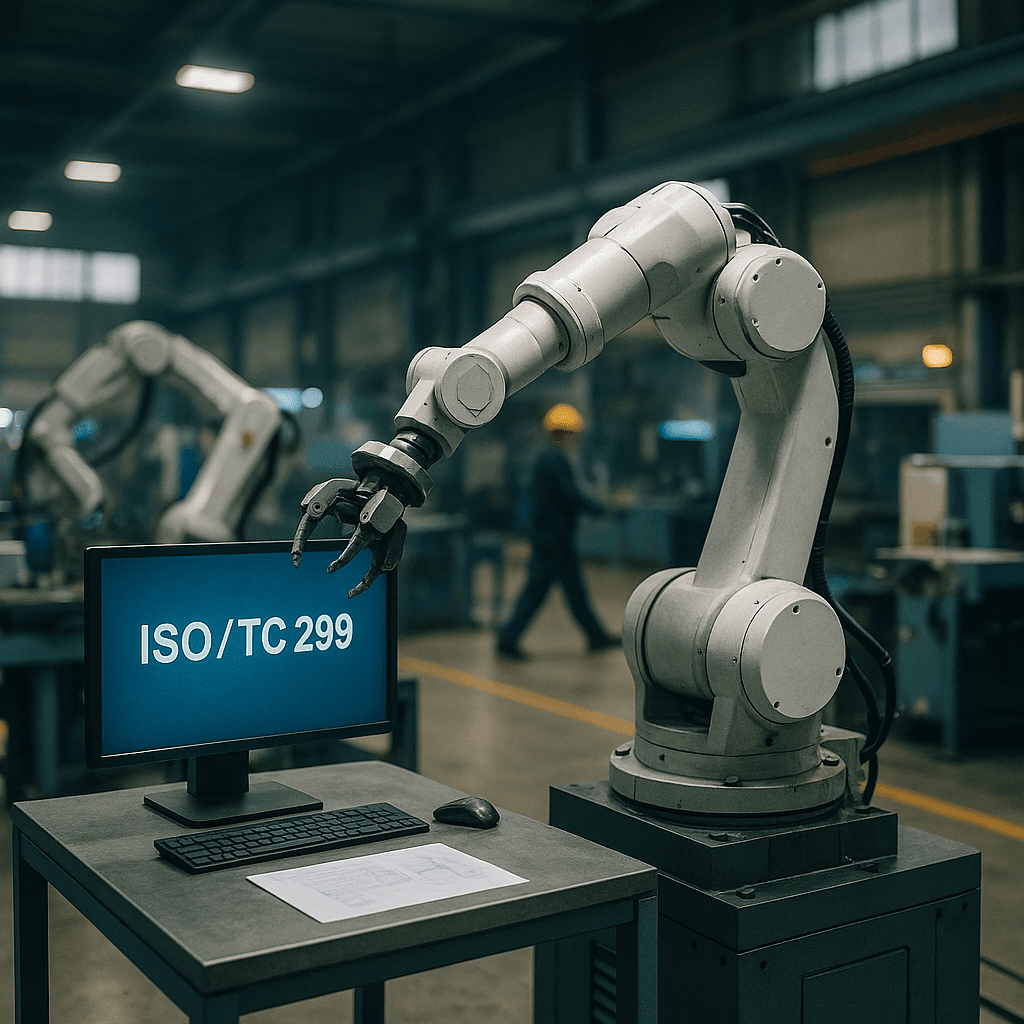
Industrial buyers have never had a way to compare two robots on energy the way they compare two motors on efficiency class. That is about to change — and the company writing the rulebook is ABB.
Through the Swedish Institute for Standards (SIS), ABB Robotics is chairing Working Group 11 of ISO/TC 299 (Robotics), which has spent roughly 18 months drafting the first international Technical Specification for measuring the energy consumption of industrial robots. The draft has been issued for ballot to ISO member countries, with publication targeted for around August 2026 if approved — typically within a year of a positive ballot, according to Modern Machine Shop's reporting. The document number has not yet been assigned.
Note one correction up front: trade coverage has occasionally framed this as an IEC effort. It is not. This is an ISO Technical Specification under ISO/TC 299, not an IEC standard. The distinction matters because the regulatory ecosystems built on top of ISO and IEC documents are different.
What is actually in version 1
The initial scope is narrow on purpose. Version 1 covers six-axis articulated industrial robot arms only. Collaborative robots, SCARA, delta, and autonomous mobile robots are explicitly out of scope for the first edition, though all are flagged as candidates for follow-on work. For vendors whose volume sits in those classes — and for the integrators selling them — that is a temporary reprieve, not an exemption.
The hard technical problem the working group is solving is comparability. A robot's energy draw depends on its size, payload, the path it traces, the surrounding environment, and the duty cycle of the task. Two arms doing nominally the same job can post very different kWh numbers depending on how the test is set up. The TS has to define a representative operating condition that produces a number a procurement team can actually put in an RFP.
ABB's Gianluca Brotto, Head of Sustainability for ABB Robotics, framed the gap bluntly: "Unlike other products such as fridges, TVs, washing machines and motors, which have clearly defined standards for how to measure and compare energy efficiency, there is no standard for measuring the energy consumption of a robot." Emma Brimdyr, Global R&D Sustainability Specialist at ABB Robotics, is the other named ABB participant in the working group.
Who is actually in the room
A reflexive reading of "ABB writes the standard" is that Europe's incumbent is locking out FANUC, Yaskawa, KUKA, and the Chinese vendors. That reading does not survive contact with the participant list.
The working group includes experts from ten countries: China, Japan, Germany, Denmark, Mexico, the United States, Korea, France, the United Kingdom, and Sweden. KUKA's national body (Germany), FANUC and Yaskawa's (Japan), and the major Chinese vendor base are already at the table. ABB's advantage is not exclusion — it is agenda setting. The chair influences which payloads, which trajectories, and which duty cycles define a "representative" test. That is where the spec becomes a competitive instrument, not in who signs the cover page.
The IE3/IE4 precedent — read carefully
The motor-efficiency analogy is the right one, but it has to be read precisely. IEC 60034-30-1, published in March 2014, defined the IE1 through IE4 efficiency classes for low-voltage AC motors. The standard itself did not move shelf space. What moved shelf space was EU Regulation 2019/1781, the Ecodesign minimum energy performance standards (MEPS), which made IE3 the legal minimum for 0.75–1000 kW motors from 1 July 2021 and IE4 mandatory for 75–200 kW motors from 1 July 2023.
The lesson for the robot TS is the same one the motor world learned: a standard alone is a measurement convention. It becomes procurement teeth only when a regulator or a very large OEM buyer writes the number into a binding spec. The ISO document is the prerequisite, not the trigger.
Who feels it first
The buyers with a real reason to act on a kWh-per-cycle line are the OEMs already under CSRD and Scope 3 disclosure pressure: automotive, electronics, and food and beverage. They are the customers most likely to start adding an energy clause to supplier scorecards the moment the TS publishes — well before any regulator codifies it. A3's framing of the robot-energy problem tracks with that buyer profile.
The system integrator tier feels it next. Today's "30% energy savings" claim is slideware; once a standardized test exists, that number becomes testable and, in principle, contractually enforceable. One vendor data point worth treating as anecdote rather than benchmark: ABB has pointed to a KUKA customer reportedly cutting fleet energy roughly 35% by upgrading to a newer arm generation. If even half of that spread is real, a standardized test will produce visible competitive separation between vendors and between robot generations — which is exactly why the test method matters.
What is not yet settled — and worth watching
-
The document number. ISO has not yet assigned a TS number. Until it does, references to the spec are necessarily generic.
-
Regulatory uptake. Whether the EU folds the TS into an Ecodesign-style MEPS regime, or China codifies it into procurement guidance, will determine whether the standard moves the market or remains a reference document. The IE-class timeline suggests a multi-year lag.
-
Scope expansion. When (not if) WG 11 opens version 2 to cobots, SCARA, delta, and AMRs, the competitive map redraws. Materials-handling trade press is already tracking the story, which is a tell that the AMR vendors know they are next.
-
The first public RFP. Watch for a German automaker to be the first to put a kWh-per-cycle clause into a published robot RFP. That is the event that converts a measurement convention into procurement language.
The honest caveats
The TS is still in draft. The document number is unassigned. Version 1 covers only six-axis articulated arms. Any "winners and losers" framing — including this article's — is plausible but not yet supported by a published comparison test conducted under the new method. ISO 9283:1998 has standardized robot performance criteria for decades without standardizing energy; the new TS fills that specific gap, nothing more and nothing less. The strategic question is who writes the next gap-filler, and who is in the chair when they do.
Related reading
Sources
-
Modern Machine Shop — Technical Specification Amps Up Robot Energy Efficiency
-
Automation World — ABB Releases Industrial Robot Energy Consumption Specification
-
ISO 9283:1998 — Manipulating industrial robots — Performance criteria and related test methods
-
ABB Technical Note — IEC 60034-30-1 on efficiency classes for low-voltage motors