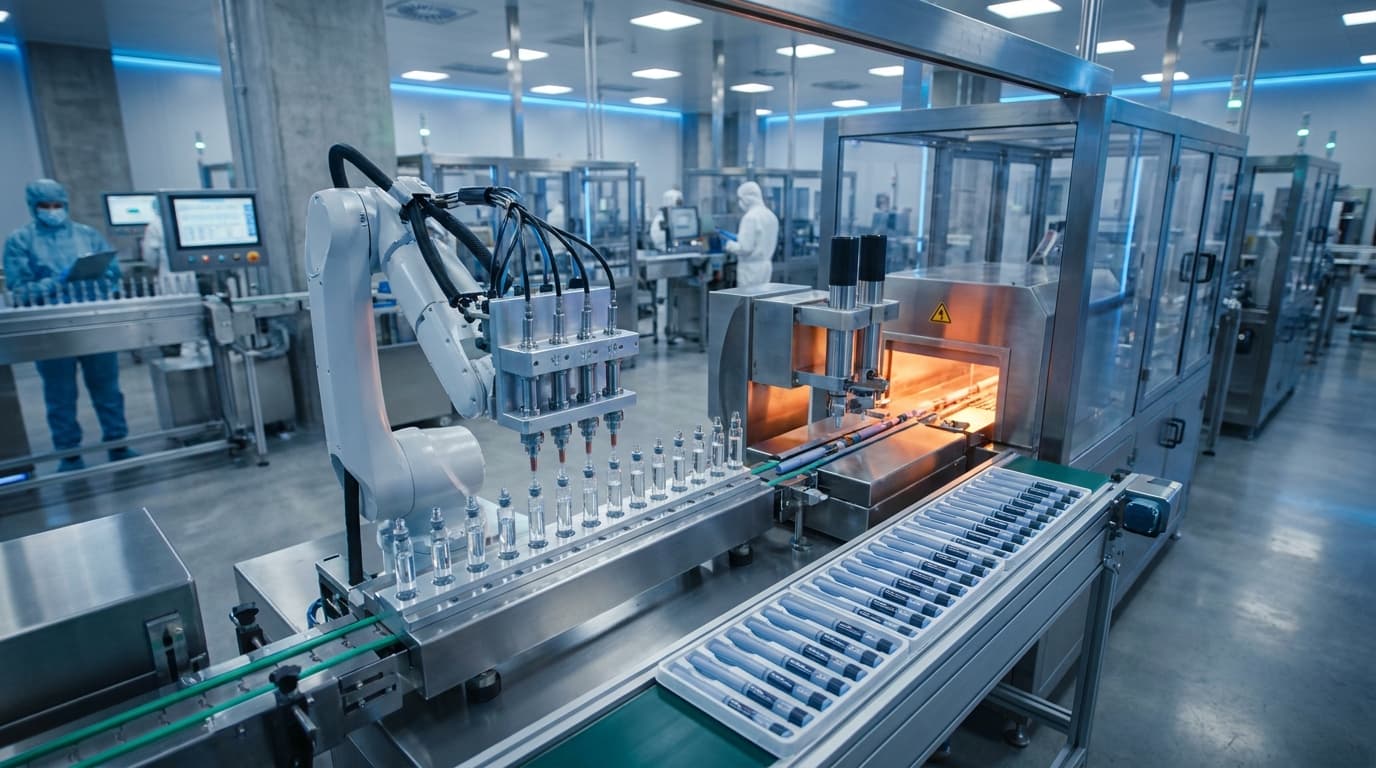
Outside of semiconductors, the single largest source of new greenfield industrial construction in the United States right now is not batteries, not steel, not data-center concrete. It is injectable drug manufacturing — and two companies, Eli Lilly and Novo Nordisk, are responsible for the vast majority of it.
Add up what the two have publicly committed to in the U.S. since 2023 and the number clears $50 billion. Lilly alone announced a $27 billion four-site program in February 2025 — three API plants and one injectables plant — layered on top of earlier commitments to its Concord, North Carolina parenteral campus and its Lebanon, Indiana footprint. Novo Nordisk put $4.1 billion into a second Clayton, NC fill-finish plant in June 2024 and now plans roughly $9 billion in global capex in 2025, up from about $6.3 billion the year before, almost entirely to chase GLP-1 demand.
For comparison, the Environmental Defense Fund pegged cumulative announced U.S. EV and battery manufacturing investment at roughly $188 billion over nearly a decade, with about $125 billion of that coming after the Inflation Reduction Act. The pharma number is smaller in absolute terms, but it has accumulated in three years rather than nine, and — critically — it is being built on time.
Mapping the footprint
Lilly's U.S. capacity story is now a four-state map.
-
Concord, NC. A $2 billion parenteral products and device site spanning 1.3 million square feet across ten interlinked buildings. Operations began in 2024. The original commitment was $1 billion and 600 jobs; it more than doubled before the ribbon was cut.
-
Lebanon, IN. Planned capital on the Lebanon campus now exceeds $18 billion, anchored by the $4.5 billion Lilly Medicine Foundry — a 1.2 million-square-foot facility designed to compress process development and commercial-scale manufacturing into one site. Construction broke ground in May 2025.
-
Goochland County, VA. In September 2025 Lilly committed $5 billion to a fully integrated API and drug-product facility — its first under one roof in the U.S. — explicitly designed for bioconjugates and monoclonal antibodies alongside next-generation GLP-1 candidates.
-
Durham, NC. A separate $1 billion site initiated earlier in the cycle that remains part of the broader U.S. expansion baseline.
Novo Nordisk's U.S. expansion is more geographically compact and entirely centered on Clayton, NC, where its $4.1 billion second fill-finish plant will add 1.4 million square feet and about 1,000 jobs, with completion targeted between 2027 and 2029.
Why this looks nothing like the EV buildout
The post-IRA EV wave was supposed to be the defining industrial story of the decade. By dollar count it still is. By execution, it has stumbled. A wave of 2025 delays and cancellations — including Ford's F-150 EV slipping to 2028 — has chipped away at the announced totals, and Stellantis's full-year 2025 results disclosed roughly €22.2 billion in product and EV supply-chain reset charges. Higher projections of total EV investment still float around $312 billion, but the gap between announced and allocated keeps widening.
GLP-1 capex has had nothing like that retracement, for one simple reason: both Mounjaro/Zepbound and Ozempic/Wegovy are still demand-constrained. The bottleneck is supply. Every additional vial Lilly or Novo can fill is a vial they can sell. That is not the position any EV OEM is in right now, and it explains why pharma boards approve these checks faster and revisit them less often than auto boards do.
The API gap
The catch is what is actually being built. Most of the U.S. footprint is fill-finish — vialing, pen-injector assembly, secondary packaging, device manufacturing — not active pharmaceutical ingredient (API) synthesis.
According to BioProcess International's reporting, all injectable semaglutide API for Ozempic and Wegovy is still made in Denmark. Oral Rybelsus API is largely produced in North Carolina, but injectable API self-sufficiency in the U.S. does not exist yet. Lilly synthesizes tirzepatide API internally, but the peptide supply chain still leans on European intermediates and reagents.
That matters because peptide API manufacturing — typically solid-phase or hybrid synthesis — is a different beast than small-molecule chemistry. It is reagent- and amino-acid intensive, bottlenecked on protected amino acids and coupling reagents, and the global merchant capacity sits with a small set of specialists. India's peptide CDMO sector is estimated at only about 3% of the global market and is itself reagent-constrained.
Lilly's Goochland VA site is the most direct admission that the integrated API + drug-product model needs to come home. Until those plants are mechanically complete, the U.S. is reshoring the last mile of GLP-1 production while still importing the molecule itself.
The fill-finish squeeze pulls in the CDMOs
Because the choke point is sterile fill-finish, the contract-manufacturing market is being financialized around essentially two customers.
Novo Holdings' 2024 acquisition of Catalent gave Novo Nordisk effectively captive access to Catalent's Bloomington and Brussels fill-finish capacity — the core of the Wegovy fill network. Thermo Fisher's Greenville, NC site is reportedly contributing about 70 million additional vials per year of Novo product under contract. And in Europe, CordenPharma announced a €900 million peptide-platform expansion across U.S. and European sites — the largest single CDMO bet on peptides on record, and explicitly tied to GLP-1 demand.
The signal for the CDMO sector is unusually clean: peptide aseptic-fill capacity is the scarcest unit of production in pharma right now, and the two anchor customers have the balance sheets to underwrite multi-year offtake.
The cold-chain story underneath
What gets less coverage is the parallel infrastructure being built to move the product. GLP-1 drugs require strict 2–8°C handling end to end; temperature excursions degrade the peptide. Validated packaging and reefer logistics are now a binding constraint on commercial volume, on top of fill capacity.
For freight operators, that means a multi-year demand pull for refrigerated truckload and parcel capacity, qualified packaging vendors, and DSCSA-grade serialization at the pharmacy handoff. It is not a sexy capex line, but for the cold-chain logistics segment it is the most reliable demand signal of the decade.
Why Indiana and the Carolinas, not the Gulf Coast
Peptide and parenteral plants do not look like small-molecule API plants. The engineering view from CRB emphasizes more clean utilities, more chromatography, a different hazardous-waste profile, and a workforce skewed toward process chemists and aseptic-fill technicians rather than bulk-chemicals operators.
That tilts site selection toward existing biopharma talent corridors — the North Carolina Research Triangle, central Indiana, and now Richmond/Goochland — rather than the Gulf Coast chemical clusters that have historically attracted bulk pharma intermediates. It is also why Lilly's Lebanon, IN campus has compounded so quickly: once the utility backbone, the labor base, and the construction supply chain are sized for one mega-site, the marginal cost of the next building drops sharply.
The orforglipron risk
The largest open question hanging over this capex wave is oral GLP-1s. Lilly's orforglipron and Novo's oral semaglutide programs, if they reach the volumes the pipeline implies, would shift incremental demand toward small-molecule tablet lines and away from sterile injectable fill. That is a different plant, a different supply chain, and a different unit economics.
None of that invalidates what is being built today — injectables will be the workhorse for years — but it does create a real risk of stranded fill-finish capacity at the back end of the decade if the oral franchises win share faster than expected. For CDMOs that have just signed multi-year peptide offtake commitments, that is the scenario worth modeling.
The bottom line
The reshoring story of the early 2020s was supposed to be semiconductors and EVs, and on paper it still is. But on a build-versus-announce basis, GLP-1 manufacturing is the cleanest example in American industry of money being committed and concrete being poured on schedule. Two demand-constrained customers, a CDMO sector consolidating around them, a real API gap that has not yet been closed, and a cold-chain buildout that nobody is pricing — that is the actual shape of the largest non-semiconductor industrial construction wave in the country right now.
Related reading
Sources
-
Eli Lilly announces $27B investment to boost U.S. manufacturing — Xtalks
-
Eli Lilly to build $5 billion Virginia manufacturing facility — CNBC
-
Eli Lilly's Parenteral Products and Device Facility, Concord, NC — Pharmaceutical Technology
-
Lilly Selects North Carolina for New Manufacturing Site — EDPNC
-
Lilly announces $4.5 billion Lilly Medicine Foundry — Lilly Investor Relations
-
Construction begins on $4.5 billion Lilly facility in Lebanon — WFYI
-
Lilly announces $1 billion investment in new NC facility — Lilly IR
-
Novo Nordisk announces $4.1B investment in Clayton, NC — Novo Nordisk
-
[Novo Nordisk to spend ~$9 billion in 2025 — Pharma Manufacturing](https://www.pharmamanufacturing.com/industry-news/news/55266180/novo-nordisk-to-spend-about-9-billion-in-2025-to-create-additional-capacity)
-
Catalent paves the way for Novo's U.S. GLP-1 expansion — BioProcess International
-
Lilly, Novo Nordisk expand operations amid GLP-1 boom — BioProcess International
-
CordenPharma €900M peptide-platform expansion — CordenPharma
-
Indian CDMOs gear up for post-semaglutide peptide market — Business Standard
-
The GLP-1 boom: Challenges, trends, and CapEx strategies — CRB
-
U.S. EV Manufacturing Investments and Jobs — Environmental Defense Fund
-
Every EV canceled or delayed in the U.S. this year — The News Wheel
-
Cold Chain Solutions 101: How GLP-1 Medications are Shipped — Veritiv