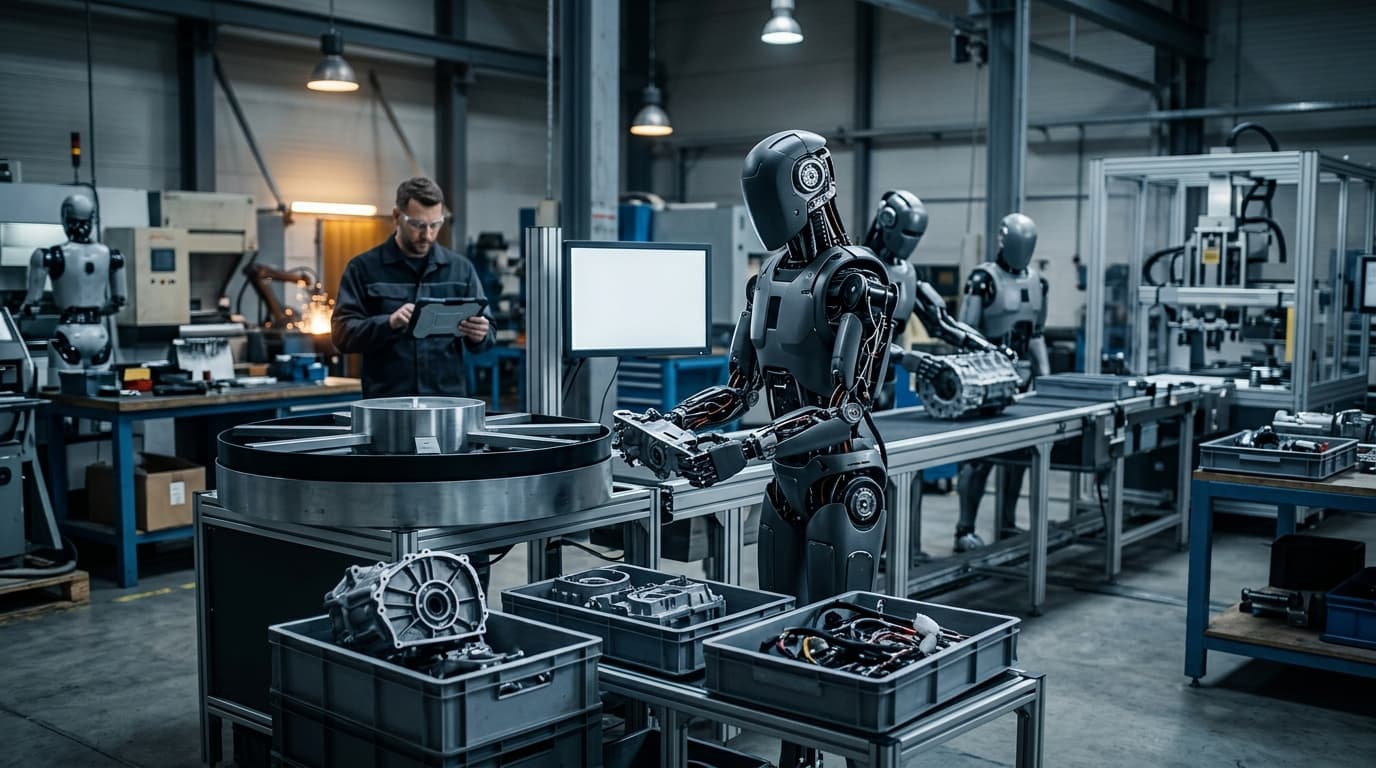
At CES 2026, Hyundai Motor Group did something the humanoid category has mostly avoided: it attached calendar dates to a deployment plan. Under a 'Physical AI' banner, the company said 100% of Boston Dynamics' 2026 production Atlas units are committed internally — to Hyundai's Robotics Metaplant Application Center (RMAC) and to Google DeepMind — with first factory-floor work scheduled for 2028 at Hyundai Motor Group Metaplant America (HMGMA) near Savannah, Georgia, beginning with parts sequencing and expanding to component assembly by 2030 (Boston Dynamics; Axios).
That is a more concrete schedule than any other OEM has put on the table — and it lands in a quarter when BMW just concluded its Spartanburg pilot, Mercedes-Benz is staffing humanoids into intra-logistics, and Tesla has slipped Optimus V3 again. The competitive picture is now clear enough to write down.
What Hyundai actually committed to
The headline is the absorption of supply. Boston Dynamics confirmed that the entirety of 2026 production Atlas output goes to Hyundai's RMAC and to Google DeepMind, with external customers slated for early 2027 (Boston Dynamics). The first work order is narrow on purpose: parts sequencing at HMGMA in 2028, chosen for what Hyundai described as 'proven safety and quality benefits,' with component assembly added by 2030 (Axios).
The production-spec Atlas itself is the platform underneath all of this: 56 degrees of freedom, 2.3-meter (7.5 ft) reach, 50 kg (110 lb) lift capacity, fully electric with autonomous battery swap, and a stated −20 °C to 40 °C operating range (Boston Dynamics). Cognition is being supplied through a new partnership with Google DeepMind, which is integrating foundation models into the Atlas stack (Boston Dynamics).
The framing strategy was unveiled at CES under 'Partnering Human Progress,' alongside a Software-Defined Factory pitch and the first public stage appearance of the production Atlas unit (Hyundai Newsroom).
Why this announcement is structurally different
Hyundai is the only player on the board that owns the OEM, the robot company, and a Tier 1 actuator supplier inside a single corporate group. Boston Dynamics named Hyundai Mobis as the actuator supplier and supply-chain collaborator for Atlas (Boston Dynamics). DeepMind sits on top as the cognitive layer. BMW, Mercedes-Benz, and Tesla are each working with at least one independent vendor — Figure, Hexagon, Apptronik, or in Tesla's case, themselves on a separate timeline — and none can underwrite both the hardware roadmap and the customer demand the way Hyundai now can.
That vertical posture matters for the second part of the announcement: capacity. Hyundai is targeting 30,000 Atlas units per year by 2028 from a dedicated robotics factory, embedded inside a broader ~$26 billion U.S. investment package that also includes a Louisiana steel plant and expanded Georgia output (Axios). A 30,000-unit annual run rate is several orders of magnitude above current global humanoid deployments, and it is being announced by the same company that controls the first customer.
What's actually being deployed first — and where
Strip away the keynote language and the first job at HMGMA is parts sequencing — moving kits of parts to the right station in the right order at the right time. Component assembly is staged for 2030, with longer-term ambitions around repetitive, heavy, and complex operations across full sites (Axios). Notably absent from the 2028 scope: welding, fastening, and final assembly.
This is the pattern across every OEM that has announced a date. The first jobs are material handoff, sequencing, kitting, and parts placement — not value-add assembly. That is where takt-time and uptime disclosures will first appear, and it is the test most operators should be running in their own plants: can a humanoid actually beat a fixed-base alternative on cost per part moved.
The OEM scoreboard, as of this quarter
BMW Spartanburg (Figure 02 — concluded). BMW's Figure 02 pilot in South Carolina wrapped in Q1 2026 after approximately 1,250 operating hours, moving more than 90,000 sheet-metal components and contributing to production of over 30,000 X3s before the robot was retired in favor of Figure 03 (BMW Group; Figure AI). That is the only quantified field benchmark anyone in the category has published.
BMW Leipzig (Hexagon AEON — summer 2026). BMW Group's European pilot is queued at Leipzig with Hexagon Robotics' AEON humanoid on high-voltage battery assembly, alongside a newly established 'Center of Competence for Physical AI in Production' (BMW Group). HV battery assembly is a meaningfully more demanding scope than Spartanburg's sheet-metal moves.
Mercedes-Benz Berlin and Hungary (Apptronik Apollo). Mercedes-Benz is piloting Apptronik's Apollo in intra-logistics — delivering parts to assembly workers — starting at the Berlin-Marienfelde Digital Factory Campus (Mercedes-Benz; Manufacturing Dive). Apollo's physical envelope — 5'8", 160 lb, roughly 55-lb payload, ~4-hour battery — is smaller than Atlas, which is consistent with a logistics-first scope (Manufacturing Dive). Mercedes also put more than €100 million into Apptronik's most recent round, alongside Google, ARK, and Korea Investment Partners (Mike Kalil).
Tesla Fremont (Optimus V3 — mid/late 2026). Tesla has pushed the Optimus V3 reveal to late July/August 2026 and is converting the former Model S/X line at Fremont into humanoid production, with a stated 1-million-unit/year design capacity. Elon Musk has publicly conceded the near-term ramp will be 'quite slow' (Electrek).
What OEMs have disclosed — and what they haven't
For all the keynote density of the last twelve months, the field still has exactly one quantified disclosure: BMW's Spartanburg numbers. The published figures — ~1,250 hours, ~90,000 components, ~1.2 million steps over roughly 10-hour shifts five days a week for around ten months — give a rough productivity envelope but stop short of cycles per hour at a specific station, mean time between failures, or human intervention rate (BMW Group; Figure AI).
Hyundai has not yet published RMAC throughput targets, and no OEM has disclosed a cost-per-unit-equivalent for a humanoid station versus the cobot or fixed automation it displaces. Until one does, the financial case is being made on capacity announcements and unit-count promises rather than line-side economics.
Tier 1 and supplier read-across
The most direct read-across inside the Hyundai group is Hyundai Mobis, which Boston Dynamics named as actuator supplier and supply-chain collaborator for Atlas (Boston Dynamics). At a 30,000-unit/year production target, the actuator content per robot is the most concrete recurring revenue line in the entire announcement (Axios).
Beyond Mobis, the broader supplier implication runs through harmonic drives, force-torque sensing, vision integrators, and — less discussed but operationally critical — battery and charging infrastructure capable of supporting fleet operation. The autonomous battery-swap capability disclosed for Atlas is what makes 24/7 fleet duty plausible at all (Boston Dynamics).
The skeptic's column
The case against humanoids, as articulated by operators who have run cobot lines for a decade, is straightforward: every announced first job — parts sequencing at HMGMA, sheet-metal moves at Spartanburg, intra-logistics at Berlin — could in principle be done by a fixed-base manipulator or an AMR with a simple arm. The humanoid form factor only pays for itself if a single platform replaces several single-purpose systems, or if the labor it displaces is genuinely fungible across stations. Neither has been demonstrated at scale.
The fact that none of the OEMs has put a humanoid on a fastening, welding, or final-assembly task in their public roadmaps is the tell. BMW's Leipzig HV battery pilot, scheduled for summer 2026, is the closest thing to a value-add deployment on the calendar (BMW Group) — and even that is assembly-adjacent rather than primary structural work.
What to watch next
Five disclosures will move the conversation from announcement to economics: published cycle times from RMAC; the first non-Hyundai Atlas customer in 2027 (Boston Dynamics); BMW's Leipzig pilot KPIs once the AEON deployment runs through a full quarter; the Optimus V3 reveal in mid/late 2026 (Electrek); and any OEM willing to publish a defensible cost-per-unit-equivalent for a humanoid station against the alternative it replaced. The independent trade press has begun triangulating dates and task scopes around the Hyundai program (New Atlas), but the line-side numbers are what will tell operators whether to budget for this category in 2027 capex plans.
For now, Hyundai's contribution is to have given the industry a forcing function. With a 2028 floor date, a 30,000-unit production line, and a vertically integrated supply chain, the bar for what counts as a credible humanoid program just moved.
Related reading
-
[Schaeffler Bought Thousands of Humanoids on a Subscription — Then Became the Company That Builds Their Joints](/article/schaeffler-humanoid-robots-subscription-actuator-supply)