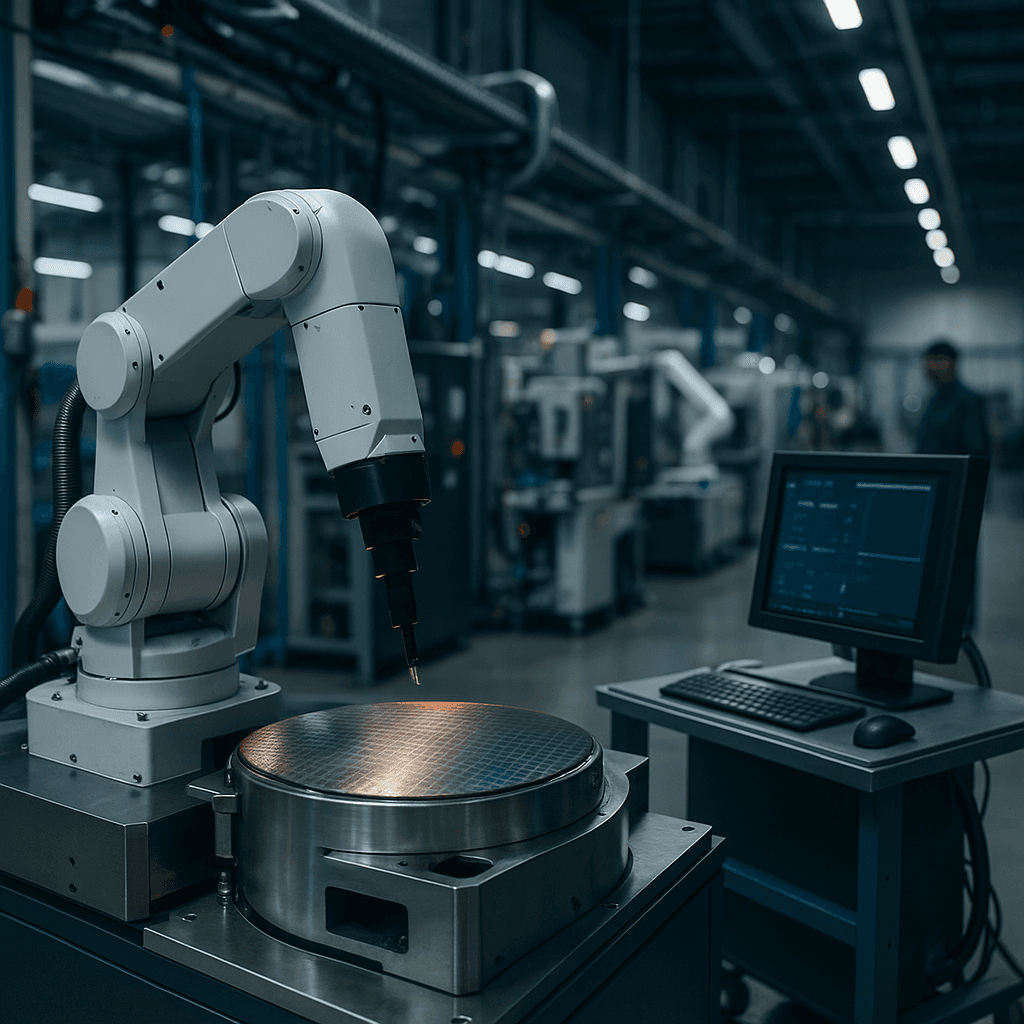
On May 19, 2026, at KoMiCo's headquarters in Anseong, Gyeonggi Province, Citibank Korea and the Export-Import Bank of Korea (KEXIM) signed a $100 million syndicated financing package to underwrite KoMiCo's U.S. expansion. The headline number is modest. The signal is not.
KoMiCo is not a fab. It is a back-end services specialist that cleans, coats, repairs, and diagnoses the equipment parts that fabs depend on. The proceeds will fund and operate its three U.S. subsidiaries — in Austin, Texas; Hillsboro, Oregon; and Phoenix/Mesa, Arizona — and improve the company's debt structure (The Korea Herald). What makes the deal worth reading closely is the structure: a Korean policy bank co-lending alongside a private commercial bank to push a supplier, not a chipmaker, deeper into the U.S. footprint.
What KoMiCo actually does — and why it matters at 3nm
KoMiCo performs precision cleaning, advanced coatings, repair, and diagnostics on parts used in EUV and sub-1nm-generation semiconductor tooling (GPEC). At leading-edge nodes, the contamination and surface-condition tolerances on consumable equipment parts are tight enough that the refurbishment supply chain becomes a yield variable, not a cost-center afterthought.
The Arizona Commerce Authority cites a rule of thumb that every square foot of wafer-production cleanroom requires on the order of 50 square feet of supporting cleanroom and infrastructure (Arizona Commerce Authority). That ratio is the cluster economics in a sentence: you cannot scale a fab cluster faster than you can scale the back-end services tier around it. Cleaning, coating, and refurb capacity is one of the binding constraints.
Where the money lands
The most visible piece of the deal is in Mesa, Arizona. KoMiCo's new facility there is 125,000 square feet, represents more than $60 million in capital investment, and held its grand opening on January 12, 2026. The site is designed to grow from 50 initial jobs to more than 200 (GPEC, KTAR News). It is KoMiCo's third U.S. site and its tenth globally.
The customer list is the part operators should mark up. KoMiCo's U.S. customer base, per company materials and entity records, includes Intel, Samsung, and Micron, and the Mesa siting positions it to service TSMC's Arizona buildout as part of the Phoenix-area cluster (The Korea Herald, In Business Phoenix). Samsung Electronics' Device Solutions division named KoMiCo an outstanding partner for 2026 — its top quality-innovation recognition — which is the anchor-customer tell that matters for any second-tier supplier's bankability (The Korea Times).
The policy-bank angle
The signing party tells you the doctrine. Citibank Korea's Commercial Banking Head Hwang Jae-won, KEXIM Senior Executive Vice President Kim Jin-seop, and KoMiCo CEO Choi Yong-ha signed the facility, with CFO Lee Sang-won also involved. Hwang explicitly framed the transaction as "meaningful cooperation between policy and private finance in supporting Korean companies' overseas expansion" (The Korea Herald).
That framing is not throwaway language. KEXIM has publicly committed to channel roughly 50 trillion won into semiconductors, batteries, and biotech under its strategic-industry support plan, and has posted record lending figures on the back of Korea's export surge (The Korea Herald). In March 2026, KEXIM launched a "Global Expansion K-Finance Council" with KB Kookmin, Shinhan, Hana, Woori, NH Nonghyup, and Suhyup to share deal flow and co-finance Korean overseas projects (Seoul Economic Daily). The KoMiCo deal pairs KEXIM with Citibank Korea rather than the six Council banks, but the pattern — policy bank plus commercial bank, underwriting Korean champions abroad — is the same.
Why this is a leading indicator for operators
Capex on fabs is the loud signal. TSMC's Phoenix investment is reported at $165 billion, and Arizona has become a magnet for relocating chemicals, packaging, and logistics firms (In Business Phoenix). The Semiconductor Industry Association's tracker continues to grow as supplier-relocation deals stack up (SIA).
The quieter, more reliable signal is the financing line moving underneath the capex announcements. When a Korean policy bank co-lends $100 million to a back-end services supplier so it can scale across three U.S. cities, you are watching the home government decide that the U.S. cluster is durable enough to be worth de-risking its national champions into. Export-credit support for a second-tier supplier — not for a chipmaker — is a structural commitment, because services-tier capacity only pays off if the surrounding fab demand actually materializes over the depreciation window.
A cluster-by-cluster read
The three KoMiCo U.S. subsidiaries map cleanly onto the U.S. fab geography that the research block establishes:
-
Arizona (Phoenix/Mesa). TSMC's North Phoenix buildout and KoMiCo's new Mesa plant sit inside an ecosystem that In Business Phoenix characterizes as a magnet for relocating supply-chain firms (In Business Phoenix). Mesa is where this deal's marginal capacity lands.
-
Texas (Austin). KoMiCo's Austin subsidiary is one of the three sites being funded; it sits in the same state as Samsung's Taylor project — and Samsung is KoMiCo's anchor customer (The Korea Herald, The Korea Times).
-
Oregon (Hillsboro). KoMiCo's Hillsboro subsidiary serves Intel, per the company's own customer base disclosures (The Korea Herald).
-
Idaho. Micron is on KoMiCo's named U.S. customer list, though the company's three financed U.S. subsidiaries are in Texas, Oregon, and Arizona rather than Idaho (The Korea Herald). That geographic gap is itself worth tracking.
What to watch next
If KEXIM's strategic-industry plan plays out the way its public commitments suggest, the KoMiCo facility will not be a one-off. Follow-on deals worth watching: additional KEXIM (and, by analogy, Japanese counterparts like JBIC and NEXI) financings for Korean and Japanese chip-services subs — gases, photoresists, equipment refurbishment, materials handling — relocating into U.S. fab clusters. The structural question is whether the K-Finance Council itself starts co-lending into U.S. supplier capex alongside KEXIM, which would multiply the deal flow rather than just diversify it (Seoul Economic Daily).
The bottom line
For executives and investors trying to triangulate which U.S. fab clusters are real and which are politically supported announcements, the most useful tape to read is not the next ribbon-cutting in Phoenix or Taylor. It is the export-credit financings flowing to the suppliers two tiers behind the chipmaker. The KoMiCo deal is small. The doctrine behind it is not.
Related reading
-
The U.S. Trade Chief Just Sequenced Chip Tariffs — Memory and Mature Nodes Are the Exposed Surface
-
Wood Mackenzie Just Named the Reshoring Bottleneck No Capex Plan Has Solved: Electricity
Sources
-
Citibank Korea, Korea Eximbank back KoMiCo's US chip expansion — The Korea Herald
-
KoMiCo opens semiconductor equipment cleaning, coating facility in Mesa — GPEC
-
Semiconductor equipment cleaning, coating facility opens — KTAR News
-
Precision Cleaning: Strengthening Arizona's Chip Future — In Business Phoenix
-
Eximbank Korea posts record lending figures on export surge — The Korea Herald
-
Export-Import Bank Launches 'K-Finance Council' with 6 Banks — Seoul Economic Daily
-
Arizona Manufacturing Semiconductor Advantages — Arizona Commerce Authority