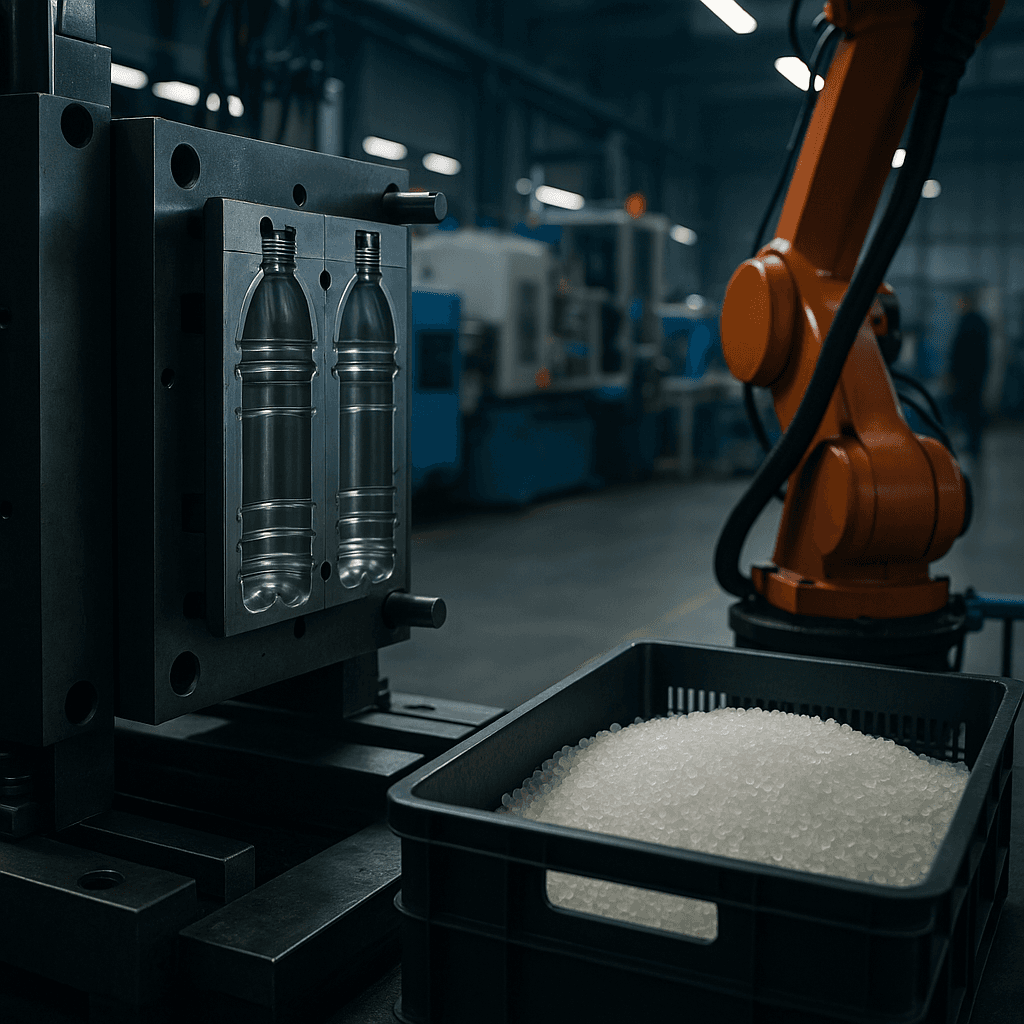
The most important number in plastic packaging this spring is not a price. It is a year. Resin buyers asking converters when costs return to normal are being told the same thing across the polyolefin complex: not this quarter, not this year — 2027. ICIS analyst Andrea Bassetti put it plainly to Packaging Dive: 'it'll take all the way into 2027 for us to get back to where we were.' Silgan Holdings has guided investors to recovery in Q4 and 'well into '27.'
That timeline reframes what is happening. This is not the familiar tariff narrative, where a policy line item gets added to a landed cost and procurement reprices a contract. The Israel–Iran conflict that began on Feb. 27, 2026 took physical petrochemical capacity off the board. For consumer packaged goods, food, and pharma operators, the consequence is structural rather than cyclical: packaging has become a margin problem that does not resolve on the usual contract-cycle clock.
From a tariff story to a feedstock shock
The mechanism runs upstream to down, and every link is physical. Israeli strikes knocked out sites responsible for roughly 85% of Iran's petrochemical capacity, and disruption to the Strait of Hormuz — the chokepoint for about 20% of global oil and LNG — squeezed the feedstock that the polymer chain runs on (Packaging Dive; Packaging Gateway).
That matters because the world's plastic supply is fed through naphtha. Asian steam crackers source more than 60% of their naphtha from the Middle East, so the disruption transmitted quickly into resin production: LG Chem shut its 800,000-tonne-per-year No. 2 naphtha cracker on Mar. 23, 2026, and Formosa declared force majeure with its Mailiao crackers running at roughly 70% capacity (ResourceWise).
By Mar. 13, 2026, the industry had logged 31 force majeure declarations — including Dow at Deer Park, Texas, LyondellBasell, and Indorama. Dow COO Karen Carter estimated that roughly half of global ethylene and polyethylene supply was offline, constrained, or otherwise impacted (Packaging Dive). When that much primary capacity goes to force majeure, the constraint passes straight to converters — and from there to the brands they serve.
The price move, in cents per pound
The pricing data is unambiguous. According to Plastics Technology's May 2026 resin trajectory, polyethylene is up about 15 cents per pound year to date, with producers seeking roughly another 20 cents in April. Polypropylene has climbed about 33.5 cents per pound since the start of the year. PET rose 8–10 cents per pound in March, and polystyrene is being pushed up by benzene trading above $4 per gallon. Polyolefins are bearing the brunt because they sit closest to the disrupted naphtha-and-ethylene leg of the chain.
Converters are passing it through, in some cases at record speed. Emerald Packaging raised prices about 8% — its largest-ever monthly increase — with CEO Kevin Kelly citing resin up roughly 115%. Sun Chemical implemented immediate price increases and surcharges across all divisions (Packaging Dive).
The earnings impact is now visible on the income statement. Silgan Holdings expects roughly $50 million of incremental cost in Q2 2026 and about a $10 million hit to adjusted EBITDA; CEO Adam Greenlee described the resin inflation as 'unprecedented.' Greif's CEO acknowledged 'direct impacts' as well. A useful calibration from the same reporting: every $10 per barrel of oil adds on the order of a few cents per pound to resin cost — a reminder that the feedstock and shipping channels, not a tariff schedule, are setting the price.
Why it lands on the CPG P&L
Packaging is a material and relatively sticky slice of a SKU's cost of goods. Industry practitioners commonly cite a range on the order of 5–15% of CPG COGS for packaging; treat that as an illustrative planning band rather than a hard, sourced figure, because it is a widely repeated rule of thumb rather than a primary statistic. The point holds regardless of the exact percentage: that slice is large enough to move gross margin and difficult to re-engineer on short notice.
The pass-through math is where it gets stuck. A converter facing resin up double digits — or, in Emerald's account, roughly 115% — cannot absorb the spread indefinitely on its own margin. The cost moves to the brand. The brand can absorb it, re-spec the pack, or take shelf price. Each option has friction: retailer price negotiations, consumer elasticity, and the engineering lead time to qualify a lighter or different package. That friction is why a feedstock shock priced in cents per pound becomes a multi-quarter margin question for food, beverage, and pharma lines rather than a one-time adjustment.
The 2027 question — and the snap-back caveat
The recovery guidance is consistent across independent voices: ICIS's Bassetti expects normalization to run into 2027, and Silgan has told investors recovery extends into Q4 and well into 2027. That is the planning base case.
But it is not deterministic, and operators should hold the caveat as tightly as the base case. Analyst George Staphos has framed the length of the conflict as the single biggest variable. Because a meaningful portion of the disruption is shipping-driven rather than purely capacity-destroyed, prices could partly 'snap back' if the Strait of Hormuz reopens (Packaging Dive). This is a risk to flag in both directions: a procurement organization that locks in long, high-priced resin for all volume could be caught offside by a partial reversal, while one that assumes a quick reopening could be exposed if the conflict persists. The asymmetry, not a single point forecast, is what should drive contract structure.
The procurement playbook now in motion
Buyers are visibly shifting from lowest-unit-price purchasing to resilience sourcing. The moves reported across the sector are concrete (Packaging Gateway):
- Index-linked pricing and shorter contract review cycles, so price tracks a published feedstock benchmark instead of locking a bet on a volatile market.
- Pack-spec simplification and lightweighting — taking grams out of the package to blunt a per-pound resin increase.
- Supplier and region diversification, moving away from single-region polymer exposure. The fragility is specific: about 84% of Middle East PE depends on Hormuz transit.
- Long-term recycler contracts for recycled resin, which carries roughly a 20% premium — accepted now as the cost of supply security rather than purely a sustainability line.
The through-line is that resilience is being repriced as a form of cost competitiveness, not an overhead. That is the structural-versus-cyclical distinction in operational terms.
The cross-category tell: O'Reilly and Bazooka
The same 'supply constraints emerge' signal is showing up well beyond plastics, which is the strongest evidence that buyers are repricing supply risk as a category. O'Reilly Automotive's private label exceeded 50% of Q1 revenue, and President Brent Kirby has described using multi-sourced SKUs when 'supply chain constraints emerge,' with the company explicitly monitoring Iran-war effects on motor-oil supply (Supply Chain Dive).
At ISM World on Apr. 28, 2026, Bazooka's VP Erika Nava described splitting tariff and input-cost pain with suppliers and, in exchange, gaining access to supplier cost structures (Supply Chain Dive). Different category, same posture: open the cost book, share the burden, multi-source the spec. When a parts retailer and a candy maker independently converge on the same supplier strategy, the resin story is best read as one instance of a broader repricing of supply risk.
Who eats the spread
Strip away the geopolitics and the open planning question is narrow and concrete: between now and a 2027 reset, who absorbs the gap — the converter, the brand, or the shelf? The evidence so far is that no single party is carrying it cleanly. Converters like Emerald, Sun Chemical, Silgan, and Greif are pushing record increases and surcharges upstream of their own margin; Silgan is still booking a real EBITDA hit; and brands have to decide between absorption, re-spec, and price.
What determines the split is partly outside any operator's control — the length of the conflict and whether Hormuz reopens — and partly inside it: how index-linked the contracts are, how much weight comes out of the pack, how diversified the polymer base is, and how willing trading partners are to open cost structures and share the burden the way Bazooka's suppliers did. Operators who treat 2027 as the base case while hedging the snap-back, and who use this window to standardize specs and de-risk single-region polymer, will enter the reset having paid for resilience rather than just having paid for resin.
Related reading
Sources
- Plastic packaging converters raise red flags over Iran war impact — Packaging Dive (May 14, 2026)
- The Iran war is hitting packaging supply chains. Are the impacts temporary? — Packaging Dive (Mar. 19, 2026)
- May 2026: Price Trajectory for All Resins Shifts Sharply Upward — Plastics Technology
- Iran Conflict and Global Petrochemical Supply Disruptions: Korea, Taiwan, Japan, Europe — ResourceWise
- Packaging sector faces structural cost reset — Packaging Gateway (Apr. 2026)
- O'Reilly broadens supplier base with private label push — Supply Chain Dive (May 15, 2026)
- 4 ways Bazooka rethought its supplier strategy in face of tariffs — Supply Chain Dive (Apr. 28, 2026)