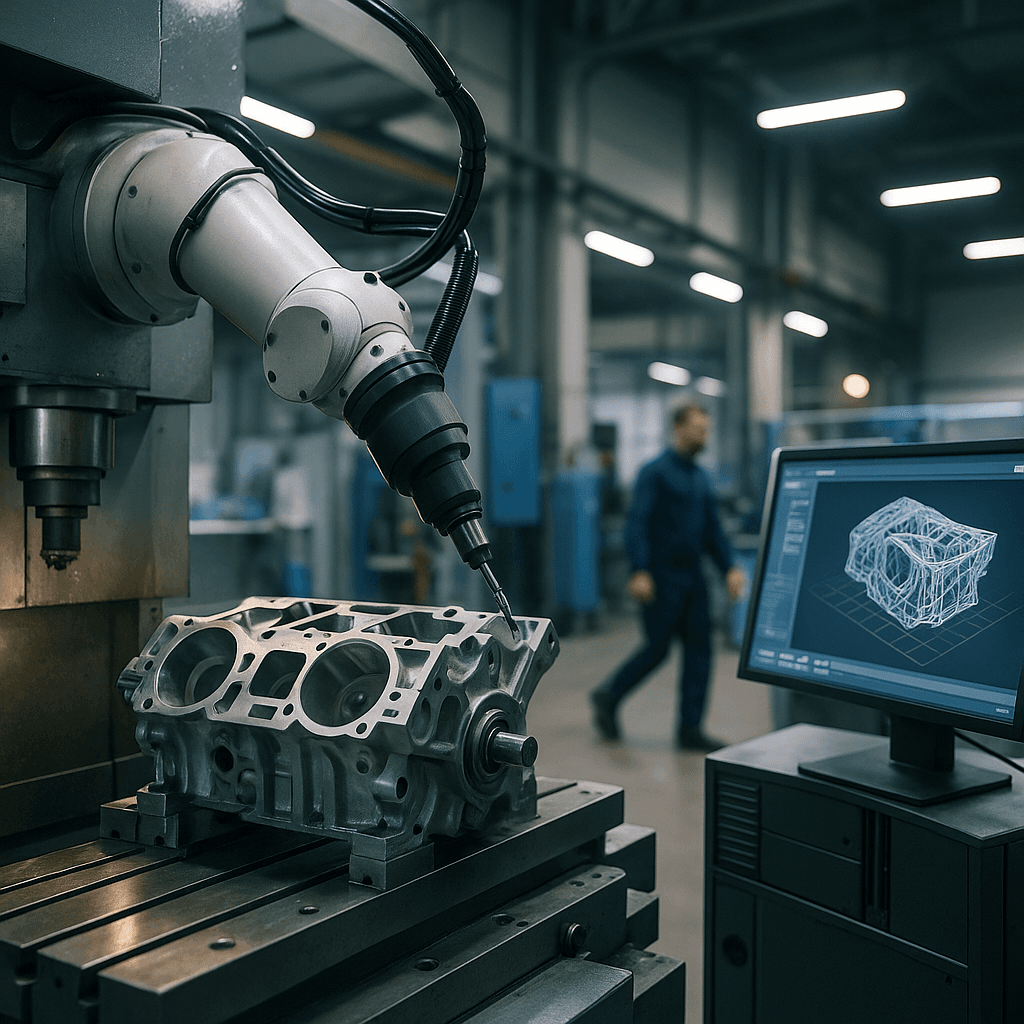
On May 18, 2026, Stellantis and Accenture announced plans for a strategic partnership to advance AI-driven manufacturing with NVIDIA. Read the language precisely, because the framing matters more than the headline: this is plans for a strategic initiative, not a signed or executed contract. Both the Accenture release and the Stellantis release describe intent, with NVIDIA positioned as the technology provider rather than a co-announcing party.
For operators, the useful exercise is separating what was announced from what was committed. Announced intent is not deployed line capacity — and on the metrics that decide whether a manufacturing AI program is real, this announcement is silent.
What was actually announced
The disclosed scope is digital-twin and simulation-led. It centers on NVIDIA Omniverse libraries, accelerated computing, and what the parties call "physical AI" and advanced simulation. The use cases named are predictive quality monitoring, physics-informed quality and maintenance, closed-loop optimization, and agentic orchestration for throughput. That is a digital-twin and decision-support agenda — not an announcement of deployed, line-level visual inspection or predictive maintenance running as live capacity.
No quantified targets were disclosed. There are zero figures for scrap, OEE, defect escape, integration cost, or capital reallocation. The releases reference "initial deployments in selected plants," with pilots in North America in 2026; the number of plants was not disclosed. Francesco Ciancia, Stellantis' Head of Manufacturing, framed the program in aspirational terms: By combining digital twins, AI and advanced simulation, we are rethinking how we design, operate and continuously improve our production systems. That is a statement of direction, not a capacity claim — and it should be read as such.
The real story is consolidation, not the partnership
The more consequential signal is what the Stellantis deliverable resembles. In October 2025, Accenture launched its "Physical AI Orchestrator," a productized cloud stack that bundles NVIDIA Omniverse — including the "Mega" Omniverse Blueprint — with NVIDIA Metropolis and Accenture's AI Refinery agents. The Stellantis program maps closely onto that pre-existing, off-the-shelf offering.
That distinction is everything. A bespoke build is a one-off engineering project an OEM can renegotiate, rebuild, or walk away from. A productized stack adopted by a global OEM is a reference architecture — a repeatable pattern the integrator can resell, and that an industry quietly standardizes around. The Stellantis news reads less like a custom partnership than like a marquee customer for an existing product line.
The vendor triangle becomes a reference architecture
Stack a consulting integrator (Accenture) on top of a single simulation-and-silicon platform (NVIDIA Omniverse plus accelerated compute), then attach a global automaker as the lighthouse account, and you get a de facto reference architecture for software-defined manufacturing. The pattern is not new to NVIDIA's automotive playbook: NVIDIA has documented AI-enabled factory digital-twin work with BMW (see NVIDIA's GTC 2025 session S71550 on automotive factory planning at BMW), and the same Omniverse factory digital-twin approach has been associated with Mercedes-Benz and Foxconn.
The competitive risk for the broader industry is convergence. When the largest OEMs adopt the same integrator-plus-platform triangle, the question for everyone downstream stops being "which architecture is best" and becomes "how fast can we conform to the one our customers chose."
The supplier ripple
That conformance pressure runs straight into the supply base. Digital twins are only as useful as the data and interfaces feeding them. If a global OEM standardizes its plant-floor simulation and orchestration on a specific Omniverse-centric stack, the tier-1 and tier-2 suppliers feeding that OEM face pressure to mirror compatible digital-twin models, data schemas, and integration points. The cost of that mirroring — engineering hours, licensed tooling, ongoing integration — lands on suppliers operating at thinner margins than the OEM, and it deepens lock-in for whichever stack the anchor customer selected. None of this is in the press release; it is the predictable second-order effect of a global automaker adopting a productized reference architecture.
Pricing power concentrates with the silicon
"Software-defined manufacturing" is not free software. It is recurring compute, simulation licensing, and integration fees, with NVIDIA accelerated computing sitting underneath the digital twin. As more automotive capacity routes through one accelerator-and-platform layer, pricing power concentrates with the platform owner — inside an industry whose unit economics are already tight. That is a structural cost the announcement does not quantify and that operators will have to model themselves.
The capex reality check
The financial backdrop sharpens the question of what gets funded. Per Stellantis's Q1 2026 results, net revenues were €38.1B (up 6% year over year), net profit €0.4B, and adjusted operating income €1.0B — a thin 2.5% margin. Industrial free cash flow was negative €1.9B; a 37% year-over-year improvement, but still deeply negative. The release attributes part of the pressure to "facility-related costs stemming from plans to match production capacity and cost structure to market demand" — capacity and cost reduction is the priority backdrop against which any new AI capex must compete.
Secondary earnings coverage (not stated in the verified press release, and therefore treated here as unconfirmed background) has reported 2026 capital expenditure guided slightly below 7% of net revenues, concentrated on four core brands, alongside European capacity reductions and a potential roughly €1B raw-material headwind. Whether or not those figures hold, the verified picture is unambiguous: a company cutting capacity and burning industrial cash has limited room to layer new AI capex on top without reallocating existing automation budgets. The opportunity cost is the story.
Evidence versus claims
The numbers most often used to justify factory AI spend deserve a hard look. Widely cited outcomes for AI visual inspection and digital-twin optimization — on the order of 35–47% scrap, defect, or warranty reductions, roughly 22% OEE gains, and 6–8 month paybacks — originate from vendor and consultancy marketing, not from peer-reviewed or operator-audited studies. That asymmetry is itself the reportable finding: strong supplier-sourced claims, scarce independent operator-verified data. None of those figures appear in the Stellantis–Accenture announcement, and they should not be treated as forecasts for it.
What to watch
- Plans versus a signed agreement. Track whether "plans for a strategic partnership" converts into an executed, scoped contract — and on what terms.
- Named pilot plants and a plant count. The releases name neither. The first disclosure of specific sites will indicate real commitment.
- First independently reported OEE or scrap data. Operator-verified results — not vendor case studies — are the threshold for treating this as proven.
- Supplier contractual pressure. Whether tier-1/tier-2 suppliers are pushed onto the same digital-twin stack and data interfaces will show how far the reference architecture spreads.
- Capex disclosure. Whether Stellantis discloses which existing automation or facility budgets are reallocated to fund this, given negative industrial free cash flow.
Related reading
Sources
- Stellantis and Accenture Announce Plans for a Strategic Partnership to Advance AI-Driven Manufacturing with NVIDIA — Accenture Newsroom
- Stellantis and Accenture Announce Plans for a Strategic Partnership to Advance AI-Driven Manufacturing with NVIDIA — Stellantis Media
- Accenture Launches 'Physical AI Orchestrator' to Help Manufacturers Build Software-Defined Facilities — Accenture Newsroom (Oct 28, 2025)
- Stellantis Reports Q1 2026 Financial Results — Stellantis Media
- Advancing Automotive Factory Planning at BMW With AI-Enabled Digital Twins — GTC 2025 Session S71550, NVIDIA On-Demand
This article contains AI-assisted content and has been reviewed in our editorial workflow.